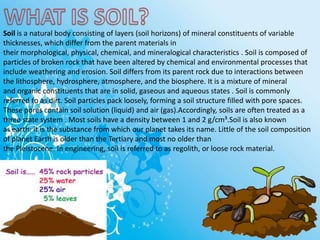
Soil is a natural body consisting of layers (soil horizons) of mineral constituents of variable
thicknesses, which differ from the parent materials in
their morphological, physical, chemical, and mineralogical characteristics . Soil is composed of
particles of broken rock that have been altered by chemical and environmental processes that
include weathering and erosion. Soil differs from its parent rock due to interactions between
the lithosphere, hydrosphere, atmosphere, and the biosphere. It is a mixture of mineral
and organic constituents that are in solid, gaseous and aqueous states . Soil is commonly
referred to as dirt. Soil particles pack loosely, forming a soil structure filled with pore spaces.
These pores contain soil solution (liquid) and air (gas).Accordingly, soils are often treated as a
three state system . Most soils have a density between 1 and 2 g/cm³.Soil is also known
as earth: it is the substance from which our planet takes its name. Little of the soil composition
of planet Earth is older than the Tertiary and most no older than
the Pleistocene. In engineering, soil is referred to as regolith, or loose rock material.
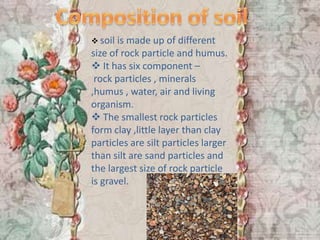
 soil is made up of different
size of rock particle and humus.
 It has six component –
 rock particles , minerals
,humus , water, air and living
organism.
 The smallest rock particles
form clay ,little layer than clay
particles are silt particles larger
than silt are sand particles and
the largest size of rock particle
is gravel.
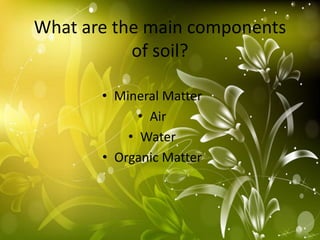
What are the main components
           of soil?

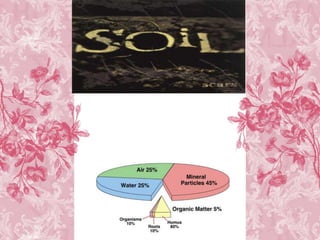
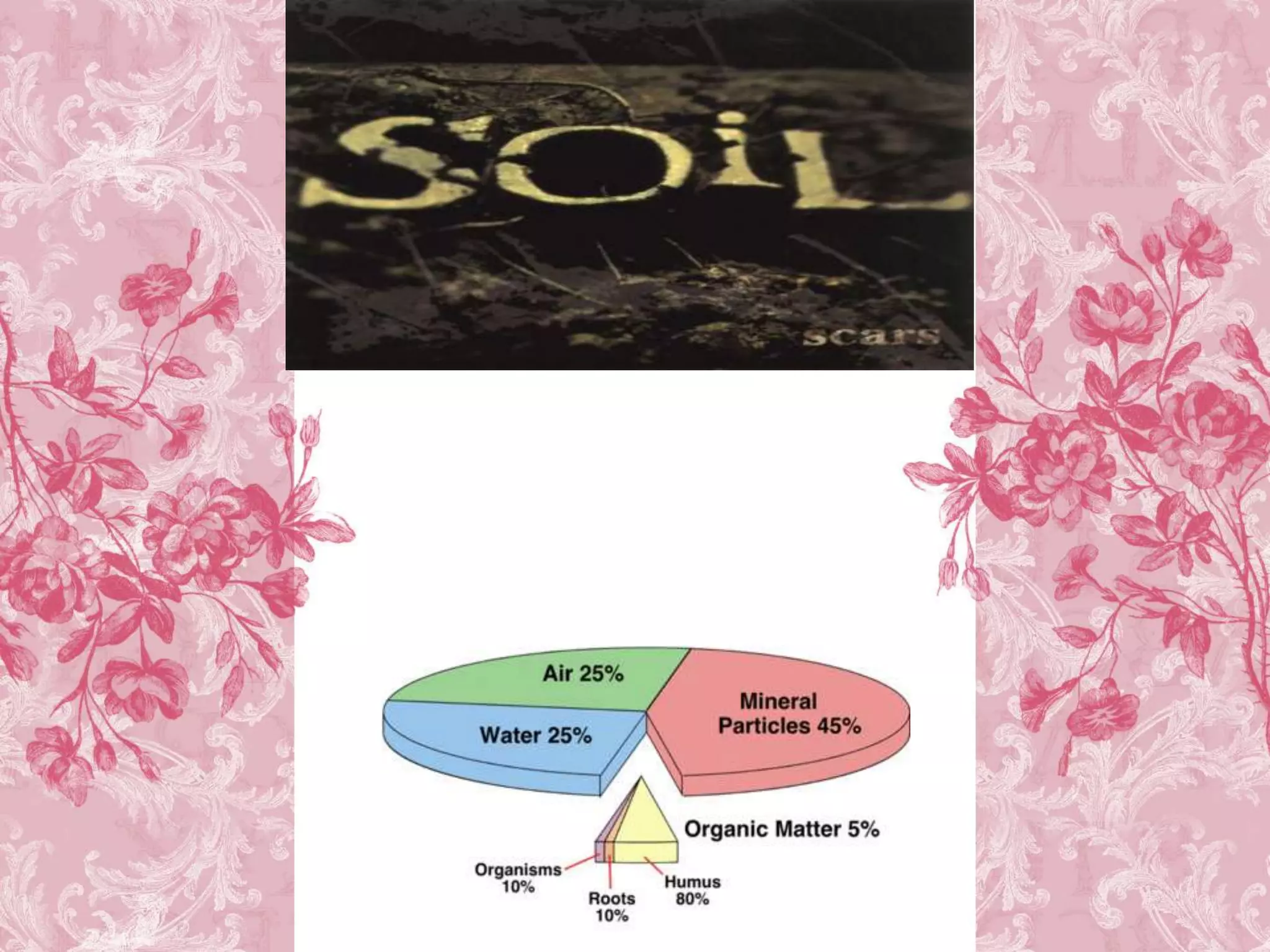
       • Mineral Matter
             • Air
           • Water
       • Organic Matter
Soil is created from rocks.
Different natural factors like
earthquake,         stream       of
water, wind, ice and organic
materials cause the rocks to break.
Big rocks turn into pretty pebbles.
Pebbles turn into sand and finally
we get clay from the sand. Both
sand, clay and different organic
materials create soil.
We should ban polythene bags because polythene and plastic bags pollute soil .they also
kill organisms living in soil .other substances which pollute the soil are a number of waste
products ,chemicals and pesticides . Waste products and chemicals should be treated
before they are released into the soil .The use of pesticides should be minimized .
Polythene bags can best be defined as a non-biodegradable substance that is used by the
majority as packing materials. Despite the fact that they are cheap as well as light, they are
hazardous in the following ways;
- The fact that they are non-biodegradable makes them hard to dispose and as a
result, they can act as breeding places for many of the disease germs which, sooner than
later cause an epidemic in the surrounding people.
-The fact that they are very light also makes it very easy for them to be blown from place
to place and as a result, the unending littering of the environment.
-These polythene bags have over time been proven to be environmentally unfriendly
considering the time taken for their decomposition. As a result of this time spun they can
cause further problems like blocking water penetration into the soil which in turn affects
food growth and development.
Polythene are therefore the most outstanding of all the waste in the homes and are hard
to dispose off.
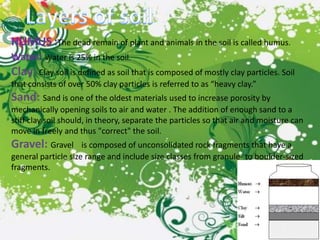
HUMUS :The dead remain of plant and animals in the soil is called humus.
Water: Water is 25% in the soil.
Clay: Clay soil is defined as soil that is composed of mostly clay particles. Soil
that consists of over 50% clay particles is referred to as “heavy clay.”
Sand: Sand is one of the oldest materials used to increase porosity by
mechanically opening soils to air and water . The addition of enough sand to a
stiff clay soil should, in theory, separate the particles so that air and moisture can
move in freely and thus "correct" the soil.
Gravel: Gravel       is composed of unconsolidated rock fragments that have a
general particle size range and include size classes from granule- to boulder-sized
fragments.
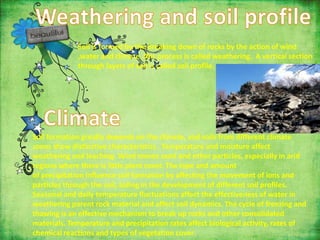
Soil is formed by the breaking down of rocks by the action of wind
             ,water and climate .this process is called weathering. A vertical section
             through layers of soil is called soil profile.


Soil formation greatly depends on the climate, and soils from different climate
zones show distinctive characteristics . Temperature and moisture affect
weathering and leaching. Wind moves sand and other particles, especially in arid
regions where there is little plant cover. The type and amount
of precipitation influence soil formation by affecting the movement of ions and
particles through the soil, aiding in the development of different soil profiles.
Seasonal and daily temperature fluctuations affect the effectiveness of water in
weathering parent rock material and affect soil dynamics. The cycle of freezing and
thawing is an effective mechanism to break up rocks and other consolidated
materials. Temperature and precipitation rates affect biological activity, rates of
chemical reactions and types of vegetation cover.
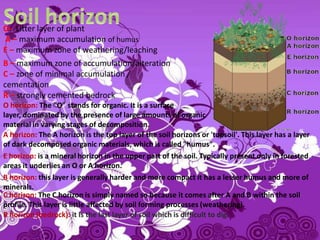
O- Litter layer of plant
 A – maximum accumulation of humus
E – maximum zone of weathering/leaching
B – maximum zone of accumulation/alteration
C – zone of minimal accumulation /
cementation
R – strongly cemented bedrock
O horizon: The "O" stands for organic. It is a surface
layer, dominated by the presence of large amounts of organic
material in varying stages of decomposition.
A horizon: The A horizon is the top layer of the soil horizons or 'topsoil'. This layer has a layer
of dark decomposed organic materials, which is called "humus".
E horizon: is a mineral horizon in the upper part of the soil. Typically present only in forested
areas it underlies an O or A horizon.
B horizon: this layer is generally harder and more compact it has a lesser humus and more of
minerals.
C horizon: The C horizon is simply named so because it comes after A and B within the soil
profile. This layer is little affected by soil forming processes (weathering).
R horizon (bedrock): it is the last layer of soil which is difficult to dig.
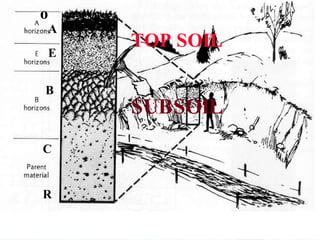
o
    A
        TOP SOIL
    E


B
        SUBSOIL
C


R
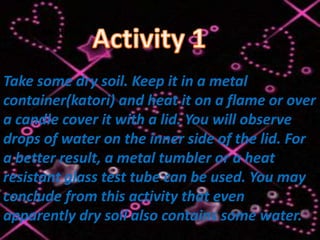
Activity 1


Take some dry soil. Keep it in a metal
container(katori) and heat it on a flame or over
a candle cover it with a lid. You will observe
drops of water on the inner side of the lid. For
a better result, a metal tumbler or a heat
resistant glass test tube can be used. You may
conclude from this activity that even
apparently dry soil also contains some water.
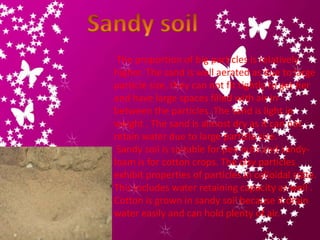
The proportion of big particles is relatively
higher. The sand is well aerated as due to large
particle size, they can not fit tightly to get her
and have large spaces filled with air in
between the particles. The sand is light in
weight . The sand is almost dry as it can not
retain water due to large particle size.
 Sandy soil is suitable for pee nuts and sandy-
loam is for cotton crops. The clay particles
exhibit properties of particles in colloidal state.
This includes water retaining capacity as well .
Cotton is grown in sandy soil because it drain
water easily and can hold plenty of air.
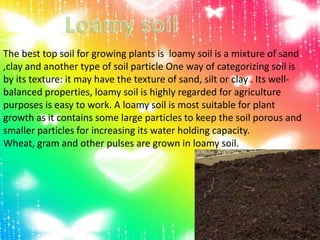
The best top soil for growing plants is loamy soil is a mixture of sand
,clay and another type of soil particle One way of categorizing soil is
by its texture: it may have the texture of sand, silt or clay . Its well-
balanced properties, loamy soil is highly regarded for agriculture
purposes is easy to work. A loamy soil is most suitable for plant
growth as it contains some large particles to keep the soil porous and
smaller particles for increasing its water holding capacity.
Wheat, gram and other pulses are grown in loamy soil.
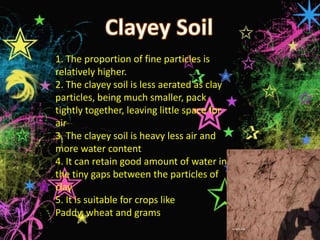
1. The proportion of fine particles is
relatively higher.
2. The clayey soil is less aerated as clay
particles, being much smaller, pack
tightly together, leaving little space for
air
3. The clayey soil is heavy less air and
more water content
4. It can retain good amount of water in
the tiny gaps between the particles of
clay
5. It is suitable for crops like
Paddy, wheat and grams
Dig some soil from your garden or field. Put it
in a glass tumbler or a wide mouth bottle filled
with water, observe the evolution of air
bubbles. You can repeat this activity by taking
soils from different areas, like near a pond or
near the drains. Make a comparison in the
number of air bubbles evolved by taking some
amount of soil from different places. This
activity gives an idea that soil contains air.
The continuous transition of soil from a certain place in
natural way is called soil erosion. It is caused by water and
wind . Rain water , river current sea wave , strong wind etc
are main sources of agent of soil erosion . Heavy rain
separates the soil particle from the soil. This soil erosion
happens at the two sides of river . Sea waves beating
continuously at the shore wash away the soil from there . So
soil erosion happens . In summer the dust blows away by the
wind from the surface of the ground . Thus the soil becomes
in sterile. The dust from the desert blows away by the soil
erosion .At waste land and at the place without plant and
trees, it causes by deforestation.
Soil is very useful and very important natural wealth. It is
formed in a natural process .The plants grow on the soil
collecting water, mineral salt, cultivation is done on the
surface of the earth. We can’t grow paddy , jute and wheat
without soil. Besides this potatoes, ground nuts, ware also
cultivated on the sandy soil. Vegetables are plenty cultivated
on different types of soil. Beside this soil is used to build
houses, roads and earth and to make pots. Different kinds of
mineral wealth are also collected by digging the soil .
Different kinds of micro organisms like ants, white-ants also
live in the soil . Besides this cows, buffalos , camels and
horses live on the land. So soil is very very useful to us.
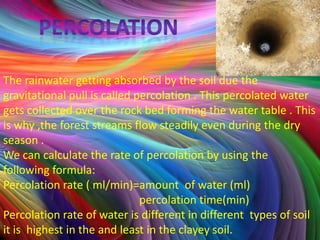
The rainwater getting absorbed by the soil due the
gravitational pull is called percolation . This percolated water
gets collected over the rock bed forming the water table . This
is why ,the forest streams flow steadily even during the dry
season .
We can calculate the rate of percolation by using the
following formula:
Percolation rate ( ml/min)=amount of water (ml)
                              percolation time(min)
Percolation rate of water is different in different types of soil
it is highest in the and least in the clayey soil.
Soil
Soil

Soil

  • 2.
    Soil is anatural body consisting of layers (soil horizons) of mineral constituents of variable thicknesses, which differ from the parent materials in their morphological, physical, chemical, and mineralogical characteristics . Soil is composed of particles of broken rock that have been altered by chemical and environmental processes that include weathering and erosion. Soil differs from its parent rock due to interactions between the lithosphere, hydrosphere, atmosphere, and the biosphere. It is a mixture of mineral and organic constituents that are in solid, gaseous and aqueous states . Soil is commonly referred to as dirt. Soil particles pack loosely, forming a soil structure filled with pore spaces. These pores contain soil solution (liquid) and air (gas).Accordingly, soils are often treated as a three state system . Most soils have a density between 1 and 2 g/cm³.Soil is also known as earth: it is the substance from which our planet takes its name. Little of the soil composition of planet Earth is older than the Tertiary and most no older than the Pleistocene. In engineering, soil is referred to as regolith, or loose rock material.
  • 3.
     soil ismade up of different size of rock particle and humus.  It has six component – rock particles , minerals ,humus , water, air and living organism.  The smallest rock particles form clay ,little layer than clay particles are silt particles larger than silt are sand particles and the largest size of rock particle is gravel.
  • 4.
    What are themain components of soil? • Mineral Matter • Air • Water • Organic Matter
  • 5.
    Soil is createdfrom rocks. Different natural factors like earthquake, stream of water, wind, ice and organic materials cause the rocks to break. Big rocks turn into pretty pebbles. Pebbles turn into sand and finally we get clay from the sand. Both sand, clay and different organic materials create soil.
  • 6.
    We should banpolythene bags because polythene and plastic bags pollute soil .they also kill organisms living in soil .other substances which pollute the soil are a number of waste products ,chemicals and pesticides . Waste products and chemicals should be treated before they are released into the soil .The use of pesticides should be minimized . Polythene bags can best be defined as a non-biodegradable substance that is used by the majority as packing materials. Despite the fact that they are cheap as well as light, they are hazardous in the following ways; - The fact that they are non-biodegradable makes them hard to dispose and as a result, they can act as breeding places for many of the disease germs which, sooner than later cause an epidemic in the surrounding people. -The fact that they are very light also makes it very easy for them to be blown from place to place and as a result, the unending littering of the environment. -These polythene bags have over time been proven to be environmentally unfriendly considering the time taken for their decomposition. As a result of this time spun they can cause further problems like blocking water penetration into the soil which in turn affects food growth and development. Polythene are therefore the most outstanding of all the waste in the homes and are hard to dispose off.
  • 7.
    HUMUS :The deadremain of plant and animals in the soil is called humus. Water: Water is 25% in the soil. Clay: Clay soil is defined as soil that is composed of mostly clay particles. Soil that consists of over 50% clay particles is referred to as “heavy clay.” Sand: Sand is one of the oldest materials used to increase porosity by mechanically opening soils to air and water . The addition of enough sand to a stiff clay soil should, in theory, separate the particles so that air and moisture can move in freely and thus "correct" the soil. Gravel: Gravel is composed of unconsolidated rock fragments that have a general particle size range and include size classes from granule- to boulder-sized fragments.
  • 8.
    Soil is formedby the breaking down of rocks by the action of wind ,water and climate .this process is called weathering. A vertical section through layers of soil is called soil profile. Soil formation greatly depends on the climate, and soils from different climate zones show distinctive characteristics . Temperature and moisture affect weathering and leaching. Wind moves sand and other particles, especially in arid regions where there is little plant cover. The type and amount of precipitation influence soil formation by affecting the movement of ions and particles through the soil, aiding in the development of different soil profiles. Seasonal and daily temperature fluctuations affect the effectiveness of water in weathering parent rock material and affect soil dynamics. The cycle of freezing and thawing is an effective mechanism to break up rocks and other consolidated materials. Temperature and precipitation rates affect biological activity, rates of chemical reactions and types of vegetation cover.
  • 9.
    O- Litter layerof plant A – maximum accumulation of humus E – maximum zone of weathering/leaching B – maximum zone of accumulation/alteration C – zone of minimal accumulation / cementation R – strongly cemented bedrock O horizon: The "O" stands for organic. It is a surface layer, dominated by the presence of large amounts of organic material in varying stages of decomposition. A horizon: The A horizon is the top layer of the soil horizons or 'topsoil'. This layer has a layer of dark decomposed organic materials, which is called "humus". E horizon: is a mineral horizon in the upper part of the soil. Typically present only in forested areas it underlies an O or A horizon. B horizon: this layer is generally harder and more compact it has a lesser humus and more of minerals. C horizon: The C horizon is simply named so because it comes after A and B within the soil profile. This layer is little affected by soil forming processes (weathering). R horizon (bedrock): it is the last layer of soil which is difficult to dig.
  • 10.
    o A TOP SOIL E B SUBSOIL C R
  • 11.
    Activity 1 Take somedry soil. Keep it in a metal container(katori) and heat it on a flame or over a candle cover it with a lid. You will observe drops of water on the inner side of the lid. For a better result, a metal tumbler or a heat resistant glass test tube can be used. You may conclude from this activity that even apparently dry soil also contains some water.
  • 12.
    The proportion ofbig particles is relatively higher. The sand is well aerated as due to large particle size, they can not fit tightly to get her and have large spaces filled with air in between the particles. The sand is light in weight . The sand is almost dry as it can not retain water due to large particle size. Sandy soil is suitable for pee nuts and sandy- loam is for cotton crops. The clay particles exhibit properties of particles in colloidal state. This includes water retaining capacity as well . Cotton is grown in sandy soil because it drain water easily and can hold plenty of air.
  • 13.
    The best topsoil for growing plants is loamy soil is a mixture of sand ,clay and another type of soil particle One way of categorizing soil is by its texture: it may have the texture of sand, silt or clay . Its well- balanced properties, loamy soil is highly regarded for agriculture purposes is easy to work. A loamy soil is most suitable for plant growth as it contains some large particles to keep the soil porous and smaller particles for increasing its water holding capacity. Wheat, gram and other pulses are grown in loamy soil.
  • 14.
    1. The proportionof fine particles is relatively higher. 2. The clayey soil is less aerated as clay particles, being much smaller, pack tightly together, leaving little space for air 3. The clayey soil is heavy less air and more water content 4. It can retain good amount of water in the tiny gaps between the particles of clay 5. It is suitable for crops like Paddy, wheat and grams
  • 15.
    Dig some soilfrom your garden or field. Put it in a glass tumbler or a wide mouth bottle filled with water, observe the evolution of air bubbles. You can repeat this activity by taking soils from different areas, like near a pond or near the drains. Make a comparison in the number of air bubbles evolved by taking some amount of soil from different places. This activity gives an idea that soil contains air.
  • 16.
    The continuous transitionof soil from a certain place in natural way is called soil erosion. It is caused by water and wind . Rain water , river current sea wave , strong wind etc are main sources of agent of soil erosion . Heavy rain separates the soil particle from the soil. This soil erosion happens at the two sides of river . Sea waves beating continuously at the shore wash away the soil from there . So soil erosion happens . In summer the dust blows away by the wind from the surface of the ground . Thus the soil becomes in sterile. The dust from the desert blows away by the soil erosion .At waste land and at the place without plant and trees, it causes by deforestation.
  • 17.
    Soil is veryuseful and very important natural wealth. It is formed in a natural process .The plants grow on the soil collecting water, mineral salt, cultivation is done on the surface of the earth. We can’t grow paddy , jute and wheat without soil. Besides this potatoes, ground nuts, ware also cultivated on the sandy soil. Vegetables are plenty cultivated on different types of soil. Beside this soil is used to build houses, roads and earth and to make pots. Different kinds of mineral wealth are also collected by digging the soil . Different kinds of micro organisms like ants, white-ants also live in the soil . Besides this cows, buffalos , camels and horses live on the land. So soil is very very useful to us.
  • 18.
    The rainwater gettingabsorbed by the soil due the gravitational pull is called percolation . This percolated water gets collected over the rock bed forming the water table . This is why ,the forest streams flow steadily even during the dry season . We can calculate the rate of percolation by using the following formula: Percolation rate ( ml/min)=amount of water (ml) percolation time(min) Percolation rate of water is different in different types of soil it is highest in the and least in the clayey soil.