Matrices
Introduction
Matrices - Introduction
Matrix algebra has at least two advantages:
•Reduces complicated systems of equations to simple
expressions
•Adaptable to systematic method of mathematical treatment
and well suited to computers
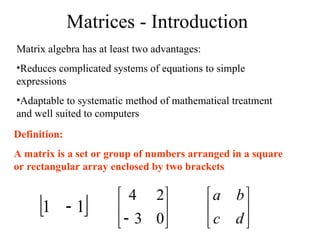
Definition:
A matrix is a set or group of numbers arranged in a square
or rectangular array enclosed by two brackets
 
1
1  





 0
3
2
4






d
c
b
a
Matrices - Introduction
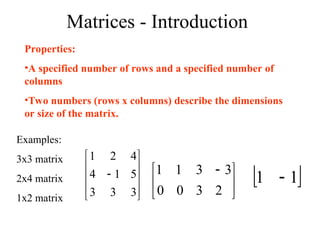
Properties:
•A specified number of rows and a specified number of
columns
•Two numbers (rows x columns) describe the dimensions
or size of the matrix.
Examples:
3x3 matrix
2x4 matrix
1x2 matrix











3
3
3
5
1
4
4
2
1





 
2
3
3
3
0
1
0
1
 
1
1 
Matrices - Introduction
A matrix is denoted by a bold capital letter and the elements
within the matrix are denoted by lower case letters
e.g. matrix [A] with elements aij














mn
ij
m
m
n
ij
in
ij
a
a
a
a
a
a
a
a
a
a
a
a
2
1
2
22
21
12
11
...
...




i goes from 1 to m
j goes from 1 to n
Amxn=
mAn
Matrices
Matrix Operations
Matrices - Operations
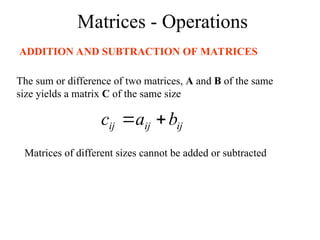
ADDITION AND SUBTRACTION OF MATRICES
The sum or difference of two matrices, A and B of the same
size yields a matrix C of the same size
ij
ij
ij b
a
c 

Matrices of different sizes cannot be added or subtracted
Matrices - Operations
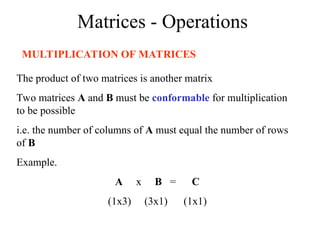
MULTIPLICATION OF MATRICES
The product of two matrices is another matrix
Two matrices A and B must be conformable for multiplication
to be possible
i.e. the number of columns of A must equal the number of rows
of B
Example.
A x B = C
(1x3) (3x1) (1x1)
Matrices - Operations























22
21
12
11
32
31
22
21
12
11
23
22
21
13
12
11
c
c
c
c
b
b
b
b
b
b
a
a
a
a
a
a
22
32
23
22
22
12
21
21
31
23
21
22
11
21
12
32
13
22
12
12
11
11
31
13
21
12
11
11
)
(
)
(
)
(
)
(
)
(
)
(
)
(
)
(
)
(
)
(
)
(
)
(
c
b
a
b
a
b
a
c
b
a
b
a
b
a
c
b
a
b
a
b
a
c
b
a
b
a
b
a
























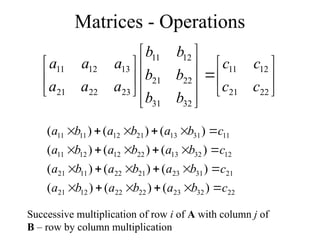
Successive multiplication of row i of A with column j of
B – row by column multiplication
Matrices - Operations











































)
3
7
(
)
2
2
(
)
8
4
(
)
5
7
(
)
6
2
(
)
4
4
(
)
3
3
(
)
2
2
(
)
8
1
(
)
5
3
(
)
6
2
(
)
4
1
(
3
5
2
6
8
4
7
2
4
3
2
1







57
63
21
31
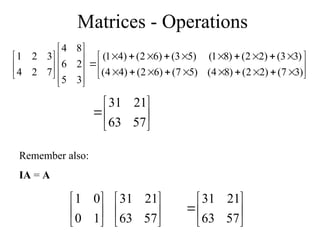
Remember also:
IA = A






1
0
0
1






57
63
21
31







57
63
21
31
Matrices - Operations
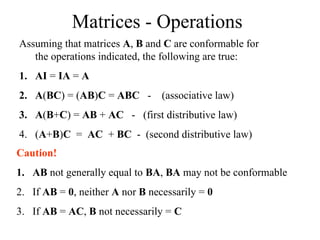
Assuming that matrices A, B and C are conformable for
the operations indicated, the following are true:
1. AI = IA = A
2. A(BC) = (AB)C = ABC - (associative law)
3. A(B+C) = AB + AC - (first distributive law)
4. (A+B)C = AC + BC - (second distributive law)
Caution!
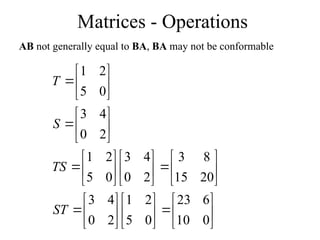
1. AB not generally equal to BA, BA may not be conformable
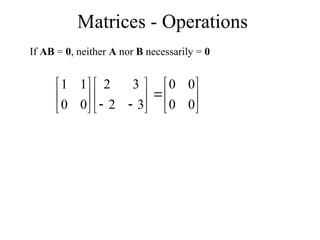
2. If AB = 0, neither A nor B necessarily = 0
3. If AB = AC, B not necessarily = C
Matrices - Operations
AB not generally equal to BA, BA may not be conformable






















































0
10
6
23
0
5
2
1
2
0
4
3
20
15
8
3
2
0
4
3
0
5
2
1
2
0
4
3
0
5
2
1
ST
TS
S
T
Matrices - Operations
If AB = 0, neither A nor B necessarily = 0





















0
0
0
0
3
2
3
2
0
0
1
1
Matrices - Operations
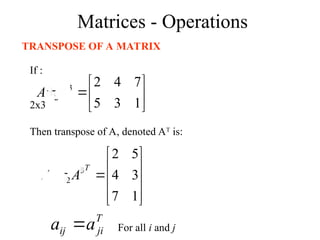
TRANSPOSE OF A MATRIX
If :








1
3
5
7
4
2
3
2 A
A
2x3












1
7
3
4
5
2
3
2
T
T
A
A
Then transpose of A, denoted AT
is:
T
ji
ij a
a  For all i and j
Matrices - Operations
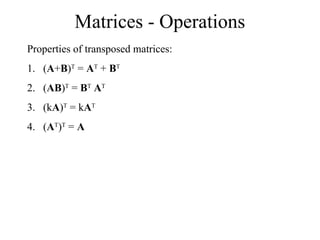
Properties of transposed matrices:
1. (A+B)T
= AT
+ BT
2. (AB)T
= BT
AT
3. (kA)T
= kAT
4. (AT
)T
= A
Matrices - Operations
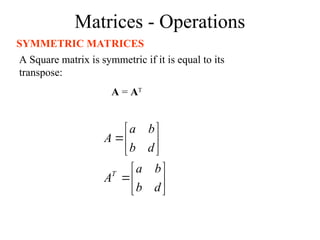
SYMMETRIC MATRICES
A Square matrix is symmetric if it is equal to its
transpose:
A = AT














d
b
b
a
A
d
b
b
a
A
T
Matrices - Operations
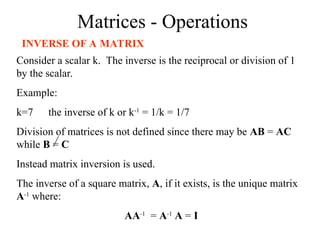
INVERSE OF A MATRIX
Consider a scalar k. The inverse is the reciprocal or division of 1
by the scalar.
Example:
k=7 the inverse of k or k-1
= 1/k = 1/7
Division of matrices is not defined since there may be AB = AC
while B = C
Instead matrix inversion is used.
The inverse of a square matrix, A, if it exists, is the unique matrix
A-1
where:
AA-1
= A-1
A = I
Matrices - Operations
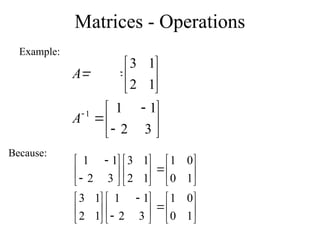
Example:


















3
2
1
1
1
2
1
3
1
2
2
A
A
A










































1
0
0
1
3
2
1
1
1
2
1
3
1
0
0
1
1
2
1
3
3
2
1
1
Because:
Matrices - Operations
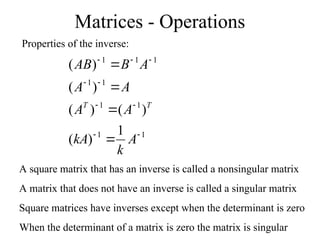
Properties of the inverse:
1
1
1
1
1
1
1
1
1
1
)
(
)
(
)
(
)
(
)
(













A
k
kA
A
A
A
A
A
B
AB
T
T
A square matrix that has an inverse is called a nonsingular matrix
A matrix that does not have an inverse is called a singular matrix
Square matrices have inverses except when the determinant is zero
When the determinant of a matrix is zero the matrix is singular
Matrices - Operations
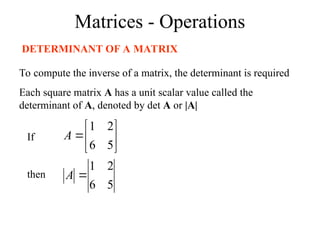
DETERMINANT OF A MATRIX
To compute the inverse of a matrix, the determinant is required
Each square matrix A has a unit scalar value called the
determinant of A, denoted by det A or |A|
5
6
2
1
5
6
2
1








A
A
If
then
Matrices - Operations
If A = [A] is a single element (1x1), then the determinant is
defined as the value of the element
Then |A| =det A = a11
If A is (n x n), its determinant may be defined in terms of order
(n-1) or less.
Matrices - Operations
MINORS
If A is an n x n matrix and one row and one column are deleted,
the resulting matrix is an (n-1) x (n-1) submatrix of A.
The determinant of such a submatrix is called a minor of A and
is designated by mij , where i and j correspond to the deleted
row and column, respectively.
mij is the minor of the element aij in A.
Matrices - Operations











33
32
31
23
22
21
13
12
11
a
a
a
a
a
a
a
a
a
A
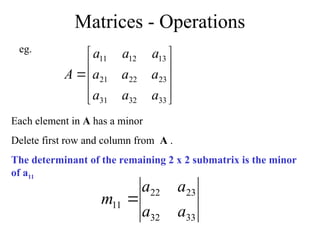
Each element in A has a minor
Delete first row and column from A .
The determinant of the remaining 2 x 2 submatrix is the minor
of a11
eg.
33
32
23
22
11
a
a
a
a
m 
Matrices - Operations
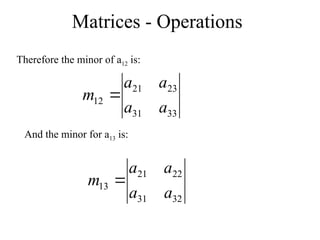
Therefore the minor of a12 is:
And the minor for a13 is:
33
31
23
21
12
a
a
a
a
m 
32
31
22
21
13
a
a
a
a
m 
Matrices - Operations
COFACTORS
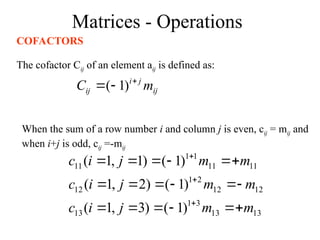
The cofactor Cij of an element aij is defined as:
ij
j
i
ij m
C 

 )
1
(
When the sum of a row number i and column j is even, cij = mij and
when i+j is odd, cij =-mij
13
13
3
1
13
12
12
2
1
12
11
11
1
1
11
)
1
(
)
3
,
1
(
)
1
(
)
2
,
1
(
)
1
(
)
1
,
1
(
m
m
j
i
c
m
m
j
i
c
m
m
j
i
c





















Matrices - Operations
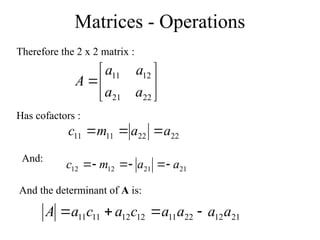
Therefore the 2 x 2 matrix :







22
21
12
11
a
a
a
a
A
Has cofactors :
22
22
11
11 a
a
m
c 


And:
21
21
12
12 a
a
m
c 





And the determinant of A is:
21
12
22
11
12
12
11
11 a
a
a
a
c
a
c
a
A 



Matrices - Operations
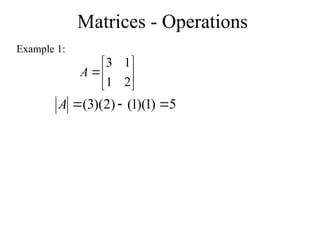
Example 1:







2
1
1
3
A
5
)
1
)(
1
(
)
2
)(
3
( 


A
Matrices - Operations
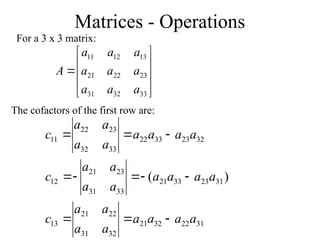
For a 3 x 3 matrix:











33
32
31
23
22
21
13
12
11
a
a
a
a
a
a
a
a
a
A
The cofactors of the first row are:
31
22
32
21
32
31
22
21
13
31
23
33
21
33
31
23
21
12
32
23
33
22
33
32
23
22
11
)
(
a
a
a
a
a
a
a
a
c
a
a
a
a
a
a
a
a
c
a
a
a
a
a
a
a
a
c











Matrices - Operations
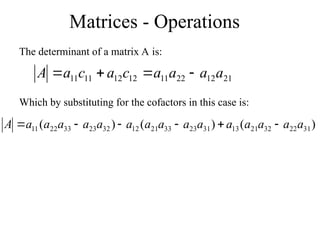
The determinant of a matrix A is:
21
12
22
11
12
12
11
11 a
a
a
a
c
a
c
a
A 



Which by substituting for the cofactors in this case is:
)
(
)
(
)
( 31
22
32
21
13
31
23
33
21
12
32
23
33
22
11 a
a
a
a
a
a
a
a
a
a
a
a
a
a
a
A 





Matrices - Operations
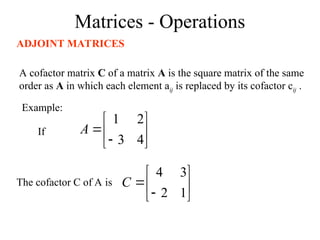
ADJOINT MATRICES
A cofactor matrix C of a matrix A is the square matrix of the same
order as A in which each element aij is replaced by its cofactor cij .
Example:








4
3
2
1
A








1
2
3
4
C
If
The cofactor C of A is
Matrices - Operations
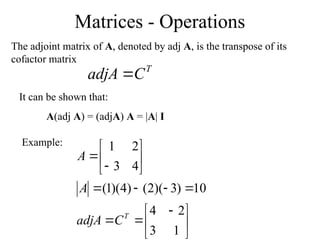
The adjoint matrix of A, denoted by adj A, is the transpose of its
cofactor matrix
T
C
adjA 
It can be shown that:
A(adj A) = (adjA) A = |A| I
Example:





 














1
3
2
4
10
)
3
)(
2
(
)
4
)(
1
(
4
3
2
1
T
C
adjA
A
A
Matrices - Operations
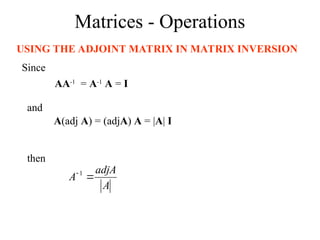
USING THE ADJOINT MATRIX IN MATRIX INVERSION
A
adjA
A 
 1
Since
AA-1
= A-1
A = I
and
A(adj A) = (adjA) A = |A| I
then
Matrices and Linear Equations
Linear Equations
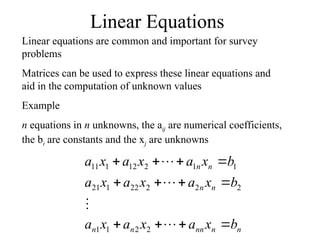
Linear Equations
Linear equations are common and important for survey
problems
Matrices can be used to express these linear equations and
aid in the computation of unknown values
Example
n equations in n unknowns, the aij are numerical coefficients,
the bi are constants and the xj are unknowns
n
n
nn
n
n
n
n
n
n
b
x
a
x
a
x
a
b
x
a
x
a
x
a
b
x
a
x
a
x
a
















2
2
1
1
2
2
2
22
1
21
1
1
2
12
1
11
Linear Equations
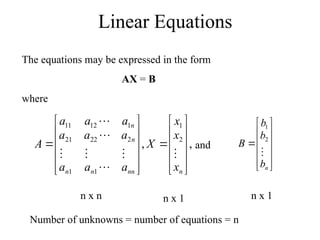
The equations may be expressed in the form
AX = B
where
,
, 2
1
1
1
2
22
21
1
12
11


























n
nn
n
n
n
n
x
x
x
X
a
a
a
a
a
a
a
a
a
A







and













n
b
b
b
B

2
1
n x n n x 1 n x 1
Number of unknowns = number of equations = n
Linear Equations
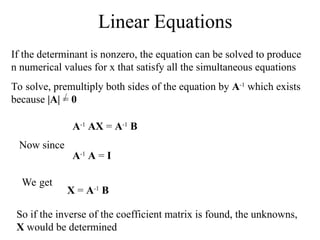
If the determinant is nonzero, the equation can be solved to produce
n numerical values for x that satisfy all the simultaneous equations
To solve, premultiply both sides of the equation by A-1
which exists
because |A| = 0
A-1
AX = A-1
B
Now since
A-1
A = I
We get
X = A-1
B
So if the inverse of the coefficient matrix is found, the unknowns,
X would be determined
Linear Equations
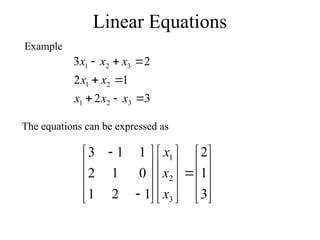
Example
3
2
1
2
2
3
3
2
1
2
1
3
2
1








x
x
x
x
x
x
x
x
The equations can be expressed as

































3
1
2
1
2
1
0
1
2
1
1
3
3
2
1
x
x
x
Linear Equations
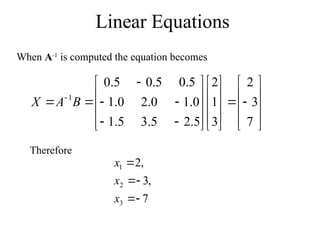
When A-1
is computed the equation becomes






































 
7
3
2
3
1
2
5
.
2
5
.
3
5
.
1
0
.
1
0
.
2
0
.
1
5
.
0
5
.
0
5
.
0
1
B
A
X
Therefore
7
,
3
,
2
3
2
1





x
x
x
Linear Equations
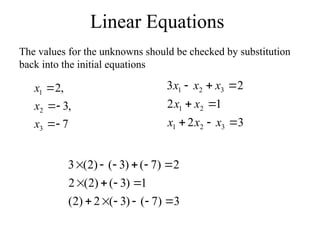
The values for the unknowns should be checked by substitution
back into the initial equations
3
2
1
2
2
3
3
2
1
2
1
3
2
1








x
x
x
x
x
x
x
x
3
)
7
(
)
3
(
2
)
2
(
1
)
3
(
)
2
(
2
2
)
7
(
)
3
(
)
2
(
3
















7
,
3
,
2
3
2
1





x
x
x

ALLIED MATHEMATICS -I UNIT III MATRICES.ppt