Contents
INTRODUCTION
3D printing or additive manufacturing is a
computer-controlled production technique
that builds a product layer by layer.
It is called additive manufacturing because a
new material is continually added to it when
it wants
How 3D Printing Works
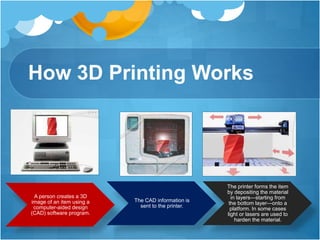
A person creates a 3D
image of an item using a
computer-aided design
(CAD) software program.
The CAD information is
sent to the printer.
The printer forms the item
by depositing the material
in layers—starting from
the bottom layer—onto a
platform. In some cases
light or lasers are used to
harden the material.
CONSTRUCTION PROCESS
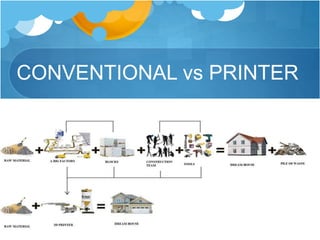
CONVENTIONAL vs PRINTER
THE PRINTED VILLA
BRIDGE
APPLICATIONS
Printed soil
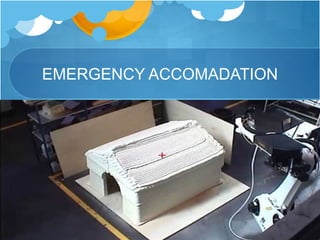
Emergency accommodation
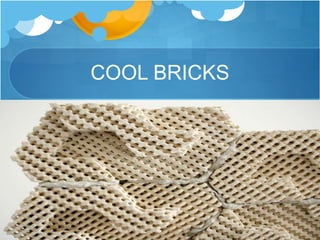
Cool bricks
PRINTED SOIL
EMERGENCY ACCOMADATION
COOL BRICKS
STRENGTH & SAFETY OF
STRUCTURE
Normal structure: 3000-6000 psi (pounds per sq
inch)
Printed structure: up to10000 psi
Hollow walls
Does not compromise structural strength
Save materials
ADVANTAGES
Recycle concrete, building waste & industrial wastages
are used in stood of using bricks & motor.
By using waste materials like concrete waste etc are
recycled.
The system extrudes a mix of high grade cement &
glass fabric material, layer by layer, similar to traditional
rapid prototyping process gives more strength to this
concrete.
DISADVANTAGES
Reduced employee numbers in the industry, since the 3D printer does
most of the work
A limited number of materials can be used, since the same printer might
not be able to print the required multiple materials
Higher risks – any errors in the digital model can result in problematic
issues on site during the printing/construction phase
Conventional product manufacturing companies and plant renting
companies could suffer as their products are no longer required
CONCLUSION
Future construction by 3D printing

Future construction by 3D printing

  • 4.
  • 5.
    INTRODUCTION 3D printing oradditive manufacturing is a computer-controlled production technique that builds a product layer by layer. It is called additive manufacturing because a new material is continually added to it when it wants
  • 6.
    How 3D PrintingWorks A person creates a 3D image of an item using a computer-aided design (CAD) software program. The CAD information is sent to the printer. The printer forms the item by depositing the material in layers—starting from the bottom layer—onto a platform. In some cases light or lasers are used to harden the material.
  • 7.
  • 8.
  • 10.
  • 11.
  • 12.
  • 13.
  • 14.
  • 15.
  • 16.
    STRENGTH & SAFETYOF STRUCTURE Normal structure: 3000-6000 psi (pounds per sq inch) Printed structure: up to10000 psi Hollow walls Does not compromise structural strength Save materials
  • 17.
    ADVANTAGES Recycle concrete, buildingwaste & industrial wastages are used in stood of using bricks & motor. By using waste materials like concrete waste etc are recycled. The system extrudes a mix of high grade cement & glass fabric material, layer by layer, similar to traditional rapid prototyping process gives more strength to this concrete.
  • 18.
    DISADVANTAGES Reduced employee numbersin the industry, since the 3D printer does most of the work A limited number of materials can be used, since the same printer might not be able to print the required multiple materials Higher risks – any errors in the digital model can result in problematic issues on site during the printing/construction phase Conventional product manufacturing companies and plant renting companies could suffer as their products are no longer required
  • 19.