SEMINAR ON-
3D PRINTING
Submitted by:
Anju Dewangan
Submitted to:
Dr. G.K. Agrawal Sir
Content
• Introduction
• History
• Terminology
• Additive processes
• What is 3D printing?
• General Principles
• 3D printing Methods
• Applications
• Challenges
• Advantages
• Disadvantages
• Conclusion
INTRODUTION
• 3D printing is a form of additive
manufacturing technology where a three
dimensional object is created by laying
down successive layers of material.
• It is also known as ADDITIVE
MANUFACTURING.
• 3D printing is a achieved using an additive
process, where successive layers of
material are laid down in different shapes.
History
• The technology for printing physical 3D
object from digital data was first developed
by Charles Hull in 1984.
• He name the technique as stereo
lithography and obtained a patent for the
technique in 1986.
• By the end of 1980s, other similar
technologies such as Fused Deposition
Terminology
• Additive manufacturing –Refers to
technologies that create object through
sequential layering.
• Rapid prototyping – Is a group of
techniques used to quickly fabricate a
scale model of a physical part or assembly
using three dimensional computer aided
design (CAD) data.
• Subtractive processes – Removal of
material by methods such as cutting or
drilling.
Additive Processes
• Extrusion deposition (Fused deposition
modeling)
• Granular materials binding
• Lamination
• Photo polymerization
• Mask-image –projection-based stereo
lithography
What is 3D Printing?
• For methods of applying a 2-D image on a 3-
D surface
• Additive manufacturing or 3D printing is a
process of making a three-
dimensional solid object of virtually any
shape from a digital model. 3D printing is
achieved using an additive process, where
successive layers of material are laid down
in different shapes.
General Principles
• Modeling
• Printing
• Finishing
Modeling
• Additive manufacturing takes virtual
blueprints from Computer aided
design (CAD) animation modeling
software and "slices" them into digital
cross-sections for the machine to
successively use as a guideline for printing.
Printing
• To perform a print, the machine reads the
design and lays down successive layers of
liquid, powder, or sheet material to build
the model from a series of cross sections.
• These layers, which correspond to the
virtual cross sections from the CAD model,
are joined together or automatically fused
to create the final shape.
• The primary advantage of this technique is
Finishing
• Though the printer-produced resolution is
sufficient for many applications, printing a
slightly oversized version of the desired
object in standard resolution, and then
removing material with a higher-resolution
subtractive process can achieve a higher-
resolution.
Different Methods
• Selective laser sintering (SLS)
• Stereo lithography
• Fused deposition modeling (FDM)
• Laminated object manufacturing
Selective laser sintering
(SLS)
• Selective laser sintering (SLS) is an additive
manufacturing technique that uses a high
power laser (for example, a carbon dioxide
laser) to fuse small particles of plastic, metal
(direct metal laser sintering),ceramic or glass
powders into a mass that has a desired 3-
dimensional shape
STEREOLITHOGRAPHY
• Stereo
lithography is an
additive
manufacturing
process using a
vat of liquid UV-
curable
photopolymer ”re
sin” and a UV
laser to build
parts a layer at a
time.
STEREOLITHOGRAPHY
(Cont…)
• CAD (Computer Aided
Design) Programs help
users create STL Files
for the 3D Printers to
read.
• STL (Stereo
Lithography) file format
– a file format which
uses many little
triangles to make a 3
dimensional plot of the
objects intended
surface.
FDM
• Fused deposition
modeling (FDM) is
an additive
manufacturing
technology
commonly used for
modeling,
prototyping, and
production
applications
Laminated object
manufacturing
• Laminated object
manufacturing (LOM)
is a rapid prototyping
system developed by
Helisys Inc. In it,
layers of adhesive-
coated paper, plastic
or metal laminates
are successively
glued together and
cut to shape with a
knife or laser cutter.
Applications
• Prototyping
• Modeling
• Custom parts
• Design
• Research
Challenges Facing 3D
Printing
• Intellectual
property rights of
the 3D Printer
users.
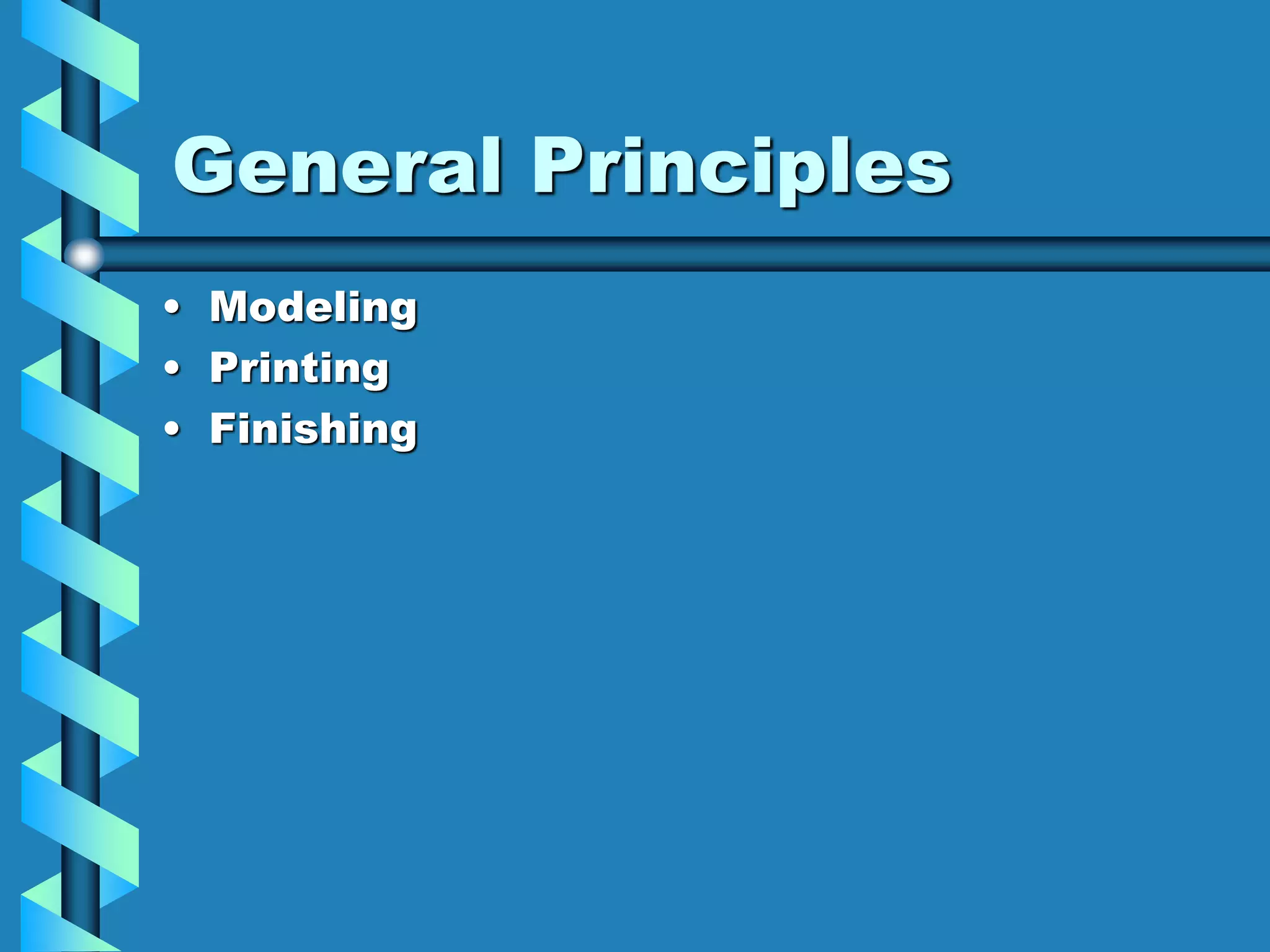
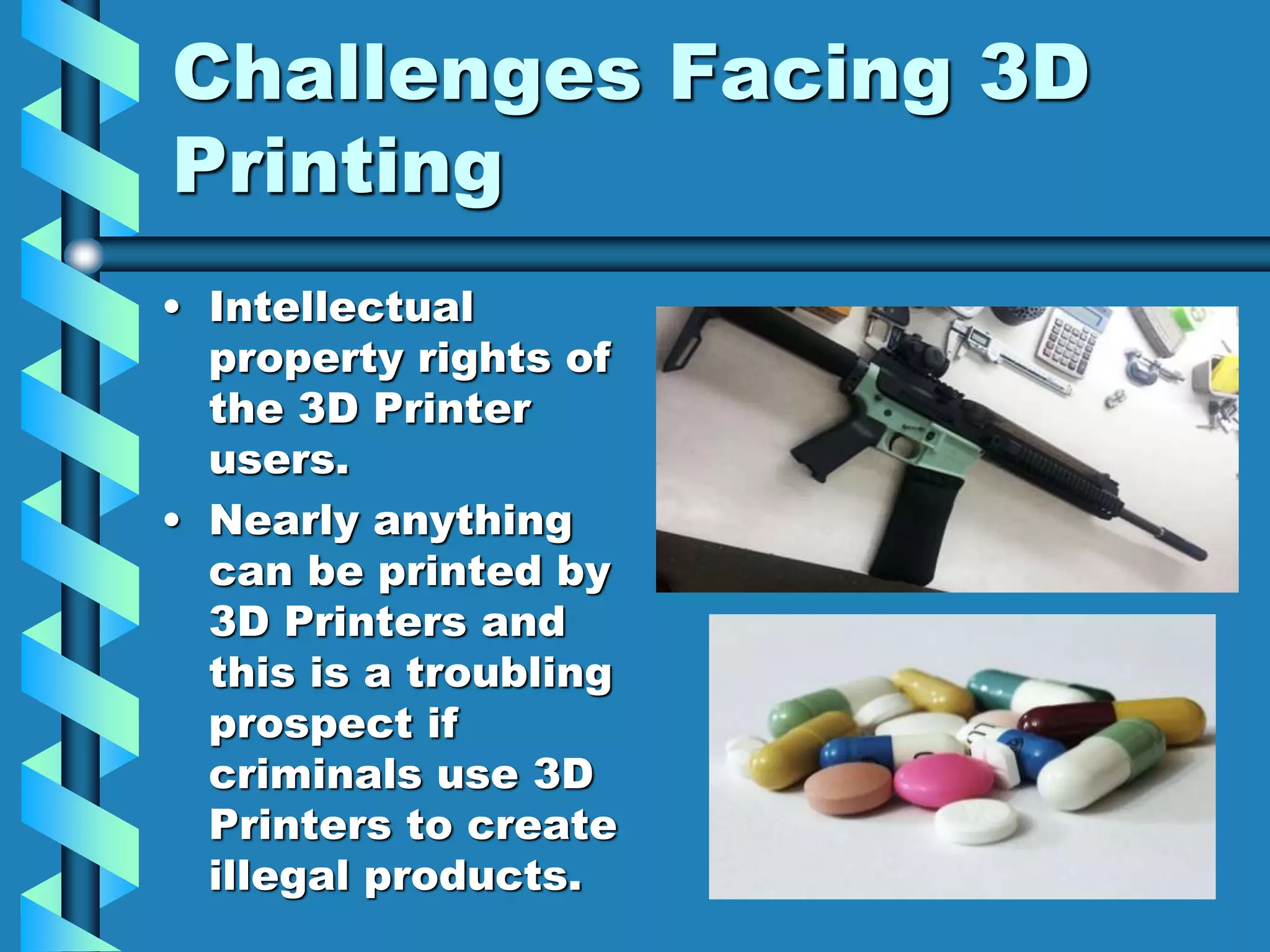
• Nearly anything
can be printed by
3D Printers and
this is a troubling
prospect if
criminals use 3D
Printers to create
illegal products.
Advantages
• Clean process
• Wastage of material is negligible
• Good for job production
• More affordable
• 3D printing technology requires no toxic
chemical like those used in stereo
lithography printing technology
Disadvantages
• Process is very slow
• Components do not have enough strength
• Process is not a mass production
Conclusion
• Nothing communicates ideas
faster than a 3D part or model.
With 3D printer you can bring
CAD files and design ideas to
life- right from your desktop.
• Test from fit and function and as
many design variations as you
like with functional parts.
Thanks

3D PRINTING

  • 1.
    SEMINAR ON- 3D PRINTING Submittedby: Anju Dewangan Submitted to: Dr. G.K. Agrawal Sir
  • 2.
    Content • Introduction • History •Terminology • Additive processes • What is 3D printing? • General Principles • 3D printing Methods • Applications • Challenges • Advantages • Disadvantages • Conclusion
  • 3.
    INTRODUTION • 3D printingis a form of additive manufacturing technology where a three dimensional object is created by laying down successive layers of material. • It is also known as ADDITIVE MANUFACTURING. • 3D printing is a achieved using an additive process, where successive layers of material are laid down in different shapes.
  • 4.
    History • The technologyfor printing physical 3D object from digital data was first developed by Charles Hull in 1984. • He name the technique as stereo lithography and obtained a patent for the technique in 1986. • By the end of 1980s, other similar technologies such as Fused Deposition
  • 5.
    Terminology • Additive manufacturing–Refers to technologies that create object through sequential layering. • Rapid prototyping – Is a group of techniques used to quickly fabricate a scale model of a physical part or assembly using three dimensional computer aided design (CAD) data. • Subtractive processes – Removal of material by methods such as cutting or drilling.
  • 6.
    Additive Processes • Extrusiondeposition (Fused deposition modeling) • Granular materials binding • Lamination • Photo polymerization • Mask-image –projection-based stereo lithography
  • 7.
    What is 3DPrinting? • For methods of applying a 2-D image on a 3- D surface • Additive manufacturing or 3D printing is a process of making a three- dimensional solid object of virtually any shape from a digital model. 3D printing is achieved using an additive process, where successive layers of material are laid down in different shapes.
  • 8.
  • 9.
    Modeling • Additive manufacturingtakes virtual blueprints from Computer aided design (CAD) animation modeling software and "slices" them into digital cross-sections for the machine to successively use as a guideline for printing.
  • 10.
    Printing • To performa print, the machine reads the design and lays down successive layers of liquid, powder, or sheet material to build the model from a series of cross sections. • These layers, which correspond to the virtual cross sections from the CAD model, are joined together or automatically fused to create the final shape. • The primary advantage of this technique is
  • 11.
    Finishing • Though theprinter-produced resolution is sufficient for many applications, printing a slightly oversized version of the desired object in standard resolution, and then removing material with a higher-resolution subtractive process can achieve a higher- resolution.
  • 12.
    Different Methods • Selectivelaser sintering (SLS) • Stereo lithography • Fused deposition modeling (FDM) • Laminated object manufacturing
  • 13.
    Selective laser sintering (SLS) •Selective laser sintering (SLS) is an additive manufacturing technique that uses a high power laser (for example, a carbon dioxide laser) to fuse small particles of plastic, metal (direct metal laser sintering),ceramic or glass powders into a mass that has a desired 3- dimensional shape
  • 14.
    STEREOLITHOGRAPHY • Stereo lithography isan additive manufacturing process using a vat of liquid UV- curable photopolymer ”re sin” and a UV laser to build parts a layer at a time.
  • 15.
    STEREOLITHOGRAPHY (Cont…) • CAD (ComputerAided Design) Programs help users create STL Files for the 3D Printers to read. • STL (Stereo Lithography) file format – a file format which uses many little triangles to make a 3 dimensional plot of the objects intended surface.
  • 16.
    FDM • Fused deposition modeling(FDM) is an additive manufacturing technology commonly used for modeling, prototyping, and production applications
  • 17.
    Laminated object manufacturing • Laminatedobject manufacturing (LOM) is a rapid prototyping system developed by Helisys Inc. In it, layers of adhesive- coated paper, plastic or metal laminates are successively glued together and cut to shape with a knife or laser cutter.
  • 18.
    Applications • Prototyping • Modeling •Custom parts • Design • Research
  • 19.
    Challenges Facing 3D Printing •Intellectual property rights of the 3D Printer users. • Nearly anything can be printed by 3D Printers and this is a troubling prospect if criminals use 3D Printers to create illegal products.
  • 20.
    Advantages • Clean process •Wastage of material is negligible • Good for job production • More affordable • 3D printing technology requires no toxic chemical like those used in stereo lithography printing technology
  • 21.
    Disadvantages • Process isvery slow • Components do not have enough strength • Process is not a mass production
  • 22.
    Conclusion • Nothing communicatesideas faster than a 3D part or model. With 3D printer you can bring CAD files and design ideas to life- right from your desktop. • Test from fit and function and as many design variations as you like with functional parts.
  • 23.