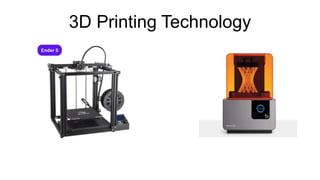
3D Printing Technology
What is 3D Printing?
Definition: Additive
manufacturing process creating
three-dimensional objects layer
by layer.
 Historical background: Introduction in the 1980s and evolution
over the years.
How Does 3D Printing Work?
3D printing, also known as additive manufacturing, is a revolutionary manufacturing technology that allows the creation of
three-dimensional objects layer by layer, based on a digital model.
The process involves several key steps, each contributing to the precision and customization that define 3D printing:
Digital Design: The 3D printing process begins with a digital 3D model created using computer-aided design (CAD) software.
Slicing the Model: The digital model is sliced into thin, horizontal layers using specialized software. It also generates a program in G &
M codes that 3d printer can understand and execute the printing.
Material Selection: Various materials can be used in 3D printing, including plastics, metals, ceramics, and even bio-compatible
materials.
Layer-by-Layer Building: The 3D printer reads each sliced layer of the digital model and builds the physical object layer by layer.
Support Structures (if needed): Some 3D printed objects may require support structures during printing to prevent overhangs and
ensure stability.
Post-Processing: Removing support structures, surface finishing, and additional treatments like painting or coating.
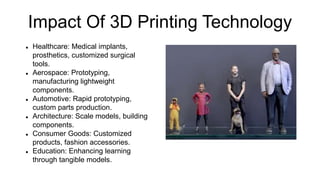
Impact Of 3D Printing Technology
 Healthcare: Medical implants,
prosthetics, customized surgical
tools.
 Aerospace: Prototyping,
manufacturing lightweight
components.
 Automotive: Rapid prototyping,
custom parts production.
 Architecture: Scale models, building
components.
 Consumer Goods: Customized
products, fashion accessories.
 Education: Enhancing learning
through tangible models.
Types of 3D printing technologies
Fused Deposition
Modeling (FDM)
Stereolitho-
graphy (SLA)
Selective Laser
Sintering (SLS)
Multi Jet Fusion
(MJF)
Binder Jetting Digital Light
Processing (DLP)
Advantages of 3D Printing
Rapid Prototyping: Accelerated product development cycles.
Customization: Tailoring products to individual needs.
Cost-Effective: Reduced material waste and production costs.
Complexity: Ability to create intricate designs and geometries.
On-Demand Production: Manufacturing products as needed.
Innovations in 3D Printing
4D Printing: Objects that can change shape or functionality over time.
Bioprinting: Printing human tissues and organs for medical purposes.
Metal 3D Printing: Advancements in printing metal components.
Continuous Printing: Continuous production of large-scale objects.
Future Trends in 3D Printing
Industry 4.0
Integration: 3D
printing in smart
factories.
Artificial
Intelligence: AI-
driven design
optimization.
Sustainable
Materials: Eco-
friendly printing
materials.
Space Exploration:
3D printing in space
for on-demand
manufacturing.
Conclusion
 3D printing stands at the forefront of a transformative technological revolution,
offering a paradigm shift in manufacturing and design.
 Throughout this presentation, we have delved into the myriad applications and
benefits of 3D printing, from rapid prototyping to personalized healthcare solutions
and sustainable manufacturing practices.

Exploring the Future: 3D Printing Technology.pptx

  • 1.
  • 2.
    What is 3DPrinting? Definition: Additive manufacturing process creating three-dimensional objects layer by layer.  Historical background: Introduction in the 1980s and evolution over the years.
  • 3.
    How Does 3DPrinting Work? 3D printing, also known as additive manufacturing, is a revolutionary manufacturing technology that allows the creation of three-dimensional objects layer by layer, based on a digital model. The process involves several key steps, each contributing to the precision and customization that define 3D printing: Digital Design: The 3D printing process begins with a digital 3D model created using computer-aided design (CAD) software. Slicing the Model: The digital model is sliced into thin, horizontal layers using specialized software. It also generates a program in G & M codes that 3d printer can understand and execute the printing. Material Selection: Various materials can be used in 3D printing, including plastics, metals, ceramics, and even bio-compatible materials. Layer-by-Layer Building: The 3D printer reads each sliced layer of the digital model and builds the physical object layer by layer. Support Structures (if needed): Some 3D printed objects may require support structures during printing to prevent overhangs and ensure stability. Post-Processing: Removing support structures, surface finishing, and additional treatments like painting or coating.
  • 4.
    Impact Of 3DPrinting Technology  Healthcare: Medical implants, prosthetics, customized surgical tools.  Aerospace: Prototyping, manufacturing lightweight components.  Automotive: Rapid prototyping, custom parts production.  Architecture: Scale models, building components.  Consumer Goods: Customized products, fashion accessories.  Education: Enhancing learning through tangible models.
  • 5.
    Types of 3Dprinting technologies Fused Deposition Modeling (FDM) Stereolitho- graphy (SLA) Selective Laser Sintering (SLS) Multi Jet Fusion (MJF) Binder Jetting Digital Light Processing (DLP)
  • 6.
    Advantages of 3DPrinting Rapid Prototyping: Accelerated product development cycles. Customization: Tailoring products to individual needs. Cost-Effective: Reduced material waste and production costs. Complexity: Ability to create intricate designs and geometries. On-Demand Production: Manufacturing products as needed.
  • 7.
    Innovations in 3DPrinting 4D Printing: Objects that can change shape or functionality over time. Bioprinting: Printing human tissues and organs for medical purposes. Metal 3D Printing: Advancements in printing metal components. Continuous Printing: Continuous production of large-scale objects.
  • 8.
    Future Trends in3D Printing Industry 4.0 Integration: 3D printing in smart factories. Artificial Intelligence: AI- driven design optimization. Sustainable Materials: Eco- friendly printing materials. Space Exploration: 3D printing in space for on-demand manufacturing.
  • 9.
    Conclusion  3D printingstands at the forefront of a transformative technological revolution, offering a paradigm shift in manufacturing and design.  Throughout this presentation, we have delved into the myriad applications and benefits of 3D printing, from rapid prototyping to personalized healthcare solutions and sustainable manufacturing practices.