Dr. Sachin Tawade,
M.Sc., Ph.D. (Botany)
Assistant Professor & Head,
Department of Botany,
Digambarrao Bindu ACS College,
Bhokar
Meristematic Tissue:
Definition
“Meristematic tissue is the plant tissue that has the ability to divide
actively throughout its life.”
What is Meristematic Tissue?
Carl Wilhelm von Nägeli coined the term “meristem.” Meristematic tissue
contains undifferentiated cells, which are the building blocks of the
specialized plant structures.
The cells of the meristematic tissue divide actively to form specialized
structures such as buds of leaves and flowers, tips of roots and shoots,
etc. These cell help to increase the length and girth of the plant.
The meristematic tissue is usually found in the apices of the root systems
and the shoots and is in a continuous state of division.
Characteristics of Meristematic Tissue
The characteristics of meristematic tissue are as follows:
1) The cells of these tissues are commonly called meristems.
2) The meristematic tissue has the quality of self-renewal. Every time
the cell divides, one cell remains identical to the parent cell, and
the others form specialized structures.
3) They have very small and few vacuoles.
4) The meristematic tissue is living and thin-walled.
5) The protoplasm of the cells is very dense.
6) The meristematic tissues heal the wounds of an injured plant.
7) The cells of the meristematic tissue are young and immature.
8) They do not store food.
9) They exhibit a very high metabolic activity.
10) 10 They possess a single, large and prominent nucleus.
Meristematic Tissue is mainly classified on the basis of Origin, stages of
development, position and functions.
Meristematic Tissue On the basis of Origin
Promeristem:
The earliest and youngest meristematic tissue.
It originates from the embryo.
The primary meristem arises from the promeristem.
It is found in the root and the shoot tips.
It occupies very small area in plant body
Primary Meristem
It arises from the promeristem after few divisions called as primary
meristem.
It present from embryonic stages of development and persists through out
the life of the plant.
Cells divide actively.
Ex. Apical meristem
It is present below the promeristem and forms the permanent tissue.
Secondary Meristem
It originates from the primary meristem.
The permanent tissue forms from the secondary meristem.
It do not have ability to divide and redivide.
But under certain condition it regain power of cell division.
Meristematic Tissue On the Basis of Position
Apical Meristem:
These are present at the tips of the roots and shoots and helps in the
increase of the height of the plants.
Various cell divisions facilitate the growth of the cells in the roots and
shoots and help in cellular enlargement.
Apical meristem is divided into-promeristem zone, which contains
actively dividing cells, and the meristematic zone, which contains
protoderm, procambium, and ground meristem.
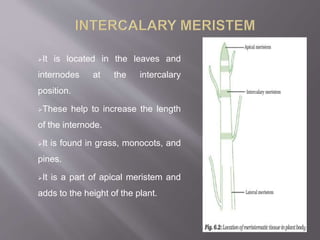
It is located in the leaves and
internodes at the intercalary
position.
These help to increase the length
of the internode.
It is found in grass, monocots, and
pines.
It is a part of apical meristem and
adds to the height of the plant.
It is located in the stems and roots on the lateral side.
It increases the thickness of the plant.
Vascular cambium and cork cambium are the two lateral
meristems.
These divide preclinically or radially and give rise to secondary
permanent tissues.
 It is the outermost plant tissue and forms the epidermis.
 It protects the plants from any mechanical shocks.
 It is the innermost tissue and gives rise to xylem and phloem.
 It helps in the transport of water and nutrients to different parts of
the plant.
 The cells are large with thick walls.
 It forms the cortex, pericycle, and pith.

Meristematic tissue

  • 1.
    Dr. Sachin Tawade, M.Sc.,Ph.D. (Botany) Assistant Professor & Head, Department of Botany, Digambarrao Bindu ACS College, Bhokar
  • 2.
    Meristematic Tissue: Definition “Meristematic tissueis the plant tissue that has the ability to divide actively throughout its life.” What is Meristematic Tissue? Carl Wilhelm von Nägeli coined the term “meristem.” Meristematic tissue contains undifferentiated cells, which are the building blocks of the specialized plant structures. The cells of the meristematic tissue divide actively to form specialized structures such as buds of leaves and flowers, tips of roots and shoots, etc. These cell help to increase the length and girth of the plant. The meristematic tissue is usually found in the apices of the root systems and the shoots and is in a continuous state of division.
  • 3.
    Characteristics of MeristematicTissue The characteristics of meristematic tissue are as follows: 1) The cells of these tissues are commonly called meristems. 2) The meristematic tissue has the quality of self-renewal. Every time the cell divides, one cell remains identical to the parent cell, and the others form specialized structures. 3) They have very small and few vacuoles. 4) The meristematic tissue is living and thin-walled. 5) The protoplasm of the cells is very dense. 6) The meristematic tissues heal the wounds of an injured plant. 7) The cells of the meristematic tissue are young and immature. 8) They do not store food. 9) They exhibit a very high metabolic activity. 10) 10 They possess a single, large and prominent nucleus.
  • 4.
    Meristematic Tissue ismainly classified on the basis of Origin, stages of development, position and functions. Meristematic Tissue On the basis of Origin Promeristem: The earliest and youngest meristematic tissue. It originates from the embryo. The primary meristem arises from the promeristem. It is found in the root and the shoot tips. It occupies very small area in plant body
  • 5.
    Primary Meristem It arisesfrom the promeristem after few divisions called as primary meristem. It present from embryonic stages of development and persists through out the life of the plant. Cells divide actively. Ex. Apical meristem It is present below the promeristem and forms the permanent tissue. Secondary Meristem It originates from the primary meristem. The permanent tissue forms from the secondary meristem. It do not have ability to divide and redivide. But under certain condition it regain power of cell division.
  • 6.
    Meristematic Tissue Onthe Basis of Position Apical Meristem: These are present at the tips of the roots and shoots and helps in the increase of the height of the plants. Various cell divisions facilitate the growth of the cells in the roots and shoots and help in cellular enlargement. Apical meristem is divided into-promeristem zone, which contains actively dividing cells, and the meristematic zone, which contains protoderm, procambium, and ground meristem.
  • 7.
    It is locatedin the leaves and internodes at the intercalary position. These help to increase the length of the internode. It is found in grass, monocots, and pines. It is a part of apical meristem and adds to the height of the plant.
  • 8.
    It is locatedin the stems and roots on the lateral side. It increases the thickness of the plant. Vascular cambium and cork cambium are the two lateral meristems. These divide preclinically or radially and give rise to secondary permanent tissues.
  • 9.
     It isthe outermost plant tissue and forms the epidermis.  It protects the plants from any mechanical shocks.
  • 10.
     It isthe innermost tissue and gives rise to xylem and phloem.  It helps in the transport of water and nutrients to different parts of the plant.
  • 11.
     The cellsare large with thick walls.  It forms the cortex, pericycle, and pith.