An Appraisal Process at Verizon The 360- Degree Feedback University of Maryland, University College – AMBA 602/9047 –Fall 2008 Brought to you by  Tami E. Johnson for Howard Fero, Professor – November 2, 2008
Reach Your PEAK – Verizon’s Way P erformance E ngagement A ttendance K nowledge By enhancing abilities to achieve Verizon Telecom’s Six Strategic Imperatives through improved efficiency, increased productivity and employee development to reach PEAK performance.  We explore an element of  Performance  in the 360-Degree Feedback . . . 360-Degree Feedback The Agenda
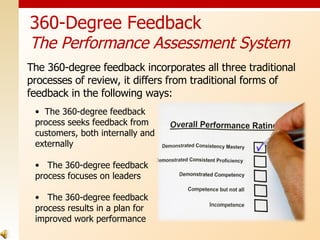
360-Degree Feedback The Performance Assessment System The 360-degree feedback incorporates all three traditional processes of review, it differs from traditional forms of feedback in the following ways: The 360-degree feedback process seeks feedback from customers, both internally and externally The 360-degree feedback process focuses on leaders The 360-degree feedback process results in a plan for improved work performance
Compare and assess traditional feedback vs. 360-degree feedback, there are many benefits explored to both.  Research shows that for any 360-degree feedback, there are essential elements that must happen in order for the process to be effective and ensure support for an application to move away from traditional feedback. 360-Degree Feedback Traditional Feedback vs 360-Degree Feedback
At Verizon, the appraisal process is designed to serve its participants positively, ensuring that the feedback is valid and that the process will benefit the workplace.  However, there are some cases where this dynamic is challenged. 360-Degree Feedback The Strengths & Limitations of the System Limitations as the ratee  Limitations as the rater
Success in 360-degree feedback review, evaluators must: Know the ratee professionally for six months or more Have worked closely with the ratee in the recent past Know the ratee’s position and work responsibilities 360-Degree Feedback Other Strengths & Limitations of the System Examples :  Bosses | Peers | Subordinates | Customers
The key to effective management is delegation. -- Steven R. Covey 360-Degree Feedback Lessons Learned & Best Practices
Help people overcome resistance in participating by: Giving power of voice Giving power of influence Giving power of action 360-Degree Feedback Conclusions & Recommendations
360-Degree Feedback Reference List Bernardin, J.H. (2007) in custom AMBA 602 text by McGraw-Hill: The Dynamics of Individuals and Groups in Work Organizations. Fletcher, Clive (2004). Appraisal and Feedback: Making performance review work (3rd ed.). London: Chartered Institute of Personnel and Development (CIPD) Kinicki, A., & Kreitner, R. (2008). Organizational Behavior: Key concepts, skills & best practices (3rd ed.). New York: McGraw-Hill/Irwin  McKirchy, Karen. (1998). Powerful Performance Appraisals: How to set expectations and work together to improve performance.  New Jersey: Career Press eWeb Portal – PEAK. PEAK quick training series survey. Retrieved September 30, 2008 from  http://myeweb.verizon.com/eweb/myportal/aboutyou/yourtoolkit/peak SkillSoft Corporation, Copyright 2002. Resistance to 360-degree feedback participation. Retrieved September 30, 2008 from  http://netlearn.verizon.com/skillsoft/web/sb/sbMGMT0152001001.htm . SkillSoft Corporation, Copyright 2002. 360-degree feedback vs. traditional feedback. Retrieved September 30, 2008 from  http://netlearn.verizon.com/skillsoft/web/sb/sbMGMT0152001001.htm .  SkillSoft Corporation, Copyright 2002. Involving participants in 360-degree feedback. Retrieved September 30, 2008 from  http://netlearn.verizon.com/skillsoft/web/sb/sbMGMT0152001001.htm .
360-Degree Feedback Appendix

360-Degree Feedback Process

  • 1.
    An Appraisal Processat Verizon The 360- Degree Feedback University of Maryland, University College – AMBA 602/9047 –Fall 2008 Brought to you by Tami E. Johnson for Howard Fero, Professor – November 2, 2008
  • 2.
    Reach Your PEAK– Verizon’s Way P erformance E ngagement A ttendance K nowledge By enhancing abilities to achieve Verizon Telecom’s Six Strategic Imperatives through improved efficiency, increased productivity and employee development to reach PEAK performance. We explore an element of Performance in the 360-Degree Feedback . . . 360-Degree Feedback The Agenda
  • 3.
    360-Degree Feedback ThePerformance Assessment System The 360-degree feedback incorporates all three traditional processes of review, it differs from traditional forms of feedback in the following ways: The 360-degree feedback process seeks feedback from customers, both internally and externally The 360-degree feedback process focuses on leaders The 360-degree feedback process results in a plan for improved work performance
  • 4.
    Compare and assesstraditional feedback vs. 360-degree feedback, there are many benefits explored to both. Research shows that for any 360-degree feedback, there are essential elements that must happen in order for the process to be effective and ensure support for an application to move away from traditional feedback. 360-Degree Feedback Traditional Feedback vs 360-Degree Feedback
  • 5.
    At Verizon, theappraisal process is designed to serve its participants positively, ensuring that the feedback is valid and that the process will benefit the workplace. However, there are some cases where this dynamic is challenged. 360-Degree Feedback The Strengths & Limitations of the System Limitations as the ratee Limitations as the rater
  • 6.
    Success in 360-degreefeedback review, evaluators must: Know the ratee professionally for six months or more Have worked closely with the ratee in the recent past Know the ratee’s position and work responsibilities 360-Degree Feedback Other Strengths & Limitations of the System Examples : Bosses | Peers | Subordinates | Customers
  • 7.
    The key toeffective management is delegation. -- Steven R. Covey 360-Degree Feedback Lessons Learned & Best Practices
  • 8.
    Help people overcomeresistance in participating by: Giving power of voice Giving power of influence Giving power of action 360-Degree Feedback Conclusions & Recommendations
  • 9.
    360-Degree Feedback ReferenceList Bernardin, J.H. (2007) in custom AMBA 602 text by McGraw-Hill: The Dynamics of Individuals and Groups in Work Organizations. Fletcher, Clive (2004). Appraisal and Feedback: Making performance review work (3rd ed.). London: Chartered Institute of Personnel and Development (CIPD) Kinicki, A., & Kreitner, R. (2008). Organizational Behavior: Key concepts, skills & best practices (3rd ed.). New York: McGraw-Hill/Irwin McKirchy, Karen. (1998). Powerful Performance Appraisals: How to set expectations and work together to improve performance. New Jersey: Career Press eWeb Portal – PEAK. PEAK quick training series survey. Retrieved September 30, 2008 from http://myeweb.verizon.com/eweb/myportal/aboutyou/yourtoolkit/peak SkillSoft Corporation, Copyright 2002. Resistance to 360-degree feedback participation. Retrieved September 30, 2008 from http://netlearn.verizon.com/skillsoft/web/sb/sbMGMT0152001001.htm . SkillSoft Corporation, Copyright 2002. 360-degree feedback vs. traditional feedback. Retrieved September 30, 2008 from http://netlearn.verizon.com/skillsoft/web/sb/sbMGMT0152001001.htm . SkillSoft Corporation, Copyright 2002. Involving participants in 360-degree feedback. Retrieved September 30, 2008 from http://netlearn.verizon.com/skillsoft/web/sb/sbMGMT0152001001.htm .
  • 10.