360-DEGREE FEEDBACK
360-DEGREE FEEDBACK
Background Contemporary 360-degree methods have roots as early as the 1940s 360-degree performance appraisal has historical roots within a military context. During the 1950s and 1960s this trend continued in the United States within the Military service academies.  At the United States Naval Academy at Annapolis, the midshipmen used a multi-source process called “peer grease” to evaluate the leadership skills of their classmates.  During the 1960s and 1970s, organizations like Bank of America, United Airlines, Bell Labs, Disney, Federal Express, Nestle, and RCA experimented with multi-source feedback in a variety of measurement situations.
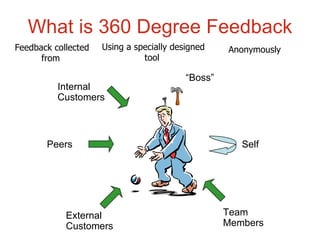
What is 360 Degree Feedback Internal Customers “ Boss” Peers External Customers Team Members Self Feedback collected from  Using a specially designed tool  Anonymously
360-Degree Feedback Provides performance data from multiple points of reference Like a compass, it is a navigational tool More powerful, reliable and accurate as compared to traditional, single source feedback processes
The feedback tends to not only be more balanced, but harder to dismiss due to its' broader range of input  360° feedback answers three basic questions: Why should I improve my performance? What do I need to improve? How can I improve? 360-Degree Feedback
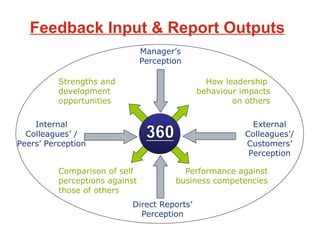
Feedback Input & Report Outputs External Colleagues’/ Customers’ Perception Internal Colleagues’ / Peers’ Perception Direct Reports’ Perception Manager’s Perception Strengths and development opportunities How leadership  behaviour impacts on others Performance against business competencies Comparison of self perceptions against those of others
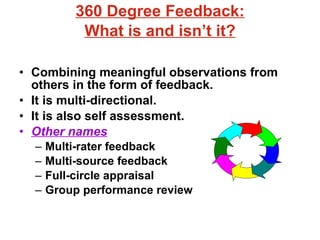
360 Degree Feedback: What is and isn’t it? Combining meaningful observations from others in the form of feedback. It is multi-directional. It is also self assessment. Other names Multi-rater feedback Multi-source feedback Full-circle appraisal Group performance review
360-Degree Feedback Provides well rounded feedback. It is not just feedback from the supervisor. Reduces opportunity for the halo or horn affect. Helps team members work more effectively together. A great way to understand organizational needs. Helps identify developmental needs. IS NOT AN EVALUATION
Not just a performance system … 360-degree feedback should be regarded as an organizational process rather than a mechanical tool.
How its being used ……. Leadership development programs. Voluntary feedback Team assessments  Organizational Change Assessment of training needs Assist performance management
Benefits For the organisation: Promotes constructive feedback and open communication Develops a culture of continuous performance improvement  Builds leadership/ managerial capability Embeds values and expected working competencies Can be a powerful trigger for change Provides feedback about leadership and management ‘strength’
Benefits For the individual: Increased self-awareness  Discovering the blind spots Understanding the strengths and opportunities for development Taking ownership and control of own development Helps managers to know how to get it ‘right’
Pitfalls When used in lieu of performance management, …… When “laid” on supervisors ………….. When requested of skeptical employees, ….. When not connected to organizational or leadership strategy, …. When respondents don’t know how to provide constructive feedback, …….. When there is insufficient information, …..  When the focus is on the negative, …… When there is workplace overload, …….. When implemented as fad without systemic support ……. When there is unethical behavior in the organization….
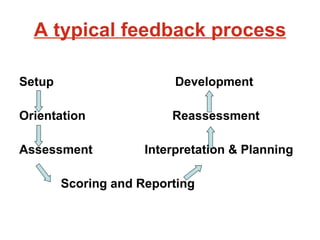
A typical feedback process Setup  Development Orientation  Reassessment Assessment  Interpretation & Planning Scoring and Reporting
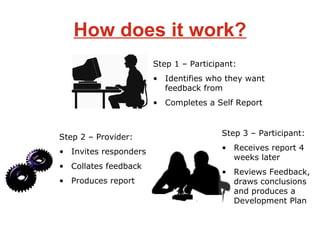
How does it work? Step 2 – Provider:  Invites responders Collates feedback Produces report Step 1 – Participant:  Identifies who they want feedback from Completes a Self Report Step 3 – Participant:  Receives report 4 weeks later Reviews Feedback, draws conclusions and produces a Development Plan
Strategies for Success Don't force it on people Explain what it is, what it does, how it's used, and its' benefits to all concerned, continually Emphasize confidentiality Disconnect it from any compensation decisions (raises, bonuses, etc.) - make it developmental Provide information on its purpose and process to assessors Conduct structured feedback workshops for feedback recipients Spend time with those people having difficulty with their feedback
Strategies for Success (Contd) Know the instrument you're using thoroughly Provide seamless coordination and support for distributing and collecting the assessment instruments Be trained in how to facilitate a 360° process. There's more to it than meets the eye. Align your 360° process with the organization's culture, procedures, and practices. Support and reinforce it. Make sure your vendor provides back-up support in case problems occur with the instruments or the process
Why are Companies not adopting 360 degree approach? It is time consuming  Emotional attachment in peers leads to no proper response. Appraises are not ready to take feedback In our culture we don't disrespect elders, thus subordinates never provide negative results.
“ 360 DEGREE PERFORMANCE APPRAISAL” An outlook


Problems – 360 Degree Appraisal Most costly  and time consuming type of appraisal. Tend to be somewhat shocking to managers at first- described as the "SARAH reaction: Shock, Anger, Rejection, Acceptance, Help". The problems may arise with subordinate assessments where employees desire to “get the boss” or may alternatively “scratch the back” of a manager for expected future favors.  The organization implementing this type of performance appraisal must clearly define the mission and the scope of the appraisal. Otherwise it might prove counter productive.
CASE STUDY:BBC  360 Degree Feedback - Leadership Development, Culture Change and Organization Development What was the client need? The BBC Making It Happen team, led by Greg Dyke, had identified the need to develop the BBC’s leadership capability. The BBC needed to develop a performance culture and 360 degree feedback was seen as key to underpinning success.
What approach was used? As part of the BBC Leadership Strategy Board, I led the planning, development and roll-out of a bespoke 360 degree feedback system and process (BBC 360). This involved leading my team to define the BBC Leadership Competency model (to support the Making it Happen "Lead More, Manage Well" team). We developed an in-house and online bespoke 360 feedback system and trialled the approach around the BBC with willing pilot groups to establish acceptance. The paperless data-collection approach (integrated into the BBC's e-mail and e-learning systems) facilitated very easy administration. We also trained around seventy BBC people to become facilitators around the corporation.
What was the outcome? After initial reluctance and suspicion, BBC leaders have now widely accepted BBC 360 as part of the way they work. It was vitally important to ensure that data were kept confidential and every participant receives a one-to-one coaching session with a trained facilitator to get their results. Every BBC leader who attends the BBC Leadership Programme at Ashridge benefits from a feedback session that dovetails into a coaching relationship (these number nearly 4,000 feedback sessions so far). 360 feedback is consistently reported as one of the most valuable aspects of the entire BBC Leadership Programme.
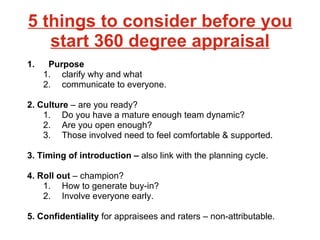
5 things to consider before you start 360 degree appraisal Purpose  clarify why and what  communicate to everyone. 2. Culture  – are you ready?  Do you have a mature enough team dynamic?  Are you open enough?  Those involved need to feel comfortable & supported.   3. Timing of introduction –  also link with the planning cycle.  4. Roll out  – champion?  How to generate buy-in?  Involve everyone early. 5. Confidentiality  for appraisees and raters – non-attributable.
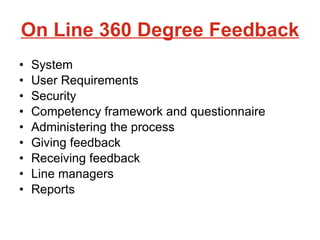
On Line 360 Degree Feedback System User Requirements Security Competency framework and questionnaire Administering the process Giving feedback Receiving feedback Line managers Reports
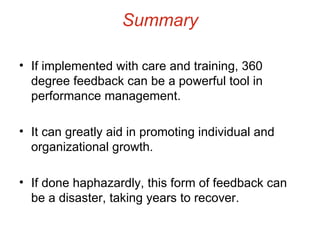
Summary If implemented with care and training, 360 degree feedback can be a powerful tool in performance management. It can greatly aid in promoting individual and organizational growth. If done haphazardly, this form of feedback can be a disaster, taking years to recover.
Thank you and good day …

360 Degree Feedback

  • 1.
  • 2.
  • 3.
    Background Contemporary 360-degreemethods have roots as early as the 1940s 360-degree performance appraisal has historical roots within a military context. During the 1950s and 1960s this trend continued in the United States within the Military service academies. At the United States Naval Academy at Annapolis, the midshipmen used a multi-source process called “peer grease” to evaluate the leadership skills of their classmates. During the 1960s and 1970s, organizations like Bank of America, United Airlines, Bell Labs, Disney, Federal Express, Nestle, and RCA experimented with multi-source feedback in a variety of measurement situations.
  • 4.
    What is 360Degree Feedback Internal Customers “ Boss” Peers External Customers Team Members Self Feedback collected from Using a specially designed tool Anonymously
  • 5.
    360-Degree Feedback Providesperformance data from multiple points of reference Like a compass, it is a navigational tool More powerful, reliable and accurate as compared to traditional, single source feedback processes
  • 6.
    The feedback tendsto not only be more balanced, but harder to dismiss due to its' broader range of input 360° feedback answers three basic questions: Why should I improve my performance? What do I need to improve? How can I improve? 360-Degree Feedback
  • 7.
    Feedback Input &Report Outputs External Colleagues’/ Customers’ Perception Internal Colleagues’ / Peers’ Perception Direct Reports’ Perception Manager’s Perception Strengths and development opportunities How leadership behaviour impacts on others Performance against business competencies Comparison of self perceptions against those of others
  • 8.
    360 Degree Feedback:What is and isn’t it? Combining meaningful observations from others in the form of feedback. It is multi-directional. It is also self assessment. Other names Multi-rater feedback Multi-source feedback Full-circle appraisal Group performance review
  • 9.
    360-Degree Feedback Provideswell rounded feedback. It is not just feedback from the supervisor. Reduces opportunity for the halo or horn affect. Helps team members work more effectively together. A great way to understand organizational needs. Helps identify developmental needs. IS NOT AN EVALUATION
  • 10.
    Not just aperformance system … 360-degree feedback should be regarded as an organizational process rather than a mechanical tool.
  • 11.
    How its beingused ……. Leadership development programs. Voluntary feedback Team assessments Organizational Change Assessment of training needs Assist performance management
  • 12.
    Benefits For theorganisation: Promotes constructive feedback and open communication Develops a culture of continuous performance improvement Builds leadership/ managerial capability Embeds values and expected working competencies Can be a powerful trigger for change Provides feedback about leadership and management ‘strength’
  • 13.
    Benefits For theindividual: Increased self-awareness Discovering the blind spots Understanding the strengths and opportunities for development Taking ownership and control of own development Helps managers to know how to get it ‘right’
  • 14.
    Pitfalls When usedin lieu of performance management, …… When “laid” on supervisors ………….. When requested of skeptical employees, ….. When not connected to organizational or leadership strategy, …. When respondents don’t know how to provide constructive feedback, …….. When there is insufficient information, ….. When the focus is on the negative, …… When there is workplace overload, …….. When implemented as fad without systemic support ……. When there is unethical behavior in the organization….
  • 15.
    A typical feedbackprocess Setup Development Orientation Reassessment Assessment Interpretation & Planning Scoring and Reporting
  • 16.
    How does itwork? Step 2 – Provider: Invites responders Collates feedback Produces report Step 1 – Participant: Identifies who they want feedback from Completes a Self Report Step 3 – Participant: Receives report 4 weeks later Reviews Feedback, draws conclusions and produces a Development Plan
  • 17.
    Strategies for SuccessDon't force it on people Explain what it is, what it does, how it's used, and its' benefits to all concerned, continually Emphasize confidentiality Disconnect it from any compensation decisions (raises, bonuses, etc.) - make it developmental Provide information on its purpose and process to assessors Conduct structured feedback workshops for feedback recipients Spend time with those people having difficulty with their feedback
  • 18.
    Strategies for Success(Contd) Know the instrument you're using thoroughly Provide seamless coordination and support for distributing and collecting the assessment instruments Be trained in how to facilitate a 360° process. There's more to it than meets the eye. Align your 360° process with the organization's culture, procedures, and practices. Support and reinforce it. Make sure your vendor provides back-up support in case problems occur with the instruments or the process
  • 19.
    Why are Companiesnot adopting 360 degree approach? It is time consuming Emotional attachment in peers leads to no proper response. Appraises are not ready to take feedback In our culture we don't disrespect elders, thus subordinates never provide negative results.
  • 20.
    “ 360 DEGREEPERFORMANCE APPRAISAL” An outlook
  • 21.
  • 22.
  • 23.
  • 24.
  • 25.
    Problems – 360Degree Appraisal Most costly and time consuming type of appraisal. Tend to be somewhat shocking to managers at first- described as the "SARAH reaction: Shock, Anger, Rejection, Acceptance, Help". The problems may arise with subordinate assessments where employees desire to “get the boss” or may alternatively “scratch the back” of a manager for expected future favors. The organization implementing this type of performance appraisal must clearly define the mission and the scope of the appraisal. Otherwise it might prove counter productive.
  • 26.
    CASE STUDY:BBC 360 Degree Feedback - Leadership Development, Culture Change and Organization Development What was the client need? The BBC Making It Happen team, led by Greg Dyke, had identified the need to develop the BBC’s leadership capability. The BBC needed to develop a performance culture and 360 degree feedback was seen as key to underpinning success.
  • 27.
    What approach wasused? As part of the BBC Leadership Strategy Board, I led the planning, development and roll-out of a bespoke 360 degree feedback system and process (BBC 360). This involved leading my team to define the BBC Leadership Competency model (to support the Making it Happen "Lead More, Manage Well" team). We developed an in-house and online bespoke 360 feedback system and trialled the approach around the BBC with willing pilot groups to establish acceptance. The paperless data-collection approach (integrated into the BBC's e-mail and e-learning systems) facilitated very easy administration. We also trained around seventy BBC people to become facilitators around the corporation.
  • 28.
    What was theoutcome? After initial reluctance and suspicion, BBC leaders have now widely accepted BBC 360 as part of the way they work. It was vitally important to ensure that data were kept confidential and every participant receives a one-to-one coaching session with a trained facilitator to get their results. Every BBC leader who attends the BBC Leadership Programme at Ashridge benefits from a feedback session that dovetails into a coaching relationship (these number nearly 4,000 feedback sessions so far). 360 feedback is consistently reported as one of the most valuable aspects of the entire BBC Leadership Programme.
  • 29.
    5 things toconsider before you start 360 degree appraisal Purpose clarify why and what communicate to everyone. 2. Culture – are you ready? Do you have a mature enough team dynamic? Are you open enough? Those involved need to feel comfortable & supported. 3. Timing of introduction – also link with the planning cycle. 4. Roll out – champion? How to generate buy-in? Involve everyone early. 5. Confidentiality for appraisees and raters – non-attributable.
  • 30.
    On Line 360Degree Feedback System User Requirements Security Competency framework and questionnaire Administering the process Giving feedback Receiving feedback Line managers Reports
  • 31.
    Summary If implementedwith care and training, 360 degree feedback can be a powerful tool in performance management. It can greatly aid in promoting individual and organizational growth. If done haphazardly, this form of feedback can be a disaster, taking years to recover.
  • 32.
    Thank you andgood day …