Mani Rajoria ,15
Nidhi Kaim , 26
Preetika ,16
Pooja Yadav,05
Manisha Jindal,32
 Performance appraisals are essential for the
effective management and evaluation of staff.
 Appraisals help in developing individuals, improve
organizational performance, and feed into business
planning.
 Formal performance appraisals are generally
conducted annually for all staff in the organization.
 It is Essential for career and succession planning.
 Provides a formal, recorded, regular review of an
individual's performance, and a plan for future
development.
 Important for staff motivation, attitude and behavior
development, communicating and aligning individual
and organizational aims, and fostering positive
relationships between management and staff.
This is defined as the systematic collection &
feedback of performance data on an individual
derived from no. of stakeholders in their
performance
Not just a performance system
 360-degree feedback should be regarded as an
organizational process rather than a mechanical
tool
.
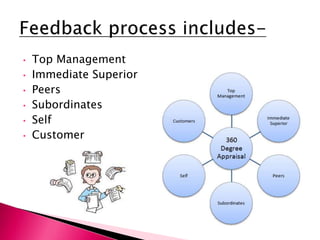
 An appraisal made by top management, immediate
superior, peers, subordinates, self and customers is
called 360 Degree Appraisal.
 This method is very reliable because evaluation is
done by many different parties.
 This method is mostly used to evaluate the
performance of the employees. However, it is also
used to evaluate other qualities such as talents,
behavior, values, ethical standards, tempers, loyalty,
etc.
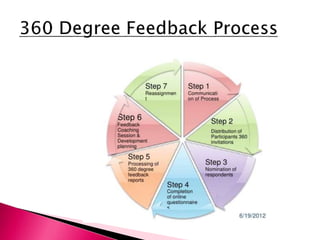
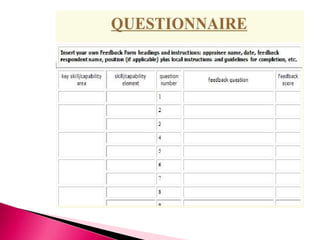
 By using a questionnaire which asks
participants to rate the individual according
to observed behaviors - usually managerial or
business-specific competencies.
 This process will not suit all companies. One
should assess how well it would fit with the
current culture before launching a scheme
and a pilot scheme is worth building into the
programme
• Top Management
• Immediate Superior
• Peers
• Subordinates
• Self
• Customer
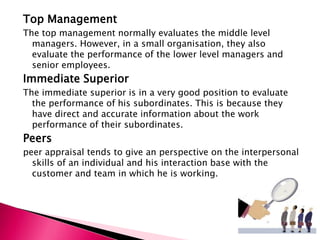
Top Management
The top management normally evaluates the middle level
managers. However, in a small organisation, they also
evaluate the performance of the lower level managers and
senior employees.
Immediate Superior
The immediate superior is in a very good position to evaluate
the performance of his subordinates. This is because they
have direct and accurate information about the work
performance of their subordinates.
Peers
peer appraisal tends to give an perspective on the interpersonal
skills of an individual and his interaction base with the
customer and team in which he is working.
Subordinates
The subordinate appraisal is an evaluation tool whereby
employees assess the performance of their supervisor
Self
In the self-appraisal, a person evaluates his own performance.
He should be honest while evaluating himself. This results in
self-development.
Customer
Customers can also evaluate the performance of the employees
who interacts with them. It is also given a lot of importance
because the customer is the most important person for the
business. Organisations use customer appraisals to improve
the strengths and remove the weaknesses of their employees.
• 360 degree measures behaviour and competencies.
• 360 degree addresses skills such as listening, planning, and
goal-setting.
• 360 degree focuses on subjective areas such as teamwork,
character, and leadership effectiveness.
• 360 degree provide feedback on how others perceive an
employee.
To the individual
 Discovering the blind spots.
 Increased self-awareness
 Discovering the blind spots
 Understanding the strengths and opportunities for
development
 Taking ownership and control of own development
 Helps managers to know how to get it ‘right’
To the organization
 Provides better opportunities for career
development.
 Improve customer service.
 Facilitates in conducting relevant training
programs.
 Build leadership and managerial capability
 It helps identify top performers.
 Develop a culture of continuous performance
improvement
Benefit to the team
 Increases communication between the team.
 Generates a higher level of trust.
 Increases team effectiveness.
 It is time consuming
 Emotional attachment in peers leads to no proper
response
 Appraises are not ready to take feedback
 In our culture we don't disrespect elders, thus
subordinates never provide negative results
 Process suffers because of the lack of knowledge on
the part of participants or raters

360 degree appraisal

  • 1.
    Mani Rajoria ,15 NidhiKaim , 26 Preetika ,16 Pooja Yadav,05 Manisha Jindal,32
  • 2.
     Performance appraisalsare essential for the effective management and evaluation of staff.  Appraisals help in developing individuals, improve organizational performance, and feed into business planning.  Formal performance appraisals are generally conducted annually for all staff in the organization.
  • 3.
     It isEssential for career and succession planning.  Provides a formal, recorded, regular review of an individual's performance, and a plan for future development.  Important for staff motivation, attitude and behavior development, communicating and aligning individual and organizational aims, and fostering positive relationships between management and staff.
  • 5.
    This is definedas the systematic collection & feedback of performance data on an individual derived from no. of stakeholders in their performance Not just a performance system  360-degree feedback should be regarded as an organizational process rather than a mechanical tool .
  • 6.
     An appraisalmade by top management, immediate superior, peers, subordinates, self and customers is called 360 Degree Appraisal.  This method is very reliable because evaluation is done by many different parties.  This method is mostly used to evaluate the performance of the employees. However, it is also used to evaluate other qualities such as talents, behavior, values, ethical standards, tempers, loyalty, etc.
  • 8.
     By usinga questionnaire which asks participants to rate the individual according to observed behaviors - usually managerial or business-specific competencies.  This process will not suit all companies. One should assess how well it would fit with the current culture before launching a scheme and a pilot scheme is worth building into the programme
  • 10.
    • Top Management •Immediate Superior • Peers • Subordinates • Self • Customer
  • 11.
    Top Management The topmanagement normally evaluates the middle level managers. However, in a small organisation, they also evaluate the performance of the lower level managers and senior employees. Immediate Superior The immediate superior is in a very good position to evaluate the performance of his subordinates. This is because they have direct and accurate information about the work performance of their subordinates. Peers peer appraisal tends to give an perspective on the interpersonal skills of an individual and his interaction base with the customer and team in which he is working.
  • 12.
    Subordinates The subordinate appraisalis an evaluation tool whereby employees assess the performance of their supervisor Self In the self-appraisal, a person evaluates his own performance. He should be honest while evaluating himself. This results in self-development. Customer Customers can also evaluate the performance of the employees who interacts with them. It is also given a lot of importance because the customer is the most important person for the business. Organisations use customer appraisals to improve the strengths and remove the weaknesses of their employees.
  • 13.
    • 360 degreemeasures behaviour and competencies. • 360 degree addresses skills such as listening, planning, and goal-setting. • 360 degree focuses on subjective areas such as teamwork, character, and leadership effectiveness. • 360 degree provide feedback on how others perceive an employee.
  • 14.
    To the individual Discovering the blind spots.  Increased self-awareness  Discovering the blind spots  Understanding the strengths and opportunities for development  Taking ownership and control of own development  Helps managers to know how to get it ‘right’
  • 15.
    To the organization Provides better opportunities for career development.  Improve customer service.  Facilitates in conducting relevant training programs.  Build leadership and managerial capability  It helps identify top performers.  Develop a culture of continuous performance improvement
  • 16.
    Benefit to theteam  Increases communication between the team.  Generates a higher level of trust.  Increases team effectiveness.
  • 17.
     It istime consuming  Emotional attachment in peers leads to no proper response  Appraises are not ready to take feedback  In our culture we don't disrespect elders, thus subordinates never provide negative results  Process suffers because of the lack of knowledge on the part of participants or raters