BY
Sudha Rajaram
360 Degree Appraisal System
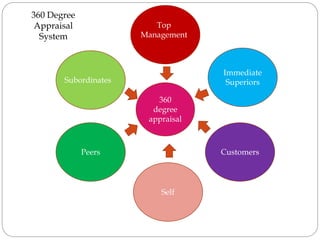
CustomersPeers
Self
Immediate
Superiors
360
degree
appraisal
Top
Management
Subordinates
360 Degree
Appraisal
System
Preview
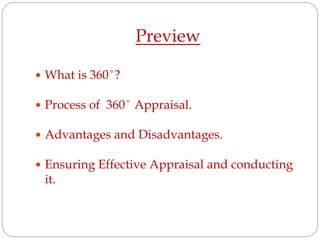
 What is 360 ̊ ?
 Process of 360 ̊ Appraisal.
 Advantages and Disadvantages.
 Ensuring Effective Appraisal and conducting
it.
What is 360 degree appraisal ?
360 degree feedback is defined as “ The
systematic collection and feedback of
performance data on an individual or group
derived from a number of stakeholders in
performance. “
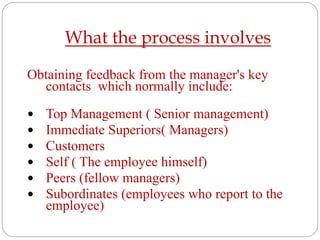
What the process involves
Obtaining feedback from the manager's key
contacts which normally include:
 Top Management ( Senior management)
 Immediate Superiors( Managers)
 Customers
 Self ( The employee himself)
 Peers (fellow managers)
 Subordinates (employees who report to the
employee)
What the process involves
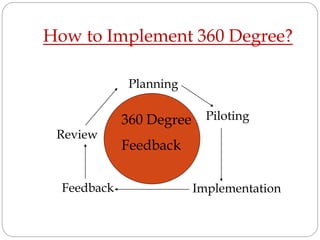
How to Implement 360 Degree?
360 Degree
Feedback
Planning
Piloting
ImplementationFeedback
Review
How is Feedback obtained?
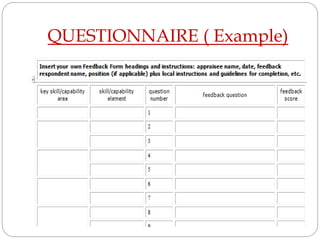
• By using a questionnaire which asks participants
to rate the individual according to observed
behaviors - usually managerial or business-
specific competencies.
• This process will not suit all companies. One
should assess how well it would fit with the
current culture before launching a scheme and a
pilot scheme is worth building into the
programme
QUESTIONNAIRE ( Example)
What does 360 ̊ measure ?
 360 degree measures behaviors and competencies.
 360 degree addresses skills such as listening,
planning, and goal-setting.
 360 degree focuses on subjective areas such as
teamwork, character, and leadership effectiveness.
 360 degree provide feedback on how others
perceive an employee.
ADVANTAGES
&
DISADVANTAGES
Advantages
 Method of collecting information from as many
sources in an employees environment.
 Honest assessment as viewed by a variety of
constituents.
 Confidential input from many people of how an
employee fares in his job.
 Helps employees in seeing themselves as others
see them.
 It provides information which neither employee
nor his/her superior may be aware.
Advantages
 Confidentiality an important aspect.
 Employees find this method to be fair.
 Gives an indication of performance enhancing or
distracting work situation.
 Allows to improve the system creating greater
harmony and overall improvement.
 Help employees identify strenght and address
skill gaps.
 Lends to continuous learning , growing self
confidence and improved productivity.
Advantages
The system is helpful to the supervisor as :
 Accurate assessment.
 Eliminate accusations of favoritism.
 Provides greater Objectivity.
Disadvantages
•360 performance rating system is not a validated or
corroborated technique for Performance appraisal.
•With the increase in the number of raters from one
to five (commonly), it become difficult to separate,
calculate and eliminate personal biasness and
differences.
•360 degree feedback as a process requires
commitment of top management and the HR,
resources(time, financial resources etc), planned
implementation and follow up.
Disadvantages
•It is often time consuming and difficult to analyze the
information gathered.
•The results can be manipulated by the employees
towards their desired ratings with the help of the raters.
•Often, the process suffers because of the lack of
knowledge on the part of the participants or the raters.
Ensuring Effective appraisal
 Comply with the law
 To ensure that the performance appraisal system does not
violate principles of fair employment practices:
- Job related performance standards
- Provide employees with a written copy of the standards
before the appraisal
- Standards must be based on observable or measurable
behaviour
- Train the raters
- Provide feedback
- Implement an appeal system to settle disagreements
Conducting the Appraisal Interview
•Ask for self assessment
•Invite participation
•Express appreciation
•Minimize criticism
•Change behaviour, not the person
•Focus on solving problems
•Be supportive
•Establish goals
•Follow up day-to-day
THANK YOU

360 degree appraisal system

  • 1.
  • 2.
  • 3.
    Preview  What is360 ̊ ?  Process of 360 ̊ Appraisal.  Advantages and Disadvantages.  Ensuring Effective Appraisal and conducting it.
  • 4.
    What is 360degree appraisal ? 360 degree feedback is defined as “ The systematic collection and feedback of performance data on an individual or group derived from a number of stakeholders in performance. “
  • 5.
    What the processinvolves Obtaining feedback from the manager's key contacts which normally include:  Top Management ( Senior management)  Immediate Superiors( Managers)  Customers  Self ( The employee himself)  Peers (fellow managers)  Subordinates (employees who report to the employee) What the process involves
  • 6.
    How to Implement360 Degree? 360 Degree Feedback Planning Piloting ImplementationFeedback Review
  • 7.
    How is Feedbackobtained? • By using a questionnaire which asks participants to rate the individual according to observed behaviors - usually managerial or business- specific competencies. • This process will not suit all companies. One should assess how well it would fit with the current culture before launching a scheme and a pilot scheme is worth building into the programme
  • 8.
  • 9.
    What does 360̊ measure ?  360 degree measures behaviors and competencies.  360 degree addresses skills such as listening, planning, and goal-setting.  360 degree focuses on subjective areas such as teamwork, character, and leadership effectiveness.  360 degree provide feedback on how others perceive an employee.
  • 10.
  • 11.
    Advantages  Method ofcollecting information from as many sources in an employees environment.  Honest assessment as viewed by a variety of constituents.  Confidential input from many people of how an employee fares in his job.  Helps employees in seeing themselves as others see them.  It provides information which neither employee nor his/her superior may be aware.
  • 12.
    Advantages  Confidentiality animportant aspect.  Employees find this method to be fair.  Gives an indication of performance enhancing or distracting work situation.  Allows to improve the system creating greater harmony and overall improvement.  Help employees identify strenght and address skill gaps.  Lends to continuous learning , growing self confidence and improved productivity.
  • 13.
    Advantages The system ishelpful to the supervisor as :  Accurate assessment.  Eliminate accusations of favoritism.  Provides greater Objectivity.
  • 14.
    Disadvantages •360 performance ratingsystem is not a validated or corroborated technique for Performance appraisal. •With the increase in the number of raters from one to five (commonly), it become difficult to separate, calculate and eliminate personal biasness and differences. •360 degree feedback as a process requires commitment of top management and the HR, resources(time, financial resources etc), planned implementation and follow up.
  • 15.
    Disadvantages •It is oftentime consuming and difficult to analyze the information gathered. •The results can be manipulated by the employees towards their desired ratings with the help of the raters. •Often, the process suffers because of the lack of knowledge on the part of the participants or the raters.
  • 16.
    Ensuring Effective appraisal Comply with the law  To ensure that the performance appraisal system does not violate principles of fair employment practices: - Job related performance standards - Provide employees with a written copy of the standards before the appraisal - Standards must be based on observable or measurable behaviour - Train the raters - Provide feedback - Implement an appeal system to settle disagreements
  • 17.
    Conducting the AppraisalInterview •Ask for self assessment •Invite participation •Express appreciation •Minimize criticism •Change behaviour, not the person •Focus on solving problems •Be supportive •Establish goals •Follow up day-to-day
  • 18.