360 DEGREE
APPRAISAL
      submitted by Avinash
PERFORMANCE
   The accomplishment of a given task
    measured against preset known standards
    of accuracy, completeness, cost, and speed. In
    a contract
   performance is deemed to be the fulfillment of
    an obligation, in a manner that releases the
    performer from all liabilities under the contract.
APPRAISAL
 1. It is an
Impartial analysis and evaluation conducted acc
  ording to established criteria to determine the
  acceptability, merit, or worthof an item
PERFORMANCE APPRAISAL
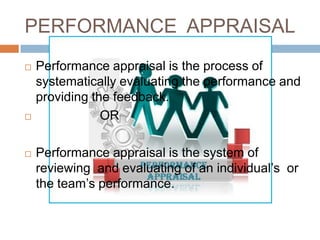
   Performance appraisal is the process of
    systematically evaluating the performance and
    providing the feedback.
               OR

   Performance appraisal is the system of
    reviewing and evaluating of an individual’s or
    the team’s performance.
   OR
   Performance appraisal may be defined as an
    integrative process involving, evaluation of
    employee’s competence, contributions,
    improvements, opportunities,and potential for
    future growth with organizational objective…
OBJECTIVE
   1. Increased motivation to perform effectively
   2. Increased self-esteem of employees
   3. Better clarity and definition of job fyunctions
    and responsibility
   4.Valuable communication developed among
    appraisal participants
   5.Reward distributed on fair and credible basis
   6. Improve manpower planning
WHY PERFORMANCE
APPRAISAL
   1. For development decisions
   A* personal development
   B* development of skills
   C* self analysis
   D* self development planning
   2. Administrative decisions

   A* personal decisions
   B* removal of deficiencies in performance
   C* Job redesign
METHOD OF PERFORMANCE
APPRAISAL
   A* PAST ORIENTED

   1. Essay appraisal
   2. Graphic rating scale appraisal
   3. field review appraisal
   4. Forced-choice rating appraisal
   5. Critical incident appraisal
   6.Work standard approach
   7. Ranking method appraisal
   B* FUTURE ORIENTED

   1. Management by objectives appraisal
   2.Assessment centres
   3.Behaviourally anchored rating scale
   4.360-degree appraisal
   5.Balanced scorecard.
360-Degree Appraisal
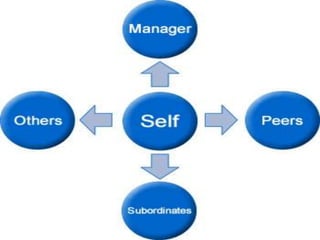
   360-degree feedback, also known as multi-
    rater feedback, or multisource assessment,
    it is feedback that comes from all around an
    employee. Feedback is provided by
    subordinates, peers, and supervisors. It also
    includes a self-assessment and, in some
    cases, feedback from external sources such
    as customers and suppliers or other interested
    stakeholders
What is 360° feedback?
   Behavioural: A tool which gives you insight
    into the way others perceive you as a leader-
    manager, based on your behaviours
   Multidimensional: Opinions are gathered
    from you, your manager, your peers and your
    staff
   Developmental: A critical supplement to
    goal-based performance assessment for
    leader-managers
Companies practicing 360
degree
   1.wipro
   2.infosys
   3.Reliance industries
   4maruti
   5 HCL
History

   The German Military first began gathering
    feedback from multiple sources in order to
    evaluate performance during World War II .
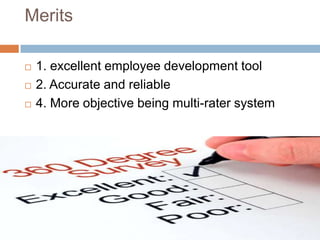
Merits

   1. excellent employee development tool
   2. Accurate and reliable
   4. More objective being multi-rater system
   A more balanced view of individual performance - everyone
    who interacts with you
   Powerful - more likely to prompt behaviour change, where
    arequired
   Reveals unique information not captured through day to day
    interactions (reflection)
   Source of relInformative - tells you what other people
    want from you
   Development focused - a self directed learning tool
   reiable feedback for managers
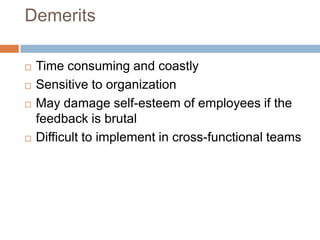
Demerits

   Time consuming and coastly
   Sensitive to organization
   May damage self-esteem of employees if the
    feedback is brutal
   Difficult to implement in cross-functional teams

360 degree appraisal

  • 1.
    360 DEGREE APPRAISAL submitted by Avinash
  • 2.
    PERFORMANCE  The accomplishment of a given task measured against preset known standards of accuracy, completeness, cost, and speed. In a contract  performance is deemed to be the fulfillment of an obligation, in a manner that releases the performer from all liabilities under the contract.
  • 3.
    APPRAISAL  1. Itis an Impartial analysis and evaluation conducted acc ording to established criteria to determine the acceptability, merit, or worthof an item
  • 4.
    PERFORMANCE APPRAISAL  Performance appraisal is the process of systematically evaluating the performance and providing the feedback.  OR  Performance appraisal is the system of reviewing and evaluating of an individual’s or the team’s performance.
  • 5.
    OR  Performance appraisal may be defined as an integrative process involving, evaluation of employee’s competence, contributions, improvements, opportunities,and potential for future growth with organizational objective…
  • 6.
    OBJECTIVE  1. Increased motivation to perform effectively  2. Increased self-esteem of employees  3. Better clarity and definition of job fyunctions and responsibility  4.Valuable communication developed among appraisal participants  5.Reward distributed on fair and credible basis  6. Improve manpower planning
  • 7.
    WHY PERFORMANCE APPRAISAL  1. For development decisions  A* personal development  B* development of skills  C* self analysis  D* self development planning
  • 8.
    2. Administrative decisions  A* personal decisions  B* removal of deficiencies in performance  C* Job redesign
  • 9.
    METHOD OF PERFORMANCE APPRAISAL  A* PAST ORIENTED  1. Essay appraisal  2. Graphic rating scale appraisal  3. field review appraisal  4. Forced-choice rating appraisal  5. Critical incident appraisal  6.Work standard approach  7. Ranking method appraisal
  • 10.
    B* FUTURE ORIENTED  1. Management by objectives appraisal  2.Assessment centres  3.Behaviourally anchored rating scale  4.360-degree appraisal  5.Balanced scorecard.
  • 11.
    360-Degree Appraisal  360-degree feedback, also known as multi- rater feedback, or multisource assessment, it is feedback that comes from all around an employee. Feedback is provided by subordinates, peers, and supervisors. It also includes a self-assessment and, in some cases, feedback from external sources such as customers and suppliers or other interested stakeholders
  • 12.
    What is 360°feedback?  Behavioural: A tool which gives you insight into the way others perceive you as a leader- manager, based on your behaviours  Multidimensional: Opinions are gathered from you, your manager, your peers and your staff  Developmental: A critical supplement to goal-based performance assessment for leader-managers
  • 14.
    Companies practicing 360 degree  1.wipro  2.infosys  3.Reliance industries  4maruti  5 HCL
  • 15.
    History  The German Military first began gathering feedback from multiple sources in order to evaluate performance during World War II .
  • 16.
    Merits  1. excellent employee development tool  2. Accurate and reliable  4. More objective being multi-rater system
  • 17.
    A more balanced view of individual performance - everyone who interacts with you  Powerful - more likely to prompt behaviour change, where arequired  Reveals unique information not captured through day to day interactions (reflection)  Source of relInformative - tells you what other people want from you  Development focused - a self directed learning tool  reiable feedback for managers
  • 18.
    Demerits  Time consuming and coastly  Sensitive to organization  May damage self-esteem of employees if the feedback is brutal  Difficult to implement in cross-functional teams