Performance Appraisal!
“Human Resource Management”
Project Presentation
Presenters
Wasif Nawaz
Baseer Khan
Aqib Najeeb
Shahrukh Sheikh
Maria Sarfaraz
Submitted to: Dr. Shazia Akhtar
Statement of Discussion
 “Performance Appraisal should be multifaceted.
Supervisor should be able to evaluate
their employees, and employees should be able
to evaluate their supervisors, and Customers
should evaluate them all”.
Performance Appraisal
 Concept
 Purpose
 Role of Performance Appraisal in:
 Motivation
 Training and Development
 Recruitment.
360-Degree!
The 360 Evolution
 At the beginning it was designed for
managers or career development
 Now the same evaluation process is used
from the CEO down to Maintenance
 And both are contributing the
each other’s evaluation
Who Uses It?
 90 percent of Fortune 1000 companies
 In our opinion every
Company
School
Firm
Sports Team
Etc…
 Should use this system for Improvement
The Types
 1. Top-Down Employee
Performance Evaluations
 2. Peer-to-Peer Employee
Performance Evaluations
 3. Down-Top Performance
Evaluation
 4. Self-Assessment Performance
Reviews
 External Sources
Top-Down Employee Performance
Evaluations
 Most Common and Most Effective
 Assessment given directly from manager
 First-line supervisor can be more effective
 Becomes more reliable when supervisors are
trained
Self-Assessment Performance Reviews
 Employee asked to rate
themselves
 Helps employee reflect on their
performance and be an active
part of their review
 Discussions on how they feel
about their performance
Peer-to-Peer Employee Performance
Evaluations
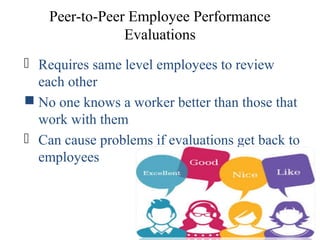
 Requires same level employees to review
each other
 No one knows a worker better than those that
work with them
 Can cause problems if evaluations get back to
employees
Upward Evaluation
 Subordinates have a unique, often essential,
perspective
 Valuable data on supervisory behaviors
 Employees feel they have a greater voice
 Anonymity is essential
 Need precautions
Customer Evaluation
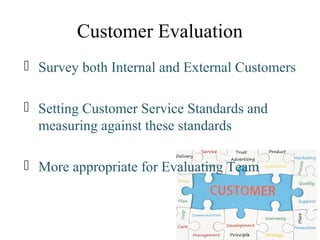
 Survey both Internal and External Customers
 Setting Customer Service Standards and
measuring against these standards
 More appropriate for Evaluating Team
360-Degree Performance Reviews
• Customers, Suppliers, Peers, and self
assessment direct reports
• Very effective if kept anonymous
• Every angle is accounted for and gives a true
performance picture
Why is 360 Valuable to You?
 Identifies your strengths and weaknesses
from the perspective of others.
 Effective Working environment
 Improves your productivity and work
relationships with those around you. 
Strategic Mission
 The purpose of doing 360 must be clearly
defined
 If the mission is to develop and grow all
employees must know that it is all for
everyone's improvement
 If communication breaks down employees
could fear everyone attacking them in the
evaluations
Be Careful
 You cannot be reckless with 360’s!
 If there are not clear goals set ahead of time
then…
The evaluations will have no direction
They will be hard to interpret
 It is best to have experts conduct these
evaluations to ensure maximum effectiveness
&
 Closely evaluated goals
 Kept employees accountable for their inputs
 Helped their employees to use evaluations
accurately
 Carefully watch for Gaming
Cont…
 They find with 360 prejudices related to
Age
Gender
Race
Religion
Or any other factors
• This has lead to great successes for Intel
breach thousands benchmark!
Pros of
 More comprehensive system because
responses are gathered from multiple
perspectives
 Feedback from peers and others may increase
employee self-development
Pros Continued
 It may lessen prejudices because the
feedback comes from more people, not just
one person
 Quality of information is better
 It complements TQM initiatives by
emphasizing internal/external customers and
teams
In case of Dis-agreement
 Requires training to work
 Employees could give dishonest and invalid
feedback
 Can Be expensive
Cont..
 Complex system in combining all responses
 Feedback can be intimidating. Employees
could feel like they are being “attacked”
 Could be conflicting opinions, but accurate
from their own standpoints
 Helps individuals and companies improve,
grow and developed
 Provides honest and unbiased helpful
feedback
 Increasing individuals performance with 360-
degree evaluations will lead to overall
success for a firm

360 degree feedback (

  • 1.
  • 2.
    “Human Resource Management” ProjectPresentation Presenters Wasif Nawaz Baseer Khan Aqib Najeeb Shahrukh Sheikh Maria Sarfaraz Submitted to: Dr. Shazia Akhtar
  • 3.
    Statement of Discussion “Performance Appraisal should be multifaceted. Supervisor should be able to evaluate their employees, and employees should be able to evaluate their supervisors, and Customers should evaluate them all”.
  • 4.
    Performance Appraisal  Concept Purpose  Role of Performance Appraisal in:  Motivation  Training and Development  Recruitment.
  • 5.
  • 6.
    The 360 Evolution At the beginning it was designed for managers or career development  Now the same evaluation process is used from the CEO down to Maintenance  And both are contributing the each other’s evaluation
  • 7.
    Who Uses It? 90 percent of Fortune 1000 companies  In our opinion every Company School Firm Sports Team Etc…  Should use this system for Improvement
  • 8.
    The Types  1.Top-Down Employee Performance Evaluations  2. Peer-to-Peer Employee Performance Evaluations  3. Down-Top Performance Evaluation  4. Self-Assessment Performance Reviews  External Sources
  • 9.
    Top-Down Employee Performance Evaluations Most Common and Most Effective  Assessment given directly from manager  First-line supervisor can be more effective  Becomes more reliable when supervisors are trained
  • 10.
    Self-Assessment Performance Reviews Employee asked to rate themselves  Helps employee reflect on their performance and be an active part of their review  Discussions on how they feel about their performance
  • 11.
    Peer-to-Peer Employee Performance Evaluations Requires same level employees to review each other  No one knows a worker better than those that work with them  Can cause problems if evaluations get back to employees
  • 12.
    Upward Evaluation  Subordinateshave a unique, often essential, perspective  Valuable data on supervisory behaviors  Employees feel they have a greater voice  Anonymity is essential  Need precautions
  • 13.
    Customer Evaluation  Surveyboth Internal and External Customers  Setting Customer Service Standards and measuring against these standards  More appropriate for Evaluating Team
  • 14.
    360-Degree Performance Reviews •Customers, Suppliers, Peers, and self assessment direct reports • Very effective if kept anonymous • Every angle is accounted for and gives a true performance picture
  • 15.
    Why is 360Valuable to You?  Identifies your strengths and weaknesses from the perspective of others.  Effective Working environment  Improves your productivity and work relationships with those around you. 
  • 16.
    Strategic Mission  Thepurpose of doing 360 must be clearly defined  If the mission is to develop and grow all employees must know that it is all for everyone's improvement  If communication breaks down employees could fear everyone attacking them in the evaluations
  • 17.
    Be Careful  Youcannot be reckless with 360’s!  If there are not clear goals set ahead of time then… The evaluations will have no direction They will be hard to interpret  It is best to have experts conduct these evaluations to ensure maximum effectiveness
  • 18.
    &  Closely evaluatedgoals  Kept employees accountable for their inputs  Helped their employees to use evaluations accurately  Carefully watch for Gaming
  • 19.
    Cont…  They findwith 360 prejudices related to Age Gender Race Religion Or any other factors • This has lead to great successes for Intel breach thousands benchmark!
  • 20.
    Pros of  Morecomprehensive system because responses are gathered from multiple perspectives  Feedback from peers and others may increase employee self-development
  • 21.
    Pros Continued  Itmay lessen prejudices because the feedback comes from more people, not just one person  Quality of information is better  It complements TQM initiatives by emphasizing internal/external customers and teams
  • 22.
    In case ofDis-agreement  Requires training to work  Employees could give dishonest and invalid feedback  Can Be expensive
  • 23.
    Cont..  Complex systemin combining all responses  Feedback can be intimidating. Employees could feel like they are being “attacked”  Could be conflicting opinions, but accurate from their own standpoints
  • 24.
     Helps individualsand companies improve, grow and developed  Provides honest and unbiased helpful feedback  Increasing individuals performance with 360- degree evaluations will lead to overall success for a firm