ABC model choice via random forests
1 simulation-based methods in
Econometrics
2 Genetics of ABC
3 Approximate Bayesian computation
4 ABC for model choice
5 ABC model choice via random forests
Random forests
ABC with random forests
Illustrations
6 ABC estimation via random forests
7 [some] asymptotics of ABC
Leaning towards machine learning
Main notions:
• ABC-MC seen as learning about which model is most
appropriate from a huge (reference) table
• exploiting a large number of summary statistics not an issue
for machine learning methods intended to estimate efficient
combinations
• abandoning (temporarily?) the idea of estimating posterior
probabilities of the models, poorly approximated by machine
learning methods, and replacing those by posterior predictive
expected loss
[Cornuet et al., 2014, in progress]
Random forests
Technique that stemmed from Leo Breiman’s bagging (or
bootstrap aggregating) machine learning algorithm for both
classification and regression
[Breiman, 1996]
Improved classification performances by averaging over
classification schemes of randomly generated training sets, creating
a “forest” of (CART) decision trees, inspired by Amit and Geman
(1997) ensemble learning
[Breiman, 2001]
Growing the forest
Breiman’s solution for inducing random features in the trees of the
forest:
• boostrap resampling of the dataset and
• random subset-ing [of size
√
t] of the covariates driving the
classification at every node of each tree
Covariate xτ that drives the node separation
xτ cτ
and the separation bound cτ chosen by minimising entropy or Gini
index
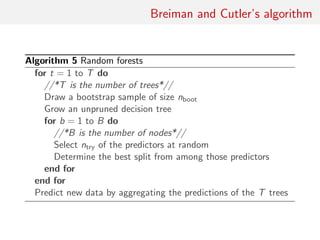
Breiman and Cutler’s algorithm
Algorithm 5 Random forests
for t = 1 to T do
//*T is the number of trees*//
Draw a bootstrap sample of size nboot
Grow an unpruned decision tree
for b = 1 to B do
//*B is the number of nodes*//
Select ntry of the predictors at random
Determine the best split from among those predictors
end for
end for
Predict new data by aggregating the predictions of the T trees
Subsampling
Due to both large datasets [practical] and theoretical
recommendation from G´erard Biau [private communication], from
independence between trees to convergence issues, boostrap
sample of much smaller size than original data size
N = o(n)
Subsampling
Due to both large datasets [practical] and theoretical
recommendation from G´erard Biau [private communication], from
independence between trees to convergence issues, boostrap
sample of much smaller size than original data size
N = o(n)
Each CART tree stops when number of observations per node is 1:
no culling of the branches
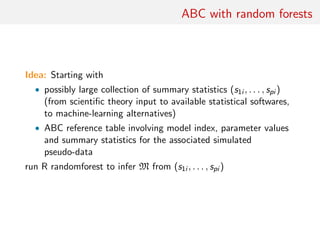
ABC with random forests
Idea: Starting with
• possibly large collection of summary statistics (s1i , . . . , spi )
(from scientific theory input to available statistical softwares,
to machine-learning alternatives)
• ABC reference table involving model index, parameter values
and summary statistics for the associated simulated
pseudo-data
run R randomforest to infer M from (s1i , . . . , spi )
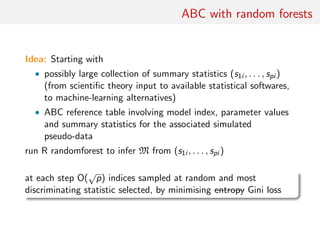
ABC with random forests
Idea: Starting with
• possibly large collection of summary statistics (s1i , . . . , spi )
(from scientific theory input to available statistical softwares,
to machine-learning alternatives)
• ABC reference table involving model index, parameter values
and summary statistics for the associated simulated
pseudo-data
run R randomforest to infer M from (s1i , . . . , spi )
at each step O(
√
p) indices sampled at random and most
discriminating statistic selected, by minimising entropy Gini loss
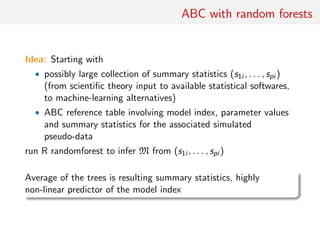
ABC with random forests
Idea: Starting with
• possibly large collection of summary statistics (s1i , . . . , spi )
(from scientific theory input to available statistical softwares,
to machine-learning alternatives)
• ABC reference table involving model index, parameter values
and summary statistics for the associated simulated
pseudo-data
run R randomforest to infer M from (s1i , . . . , spi )
Average of the trees is resulting summary statistics, highly
non-linear predictor of the model index
Outcome of ABC-RF
Random forest predicts a (MAP) model index, from the observed
dataset: The predictor provided by the forest is “sufficient” to
select the most likely model but not to derive associated posterior
probability
Outcome of ABC-RF
Random forest predicts a (MAP) model index, from the observed
dataset: The predictor provided by the forest is “sufficient” to
select the most likely model but not to derive associated posterior
probability
• exploit entire forest by computing how many trees lead to
picking each of the models under comparison but variability
too high to be trusted
• frequency of trees associated with majority model is no proper
substitute to the true posterior probability
• And usual ABC-MC approximation equally highly variable and
hard to assess
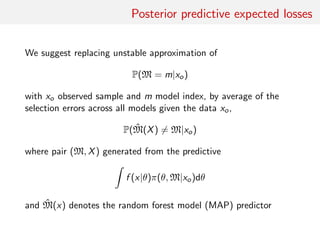
Posterior predictive expected losses
We suggest replacing unstable approximation of
P(M = m|xo)
with xo observed sample and m model index, by average of the
selection errors across all models given the data xo,
P( ˆM(X) = M|xo)
where pair (M, X) generated from the predictive
f (x|θ)π(θ, M|xo)dθ
and ˆM(x) denotes the random forest model (MAP) predictor
Posterior predictive expected losses
Arguments:
• Bayesian estimate of the posterior error
• integrates error over most likely part of the parameter space
• gives an averaged error rather than the posterior probability of
the null hypothesis
• easily computed: Given ABC subsample of parameters from
reference table, simulate pseudo-samples associated with
those and derive error frequency
toy: MA(1) vs. MA(2)
Comparing an MA(1) and an MA(2) models:
xt = t − ϑ1 t−1[−ϑ2 t−2]
Earlier illustration using first two autocorrelations as S(x)
[Marin et al., Stat. & Comp., 2011]
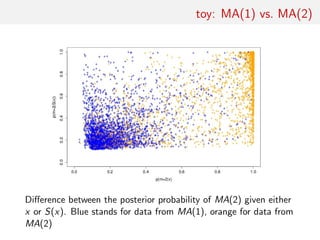
Result #1: values of p(m|x) [obtained by numerical integration]
and p(m|S(x)) [obtained by mixing ABC outcome and density
estimation] highly differ!
toy: MA(1) vs. MA(2)
Difference between the posterior probability of MA(2) given either
x or S(x). Blue stands for data from MA(1), orange for data from
MA(2)
toy: MA(1) vs. MA(2)
Comparing an MA(1) and an MA(2) models:
xt = t − ϑ1 t−1[−ϑ2 t−2]
Earlier illustration using two autocorrelations as S(x)
[Marin et al., Stat. & Comp., 2011]
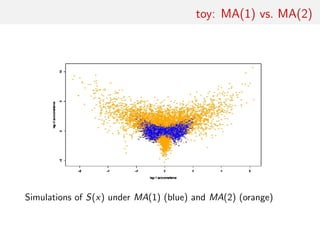
Result #2: Embedded models, with simulations from MA(1)
within those from MA(2), hence linear classification poor
toy: MA(1) vs. MA(2)
Simulations of S(x) under MA(1) (blue) and MA(2) (orange)
toy: MA(1) vs. MA(2)
Comparing an MA(1) and an MA(2) models:
xt = t − ϑ1 t−1[−ϑ2 t−2]
Earlier illustration using two autocorrelations as S(x)
[Marin et al., Stat. & Comp., 2011]
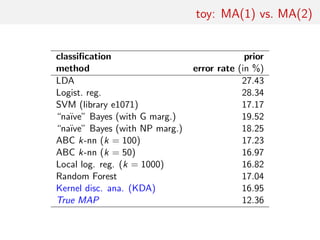
Result #3: On such a small dimension problem, random forests
should come second to k-nn ou kernel discriminant analyses
toy: MA(1) vs. MA(2)
classification prior
method error rate (in %)
LDA 27.43
Logist. reg. 28.34
SVM (library e1071) 17.17
“na¨ıve” Bayes (with G marg.) 19.52
“na¨ıve” Bayes (with NP marg.) 18.25
ABC k-nn (k = 100) 17.23
ABC k-nn (k = 50) 16.97
Local log. reg. (k = 1000) 16.82
Random Forest 17.04
Kernel disc. ana. (KDA) 16.95
True MAP 12.36
Evolution scenarios based on SNPs
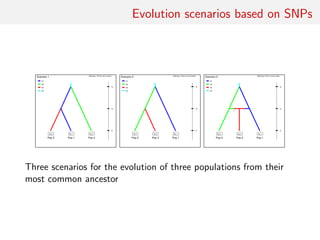
Three scenarios for the evolution of three populations from their
most common ancestor
Evolution scenarios based on SNPs
DIYBAC header (!)
7 parameters and 48 summary statistics
3 scenarios: 7 7 7
scenario 1 [0.33333] (6)
N1 N2 N3
0 sample 1
0 sample 2
0 sample 3
ta merge 1 3
ts merge 1 2
ts varne 1 N4
scenario 2 [0.33333] (6)
N1 N2 N3
..........
ts varne 1 N4
scenario 3 [0.33333] (7)
N1 N2 N3
........
historical parameters priors (7,1)
N1 N UN[100.0,30000.0,0.0,0.0]
N2 N UN[100.0,30000.0,0.0,0.0]
N3 N UN[100.0,30000.0,0.0,0.0]
ta T UN[10.0,30000.0,0.0,0.0]
ts T UN[10.0,30000.0,0.0,0.0]
N4 N UN[100.0,30000.0,0.0,0.0]
r A UN[0.05,0.95,0.0,0.0]
ts>ta
DRAW UNTIL
Evolution scenarios based on SNPs
Model 1 with 6 parameters:
• four effective sample sizes: N1 for population 1, N2 for
population 2, N3 for population 3 and, finally, N4 for the
native population;
• the time of divergence ta between populations 1 and 3;
• the time of divergence ts between populations 1 and 2.
• effective sample sizes with independent uniform priors on
[100, 30000]
• vector of divergence times (ta, ts) with uniform prior on
{(a, s) ∈ [10, 30000] ⊗ [10, 30000]|a < s}
Evolution scenarios based on SNPs
Model 2 with same parameters as model 1 but the divergence time
ta corresponds to a divergence between populations 2 and 3; prior
distributions identical to those of model 1
Model 3 with extra seventh parameter, admixture rate r. For that
scenario, at time ta admixture between populations 1 and 2 from
which population 3 emerges. Prior distribution on r uniform on
[0.05, 0.95]. In that case models 1 and 2 are not embeddeded in
model 3. Prior distributions for other parameters the same as in
model 1
Evolution scenarios based on SNPs
Set of 48 summary statistics:
Single sample statistics
• proportion of loci with null gene diversity (= proportion of monomorphic
loci)
• mean gene diversity across polymorphic loci
[Nei, 1987]
• variance of gene diversity across polymorphic loci
• mean gene diversity across all loci
Evolution scenarios based on SNPs
Set of 48 summary statistics:
Two sample statistics
• proportion of loci with null FST distance between both samples
[Weir and Cockerham, 1984]
• mean across loci of non null FST distances between both samples
• variance across loci of non null FST distances between both samples
• mean across loci of FST distances between both samples
• proportion of 1 loci with null Nei’s distance between both samples
[Nei, 1972]
• mean across loci of non null Nei’s distances between both samples
• variance across loci of non null Nei’s distances between both samples
• mean across loci of Nei’s distances between the two samples
Evolution scenarios based on SNPs
Set of 48 summary statistics:
Three sample statistics
• proportion of loci with null admixture estimate
• mean across loci of non null admixture estimate
• variance across loci of non null admixture estimated
• mean across all locus admixture estimates
Evolution scenarios based on SNPs
For a sample of 1000 SNIPs measured on 25 biallelic individuals
per population, learning ABC reference table with 20, 000
simulations, prior predictive error rates:
• “na¨ıve Bayes” classifier 33.3%
• raw LDA classifier 23.27%
• ABC k-nn [Euclidean dist. on summaries normalised by MAD]
25.93%
• ABC k-nn [unnormalised Euclidean dist. on LDA components]
22.12%
• local logistic classifier based on LDA components with
• k = 500 neighbours 22.61%
• random forest on summaries 21.03%
(Error rates computed on a prior sample of size 104)
Evolution scenarios based on SNPs
For a sample of 1000 SNIPs measured on 25 biallelic individuals
per population, learning ABC reference table with 20, 000
simulations, prior predictive error rates:
• “na¨ıve Bayes” classifier 33.3%
• raw LDA classifier 23.27%
• ABC k-nn [Euclidean dist. on summaries normalised by MAD]
25.93%
• ABC k-nn [unnormalised Euclidean dist. on LDA components]
22.12%
• local logistic classifier based on LDA components with
• k = 1000 neighbours 22.46%
• random forest on summaries 21.03%
(Error rates computed on a prior sample of size 104)
Evolution scenarios based on SNPs
For a sample of 1000 SNIPs measured on 25 biallelic individuals
per population, learning ABC reference table with 20, 000
simulations, prior predictive error rates:
• “na¨ıve Bayes” classifier 33.3%
• raw LDA classifier 23.27%
• ABC k-nn [Euclidean dist. on summaries normalised by MAD]
25.93%
• ABC k-nn [unnormalised Euclidean dist. on LDA components]
22.12%
• local logistic classifier based on LDA components with
• k = 5000 neighbours 22.43%
• random forest on summaries 21.03%
(Error rates computed on a prior sample of size 104)
Evolution scenarios based on SNPs
For a sample of 1000 SNIPs measured on 25 biallelic individuals
per population, learning ABC reference table with 20, 000
simulations, prior predictive error rates:
• “na¨ıve Bayes” classifier 33.3%
• raw LDA classifier 23.27%
• ABC k-nn [Euclidean dist. on summaries normalised by MAD]
25.93%
• ABC k-nn [unnormalised Euclidean dist. on LDA components]
22.12%
• local logistic classifier based on LDA components with
• k = 5000 neighbours 22.43%
• random forest on LDA components only 23.1%
(Error rates computed on a prior sample of size 104)
Evolution scenarios based on SNPs
For a sample of 1000 SNIPs measured on 25 biallelic individuals
per population, learning ABC reference table with 20, 000
simulations, prior predictive error rates:
• “na¨ıve Bayes” classifier 33.3%
• raw LDA classifier 23.27%
• ABC k-nn [Euclidean dist. on summaries normalised by MAD]
25.93%
• ABC k-nn [unnormalised Euclidean dist. on LDA components]
22.12%
• local logistic classifier based on LDA components with
• k = 5000 neighbours 22.43%
• random forest on summaries and LDA components 19.03%
(Error rates computed on a prior sample of size 104)
Evolution scenarios based on SNPs
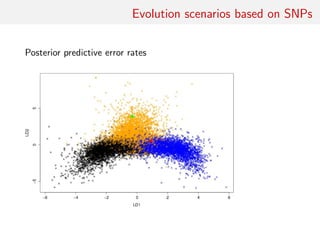
Posterior predictive error rates
Evolution scenarios based on SNPs
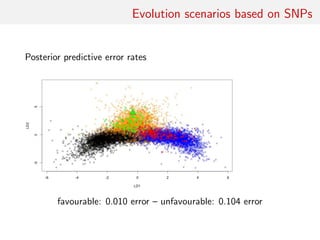
Posterior predictive error rates
favourable: 0.010 error – unfavourable: 0.104 error
Evolution scenarios based on microsatellites
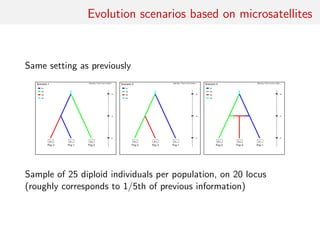
Same setting as previously
Sample of 25 diploid individuals per population, on 20 locus
(roughly corresponds to 1/5th of previous information)
Evolution scenarios based on microsatellites
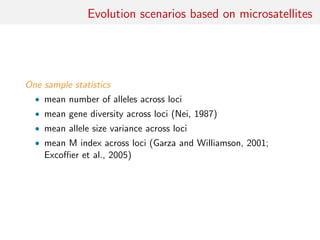
One sample statistics
• mean number of alleles across loci
• mean gene diversity across loci (Nei, 1987)
• mean allele size variance across loci
• mean M index across loci (Garza and Williamson, 2001;
Excoffier et al., 2005)
Evolution scenarios based on microsatellites
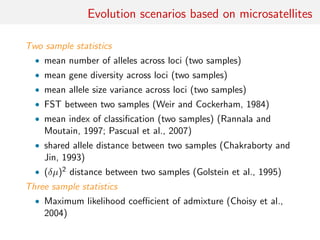
Two sample statistics
• mean number of alleles across loci (two samples)
• mean gene diversity across loci (two samples)
• mean allele size variance across loci (two samples)
• FST between two samples (Weir and Cockerham, 1984)
• mean index of classification (two samples) (Rannala and
Moutain, 1997; Pascual et al., 2007)
• shared allele distance between two samples (Chakraborty and
Jin, 1993)
• (δµ)2 distance between two samples (Golstein et al., 1995)
Three sample statistics
• Maximum likelihood coefficient of admixture (Choisy et al.,
2004)
Evolution scenarios based on microsatellites
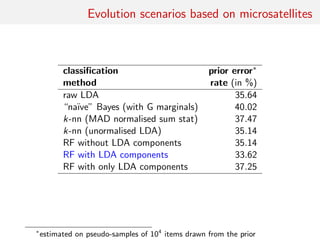
classification prior error∗
method rate (in %)
raw LDA 35.64
“na¨ıve” Bayes (with G marginals) 40.02
k-nn (MAD normalised sum stat) 37.47
k-nn (unormalised LDA) 35.14
RF without LDA components 35.14
RF with LDA components 33.62
RF with only LDA components 37.25
∗
estimated on pseudo-samples of 104
items drawn from the prior
Evolution scenarios based on microsatellites
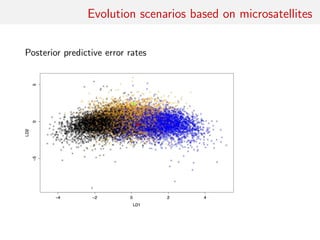
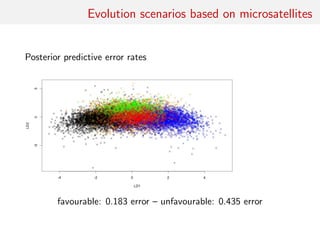
Posterior predictive error rates
Evolution scenarios based on microsatellites
Posterior predictive error rates
favourable: 0.183 error – unfavourable: 0.435 error
Back to Asian Ladybirds [message in a beetle]
Comparing 10 scenarios of Asian beetle invasion beetle moves
Back to Asian Ladybirds [message in a beetle]
Comparing 10 scenarios of Asian beetle invasion beetle moves
classification prior error†
method rate (in %)
raw LDA 38.94
“na¨ıve” Bayes (with G margins) 54.02
k-nn (MAD normalised sum stat) 58.47
RF without LDA components 38.84
RF with LDA components 35.32
†
estimated on pseudo-samples of 104
items drawn from the prior
Back to Asian Ladybirds [message in a beetle]
Comparing 10 scenarios of Asian beetle invasion beetle moves
Random forest allocation frequencies
1 2 3 4 5 6 7 8 9 10
0.168 0.1 0.008 0.066 0.296 0.016 0.092 0.04 0.014 0.2
Posterior predictive error based on 20,000 prior simulations and
keeping 500 neighbours (or 100 neighbours and 10 pseudo-datasets
per parameter)
0.3682
Back to Asian Ladybirds [message in a beetle]
Comparing 10 scenarios of Asian beetle invasion
Back to Asian Ladybirds [message in a beetle]
Comparing 10 scenarios of Asian beetle invasion
Back to Asian Ladybirds [message in a beetle]
Comparing 10 scenarios of Asian beetle invasion
0 500 1000 1500 2000
0.400.450.500.550.600.65
k
error
posterior predictive error 0.368
conclusion on random forests
• unlimited aggregation of arbitrary summary statistics
• recovery of discriminant statistics when available
• automated implementation with reduced calibration
• self-evaluation by posterior predictive error
• soon to appear in DIYABC
ABC estimation via random forests
1 simulation-based methods in
Econometrics
2 Genetics of ABC
3 Approximate Bayesian computation
4 ABC for model choice
5 ABC model choice via random forests
6 ABC estimation via random forests
7 [some] asymptotics of ABC
Two basic issues with ABC
ABC compares numerous simulated dataset to the observed one
Two major difficulties:
• to decrease approximation error (or tolerance ) and hence
ensure reliability of ABC, total number of simulations very
large;
• calibration of ABC (tolerance, distance, summary statistics,
post-processing, &tc) critical and hard to automatise
classification of summaries by random forests
Given a large collection of summary statistics, rather than selecting
a subset and excluding the others, estimate each parameter of
interest by a machine learning tool like random forests
• RF can handle thousands of predictors
• ignore useless components
• fast estimation method with good local properties
• automatised method with few calibration steps
• substitute to Fearnhead and Prangle (2012) preliminary
estimation of ˆθ(yobs)
• includes a natural (classification) distance measure that avoids
choice of both distance and tolerance
[Marin et al., 2016]
random forests as non-parametric regression
CART means Classification and Regression Trees
For regression purposes, i.e., to predict y as f (x), similar binary
trees in random forests
1 at each tree node, split data into two daughter nodes
2 split variable and bound chosen to minimise heterogeneity
criterion
3 stop splitting when enough homogeneity in current branch
4 predicted values at terminal nodes (or leaves) are average
response variable y for all observations in final leaf
Illustration
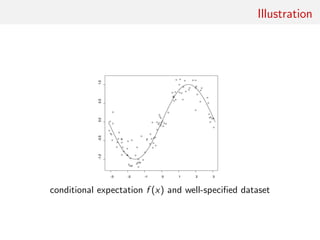
conditional expectation f (x) and well-specified dataset
Illustration
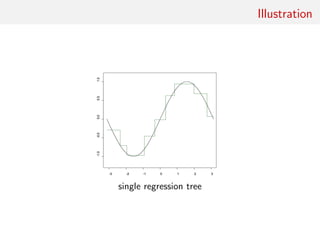
single regression tree
Illustration
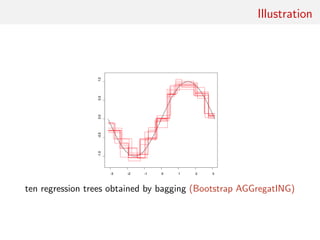
ten regression trees obtained by bagging (Bootstrap AGGregatING)
Illustration
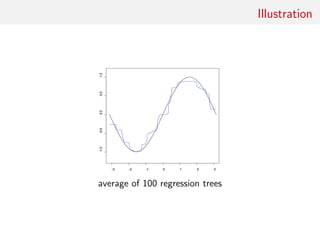
average of 100 regression trees
bagging reduces learning variance
When growing forest with many trees,
• grow each tree on an independent bootstrap sample
• at each node, select m variables at random out of all M
possible variables
• Find the best dichotomous split on the selected m variables
• predictor function estimated by averaging trees
bagging reduces learning variance
When growing forest with many trees,
• grow each tree on an independent bootstrap sample
• at each node, select m variables at random out of all M
possible variables
• Find the best dichotomous split on the selected m variables
• predictor function estimated by averaging trees
Improve on CART with respect to accuracy and stability
prediction error
A given simulation (ysim, xsim) in the training table is not used in
about 1/3 of the trees (“out-of-bag” case)
Average predictions ˆFoob(xsim) of these trees to give out-of-bag
predictor of ysim
Related methods
• adjusted local linear: Beaumont et al. (2002) Approximate Bayesian
computation in population genetics, Genetics
• ridge regression: Blum et al. (2013) A Comparative Review of
Dimension Reduction Methods in Approximate Bayesian Computation,
Statistical Science
• linear discriminant analysis: Estoup et al. (2012) Estimation of
demo-genetic model probabilities with Approximate Bayesian
Computation using linear discriminant analysis on summary statistics,
Molecular Ecology Resources
• adjusted neural networks: Blum and Fran¸cois (2010) Non-linear
regression models for Approximate Bayesian Computation, Statistics and
Computing
ABC parameter estimation (ODOF)
One dimension = one forest (ODOF) methodology
ABC parameter estimation (ODOF)
One dimension = one forest (ODOF) methodology
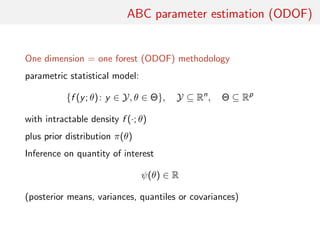
parametric statistical model:
{f (y; θ): y ∈ Y, θ ∈ Θ}, Y ⊆ Rn
, Θ ⊆ Rp
with intractable density f (·; θ)
plus prior distribution π(θ)
Inference on quantity of interest
ψ(θ) ∈ R
(posterior means, variances, quantiles or covariances)
common reference table
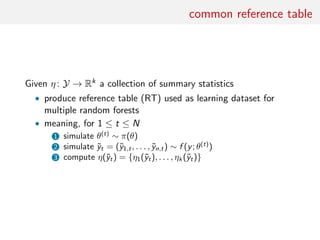
Given η: Y → Rk a collection of summary statistics
• produce reference table (RT) used as learning dataset for
multiple random forests
• meaning, for 1 ≤ t ≤ N
1 simulate θ(t)
∼ π(θ)
2 simulate ˜yt = (˜y1,t, . . . , ˜yn,t) ∼ f (y; θ(t)
)
3 compute η(˜yt) = {η1(˜yt), . . . , ηk (˜yt)}
ABC posterior expectations
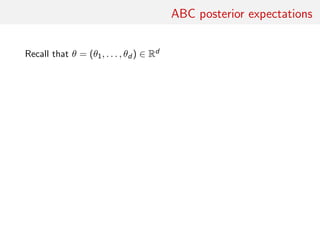
Recall that θ = (θ1, . . . , θd ) ∈ Rd
ABC posterior expectations
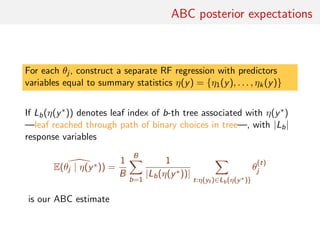
For each θj , construct a separate RF regression with predictors
variables equal to summary statistics η(y) = {η1(y), . . . , ηk(y)}
If Lb(η(y∗)) denotes leaf index of b-th tree associated with η(y∗)
—leaf reached through path of binary choices in tree—, with |Lb|
response variables
E(θj | η(y∗)) =
1
B
B
b=1
1
|Lb(η(y∗))|
t:η(yt )∈Lb(η(y∗))
θ
(t)
j
is our ABC estimate
ABC posterior quantile estimate
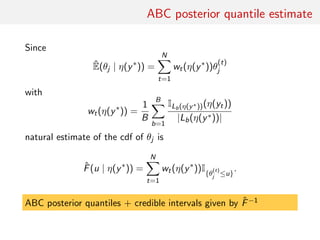
Random forests also available for quantile regression
[Meinshausen, 2006, JMLR]
Since
ˆE(θj | η(y∗
)) =
N
t=1
wt(η(y∗
))θ
(t)
j
with
wt(η(y∗
)) =
1
B
B
b=1
ILb(η(y∗))(η(yt))
|Lb(η(y∗))|
natural estimate of the cdf of θj is
ˆF(u | η(y∗
)) =
N
t=1
wt(η(y∗
))I{θ
(t)
j ≤u}
.
ABC posterior quantile estimate
Since
ˆE(θj | η(y∗
)) =
N
t=1
wt(η(y∗
))θ
(t)
j
with
wt(η(y∗
)) =
1
B
B
b=1
ILb(η(y∗))(η(yt))
|Lb(η(y∗))|
natural estimate of the cdf of θj is
ˆF(u | η(y∗
)) =
N
t=1
wt(η(y∗
))I{θ
(t)
j ≤u}
.
ABC posterior quantiles + credible intervals given by ˆF−1
ABC variances
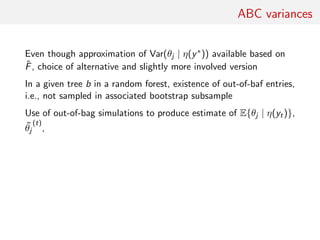
Even though approximation of Var(θj | η(y∗)) available based on
ˆF, choice of alternative and slightly more involved version
In a given tree b in a random forest, existence of out-of-baf entries,
i.e., not sampled in associated bootstrap subsample
Use of out-of-bag simulations to produce estimate of E{θj | η(yt)},
˜θj
(t)
,
ABC variances
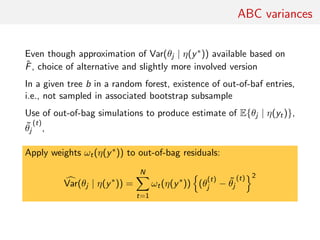
Even though approximation of Var(θj | η(y∗)) available based on
ˆF, choice of alternative and slightly more involved version
In a given tree b in a random forest, existence of out-of-baf entries,
i.e., not sampled in associated bootstrap subsample
Use of out-of-bag simulations to produce estimate of E{θj | η(yt)},
˜θj
(t)
,
Apply weights ωt(η(y∗)) to out-of-bag residuals:
Var(θj | η(y∗
)) =
N
t=1
ωt(η(y∗
)) (θ
(t)
j − ˜θj
(t) 2
ABC covariances
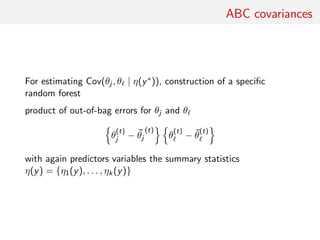
For estimating Cov(θj , θ | η(y∗)), construction of a specific
random forest
product of out-of-bag errors for θj and θ
θ
(t)
j − ˜θj
(t)
θ
(t)
− ˜θ
(t)
with again predictors variables the summary statistics
η(y) = {η1(y), . . . , ηk(y)}
Gaussian toy example
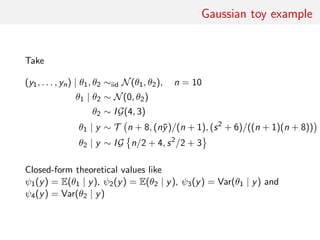
Take
(y1, . . . , yn) | θ1, θ2 ∼iid N(θ1, θ2), n = 10
θ1 | θ2 ∼ N(0, θ2)
θ2 ∼ IG(4, 3)
θ1 | y ∼ T n + 8, (n¯y)/(n + 1), (s2
+ 6)/((n + 1)(n + 8))
θ2 | y ∼ IG n/2 + 4, s2
/2 + 3
Closed-form theoretical values like
ψ1(y) = E(θ1 | y), ψ2(y) = E(θ2 | y), ψ3(y) = Var(θ1 | y) and
ψ4(y) = Var(θ2 | y)
Gaussian toy example
Reference table of N = 10, 000 Gaussian replicates
Independent Gaussian test set of size Npred = 100
k = 53 summary statistics: the sample mean, the sample
variance and the sample median absolute deviation, and 50
independent pure-noise variables (uniform [0,1])
Gaussian toy example
−2 −1 0 1 2
−2−1012
ψ1
ψ~
1
0.5 1.0 1.5 2.0 2.5
0.51.01.52.02.5
ψ2
ψ~
2
0.05 0.10 0.15 0.20 0.25 0.30 0.35
0.050.150.250.35
ψ3
ψ~
3
0.0 0.2 0.4 0.6 0.80.00.20.40.60.8
ψ4
ψ~
4
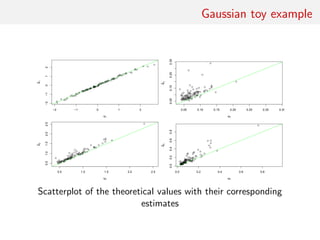
Scatterplot of the theoretical values with their corresponding
estimates
Gaussian toy example
−4 −3 −2 −1 0 1 2
−4−3−2−1012
Q0.025(θ1 | y)
Q
~
0.025(θ1|y)
−1 0 1 2 3 4
−101234
Q0.975(θ1 | y)
Q
~
0.975(θ1|y)
0.2 0.4 0.6 0.8 1.0 1.2
0.20.40.60.81.01.2
Q0.025(θ2 | y)
Q
~
0.025(θ2|y)
1 2 3 4 512345
Q0.975(θ2 | y)
Q
~
0.975(θ2|y)
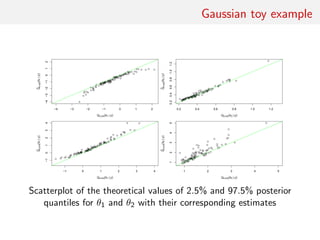
Scatterplot of the theoretical values of 2.5% and 97.5% posterior
quantiles for θ1 and θ2 with their corresponding estimates
Gaussian toy example
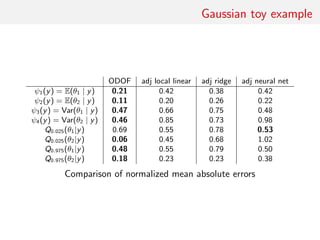
ODOF adj local linear adj ridge adj neural net
ψ1(y) = E(θ1 | y) 0.21 0.42 0.38 0.42
ψ2(y) = E(θ2 | y) 0.11 0.20 0.26 0.22
ψ3(y) = Var(θ1 | y) 0.47 0.66 0.75 0.48
ψ4(y) = Var(θ2 | y) 0.46 0.85 0.73 0.98
Q0.025(θ1|y) 0.69 0.55 0.78 0.53
Q0.025(θ2|y) 0.06 0.45 0.68 1.02
Q0.975(θ1|y) 0.48 0.55 0.79 0.50
Q0.975(θ2|y) 0.18 0.23 0.23 0.38
Comparison of normalized mean absolute errors
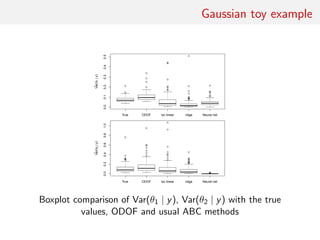
Gaussian toy example
True ODOF loc linear ridge Neural net
0.00.10.20.30.40.5
Var
~
(θ1|y)
True ODOF loc linear ridge Neural net
0.00.20.40.60.81.0
Var
~
(θ2|y)
Boxplot comparison of Var(θ1 | y), Var(θ2 | y) with the true
values, ODOF and usual ABC methods
Comments
ABC RF methods mostly insensitive both to strong correlations
between the summary statistics and to the presence of noisy
variables.
implies less number of simulations and no calibration
Next steps: adaptive schemes, deep learning, inclusion in DIYABC
[some] asymptotics of ABC
1 simulation-based methods in
Econometrics
2 Genetics of ABC
3 Approximate Bayesian computation
4 ABC for model choice
5 ABC model choice via random forests
6 ABC estimation via random forests
7 [some] asymptotics of ABC
consistency of ABC posteriors
Asymptotic study of the ABC-posterior z = z(n)
• ABC posterior consistency and convergence rate (in n)
• Asymptotic shape of π (·|y(n))
• Asymptotic behaviour of ˆθ = EABC[θ|y(n)]
[Frazier et al., 2016]
consistency of ABC posteriors
• Concentration around true value and Bayesian consistency less
stringent conditions on the convergence speed of tolerance n
to zero, when compared with asymptotic normality of ABC
posterior
• asymptotic normality of ABC posterior mean does not require
asymptotic normality of ABC posterior
ABC posterior consistency
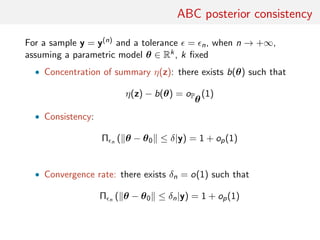
For a sample y = y(n) and a tolerance = n, when n → +∞,
assuming a parametric model θ ∈ Rk, k fixed
• Concentration of summary η(z): there exists b(θ) such that
η(z) − b(θ) = oP
θ
(1)
• Consistency:
Π n ( θ − θ0 ≤ δ|y) = 1 + op(1)
• Convergence rate: there exists δn = o(1) such that
Π n ( θ − θ0 ≤ δn|y) = 1 + op(1)
Related results
existing studies on the large sample properties of ABC, in which
the asymptotic properties of point estimators derived from ABC
have been the primary focus
[Creel et al., 2015; Jasra, 2015; Li & Fearnhead, 2015]
Convergence when n σn
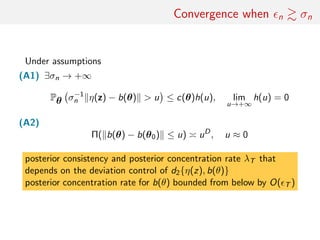
Under assumptions
(A1) ∃σn → +∞
Pθ σ−1
n η(z) − b(θ) > u ≤ c(θ)h(u), lim
u→+∞
h(u) = 0
(A2)
Π( b(θ) − b(θ0) ≤ u) uD
, u ≈ 0
posterior consistency and posterior concentration rate λT that
depends on the deviation control of d2{η(z), b(θ)}
posterior concentration rate for b(θ) bounded from below by O( T )
Convergence when n σn
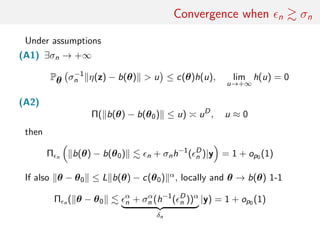
Under assumptions
(A1) ∃σn → +∞
Pθ σ−1
n η(z) − b(θ) > u ≤ c(θ)h(u), lim
u→+∞
h(u) = 0
(A2)
Π( b(θ) − b(θ0) ≤ u) uD
, u ≈ 0
then
Π n b(θ) − b(θ0) n + σnh−1
( D
n )|y = 1 + op0 (1)
If also θ − θ0 ≤ L b(θ) − c(θ0) α, locally and θ → b(θ) 1-1
Π n ( θ − θ0
α
n + σα
n (h−1
( D
n ))α
δn
|y) = 1 + op0 (1)
Comments
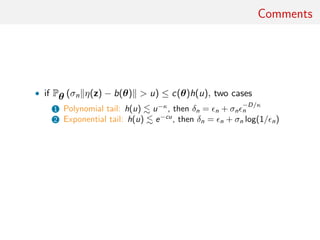
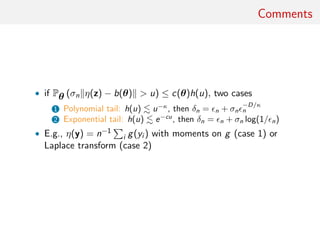
• if Pθ (σn η(z) − b(θ) > u) ≤ c(θ)h(u), two cases
1 Polynomial tail: h(u) u−κ
, then δn = n + σn
−D/κ
n
2 Exponential tail: h(u) e−cu
, then δn = n + σn log(1/ n)
Comments
• if Pθ (σn η(z) − b(θ) > u) ≤ c(θ)h(u), two cases
1 Polynomial tail: h(u) u−κ
, then δn = n + σn
−D/κ
n
2 Exponential tail: h(u) e−cu
, then δn = n + σn log(1/ n)
• E.g., η(y) = n−1
i g(yi ) with moments on g (case 1) or
Laplace transform (case 2)
Comments
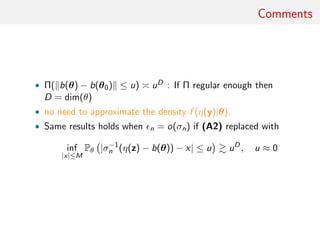
• Π( b(θ) − b(θ0) ≤ u) uD : If Π regular enough then
D = dim(θ)
• no need to approximate the density f (η(y)|θ).
• Same results holds when n = o(σn) if (A2) replaced with
inf
|x|≤M
Pθ |σ−1
n (η(z) − b(θ)) − x| ≤ u uD
, u ≈ 0
proof
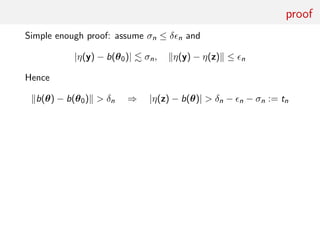
Simple enough proof: assume σn ≤ δ n and
|η(y) − b(θ0)| σn, η(y) − η(z) ≤ n
Hence
b(θ) − b(θ0) > δn ⇒ |η(z) − b(θ)| > δn − n − σn := tn
proof
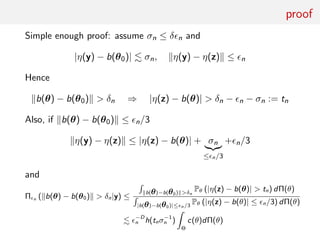
Simple enough proof: assume σn ≤ δ n and
|η(y) − b(θ0)| σn, η(y) − η(z) ≤ n
Hence
b(θ) − b(θ0) > δn ⇒ |η(z) − b(θ)| > δn − n − σn := tn
Also, if b(θ) − b(θ0) ≤ n/3
η(y) − η(z) ≤ |η(z) − b(θ)| + σn
≤ n/3
+ n/3
and
Π n ( b(θ) − b(θ0) > δn|y) ≤
b(θ)−b(θ0) >δn
Pθ (|η(z) − b(θ)| > tn) dΠ(θ)
|b(θ)−b(θ0)|≤ n/3
Pθ (|η(z) − b(θ)| ≤ n/3) dΠ(θ)
−D
n h(tnσ−1
n )
Θ
c(θ)dΠ(θ)
Summary statistic and (in)consistency
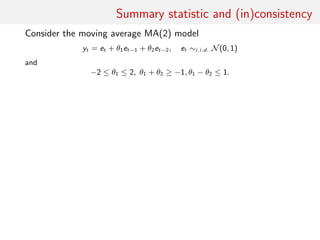
Consider the moving average MA(2) model
yt = et + θ1et−1 + θ2et−2, et ∼i.i.d. N(0, 1)
and
−2 ≤ θ1 ≤ 2, θ1 + θ2 ≥ −1, θ1 − θ2 ≤ 1.
Summary statistic and (in)consistency
Consider the moving average MA(2) model
yt = et + θ1et−1 + θ2et−2, et ∼i.i.d. N(0, 1)
and
−2 ≤ θ1 ≤ 2, θ1 + θ2 ≥ −1, θ1 − θ2 ≤ 1.
summary statistics equal to sample autocovariances
ηj (y) = T−1
T
t=1+j
yt yt−j j = 0, 1
with
η0(y)
P
→ E[y2
t ] = 1 + (θ01)2
+ (θ02)2
and η1(y)
P
→ E[yt yt−1] = θ01(1 + θ02)
For ABC target pε (θ|η(y)) to be degenerate at θ0
0 = b(θ0) − b (θ) =
1 + (θ01)2
+ (θ02)2
θ01(1 + θ02)
−
1 + (θ1)2
+ (θ2)2
θ1(1 + θ2)
must have unique solution θ = θ0
Take θ01 = .6, θ02 = .2: equation has 2 solutions
θ1 = .6, θ2 = .2 and θ1 ≈ .5453, θ2 ≈ .3204
Asymptotic shape of posterior distribution
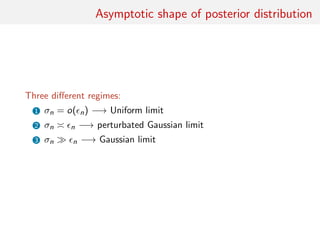
Three different regimes:
1 σn = o( n) −→ Uniform limit
2 σn n −→ perturbated Gaussian limit
3 σn n −→ Gaussian limit
Assumptions
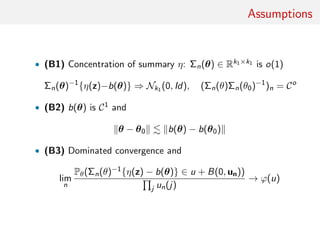
• (B1) Concentration of summary η: Σn(θ) ∈ Rk1×k1 is o(1)
Σn(θ)−1
{η(z)−b(θ)} ⇒ Nk1 (0, Id), (Σn(θ)Σn(θ0)−1
)n = Co
• (B2) b(θ) is C1 and
θ − θ0 b(θ) − b(θ0)
• (B3) Dominated convergence and
lim
n
Pθ(Σn(θ)−1{η(z) − b(θ)} ∈ u + B(0, un))
j un(j)
→ ϕ(u)
main result
Set Σn(θ) = σnD(θ) for θ ≈ θ0 and Zo = Σn(θ0)−1(η(y) − θ0),
then under (B1) and (B2)
• when nσ−1
n → +∞
Π n [ −1
n (θ − θ0) ∈ A|y] ⇒ UB0 (A), B0 = {x ∈ Rk
; b (θ0)T
x ≤ 1}
• when nσ−1
n → c
Π n [Σn(θ0)−1
(θ − θ0) − Zo
∈ A|y] ⇒ Qc(A), Qc = N
• when nσ−1
n → 0 and (B3) holds, set
Vn = [b (θ0)]T
Σn(θ0)b (θ0)
then
Π n [V −1
n (θ − θ0) − ˜Zo
∈ A|y] ⇒ Φ(A),
intuition
Set x(θ) = σ−1
n (θ − θ0) − Zo (k = 1)
πn := Π n [ −1
n (θ − θ0) ∈ A|y]
=
|θ−θ0|≤un
1lx(θ)∈A
Pθ σ−1
n (η(z) − b(θ)) + x(θ) ≤ σ−1
n n p(θ)dθ
|θ−θ0|≤un
Pθ σ−1
n (η(z) − b(θ)) + x(θ) ≤ σ−1
n n p(θ)dθ
+ op(1)
• If n/σn 1 :
Pθ |σ−1
n (η(z) − b(θ)) + x(θ)| ≤ σ−1
n n = 1+o(1), iff |x| ≤ σ−1
n
• If n/σn = o(1)
Pθ |σ−1
n (η(z) − b(θ)) + x| ≤ σ−1
n n = φ(x)σn(1 + o(1))
more comments
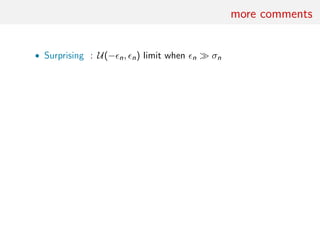
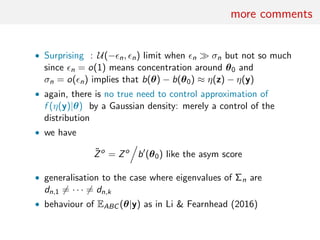
• Surprising : U(− n, n) limit when n σn
more comments
• Surprising : U(− n, n) limit when n σn but not so much
since n = o(1) means concentration around θ0 and
σn = o( n) implies that b(θ) − b(θ0) ≈ η(z) − η(y)
• again, there is no true need to control approximation of
f (η(y)|θ) by a Gaussian density: merely a control of the
distribution
• we have
˜Zo
= Zo
b (θ0) like the asym score
• generalisation to the case where eigenvalues of Σn are
dn,1 = · · · = dn,k
• behaviour of EABC (θ|y) as in Li & Fearnhead (2016)
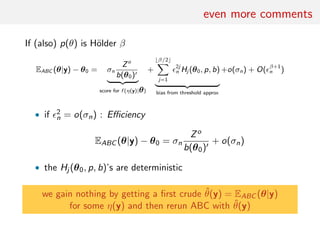
even more comments
If (also) p(θ) is H¨older β
EABC (θ|y) − θ0 = σn
Zo
b(θ0)
score for f (η(y)|θ)
+
β/2
j=1
2j
n Hj (θ0, p, b)
bias from threshold approx
+o(σn) + O( β+1
n )
• if 2
n = o(σn) : Efficiency
EABC (θ|y) − θ0 = σn
Zo
b(θ0)
+ o(σn)
• the Hj (θ0, p, b)’s are deterministic
we gain nothing by getting a first crude ˆθ(y) = EABC (θ|y)
for some η(y) and then rerun ABC with ˆθ(y)
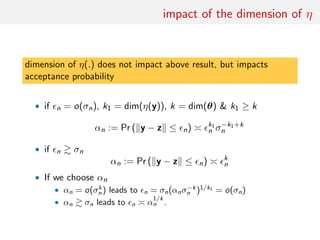
impact of the dimension of η
dimension of η(.) does not impact above result, but impacts
acceptance probability
• if n = o(σn), k1 = dim(η(y)), k = dim(θ) & k1 ≥ k
αn := Pr ( y − z ≤ n) k1
n σ−k1+k
n
• if n σn
αn := Pr ( y − z ≤ n) k
n
• If we choose αn
• αn = o(σk
n ) leads to n = σn(αnσ−k
n )1/k1
= o(σn)
• αn σn leads to n α
1/k
n .
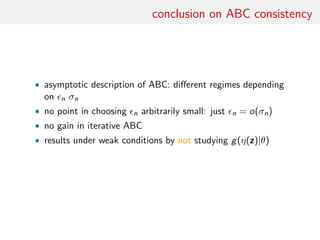
conclusion on ABC consistency
• asymptotic description of ABC: different regimes depending
on n σn
• no point in choosing n arbitrarily small: just n = o(σn)
• no gain in iterative ABC
• results under weak conditions by not studying g(η(z)|θ)
conclusion on ABC consistency
• asymptotic description of ABC: different regimes depending
on n σn
• no point in choosing n arbitrarily small: just n = o(σn)
• no gain in iterative ABC
• results under weak conditions by not studying g(η(z)|θ)
the end

ABC short course: final chapters

  • 1.
    ABC model choicevia random forests 1 simulation-based methods in Econometrics 2 Genetics of ABC 3 Approximate Bayesian computation 4 ABC for model choice 5 ABC model choice via random forests Random forests ABC with random forests Illustrations 6 ABC estimation via random forests 7 [some] asymptotics of ABC
  • 2.
    Leaning towards machinelearning Main notions: • ABC-MC seen as learning about which model is most appropriate from a huge (reference) table • exploiting a large number of summary statistics not an issue for machine learning methods intended to estimate efficient combinations • abandoning (temporarily?) the idea of estimating posterior probabilities of the models, poorly approximated by machine learning methods, and replacing those by posterior predictive expected loss [Cornuet et al., 2014, in progress]
  • 3.
    Random forests Technique thatstemmed from Leo Breiman’s bagging (or bootstrap aggregating) machine learning algorithm for both classification and regression [Breiman, 1996] Improved classification performances by averaging over classification schemes of randomly generated training sets, creating a “forest” of (CART) decision trees, inspired by Amit and Geman (1997) ensemble learning [Breiman, 2001]
  • 4.
    Growing the forest Breiman’ssolution for inducing random features in the trees of the forest: • boostrap resampling of the dataset and • random subset-ing [of size √ t] of the covariates driving the classification at every node of each tree Covariate xτ that drives the node separation xτ cτ and the separation bound cτ chosen by minimising entropy or Gini index
  • 5.
    Breiman and Cutler’salgorithm Algorithm 5 Random forests for t = 1 to T do //*T is the number of trees*// Draw a bootstrap sample of size nboot Grow an unpruned decision tree for b = 1 to B do //*B is the number of nodes*// Select ntry of the predictors at random Determine the best split from among those predictors end for end for Predict new data by aggregating the predictions of the T trees
  • 6.
    Subsampling Due to bothlarge datasets [practical] and theoretical recommendation from G´erard Biau [private communication], from independence between trees to convergence issues, boostrap sample of much smaller size than original data size N = o(n)
  • 7.
    Subsampling Due to bothlarge datasets [practical] and theoretical recommendation from G´erard Biau [private communication], from independence between trees to convergence issues, boostrap sample of much smaller size than original data size N = o(n) Each CART tree stops when number of observations per node is 1: no culling of the branches
  • 8.
    ABC with randomforests Idea: Starting with • possibly large collection of summary statistics (s1i , . . . , spi ) (from scientific theory input to available statistical softwares, to machine-learning alternatives) • ABC reference table involving model index, parameter values and summary statistics for the associated simulated pseudo-data run R randomforest to infer M from (s1i , . . . , spi )
  • 9.
    ABC with randomforests Idea: Starting with • possibly large collection of summary statistics (s1i , . . . , spi ) (from scientific theory input to available statistical softwares, to machine-learning alternatives) • ABC reference table involving model index, parameter values and summary statistics for the associated simulated pseudo-data run R randomforest to infer M from (s1i , . . . , spi ) at each step O( √ p) indices sampled at random and most discriminating statistic selected, by minimising entropy Gini loss
  • 10.
    ABC with randomforests Idea: Starting with • possibly large collection of summary statistics (s1i , . . . , spi ) (from scientific theory input to available statistical softwares, to machine-learning alternatives) • ABC reference table involving model index, parameter values and summary statistics for the associated simulated pseudo-data run R randomforest to infer M from (s1i , . . . , spi ) Average of the trees is resulting summary statistics, highly non-linear predictor of the model index
  • 11.
    Outcome of ABC-RF Randomforest predicts a (MAP) model index, from the observed dataset: The predictor provided by the forest is “sufficient” to select the most likely model but not to derive associated posterior probability
  • 12.
    Outcome of ABC-RF Randomforest predicts a (MAP) model index, from the observed dataset: The predictor provided by the forest is “sufficient” to select the most likely model but not to derive associated posterior probability • exploit entire forest by computing how many trees lead to picking each of the models under comparison but variability too high to be trusted • frequency of trees associated with majority model is no proper substitute to the true posterior probability • And usual ABC-MC approximation equally highly variable and hard to assess
  • 13.
    Posterior predictive expectedlosses We suggest replacing unstable approximation of P(M = m|xo) with xo observed sample and m model index, by average of the selection errors across all models given the data xo, P( ˆM(X) = M|xo) where pair (M, X) generated from the predictive f (x|θ)π(θ, M|xo)dθ and ˆM(x) denotes the random forest model (MAP) predictor
  • 14.
    Posterior predictive expectedlosses Arguments: • Bayesian estimate of the posterior error • integrates error over most likely part of the parameter space • gives an averaged error rather than the posterior probability of the null hypothesis • easily computed: Given ABC subsample of parameters from reference table, simulate pseudo-samples associated with those and derive error frequency
  • 15.
    toy: MA(1) vs.MA(2) Comparing an MA(1) and an MA(2) models: xt = t − ϑ1 t−1[−ϑ2 t−2] Earlier illustration using first two autocorrelations as S(x) [Marin et al., Stat. & Comp., 2011] Result #1: values of p(m|x) [obtained by numerical integration] and p(m|S(x)) [obtained by mixing ABC outcome and density estimation] highly differ!
  • 16.
    toy: MA(1) vs.MA(2) Difference between the posterior probability of MA(2) given either x or S(x). Blue stands for data from MA(1), orange for data from MA(2)
  • 17.
    toy: MA(1) vs.MA(2) Comparing an MA(1) and an MA(2) models: xt = t − ϑ1 t−1[−ϑ2 t−2] Earlier illustration using two autocorrelations as S(x) [Marin et al., Stat. & Comp., 2011] Result #2: Embedded models, with simulations from MA(1) within those from MA(2), hence linear classification poor
  • 18.
    toy: MA(1) vs.MA(2) Simulations of S(x) under MA(1) (blue) and MA(2) (orange)
  • 19.
    toy: MA(1) vs.MA(2) Comparing an MA(1) and an MA(2) models: xt = t − ϑ1 t−1[−ϑ2 t−2] Earlier illustration using two autocorrelations as S(x) [Marin et al., Stat. & Comp., 2011] Result #3: On such a small dimension problem, random forests should come second to k-nn ou kernel discriminant analyses
  • 20.
    toy: MA(1) vs.MA(2) classification prior method error rate (in %) LDA 27.43 Logist. reg. 28.34 SVM (library e1071) 17.17 “na¨ıve” Bayes (with G marg.) 19.52 “na¨ıve” Bayes (with NP marg.) 18.25 ABC k-nn (k = 100) 17.23 ABC k-nn (k = 50) 16.97 Local log. reg. (k = 1000) 16.82 Random Forest 17.04 Kernel disc. ana. (KDA) 16.95 True MAP 12.36
  • 21.
    Evolution scenarios basedon SNPs Three scenarios for the evolution of three populations from their most common ancestor
  • 22.
    Evolution scenarios basedon SNPs DIYBAC header (!) 7 parameters and 48 summary statistics 3 scenarios: 7 7 7 scenario 1 [0.33333] (6) N1 N2 N3 0 sample 1 0 sample 2 0 sample 3 ta merge 1 3 ts merge 1 2 ts varne 1 N4 scenario 2 [0.33333] (6) N1 N2 N3 .......... ts varne 1 N4 scenario 3 [0.33333] (7) N1 N2 N3 ........ historical parameters priors (7,1) N1 N UN[100.0,30000.0,0.0,0.0] N2 N UN[100.0,30000.0,0.0,0.0] N3 N UN[100.0,30000.0,0.0,0.0] ta T UN[10.0,30000.0,0.0,0.0] ts T UN[10.0,30000.0,0.0,0.0] N4 N UN[100.0,30000.0,0.0,0.0] r A UN[0.05,0.95,0.0,0.0] ts>ta DRAW UNTIL
  • 23.
    Evolution scenarios basedon SNPs Model 1 with 6 parameters: • four effective sample sizes: N1 for population 1, N2 for population 2, N3 for population 3 and, finally, N4 for the native population; • the time of divergence ta between populations 1 and 3; • the time of divergence ts between populations 1 and 2. • effective sample sizes with independent uniform priors on [100, 30000] • vector of divergence times (ta, ts) with uniform prior on {(a, s) ∈ [10, 30000] ⊗ [10, 30000]|a < s}
  • 24.
    Evolution scenarios basedon SNPs Model 2 with same parameters as model 1 but the divergence time ta corresponds to a divergence between populations 2 and 3; prior distributions identical to those of model 1 Model 3 with extra seventh parameter, admixture rate r. For that scenario, at time ta admixture between populations 1 and 2 from which population 3 emerges. Prior distribution on r uniform on [0.05, 0.95]. In that case models 1 and 2 are not embeddeded in model 3. Prior distributions for other parameters the same as in model 1
  • 25.
    Evolution scenarios basedon SNPs Set of 48 summary statistics: Single sample statistics • proportion of loci with null gene diversity (= proportion of monomorphic loci) • mean gene diversity across polymorphic loci [Nei, 1987] • variance of gene diversity across polymorphic loci • mean gene diversity across all loci
  • 26.
    Evolution scenarios basedon SNPs Set of 48 summary statistics: Two sample statistics • proportion of loci with null FST distance between both samples [Weir and Cockerham, 1984] • mean across loci of non null FST distances between both samples • variance across loci of non null FST distances between both samples • mean across loci of FST distances between both samples • proportion of 1 loci with null Nei’s distance between both samples [Nei, 1972] • mean across loci of non null Nei’s distances between both samples • variance across loci of non null Nei’s distances between both samples • mean across loci of Nei’s distances between the two samples
  • 27.
    Evolution scenarios basedon SNPs Set of 48 summary statistics: Three sample statistics • proportion of loci with null admixture estimate • mean across loci of non null admixture estimate • variance across loci of non null admixture estimated • mean across all locus admixture estimates
  • 28.
    Evolution scenarios basedon SNPs For a sample of 1000 SNIPs measured on 25 biallelic individuals per population, learning ABC reference table with 20, 000 simulations, prior predictive error rates: • “na¨ıve Bayes” classifier 33.3% • raw LDA classifier 23.27% • ABC k-nn [Euclidean dist. on summaries normalised by MAD] 25.93% • ABC k-nn [unnormalised Euclidean dist. on LDA components] 22.12% • local logistic classifier based on LDA components with • k = 500 neighbours 22.61% • random forest on summaries 21.03% (Error rates computed on a prior sample of size 104)
  • 29.
    Evolution scenarios basedon SNPs For a sample of 1000 SNIPs measured on 25 biallelic individuals per population, learning ABC reference table with 20, 000 simulations, prior predictive error rates: • “na¨ıve Bayes” classifier 33.3% • raw LDA classifier 23.27% • ABC k-nn [Euclidean dist. on summaries normalised by MAD] 25.93% • ABC k-nn [unnormalised Euclidean dist. on LDA components] 22.12% • local logistic classifier based on LDA components with • k = 1000 neighbours 22.46% • random forest on summaries 21.03% (Error rates computed on a prior sample of size 104)
  • 30.
    Evolution scenarios basedon SNPs For a sample of 1000 SNIPs measured on 25 biallelic individuals per population, learning ABC reference table with 20, 000 simulations, prior predictive error rates: • “na¨ıve Bayes” classifier 33.3% • raw LDA classifier 23.27% • ABC k-nn [Euclidean dist. on summaries normalised by MAD] 25.93% • ABC k-nn [unnormalised Euclidean dist. on LDA components] 22.12% • local logistic classifier based on LDA components with • k = 5000 neighbours 22.43% • random forest on summaries 21.03% (Error rates computed on a prior sample of size 104)
  • 31.
    Evolution scenarios basedon SNPs For a sample of 1000 SNIPs measured on 25 biallelic individuals per population, learning ABC reference table with 20, 000 simulations, prior predictive error rates: • “na¨ıve Bayes” classifier 33.3% • raw LDA classifier 23.27% • ABC k-nn [Euclidean dist. on summaries normalised by MAD] 25.93% • ABC k-nn [unnormalised Euclidean dist. on LDA components] 22.12% • local logistic classifier based on LDA components with • k = 5000 neighbours 22.43% • random forest on LDA components only 23.1% (Error rates computed on a prior sample of size 104)
  • 32.
    Evolution scenarios basedon SNPs For a sample of 1000 SNIPs measured on 25 biallelic individuals per population, learning ABC reference table with 20, 000 simulations, prior predictive error rates: • “na¨ıve Bayes” classifier 33.3% • raw LDA classifier 23.27% • ABC k-nn [Euclidean dist. on summaries normalised by MAD] 25.93% • ABC k-nn [unnormalised Euclidean dist. on LDA components] 22.12% • local logistic classifier based on LDA components with • k = 5000 neighbours 22.43% • random forest on summaries and LDA components 19.03% (Error rates computed on a prior sample of size 104)
  • 33.
    Evolution scenarios basedon SNPs Posterior predictive error rates
  • 34.
    Evolution scenarios basedon SNPs Posterior predictive error rates favourable: 0.010 error – unfavourable: 0.104 error
  • 35.
    Evolution scenarios basedon microsatellites Same setting as previously Sample of 25 diploid individuals per population, on 20 locus (roughly corresponds to 1/5th of previous information)
  • 36.
    Evolution scenarios basedon microsatellites One sample statistics • mean number of alleles across loci • mean gene diversity across loci (Nei, 1987) • mean allele size variance across loci • mean M index across loci (Garza and Williamson, 2001; Excoffier et al., 2005)
  • 37.
    Evolution scenarios basedon microsatellites Two sample statistics • mean number of alleles across loci (two samples) • mean gene diversity across loci (two samples) • mean allele size variance across loci (two samples) • FST between two samples (Weir and Cockerham, 1984) • mean index of classification (two samples) (Rannala and Moutain, 1997; Pascual et al., 2007) • shared allele distance between two samples (Chakraborty and Jin, 1993) • (δµ)2 distance between two samples (Golstein et al., 1995) Three sample statistics • Maximum likelihood coefficient of admixture (Choisy et al., 2004)
  • 38.
    Evolution scenarios basedon microsatellites classification prior error∗ method rate (in %) raw LDA 35.64 “na¨ıve” Bayes (with G marginals) 40.02 k-nn (MAD normalised sum stat) 37.47 k-nn (unormalised LDA) 35.14 RF without LDA components 35.14 RF with LDA components 33.62 RF with only LDA components 37.25 ∗ estimated on pseudo-samples of 104 items drawn from the prior
  • 39.
    Evolution scenarios basedon microsatellites Posterior predictive error rates
  • 40.
    Evolution scenarios basedon microsatellites Posterior predictive error rates favourable: 0.183 error – unfavourable: 0.435 error
  • 41.
    Back to AsianLadybirds [message in a beetle] Comparing 10 scenarios of Asian beetle invasion beetle moves
  • 42.
    Back to AsianLadybirds [message in a beetle] Comparing 10 scenarios of Asian beetle invasion beetle moves classification prior error† method rate (in %) raw LDA 38.94 “na¨ıve” Bayes (with G margins) 54.02 k-nn (MAD normalised sum stat) 58.47 RF without LDA components 38.84 RF with LDA components 35.32 † estimated on pseudo-samples of 104 items drawn from the prior
  • 43.
    Back to AsianLadybirds [message in a beetle] Comparing 10 scenarios of Asian beetle invasion beetle moves Random forest allocation frequencies 1 2 3 4 5 6 7 8 9 10 0.168 0.1 0.008 0.066 0.296 0.016 0.092 0.04 0.014 0.2 Posterior predictive error based on 20,000 prior simulations and keeping 500 neighbours (or 100 neighbours and 10 pseudo-datasets per parameter) 0.3682
  • 44.
    Back to AsianLadybirds [message in a beetle] Comparing 10 scenarios of Asian beetle invasion
  • 45.
    Back to AsianLadybirds [message in a beetle] Comparing 10 scenarios of Asian beetle invasion
  • 46.
    Back to AsianLadybirds [message in a beetle] Comparing 10 scenarios of Asian beetle invasion 0 500 1000 1500 2000 0.400.450.500.550.600.65 k error posterior predictive error 0.368
  • 47.
    conclusion on randomforests • unlimited aggregation of arbitrary summary statistics • recovery of discriminant statistics when available • automated implementation with reduced calibration • self-evaluation by posterior predictive error • soon to appear in DIYABC
  • 48.
    ABC estimation viarandom forests 1 simulation-based methods in Econometrics 2 Genetics of ABC 3 Approximate Bayesian computation 4 ABC for model choice 5 ABC model choice via random forests 6 ABC estimation via random forests 7 [some] asymptotics of ABC
  • 49.
    Two basic issueswith ABC ABC compares numerous simulated dataset to the observed one Two major difficulties: • to decrease approximation error (or tolerance ) and hence ensure reliability of ABC, total number of simulations very large; • calibration of ABC (tolerance, distance, summary statistics, post-processing, &tc) critical and hard to automatise
  • 50.
    classification of summariesby random forests Given a large collection of summary statistics, rather than selecting a subset and excluding the others, estimate each parameter of interest by a machine learning tool like random forests • RF can handle thousands of predictors • ignore useless components • fast estimation method with good local properties • automatised method with few calibration steps • substitute to Fearnhead and Prangle (2012) preliminary estimation of ˆθ(yobs) • includes a natural (classification) distance measure that avoids choice of both distance and tolerance [Marin et al., 2016]
  • 51.
    random forests asnon-parametric regression CART means Classification and Regression Trees For regression purposes, i.e., to predict y as f (x), similar binary trees in random forests 1 at each tree node, split data into two daughter nodes 2 split variable and bound chosen to minimise heterogeneity criterion 3 stop splitting when enough homogeneity in current branch 4 predicted values at terminal nodes (or leaves) are average response variable y for all observations in final leaf
  • 52.
    Illustration conditional expectation f(x) and well-specified dataset
  • 53.
  • 54.
    Illustration ten regression treesobtained by bagging (Bootstrap AGGregatING)
  • 55.
  • 56.
    bagging reduces learningvariance When growing forest with many trees, • grow each tree on an independent bootstrap sample • at each node, select m variables at random out of all M possible variables • Find the best dichotomous split on the selected m variables • predictor function estimated by averaging trees
  • 57.
    bagging reduces learningvariance When growing forest with many trees, • grow each tree on an independent bootstrap sample • at each node, select m variables at random out of all M possible variables • Find the best dichotomous split on the selected m variables • predictor function estimated by averaging trees Improve on CART with respect to accuracy and stability
  • 58.
    prediction error A givensimulation (ysim, xsim) in the training table is not used in about 1/3 of the trees (“out-of-bag” case) Average predictions ˆFoob(xsim) of these trees to give out-of-bag predictor of ysim
  • 59.
    Related methods • adjustedlocal linear: Beaumont et al. (2002) Approximate Bayesian computation in population genetics, Genetics • ridge regression: Blum et al. (2013) A Comparative Review of Dimension Reduction Methods in Approximate Bayesian Computation, Statistical Science • linear discriminant analysis: Estoup et al. (2012) Estimation of demo-genetic model probabilities with Approximate Bayesian Computation using linear discriminant analysis on summary statistics, Molecular Ecology Resources • adjusted neural networks: Blum and Fran¸cois (2010) Non-linear regression models for Approximate Bayesian Computation, Statistics and Computing
  • 60.
    ABC parameter estimation(ODOF) One dimension = one forest (ODOF) methodology
  • 61.
    ABC parameter estimation(ODOF) One dimension = one forest (ODOF) methodology parametric statistical model: {f (y; θ): y ∈ Y, θ ∈ Θ}, Y ⊆ Rn , Θ ⊆ Rp with intractable density f (·; θ) plus prior distribution π(θ) Inference on quantity of interest ψ(θ) ∈ R (posterior means, variances, quantiles or covariances)
  • 62.
    common reference table Givenη: Y → Rk a collection of summary statistics • produce reference table (RT) used as learning dataset for multiple random forests • meaning, for 1 ≤ t ≤ N 1 simulate θ(t) ∼ π(θ) 2 simulate ˜yt = (˜y1,t, . . . , ˜yn,t) ∼ f (y; θ(t) ) 3 compute η(˜yt) = {η1(˜yt), . . . , ηk (˜yt)}
  • 63.
    ABC posterior expectations Recallthat θ = (θ1, . . . , θd ) ∈ Rd
  • 64.
    ABC posterior expectations Foreach θj , construct a separate RF regression with predictors variables equal to summary statistics η(y) = {η1(y), . . . , ηk(y)} If Lb(η(y∗)) denotes leaf index of b-th tree associated with η(y∗) —leaf reached through path of binary choices in tree—, with |Lb| response variables E(θj | η(y∗)) = 1 B B b=1 1 |Lb(η(y∗))| t:η(yt )∈Lb(η(y∗)) θ (t) j is our ABC estimate
  • 65.
    ABC posterior quantileestimate Random forests also available for quantile regression [Meinshausen, 2006, JMLR] Since ˆE(θj | η(y∗ )) = N t=1 wt(η(y∗ ))θ (t) j with wt(η(y∗ )) = 1 B B b=1 ILb(η(y∗))(η(yt)) |Lb(η(y∗))| natural estimate of the cdf of θj is ˆF(u | η(y∗ )) = N t=1 wt(η(y∗ ))I{θ (t) j ≤u} .
  • 66.
    ABC posterior quantileestimate Since ˆE(θj | η(y∗ )) = N t=1 wt(η(y∗ ))θ (t) j with wt(η(y∗ )) = 1 B B b=1 ILb(η(y∗))(η(yt)) |Lb(η(y∗))| natural estimate of the cdf of θj is ˆF(u | η(y∗ )) = N t=1 wt(η(y∗ ))I{θ (t) j ≤u} . ABC posterior quantiles + credible intervals given by ˆF−1
  • 67.
    ABC variances Even thoughapproximation of Var(θj | η(y∗)) available based on ˆF, choice of alternative and slightly more involved version In a given tree b in a random forest, existence of out-of-baf entries, i.e., not sampled in associated bootstrap subsample Use of out-of-bag simulations to produce estimate of E{θj | η(yt)}, ˜θj (t) ,
  • 68.
    ABC variances Even thoughapproximation of Var(θj | η(y∗)) available based on ˆF, choice of alternative and slightly more involved version In a given tree b in a random forest, existence of out-of-baf entries, i.e., not sampled in associated bootstrap subsample Use of out-of-bag simulations to produce estimate of E{θj | η(yt)}, ˜θj (t) , Apply weights ωt(η(y∗)) to out-of-bag residuals: Var(θj | η(y∗ )) = N t=1 ωt(η(y∗ )) (θ (t) j − ˜θj (t) 2
  • 69.
    ABC covariances For estimatingCov(θj , θ | η(y∗)), construction of a specific random forest product of out-of-bag errors for θj and θ θ (t) j − ˜θj (t) θ (t) − ˜θ (t) with again predictors variables the summary statistics η(y) = {η1(y), . . . , ηk(y)}
  • 70.
    Gaussian toy example Take (y1,. . . , yn) | θ1, θ2 ∼iid N(θ1, θ2), n = 10 θ1 | θ2 ∼ N(0, θ2) θ2 ∼ IG(4, 3) θ1 | y ∼ T n + 8, (n¯y)/(n + 1), (s2 + 6)/((n + 1)(n + 8)) θ2 | y ∼ IG n/2 + 4, s2 /2 + 3 Closed-form theoretical values like ψ1(y) = E(θ1 | y), ψ2(y) = E(θ2 | y), ψ3(y) = Var(θ1 | y) and ψ4(y) = Var(θ2 | y)
  • 71.
    Gaussian toy example Referencetable of N = 10, 000 Gaussian replicates Independent Gaussian test set of size Npred = 100 k = 53 summary statistics: the sample mean, the sample variance and the sample median absolute deviation, and 50 independent pure-noise variables (uniform [0,1])
  • 72.
    Gaussian toy example −2−1 0 1 2 −2−1012 ψ1 ψ~ 1 0.5 1.0 1.5 2.0 2.5 0.51.01.52.02.5 ψ2 ψ~ 2 0.05 0.10 0.15 0.20 0.25 0.30 0.35 0.050.150.250.35 ψ3 ψ~ 3 0.0 0.2 0.4 0.6 0.80.00.20.40.60.8 ψ4 ψ~ 4 Scatterplot of the theoretical values with their corresponding estimates
  • 73.
    Gaussian toy example −4−3 −2 −1 0 1 2 −4−3−2−1012 Q0.025(θ1 | y) Q ~ 0.025(θ1|y) −1 0 1 2 3 4 −101234 Q0.975(θ1 | y) Q ~ 0.975(θ1|y) 0.2 0.4 0.6 0.8 1.0 1.2 0.20.40.60.81.01.2 Q0.025(θ2 | y) Q ~ 0.025(θ2|y) 1 2 3 4 512345 Q0.975(θ2 | y) Q ~ 0.975(θ2|y) Scatterplot of the theoretical values of 2.5% and 97.5% posterior quantiles for θ1 and θ2 with their corresponding estimates
  • 74.
    Gaussian toy example ODOFadj local linear adj ridge adj neural net ψ1(y) = E(θ1 | y) 0.21 0.42 0.38 0.42 ψ2(y) = E(θ2 | y) 0.11 0.20 0.26 0.22 ψ3(y) = Var(θ1 | y) 0.47 0.66 0.75 0.48 ψ4(y) = Var(θ2 | y) 0.46 0.85 0.73 0.98 Q0.025(θ1|y) 0.69 0.55 0.78 0.53 Q0.025(θ2|y) 0.06 0.45 0.68 1.02 Q0.975(θ1|y) 0.48 0.55 0.79 0.50 Q0.975(θ2|y) 0.18 0.23 0.23 0.38 Comparison of normalized mean absolute errors
  • 75.
    Gaussian toy example TrueODOF loc linear ridge Neural net 0.00.10.20.30.40.5 Var ~ (θ1|y) True ODOF loc linear ridge Neural net 0.00.20.40.60.81.0 Var ~ (θ2|y) Boxplot comparison of Var(θ1 | y), Var(θ2 | y) with the true values, ODOF and usual ABC methods
  • 76.
    Comments ABC RF methodsmostly insensitive both to strong correlations between the summary statistics and to the presence of noisy variables. implies less number of simulations and no calibration Next steps: adaptive schemes, deep learning, inclusion in DIYABC
  • 77.
    [some] asymptotics ofABC 1 simulation-based methods in Econometrics 2 Genetics of ABC 3 Approximate Bayesian computation 4 ABC for model choice 5 ABC model choice via random forests 6 ABC estimation via random forests 7 [some] asymptotics of ABC
  • 78.
    consistency of ABCposteriors Asymptotic study of the ABC-posterior z = z(n) • ABC posterior consistency and convergence rate (in n) • Asymptotic shape of π (·|y(n)) • Asymptotic behaviour of ˆθ = EABC[θ|y(n)] [Frazier et al., 2016]
  • 79.
    consistency of ABCposteriors • Concentration around true value and Bayesian consistency less stringent conditions on the convergence speed of tolerance n to zero, when compared with asymptotic normality of ABC posterior • asymptotic normality of ABC posterior mean does not require asymptotic normality of ABC posterior
  • 80.
    ABC posterior consistency Fora sample y = y(n) and a tolerance = n, when n → +∞, assuming a parametric model θ ∈ Rk, k fixed • Concentration of summary η(z): there exists b(θ) such that η(z) − b(θ) = oP θ (1) • Consistency: Π n ( θ − θ0 ≤ δ|y) = 1 + op(1) • Convergence rate: there exists δn = o(1) such that Π n ( θ − θ0 ≤ δn|y) = 1 + op(1)
  • 81.
    Related results existing studieson the large sample properties of ABC, in which the asymptotic properties of point estimators derived from ABC have been the primary focus [Creel et al., 2015; Jasra, 2015; Li & Fearnhead, 2015]
  • 82.
    Convergence when nσn Under assumptions (A1) ∃σn → +∞ Pθ σ−1 n η(z) − b(θ) > u ≤ c(θ)h(u), lim u→+∞ h(u) = 0 (A2) Π( b(θ) − b(θ0) ≤ u) uD , u ≈ 0 posterior consistency and posterior concentration rate λT that depends on the deviation control of d2{η(z), b(θ)} posterior concentration rate for b(θ) bounded from below by O( T )
  • 83.
    Convergence when nσn Under assumptions (A1) ∃σn → +∞ Pθ σ−1 n η(z) − b(θ) > u ≤ c(θ)h(u), lim u→+∞ h(u) = 0 (A2) Π( b(θ) − b(θ0) ≤ u) uD , u ≈ 0 then Π n b(θ) − b(θ0) n + σnh−1 ( D n )|y = 1 + op0 (1) If also θ − θ0 ≤ L b(θ) − c(θ0) α, locally and θ → b(θ) 1-1 Π n ( θ − θ0 α n + σα n (h−1 ( D n ))α δn |y) = 1 + op0 (1)
  • 84.
    Comments • if Pθ(σn η(z) − b(θ) > u) ≤ c(θ)h(u), two cases 1 Polynomial tail: h(u) u−κ , then δn = n + σn −D/κ n 2 Exponential tail: h(u) e−cu , then δn = n + σn log(1/ n)
  • 85.
    Comments • if Pθ(σn η(z) − b(θ) > u) ≤ c(θ)h(u), two cases 1 Polynomial tail: h(u) u−κ , then δn = n + σn −D/κ n 2 Exponential tail: h(u) e−cu , then δn = n + σn log(1/ n) • E.g., η(y) = n−1 i g(yi ) with moments on g (case 1) or Laplace transform (case 2)
  • 86.
    Comments • Π( b(θ)− b(θ0) ≤ u) uD : If Π regular enough then D = dim(θ) • no need to approximate the density f (η(y)|θ). • Same results holds when n = o(σn) if (A2) replaced with inf |x|≤M Pθ |σ−1 n (η(z) − b(θ)) − x| ≤ u uD , u ≈ 0
  • 87.
    proof Simple enough proof:assume σn ≤ δ n and |η(y) − b(θ0)| σn, η(y) − η(z) ≤ n Hence b(θ) − b(θ0) > δn ⇒ |η(z) − b(θ)| > δn − n − σn := tn
  • 88.
    proof Simple enough proof:assume σn ≤ δ n and |η(y) − b(θ0)| σn, η(y) − η(z) ≤ n Hence b(θ) − b(θ0) > δn ⇒ |η(z) − b(θ)| > δn − n − σn := tn Also, if b(θ) − b(θ0) ≤ n/3 η(y) − η(z) ≤ |η(z) − b(θ)| + σn ≤ n/3 + n/3 and Π n ( b(θ) − b(θ0) > δn|y) ≤ b(θ)−b(θ0) >δn Pθ (|η(z) − b(θ)| > tn) dΠ(θ) |b(θ)−b(θ0)|≤ n/3 Pθ (|η(z) − b(θ)| ≤ n/3) dΠ(θ) −D n h(tnσ−1 n ) Θ c(θ)dΠ(θ)
  • 89.
    Summary statistic and(in)consistency Consider the moving average MA(2) model yt = et + θ1et−1 + θ2et−2, et ∼i.i.d. N(0, 1) and −2 ≤ θ1 ≤ 2, θ1 + θ2 ≥ −1, θ1 − θ2 ≤ 1.
  • 90.
    Summary statistic and(in)consistency Consider the moving average MA(2) model yt = et + θ1et−1 + θ2et−2, et ∼i.i.d. N(0, 1) and −2 ≤ θ1 ≤ 2, θ1 + θ2 ≥ −1, θ1 − θ2 ≤ 1. summary statistics equal to sample autocovariances ηj (y) = T−1 T t=1+j yt yt−j j = 0, 1 with η0(y) P → E[y2 t ] = 1 + (θ01)2 + (θ02)2 and η1(y) P → E[yt yt−1] = θ01(1 + θ02) For ABC target pε (θ|η(y)) to be degenerate at θ0 0 = b(θ0) − b (θ) = 1 + (θ01)2 + (θ02)2 θ01(1 + θ02) − 1 + (θ1)2 + (θ2)2 θ1(1 + θ2) must have unique solution θ = θ0 Take θ01 = .6, θ02 = .2: equation has 2 solutions θ1 = .6, θ2 = .2 and θ1 ≈ .5453, θ2 ≈ .3204
  • 91.
    Asymptotic shape ofposterior distribution Three different regimes: 1 σn = o( n) −→ Uniform limit 2 σn n −→ perturbated Gaussian limit 3 σn n −→ Gaussian limit
  • 92.
    Assumptions • (B1) Concentrationof summary η: Σn(θ) ∈ Rk1×k1 is o(1) Σn(θ)−1 {η(z)−b(θ)} ⇒ Nk1 (0, Id), (Σn(θ)Σn(θ0)−1 )n = Co • (B2) b(θ) is C1 and θ − θ0 b(θ) − b(θ0) • (B3) Dominated convergence and lim n Pθ(Σn(θ)−1{η(z) − b(θ)} ∈ u + B(0, un)) j un(j) → ϕ(u)
  • 93.
    main result Set Σn(θ)= σnD(θ) for θ ≈ θ0 and Zo = Σn(θ0)−1(η(y) − θ0), then under (B1) and (B2) • when nσ−1 n → +∞ Π n [ −1 n (θ − θ0) ∈ A|y] ⇒ UB0 (A), B0 = {x ∈ Rk ; b (θ0)T x ≤ 1} • when nσ−1 n → c Π n [Σn(θ0)−1 (θ − θ0) − Zo ∈ A|y] ⇒ Qc(A), Qc = N • when nσ−1 n → 0 and (B3) holds, set Vn = [b (θ0)]T Σn(θ0)b (θ0) then Π n [V −1 n (θ − θ0) − ˜Zo ∈ A|y] ⇒ Φ(A),
  • 94.
    intuition Set x(θ) =σ−1 n (θ − θ0) − Zo (k = 1) πn := Π n [ −1 n (θ − θ0) ∈ A|y] = |θ−θ0|≤un 1lx(θ)∈A Pθ σ−1 n (η(z) − b(θ)) + x(θ) ≤ σ−1 n n p(θ)dθ |θ−θ0|≤un Pθ σ−1 n (η(z) − b(θ)) + x(θ) ≤ σ−1 n n p(θ)dθ + op(1) • If n/σn 1 : Pθ |σ−1 n (η(z) − b(θ)) + x(θ)| ≤ σ−1 n n = 1+o(1), iff |x| ≤ σ−1 n • If n/σn = o(1) Pθ |σ−1 n (η(z) − b(θ)) + x| ≤ σ−1 n n = φ(x)σn(1 + o(1))
  • 95.
    more comments • Surprising: U(− n, n) limit when n σn
  • 96.
    more comments • Surprising: U(− n, n) limit when n σn but not so much since n = o(1) means concentration around θ0 and σn = o( n) implies that b(θ) − b(θ0) ≈ η(z) − η(y) • again, there is no true need to control approximation of f (η(y)|θ) by a Gaussian density: merely a control of the distribution • we have ˜Zo = Zo b (θ0) like the asym score • generalisation to the case where eigenvalues of Σn are dn,1 = · · · = dn,k • behaviour of EABC (θ|y) as in Li & Fearnhead (2016)
  • 97.
    even more comments If(also) p(θ) is H¨older β EABC (θ|y) − θ0 = σn Zo b(θ0) score for f (η(y)|θ) + β/2 j=1 2j n Hj (θ0, p, b) bias from threshold approx +o(σn) + O( β+1 n ) • if 2 n = o(σn) : Efficiency EABC (θ|y) − θ0 = σn Zo b(θ0) + o(σn) • the Hj (θ0, p, b)’s are deterministic we gain nothing by getting a first crude ˆθ(y) = EABC (θ|y) for some η(y) and then rerun ABC with ˆθ(y)
  • 98.
    impact of thedimension of η dimension of η(.) does not impact above result, but impacts acceptance probability • if n = o(σn), k1 = dim(η(y)), k = dim(θ) & k1 ≥ k αn := Pr ( y − z ≤ n) k1 n σ−k1+k n • if n σn αn := Pr ( y − z ≤ n) k n • If we choose αn • αn = o(σk n ) leads to n = σn(αnσ−k n )1/k1 = o(σn) • αn σn leads to n α 1/k n .
  • 99.
    conclusion on ABCconsistency • asymptotic description of ABC: different regimes depending on n σn • no point in choosing n arbitrarily small: just n = o(σn) • no gain in iterative ABC • results under weak conditions by not studying g(η(z)|θ)
  • 100.
    conclusion on ABCconsistency • asymptotic description of ABC: different regimes depending on n σn • no point in choosing n arbitrarily small: just n = o(σn) • no gain in iterative ABC • results under weak conditions by not studying g(η(z)|θ) the end