2.3
INFORMATION
CODING SCHEMES
2.3 Information Coding Schemes

    Learning Outcomes

   1.   Identify the coding system used in data processing
   2.   Differentiate the coding system
2.3 Information Coding Schemes
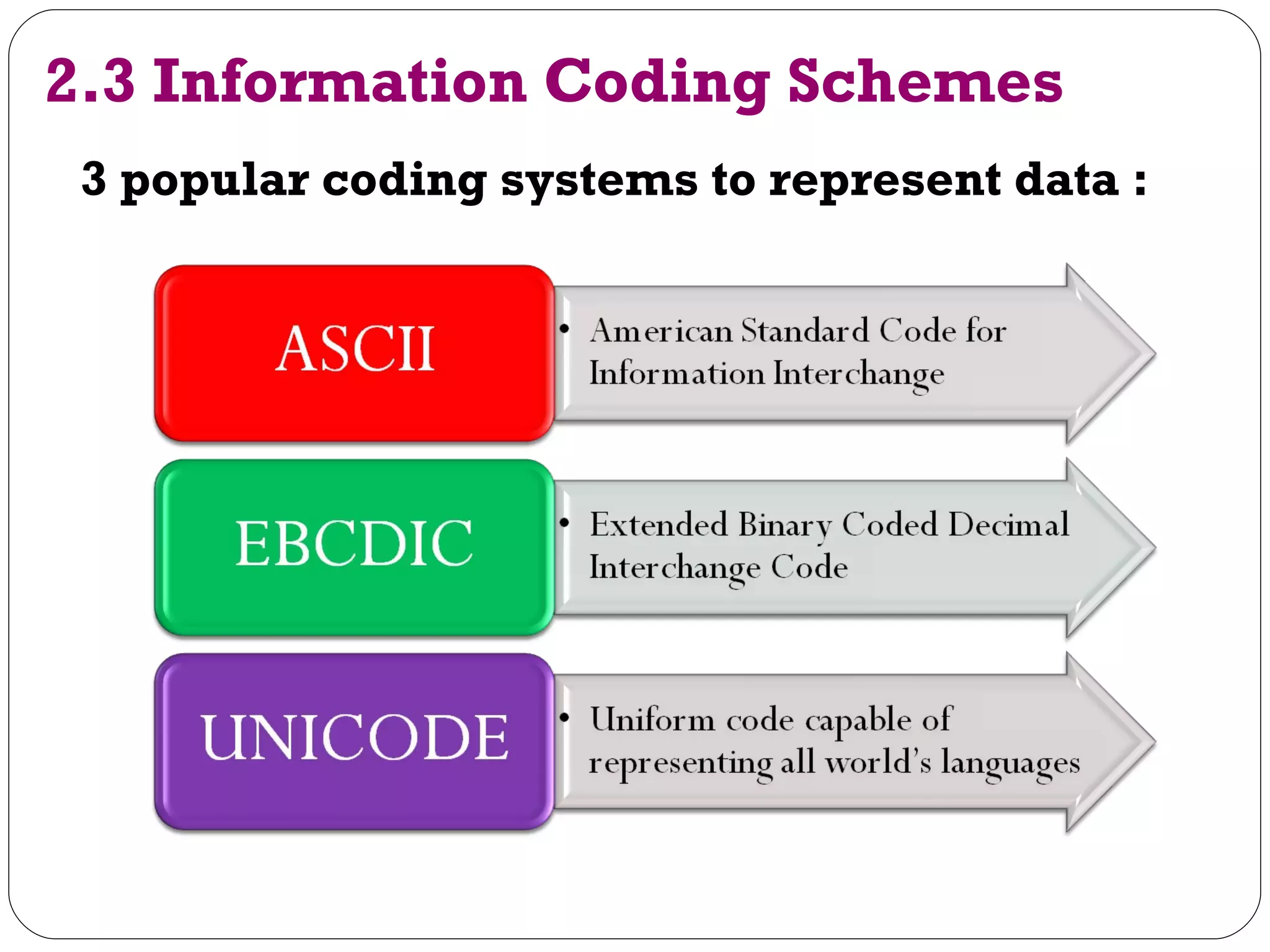
 3 popular coding systems to represent data :
2.3 Information Coding Schemes
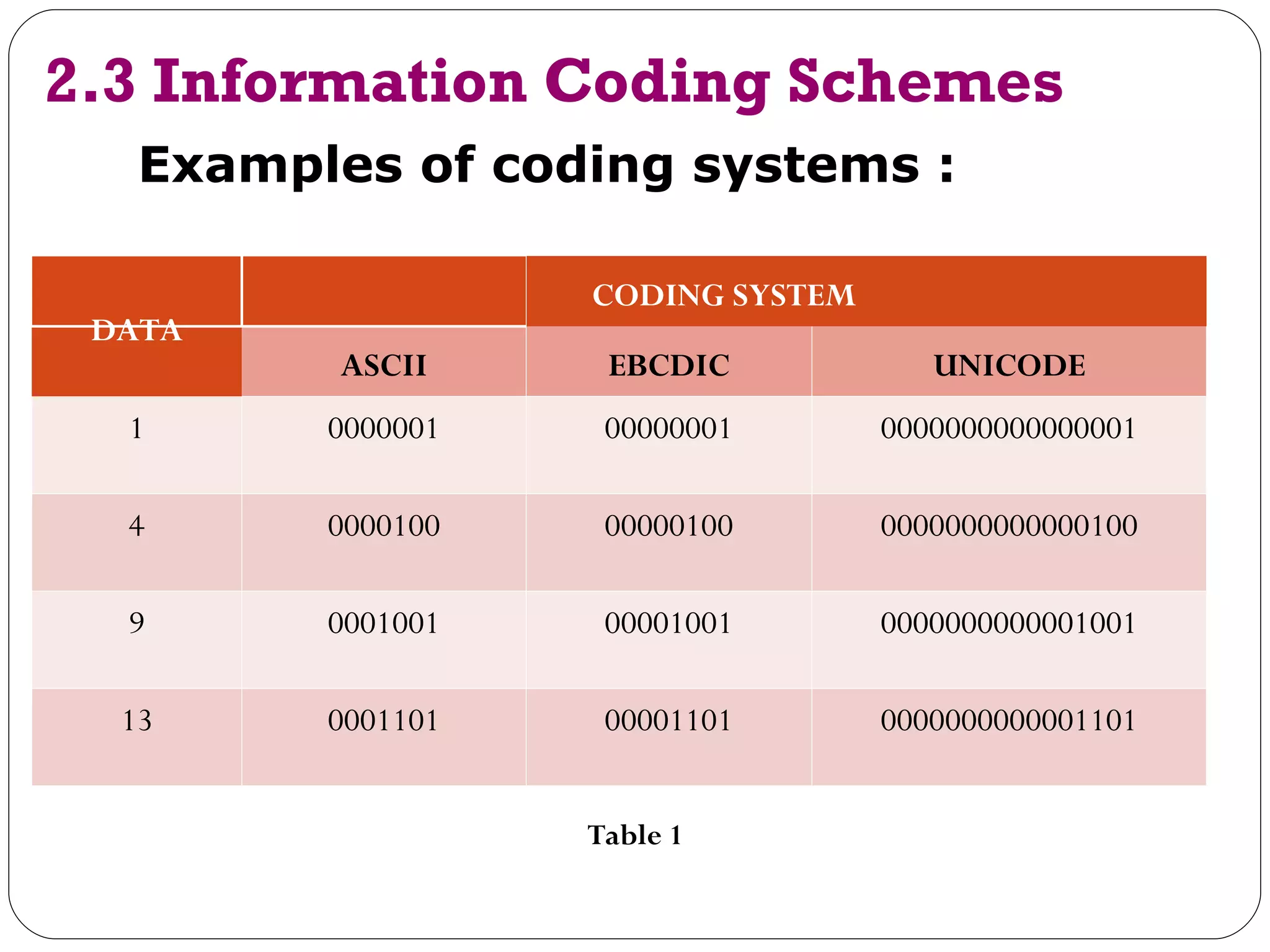
   Examples of coding systems :

                   CODING SYSTEM
 DATA
         ASCII      EBCDIC            UNICODE
  1      0000001    00000001       0000000000000001

  4      0000100    00000100       0000000000000100

  9      0001001    00001001       0000000000001001

  13     0001101    00001101       0000000000001101


                   Table 1

2.3 information coding_scheme

  • 1.
  • 2.
    2.3 Information CodingSchemes Learning Outcomes 1. Identify the coding system used in data processing 2. Differentiate the coding system
  • 3.
    2.3 Information CodingSchemes 3 popular coding systems to represent data :
  • 5.
    2.3 Information CodingSchemes Examples of coding systems : CODING SYSTEM DATA ASCII EBCDIC UNICODE 1 0000001 00000001 0000000000000001 4 0000100 00000100 0000000000000100 9 0001001 00001001 0000000000001001 13 0001101 00001101 0000000000001101 Table 1

Editor's Notes

  • #3 a character-encoding scheme
  • #4 a character-encoding scheme
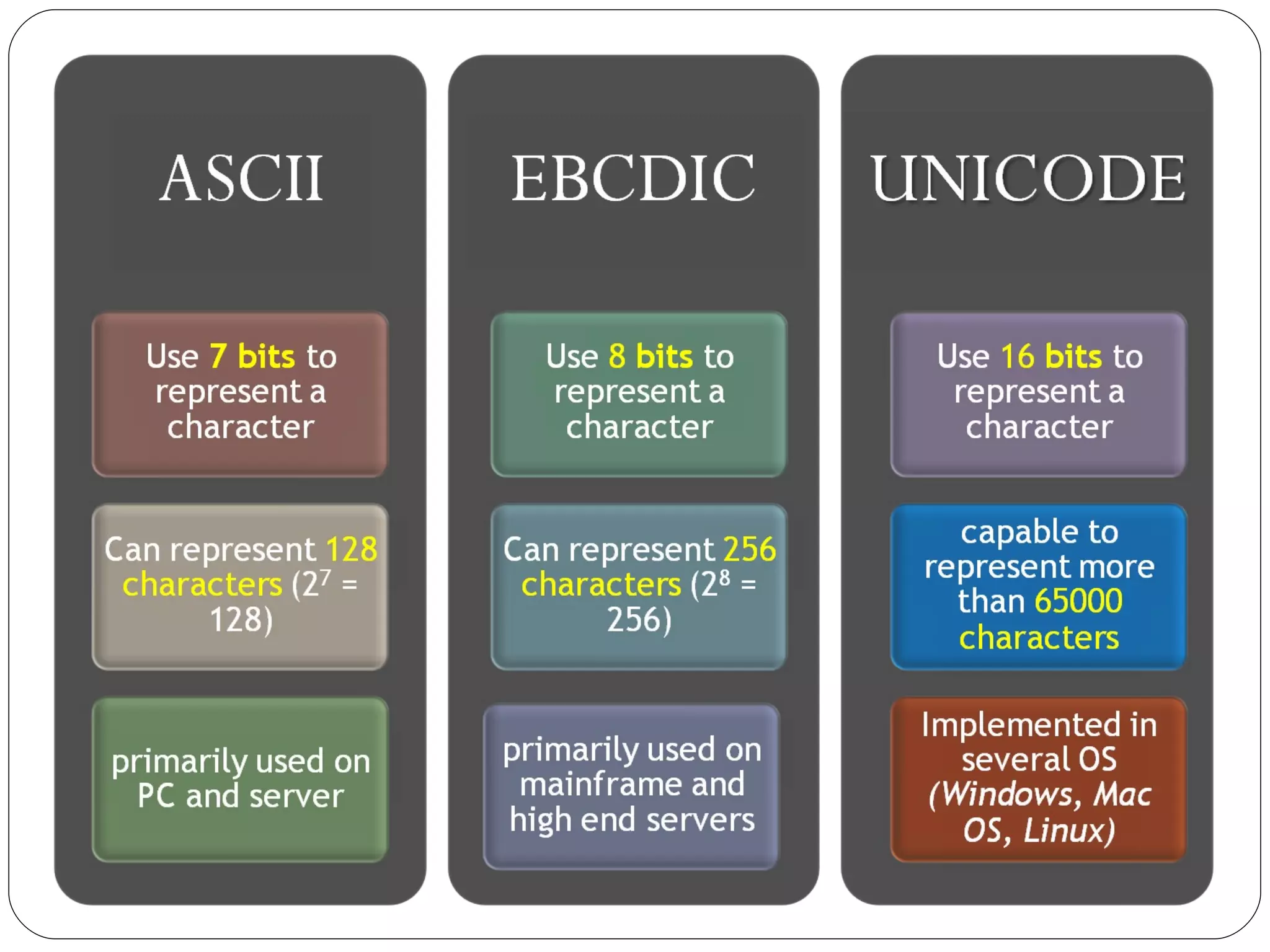
  • #5 What is ASCII? ASCII is the American Standard Code for Information Interchange, also known as ANSI X3.4. There are many variants of this standard, typically to allow different code pages for language encoding, but they all basically follow the same format. ASCII is quite elegant in the way it represents characters, and it is very easy to write code to manipulate upper/lowercase and check for valid data ranges. ASCII is essentially a 7-bit code which allows the 8th most significant bit (MSB) to be used for error checking, however most modern computer systems tend to use ASCII values of 128 and above for extended character sets. EBCDIC (Extended Binary Coded Decimal Interchange Code) is a character encoding set used by IBM mainframes. Unlike virtually every computer system in the world which uses a variant of ASCII, IBM mainframes and midrange systems such as the AS/400 tend to use a wholly incompatible character set primarily designed for ease of use on punched cards. (For an excellent page on punched cards, see Doug Jones's Punched Card Codes). EBCDIC uses the full 8 bits available to it, so parity checking cannot be used on an 8 bit system. Also, EBCDIC has a wider range of control characters than ASCII. Essentially a seven-bit code, ASCII allows the eighth most significant bit (MSB) for error checking, but most contemporary computer systems use the ASCII codes above 128 for extended character sets. Whereas ASCII is a character encoding set common on a number of different computer systems, EBCDIC is a character set particular to IBM mainframes. documentation of EBCDIC is hard to obtain from IBM, in contrast to ASCII which is well documented and widely available.