Art Integrated Activity
Network Technologies
The technology which is used to exchange the data between small and
large information. ... By using networking, users can send messages, files
through e-mail or other channels based on the organization's requirement.
What Is network technology?
Advantages of network
- It enhances communication and availability of
information.
- It allows for more convenient resource sharing.
- It makes file sharing easier.
- It is an inexpensive system.
- It increases cost efficiency.
- It boosts storage capacity.
Disadvantages of network
- It lacks independence.
- It poses security difficulties.
- It allows for more presence of computer viruses and malware.
- Its light policing usage promotes negative acts.
- It requires an efficient handler.
- It requires an expensive set-up.
Types of network
There are 11 types of network
1. Personal Area Network (PAN)
2. Local Area Network (LAN)
3. Wireless Local Area Network (WLAN)
4. Campus Area Network (CAN)
5. Metropolitan Area Network (MAN)
6. Wide Area Network (WAN)
7. Storage-Area Network (SAN)
8. System-Area Network (also known as SAN)
9. Passive Optical Local Area Network (POLAN)
10. Enterprise Private Network (EPN)
11. Virtual Private Network (VPN)
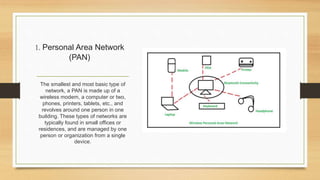
1. Personal Area Network
(PAN)
The smallest and most basic type of
network, a PAN is made up of a
wireless modem, a computer or two,
phones, printers, tablets, etc., and
revolves around one person in one
building. These types of networks are
typically found in small offices or
residences, and are managed by one
person or organization from a single
device.
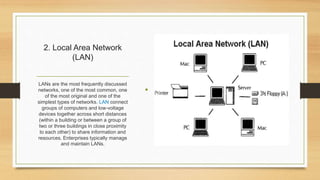
2. Local Area Network
(LAN)
LANs are the most frequently discussed
networks, one of the most common, one
of the most original and one of the
simplest types of networks. LAN connect
groups of computers and low-voltage
devices together across short distances
(within a building or between a group of
two or three buildings in close proximity
to each other) to share information and
resources. Enterprises typically manage
and maintain LANs.
•
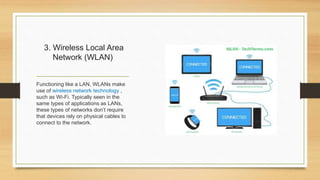
3. Wireless Local Area
Network (WLAN)
Functioning like a LAN, WLANs make
use of wireless network technology ,
such as Wi-Fi. Typically seen in the
same types of applications as LANs,
these types of networks don’t require
that devices rely on physical cables to
connect to the network.
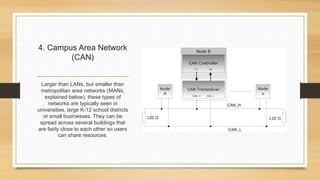
4. Campus Area Network
(CAN)
Larger than LANs, but smaller than
metropolitan area networks (MANs,
explained below), these types of
networks are typically seen in
universities, large K-12 school districts
or small businesses. They can be
spread across several buildings that
are fairly close to each other so users
can share resources.
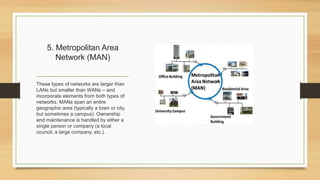
5. Metropolitan Area
Network (MAN)
These types of networks are larger than
LANs but smaller than WANs – and
incorporate elements from both types of
networks. MANs span an entire
geographic area (typically a town or city,
but sometimes a campus). Ownership
and maintenance is handled by either a
single person or company (a local
council, a large company, etc.).
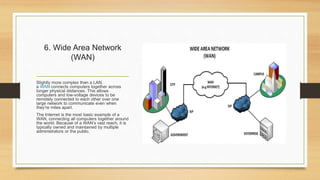
6. Wide Area Network
(WAN)
Slightly more complex than a LAN,
a WAN connects computers together across
longer physical distances. This allows
computers and low-voltage devices to be
remotely connected to each other over one
large network to communicate even when
they’re miles apart.
The Internet is the most basic example of a
WAN, connecting all computers together around
the world. Because of a WAN’s vast reach, it is
typically owned and maintained by multiple
administrators or the public.
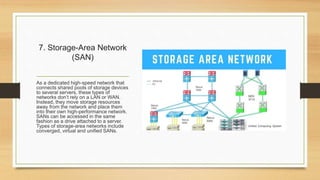
7. Storage-Area Network
(SAN)
As a dedicated high-speed network that
connects shared pools of storage devices
to several servers, these types of
networks don’t rely on a LAN or WAN.
Instead, they move storage resources
away from the network and place them
into their own high-performance network.
SANs can be accessed in the same
fashion as a drive attached to a server.
Types of storage-area networks include
converged, virtual and unified SANs.
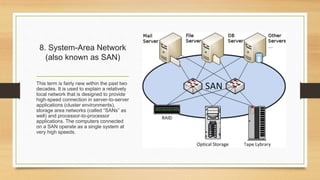
8. System-Area Network
(also known as SAN)
This term is fairly new within the past two
decades. It is used to explain a relatively
local network that is designed to provide
high-speed connection in server-to-server
applications (cluster environments),
storage area networks (called “SANs” as
well) and processor-to-processor
applications. The computers connected
on a SAN operate as a single system at
very high speeds.
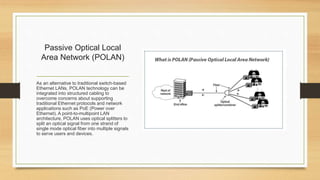
Passive Optical Local
Area Network (POLAN)
As an alternative to traditional switch-based
Ethernet LANs, POLAN technology can be
integrated into structured cabling to
overcome concerns about supporting
traditional Ethernet protocols and network
applications such as PoE (Power over
Ethernet). A point-to-multipoint LAN
architecture, POLAN uses optical splitters to
split an optical signal from one strand of
single mode optical fiber into multiple signals
to serve users and devices.
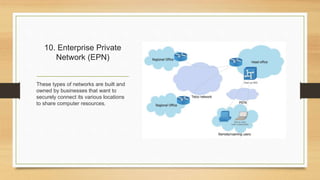
10. Enterprise Private
Network (EPN)
These types of networks are built and
owned by businesses that want to
securely connect its various locations
to share computer resources.
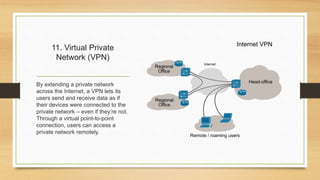
11. Virtual Private
Network (VPN)
By extending a private network
across the Internet, a VPN lets its
users send and receive data as if
their devices were connected to the
private network – even if they’re not.
Through a virtual point-to-point
connection, users can access a
private network remotely.
Categorizing network
• Based on transmission medium:
- Wired
• Easy to control signal transmission
• Protect from interference from other transmitting sources
• Higher data rates, less errors, more predictable
- Wireless
• Allows mobility
• Allows convenience
Infrastructure Protocols
• Infrastructure protocols differ from LAN and WAN protocols
• They trend to focus on extending network functionality to a small
subset of users or even to a single client
Infrastructure Protocols
• Point-to-point protocol (PPP) is used to connect client systems into an
existing WAN infrastructure
• Point-to-point tunnelling protocol (PPTP) is most often used when
connecting users using virtual private networks
• Layer 2 tunnelling protocol (L2TP) is the next generation of tunnelling and
is similar in function to PPTP
Wireless network technology
• Wireless generally requires line of sight (LOS) between the two connection
points
• Buildings are natural formations can cause problems when trying to send and
receive signals
• Wireless offers freedom from monthly WAN fees, but the up-front cost for
purchasing and installing wireless may be prohibitive
Sanvi Gulati
8-B (Diamond)

Network technology ppt

  • 1.
  • 2.
  • 3.
    The technology whichis used to exchange the data between small and large information. ... By using networking, users can send messages, files through e-mail or other channels based on the organization's requirement. What Is network technology?
  • 4.
    Advantages of network -It enhances communication and availability of information. - It allows for more convenient resource sharing. - It makes file sharing easier. - It is an inexpensive system. - It increases cost efficiency. - It boosts storage capacity.
  • 5.
    Disadvantages of network -It lacks independence. - It poses security difficulties. - It allows for more presence of computer viruses and malware. - Its light policing usage promotes negative acts. - It requires an efficient handler. - It requires an expensive set-up.
  • 6.
    Types of network Thereare 11 types of network 1. Personal Area Network (PAN) 2. Local Area Network (LAN) 3. Wireless Local Area Network (WLAN) 4. Campus Area Network (CAN) 5. Metropolitan Area Network (MAN) 6. Wide Area Network (WAN) 7. Storage-Area Network (SAN) 8. System-Area Network (also known as SAN) 9. Passive Optical Local Area Network (POLAN) 10. Enterprise Private Network (EPN) 11. Virtual Private Network (VPN)
  • 7.
    1. Personal AreaNetwork (PAN) The smallest and most basic type of network, a PAN is made up of a wireless modem, a computer or two, phones, printers, tablets, etc., and revolves around one person in one building. These types of networks are typically found in small offices or residences, and are managed by one person or organization from a single device.
  • 8.
    2. Local AreaNetwork (LAN) LANs are the most frequently discussed networks, one of the most common, one of the most original and one of the simplest types of networks. LAN connect groups of computers and low-voltage devices together across short distances (within a building or between a group of two or three buildings in close proximity to each other) to share information and resources. Enterprises typically manage and maintain LANs. •
  • 9.
    3. Wireless LocalArea Network (WLAN) Functioning like a LAN, WLANs make use of wireless network technology , such as Wi-Fi. Typically seen in the same types of applications as LANs, these types of networks don’t require that devices rely on physical cables to connect to the network.
  • 10.
    4. Campus AreaNetwork (CAN) Larger than LANs, but smaller than metropolitan area networks (MANs, explained below), these types of networks are typically seen in universities, large K-12 school districts or small businesses. They can be spread across several buildings that are fairly close to each other so users can share resources.
  • 11.
    5. Metropolitan Area Network(MAN) These types of networks are larger than LANs but smaller than WANs – and incorporate elements from both types of networks. MANs span an entire geographic area (typically a town or city, but sometimes a campus). Ownership and maintenance is handled by either a single person or company (a local council, a large company, etc.).
  • 12.
    6. Wide AreaNetwork (WAN) Slightly more complex than a LAN, a WAN connects computers together across longer physical distances. This allows computers and low-voltage devices to be remotely connected to each other over one large network to communicate even when they’re miles apart. The Internet is the most basic example of a WAN, connecting all computers together around the world. Because of a WAN’s vast reach, it is typically owned and maintained by multiple administrators or the public.
  • 13.
    7. Storage-Area Network (SAN) Asa dedicated high-speed network that connects shared pools of storage devices to several servers, these types of networks don’t rely on a LAN or WAN. Instead, they move storage resources away from the network and place them into their own high-performance network. SANs can be accessed in the same fashion as a drive attached to a server. Types of storage-area networks include converged, virtual and unified SANs.
  • 14.
    8. System-Area Network (alsoknown as SAN) This term is fairly new within the past two decades. It is used to explain a relatively local network that is designed to provide high-speed connection in server-to-server applications (cluster environments), storage area networks (called “SANs” as well) and processor-to-processor applications. The computers connected on a SAN operate as a single system at very high speeds.
  • 15.
    Passive Optical Local AreaNetwork (POLAN) As an alternative to traditional switch-based Ethernet LANs, POLAN technology can be integrated into structured cabling to overcome concerns about supporting traditional Ethernet protocols and network applications such as PoE (Power over Ethernet). A point-to-multipoint LAN architecture, POLAN uses optical splitters to split an optical signal from one strand of single mode optical fiber into multiple signals to serve users and devices.
  • 16.
    10. Enterprise Private Network(EPN) These types of networks are built and owned by businesses that want to securely connect its various locations to share computer resources.
  • 17.
    11. Virtual Private Network(VPN) By extending a private network across the Internet, a VPN lets its users send and receive data as if their devices were connected to the private network – even if they’re not. Through a virtual point-to-point connection, users can access a private network remotely.
  • 18.
    Categorizing network • Basedon transmission medium: - Wired • Easy to control signal transmission • Protect from interference from other transmitting sources • Higher data rates, less errors, more predictable - Wireless • Allows mobility • Allows convenience
  • 19.
    Infrastructure Protocols • Infrastructureprotocols differ from LAN and WAN protocols • They trend to focus on extending network functionality to a small subset of users or even to a single client
  • 20.
    Infrastructure Protocols • Point-to-pointprotocol (PPP) is used to connect client systems into an existing WAN infrastructure • Point-to-point tunnelling protocol (PPTP) is most often used when connecting users using virtual private networks • Layer 2 tunnelling protocol (L2TP) is the next generation of tunnelling and is similar in function to PPTP
  • 21.
    Wireless network technology •Wireless generally requires line of sight (LOS) between the two connection points • Buildings are natural formations can cause problems when trying to send and receive signals • Wireless offers freedom from monthly WAN fees, but the up-front cost for purchasing and installing wireless may be prohibitive
  • 22.