











Orientation, Training and
Development
Raja El-Majzoub
ORIENTATION
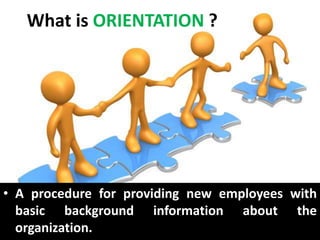
What is ORIENTATION ?
• A procedure for providing new employees with
basic background information about the
organization.
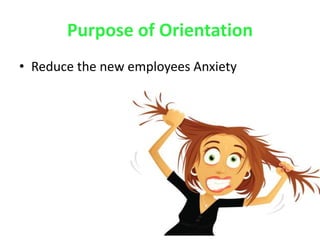
Purpose of Orientation
• Reduce the new employees Anxiety
Purpose of Orientation
• Employees feel Welcome
Purpose of Orientation
• Provide Information
Purpose of Orientation
• Reinforcing a Favorable Impression
Stages in an Orientation Program
• General information about organization.
• Specific information about the department
where employees is assigned to.
• Evaluation and follow-up.
Areas Covered in an Orientation
Program
• Introduction to other employees.
Areas Covered in an Orientation
Program
• Expectation for attendance, conduct and
appearance.
Areas Covered in an Orientation
Program
• Condition of employment such as hours, and
pay periods.
Areas Covered in an Orientation
Program
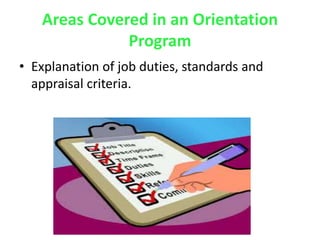
• Explanation of job duties, standards and
appraisal criteria.
Safety Regulations
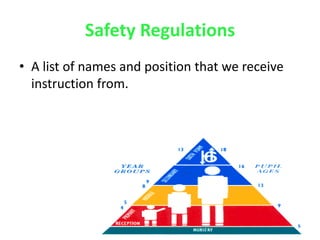
• A list of names and position that we receive
instruction from.
Safety Regulations
• Explanation of organization purpose and goals
Safety Regulations
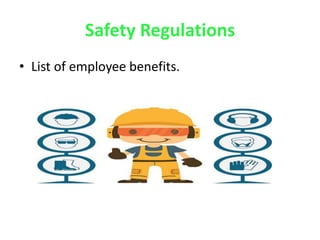
• List of employee benefits.
Safety Regulations
• Copies of insurance Plans.
Training
Training
• An organization planned efforts to help
employees acquired job-related knowledge,
skills, abilities, and behaviors with the goals of
a playing these on the job
• (Raymon A. Noe- fundamental of HRM)
The Benefits of Training
• Increases workers productivity.
The Benefits of Training
• Increases workers Job Satisfaction.
The Benefits of Training
• Keep Workers skills and knowledge up-to-
date.
The Benefits of Training
• Helps to motivate workers.
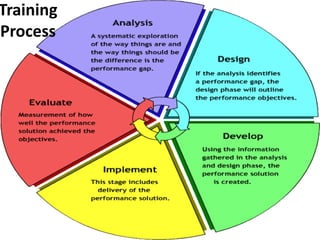
Training
Process
Types of Training
• 1- On the Job Training.
• 2- Off the Job Training.
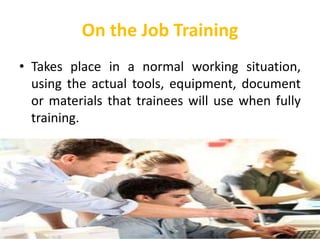
On the Job Training
• Takes place in a normal working situation,
using the actual tools, equipment, document
or materials that trainees will use when fully
training.
Off the Job Training
• Training carried out by parties external to the
organization and usually on not owned by the
employee.
Training Methods
Training Methods
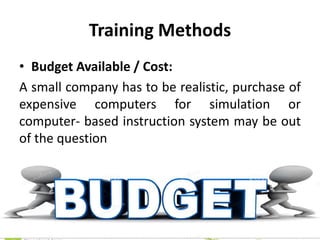
• Budget Available / Cost:
A small company has to be realistic, purchase of
expensive computers for simulation or
computer- based instruction system may be out
of the question
Training Methods
• The Skill of the trainer:
The trainer should avoid any method he is not
familiar with until he has mastered the
necessary skills to use is efficiently .
Training Methods
• The Objectives of the program :
Certain methods are particularly suited for
developing skills, some for helping trainees
acquire knowledge and others for changing
attitudes. The methods must be chosen with the
course objective in mind.
Training Methods
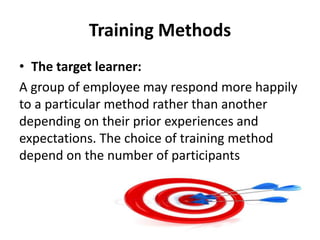
• The target learner:
A group of employee may respond more happily
to a particular method rather than another
depending on their prior experiences and
expectations. The choice of training method
depend on the number of participants
Training Methods
• Effectiveness of training method:
One more factor deserves special attention as it
can make or break the success of training
program .
Selecting Training Method
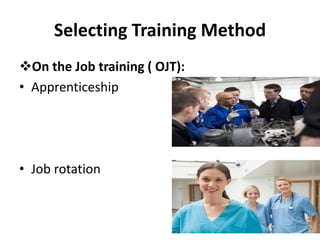
On the Job training ( OJT):
• Apprenticeship
• Job rotation
Selecting Training Method
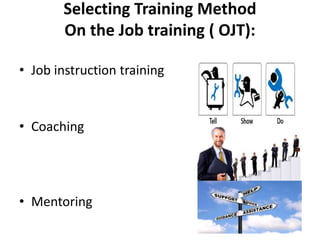
On the Job training ( OJT):
• Job instruction training
• Coaching
• Mentoring
Selecting Training Method
Off the job training
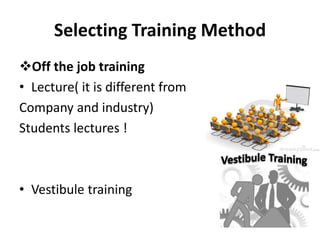
• Lecture( it is different from
Company and industry)
Students lectures !
• Vestibule training
Selecting Training Method
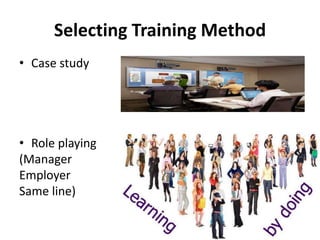
• Case study
• Role playing
(Manager
Employer
Same line)
Training Facilitator
• Effective trainers use training methods which
encourage learners to learn by doing.
• Good trainers learn from their mistakes .
Training Facilitator
• They give lectures to the trainees:
While lectures do have some values, they are
one monologue , they need a regular change of
pace.
Training Facilitator
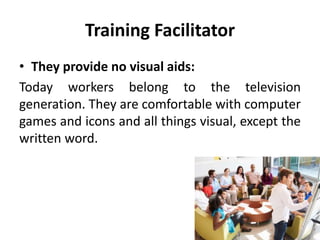
• They provide no visual aids:
Today workers belong to the television
generation. They are comfortable with computer
games and icons and all things visual, except the
written word.
Training Facilitator
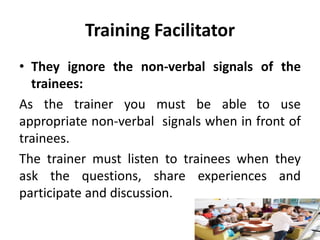
• They ignore the non-verbal signals of the
trainees:
As the trainer you must be able to use
appropriate non-verbal signals when in front of
trainees.
The trainer must listen to trainees when they
ask the questions, share experiences and
participate and discussion.
EMPLOYEE DEVELOPMENT
Employee development
• Can be defined as a process where the
employee with the support of his/her
employer undergoes various training
programs to enhance his/her skills and acquire
new knowledge and learnings
What is employee development?
• Joint initiative of the employee
• Joint initiative of the employer
• Upgrade the existing skills and knowledge of
an individual
What is employee development?
• Keep employees abreast with the latest
developments .
• survive the fierce competition
Examples of Employee Development
Activities
• Professional Growth:
Human resource professionals must encourage
employees to participate in internal or external
trainings,
Examples of Employee Development
Activities
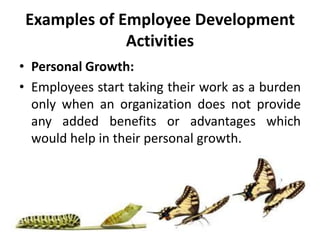
• Personal Growth:
• Employees start taking their work as a burden
only when an organization does not provide
any added benefits or advantages which
would help in their personal growth.
Importance of employee
development
• Enhance their skills and upgrade their existing
knowledge in order to perform better.
• Activities and trainings make an employee
aware of the latest developments and what is
happening around him?
Importance of employee
development
• is important not only for professional but also
personal growth of employees.
• Employee development activities prepare
individuals for adverse conditions and
unforeseen situations.
Importance of employee
development
• Every employee likes to acquire new skills and
learnings while at job.
• A sense of pride develops when they feel that
their organization is investing time and
resources to train them.
Importance of employee
development
• Employee development is essential for
extracting the best out of employees.
Importance of employee
development
• Employee development creates a learning
culture in the organization where every
employee is motivated to learn new skills and
acquire new learnings. Their careers should
be given an extra push.
What is the Relationship?
• At the end we can deduce that, to develop
ourselves and our work or our position , it
needs orientation or coaching to achieve our
goals as well as to learn from training , trainer
is not enough , you have to start from yourself
then learn from others.
Thank you

Human resource management

  • 1.
  • 2.
  • 3.
    What is ORIENTATION? • A procedure for providing new employees with basic background information about the organization.
  • 4.
    Purpose of Orientation •Reduce the new employees Anxiety
  • 5.
    Purpose of Orientation •Employees feel Welcome
  • 6.
    Purpose of Orientation •Provide Information
  • 7.
    Purpose of Orientation •Reinforcing a Favorable Impression
  • 8.
    Stages in anOrientation Program • General information about organization. • Specific information about the department where employees is assigned to. • Evaluation and follow-up.
  • 9.
    Areas Covered inan Orientation Program • Introduction to other employees.
  • 10.
    Areas Covered inan Orientation Program • Expectation for attendance, conduct and appearance.
  • 11.
    Areas Covered inan Orientation Program • Condition of employment such as hours, and pay periods.
  • 12.
    Areas Covered inan Orientation Program • Explanation of job duties, standards and appraisal criteria.
  • 13.
    Safety Regulations • Alist of names and position that we receive instruction from.
  • 14.
    Safety Regulations • Explanationof organization purpose and goals
  • 15.
    Safety Regulations • Listof employee benefits.
  • 16.
    Safety Regulations • Copiesof insurance Plans.
  • 17.
  • 18.
    Training • An organizationplanned efforts to help employees acquired job-related knowledge, skills, abilities, and behaviors with the goals of a playing these on the job • (Raymon A. Noe- fundamental of HRM)
  • 19.
  • 20.
    The Benefits ofTraining • Increases workers productivity.
  • 21.
    The Benefits ofTraining • Increases workers Job Satisfaction.
  • 22.
    The Benefits ofTraining • Keep Workers skills and knowledge up-to- date.
  • 23.
    The Benefits ofTraining • Helps to motivate workers.
  • 24.
  • 25.
    Types of Training •1- On the Job Training. • 2- Off the Job Training.
  • 26.
    On the JobTraining • Takes place in a normal working situation, using the actual tools, equipment, document or materials that trainees will use when fully training.
  • 27.
    Off the JobTraining • Training carried out by parties external to the organization and usually on not owned by the employee.
  • 28.
  • 29.
    Training Methods • BudgetAvailable / Cost: A small company has to be realistic, purchase of expensive computers for simulation or computer- based instruction system may be out of the question
  • 30.
    Training Methods • TheSkill of the trainer: The trainer should avoid any method he is not familiar with until he has mastered the necessary skills to use is efficiently .
  • 31.
    Training Methods • TheObjectives of the program : Certain methods are particularly suited for developing skills, some for helping trainees acquire knowledge and others for changing attitudes. The methods must be chosen with the course objective in mind.
  • 32.
    Training Methods • Thetarget learner: A group of employee may respond more happily to a particular method rather than another depending on their prior experiences and expectations. The choice of training method depend on the number of participants
  • 33.
    Training Methods • Effectivenessof training method: One more factor deserves special attention as it can make or break the success of training program .
  • 34.
  • 35.
    Selecting Training Method Onthe Job training ( OJT): • Apprenticeship • Job rotation
  • 36.
    Selecting Training Method Onthe Job training ( OJT): • Job instruction training • Coaching • Mentoring
  • 37.
    Selecting Training Method Offthe job training • Lecture( it is different from Company and industry) Students lectures ! • Vestibule training
  • 38.
    Selecting Training Method •Case study • Role playing (Manager Employer Same line)
  • 40.
  • 41.
    Training Facilitator • Effectivetrainers use training methods which encourage learners to learn by doing. • Good trainers learn from their mistakes .
  • 42.
    Training Facilitator • Theygive lectures to the trainees: While lectures do have some values, they are one monologue , they need a regular change of pace.
  • 43.
    Training Facilitator • Theyprovide no visual aids: Today workers belong to the television generation. They are comfortable with computer games and icons and all things visual, except the written word.
  • 44.
    Training Facilitator • Theyignore the non-verbal signals of the trainees: As the trainer you must be able to use appropriate non-verbal signals when in front of trainees. The trainer must listen to trainees when they ask the questions, share experiences and participate and discussion.
  • 45.
  • 46.
    Employee development • Canbe defined as a process where the employee with the support of his/her employer undergoes various training programs to enhance his/her skills and acquire new knowledge and learnings
  • 47.
    What is employeedevelopment? • Joint initiative of the employee • Joint initiative of the employer • Upgrade the existing skills and knowledge of an individual
  • 48.
    What is employeedevelopment? • Keep employees abreast with the latest developments . • survive the fierce competition
  • 49.
    Examples of EmployeeDevelopment Activities • Professional Growth: Human resource professionals must encourage employees to participate in internal or external trainings,
  • 50.
    Examples of EmployeeDevelopment Activities • Personal Growth: • Employees start taking their work as a burden only when an organization does not provide any added benefits or advantages which would help in their personal growth.
  • 51.
    Importance of employee development •Enhance their skills and upgrade their existing knowledge in order to perform better. • Activities and trainings make an employee aware of the latest developments and what is happening around him?
  • 52.
    Importance of employee development •is important not only for professional but also personal growth of employees. • Employee development activities prepare individuals for adverse conditions and unforeseen situations.
  • 53.
    Importance of employee development •Every employee likes to acquire new skills and learnings while at job. • A sense of pride develops when they feel that their organization is investing time and resources to train them.
  • 54.
    Importance of employee development •Employee development is essential for extracting the best out of employees.
  • 55.
    Importance of employee development •Employee development creates a learning culture in the organization where every employee is motivated to learn new skills and acquire new learnings. Their careers should be given an extra push.
  • 56.
    What is theRelationship? • At the end we can deduce that, to develop ourselves and our work or our position , it needs orientation or coaching to achieve our goals as well as to learn from training , trainer is not enough , you have to start from yourself then learn from others.
  • 57.