31.1
Chapter 31
Network Security
Copyright © The McGraw-Hill Companies, Inc. Permission required for reproduction or display.
31.2
31-1 SECURITY SERVICES31-1 SECURITY SERVICES
Network security can provide five services. Four of theseNetwork security can provide five services. Four of these
services are related to the message exchanged using theservices are related to the message exchanged using the
network. The fifth service provides entity authenticationnetwork. The fifth service provides entity authentication
or identification.or identification.
Message Confidentiality
Message Integrity
Message Authentication
Message Nonrepudiation
Entity Authentication
Topics discussed in this section:Topics discussed in this section:
31.3
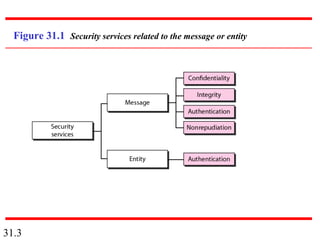
Figure 31.1 Security services related to the message or entity
31.4
31-2 MESSAGE CONFIDENTIALITY31-2 MESSAGE CONFIDENTIALITY
The concept of how to achieve message confidentialityThe concept of how to achieve message confidentiality
or privacy has not changed for thousands of years.or privacy has not changed for thousands of years.
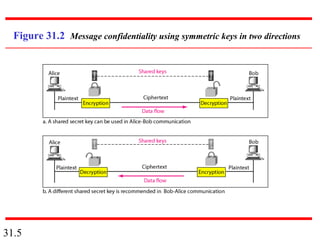
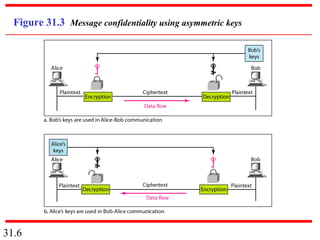
The message must be encrypted at the sender site andThe message must be encrypted at the sender site and
decrypted at the receiver site. This can be done usingdecrypted at the receiver site. This can be done using
either symmetric-key cryptography or asymmetric-keyeither symmetric-key cryptography or asymmetric-key
cryptography.cryptography.
Confidentiality with Symmetric-Key Cryptography
Confidentiality with Asymmetric-Key Cryptography
Topics discussed in this section:Topics discussed in this section:
31.5
Figure 31.2 Message confidentiality using symmetric keys in two directions
31.6
Figure 31.3 Message confidentiality using asymmetric keys
31.7
31-3 MESSAGE INTEGRITY31-3 MESSAGE INTEGRITY
Encryption and decryption provide secrecy, orEncryption and decryption provide secrecy, or
confidentiality, but not integrity. However, on occasionconfidentiality, but not integrity. However, on occasion
we may not even need secrecy, but instead must havewe may not even need secrecy, but instead must have
integrity.integrity.
Document and Fingerprint
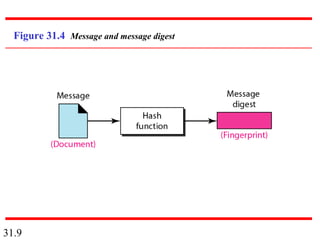
Message and Message Digest
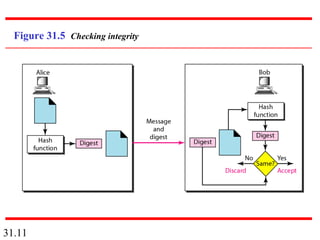
Creating and Checking the Digest
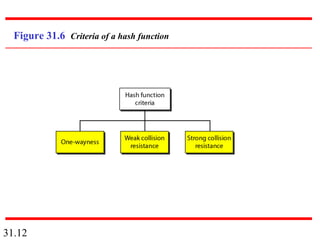
Hash Function Criteria
Hash Algorithms: SHA-1
Topics discussed in this section:Topics discussed in this section:
31.8
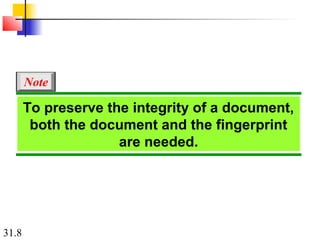
To preserve the integrity of a document,
both the document and the fingerprint
are needed.
Note
31.9
Figure 31.4 Message and message digest
31.10
The message digest needs to be kept
secret.
Note
31.11
Figure 31.5 Checking integrity
31.12
Figure 31.6 Criteria of a hash function
31.13
Can we use a conventional lossless compression method
as a hashing function?
Solution
We cannot. A lossless compression method creates a
compressed message that is reversible. You can
uncompress the compressed message to get the original
one.
Example 31.1
31.14
Can we use a checksum method as a hashing function?
Solution
We can. A checksum function is not reversible; it meets
the first criterion. However, it does not meet the other
criteria.
Example 31.2
31.15
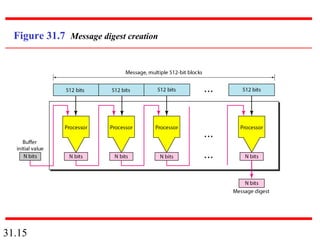
Figure 31.7 Message digest creation
31.16
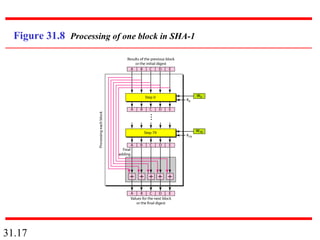
SHA-1 hash algorithms create an N-bit
message digest out of a message of
512-bit blocks.
SHA-1 has a message digest of 160 bits
(5 words of 32 bits).
Note
31.17
Figure 31.8 Processing of one block in SHA-1
31.18
31-4 MESSAGE AUTHENTICATION31-4 MESSAGE AUTHENTICATION
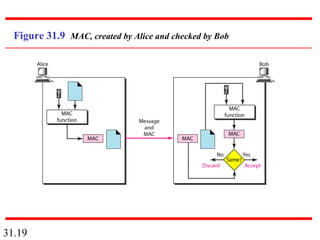
A hash function per se cannot provide authentication.A hash function per se cannot provide authentication.
The digest created by a hash function can detect anyThe digest created by a hash function can detect any
modification in the message, but not authentication.modification in the message, but not authentication.
MAC
Topics discussed in this section:Topics discussed in this section:
31.19
Figure 31.9 MAC, created by Alice and checked by Bob
31.20
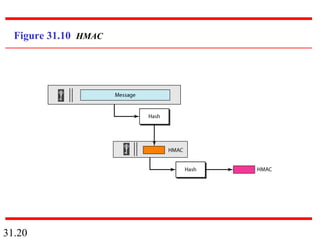
Figure 31.10 HMAC
31.21
31-5 DIGITAL SIGNATURE31-5 DIGITAL SIGNATURE
When Alice sends a message to Bob, Bob needs toWhen Alice sends a message to Bob, Bob needs to
check the authenticity of the sender; he needs to becheck the authenticity of the sender; he needs to be
sure that the message comes from Alice and not Eve.sure that the message comes from Alice and not Eve.
Bob can ask Alice to sign the message electronically.Bob can ask Alice to sign the message electronically.
In other words, an electronic signature can prove theIn other words, an electronic signature can prove the
authenticity of Alice as the sender of the message. Weauthenticity of Alice as the sender of the message. We
refer to this type of signature as a digital signature.refer to this type of signature as a digital signature.
Comparison
Need for Keys
Process
Topics discussed in this section:Topics discussed in this section:
31.22
A digital signature needs a public-key
system.
Note
31.23
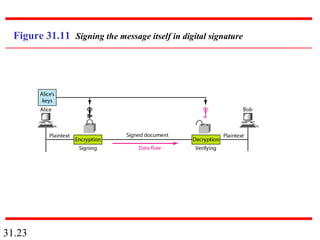
Figure 31.11 Signing the message itself in digital signature
31.24
In a cryptosystem, we use the private
and public keys of the receiver;
in digital signature, we use the private
and public keys of the sender.
Note
31.25
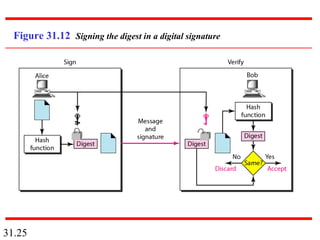
Figure 31.12 Signing the digest in a digital signature
31.26
A digital signature today provides
message integrity.
Note
31.27
Digital signature provides message
authentication.
Note
31.28
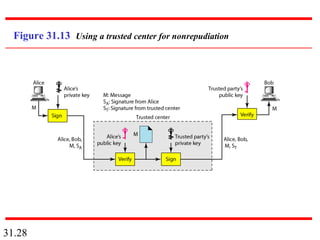
Figure 31.13 Using a trusted center for nonrepudiation
31.29
Nonrepudiation can be provided using a
trusted party.
Note
31.30
31-6 ENTITY AUTHENTICATION31-6 ENTITY AUTHENTICATION
Entity authentication is a technique designed to let oneEntity authentication is a technique designed to let one
party prove the identity of another party. An entity canparty prove the identity of another party. An entity can
be a person, a process, a client, or a server. The entitybe a person, a process, a client, or a server. The entity
whose identity needs to be proved is called the claimant;whose identity needs to be proved is called the claimant;
the party that tries to prove the identity of the claimantthe party that tries to prove the identity of the claimant
is called the verifier.is called the verifier.
Passwords
Challenge-Response
Topics discussed in this section:Topics discussed in this section:
31.31
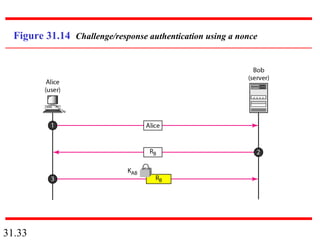
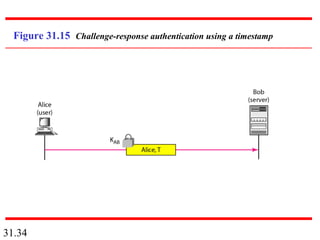
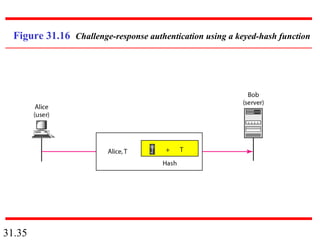
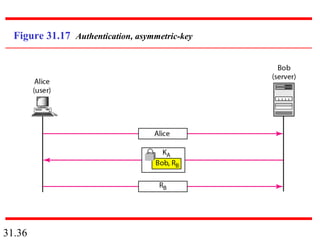
In challenge-response authentication,
the claimant proves that she knows a
secret without revealing it.
Note
31.32
The challenge is a time-varying value
sent by the verifier;
the response is the result of a function
applied on the challenge.
Note
31.33
Figure 31.14 Challenge/response authentication using a nonce
31.34
Figure 31.15 Challenge-response authentication using a timestamp
31.35
Figure 31.16 Challenge-response authentication using a keyed-hash function
31.36
Figure 31.17 Authentication, asymmetric-key
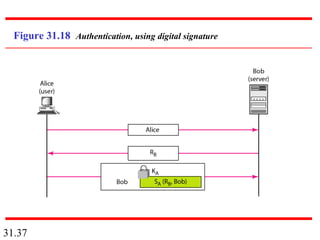
31.37
Figure 31.18 Authentication, using digital signature
31.38
31-7 KEY MANAGEMENT31-7 KEY MANAGEMENT
We never discussed how secret keys in symmetric-keyWe never discussed how secret keys in symmetric-key
cryptography and how public keys in asymmetric-keycryptography and how public keys in asymmetric-key
cryptography are distributed and maintained. In thiscryptography are distributed and maintained. In this
section, we touch on these two issues. We first discusssection, we touch on these two issues. We first discuss
the distribution of symmetric keys; we then discuss thethe distribution of symmetric keys; we then discuss the
distribution of asymmetric keys.distribution of asymmetric keys.
Symmetric-Key Distribution
Public-Key Distribution
Topics discussed in this section:Topics discussed in this section:
31.39
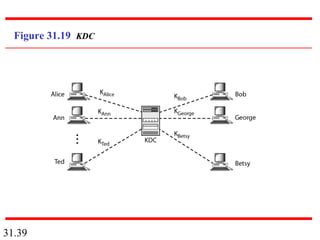
Figure 31.19 KDC
31.40
A session symmetric key between two
parties is used only once.
Note
31.41
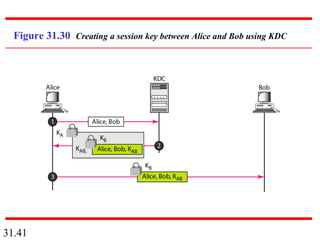
Figure 31.30 Creating a session key between Alice and Bob using KDC
31.42
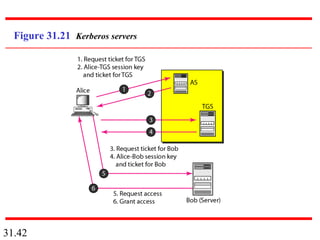
Figure 31.21 Kerberos servers
31.43
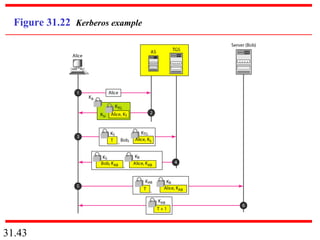
Figure 31.22 Kerberos example
31.44
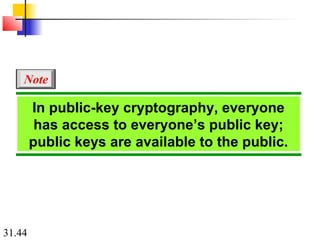
In public-key cryptography, everyone
has access to everyone’s public key;
public keys are available to the public.
Note
31.45
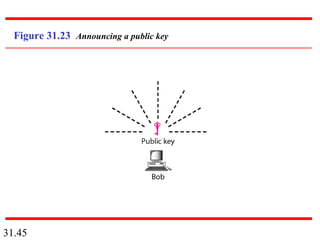
Figure 31.23 Announcing a public key
31.46
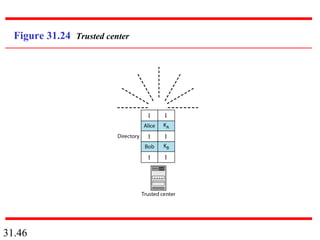
Figure 31.24 Trusted center
31.47
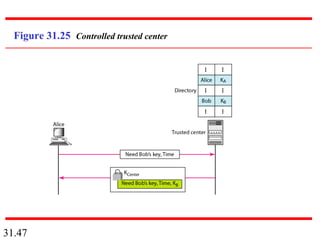
Figure 31.25 Controlled trusted center
31.48
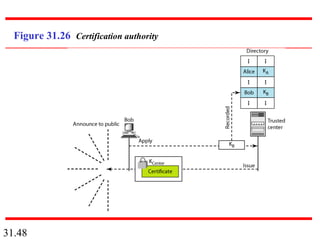
Figure 31.26 Certification authority
31.49
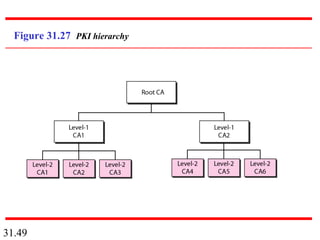
Figure 31.27 PKI hierarchy

31 Network Security

  • 1.
    31.1 Chapter 31 Network Security Copyright© The McGraw-Hill Companies, Inc. Permission required for reproduction or display.
  • 2.
    31.2 31-1 SECURITY SERVICES31-1SECURITY SERVICES Network security can provide five services. Four of theseNetwork security can provide five services. Four of these services are related to the message exchanged using theservices are related to the message exchanged using the network. The fifth service provides entity authenticationnetwork. The fifth service provides entity authentication or identification.or identification. Message Confidentiality Message Integrity Message Authentication Message Nonrepudiation Entity Authentication Topics discussed in this section:Topics discussed in this section:
  • 3.
    31.3 Figure 31.1 Securityservices related to the message or entity
  • 4.
    31.4 31-2 MESSAGE CONFIDENTIALITY31-2MESSAGE CONFIDENTIALITY The concept of how to achieve message confidentialityThe concept of how to achieve message confidentiality or privacy has not changed for thousands of years.or privacy has not changed for thousands of years. The message must be encrypted at the sender site andThe message must be encrypted at the sender site and decrypted at the receiver site. This can be done usingdecrypted at the receiver site. This can be done using either symmetric-key cryptography or asymmetric-keyeither symmetric-key cryptography or asymmetric-key cryptography.cryptography. Confidentiality with Symmetric-Key Cryptography Confidentiality with Asymmetric-Key Cryptography Topics discussed in this section:Topics discussed in this section:
  • 5.
    31.5 Figure 31.2 Messageconfidentiality using symmetric keys in two directions
  • 6.
    31.6 Figure 31.3 Messageconfidentiality using asymmetric keys
  • 7.
    31.7 31-3 MESSAGE INTEGRITY31-3MESSAGE INTEGRITY Encryption and decryption provide secrecy, orEncryption and decryption provide secrecy, or confidentiality, but not integrity. However, on occasionconfidentiality, but not integrity. However, on occasion we may not even need secrecy, but instead must havewe may not even need secrecy, but instead must have integrity.integrity. Document and Fingerprint Message and Message Digest Creating and Checking the Digest Hash Function Criteria Hash Algorithms: SHA-1 Topics discussed in this section:Topics discussed in this section:
  • 8.
    31.8 To preserve theintegrity of a document, both the document and the fingerprint are needed. Note
  • 9.
    31.9 Figure 31.4 Messageand message digest
  • 10.
    31.10 The message digestneeds to be kept secret. Note
  • 11.
  • 12.
    31.12 Figure 31.6 Criteriaof a hash function
  • 13.
    31.13 Can we usea conventional lossless compression method as a hashing function? Solution We cannot. A lossless compression method creates a compressed message that is reversible. You can uncompress the compressed message to get the original one. Example 31.1
  • 14.
    31.14 Can we usea checksum method as a hashing function? Solution We can. A checksum function is not reversible; it meets the first criterion. However, it does not meet the other criteria. Example 31.2
  • 15.
  • 16.
    31.16 SHA-1 hash algorithmscreate an N-bit message digest out of a message of 512-bit blocks. SHA-1 has a message digest of 160 bits (5 words of 32 bits). Note
  • 17.
    31.17 Figure 31.8 Processingof one block in SHA-1
  • 18.
    31.18 31-4 MESSAGE AUTHENTICATION31-4MESSAGE AUTHENTICATION A hash function per se cannot provide authentication.A hash function per se cannot provide authentication. The digest created by a hash function can detect anyThe digest created by a hash function can detect any modification in the message, but not authentication.modification in the message, but not authentication. MAC Topics discussed in this section:Topics discussed in this section:
  • 19.
    31.19 Figure 31.9 MAC,created by Alice and checked by Bob
  • 20.
  • 21.
    31.21 31-5 DIGITAL SIGNATURE31-5DIGITAL SIGNATURE When Alice sends a message to Bob, Bob needs toWhen Alice sends a message to Bob, Bob needs to check the authenticity of the sender; he needs to becheck the authenticity of the sender; he needs to be sure that the message comes from Alice and not Eve.sure that the message comes from Alice and not Eve. Bob can ask Alice to sign the message electronically.Bob can ask Alice to sign the message electronically. In other words, an electronic signature can prove theIn other words, an electronic signature can prove the authenticity of Alice as the sender of the message. Weauthenticity of Alice as the sender of the message. We refer to this type of signature as a digital signature.refer to this type of signature as a digital signature. Comparison Need for Keys Process Topics discussed in this section:Topics discussed in this section:
  • 22.
    31.22 A digital signatureneeds a public-key system. Note
  • 23.
    31.23 Figure 31.11 Signingthe message itself in digital signature
  • 24.
    31.24 In a cryptosystem,we use the private and public keys of the receiver; in digital signature, we use the private and public keys of the sender. Note
  • 25.
    31.25 Figure 31.12 Signingthe digest in a digital signature
  • 26.
    31.26 A digital signaturetoday provides message integrity. Note
  • 27.
    31.27 Digital signature providesmessage authentication. Note
  • 28.
    31.28 Figure 31.13 Usinga trusted center for nonrepudiation
  • 29.
    31.29 Nonrepudiation can beprovided using a trusted party. Note
  • 30.
    31.30 31-6 ENTITY AUTHENTICATION31-6ENTITY AUTHENTICATION Entity authentication is a technique designed to let oneEntity authentication is a technique designed to let one party prove the identity of another party. An entity canparty prove the identity of another party. An entity can be a person, a process, a client, or a server. The entitybe a person, a process, a client, or a server. The entity whose identity needs to be proved is called the claimant;whose identity needs to be proved is called the claimant; the party that tries to prove the identity of the claimantthe party that tries to prove the identity of the claimant is called the verifier.is called the verifier. Passwords Challenge-Response Topics discussed in this section:Topics discussed in this section:
  • 31.
    31.31 In challenge-response authentication, theclaimant proves that she knows a secret without revealing it. Note
  • 32.
    31.32 The challenge isa time-varying value sent by the verifier; the response is the result of a function applied on the challenge. Note
  • 33.
    31.33 Figure 31.14 Challenge/responseauthentication using a nonce
  • 34.
    31.34 Figure 31.15 Challenge-responseauthentication using a timestamp
  • 35.
    31.35 Figure 31.16 Challenge-responseauthentication using a keyed-hash function
  • 36.
  • 37.
    31.37 Figure 31.18 Authentication,using digital signature
  • 38.
    31.38 31-7 KEY MANAGEMENT31-7KEY MANAGEMENT We never discussed how secret keys in symmetric-keyWe never discussed how secret keys in symmetric-key cryptography and how public keys in asymmetric-keycryptography and how public keys in asymmetric-key cryptography are distributed and maintained. In thiscryptography are distributed and maintained. In this section, we touch on these two issues. We first discusssection, we touch on these two issues. We first discuss the distribution of symmetric keys; we then discuss thethe distribution of symmetric keys; we then discuss the distribution of asymmetric keys.distribution of asymmetric keys. Symmetric-Key Distribution Public-Key Distribution Topics discussed in this section:Topics discussed in this section:
  • 39.
  • 40.
    31.40 A session symmetrickey between two parties is used only once. Note
  • 41.
    31.41 Figure 31.30 Creatinga session key between Alice and Bob using KDC
  • 42.
  • 43.
  • 44.
    31.44 In public-key cryptography,everyone has access to everyone’s public key; public keys are available to the public. Note
  • 45.
  • 46.
  • 47.
  • 48.
  • 49.