IJRET: International Journal of Research in Engineering and Technology eISSN: 2319-1163 | pISSN: 2321-7308
_______________________________________________________________________________________
Volume: 04 Issue: 10 | Oct -2015, Available @ http://www.ijret.org 53
HIGHLY SECURE SCALABLE COMPRESSION OF ENCRYPTED
IMAGES
Maria Joseph1
, Tomson Devis2
1
M.Tech student, Department of Electronics & Communication Engg., St. Joseph’s College of Engineering &
Technology-Palai, Kerala, India, hellomariajoseph@gmail.com
2
Assistant Professor, Department of Electronics & Communication Engg., St. Joseph’s College of Engineering &
Technology-Palai, Kerala, India, tomsondevis@yahoo.com
Abstract
A highly secure scalable compression method for stream cipher encrypted images is described in this journal. The input image
first undergoes encryption and then shuffling. This shuffling in the image pixels enhances the security. For shuffling, Henon map
is used. There are two layers for the scalable compression namely base layer and enhancement layer. Base layer bits are
produced by coding a series of non-overlapping patches of uniformly down sampled version of encrypted image. In the
enhancement layer pixels are selected by random permutation and then coded. From all the available pixel samples an iterative
multi scale technique is used to reconstruct the image and finally performs decryption. The proposed method has high security.
Key Words: Encryption, Decryption, Shuffling, Scalable compression
--------------------------------------------------------------------***----------------------------------------------------------------------
1. INTRODUCTION
The role of computers and networks has made considerable
change in human life. So one of the important issues we
should consider is that protecting our data from a third party.
Most of the data that we send through our network is clear
and it is easy for an unwanted person to capture it.
Encryption is considered as the method of transforming the
data into a secret code. To read an encrypted data there must
access to the secret key so that we can decrypt it. Modern
encryption algorithm uses a key to decrypt it.
Encryption is actually a technique used to convert the data
into an unreadable format. Each encryption algorithm uses a
set of strings called key. Larger the length of key greater is
the security. This is because when length of the key
increases the possible number of combinations increases and
thus make a third party to difficult to decrypt. A system used
for encrypting and decrypting data is called cryptosystems.
These usually involve combining plain text with one or
more strings called key and making cipher text. The security
of cryptosystems lies in the security of a key rather than the
secrecy of algorithm. A strong cryptosystems has a wide
range of possible key combinations and it is not possible to
try all these key pairs. At the same time a strong
cryptosystems will produce random output to all statistical
methods and will resist to all methods for breaking codes.
Consider redundant data is transmitting through an insecure
bandwidth limited channel. The traditional way to transmit
this is to first compress it and then encrypt the data.
Compression itself means removing the redundant patterns.
Compression also means that reducing the dimensions. After
compression there will be fewer bits. But there will contain
more information per bit.
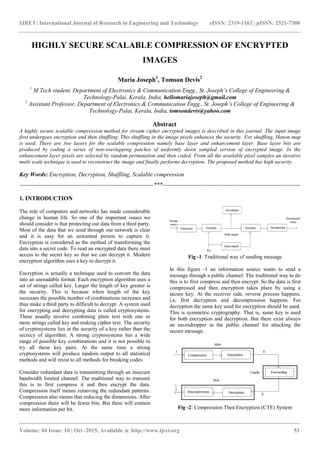
Fig -1: Traditional way of sending message
In this figure -1 an information source wants to send a
message through a public channel. The traditional way to do
this is to first compress and then encrypt. So the data is first
compressed and then encryption takes place by using a
secure key. At the receiver side, reverse process happens.
i.e, first decryption and decompression happens. For
decryption the same key used for encryption should be used.
This is symmetric cryptography. That is, same key is used
for both encryption and decryption. But there exist always
an eavesdropper in the public channel for attacking the
secure message.
Fig -2: Compression Then Encryption (CTE) System
IJRET: International Journal of Research in Engineering and Technology eISSN: 2319-1163 | pISSN: 2321-7308
_______________________________________________________________________________________
Volume: 04 Issue: 10 | Oct -2015, Available @ http://www.ijret.org 54
Consider a case in figure -2 in which Alice wants to send a
message securely and efficiently to Bob through an
untrusted channel provider Charlie. Conventionally this
could be done as follows: Alice first compress the data into
B and then encrypts into E using an encryption function
E(K), where K is used as the secret key. The encrypted data
E is then forwarded to Bob by Charlie, where Charlie is the
network provider. Upon receiving E, Bob sequentially
decode and decompress the message to retrieve the data I.
This conventional system meets many requirements but
even though in some situations we have to reverse the order
of encryption and compression. Alice is always interested in
securing her data. So she is only performing the encryption
algorithm when she has limited number of computational
resources. So in this case encryption is done by Alice at first
and then Compression is done by Charlie. So this has led to
Encryption Then Compression (ETC) System as in Figure -
3. The main task here is that compression has to be carried
out in the encryption domain as Charlie has no access to the
secret key.
Fig -3: Encryption Then Compression (ETC) System
2. RELATED WORK
Jiantao et. al proposed a scalable compression method for
stream cipher encrypted images [1]. They used standard
stream cipher format. The bit stream in the base layer is
produced by first down sampling the encrypted image and
then a series of non-overlapping patches are formed which
are uniform in nature. Johnson et. al examined the
possibility of encrypting a data stream and compressing it
without knowledge of key [2]. Using distributed source
coding principles the encrypted data can be compressed
because key will be available at the decoder. Schonberg et.
al extended Johnson’s work by considering information
source with memory [3] [4]. Using minimal number of bits
they transmitted encrypted source in this work. By applying
LDPC codes in various bit planes and exploiting the
intra/inter correlation Lazzeretti and Barni suggested
method for lossless compression of gray/color images [5].
By using the principle of source coding with side
information principle they recently demonstrated the
possibility of lossless compression of encrypted images.
Kumar and Makur applied Johnson et. al approach to the
prediction error domain by using the iid property of
prediction error sequences and achieved higher lossless
compression performance for both gray scale and color
images [6]. After the compression of gray scale and color
images which is carried out in lossless domain only
encryption is performed here. In addition to the lossless
compression, lossy compression was also investigated which
has higher compression ratios. Kumar and Makur proposed
compressive sensing mechanism to compress encrypted
images [7]. By using a modified pursuit algorithm the
original image could be estimated from the compressed and
encrypted data. Liu et. al proposed a lossless progressive
compression technique for gray / color scale images [8].
Through Slepian Wolf coding lossless compression of
encrypted images can be possible. Zhang designed an image
encryption method by performing permutation operations in
the pixel domain and showed that the resultant file can be
compressed by discarding the fine and rough coefficients in
the transform domain [9]. Here lossy compression of
encrypted image is discussed with flexible compression
ratio. Zhang et. al proposed a scalable lossy coding of
encrypted images through a multi resolution construction.
Here scalable coding of encrypted images is described [10].
Klinc et. al extended Johnson’s work to efficiently compress
block cipher encrypted data [11]. Here compression of block
cipher is considered. Zhang et. al proposed a new technique
for the compression of encrypted images through multi-layer
decomposition [12]. This is lossy compression of encrypted
gray images. Kang et. al proposed an interpolation based
technique for decompressing and there compression is
gained by down sampling and bit plane decomposition [13].
When more bit planes are transmitted higher quality of
reconstructed image can be achieved. Zhang et. al proposes
a method for compressing encrypted images in which the
information owner Alice also generates some auxiliary
information that can be used for compression and
reconstruction [14].
3. PROPOSED METHODOLOGY
In this we consider conventional stream cipher which is
applied in the standard format. That means cipher text is
produced by bitwise XORing the plain text with the key
stream. The scenario of scalable coding of encrypted image
is shown in figure -4. This work proposes a novel scalable
compression for shuffled encrypted images which has better
security. The input image first undergoes encryption in the
standard format (AES-CTR). For encryption we use AES-
128. That means the secure key that we used here is of 128
bit length. After encryption, the encrypted image undergoes
shuffling in order to increase the security. For shuffling we
use Henon map. A Henon map has the most chaotic
behavior. Here the Henon map takes a point and maps into
another point by using these two equations.
Xn+1 = 1-axn
2
+yn
Yn+1 = bxn
The shuffled image undergoes scalable compression. There
are two layers namely base layer and enhancement layer in
the scalable compression. The base layer bits Bb and
enhancement layer bits Be are generated here. From those
bits image is reconstructed and then undergoes
rearrangement of pixels. After that, it is given to the
decryption block where decryption is performed using the
IJRET: International Journal of Research in Engineering and Technology eISSN: 2319-1163 | pISSN: 2321-7308
_______________________________________________________________________________________
Volume: 04 Issue: 10 | Oct -2015, Available @ http://www.ijret.org 55
same key stream. The scalable image encoding scheme is
shown in figure -5. In order to generate base layer bits we
first uniformly down sample the shuffled image which then
undergoes wavelet decomposition. After that we divide the
latter into different patches which must be a series of non-
overlapping patches. Then we apply lossless encoding to
each of the patch to produce the base layer bit stream. The
final bit stream is generated by concatenating all the bits
from patches. Extra bits for reconstruction other than base
bits are produced by the enhancement layer. In this layer we
select pixels by random permutation. The same procedure to
generate base layer bits is adopted to this selected pixels and
by applying lossless encoding enhancement bits is finally
generated.
Fig -4: Scenario of scalable coding of encrypted images
Fig -5: Scalable image coding scheme
At the receiver side reverse process happens. That is lossless
decoding and wavelet reconstruction is done. And then the
image is decoded. Then the pixels are rearranged by using
sorting and Henon map. For final reconstruction of the
image an iterative interpolation technique called Soft
Adaptive Interpolation (SAI) is used. Finally the original
image is retrieved by using decryption. Same 128 bit key
that is used for encryption must be used for the proper
decryption.
4. RESULTS AND DISCUSSION
The proposed method has been tested for different gray
scale images. And it is possible to reconstruct the image
with more security. It is implemented by using MATLAB
2012. For input image AES - CTR encryption is applied.
Key used here is of 128 bit length. Figure -6 shows the input
image which undergoes encryption and figure -7 shows the
encrypted image. This encrypted image undergoes shuffling
by using Henon map for better security. This is shown in
figure -8. The shuffled image undergoes compression. This
means that the shuffled image is the input to both the base
and enhancement layer.
At the base layer the shuffled image is down sampled and
then undergoes wavelet decomposition at level 3. This is
shown in figure -9. After that it is divided into different
patches and apply Slepian wolf encoding. The bits generated
are shown in figure -10. Similarly enhancement layer bits
are produced by applying wavelet decomposition and
Slepian wolf encoding. This is shown in figure -11 and
figure -12.
At the receiver side reverse process happens and the image
is decoded. It is shown in figure -13. Rearrangement of
pixels is then done. After that image is reconstructed by
using Soft decision Adaptive Interpolation (SAI). This is
shown in figure -14. Finally, decryption is performed and
image is decrypted. It is shown in figure -15.
Fig -6: Input image
Fig -7: Encrypted image
IJRET: International Journal of Research in Engineering and Technology eISSN: 2319-1163 | pISSN: 2321-7308
_______________________________________________________________________________________
Volume: 04 Issue: 10 | Oct -2015, Available @ http://www.ijret.org 56
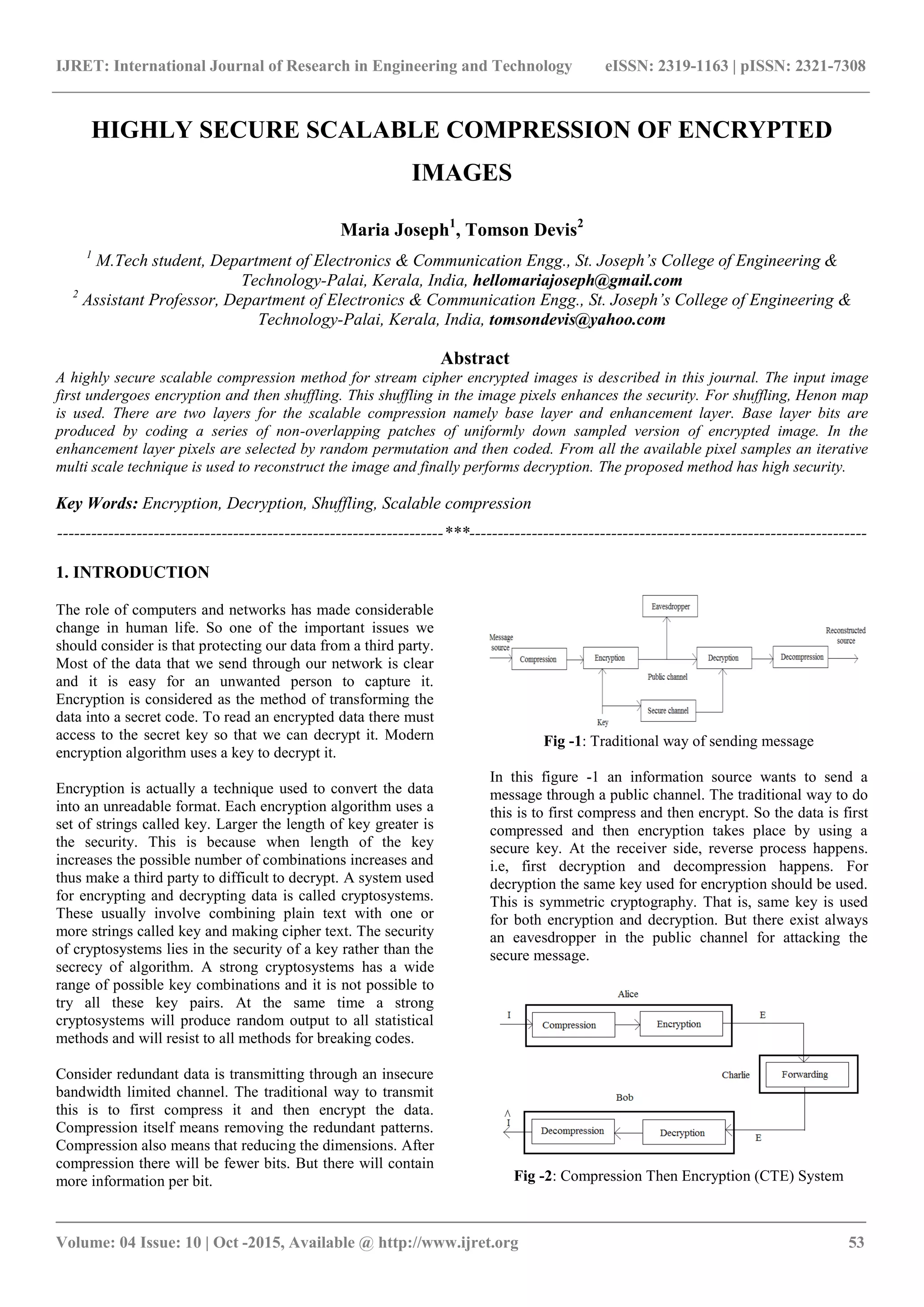
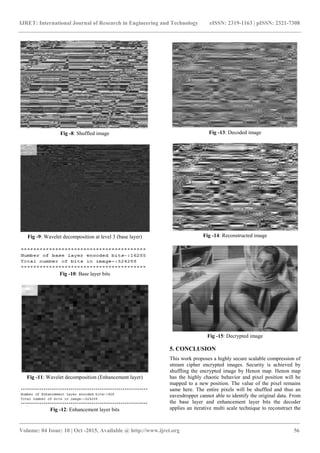
Fig -8: Shuffled image
Fig -9: Wavelet decomposition at level 3 (base layer)
Fig -10: Base layer bits
Fig -11: Wavelet decomposition (Enhancement layer)
Fig -12: Enhancement layer bits
Fig -13: Decoded image
Fig -14: Reconstructed image
Fig -15: Decrypted image
5. CONCLUSION
This work proposes a highly secure scalable compression of
stream cipher encrypted images. Security is achieved by
shuffling the encrypted image by Henon map. Henon map
has the highly chaotic behavior and pixel position will be
mapped to a new position. The value of the pixel remains
same here. The entire pixels will be shuffled and thus an
eavesdropper cannot able to identify the original data. From
the base layer and enhancement layer bits the decoder
applies an iterative multi scale technique to reconstruct the
IJRET: International Journal of Research in Engineering and Technology eISSN: 2319-1163 | pISSN: 2321-7308
_______________________________________________________________________________________
Volume: 04 Issue: 10 | Oct -2015, Available @ http://www.ijret.org 57
image. It has been tested on a large database and realized
that the proposed method has high security.
REFERENCES
[1]. Jiantao Zhou, Oscar C. Au, Guangtao Zhai, Yuan
Yan Tang and Xianming Liu, “Scalable compression
of stream cipher encrypted images through context
adaptive sampling”, IEEE transactions on
Information Forensics and Security, Vol. 9, No. 11,
November 2014.
[2]. M. Johnson, P. Ishwar, V. Prabhakaran, D.
Schonberg and K. Ramachandran, “On compressing
encrypted data”, IEEE Trans. Signal Process.,Vol.
52, No. 10, Oct 2004.
[3]. D. Schonberg, S. C. Draper and K. Ramachandran,
“On blind compression of encrypted correlated data
approaching the source entropy rate”, in Proc.43rd
Annu. Allerton Conf. Commun., Control, Comput.,
2005.
[4]. D. Schonberg, S. Draper and K. Ramachandran, “On
compression of encrypted images”, in Proc. IEEE
Int. Conf. Image Process., Oct. 2006.
[5]. R. Lazzeretti and M. Barni, “Lossless compression of
encrypted grey level and color images”, in Proc. 16th
Eur. Signal Process. Conf. (EUSIPCO), 2008.
[6]. Kumar and A. Makur, “Distributed source coding
based encryption and lossless compression of gray
scale and color images”, in Proc. 10th
Workshop
MMSP, Oct. 2008.
[7]. A Kumar and A. Makur, “Lossy compression of
encrypted image by compressive sensing technique”,
in Proc. IEEE Region 10th
Conf., Jan. 2009.
[8]. W. Liu, W. Zeng, L. Dong and Q. Yao, “Efficient
compression of encrypted grayscale images”, IEEE
Tans. Image Process., Vol. 19, No. 4, Apr. 2010.
[9]. X. Zhang, Y. Ren, G. Feng and Z. Qian,
“Compressing encrypted image using compressive
sensing”, in Proc. 7th
IEEE Int. Conf., IIH-MSP, Oct.
2011.
[10]. X. Zhang, G. Feng, Y. Ren and Z. Qian , “Scalable
coding of encrypted images”, IEEE Trans. Image
Process., Vol. 21, No.6, Jun. 2012.
[11]. D. Klinc, C. Hazay, A. Jagmohan, H. Krawczyk and
T. Rabin, “On compression of data encrypted with
block ciphers” IEEE Trans. Inf. Theory, Vol. 58, No.
11, Nov. 2012.
[12]. X. Zhang, G. Sun, L. Shen and C. Qin, “Compression
of encrypted images with multi-layer
decomposition”, Multimedia Tools Appl., Vol. 72,
No. 1, Feb. 2013.
[13]. X. Kang, A. Peng , X. Xu and X. Cao , “Performing
scalable lossy compression on pixel encrypted
images”, EURASIP J. Image Video Process, Vol.
2013, No. 32, May 2013.
[14]. X. Zhang, Y. Ren, L. Shen, Z. Qian and G. Freng,
“Compressing encrypted images with auxiliary
information”, IEEE Trans. Multimedia Vol. 16, No.
5, Aug. 2014.

Highly secure scalable compression of encrypted images

  • 1.
    IJRET: International Journalof Research in Engineering and Technology eISSN: 2319-1163 | pISSN: 2321-7308 _______________________________________________________________________________________ Volume: 04 Issue: 10 | Oct -2015, Available @ http://www.ijret.org 53 HIGHLY SECURE SCALABLE COMPRESSION OF ENCRYPTED IMAGES Maria Joseph1 , Tomson Devis2 1 M.Tech student, Department of Electronics & Communication Engg., St. Joseph’s College of Engineering & Technology-Palai, Kerala, India, hellomariajoseph@gmail.com 2 Assistant Professor, Department of Electronics & Communication Engg., St. Joseph’s College of Engineering & Technology-Palai, Kerala, India, tomsondevis@yahoo.com Abstract A highly secure scalable compression method for stream cipher encrypted images is described in this journal. The input image first undergoes encryption and then shuffling. This shuffling in the image pixels enhances the security. For shuffling, Henon map is used. There are two layers for the scalable compression namely base layer and enhancement layer. Base layer bits are produced by coding a series of non-overlapping patches of uniformly down sampled version of encrypted image. In the enhancement layer pixels are selected by random permutation and then coded. From all the available pixel samples an iterative multi scale technique is used to reconstruct the image and finally performs decryption. The proposed method has high security. Key Words: Encryption, Decryption, Shuffling, Scalable compression --------------------------------------------------------------------***---------------------------------------------------------------------- 1. INTRODUCTION The role of computers and networks has made considerable change in human life. So one of the important issues we should consider is that protecting our data from a third party. Most of the data that we send through our network is clear and it is easy for an unwanted person to capture it. Encryption is considered as the method of transforming the data into a secret code. To read an encrypted data there must access to the secret key so that we can decrypt it. Modern encryption algorithm uses a key to decrypt it. Encryption is actually a technique used to convert the data into an unreadable format. Each encryption algorithm uses a set of strings called key. Larger the length of key greater is the security. This is because when length of the key increases the possible number of combinations increases and thus make a third party to difficult to decrypt. A system used for encrypting and decrypting data is called cryptosystems. These usually involve combining plain text with one or more strings called key and making cipher text. The security of cryptosystems lies in the security of a key rather than the secrecy of algorithm. A strong cryptosystems has a wide range of possible key combinations and it is not possible to try all these key pairs. At the same time a strong cryptosystems will produce random output to all statistical methods and will resist to all methods for breaking codes. Consider redundant data is transmitting through an insecure bandwidth limited channel. The traditional way to transmit this is to first compress it and then encrypt the data. Compression itself means removing the redundant patterns. Compression also means that reducing the dimensions. After compression there will be fewer bits. But there will contain more information per bit. Fig -1: Traditional way of sending message In this figure -1 an information source wants to send a message through a public channel. The traditional way to do this is to first compress and then encrypt. So the data is first compressed and then encryption takes place by using a secure key. At the receiver side, reverse process happens. i.e, first decryption and decompression happens. For decryption the same key used for encryption should be used. This is symmetric cryptography. That is, same key is used for both encryption and decryption. But there exist always an eavesdropper in the public channel for attacking the secure message. Fig -2: Compression Then Encryption (CTE) System
  • 2.
    IJRET: International Journalof Research in Engineering and Technology eISSN: 2319-1163 | pISSN: 2321-7308 _______________________________________________________________________________________ Volume: 04 Issue: 10 | Oct -2015, Available @ http://www.ijret.org 54 Consider a case in figure -2 in which Alice wants to send a message securely and efficiently to Bob through an untrusted channel provider Charlie. Conventionally this could be done as follows: Alice first compress the data into B and then encrypts into E using an encryption function E(K), where K is used as the secret key. The encrypted data E is then forwarded to Bob by Charlie, where Charlie is the network provider. Upon receiving E, Bob sequentially decode and decompress the message to retrieve the data I. This conventional system meets many requirements but even though in some situations we have to reverse the order of encryption and compression. Alice is always interested in securing her data. So she is only performing the encryption algorithm when she has limited number of computational resources. So in this case encryption is done by Alice at first and then Compression is done by Charlie. So this has led to Encryption Then Compression (ETC) System as in Figure - 3. The main task here is that compression has to be carried out in the encryption domain as Charlie has no access to the secret key. Fig -3: Encryption Then Compression (ETC) System 2. RELATED WORK Jiantao et. al proposed a scalable compression method for stream cipher encrypted images [1]. They used standard stream cipher format. The bit stream in the base layer is produced by first down sampling the encrypted image and then a series of non-overlapping patches are formed which are uniform in nature. Johnson et. al examined the possibility of encrypting a data stream and compressing it without knowledge of key [2]. Using distributed source coding principles the encrypted data can be compressed because key will be available at the decoder. Schonberg et. al extended Johnson’s work by considering information source with memory [3] [4]. Using minimal number of bits they transmitted encrypted source in this work. By applying LDPC codes in various bit planes and exploiting the intra/inter correlation Lazzeretti and Barni suggested method for lossless compression of gray/color images [5]. By using the principle of source coding with side information principle they recently demonstrated the possibility of lossless compression of encrypted images. Kumar and Makur applied Johnson et. al approach to the prediction error domain by using the iid property of prediction error sequences and achieved higher lossless compression performance for both gray scale and color images [6]. After the compression of gray scale and color images which is carried out in lossless domain only encryption is performed here. In addition to the lossless compression, lossy compression was also investigated which has higher compression ratios. Kumar and Makur proposed compressive sensing mechanism to compress encrypted images [7]. By using a modified pursuit algorithm the original image could be estimated from the compressed and encrypted data. Liu et. al proposed a lossless progressive compression technique for gray / color scale images [8]. Through Slepian Wolf coding lossless compression of encrypted images can be possible. Zhang designed an image encryption method by performing permutation operations in the pixel domain and showed that the resultant file can be compressed by discarding the fine and rough coefficients in the transform domain [9]. Here lossy compression of encrypted image is discussed with flexible compression ratio. Zhang et. al proposed a scalable lossy coding of encrypted images through a multi resolution construction. Here scalable coding of encrypted images is described [10]. Klinc et. al extended Johnson’s work to efficiently compress block cipher encrypted data [11]. Here compression of block cipher is considered. Zhang et. al proposed a new technique for the compression of encrypted images through multi-layer decomposition [12]. This is lossy compression of encrypted gray images. Kang et. al proposed an interpolation based technique for decompressing and there compression is gained by down sampling and bit plane decomposition [13]. When more bit planes are transmitted higher quality of reconstructed image can be achieved. Zhang et. al proposes a method for compressing encrypted images in which the information owner Alice also generates some auxiliary information that can be used for compression and reconstruction [14]. 3. PROPOSED METHODOLOGY In this we consider conventional stream cipher which is applied in the standard format. That means cipher text is produced by bitwise XORing the plain text with the key stream. The scenario of scalable coding of encrypted image is shown in figure -4. This work proposes a novel scalable compression for shuffled encrypted images which has better security. The input image first undergoes encryption in the standard format (AES-CTR). For encryption we use AES- 128. That means the secure key that we used here is of 128 bit length. After encryption, the encrypted image undergoes shuffling in order to increase the security. For shuffling we use Henon map. A Henon map has the most chaotic behavior. Here the Henon map takes a point and maps into another point by using these two equations. Xn+1 = 1-axn 2 +yn Yn+1 = bxn The shuffled image undergoes scalable compression. There are two layers namely base layer and enhancement layer in the scalable compression. The base layer bits Bb and enhancement layer bits Be are generated here. From those bits image is reconstructed and then undergoes rearrangement of pixels. After that, it is given to the decryption block where decryption is performed using the
  • 3.
    IJRET: International Journalof Research in Engineering and Technology eISSN: 2319-1163 | pISSN: 2321-7308 _______________________________________________________________________________________ Volume: 04 Issue: 10 | Oct -2015, Available @ http://www.ijret.org 55 same key stream. The scalable image encoding scheme is shown in figure -5. In order to generate base layer bits we first uniformly down sample the shuffled image which then undergoes wavelet decomposition. After that we divide the latter into different patches which must be a series of non- overlapping patches. Then we apply lossless encoding to each of the patch to produce the base layer bit stream. The final bit stream is generated by concatenating all the bits from patches. Extra bits for reconstruction other than base bits are produced by the enhancement layer. In this layer we select pixels by random permutation. The same procedure to generate base layer bits is adopted to this selected pixels and by applying lossless encoding enhancement bits is finally generated. Fig -4: Scenario of scalable coding of encrypted images Fig -5: Scalable image coding scheme At the receiver side reverse process happens. That is lossless decoding and wavelet reconstruction is done. And then the image is decoded. Then the pixels are rearranged by using sorting and Henon map. For final reconstruction of the image an iterative interpolation technique called Soft Adaptive Interpolation (SAI) is used. Finally the original image is retrieved by using decryption. Same 128 bit key that is used for encryption must be used for the proper decryption. 4. RESULTS AND DISCUSSION The proposed method has been tested for different gray scale images. And it is possible to reconstruct the image with more security. It is implemented by using MATLAB 2012. For input image AES - CTR encryption is applied. Key used here is of 128 bit length. Figure -6 shows the input image which undergoes encryption and figure -7 shows the encrypted image. This encrypted image undergoes shuffling by using Henon map for better security. This is shown in figure -8. The shuffled image undergoes compression. This means that the shuffled image is the input to both the base and enhancement layer. At the base layer the shuffled image is down sampled and then undergoes wavelet decomposition at level 3. This is shown in figure -9. After that it is divided into different patches and apply Slepian wolf encoding. The bits generated are shown in figure -10. Similarly enhancement layer bits are produced by applying wavelet decomposition and Slepian wolf encoding. This is shown in figure -11 and figure -12. At the receiver side reverse process happens and the image is decoded. It is shown in figure -13. Rearrangement of pixels is then done. After that image is reconstructed by using Soft decision Adaptive Interpolation (SAI). This is shown in figure -14. Finally, decryption is performed and image is decrypted. It is shown in figure -15. Fig -6: Input image Fig -7: Encrypted image
  • 4.
    IJRET: International Journalof Research in Engineering and Technology eISSN: 2319-1163 | pISSN: 2321-7308 _______________________________________________________________________________________ Volume: 04 Issue: 10 | Oct -2015, Available @ http://www.ijret.org 56 Fig -8: Shuffled image Fig -9: Wavelet decomposition at level 3 (base layer) Fig -10: Base layer bits Fig -11: Wavelet decomposition (Enhancement layer) Fig -12: Enhancement layer bits Fig -13: Decoded image Fig -14: Reconstructed image Fig -15: Decrypted image 5. CONCLUSION This work proposes a highly secure scalable compression of stream cipher encrypted images. Security is achieved by shuffling the encrypted image by Henon map. Henon map has the highly chaotic behavior and pixel position will be mapped to a new position. The value of the pixel remains same here. The entire pixels will be shuffled and thus an eavesdropper cannot able to identify the original data. From the base layer and enhancement layer bits the decoder applies an iterative multi scale technique to reconstruct the
  • 5.
    IJRET: International Journalof Research in Engineering and Technology eISSN: 2319-1163 | pISSN: 2321-7308 _______________________________________________________________________________________ Volume: 04 Issue: 10 | Oct -2015, Available @ http://www.ijret.org 57 image. It has been tested on a large database and realized that the proposed method has high security. REFERENCES [1]. Jiantao Zhou, Oscar C. Au, Guangtao Zhai, Yuan Yan Tang and Xianming Liu, “Scalable compression of stream cipher encrypted images through context adaptive sampling”, IEEE transactions on Information Forensics and Security, Vol. 9, No. 11, November 2014. [2]. M. Johnson, P. Ishwar, V. Prabhakaran, D. Schonberg and K. Ramachandran, “On compressing encrypted data”, IEEE Trans. Signal Process.,Vol. 52, No. 10, Oct 2004. [3]. D. Schonberg, S. C. Draper and K. Ramachandran, “On blind compression of encrypted correlated data approaching the source entropy rate”, in Proc.43rd Annu. Allerton Conf. Commun., Control, Comput., 2005. [4]. D. Schonberg, S. Draper and K. Ramachandran, “On compression of encrypted images”, in Proc. IEEE Int. Conf. Image Process., Oct. 2006. [5]. R. Lazzeretti and M. Barni, “Lossless compression of encrypted grey level and color images”, in Proc. 16th Eur. Signal Process. Conf. (EUSIPCO), 2008. [6]. Kumar and A. Makur, “Distributed source coding based encryption and lossless compression of gray scale and color images”, in Proc. 10th Workshop MMSP, Oct. 2008. [7]. A Kumar and A. Makur, “Lossy compression of encrypted image by compressive sensing technique”, in Proc. IEEE Region 10th Conf., Jan. 2009. [8]. W. Liu, W. Zeng, L. Dong and Q. Yao, “Efficient compression of encrypted grayscale images”, IEEE Tans. Image Process., Vol. 19, No. 4, Apr. 2010. [9]. X. Zhang, Y. Ren, G. Feng and Z. Qian, “Compressing encrypted image using compressive sensing”, in Proc. 7th IEEE Int. Conf., IIH-MSP, Oct. 2011. [10]. X. Zhang, G. Feng, Y. Ren and Z. Qian , “Scalable coding of encrypted images”, IEEE Trans. Image Process., Vol. 21, No.6, Jun. 2012. [11]. D. Klinc, C. Hazay, A. Jagmohan, H. Krawczyk and T. Rabin, “On compression of data encrypted with block ciphers” IEEE Trans. Inf. Theory, Vol. 58, No. 11, Nov. 2012. [12]. X. Zhang, G. Sun, L. Shen and C. Qin, “Compression of encrypted images with multi-layer decomposition”, Multimedia Tools Appl., Vol. 72, No. 1, Feb. 2013. [13]. X. Kang, A. Peng , X. Xu and X. Cao , “Performing scalable lossy compression on pixel encrypted images”, EURASIP J. Image Video Process, Vol. 2013, No. 32, May 2013. [14]. X. Zhang, Y. Ren, L. Shen, Z. Qian and G. Freng, “Compressing encrypted images with auxiliary information”, IEEE Trans. Multimedia Vol. 16, No. 5, Aug. 2014.