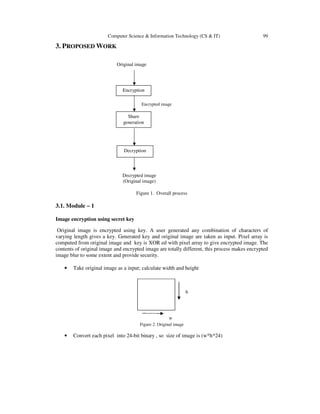
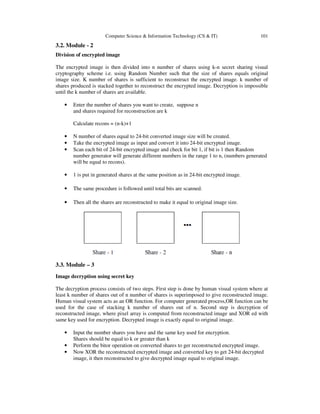
This document proposes a variable length key-based visual cryptography scheme for encrypting color images. It involves encrypting the original image using a variable length symmetric key, generating shares of the encrypted image using random numbers, and decrypting the shares by stacking a minimum number of shares and applying the same encryption key. The proposed scheme aims to improve security over simple visual cryptography by using an encryption key and random number-based share generation, making the shares and encrypted image different from the original image. It is described as having less complex share generation than other techniques while providing security through the use of encryption and a variable length key.
![VARIABLE LENGTH KEY BASED VISUAL
CRYPTOGRAPHY SCHEME FOR COLOR
IMAGE
Akhil Anjikar 1, Prashant Dahiwale2, Suchita Tarare 3
1Deparment of Information technology,
Rajiv Gandhi college of Engineering & Research, Nagpur, India.
akhil.anjikar09@gmail.com
2Department of Computer Sci. & Engg.,
Rajiv Gandhi college of Engineering & Research, Nagpur, India.
prashant.dahiwale@gmail.com
3Department of Computer Sci. & Engg.,
Rajiv Gandhi college of Engineering & Research, Nagpur, India.
suchitatarare@gmail.com
ABSTRACT
Visual Cryptography is a special encryption technique that encrypts the secret image into n
number of shares to hide information in images in such a way that it can be decrypted by the
human visual system. It is imperceptible to reveal the secret information unless a certain
number of shares (k) or more are superimposed. Simple visual cryptography is very insecure.
Variable length key based visual cryptography for color image uses a variable length Symmetric
Key based Visual Cryptographic Scheme for color images where a secret key is used to encrypt
the image and division of the encrypted image is done using Random Number. Unless the secret
key, the original image will not be decrypted. Here secret key ensures the security of image.
This paper describes the overall process of above scheme. Encryption process encrypts the
Original Image using variable length Symmetric Key, gives encrypted image. Share generation
process divides the encrypted image into n number of shares using random number. Decryption
process stacks k number of shares out of n to reconstruct encrypted image and uses the same
key for decryption.
KEYWORDS
Visual Cryptography, Secret Sharing, Random Number, Symmetric Key.
1. INTRODUCTION
Cryptography is study of mathematical technique to provide the methods for information security.
It provides such services like authentication, data security, and confidentiality. Visual
cryptography is one of the techniques used in modern world to maintain the secret massage
transmission. In this technique no need of any cryptographic algorithms likes symmetric (DES,
AES, TRIPLE DES etc) and asymmetric (RSA, Diffie- Hellman, Elliptic Curve Cryptographic)
algorithms. Noar and Shamir introduce visual cryptography in 1994 [2]. This technique is used to
David C. Wyld et al. (Eds) : SAI, CDKP, ICAITA, NeCoM, SEAS, CMCA, ASUC, Signal - 2014
pp. 97–104, 2014. © CS & IT-CSCP 2014 DOI : 10.5121/csit.2014.41110](https://image.slidesharecdn.com/variablelengthkeybasedvisual-141118211257-conversion-gate01/85/Variable-length-key-based-visual-1-320.jpg)
![VARIABLE LENGTH KEY BASED VISUAL
CRYPTOGRAPHY SCHEME FOR COLOR
IMAGE
Akhil Anjikar 1, Prashant Dahiwale2, Suchita Tarare 3
1Deparment of Information technology,
Rajiv Gandhi college of Engineering & Research, Nagpur, India.
akhil.anjikar09@gmail.com
2Department of Computer Sci. & Engg.,
Rajiv Gandhi college of Engineering & Research, Nagpur, India.
prashant.dahiwale@gmail.com
3Department of Computer Sci. & Engg.,
Rajiv Gandhi college of Engineering & Research, Nagpur, India.
suchitatarare@gmail.com
ABSTRACT
Visual Cryptography is a special encryption technique that encrypts the secret image into n
number of shares to hide information in images in such a way that it can be decrypted by the
human visual system. It is imperceptible to reveal the secret information unless a certain
number of shares (k) or more are superimposed. Simple visual cryptography is very insecure.
Variable length key based visual cryptography for color image uses a variable length Symmetric
Key based Visual Cryptographic Scheme for color images where a secret key is used to encrypt
the image and division of the encrypted image is done using Random Number. Unless the secret
key, the original image will not be decrypted. Here secret key ensures the security of image.
This paper describes the overall process of above scheme. Encryption process encrypts the
Original Image using variable length Symmetric Key, gives encrypted image. Share generation
process divides the encrypted image into n number of shares using random number. Decryption
process stacks k number of shares out of n to reconstruct encrypted image and uses the same
key for decryption.
KEYWORDS
Visual Cryptography, Secret Sharing, Random Number, Symmetric Key.
1. INTRODUCTION
Cryptography is study of mathematical technique to provide the methods for information security.
It provides such services like authentication, data security, and confidentiality. Visual
cryptography is one of the techniques used in modern world to maintain the secret massage
transmission. In this technique no need of any cryptographic algorithms likes symmetric (DES,
AES, TRIPLE DES etc) and asymmetric (RSA, Diffie- Hellman, Elliptic Curve Cryptographic)
algorithms. Noar and Shamir introduce visual cryptography in 1994 [2]. This technique is used to
David C. Wyld et al. (Eds) : SAI, CDKP, ICAITA, NeCoM, SEAS, CMCA, ASUC, Signal - 2014
pp. 97–104, 2014. © CS & IT-CSCP 2014 DOI : 10.5121/csit.2014.41110](https://image.slidesharecdn.com/variablelengthkeybasedvisual-141118211257-conversion-gate01/75/Variable-length-key-based-visual-1-2048.jpg)
![98 Computer Science & Information Technology (CS & IT)
reduce complexity of encrypted and decrypted method and also two way communication can be
achieved very securely. Traditional techniques use private and public key concepts. But it could
be achieved only by the distribution of keys [7].
Until the year 1997 visual cryptography schemes were applied to only black and white images.
First colored visual cryptography scheme was developed by Verheul and Van Tilborg. Image is a
multimedia component sensed by human perception. A color digital image is composed of a finite
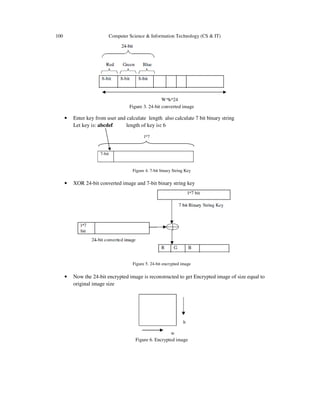
number of elements called pixels. In a 24 bit digital image each pixel consists of 24 bits, which
includes three parts, namely Red, Green and Blue, each with 8 bits [1][2].
Human visual system acts as an OR function. If shares are printed on transparencies and stack
together then anyone can visualize the image. To make it more secure we are using variable
length symmetric key. Fixed length key can be easily computed by combination of characters by
the attacker. For variable length key, it is difficult to find the key as the length can be 0 to any
number.
A Key is used to provide more security so that attacker cannot retrieve the secret information
without the key. Original image is encrypted using key and produces cipher. Cipher is decrypted
using key and the original image is retrieved. Same key is used for encryption and decryption
called symmetric encryption.
2. LITERATURE REVIEW
Visual cryptography proposed by Naor and Shamir where encryption of image means the
generation of shares without any cryptographic computation. Original image is divided into n
number by shares by applying any k-n secret sharing visual cryptographic scheme. Decryption is
done by human visual system means if shares are printed on transparencies and stack together
then anyone can visualize the image. So, if anyone get some number of shares can easily decrypt
the image. Simple visual cryptography is not very secure technique [1].
Watermarking using visual cryptography where original image is divided into shares, with k-n
secret sharing visual cryptography scheme. An enveloping technique is proposed where the secret
shares are enveloped within apparently innocent covers of digital pictures using LSB replacement
digital watermarking. This adds security to visual cryptography technique from illicit attack as it
befools the hacker’s eye. K-n secret sharing process is simple as random number is used. Shares
contain the original image contents, if anyone get shares then original image can be obtained [10].
The shares are enveloped into apparently innocent cover of digital pictures and can be sent
through same or different communication channels. Invisible digital watermarking befools the
hacker. Watermarking is a technique to put a signature of the owner within the creation. As shares
are generated from the original image this scheme does not provide more security [2].](https://image.slidesharecdn.com/variablelengthkeybasedvisual-141118211257-conversion-gate01/85/Variable-length-key-based-visual-2-320.jpg)
![Computer Science & Information Technology (CS & IT)
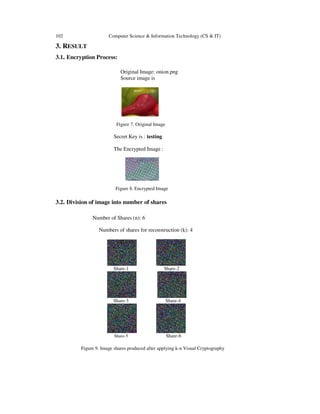
3.3. Decryption Process
Number of shares taken for
Figure 10
Secret Key is:
Key is applied on reconstructed image. The Final image is:
Figure
4. CONCLUSION
In visual cryptography encryption means the generation of shares and decryption in is based on
OR operation, so if a person gets sufficient k number of shares the image can be easily decrypted.
So simple visual cryptography is not more secure.
In this paper we have proposed a variable length key based visual cryptography for color image
with random number for share generation. In this scheme key adds robustness to the visual
cryptography techniques and variable length of the key makes it more secur
have totally different information regards to original image. For share generation we are using
random number which needs very less mathematical calculation compare with other existing
techniques of visual cryptography on color images
for encryption and random number generator for share generation this process is more secure than
other visual cryptography schemes [8].
Table 1. Comparison of other processes with Proposed Scheme
Other processes
Share generation process is applied directly on
original image.
Generated shares contain the original image
contents.
Do not provide more security.
Share generation process is complex.
Decryption is done by OR operation.
reconstruction: 4
10. Reconstructed Image
testing
11. Decrypted Image
secure. Generated shares
[3][4][5]. As we are using variable length key
Proposed scheme
Share generation process is applied on encrypted
image.
Generated shares have totally different contents.
Use of key makes it more secure.
Share generation process is simple as random
number is used.
Decryption is done by OR as well as XOR
operation.
103
e.](https://image.slidesharecdn.com/variablelengthkeybasedvisual-141118211257-conversion-gate01/85/Variable-length-key-based-visual-7-320.jpg)
![104 Computer Science & Information Technology (CS & IT)
REFERENCES
[1] M. Naor and A. Shamir, “Visual cryptography,”Advances in Cryptology-Eurocrypt94, pp.1–12,
1995.
[2] S. Craver, N. Memon, B. L. Yeo, and M. M. Yeung. Resolving Rightful Ownerships with Invisible
Watermarking Techniques: Limitations, Attacks and Implications. IEEE Journal on Selected Areas in
Communications, Vol16, No.4 May 1998, pp.573–586.
[3] F. Liu1, C.K. Wu1, X.J. Lin, Colour visual cryptography schemes, IET Information Security, July
2008.
[4] Kang InKoo el. at., Color Extended Visual Cryptography using Error Diffusion, IEEE 2010.
[5] SaiChandana B., Anuradha S., A New Visual Cryptography Scheme for Color Images, International
Journal of Engineering Science and Technology, Vol 2 (6), 2010.
[6] Li Bai , A Reliable (k,n) Image Secret Sharing Scheme by, IEEE,2006.
[7] M.Amarnath Reddy, P.Shanthi Bala, G.Aghila “visual cryptography schemes comparision”, Vol. 3
No. 5 May 2011.
[8] SaiChandana B., Anuradha S., A New Visual Cryptography Scheme for Color Images, International
Journal of Engineering Science and Technology, Vol 2 (6), 2010.
[9] Kang InKoo el. at., Color Extended Visual Cryptography using Error Diffusion, IEEE 2010.
[10] JIM CAI, “ A SHORT SURVEY ON VISUAL CRYPTOGRAPHY SCHEMES”.](https://image.slidesharecdn.com/variablelengthkeybasedvisual-141118211257-conversion-gate01/85/Variable-length-key-based-visual-8-320.jpg)


![Getting Started with Apache Spark: Big Data Made Simple [Free Meetup]](https://cdn.slidesharecdn.com/ss_thumbnails/apachesparkgettingstarted-260203175547-8361bcc3-thumbnail.jpg?width=640&height=640&fit=bounds)

