Yusufoglu, Institute of Semiconductor Electronics
Modeling and simulation of annual
energy yields of bifacial modules at
different climate zones
U. Yusufoglu, T. Lee, T. Pletzer, H. Kurz
Institute of Semiconductor Electronics, RWTH Aachen University, Germany
A. Halm, L. J. Koduvelikulathu, C. Comparotto, R. Kopecek
International Solar Energy Research Center (ISC), Konstanz, Germany
bifiPV Workshop 2014, 27.05.2014
Yusufoglu, Institute of Semiconductor Electronics
Albedo
module
elevation
Vertical
Outline
Annual energy yield simulation based on individual characteristics of solar cells
27.05.2014
Modeling and simulation of annual energy yields of bifacial modules at different climate zones
2
Optimization of tilt angle
Location
South
facing
S i m u l a t i o n r e s u l t s
Gain with respect to standard module
AnnualEnergyYield
Measured I-V
of solar cells
Cell/Module Temperature
M o d e l i n g s t e p s
Two-Diode-Model
Irradiance reaching both cell surfaces
 Direct
 Diffuse
 Albedo (effect of shadow for rear)
 AOI losses & spectral mismatch
Yusufoglu, Institute of Semiconductor Electronics
Measurement of I-V characteristics
27.05.2014
Modeling and simulation of annual energy yields of bifacial modules at different climate zones
3
 Six-inch mono-Si n-type bifacial solar cells [1]
 Separately available I-V characterics of front and rear
 Bifaciality of cells on average 80 %
Front
Rear
Rear
Front
Black chuck
Front illumination Rear illumination
Black chuck
[1] Mihailetchi et al., bifiPV2012
Black chuckBlack chuck
 Simulations with 60-cell modules using their two-diode model representation
Yusufoglu, Institute of Semiconductor Electronics
Irradiance at both planes
GHI, DNI, DHI data acquired from GeoModel Solar
with a time resolution of 15 minutes
Three irradiance types separately determined for front/rear
 Direct irradiance
– Angle of incidence using azimuth and elevation
– For rear planes of south facing modules mainly insignificant
 Diffuse irradiance
– Perez model [1]
 Encapsulation losses resolved over angle of incidence via raytracing [2]
 Spectral mismatch with King‘s model [3]
[1] Perez et al., Solar Energy 1990; 44(5); 271-289
[2] Tracey, PVLighthouse, http://www.pvlighthouse.com.au/simulation/hosted/tracey/tracey.aspx
[3] King et al., SAND2004-3535
27.05.2014
Modeling and simulation of annual energy yields of bifacial modules at different climate zones
4
Yusufoglu, Institute of Semiconductor Electronics
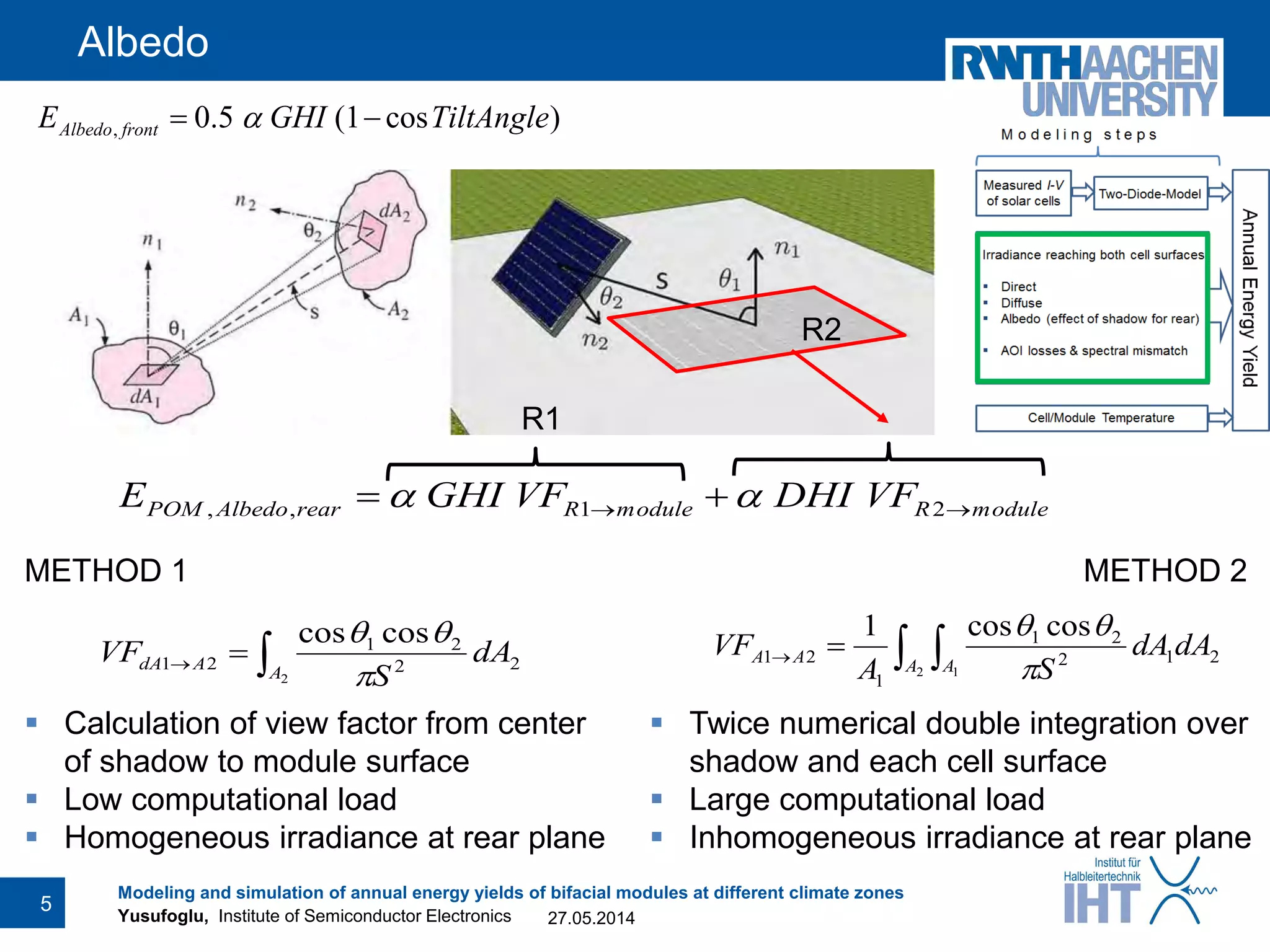
Albedo
27.05.2014
Modeling and simulation of annual energy yields of bifacial modules at different climate zones
5
)cos1(5.0, TiltAngleGHIE frontAlbedo  
odulemRodulemRrearAlbedoPOM VFDHIVFGHIE   21,, 
R1
R2
METHOD 1
 Calculation of view factor from center
of shadow to module surface
 Low computational load
 Homogeneous irradiance at rear plane
METHOD 2
 Twice numerical double integration over
shadow and each cell surface
 Large computational load
 Inhomogeneous irradiance at rear plane

2
22
21
21
coscos
A
AdA dA
S
VF


 
2 1
212
21
1
21
coscos1
A A
AA dAdA
SA
VF


Yusufoglu, Institute of Semiconductor Electronics
Cell temperature
 Time resolved ambient temperature data available
 Cell temperature calculation with NOCT formula
𝑇 𝑐𝑒𝑙𝑙 = 𝑇 𝑎𝑚𝑏𝑖𝑒𝑛𝑡 +
𝐼𝑟𝑟𝑎𝑑𝑖𝑎𝑛𝑐𝑒 [𝑊/𝑚2]
800 𝑊/𝑚2
(𝑇𝑁𝑂 𝐶𝑇 − 20 °𝐶)
 Standard modules  TNOCT = 45 °C
 Bifacial modules  TNOCT = 47 °C
27.05.2014
Modeling and simulation of annual energy yields of bifacial modules at different climate zones
6
Yusufoglu, Institute of Semiconductor Electronics
Locations studied
 Two locations with highly different climates
Oslo, Norway:
predominantly diffuse light
higher percentage of low-light
Cairo, Egypt:
predominantly direct light
long time intervals with high insolation
27.05.2014
Modeling and simulation of annual energy yields of bifacial modules at different climate zones
7
0 200 400 600 800 1000
0
200
400
600
800
1000
Frequency[hours/year]
Global horizontal irradiance [W/m2
]
Oslo
Cairo
Constraints in simulations:
 Single module operation
 smaller shadows than in field
 no additional reflection from next row
 No soiling/snow
 Constant albedo throughout the year
Yusufoglu, Institute of Semiconductor Electronics
South facing modules: Tilt angle optimization
27.05.2014
Modeling and simulation of annual energy yields of bifacial modules at different climate zones
8
1397
1402
1208
1213
1088
1093
44 46 48 50 52 54 56 58 60 62
1045
1050
Annualenergyyield[kWh/kWp]
2323
2331
1988
1996
1777
1785
22 24 26 28 30 32 34 36 38 40
1746
1756
α=0.5α=0.2
Oslo Cairo
STD STD
STDSTD
BIF
BIF
BIF
BIF
Tilt angle [°]
 α = 0.2  Larger optimal tilt angles for bifacial modules
 α = 0.5  Similar optimal tilt angles for both module types
 Larger tilt angles for higher reflective ground
[1] Yusufoglu et al., Energy Procedia, in press
Yusufoglu, Institute of Semiconductor Electronics
South facing modules: Tilt angle optimization
 Larger tilt angles for
– Higher reflective ground
– Lower installations
 Changes smaller for Oslo
 1.5% yield loss @Cairo α=0.5 h=2m when using θopt = 32° instead of 42°
[1] Yusufoglu et al., Energy Procedia, in press
27.05.2014
Modeling and simulation of annual energy yields of bifacial modules at different climate zones
9
Module
elevation
Oslo Cairo
α = 0.2 α = 0.5 α = 0.2 α = 0.5
2 m 54 56 31 32
0.5 m 54 57 32 34
0 m 55 58 35 42
Yusufoglu, Institute of Semiconductor Electronics
Vertically installed modules
 Vertically installed modules yield nearly same whether front facing East or West
 Provided a high albedo vertical installations can yield more than standard modules
 No change in yield with varying module elevation
27.05.2014
Modeling and simulation of annual energy yields of bifacial modules at different climate zones
10
0
300
600
900
1200
1500
Annualenergyyield[kh/kWp
]
STDsouth
BIFsouth
BIFfrontEast
BIFfrontWest
STDsouth
BIFsouth
BIFfrontEast
BIFfrontWest
OSLO
α = 0.2
0
400
800
1200
1600
2000
2400
CAIRO
α = 0.2
STDsouth
BIFsouth
BIFfrontEast
BIFfrontWest
STDsouth
BIFsouth
BIFfrontEast
BIFfrontWest
α = 0.5α = 0.5
Yusufoglu, Institute of Semiconductor Electronics
Module elevation & albedo on yield
 Annual gain increases with increasing height
– Effect of module elevation small in Oslo  less prone to nonoptimal installation
 Linear relationship between albedo coefficient and annual yield
– Larger slope for higher installed modules
[1] Yusufoglu et al., Energy Procedia, in press
27.05.2014
Modeling and simulation of annual energy yields of bifacial modules at different climate zones
11
0,20 0,35 0,50
1900
2000
2100
2200
2300
2400
Annualenergyyield[kWh/kWp]
Albedo coefficient
Distance of lower
module edge from ground
2 m
0.5 m
0 m
@ Cairo
1900
2000
2100
2200
2300
2400
0,0 0,5 1,0 1,5 2,0
1210
1214
1304
1308
1398
1404
Cairo
Albedo coefficient 0.5 0.35 0.2
Oslo
Annualenergyyield[kWh/kWp]
Lower module edge from ground [m]
Yusufoglu, Institute of Semiconductor Electronics
Comparison with standard modules
 Increased yields with bifacial modules than standard ones with
– Higher reflective ground
– Higher installations
 Yield gain with higher installations insignificant for Oslo
[1] Yusufoglu et al., Energy Procedia, in press
27.05.2014
Modeling and simulation of annual energy yields of bifacial modules at different climate zones
12
Module
elevation
Oslo Cairo
α = 0.2 α = 0.5 α = 0.2 α = 0.5
2 m 15.5 % 28.3 % 13.8 % 30.6 %
0.5 m 15.5 % 28.3 % 12.9 % 28.8 %
0 m 15.4 % 28.1 % 10.6 % 24.3 %
 Bifaciality gain in yield with respect to standard modules
Yusufoglu, Institute of Semiconductor Electronics
Inhomogenity at rear module plane
27.05.2014
Modeling and simulation of annual energy yields of bifacial modules at different climate zones
13
Module elevation: 2 m
α = 0.5
Module elevation: 0.1 m
α = 0.5
Irradiance at the module rear side [W/m2] on an examplary summer day in Cairo
Yusufoglu, Institute of Semiconductor Electronics
Inhomogenity at rear module plane
27.05.2014
Modeling and simulation of annual energy yields of bifacial modules at different climate zones
14
 Reduction of nonuniformity with higher module elevation
 Module installation optimization more beneficial for direct light dominated regions
Module
elevation
Oslo Cairo
α = 0.2 α = 0.5 α = 0.2 α = 0.5
2 m 15.5 % 9.3 % 28.3 % 13.9 % 13.8 % 10.0 % 30.6 % 21.5 %
0 m 15.4 % 9.3 % 28.1 % 13.3 % 10.6 % 8.3 % 24.3 % 16.5 %
 Bifaciality gain in yield with respect to standard modules
Including the inhomogenity at the rear side
Yusufoglu, Institute of Semiconductor Electronics
Conclusion
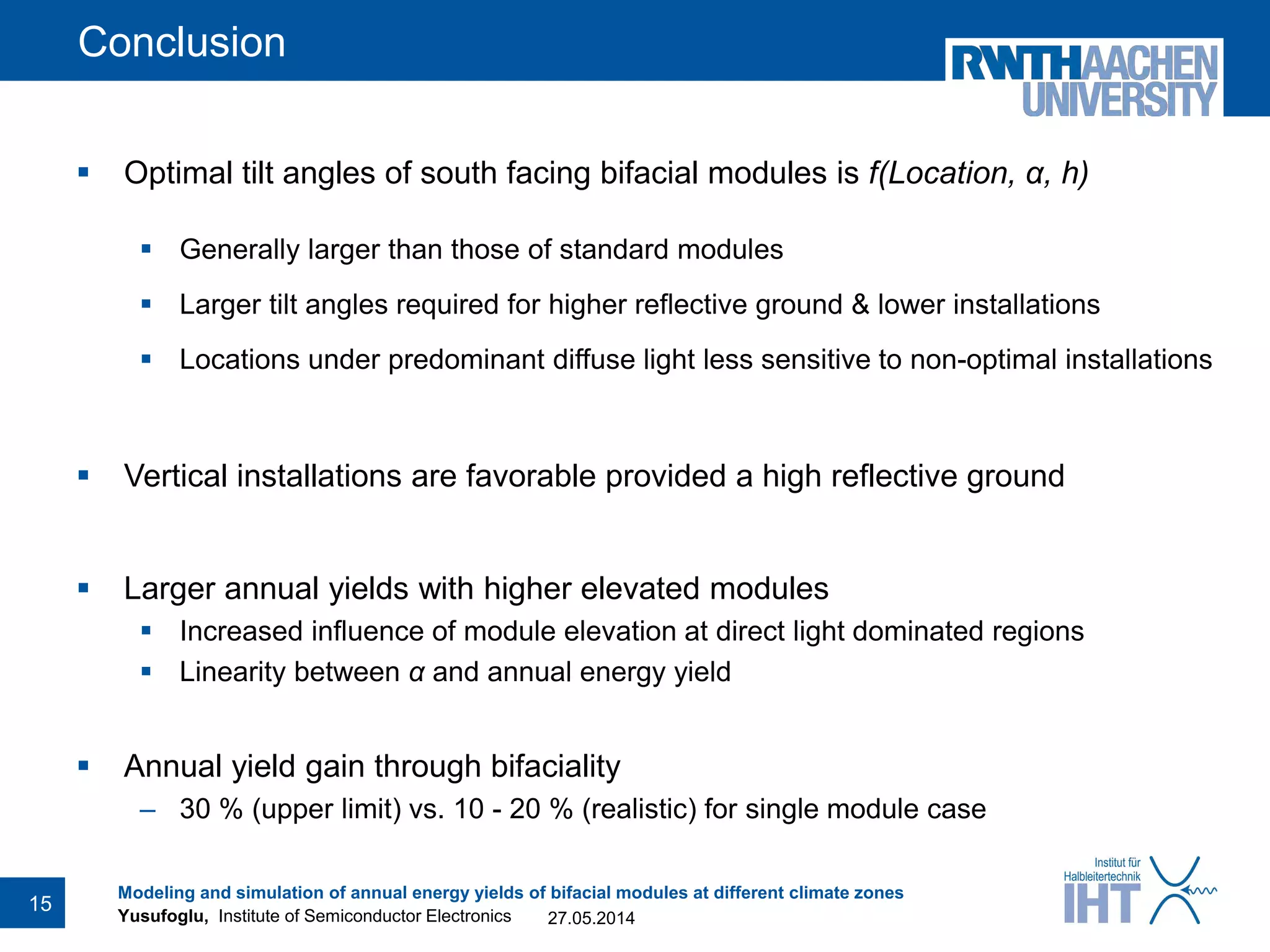
 Optimal tilt angles of south facing bifacial modules is f(Location, α, h)
 Generally larger than those of standard modules
 Larger tilt angles required for higher reflective ground & lower installations
 Locations under predominant diffuse light less sensitive to non-optimal installations
 Vertical installations are favorable provided a high reflective ground
 Larger annual yields with higher elevated modules
 Increased influence of module elevation at direct light dominated regions
 Linearity between α and annual energy yield
 Annual yield gain through bifaciality
– 30 % (upper limit) vs. 10 - 20 % (realistic) for single module case
27.05.2014
Modeling and simulation of annual energy yields of bifacial modules at different climate zones
15
Yusufoglu, Institute of Semiconductor Electronics
Thank you for your attention!
This work is part of the project “Kompetenzzentrum für innovative Photovoltaik-Modultechnik NRW” and has
been supported by the European Union – European Regional Development Fund and by the Ministry of
Economic Affairs and Energy of the State of North Rhine-Westphalia, Germany.
Thanks to the colleagues at ISC Konstanz for
the measurements.

3 yusufoglu ok

  • 1.
    Yusufoglu, Institute ofSemiconductor Electronics Modeling and simulation of annual energy yields of bifacial modules at different climate zones U. Yusufoglu, T. Lee, T. Pletzer, H. Kurz Institute of Semiconductor Electronics, RWTH Aachen University, Germany A. Halm, L. J. Koduvelikulathu, C. Comparotto, R. Kopecek International Solar Energy Research Center (ISC), Konstanz, Germany bifiPV Workshop 2014, 27.05.2014
  • 2.
    Yusufoglu, Institute ofSemiconductor Electronics Albedo module elevation Vertical Outline Annual energy yield simulation based on individual characteristics of solar cells 27.05.2014 Modeling and simulation of annual energy yields of bifacial modules at different climate zones 2 Optimization of tilt angle Location South facing S i m u l a t i o n r e s u l t s Gain with respect to standard module AnnualEnergyYield Measured I-V of solar cells Cell/Module Temperature M o d e l i n g s t e p s Two-Diode-Model Irradiance reaching both cell surfaces  Direct  Diffuse  Albedo (effect of shadow for rear)  AOI losses & spectral mismatch
  • 3.
    Yusufoglu, Institute ofSemiconductor Electronics Measurement of I-V characteristics 27.05.2014 Modeling and simulation of annual energy yields of bifacial modules at different climate zones 3  Six-inch mono-Si n-type bifacial solar cells [1]  Separately available I-V characterics of front and rear  Bifaciality of cells on average 80 % Front Rear Rear Front Black chuck Front illumination Rear illumination Black chuck [1] Mihailetchi et al., bifiPV2012 Black chuckBlack chuck  Simulations with 60-cell modules using their two-diode model representation
  • 4.
    Yusufoglu, Institute ofSemiconductor Electronics Irradiance at both planes GHI, DNI, DHI data acquired from GeoModel Solar with a time resolution of 15 minutes Three irradiance types separately determined for front/rear  Direct irradiance – Angle of incidence using azimuth and elevation – For rear planes of south facing modules mainly insignificant  Diffuse irradiance – Perez model [1]  Encapsulation losses resolved over angle of incidence via raytracing [2]  Spectral mismatch with King‘s model [3] [1] Perez et al., Solar Energy 1990; 44(5); 271-289 [2] Tracey, PVLighthouse, http://www.pvlighthouse.com.au/simulation/hosted/tracey/tracey.aspx [3] King et al., SAND2004-3535 27.05.2014 Modeling and simulation of annual energy yields of bifacial modules at different climate zones 4
  • 5.
    Yusufoglu, Institute ofSemiconductor Electronics Albedo 27.05.2014 Modeling and simulation of annual energy yields of bifacial modules at different climate zones 5 )cos1(5.0, TiltAngleGHIE frontAlbedo   odulemRodulemRrearAlbedoPOM VFDHIVFGHIE   21,,  R1 R2 METHOD 1  Calculation of view factor from center of shadow to module surface  Low computational load  Homogeneous irradiance at rear plane METHOD 2  Twice numerical double integration over shadow and each cell surface  Large computational load  Inhomogeneous irradiance at rear plane  2 22 21 21 coscos A AdA dA S VF     2 1 212 21 1 21 coscos1 A A AA dAdA SA VF  
  • 6.
    Yusufoglu, Institute ofSemiconductor Electronics Cell temperature  Time resolved ambient temperature data available  Cell temperature calculation with NOCT formula 𝑇 𝑐𝑒𝑙𝑙 = 𝑇 𝑎𝑚𝑏𝑖𝑒𝑛𝑡 + 𝐼𝑟𝑟𝑎𝑑𝑖𝑎𝑛𝑐𝑒 [𝑊/𝑚2] 800 𝑊/𝑚2 (𝑇𝑁𝑂 𝐶𝑇 − 20 °𝐶)  Standard modules  TNOCT = 45 °C  Bifacial modules  TNOCT = 47 °C 27.05.2014 Modeling and simulation of annual energy yields of bifacial modules at different climate zones 6
  • 7.
    Yusufoglu, Institute ofSemiconductor Electronics Locations studied  Two locations with highly different climates Oslo, Norway: predominantly diffuse light higher percentage of low-light Cairo, Egypt: predominantly direct light long time intervals with high insolation 27.05.2014 Modeling and simulation of annual energy yields of bifacial modules at different climate zones 7 0 200 400 600 800 1000 0 200 400 600 800 1000 Frequency[hours/year] Global horizontal irradiance [W/m2 ] Oslo Cairo Constraints in simulations:  Single module operation  smaller shadows than in field  no additional reflection from next row  No soiling/snow  Constant albedo throughout the year
  • 8.
    Yusufoglu, Institute ofSemiconductor Electronics South facing modules: Tilt angle optimization 27.05.2014 Modeling and simulation of annual energy yields of bifacial modules at different climate zones 8 1397 1402 1208 1213 1088 1093 44 46 48 50 52 54 56 58 60 62 1045 1050 Annualenergyyield[kWh/kWp] 2323 2331 1988 1996 1777 1785 22 24 26 28 30 32 34 36 38 40 1746 1756 α=0.5α=0.2 Oslo Cairo STD STD STDSTD BIF BIF BIF BIF Tilt angle [°]  α = 0.2  Larger optimal tilt angles for bifacial modules  α = 0.5  Similar optimal tilt angles for both module types  Larger tilt angles for higher reflective ground [1] Yusufoglu et al., Energy Procedia, in press
  • 9.
    Yusufoglu, Institute ofSemiconductor Electronics South facing modules: Tilt angle optimization  Larger tilt angles for – Higher reflective ground – Lower installations  Changes smaller for Oslo  1.5% yield loss @Cairo α=0.5 h=2m when using θopt = 32° instead of 42° [1] Yusufoglu et al., Energy Procedia, in press 27.05.2014 Modeling and simulation of annual energy yields of bifacial modules at different climate zones 9 Module elevation Oslo Cairo α = 0.2 α = 0.5 α = 0.2 α = 0.5 2 m 54 56 31 32 0.5 m 54 57 32 34 0 m 55 58 35 42
  • 10.
    Yusufoglu, Institute ofSemiconductor Electronics Vertically installed modules  Vertically installed modules yield nearly same whether front facing East or West  Provided a high albedo vertical installations can yield more than standard modules  No change in yield with varying module elevation 27.05.2014 Modeling and simulation of annual energy yields of bifacial modules at different climate zones 10 0 300 600 900 1200 1500 Annualenergyyield[kh/kWp ] STDsouth BIFsouth BIFfrontEast BIFfrontWest STDsouth BIFsouth BIFfrontEast BIFfrontWest OSLO α = 0.2 0 400 800 1200 1600 2000 2400 CAIRO α = 0.2 STDsouth BIFsouth BIFfrontEast BIFfrontWest STDsouth BIFsouth BIFfrontEast BIFfrontWest α = 0.5α = 0.5
  • 11.
    Yusufoglu, Institute ofSemiconductor Electronics Module elevation & albedo on yield  Annual gain increases with increasing height – Effect of module elevation small in Oslo  less prone to nonoptimal installation  Linear relationship between albedo coefficient and annual yield – Larger slope for higher installed modules [1] Yusufoglu et al., Energy Procedia, in press 27.05.2014 Modeling and simulation of annual energy yields of bifacial modules at different climate zones 11 0,20 0,35 0,50 1900 2000 2100 2200 2300 2400 Annualenergyyield[kWh/kWp] Albedo coefficient Distance of lower module edge from ground 2 m 0.5 m 0 m @ Cairo 1900 2000 2100 2200 2300 2400 0,0 0,5 1,0 1,5 2,0 1210 1214 1304 1308 1398 1404 Cairo Albedo coefficient 0.5 0.35 0.2 Oslo Annualenergyyield[kWh/kWp] Lower module edge from ground [m]
  • 12.
    Yusufoglu, Institute ofSemiconductor Electronics Comparison with standard modules  Increased yields with bifacial modules than standard ones with – Higher reflective ground – Higher installations  Yield gain with higher installations insignificant for Oslo [1] Yusufoglu et al., Energy Procedia, in press 27.05.2014 Modeling and simulation of annual energy yields of bifacial modules at different climate zones 12 Module elevation Oslo Cairo α = 0.2 α = 0.5 α = 0.2 α = 0.5 2 m 15.5 % 28.3 % 13.8 % 30.6 % 0.5 m 15.5 % 28.3 % 12.9 % 28.8 % 0 m 15.4 % 28.1 % 10.6 % 24.3 %  Bifaciality gain in yield with respect to standard modules
  • 13.
    Yusufoglu, Institute ofSemiconductor Electronics Inhomogenity at rear module plane 27.05.2014 Modeling and simulation of annual energy yields of bifacial modules at different climate zones 13 Module elevation: 2 m α = 0.5 Module elevation: 0.1 m α = 0.5 Irradiance at the module rear side [W/m2] on an examplary summer day in Cairo
  • 14.
    Yusufoglu, Institute ofSemiconductor Electronics Inhomogenity at rear module plane 27.05.2014 Modeling and simulation of annual energy yields of bifacial modules at different climate zones 14  Reduction of nonuniformity with higher module elevation  Module installation optimization more beneficial for direct light dominated regions Module elevation Oslo Cairo α = 0.2 α = 0.5 α = 0.2 α = 0.5 2 m 15.5 % 9.3 % 28.3 % 13.9 % 13.8 % 10.0 % 30.6 % 21.5 % 0 m 15.4 % 9.3 % 28.1 % 13.3 % 10.6 % 8.3 % 24.3 % 16.5 %  Bifaciality gain in yield with respect to standard modules Including the inhomogenity at the rear side
  • 15.
    Yusufoglu, Institute ofSemiconductor Electronics Conclusion  Optimal tilt angles of south facing bifacial modules is f(Location, α, h)  Generally larger than those of standard modules  Larger tilt angles required for higher reflective ground & lower installations  Locations under predominant diffuse light less sensitive to non-optimal installations  Vertical installations are favorable provided a high reflective ground  Larger annual yields with higher elevated modules  Increased influence of module elevation at direct light dominated regions  Linearity between α and annual energy yield  Annual yield gain through bifaciality – 30 % (upper limit) vs. 10 - 20 % (realistic) for single module case 27.05.2014 Modeling and simulation of annual energy yields of bifacial modules at different climate zones 15
  • 16.
    Yusufoglu, Institute ofSemiconductor Electronics Thank you for your attention! This work is part of the project “Kompetenzzentrum für innovative Photovoltaik-Modultechnik NRW” and has been supported by the European Union – European Regional Development Fund and by the Ministry of Economic Affairs and Energy of the State of North Rhine-Westphalia, Germany. Thanks to the colleagues at ISC Konstanz for the measurements.