IEC qualification testing of bifacial PV modules –
Test conditions and test requirements
bifiPV Workshop
26/27 May 2014, INES, Chambery
Dr. Werner Herrmann, René Düpont
TÜV Rheinland Energie und Umwelt GmbH
51101 Cologne, Germany
Phone: +49-221/806-2272
Email: werner.herrmann@de.tuv.com
27.05.2014
2
Product certification of c-Si PV modules
IEC EN 61215 Ed. 2
Crystalline silicon terrestrial photovoltaic (PV) modules -
Design qualification and type approval
IEC EN 61730 Ed. 1
Photovoltaic (PV) module safety qualification
- Part 1: Requirements for construction
- Part 2: Requirements for testing
Note: UL certification issues are not considered in this presentation
Modifications required for bifacial PV modules?
27.05.2014 bifiPV Workshop
26/27 May 2014, INES, Chambery
3
Specific test requirements for bifacial modules
Specific characteristic:
 PV modules with bifacial solar cells deliver a higher module current
compared to the rated values of the front side
 Qualification tests that include test conditions for module current need to
be performed at higher test severity to consider the rear side current.
 Reference rear side irradiance needs to be defined to derive test levels for
ISC,MAX total and IMP,MAX.
 Ideally these shall reflect worst case operating conditions
 Impact on IEC 61215 qualification testing:
 No impact on IEC 61730-2 safety qualification testing
27.05.2014 bifiPV Workshop
26/27 May 2014, INES, Chambery
4
Real operating conditions of bifacial PV modules
Maximum generated photocurrent
Direct sunlight to front side
Reflected sunlight to rear side
Albedo factor A
of ground surface
Height H
above ground
Inclination
angle 
IFRONT = ISTC x (1 +  x (T – 25°C)) x Gt/1000 W/m²
IREAR = ISTC x ( … ) x GREAR/1000 W/m² x BFF
GREAR = f (H,,A,GHI,DHI) BFF = Bifacial Factor
27.05.2014 bifiPV Workshop
26/27 May 2014, INES, Chambery
5
Real operating conditions of bifacial PV modules
Impact of albedo
Albedo is the fraction of the Global Horizontal
Irradiance (GHI) that is reflected.
The PVsyst modeling software provides the
following guidance for estimating an appropriate
value for albedo.
High variability  Impact of albedo on GREAR?
Albedo
Urban environment 0.14 – 0.22
Grass 0.15 – 0.25
Fresh grass 0.26
Fresh snow 0.82
Wet snow
0.55 – 0.75
Dry asphalt 0.09-0.15
Wet asphalt 0.18
Concrete 0.25-0.35
Red tiles 0.33
Aluminum 0.85
Copper 0.74
New galvanized steel 0.35
27.05.2014 bifiPV Workshop
26/27 May 2014, INES, Chambery
6
Real operating conditions of bifacial PV modules
Simulation of maximum irradiance on rear side
Source: Y. Yusufoglu (RWTH Aachen)
Input data
 Solar irradiance data: Cologne, 12.09.2011 (GHI, DHI)
 PV module dimensions: 6 x 10 x (6” solar cell)
 Inclination angle: 35°
 Height above ground: 1 m
 Albedo: 0.2, 0.5, 0.8, 0.9
Results: Rear side irradiance at noon in W/m²
GHI = 1080 W/m², DHI = 478 W/m²
albedo Maximum Minimum Average
0.2 157 150 153
0.5 358 340 348
0.8 559 530 543
0.9 626 593 608
 <3% non-
uniform
irradiance on
rear side
27.05.2014 bifiPV Workshop
26/27 May 2014, INES, Chambery
7
IEC qualification testing of bifacial PV modules
Test programme for crystalline silicon PV modules
Initial measurements:
Visual inspection, electrical performance, insulation, wet leakage current
Preconditioning (5 kWh/m²)
Temperature
cycling (200)
Electrical
parameters
Outdoor
exposure
Hot-Spot
UV
preconditioning
Temperature
cycling (50)
Humidity freeze
Electrical
terminations
Damp heat
HailMech.
load
Final measurements:
Visual inspection, electrical performance, insulation, wet leakage current
Bypass
diode
27.05.2014 bifiPV Workshop
26/27 May 2014, INES, Chambery
8
Thermal Cycling test
This test is primarily a mechanical fatigue test where differential thermal
expansion may cause cells or interconnects to crack. This test can also address
any thermal mismatch between components. (Test conditions: 200 temperature
cycles between -40°C and +85°C)
Hot Spot test
Hot-spot heating occurs in a module when its operating current exceeds the
reduced short circuit current of a shadowed or faulty cell or group of cells within it.
When such a condition occurs, the affected cell or group of cells is forced into
reverse bias and must dissipate. power, which can cause overheating.
Bypass diode test
To assess the adequacy of the thermal design and relative long-term reliability of
the bypass diodes used to limit the detrimental effects of module hot-spot
susceptibility. During the test the module is heated to 75 °C and the module’s
short circuit current at STC is applied to the diodes.
IEC qualification testing of bifacial PV modules
Stress tests affected by bifaciality
27.05.2014 bifiPV Workshop
26/27 May 2014, INES, Chambery
9
Accelerated
stress test 2
IEC qualification testing of bifacial PV modules
Pass Criteria
Initial
Diagnostic
Measurements
Accelerated
stress test 1
Final
Diagnostic
Measurements
Intermittent
Diagnostic
Measurements
Pass criteria:
 Maximum power: Degradation of output power of front side at STC
(rear side covered) for each test < 5% and <8% for each test sequence
 Electrical safety: Fulfilling the minimum requirements for insulation
(high voltage test, wet insulation test)
 Visual defects: No delamination forming a continuous path to modules
edges, no severe cracks in solar cells  check by electroluninescence
analysis)
 Other: Determination of BFF after each sequence  Information about
front side and backside behavior, but no pass criterion
27.05.2014 bifiPV Workshop
26/27 May 2014, INES, Chambery
10
IEC qualification testing of bifacial PV modules
Output power determination of bifacial PV modules
Rating of nominal output power
(Global agreement within TÜV Rheinland Group)
 Power rating/labelling of module type shall comply to nominal power of
the front side only.
 Front side output power at STC is measured by covering rear side with
an opaque sheet.
 Power rating of rear side is performed at STC or 400 W/m². This value is
to be regarded as additional information on module label or datasheet.
27.05.2014 bifiPV Workshop
26/27 May 2014, INES, Chambery
11
IEC qualification testing of bifacial PV modules
Output power determination of bifacial PV modules
Measurement of front side:
 1000 W/m²
 25°C
 Backside covered
Measurement of rear side:
 1000 W/m²
 25°C
 Front side covered
 400 W/m²
 25°C
 Front side covered
Determination of maximum current
 BFF
 Max. module
current
 Bifacial Factor (BFF): 𝐵𝐹𝐹 =
𝐼 𝑠𝑐,𝑏𝑎𝑐𝑘@1000
𝐼 𝑠𝑐,𝑓𝑟𝑜𝑛𝑡@1000
 𝐼𝑆𝐶,𝑀𝐴𝑋 = 𝐼𝑠𝑐,𝑓𝑟𝑜𝑛𝑡@1000 + 𝐼𝑠𝑐,𝑏𝑎𝑐𝑘@400
 𝐼 𝑀𝑃,𝑀𝐴𝑋 =
𝐼 𝑆𝐶,𝑡𝑜𝑡
𝐼 𝑠𝑐,𝑓𝑟𝑜𝑛𝑡@1000 𝑊/𝑚²
𝐼 𝑀𝑃,𝑓𝑟𝑜𝑛𝑡@1000 𝑊/𝑚²
27.05.2014 bifiPV Workshop
26/27 May 2014, INES, Chambery
12
IEC qualification testing of bifacial PV modules
Thermal cycling test (200 cycles)
Test procedure
Test conditions:
 200 cycles
 -40°C to +85°C
 Current injection with Imp
𝐼 𝑇𝐸𝑆𝑇 = 𝐼 𝑀𝑃,𝑀𝐴𝑋 =
𝐼𝑆𝐶,𝑡𝑜𝑡
𝐼 𝑠𝑐,𝑓𝑟𝑜𝑛𝑡@1000 𝑊/𝑚²
𝐼 𝑚𝑝,𝑓𝑟𝑜𝑛𝑡@1000 𝑊/𝑚²
27.05.2014 bifiPV Workshop
26/27 May 2014, INES, Chambery
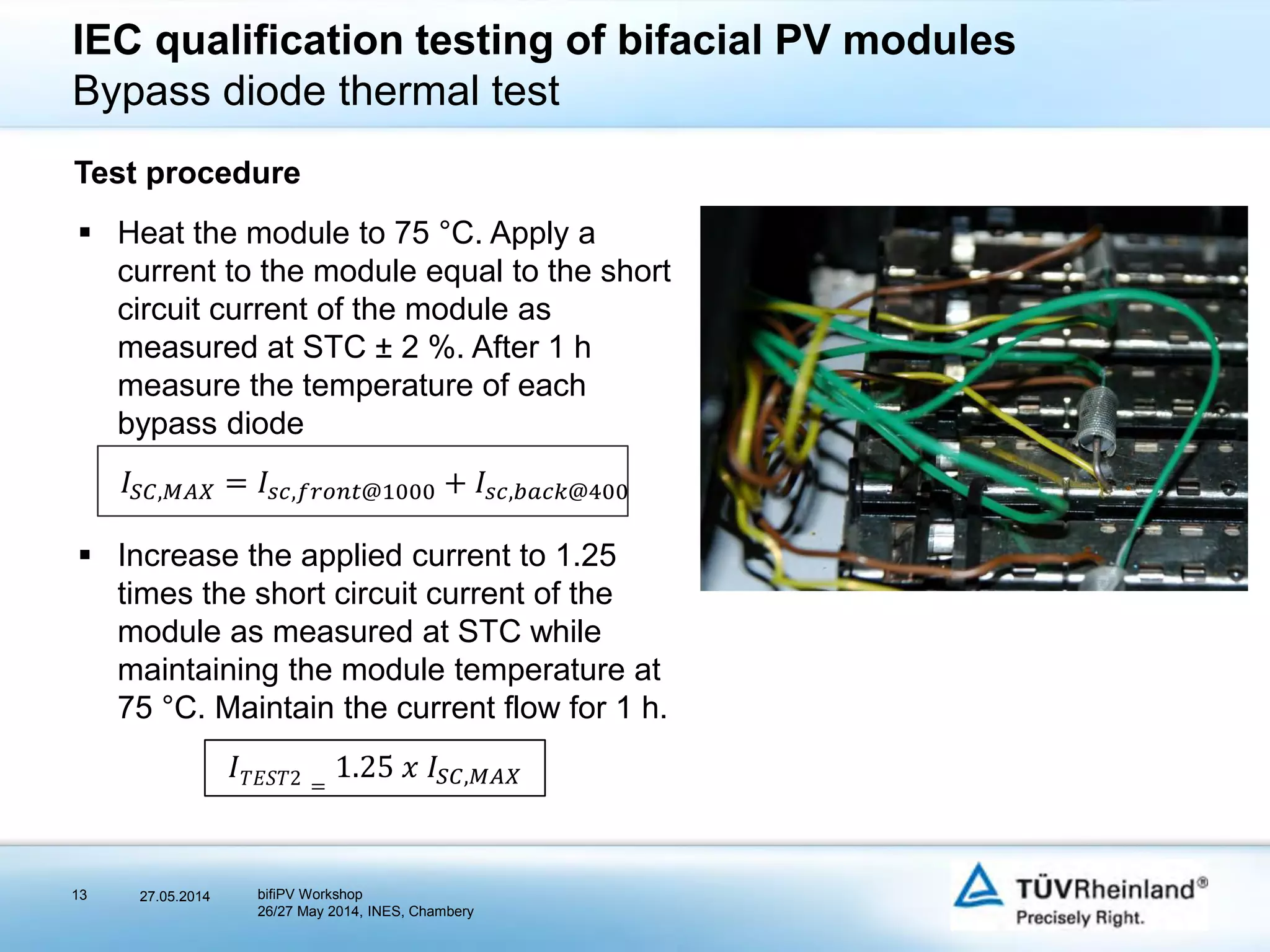
 Heat the module to 75 °C. Apply a
current to the module equal to the short
circuit current of the module as
measured at STC ± 2 %. After 1 h
measure the temperature of each
bypass diode
𝐼𝑆𝐶,𝑀𝐴𝑋 = 𝐼𝑠𝑐,𝑓𝑟𝑜𝑛𝑡@1000 + 𝐼𝑠𝑐,𝑏𝑎𝑐𝑘@400
 Increase the applied current to 1.25
times the short circuit current of the
module as measured at STC while
maintaining the module temperature at
75 °C. Maintain the current flow for 1 h.
𝐼 𝑇𝐸𝑆𝑇2 =
1.25 𝑥 𝐼𝑆𝐶,𝑀𝐴𝑋
13
IEC qualification testing of bifacial PV modules
Bypass diode thermal test
Test procedure
27.05.2014 bifiPV Workshop
26/27 May 2014, INES, Chambery
14
IEC qualification testing of bifacial PV modules
Hot-spot test
 Test is performed with a steady
state solar simulator
 Irradiation from both sides with
solar simulator is not possible
 Back side current is
compensated by higher
irradiance setting on front side
 No change in the further test
procedure
Test procedure
𝐼𝑆𝐶,𝑓𝑟𝑜𝑛𝑡 = 𝐼𝑆𝐶,𝑀𝐴𝑋 = 𝐼 𝑠𝑐,𝑓𝑟𝑜𝑛𝑡@1000 𝑊/𝑚² + 𝐼 𝑠𝑐,𝑟𝑒𝑎𝑟@400 𝑊/𝑚²
27.05.2014 bifiPV Workshop
26/27 May 2014, INES, Chambery
15
Conclusions
 Test standard IEC 61215 is applicable for bifacial PV modules.
Just test levels of current driven tests need to be modified:
a) Thermal cycling 200, b) Hot-Spot test, c) Bypass diode
thermal test
 Test current is related to 1000 W/m² front side irradiation and
400 W/m² rear side irradiation.
 Assumption of 400 W/m² irradiation on rear side has been
confirmed by simulation study with real weather data.
 Power rating of a bifacial PV module type shall be referenced to
the front side only. Power contribution of rear side shall be
informative.
27.05.2014 bifiPV Workshop
26/27 May 2014, INES, Chambery
27.05.201416
Thank you for your attention.
bifiPV Workshop
26/27 May 2014, INES, Chambery
17
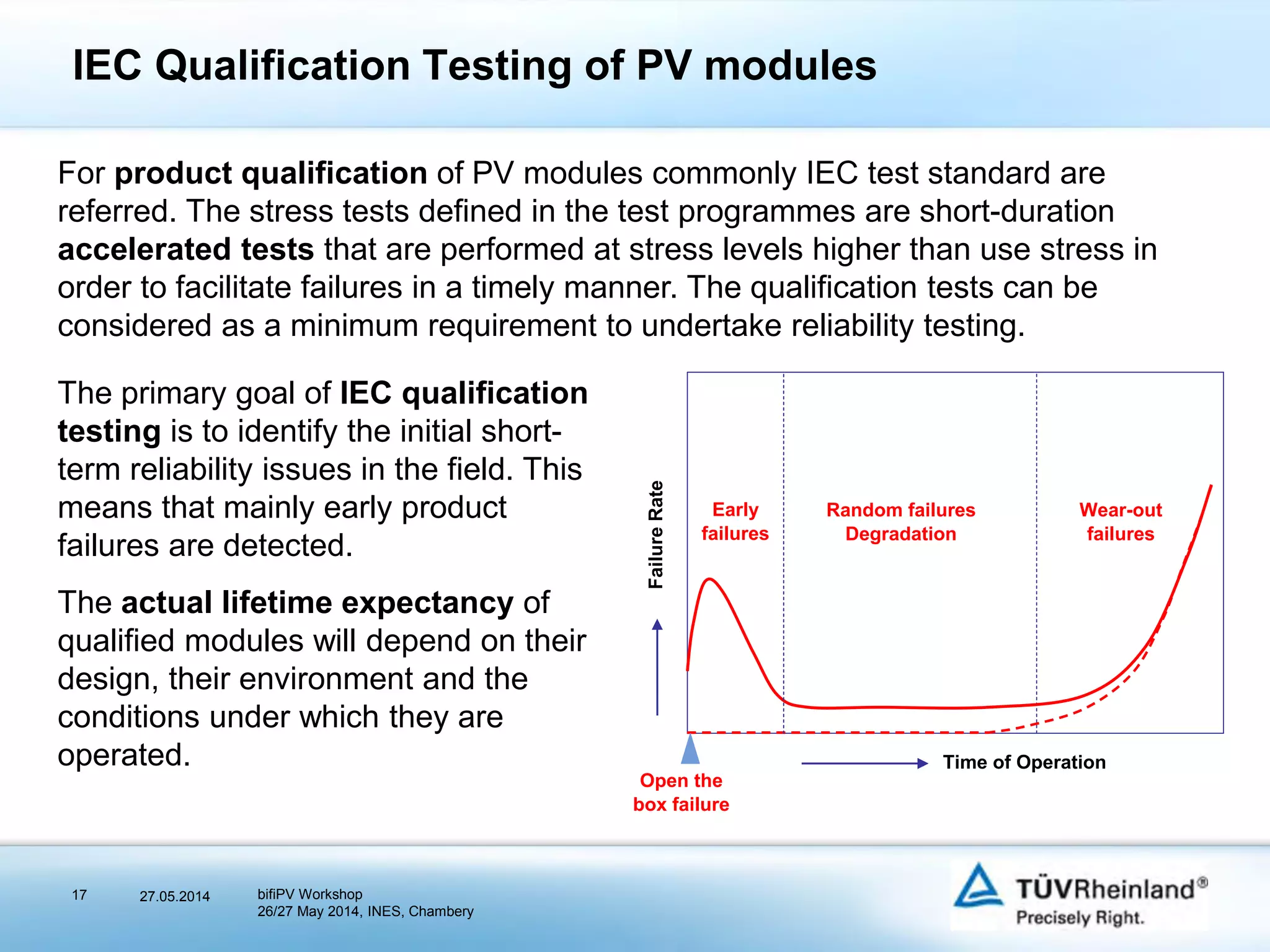
For product qualification of PV modules commonly IEC test standard are
referred. The stress tests defined in the test programmes are short-duration
accelerated tests that are performed at stress levels higher than use stress in
order to facilitate failures in a timely manner. The qualification tests can be
considered as a minimum requirement to undertake reliability testing.
The primary goal of IEC qualification
testing is to identify the initial short-
term reliability issues in the field. This
means that mainly early product
failures are detected.
The actual lifetime expectancy of
qualified modules will depend on their
design, their environment and the
conditions under which they are
operated. Time of Operation
Open the
box failure
Early
failures
Random failures
Degradation
Wear-out
failures
FailureRate
IEC Qualification Testing of PV modules
27.05.2014 bifiPV Workshop
26/27 May 2014, INES, Chambery
18
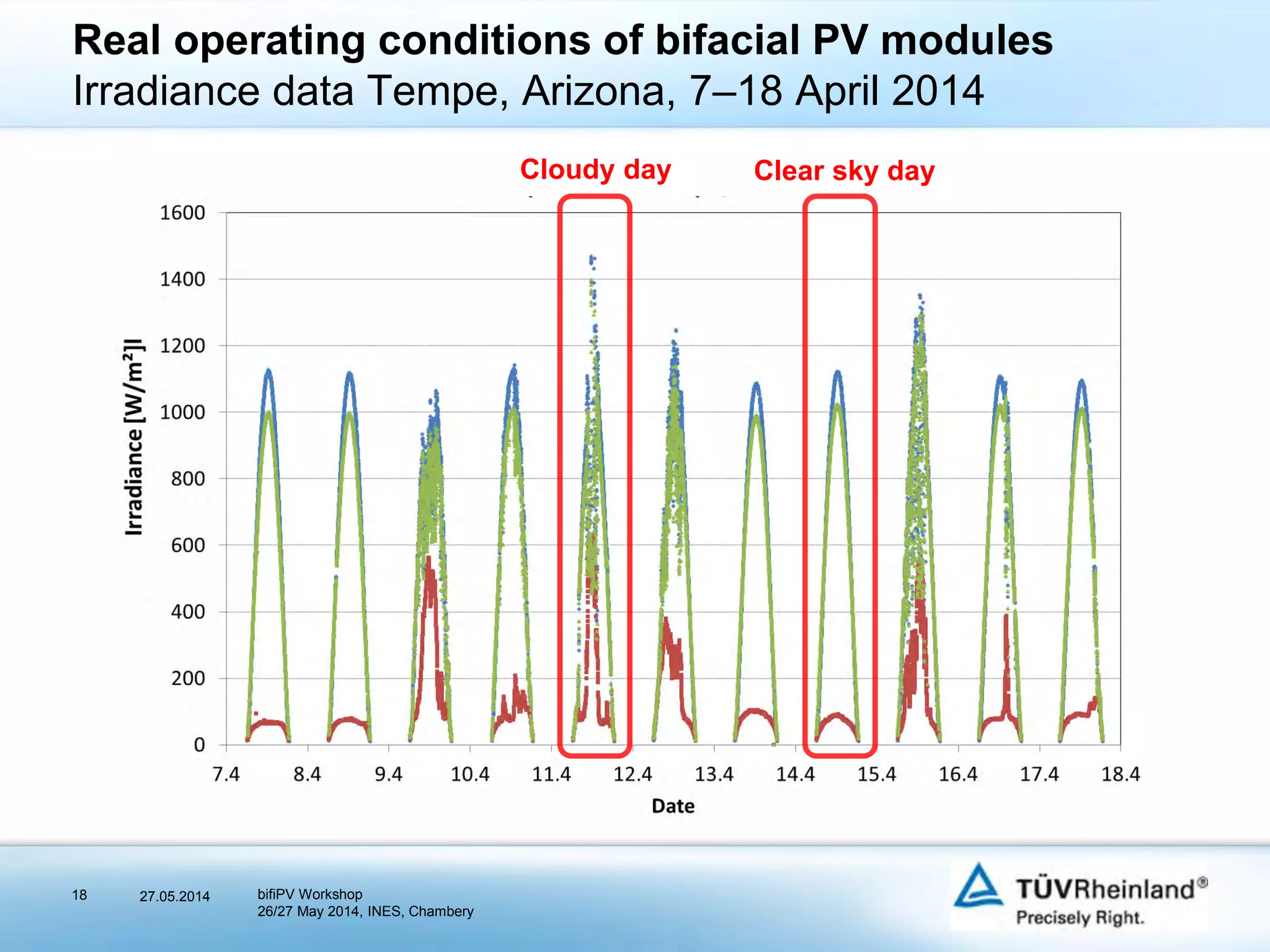
Real operating conditions of bifacial PV modules
Irradiance data Tempe, Arizona, 7–18 April 2014
Clear sky dayCloudy day
27.05.2014 bifiPV Workshop
26/27 May 2014, INES, Chambery
19
Real operating conditions of bifacial PV modules
Maximum irradiance on rear side (Tempe data)
albedo
11.04.2014
GREAR in W/m²
14.4.2014
GREAR in W/m²
0.2 166 125
0.5 376 297
0.8 587 468
0.9 657 525
Source: Y. Yusufoglu (RWTH Aachen)
Cloudy day Clear sky day
27.05.2014 bifiPV Workshop
26/27 May 2014, INES, Chambery

8 r.düpont tüv rheinland-ok

  • 1.
    IEC qualification testingof bifacial PV modules – Test conditions and test requirements bifiPV Workshop 26/27 May 2014, INES, Chambery Dr. Werner Herrmann, René Düpont TÜV Rheinland Energie und Umwelt GmbH 51101 Cologne, Germany Phone: +49-221/806-2272 Email: werner.herrmann@de.tuv.com 27.05.2014
  • 2.
    2 Product certification ofc-Si PV modules IEC EN 61215 Ed. 2 Crystalline silicon terrestrial photovoltaic (PV) modules - Design qualification and type approval IEC EN 61730 Ed. 1 Photovoltaic (PV) module safety qualification - Part 1: Requirements for construction - Part 2: Requirements for testing Note: UL certification issues are not considered in this presentation Modifications required for bifacial PV modules? 27.05.2014 bifiPV Workshop 26/27 May 2014, INES, Chambery
  • 3.
    3 Specific test requirementsfor bifacial modules Specific characteristic:  PV modules with bifacial solar cells deliver a higher module current compared to the rated values of the front side  Qualification tests that include test conditions for module current need to be performed at higher test severity to consider the rear side current.  Reference rear side irradiance needs to be defined to derive test levels for ISC,MAX total and IMP,MAX.  Ideally these shall reflect worst case operating conditions  Impact on IEC 61215 qualification testing:  No impact on IEC 61730-2 safety qualification testing 27.05.2014 bifiPV Workshop 26/27 May 2014, INES, Chambery
  • 4.
    4 Real operating conditionsof bifacial PV modules Maximum generated photocurrent Direct sunlight to front side Reflected sunlight to rear side Albedo factor A of ground surface Height H above ground Inclination angle  IFRONT = ISTC x (1 +  x (T – 25°C)) x Gt/1000 W/m² IREAR = ISTC x ( … ) x GREAR/1000 W/m² x BFF GREAR = f (H,,A,GHI,DHI) BFF = Bifacial Factor 27.05.2014 bifiPV Workshop 26/27 May 2014, INES, Chambery
  • 5.
    5 Real operating conditionsof bifacial PV modules Impact of albedo Albedo is the fraction of the Global Horizontal Irradiance (GHI) that is reflected. The PVsyst modeling software provides the following guidance for estimating an appropriate value for albedo. High variability  Impact of albedo on GREAR? Albedo Urban environment 0.14 – 0.22 Grass 0.15 – 0.25 Fresh grass 0.26 Fresh snow 0.82 Wet snow 0.55 – 0.75 Dry asphalt 0.09-0.15 Wet asphalt 0.18 Concrete 0.25-0.35 Red tiles 0.33 Aluminum 0.85 Copper 0.74 New galvanized steel 0.35 27.05.2014 bifiPV Workshop 26/27 May 2014, INES, Chambery
  • 6.
    6 Real operating conditionsof bifacial PV modules Simulation of maximum irradiance on rear side Source: Y. Yusufoglu (RWTH Aachen) Input data  Solar irradiance data: Cologne, 12.09.2011 (GHI, DHI)  PV module dimensions: 6 x 10 x (6” solar cell)  Inclination angle: 35°  Height above ground: 1 m  Albedo: 0.2, 0.5, 0.8, 0.9 Results: Rear side irradiance at noon in W/m² GHI = 1080 W/m², DHI = 478 W/m² albedo Maximum Minimum Average 0.2 157 150 153 0.5 358 340 348 0.8 559 530 543 0.9 626 593 608  <3% non- uniform irradiance on rear side 27.05.2014 bifiPV Workshop 26/27 May 2014, INES, Chambery
  • 7.
    7 IEC qualification testingof bifacial PV modules Test programme for crystalline silicon PV modules Initial measurements: Visual inspection, electrical performance, insulation, wet leakage current Preconditioning (5 kWh/m²) Temperature cycling (200) Electrical parameters Outdoor exposure Hot-Spot UV preconditioning Temperature cycling (50) Humidity freeze Electrical terminations Damp heat HailMech. load Final measurements: Visual inspection, electrical performance, insulation, wet leakage current Bypass diode 27.05.2014 bifiPV Workshop 26/27 May 2014, INES, Chambery
  • 8.
    8 Thermal Cycling test Thistest is primarily a mechanical fatigue test where differential thermal expansion may cause cells or interconnects to crack. This test can also address any thermal mismatch between components. (Test conditions: 200 temperature cycles between -40°C and +85°C) Hot Spot test Hot-spot heating occurs in a module when its operating current exceeds the reduced short circuit current of a shadowed or faulty cell or group of cells within it. When such a condition occurs, the affected cell or group of cells is forced into reverse bias and must dissipate. power, which can cause overheating. Bypass diode test To assess the adequacy of the thermal design and relative long-term reliability of the bypass diodes used to limit the detrimental effects of module hot-spot susceptibility. During the test the module is heated to 75 °C and the module’s short circuit current at STC is applied to the diodes. IEC qualification testing of bifacial PV modules Stress tests affected by bifaciality 27.05.2014 bifiPV Workshop 26/27 May 2014, INES, Chambery
  • 9.
    9 Accelerated stress test 2 IECqualification testing of bifacial PV modules Pass Criteria Initial Diagnostic Measurements Accelerated stress test 1 Final Diagnostic Measurements Intermittent Diagnostic Measurements Pass criteria:  Maximum power: Degradation of output power of front side at STC (rear side covered) for each test < 5% and <8% for each test sequence  Electrical safety: Fulfilling the minimum requirements for insulation (high voltage test, wet insulation test)  Visual defects: No delamination forming a continuous path to modules edges, no severe cracks in solar cells  check by electroluninescence analysis)  Other: Determination of BFF after each sequence  Information about front side and backside behavior, but no pass criterion 27.05.2014 bifiPV Workshop 26/27 May 2014, INES, Chambery
  • 10.
    10 IEC qualification testingof bifacial PV modules Output power determination of bifacial PV modules Rating of nominal output power (Global agreement within TÜV Rheinland Group)  Power rating/labelling of module type shall comply to nominal power of the front side only.  Front side output power at STC is measured by covering rear side with an opaque sheet.  Power rating of rear side is performed at STC or 400 W/m². This value is to be regarded as additional information on module label or datasheet. 27.05.2014 bifiPV Workshop 26/27 May 2014, INES, Chambery
  • 11.
    11 IEC qualification testingof bifacial PV modules Output power determination of bifacial PV modules Measurement of front side:  1000 W/m²  25°C  Backside covered Measurement of rear side:  1000 W/m²  25°C  Front side covered  400 W/m²  25°C  Front side covered Determination of maximum current  BFF  Max. module current  Bifacial Factor (BFF): 𝐵𝐹𝐹 = 𝐼 𝑠𝑐,𝑏𝑎𝑐𝑘@1000 𝐼 𝑠𝑐,𝑓𝑟𝑜𝑛𝑡@1000  𝐼𝑆𝐶,𝑀𝐴𝑋 = 𝐼𝑠𝑐,𝑓𝑟𝑜𝑛𝑡@1000 + 𝐼𝑠𝑐,𝑏𝑎𝑐𝑘@400  𝐼 𝑀𝑃,𝑀𝐴𝑋 = 𝐼 𝑆𝐶,𝑡𝑜𝑡 𝐼 𝑠𝑐,𝑓𝑟𝑜𝑛𝑡@1000 𝑊/𝑚² 𝐼 𝑀𝑃,𝑓𝑟𝑜𝑛𝑡@1000 𝑊/𝑚² 27.05.2014 bifiPV Workshop 26/27 May 2014, INES, Chambery
  • 12.
    12 IEC qualification testingof bifacial PV modules Thermal cycling test (200 cycles) Test procedure Test conditions:  200 cycles  -40°C to +85°C  Current injection with Imp 𝐼 𝑇𝐸𝑆𝑇 = 𝐼 𝑀𝑃,𝑀𝐴𝑋 = 𝐼𝑆𝐶,𝑡𝑜𝑡 𝐼 𝑠𝑐,𝑓𝑟𝑜𝑛𝑡@1000 𝑊/𝑚² 𝐼 𝑚𝑝,𝑓𝑟𝑜𝑛𝑡@1000 𝑊/𝑚² 27.05.2014 bifiPV Workshop 26/27 May 2014, INES, Chambery
  • 13.
     Heat themodule to 75 °C. Apply a current to the module equal to the short circuit current of the module as measured at STC ± 2 %. After 1 h measure the temperature of each bypass diode 𝐼𝑆𝐶,𝑀𝐴𝑋 = 𝐼𝑠𝑐,𝑓𝑟𝑜𝑛𝑡@1000 + 𝐼𝑠𝑐,𝑏𝑎𝑐𝑘@400  Increase the applied current to 1.25 times the short circuit current of the module as measured at STC while maintaining the module temperature at 75 °C. Maintain the current flow for 1 h. 𝐼 𝑇𝐸𝑆𝑇2 = 1.25 𝑥 𝐼𝑆𝐶,𝑀𝐴𝑋 13 IEC qualification testing of bifacial PV modules Bypass diode thermal test Test procedure 27.05.2014 bifiPV Workshop 26/27 May 2014, INES, Chambery
  • 14.
    14 IEC qualification testingof bifacial PV modules Hot-spot test  Test is performed with a steady state solar simulator  Irradiation from both sides with solar simulator is not possible  Back side current is compensated by higher irradiance setting on front side  No change in the further test procedure Test procedure 𝐼𝑆𝐶,𝑓𝑟𝑜𝑛𝑡 = 𝐼𝑆𝐶,𝑀𝐴𝑋 = 𝐼 𝑠𝑐,𝑓𝑟𝑜𝑛𝑡@1000 𝑊/𝑚² + 𝐼 𝑠𝑐,𝑟𝑒𝑎𝑟@400 𝑊/𝑚² 27.05.2014 bifiPV Workshop 26/27 May 2014, INES, Chambery
  • 15.
    15 Conclusions  Test standardIEC 61215 is applicable for bifacial PV modules. Just test levels of current driven tests need to be modified: a) Thermal cycling 200, b) Hot-Spot test, c) Bypass diode thermal test  Test current is related to 1000 W/m² front side irradiation and 400 W/m² rear side irradiation.  Assumption of 400 W/m² irradiation on rear side has been confirmed by simulation study with real weather data.  Power rating of a bifacial PV module type shall be referenced to the front side only. Power contribution of rear side shall be informative. 27.05.2014 bifiPV Workshop 26/27 May 2014, INES, Chambery
  • 16.
    27.05.201416 Thank you foryour attention. bifiPV Workshop 26/27 May 2014, INES, Chambery
  • 17.
    17 For product qualificationof PV modules commonly IEC test standard are referred. The stress tests defined in the test programmes are short-duration accelerated tests that are performed at stress levels higher than use stress in order to facilitate failures in a timely manner. The qualification tests can be considered as a minimum requirement to undertake reliability testing. The primary goal of IEC qualification testing is to identify the initial short- term reliability issues in the field. This means that mainly early product failures are detected. The actual lifetime expectancy of qualified modules will depend on their design, their environment and the conditions under which they are operated. Time of Operation Open the box failure Early failures Random failures Degradation Wear-out failures FailureRate IEC Qualification Testing of PV modules 27.05.2014 bifiPV Workshop 26/27 May 2014, INES, Chambery
  • 18.
    18 Real operating conditionsof bifacial PV modules Irradiance data Tempe, Arizona, 7–18 April 2014 Clear sky dayCloudy day 27.05.2014 bifiPV Workshop 26/27 May 2014, INES, Chambery
  • 19.
    19 Real operating conditionsof bifacial PV modules Maximum irradiance on rear side (Tempe data) albedo 11.04.2014 GREAR in W/m² 14.4.2014 GREAR in W/m² 0.2 166 125 0.5 376 297 0.8 587 468 0.9 657 525 Source: Y. Yusufoglu (RWTH Aachen) Cloudy day Clear sky day 27.05.2014 bifiPV Workshop 26/27 May 2014, INES, Chambery