Photovoltaic Technical Solutions Copyright © 2014 PVG Solutions Inc.
PV business Division
TEL.+81-45-430-3691
http://www.pvgs.jp/
PVG Solutions Inc.
bifiPV Workshop 2014
Chambery / France
Experience from bifacial PV installations of
Mega Solar using EarthON technology
27 May, 2014
Shinji Goda, CTO
0
Hokuto, Asahikawa
2014/05/27
21:08
JST
Photovoltaic Technical Solutions Copyright © 2014 PVG Solutions Inc.
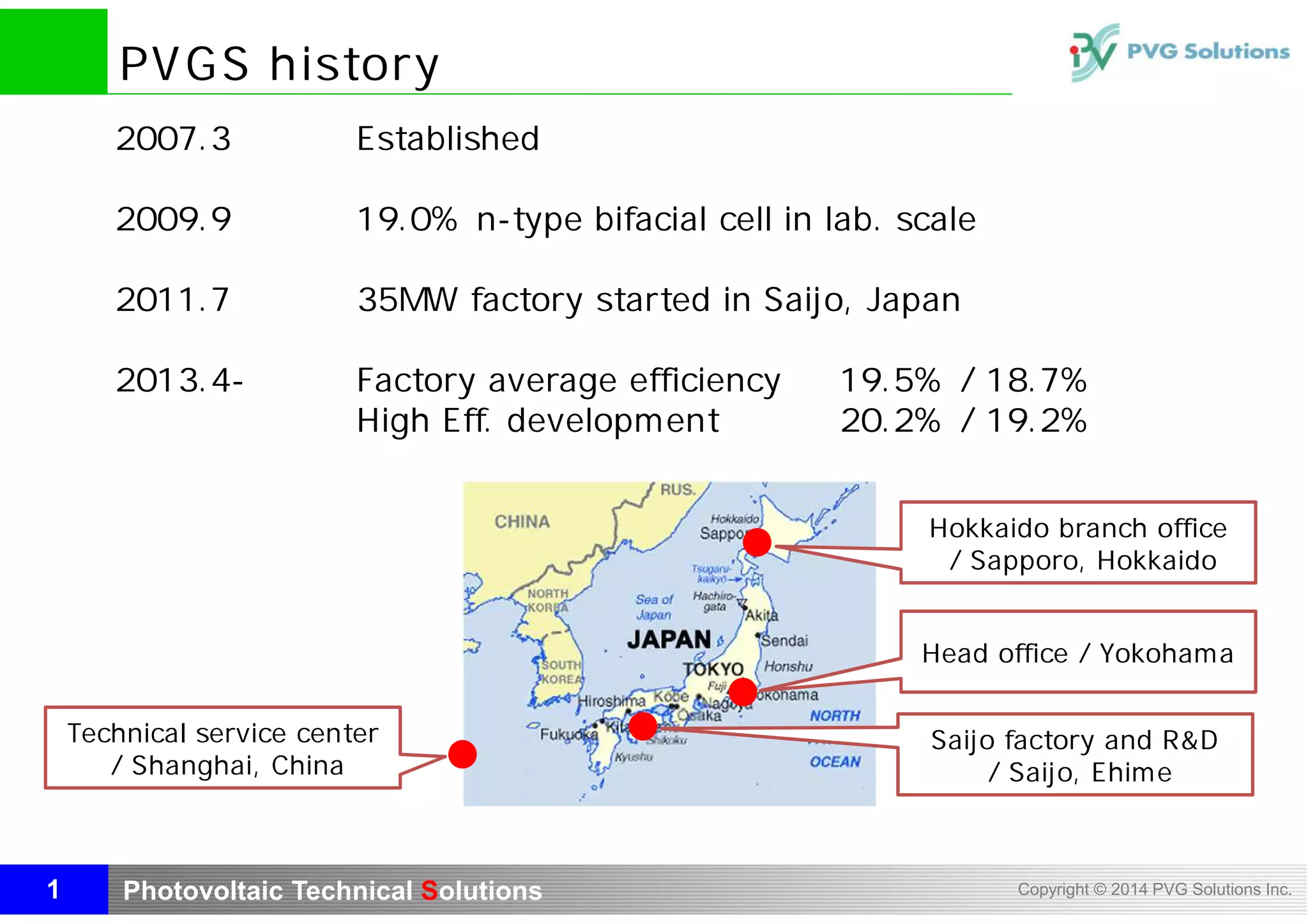
PVGS history
1
2007.3 Established
2009.9 19.0% n-type bifacial cell in lab. scale
2011.7 35MW factory started in Saijo, Japan
2013.4- Factory average efficiency 19.5% / 18.7%
High Eff. development 20.2% / 19.2%
Head office / Yokohama
Saijo factory and R&D
/ Saijo, Ehime
Hokkaido branch office
/ Sapporo, Hokkaido
Technical service center
/ Shanghai, China
Photovoltaic Technical Solutions Copyright © 2014 PVG Solutions Inc.
Bifacial application
2
Photovoltaic Technical Solutions Copyright © 2014 PVG Solutions Inc.
Advantage of bifacial
3
• Building wall, fence
• No snow cover, no leaves and bird dropping
• Good appearance
Vertical use (BIPV)
Photovoltaic Technical Solutions Copyright © 2014 PVG Solutions Inc.
Advantage of bifacial
4
• No snow cover, no sand and dust
• No maintenance
• Reflection gain from ground
• Constant power generation
independent on installation angle
Vertical use Slanted use
• Expectation of 10-30% gain by
reflection from rear side
• Effect of snow
Photovoltaic Technical Solutions Copyright © 2014 PVG Solutions Inc.
Today’s presentation
1) Technology of cell and module in PVGS
2) Mega watt class solar plant in snowy region
- Location and climate
- Array design (angle, orientation, distance to next array)
3) Evaluation
- Influence of snow (reflection, cover and shading)
- Demerit of snow and how to overcome the problem
- Power generation data
4) Conclusion
- Advantage and problem of bifacial array system
- How to overcome the demerit in snowy region
5
Photovoltaic Technical Solutions Copyright © 2014 PVG Solutions Inc.
Technology / Cell, Module
6
Photovoltaic Technical Solutions Copyright © 2014 PVG Solutions Inc.
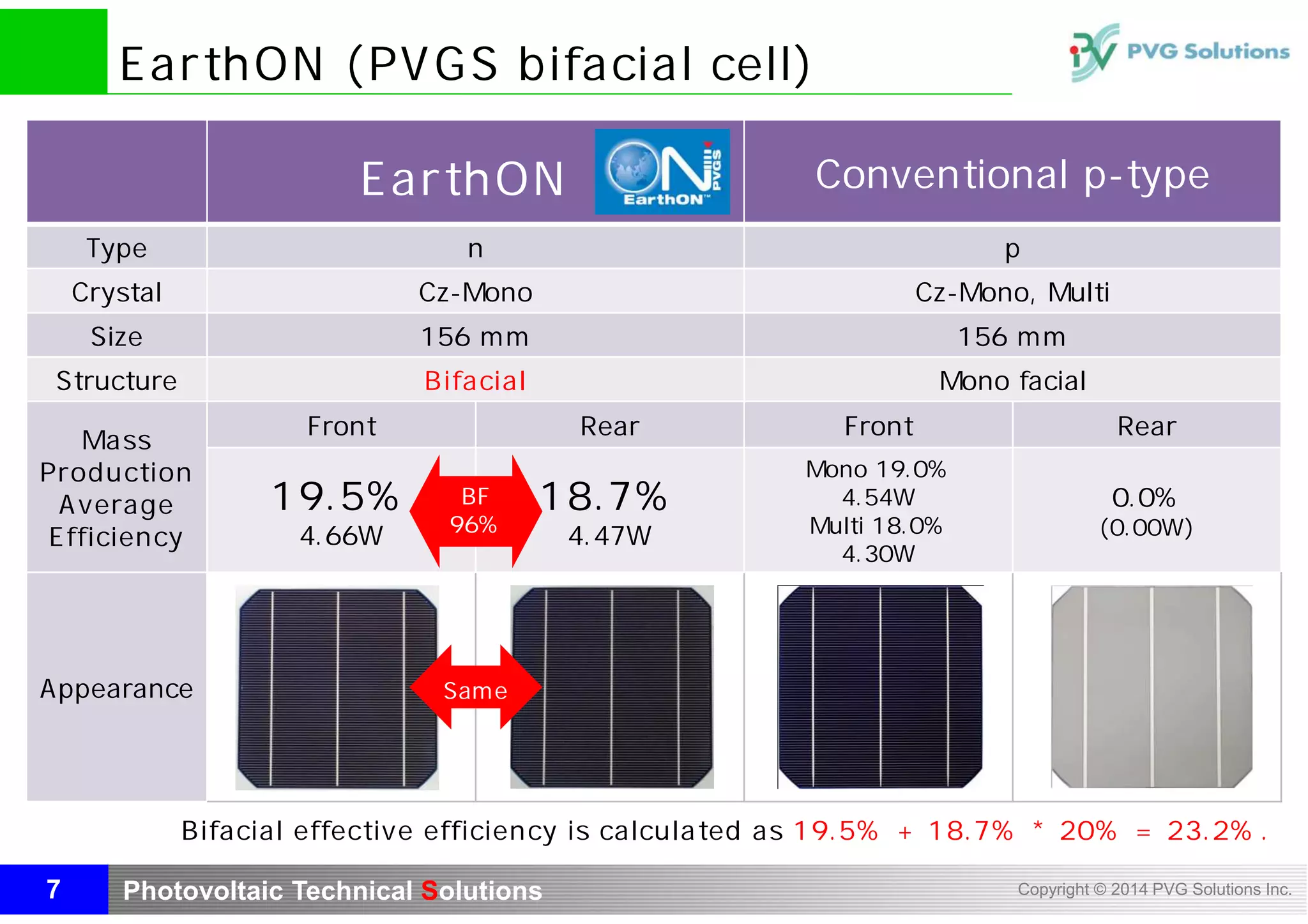
EarthON (PVGS bifacial cell)
Conventional p-type
Type n p
Crystal Cz-Mono Cz-Mono, Multi
Size 156 mm 156 mm
Structure Bifacial Mono facial
Mass
Production
Average
Efficiency
Front Rear Front Rear
19.5%
(4.66W)
18.7%
(4.47W)
Mono 19.0%
(4.54W)
Multi 18.0%
(4.30W)
0.0%
(0.00W)
Appearance Same
BF
96%
EarthON
7
Bifacial effective efficiency is calculated as 19.5% + 18.7% * 20% = 23.2%.
Photovoltaic Technical Solutions Copyright © 2014 PVG Solutions Inc.
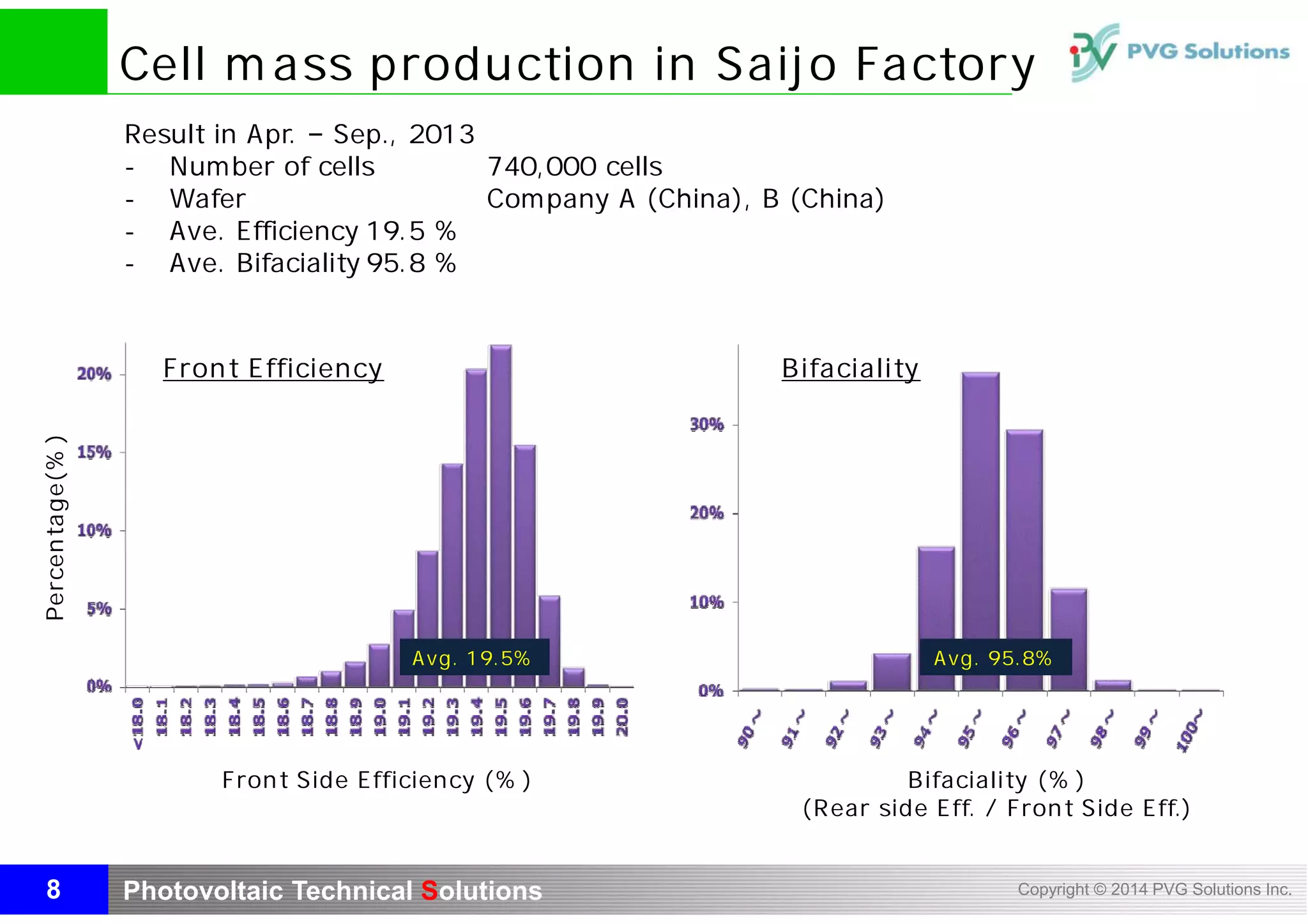
Cell mass production in Saijo Factory
Avg. 95.8%Avg. 19.5%
BifacialityFront Efficiency
Front Side Efficiency (%)
Percentage(%)
Bifaciality (%)
(Rear side Eff. / Front Side Eff.)
Result in Apr. – Sep., 2013
- Number of cells 740,000 cells
- Wafer Company A (China), B (China)
- Ave. Efficiency 19.5 %
- Ave. Bifaciality 95.8 %
8
Photovoltaic Technical Solutions Copyright © 2014 PVG Solutions Inc.
Single glass type Double glass type
Structure
Certification TUV certificated TUV and UL to be certificated
Application Slanted use Slanted use
Vertical use
Appearance
Bifacial module
9
Glass 4mmt
EVA
Transparent back sheet
Cell Cell Cell
JB
Glass 2mmt
EVA
Cell Cell Cell
Glass 2mmt
JB
Kitami, Hokkaido
Higashi-matsushima,
Miyagi
Photovoltaic Technical Solutions Copyright © 2014 PVG Solutions Inc.
Cell To Module Power Loss
10
0%
5%
10%
15%
20%
255
256
257
258
259
260
261
262
263
264
265
266
267
268
269
270
271
Percentage(%)
Front Pmax (W)
Glass 4mmt
EVA
Transparent back sheet
Cell Cell Cell
JB
Result in June, 2013
- Module structure Single glass type
- Number of modules 1,196 panels
- Cell 60 pcs in series
- Cell front efficiency Ave. 19.4% (19.1-19.7%)
Ave. Pmax = 264W, CTML = 5.2%
Photovoltaic Technical Solutions Copyright © 2014 PVG Solutions Inc.
MW class solar plant in snowy region
11
Photovoltaic Technical Solutions Copyright © 2014 PVG Solutions Inc.
Installation results of EarthON in Japan
12
IPP Location Power No. of
MDL
Orientation
/Angle
Started
① Hitachi Totsuka 500kW 2,130 South/20° Jul. 2012
② Nishiyama-sakata denki Asahikawa 250kW 1,064 South/40° Oct. 2013
③ Nishiyama-sakata denki Asahikawa 1,250kW 5,320 South/40° Dec. 2013
④ Rishiri high school Rishiri island,
Hokkaido
10kW 40 South-
East/50°
Feb. 2014
⑤ Ebara Fujisawa 300kW 1,100 South/20° Feb. 2014
⑥ Asahikawa Suishi-kai Asahikawa 750kW 3,024 South/40° Aug. 2014
(to be)
① ② ③
⑤
④
Photovoltaic Technical Solutions Copyright © 2014 PVG Solutions Inc.
Location and climate of Asahikawa
Asahikawa
latitude 43.50N.
-20
-10
0
10
20
30
Jan Feb Mar Apr May Jun July Aug Sep Oct Nov Dec
Temp.(℃)
Highest
Average
Lowest
0
20
40
60
80
100
120
140
160
180
200
Jan Feb Mar Apr May Jun July Aug Sep Oct Nov Dec
Snowfall(cm)
Temperature 1) Snow fall 2)
Heavy snow! Diamond dust
Winter festival Asahikawa ramen
*1,2) Data from Japan Meteorological Agency
13
Photovoltaic Technical Solutions Copyright © 2014 PVG Solutions Inc.
Outline of plant
Location Asahikawa, Hokkaido
Power 1,250kW (Front)
Module
5,320 panels
(PST254EarthON60)
Installation South, 40°
Operation Dec., 2013
Hokuto Solar Power Plant
(World largest bifacial plant)
14
4m
1.5m 9.87m
Module
40°
Photovoltaic Technical Solutions Copyright © 2014 PVG Solutions Inc.
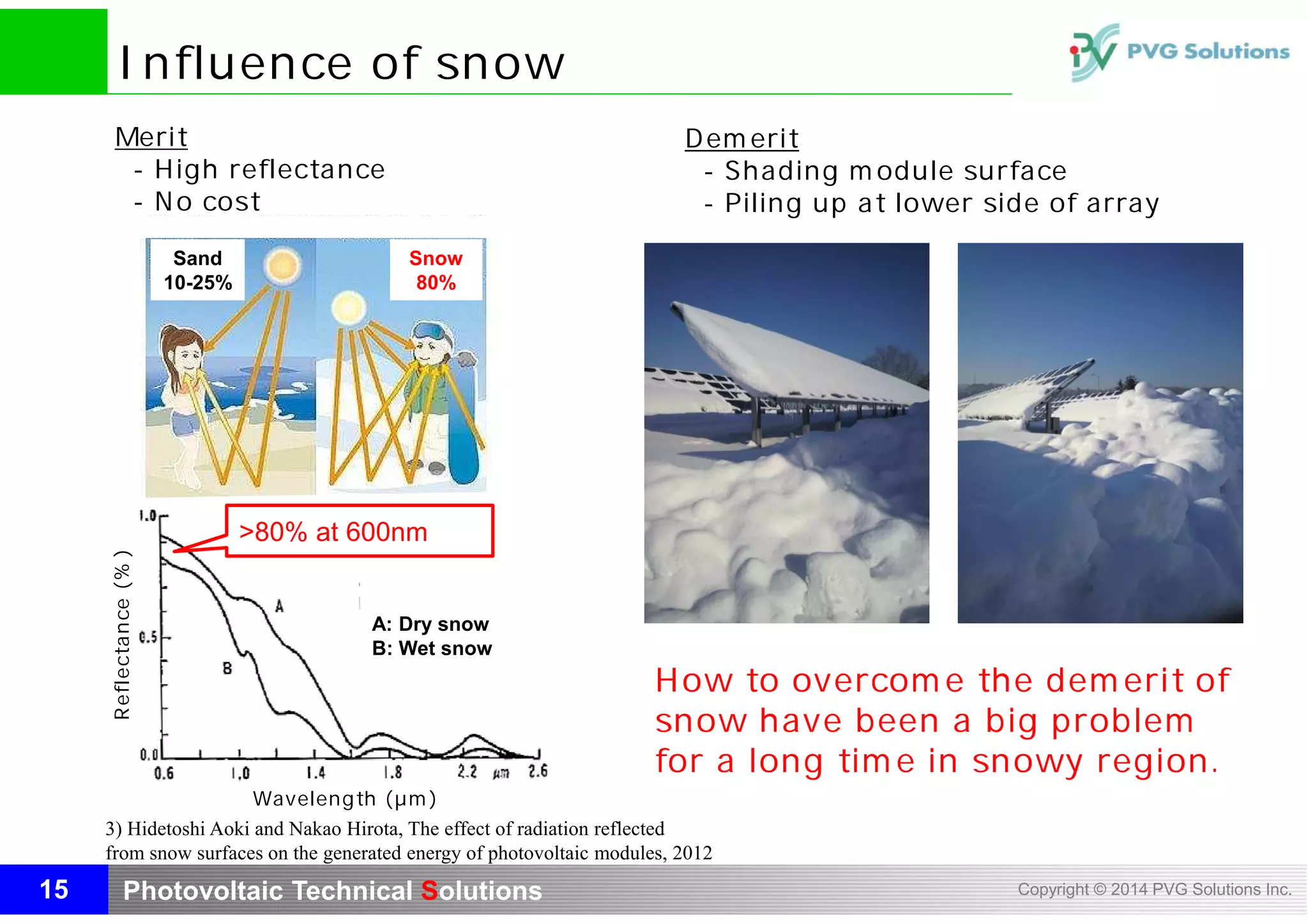
Influence of snow
15
3) Hidetoshi Aoki and Nakao Hirota, The effect of radiation reflected
from snow surfaces on the generated energy of photovoltaic modules, 2012
Merit
- High reflectance
- No cost
Reflectance(%)
Wavelength (μm)
Demerit
- Shading module surface
- Piling up at lower side of array
Snow
80%
Sand
10-25%
A: Dry snow
B: Wet snow
>80% at 600nm
How to overcome the demerit of
snow have been a big problem
for a long time in snowy region.
Photovoltaic Technical Solutions Copyright © 2014 PVG Solutions Inc.
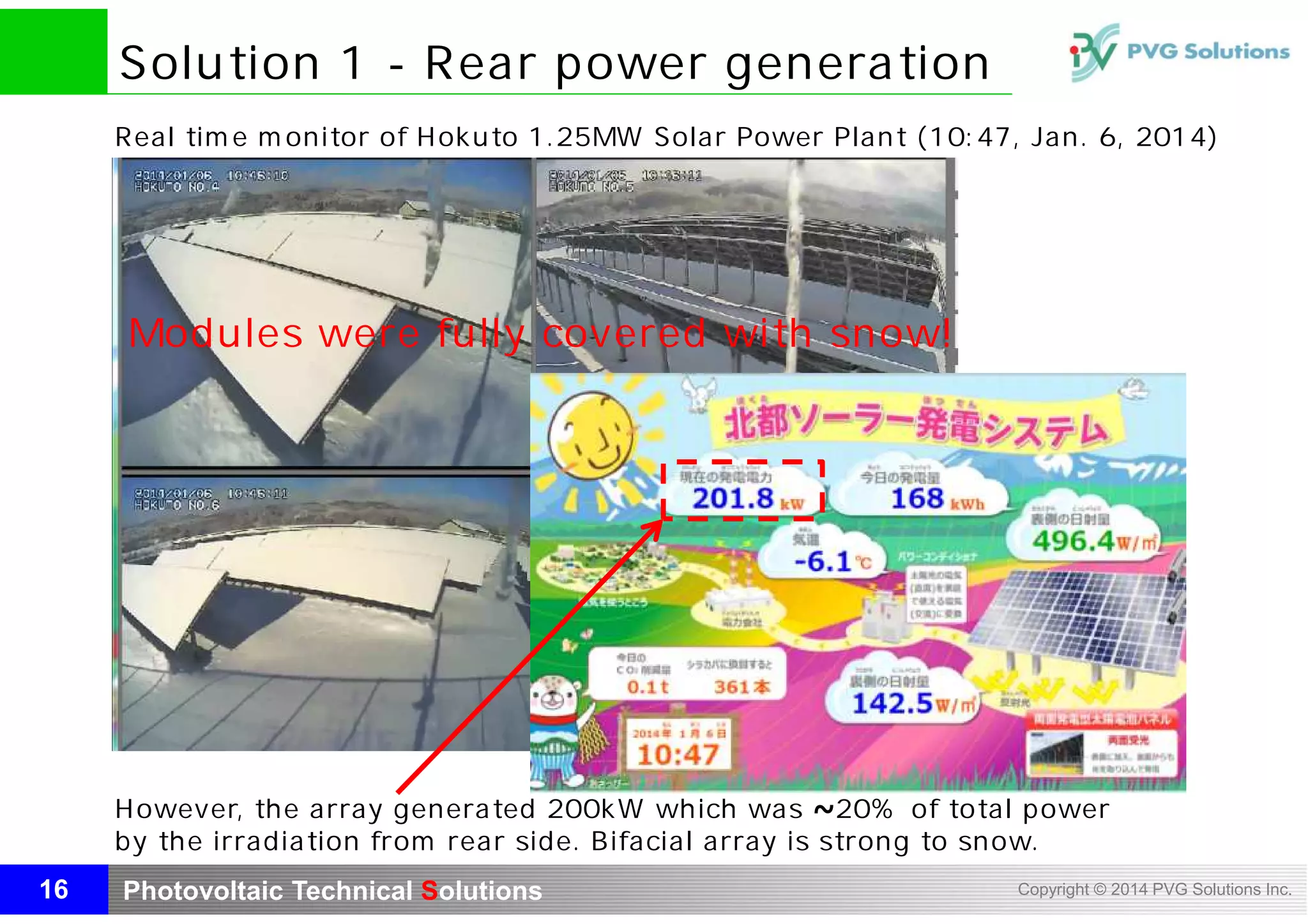
Solution 1 - Rear power generation
16
However, the array generated 200kW which was ~20% of total power
by the irradiation from rear side. Bifacial array is strong to snow.
Real time monitor of Hokuto 1.25MW Solar Power Plant (10:47, Jan. 6, 2014)
Modules were fully covered with snow!
Photovoltaic Technical Solutions Copyright © 2014 PVG Solutions Inc.
Solution 2 - Melting snow
17
Bifacial 33°
Mono-facial 33°
Mono-facial 45°
- Snow on bifacial array melted and fell down much earlier than mono-facial ones.
- Bifacial arrays were heated because of the power generation by the irradiation
from rear side and the snow became to melt earlier.
Testing in Hokkaido University of Science
(Morning)
Modules were fully covered with snow!
Consortium
Photovoltaic Technical Solutions Copyright © 2014 PVG Solutions Inc.
Power generation data
0
10
20
30
40
50
60
70
80
90
100
0
1
2
3
4
5
6
7
8
9
10
1日 6日 11日 16日 21日 26日
裏⾯発電量 表⾯発電量 傾斜⾯⽇射量 当⽇降雪量 最深積雪
Powergeneration[kWh/kW・day]
Snow[cm]
Irr.[kWh/m2・day]
Daily trend in Feb., 2014
18
Rear Front Irradiation. Snow fall Snow thick.
- PR showed poor in Dec. and Jan.
because of continuous snowing.
- However, it showed 1.0-1.1 from
Feb. which was larger than mono.
- Rear contribution was stable so
that the ratio of rear became lower
after snow disappeared in spring.
- Bifacial was demonstrated to be
strong in snowy region.
54.1
25.0
102.4
184.2
218.9
0.0
0.2
0.4
0.6
0.8
1.0
1.2
0
20
40
60
80
100
120
140
160
180
200
220
240
12月 1月 2月 3月 4月 5月 6月 7月 8月 9月 10月 11月
裏⾯発電量 表⾯発電量 システム出⼒係数(PR)
Powergeneration[MWh/月Month
PR)[−]
Rear Front System performance ratio
Monthly trend
- Rear contribution was 22% in
average.
- Bifacial was demonstrated to be
effective even if in snowy region.
Photovoltaic Technical Solutions Copyright © 2014 PVG Solutions Inc.
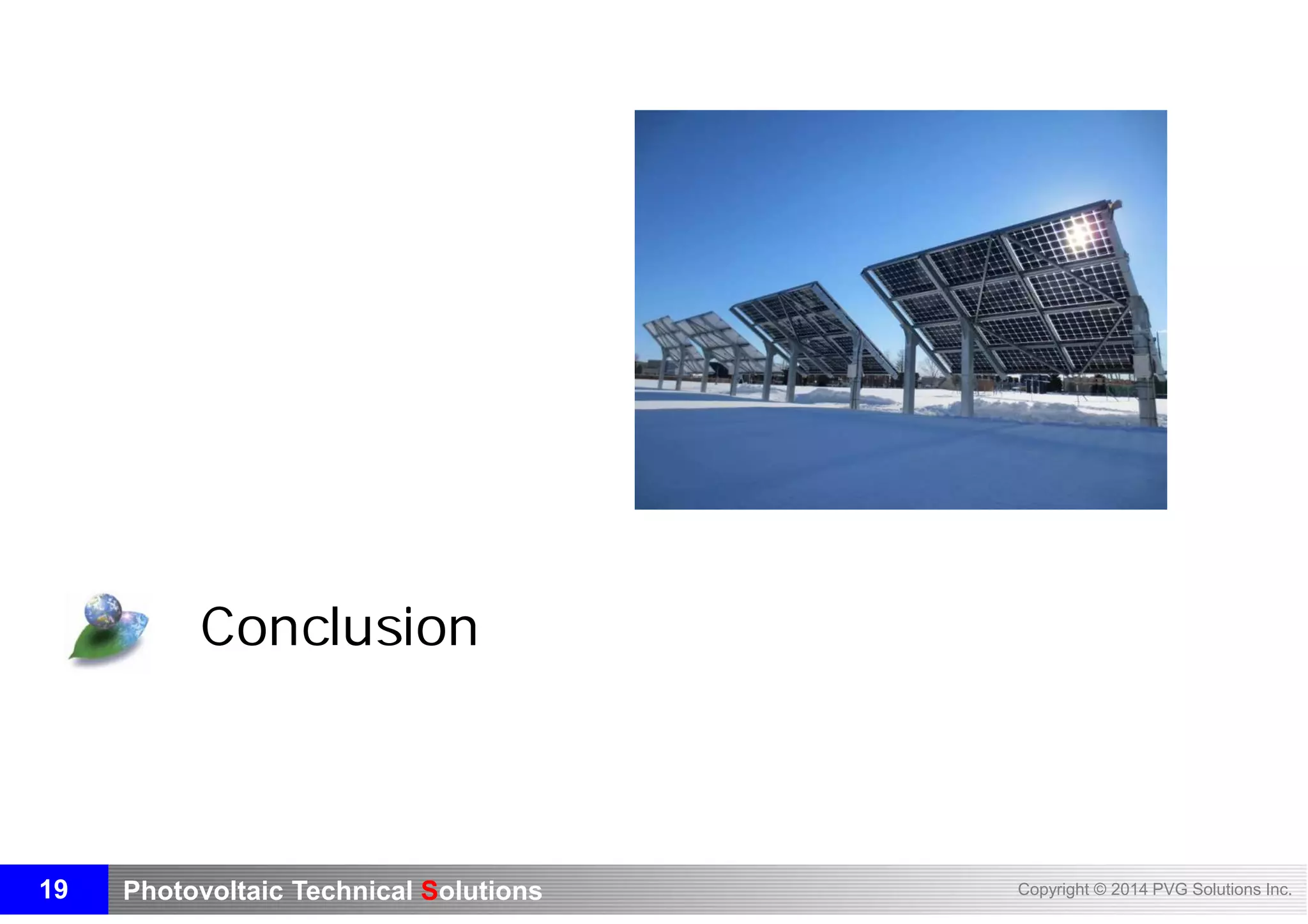
Conclusion
19
Photovoltaic Technical Solutions Copyright © 2014 PVG Solutions Inc.
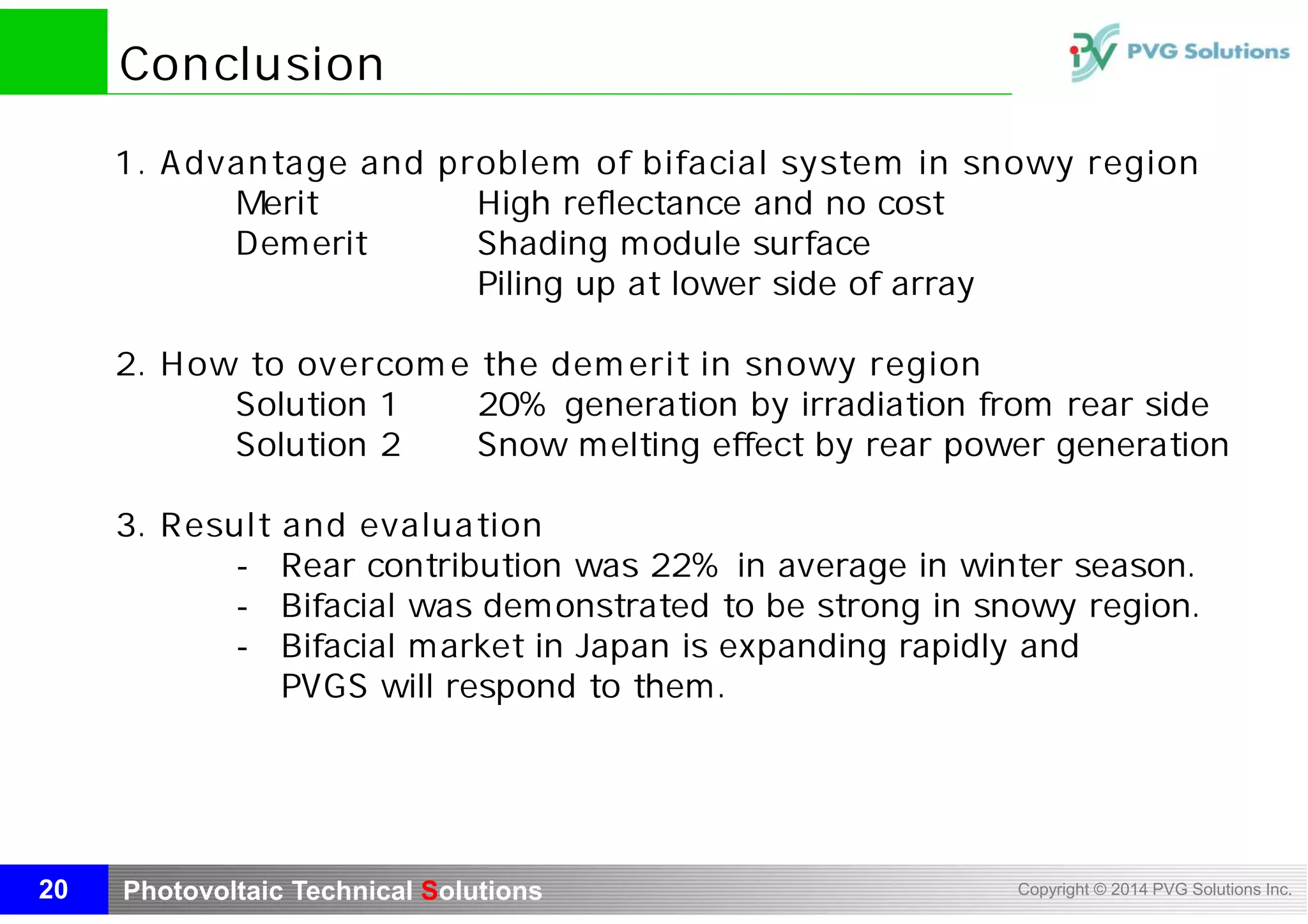
Conclusion
20
1. Advantage and problem of bifacial system in snowy region
Merit High reflectance and no cost
Demerit Shading module surface
Piling up at lower side of array
2. How to overcome the demerit in snowy region
Solution 1 20% generation by irradiation from rear side
Solution 2 Snow melting effect by rear power generation
3. Result and evaluation
- Rear contribution was 22% in average in winter season.
- Bifacial was demonstrated to be strong in snowy region.
- Bifacial market in Japan is expanding rapidly and
PVGS will respond to them.
Photovoltaic Technical Solutions Copyright © 2014 PVG Solutions Inc.
URL:http://www.pvgs.jp
pvgs@pvgs.jpPVG Solutions Inc.
Head office
Nisso 12th Bldg. 9F,3-6-12 Shinyokohama, Kohoku-ku, Yokohama-shi, Japan 222-0033
TEL:81-45-474-5656 / FAX 81-45-474-5657
Saijo Factory / Laboratory
455-1, Minato, Saijo-shi, Ehime, Japan 793-0046
TEL: 81-897-47-6030 / FAX:81-897-47-6031
Shanghai Technical Service Center
Rm 2905, Kerry Ever Bright Tower2, No.218 Tian Mu Xi Lu, Shanghai, 200070, China
TEL :86-21-63536098 / FAX: 86-21-33030779
21

2 s.goda - pvgs ok

  • 1.
    Photovoltaic Technical SolutionsCopyright © 2014 PVG Solutions Inc. PV business Division TEL.+81-45-430-3691 http://www.pvgs.jp/ PVG Solutions Inc. bifiPV Workshop 2014 Chambery / France Experience from bifacial PV installations of Mega Solar using EarthON technology 27 May, 2014 Shinji Goda, CTO 0 Hokuto, Asahikawa 2014/05/27 21:08 JST
  • 2.
    Photovoltaic Technical SolutionsCopyright © 2014 PVG Solutions Inc. PVGS history 1 2007.3 Established 2009.9 19.0% n-type bifacial cell in lab. scale 2011.7 35MW factory started in Saijo, Japan 2013.4- Factory average efficiency 19.5% / 18.7% High Eff. development 20.2% / 19.2% Head office / Yokohama Saijo factory and R&D / Saijo, Ehime Hokkaido branch office / Sapporo, Hokkaido Technical service center / Shanghai, China
  • 3.
    Photovoltaic Technical SolutionsCopyright © 2014 PVG Solutions Inc. Bifacial application 2
  • 4.
    Photovoltaic Technical SolutionsCopyright © 2014 PVG Solutions Inc. Advantage of bifacial 3 • Building wall, fence • No snow cover, no leaves and bird dropping • Good appearance Vertical use (BIPV)
  • 5.
    Photovoltaic Technical SolutionsCopyright © 2014 PVG Solutions Inc. Advantage of bifacial 4 • No snow cover, no sand and dust • No maintenance • Reflection gain from ground • Constant power generation independent on installation angle Vertical use Slanted use • Expectation of 10-30% gain by reflection from rear side • Effect of snow
  • 6.
    Photovoltaic Technical SolutionsCopyright © 2014 PVG Solutions Inc. Today’s presentation 1) Technology of cell and module in PVGS 2) Mega watt class solar plant in snowy region - Location and climate - Array design (angle, orientation, distance to next array) 3) Evaluation - Influence of snow (reflection, cover and shading) - Demerit of snow and how to overcome the problem - Power generation data 4) Conclusion - Advantage and problem of bifacial array system - How to overcome the demerit in snowy region 5
  • 7.
    Photovoltaic Technical SolutionsCopyright © 2014 PVG Solutions Inc. Technology / Cell, Module 6
  • 8.
    Photovoltaic Technical SolutionsCopyright © 2014 PVG Solutions Inc. EarthON (PVGS bifacial cell) Conventional p-type Type n p Crystal Cz-Mono Cz-Mono, Multi Size 156 mm 156 mm Structure Bifacial Mono facial Mass Production Average Efficiency Front Rear Front Rear 19.5% (4.66W) 18.7% (4.47W) Mono 19.0% (4.54W) Multi 18.0% (4.30W) 0.0% (0.00W) Appearance Same BF 96% EarthON 7 Bifacial effective efficiency is calculated as 19.5% + 18.7% * 20% = 23.2%.
  • 9.
    Photovoltaic Technical SolutionsCopyright © 2014 PVG Solutions Inc. Cell mass production in Saijo Factory Avg. 95.8%Avg. 19.5% BifacialityFront Efficiency Front Side Efficiency (%) Percentage(%) Bifaciality (%) (Rear side Eff. / Front Side Eff.) Result in Apr. – Sep., 2013 - Number of cells 740,000 cells - Wafer Company A (China), B (China) - Ave. Efficiency 19.5 % - Ave. Bifaciality 95.8 % 8
  • 10.
    Photovoltaic Technical SolutionsCopyright © 2014 PVG Solutions Inc. Single glass type Double glass type Structure Certification TUV certificated TUV and UL to be certificated Application Slanted use Slanted use Vertical use Appearance Bifacial module 9 Glass 4mmt EVA Transparent back sheet Cell Cell Cell JB Glass 2mmt EVA Cell Cell Cell Glass 2mmt JB Kitami, Hokkaido Higashi-matsushima, Miyagi
  • 11.
    Photovoltaic Technical SolutionsCopyright © 2014 PVG Solutions Inc. Cell To Module Power Loss 10 0% 5% 10% 15% 20% 255 256 257 258 259 260 261 262 263 264 265 266 267 268 269 270 271 Percentage(%) Front Pmax (W) Glass 4mmt EVA Transparent back sheet Cell Cell Cell JB Result in June, 2013 - Module structure Single glass type - Number of modules 1,196 panels - Cell 60 pcs in series - Cell front efficiency Ave. 19.4% (19.1-19.7%) Ave. Pmax = 264W, CTML = 5.2%
  • 12.
    Photovoltaic Technical SolutionsCopyright © 2014 PVG Solutions Inc. MW class solar plant in snowy region 11
  • 13.
    Photovoltaic Technical SolutionsCopyright © 2014 PVG Solutions Inc. Installation results of EarthON in Japan 12 IPP Location Power No. of MDL Orientation /Angle Started ① Hitachi Totsuka 500kW 2,130 South/20° Jul. 2012 ② Nishiyama-sakata denki Asahikawa 250kW 1,064 South/40° Oct. 2013 ③ Nishiyama-sakata denki Asahikawa 1,250kW 5,320 South/40° Dec. 2013 ④ Rishiri high school Rishiri island, Hokkaido 10kW 40 South- East/50° Feb. 2014 ⑤ Ebara Fujisawa 300kW 1,100 South/20° Feb. 2014 ⑥ Asahikawa Suishi-kai Asahikawa 750kW 3,024 South/40° Aug. 2014 (to be) ① ② ③ ⑤ ④
  • 14.
    Photovoltaic Technical SolutionsCopyright © 2014 PVG Solutions Inc. Location and climate of Asahikawa Asahikawa latitude 43.50N. -20 -10 0 10 20 30 Jan Feb Mar Apr May Jun July Aug Sep Oct Nov Dec Temp.(℃) Highest Average Lowest 0 20 40 60 80 100 120 140 160 180 200 Jan Feb Mar Apr May Jun July Aug Sep Oct Nov Dec Snowfall(cm) Temperature 1) Snow fall 2) Heavy snow! Diamond dust Winter festival Asahikawa ramen *1,2) Data from Japan Meteorological Agency 13
  • 15.
    Photovoltaic Technical SolutionsCopyright © 2014 PVG Solutions Inc. Outline of plant Location Asahikawa, Hokkaido Power 1,250kW (Front) Module 5,320 panels (PST254EarthON60) Installation South, 40° Operation Dec., 2013 Hokuto Solar Power Plant (World largest bifacial plant) 14 4m 1.5m 9.87m Module 40°
  • 16.
    Photovoltaic Technical SolutionsCopyright © 2014 PVG Solutions Inc. Influence of snow 15 3) Hidetoshi Aoki and Nakao Hirota, The effect of radiation reflected from snow surfaces on the generated energy of photovoltaic modules, 2012 Merit - High reflectance - No cost Reflectance(%) Wavelength (μm) Demerit - Shading module surface - Piling up at lower side of array Snow 80% Sand 10-25% A: Dry snow B: Wet snow >80% at 600nm How to overcome the demerit of snow have been a big problem for a long time in snowy region.
  • 17.
    Photovoltaic Technical SolutionsCopyright © 2014 PVG Solutions Inc. Solution 1 - Rear power generation 16 However, the array generated 200kW which was ~20% of total power by the irradiation from rear side. Bifacial array is strong to snow. Real time monitor of Hokuto 1.25MW Solar Power Plant (10:47, Jan. 6, 2014) Modules were fully covered with snow!
  • 18.
    Photovoltaic Technical SolutionsCopyright © 2014 PVG Solutions Inc. Solution 2 - Melting snow 17 Bifacial 33° Mono-facial 33° Mono-facial 45° - Snow on bifacial array melted and fell down much earlier than mono-facial ones. - Bifacial arrays were heated because of the power generation by the irradiation from rear side and the snow became to melt earlier. Testing in Hokkaido University of Science (Morning) Modules were fully covered with snow! Consortium
  • 19.
    Photovoltaic Technical SolutionsCopyright © 2014 PVG Solutions Inc. Power generation data 0 10 20 30 40 50 60 70 80 90 100 0 1 2 3 4 5 6 7 8 9 10 1日 6日 11日 16日 21日 26日 裏⾯発電量 表⾯発電量 傾斜⾯⽇射量 当⽇降雪量 最深積雪 Powergeneration[kWh/kW・day] Snow[cm] Irr.[kWh/m2・day] Daily trend in Feb., 2014 18 Rear Front Irradiation. Snow fall Snow thick. - PR showed poor in Dec. and Jan. because of continuous snowing. - However, it showed 1.0-1.1 from Feb. which was larger than mono. - Rear contribution was stable so that the ratio of rear became lower after snow disappeared in spring. - Bifacial was demonstrated to be strong in snowy region. 54.1 25.0 102.4 184.2 218.9 0.0 0.2 0.4 0.6 0.8 1.0 1.2 0 20 40 60 80 100 120 140 160 180 200 220 240 12月 1月 2月 3月 4月 5月 6月 7月 8月 9月 10月 11月 裏⾯発電量 表⾯発電量 システム出⼒係数(PR) Powergeneration[MWh/月Month PR)[−] Rear Front System performance ratio Monthly trend - Rear contribution was 22% in average. - Bifacial was demonstrated to be effective even if in snowy region.
  • 20.
    Photovoltaic Technical SolutionsCopyright © 2014 PVG Solutions Inc. Conclusion 19
  • 21.
    Photovoltaic Technical SolutionsCopyright © 2014 PVG Solutions Inc. Conclusion 20 1. Advantage and problem of bifacial system in snowy region Merit High reflectance and no cost Demerit Shading module surface Piling up at lower side of array 2. How to overcome the demerit in snowy region Solution 1 20% generation by irradiation from rear side Solution 2 Snow melting effect by rear power generation 3. Result and evaluation - Rear contribution was 22% in average in winter season. - Bifacial was demonstrated to be strong in snowy region. - Bifacial market in Japan is expanding rapidly and PVGS will respond to them.
  • 22.
    Photovoltaic Technical SolutionsCopyright © 2014 PVG Solutions Inc. URL:http://www.pvgs.jp pvgs@pvgs.jpPVG Solutions Inc. Head office Nisso 12th Bldg. 9F,3-6-12 Shinyokohama, Kohoku-ku, Yokohama-shi, Japan 222-0033 TEL:81-45-474-5656 / FAX 81-45-474-5657 Saijo Factory / Laboratory 455-1, Minato, Saijo-shi, Ehime, Japan 793-0046 TEL: 81-897-47-6030 / FAX:81-897-47-6031 Shanghai Technical Service Center Rm 2905, Kerry Ever Bright Tower2, No.218 Tian Mu Xi Lu, Shanghai, 200070, China TEL :86-21-63536098 / FAX: 86-21-33030779 21