White Paper | Adoption of Bi-facial modules | SgurrEnergy- www.sgurrenergy.in
Adoption of Bi-facial modules
By Jawwad Shaikh
jawwad_shaikh@sgurrenergy.com
SGURRENERGY SOLAR ENGINEERING CONSULTANTS
White Paper | Adoption of Bi-facial modules | SgurrEnergy- www.sgurrenergy.in
INTRODUCTION
Bifacial PV module technology has seen a steep increase in interest from the industry on the
back of similar success of PERC technology enabled PV modules. The technology however has
been around for some time, with commercial production in place for over a decade. So how are
the conditions different now from a few years ago? What is driving this widespread adoption of
bifacial PV modules in the present time?
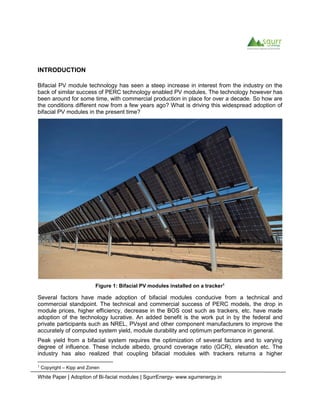
Figure 1: Bifacial PV modules installed on a tracker1
Several factors have made adoption of bifacial modules conducive from a technical and
commercial standpoint. The technical and commercial success of PERC models, the drop in
module prices, higher efficiency, decrease in the BOS cost such as trackers, etc. have made
adoption of the technology lucrative. An added benefit is the work put in by the federal and
private participants such as NREL, PVsyst and other component manufacturers to improve the
accurately of computed system yield, module durability and optimum performance in general.
Peak yield from a bifacial system requires the optimization of several factors and to varying
degree of influence. These include albedo, ground coverage ratio (GCR), elevation etc. The
industry has also realized that coupling bifacial modules with trackers returns a higher
1
Copyright – Kipp and Zonen
White Paper | Adoption of Bi-facial modules | SgurrEnergy- www.sgurrenergy.in
generation than bifacial modules on a fixed tilt system, thereby lowering the Levelized Cost of
Energy (LCOE) and improving the project Internal Rate of Return (IRR). Some estimates claim
bifacial gain as high a 30% with the right conditions. As the technology matures and prediction
techniques improve, more accurate estimates of the gain offered by bifacial modules will be
possible.
A Bloomberg report for H1 2018 puts the market share of bifacial modules at 3%, which is
expected to grow to 40% by 2025 as shown in Figure 2
Figure 2: Bifacial module market share
With module prices continually falling, bifacial PV modules are expected to replace monofacial
modules, the current workhorse of the industry.
The paper starts with the basics of bifacial modules and covers the factors that need to be
addressed if such a system has to be optimized, as a one size fits all approach is not possible.
WHAT ARE BIFACIAL PV MODULES?
As the name suggests, bifacial PV modules can generate energy from the front and rear side of
a PV module. Unlike mono-facial modules, the rear side of bifacial modules is lined with cells to
capture reflected and diffused irradiation. A comparison of the two is shown in Figure 3. The
nameplate power of the rear side of the modules is however less than the front side. Bifaciality
factor quantifies the STC-rated power of a bifacial module’s rear side in relation to the front-side
power. These ratios range between 55% and 95%.
White Paper | Adoption of Bi-facial modules | SgurrEnergy- www.sgurrenergy.in
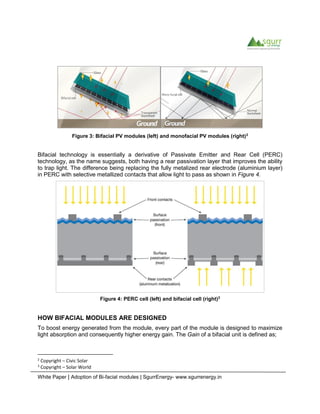
Figure 3: Bifacial PV modules (left) and monofacial PV modules (right)2
Bifacial technology is essentially a derivative of Passivate Emitter and Rear Cell (PERC)
technology, as the name suggests, both having a rear passivation layer that improves the ability
to trap light. The difference being replacing the fully metalized rear electrode (aluminium layer)
in PERC with selective metallized contacts that allow light to pass as shown in Figure 4.
Figure 4: PERC cell (left) and bifacial cell (right)3
HOW BIFACIAL MODULES ARE DESIGNED
To boost energy generated from the module, every part of the module is designed to maximize
light absorption and consequently higher energy gain. The Gain of a bifacial unit is defined as;
2
Copyright – Civic Solar
3
Copyright – Solar World
White Paper | Adoption of Bi-facial modules | SgurrEnergy- www.sgurrenergy.in
Several factors influence the overall gain. These include:
 Cell technology
 Module design
 Installation choice
 Ground conditions
 Surface reflectivity
Choice of cell technology relates to selection of n/p-type and mono/poly PERC. Installation
choices relates to fixed/tracking system, tilt, pitch etc. Ground conditions relate to irradiance,
latitude, longitude etc. Surface reflectivity is known as albedo. While module design is discussed
in this section, installation choices and surface reflectivity will be debated in the following
section.
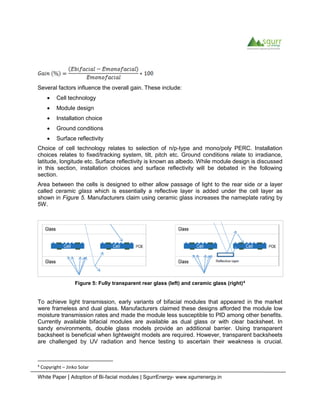
Area between the cells is designed to either allow passage of light to the rear side or a layer
called ceramic glass which is essentially a reflective layer is added under the cell layer as
shown in Figure 5. Manufacturers claim using ceramic glass increases the nameplate rating by
5W.
Figure 5: Fully transparent rear glass (left) and ceramic glass (right)4
To achieve light transmission, early variants of bifacial modules that appeared in the market
were frameless and dual glass. Manufacturers claimed these designs afforded the module low
moisture transmission rates and made the module less susceptible to PID among other benefits.
Currently available bifacial modules are available as dual glass or with clear backsheet. In
sandy environments, double glass models provide an additional barrier. Using transparent
backsheet is beneficial when lightweight models are required. However, transparent backsheets
are challenged by UV radiation and hence testing to ascertain their weakness is crucial.
4
Copyright – Jinko Solar
White Paper | Adoption of Bi-facial modules | SgurrEnergy- www.sgurrenergy.in
According to DuPont, testing polymer-based backsheets with controlled humidity is the prime
test in combination with thermal cycle for determining embrittlement effects.
The choice of using framed or frameless models depends on the application. For tracking and
floating solar plants, framed models are better suited for their higher stability and resistance
against mechanical stress. Due to the nature of the design requirement, rear-side busbars is
necessary and cell stringing mirrors that of the front side. Frameless modules are also less
prone to PID.
A key requirement for optimal performance of bifacial modules is to minimize shading on the
rear side. Junction boxes are hence become smaller and in some cases separated into multiple
units placed along the panel’s edge. All of this results in better thermal management and hence
bifacial modules usually have a better temperature coefficient than conventional monofacial
modules.
The robustness of bifacial module design in general is reflected by the lower annual degradation
rate. The current industry average is 0.5%/year.
PLANT DESIGN AND FACTORS TO BE CONSIDERED
Energy generation and Performance Ratio (PR) depend on several factors. While the choice of
cell technology and PV module design form the foundation for an optimum system, plant layout
and associated ground conditions can facilitate or hinder these objectives.
To optimally operate a bifacial PV plant it is essential to ensure adequate reflected light is
incident on the rear side of the module. This is essentially dictated by the albedo, which is
defined as the fraction of solar radiation reflected from Earth into space.
Typically, albedo is site-specific, with the type of surface beneath the model determining the
albedo of the area. Observations show that these values are often not constant, with changes
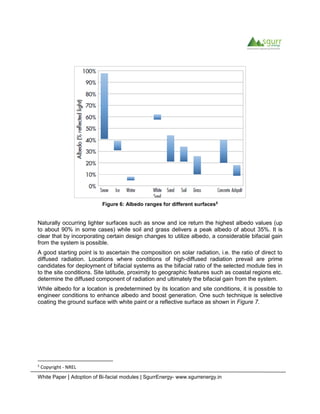
occurring daily and at seasonal intervals. Figure 6 illustrates the range of albedo values
corresponding to different surfaces.
White Paper | Adoption of Bi-facial modules | SgurrEnergy- www.sgurrenergy.in
Figure 6: Albedo ranges for different surfaces5
Naturally occurring lighter surfaces such as snow and ice return the highest albedo values (up
to about 90% in some cases) while soil and grass delivers a peak albedo of about 35%. It is
clear that by incorporating certain design changes to utilize albedo, a considerable bifacial gain
from the system is possible.
A good starting point is to ascertain the composition on solar radiation, i.e. the ratio of direct to
diffused radiation. Locations where conditions of high-diffused radiation prevail are prime
candidates for deployment of bifacial systems as the bifacial ratio of the selected module ties in
to the site conditions. Site latitude, proximity to geographic features such as coastal regions etc.
determine the diffused component of radiation and ultimately the bifacial gain from the system.
While albedo for a location is predetermined by its location and site conditions, it is possible to
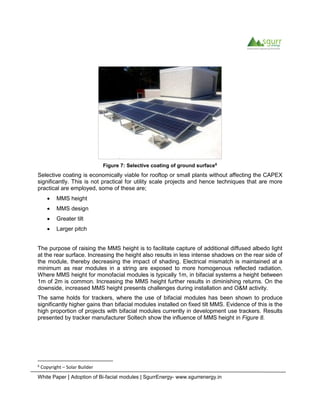
engineer conditions to enhance albedo and boost generation. One such technique is selective
coating the ground surface with white paint or a reflective surface as shown in Figure 7.
5
Copyright - NREL
White Paper | Adoption of Bi-facial modules | SgurrEnergy- www.sgurrenergy.in
Figure 7: Selective coating of ground surface6
Selective coating is economically viable for rooftop or small plants without affecting the CAPEX
significantly. This is not practical for utility scale projects and hence techniques that are more
practical are employed, some of these are;
 MMS height
 MMS design
 Greater tilt
 Larger pitch
The purpose of raising the MMS height is to facilitate capture of additional diffused albedo light
at the rear surface. Increasing the height also results in less intense shadows on the rear side of
the module, thereby decreasing the impact of shading. Electrical mismatch is maintained at a
minimum as rear modules in a string are exposed to more homogenous reflected radiation.
Where MMS height for monofacial modules is typically 1m, in bifacial systems a height between
1m of 2m is common. Increasing the MMS height further results in diminishing returns. On the
downside, increased MMS height presents challenges during installation and O&M activity.
The same holds for trackers, where the use of bifacial modules has been shown to produce
significantly higher gains than bifacial modules installed on fixed tilt MMS. Evidence of this is the
high proportion of projects with bifacial modules currently in development use trackers. Results
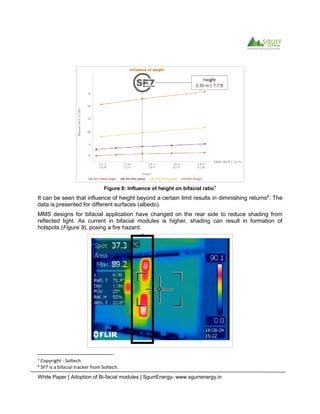
presented by tracker manufacturer Soltech show the influence of MMS height in Figure 8.
6
Copyright – Solar Builder
White Paper | Adoption of Bi-facial modules | SgurrEnergy- www.sgurrenergy.in
Figure 8: Influence of height on bifacial ratio7
It can be seen that influence of height beyond a certain limit results in diminishing returns8
. The
data is presented for different surfaces (albedo).
MMS designs for bifacial application have changed on the rear side to reduce shading from
reflected light. As current in bifacial modules is higher, shading can result in formation of
hotspots (Figure 9), posing a fire hazard.
7
Copyright - Soltech
8
SF7 is a bifacial tracker from Soltech.
White Paper | Adoption of Bi-facial modules | SgurrEnergy- www.sgurrenergy.in
Figure 9: Shading from the torque tube resulting in hotspot9
For bifacial modules on fixed tilt MMS, higher tilt angles are implemented to increase exposure
of the rear side to diffused and reflected light. A caveat however is the increased load and a
structure susceptible to higher wind loading. Compensating for these may affect project IRR.
For systems at particularly high latitudes, inter row shading concerns may arise if a sufficient
pitch is not maintained. In tracking plants, the gain can be expected to vary more significantly
than a fixed tilt system.
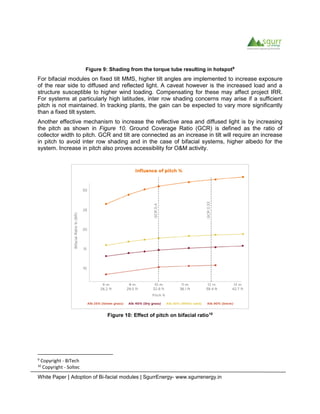
Another effective mechanism to increase the reflective area and diffused light is by increasing
the pitch as shown in Figure 10. Ground Coverage Ratio (GCR) is defined as the ratio of
collector width to pitch. GCR and tilt are connected as an increase in tilt will require an increase
in pitch to avoid inter row shading and in the case of bifacial systems, higher albedo for the
system. Increase in pitch also proves accessibility for O&M activity.
Figure 10: Effect of pitch on bifacial ratio10
9
Copyright - BiTech
10
Copyright - Soltec
White Paper | Adoption of Bi-facial modules | SgurrEnergy- www.sgurrenergy.in
Increasing the inter row spacing has a positive effect on the bifacial ratio which delivers a higher
energy output. Although the linear trend is proportion, beyond a certain value, the graph tends
to flatten out and the returns diminish. Beyond this critical value, cabling, infrastructure and cost
of additional land will add to CAPEX thereby making the project less lucrative. The appropriate
pitch for a site depends on project location, MMS design and tilt in the case of fixed tilt system.
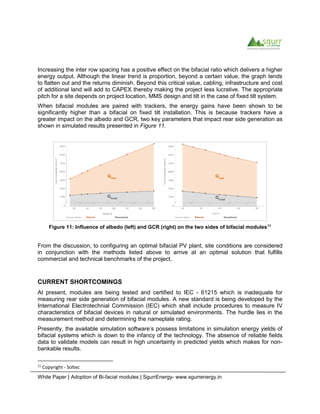
When bifacial modules are paired with trackers, the energy gains have been shown to be
significantly higher than a bifacial on fixed tilt installation. This is because trackers have a
greater impact on the albedo and GCR, two key parameters that impact rear side generation as
shown in simulated results presented in Figure 11.
Figure 11: Influence of albedo (left) and GCR (right) on the two sides of bifacial modules11
From the discussion, to configuring an optimal bifacial PV plant, site conditions are considered
in conjunction with the methods listed above to arrive at an optimal solution that fulfills
commercial and technical benchmarks of the project.
CURRENT SHORTCOMINGS
At present, modules are being tested and certified to IEC - 61215 which is inadequate for
measuring rear side generation of bifacial modules. A new standard is being developed by the
International Electrotechnial Commission (IEC) which shall include procedures to measure IV
characteristics of bifacial devices in natural or simulated environments. The hurdle lies in the
measurement method and determining the nameplate rating.
Presently, the available simulation software’s possess limitations in simulation energy yields of
bifacial systems which is down to the infancy of the technology. The absence of reliable fields
data to validate models can result in high uncertainty in predicted yields which makes for non-
bankable results.
11
Copyright - Soltec
White Paper | Adoption of Bi-facial modules | SgurrEnergy- www.sgurrenergy.in
APPLICATION OF BIFACIAL SYSTEMS
Their unique design makes bifacial modules useful where the use of monofacial modules would
not justifiable. Some areas of the application for bifacial modules are;
 Primarily in large PV fields utilizing trackers for further enhancement in energy yields.
 As railings - where they are installed vertically.
 For soundproofing in building integrated PV systems.
 In snow heavy locations – due to high albedo, bifacial gain would be significant. Such
systems can produce energy all year.
 On Carports – With the emergence of EV’s these can serve to power charging points

Bifacial PV Modules- SgurrEnergy

  • 1.
    White Paper |Adoption of Bi-facial modules | SgurrEnergy- www.sgurrenergy.in Adoption of Bi-facial modules By Jawwad Shaikh jawwad_shaikh@sgurrenergy.com SGURRENERGY SOLAR ENGINEERING CONSULTANTS
  • 2.
    White Paper |Adoption of Bi-facial modules | SgurrEnergy- www.sgurrenergy.in INTRODUCTION Bifacial PV module technology has seen a steep increase in interest from the industry on the back of similar success of PERC technology enabled PV modules. The technology however has been around for some time, with commercial production in place for over a decade. So how are the conditions different now from a few years ago? What is driving this widespread adoption of bifacial PV modules in the present time? Figure 1: Bifacial PV modules installed on a tracker1 Several factors have made adoption of bifacial modules conducive from a technical and commercial standpoint. The technical and commercial success of PERC models, the drop in module prices, higher efficiency, decrease in the BOS cost such as trackers, etc. have made adoption of the technology lucrative. An added benefit is the work put in by the federal and private participants such as NREL, PVsyst and other component manufacturers to improve the accurately of computed system yield, module durability and optimum performance in general. Peak yield from a bifacial system requires the optimization of several factors and to varying degree of influence. These include albedo, ground coverage ratio (GCR), elevation etc. The industry has also realized that coupling bifacial modules with trackers returns a higher 1 Copyright – Kipp and Zonen
  • 3.
    White Paper |Adoption of Bi-facial modules | SgurrEnergy- www.sgurrenergy.in generation than bifacial modules on a fixed tilt system, thereby lowering the Levelized Cost of Energy (LCOE) and improving the project Internal Rate of Return (IRR). Some estimates claim bifacial gain as high a 30% with the right conditions. As the technology matures and prediction techniques improve, more accurate estimates of the gain offered by bifacial modules will be possible. A Bloomberg report for H1 2018 puts the market share of bifacial modules at 3%, which is expected to grow to 40% by 2025 as shown in Figure 2 Figure 2: Bifacial module market share With module prices continually falling, bifacial PV modules are expected to replace monofacial modules, the current workhorse of the industry. The paper starts with the basics of bifacial modules and covers the factors that need to be addressed if such a system has to be optimized, as a one size fits all approach is not possible. WHAT ARE BIFACIAL PV MODULES? As the name suggests, bifacial PV modules can generate energy from the front and rear side of a PV module. Unlike mono-facial modules, the rear side of bifacial modules is lined with cells to capture reflected and diffused irradiation. A comparison of the two is shown in Figure 3. The nameplate power of the rear side of the modules is however less than the front side. Bifaciality factor quantifies the STC-rated power of a bifacial module’s rear side in relation to the front-side power. These ratios range between 55% and 95%.
  • 4.
    White Paper |Adoption of Bi-facial modules | SgurrEnergy- www.sgurrenergy.in Figure 3: Bifacial PV modules (left) and monofacial PV modules (right)2 Bifacial technology is essentially a derivative of Passivate Emitter and Rear Cell (PERC) technology, as the name suggests, both having a rear passivation layer that improves the ability to trap light. The difference being replacing the fully metalized rear electrode (aluminium layer) in PERC with selective metallized contacts that allow light to pass as shown in Figure 4. Figure 4: PERC cell (left) and bifacial cell (right)3 HOW BIFACIAL MODULES ARE DESIGNED To boost energy generated from the module, every part of the module is designed to maximize light absorption and consequently higher energy gain. The Gain of a bifacial unit is defined as; 2 Copyright – Civic Solar 3 Copyright – Solar World
  • 5.
    White Paper |Adoption of Bi-facial modules | SgurrEnergy- www.sgurrenergy.in Several factors influence the overall gain. These include:  Cell technology  Module design  Installation choice  Ground conditions  Surface reflectivity Choice of cell technology relates to selection of n/p-type and mono/poly PERC. Installation choices relates to fixed/tracking system, tilt, pitch etc. Ground conditions relate to irradiance, latitude, longitude etc. Surface reflectivity is known as albedo. While module design is discussed in this section, installation choices and surface reflectivity will be debated in the following section. Area between the cells is designed to either allow passage of light to the rear side or a layer called ceramic glass which is essentially a reflective layer is added under the cell layer as shown in Figure 5. Manufacturers claim using ceramic glass increases the nameplate rating by 5W. Figure 5: Fully transparent rear glass (left) and ceramic glass (right)4 To achieve light transmission, early variants of bifacial modules that appeared in the market were frameless and dual glass. Manufacturers claimed these designs afforded the module low moisture transmission rates and made the module less susceptible to PID among other benefits. Currently available bifacial modules are available as dual glass or with clear backsheet. In sandy environments, double glass models provide an additional barrier. Using transparent backsheet is beneficial when lightweight models are required. However, transparent backsheets are challenged by UV radiation and hence testing to ascertain their weakness is crucial. 4 Copyright – Jinko Solar
  • 6.
    White Paper |Adoption of Bi-facial modules | SgurrEnergy- www.sgurrenergy.in According to DuPont, testing polymer-based backsheets with controlled humidity is the prime test in combination with thermal cycle for determining embrittlement effects. The choice of using framed or frameless models depends on the application. For tracking and floating solar plants, framed models are better suited for their higher stability and resistance against mechanical stress. Due to the nature of the design requirement, rear-side busbars is necessary and cell stringing mirrors that of the front side. Frameless modules are also less prone to PID. A key requirement for optimal performance of bifacial modules is to minimize shading on the rear side. Junction boxes are hence become smaller and in some cases separated into multiple units placed along the panel’s edge. All of this results in better thermal management and hence bifacial modules usually have a better temperature coefficient than conventional monofacial modules. The robustness of bifacial module design in general is reflected by the lower annual degradation rate. The current industry average is 0.5%/year. PLANT DESIGN AND FACTORS TO BE CONSIDERED Energy generation and Performance Ratio (PR) depend on several factors. While the choice of cell technology and PV module design form the foundation for an optimum system, plant layout and associated ground conditions can facilitate or hinder these objectives. To optimally operate a bifacial PV plant it is essential to ensure adequate reflected light is incident on the rear side of the module. This is essentially dictated by the albedo, which is defined as the fraction of solar radiation reflected from Earth into space. Typically, albedo is site-specific, with the type of surface beneath the model determining the albedo of the area. Observations show that these values are often not constant, with changes occurring daily and at seasonal intervals. Figure 6 illustrates the range of albedo values corresponding to different surfaces.
  • 7.
    White Paper |Adoption of Bi-facial modules | SgurrEnergy- www.sgurrenergy.in Figure 6: Albedo ranges for different surfaces5 Naturally occurring lighter surfaces such as snow and ice return the highest albedo values (up to about 90% in some cases) while soil and grass delivers a peak albedo of about 35%. It is clear that by incorporating certain design changes to utilize albedo, a considerable bifacial gain from the system is possible. A good starting point is to ascertain the composition on solar radiation, i.e. the ratio of direct to diffused radiation. Locations where conditions of high-diffused radiation prevail are prime candidates for deployment of bifacial systems as the bifacial ratio of the selected module ties in to the site conditions. Site latitude, proximity to geographic features such as coastal regions etc. determine the diffused component of radiation and ultimately the bifacial gain from the system. While albedo for a location is predetermined by its location and site conditions, it is possible to engineer conditions to enhance albedo and boost generation. One such technique is selective coating the ground surface with white paint or a reflective surface as shown in Figure 7. 5 Copyright - NREL
  • 8.
    White Paper |Adoption of Bi-facial modules | SgurrEnergy- www.sgurrenergy.in Figure 7: Selective coating of ground surface6 Selective coating is economically viable for rooftop or small plants without affecting the CAPEX significantly. This is not practical for utility scale projects and hence techniques that are more practical are employed, some of these are;  MMS height  MMS design  Greater tilt  Larger pitch The purpose of raising the MMS height is to facilitate capture of additional diffused albedo light at the rear surface. Increasing the height also results in less intense shadows on the rear side of the module, thereby decreasing the impact of shading. Electrical mismatch is maintained at a minimum as rear modules in a string are exposed to more homogenous reflected radiation. Where MMS height for monofacial modules is typically 1m, in bifacial systems a height between 1m of 2m is common. Increasing the MMS height further results in diminishing returns. On the downside, increased MMS height presents challenges during installation and O&M activity. The same holds for trackers, where the use of bifacial modules has been shown to produce significantly higher gains than bifacial modules installed on fixed tilt MMS. Evidence of this is the high proportion of projects with bifacial modules currently in development use trackers. Results presented by tracker manufacturer Soltech show the influence of MMS height in Figure 8. 6 Copyright – Solar Builder
  • 9.
    White Paper |Adoption of Bi-facial modules | SgurrEnergy- www.sgurrenergy.in Figure 8: Influence of height on bifacial ratio7 It can be seen that influence of height beyond a certain limit results in diminishing returns8 . The data is presented for different surfaces (albedo). MMS designs for bifacial application have changed on the rear side to reduce shading from reflected light. As current in bifacial modules is higher, shading can result in formation of hotspots (Figure 9), posing a fire hazard. 7 Copyright - Soltech 8 SF7 is a bifacial tracker from Soltech.
  • 10.
    White Paper |Adoption of Bi-facial modules | SgurrEnergy- www.sgurrenergy.in Figure 9: Shading from the torque tube resulting in hotspot9 For bifacial modules on fixed tilt MMS, higher tilt angles are implemented to increase exposure of the rear side to diffused and reflected light. A caveat however is the increased load and a structure susceptible to higher wind loading. Compensating for these may affect project IRR. For systems at particularly high latitudes, inter row shading concerns may arise if a sufficient pitch is not maintained. In tracking plants, the gain can be expected to vary more significantly than a fixed tilt system. Another effective mechanism to increase the reflective area and diffused light is by increasing the pitch as shown in Figure 10. Ground Coverage Ratio (GCR) is defined as the ratio of collector width to pitch. GCR and tilt are connected as an increase in tilt will require an increase in pitch to avoid inter row shading and in the case of bifacial systems, higher albedo for the system. Increase in pitch also proves accessibility for O&M activity. Figure 10: Effect of pitch on bifacial ratio10 9 Copyright - BiTech 10 Copyright - Soltec
  • 11.
    White Paper |Adoption of Bi-facial modules | SgurrEnergy- www.sgurrenergy.in Increasing the inter row spacing has a positive effect on the bifacial ratio which delivers a higher energy output. Although the linear trend is proportion, beyond a certain value, the graph tends to flatten out and the returns diminish. Beyond this critical value, cabling, infrastructure and cost of additional land will add to CAPEX thereby making the project less lucrative. The appropriate pitch for a site depends on project location, MMS design and tilt in the case of fixed tilt system. When bifacial modules are paired with trackers, the energy gains have been shown to be significantly higher than a bifacial on fixed tilt installation. This is because trackers have a greater impact on the albedo and GCR, two key parameters that impact rear side generation as shown in simulated results presented in Figure 11. Figure 11: Influence of albedo (left) and GCR (right) on the two sides of bifacial modules11 From the discussion, to configuring an optimal bifacial PV plant, site conditions are considered in conjunction with the methods listed above to arrive at an optimal solution that fulfills commercial and technical benchmarks of the project. CURRENT SHORTCOMINGS At present, modules are being tested and certified to IEC - 61215 which is inadequate for measuring rear side generation of bifacial modules. A new standard is being developed by the International Electrotechnial Commission (IEC) which shall include procedures to measure IV characteristics of bifacial devices in natural or simulated environments. The hurdle lies in the measurement method and determining the nameplate rating. Presently, the available simulation software’s possess limitations in simulation energy yields of bifacial systems which is down to the infancy of the technology. The absence of reliable fields data to validate models can result in high uncertainty in predicted yields which makes for non- bankable results. 11 Copyright - Soltec
  • 12.
    White Paper |Adoption of Bi-facial modules | SgurrEnergy- www.sgurrenergy.in APPLICATION OF BIFACIAL SYSTEMS Their unique design makes bifacial modules useful where the use of monofacial modules would not justifiable. Some areas of the application for bifacial modules are;  Primarily in large PV fields utilizing trackers for further enhancement in energy yields.  As railings - where they are installed vertically.  For soundproofing in building integrated PV systems.  In snow heavy locations – due to high albedo, bifacial gain would be significant. Such systems can produce energy all year.  On Carports – With the emergence of EV’s these can serve to power charging points