© Fraunhofer ISE
Realistic Yield Expectations for Bifacial PV
Systems – an Assessment of Announced,
Predicted and Observed Benefits
Christian Reise
Alexandra Schmid
Fraunhofer Institute
for Solar Energy Systems ISE
PV Performance Modelling
and Monitoring Workshop
Cologne, October 23, 2015
© Fraunhofer ISE
2
Bifacial PV Modules and Systems
Bifacial gain
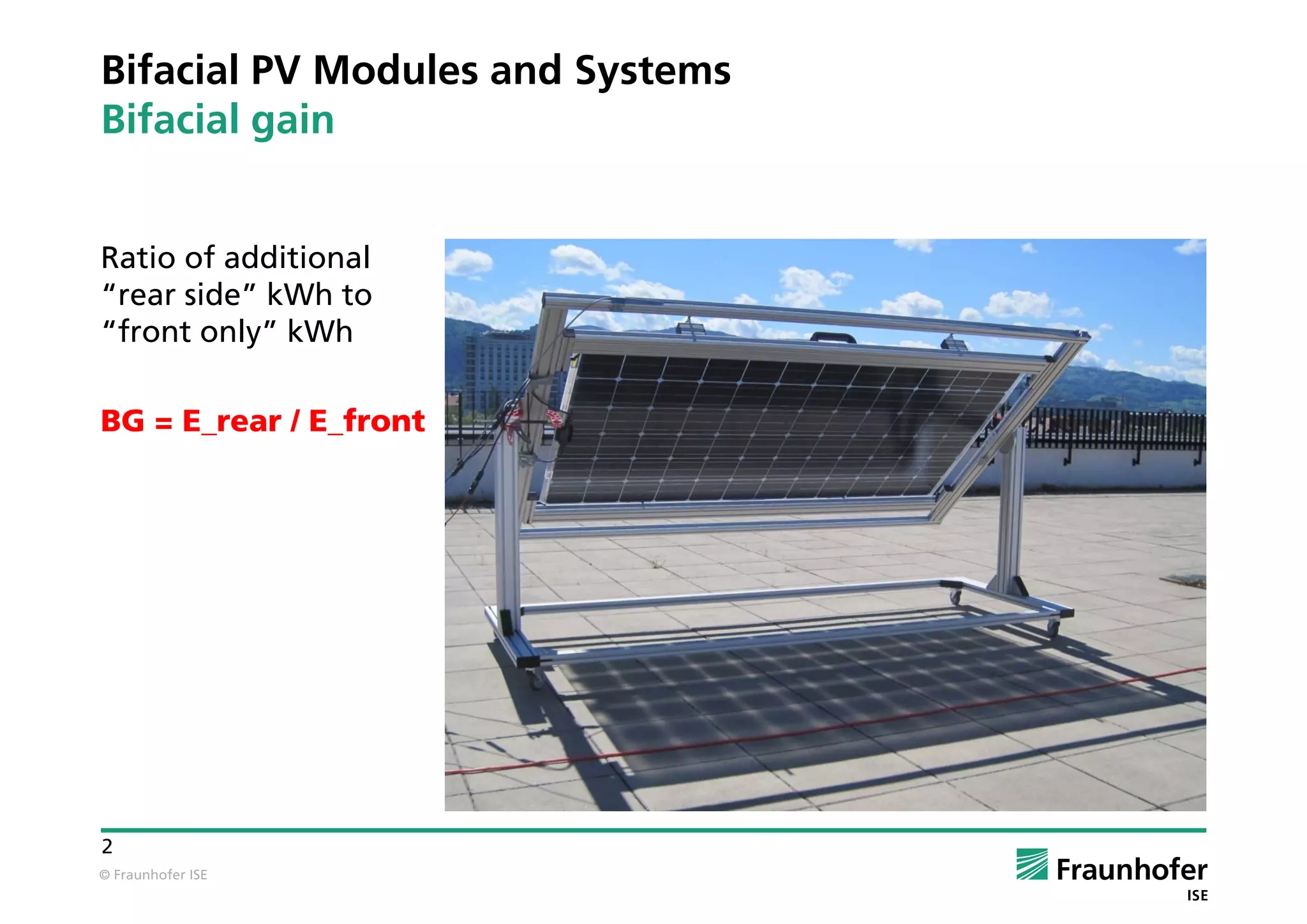
Ratio of additional
“rear side” kWh to
“front only” kWh
BG = E_rear / E_front
© Fraunhofer ISE
3
Bifacial PV Modules and Systems
Bifacial gain
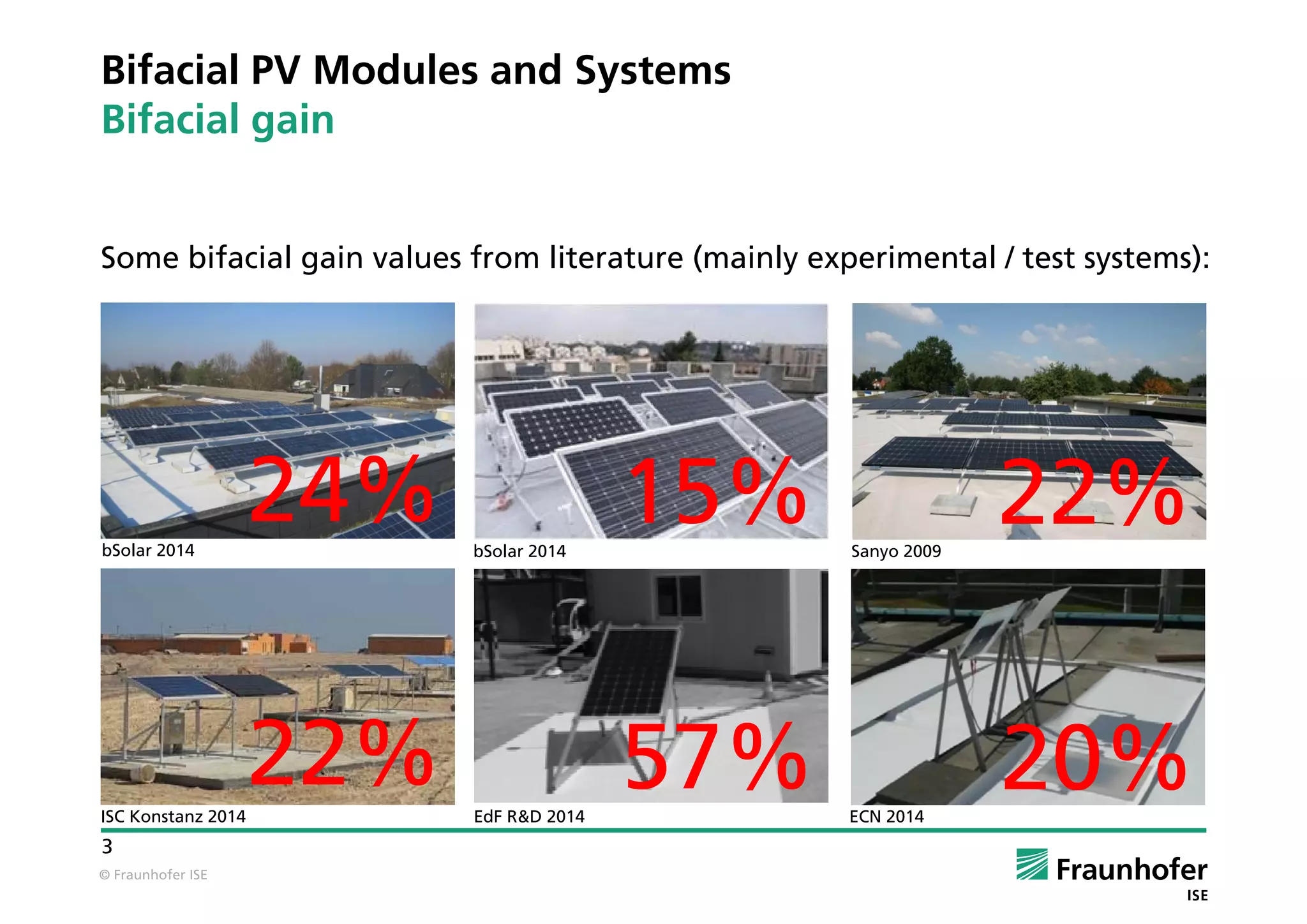
Some bifacial gain values from literature (mainly experimental / test systems):
24% 15% 22%
22% 57% 20%
bSolar 2014 Sanyo 2009bSolar 2014
ISC Konstanz 2014 EdF R&D 2014 ECN 2014
© Fraunhofer ISE
4
Bifacial PV Modules and Systems
Bifacial gain
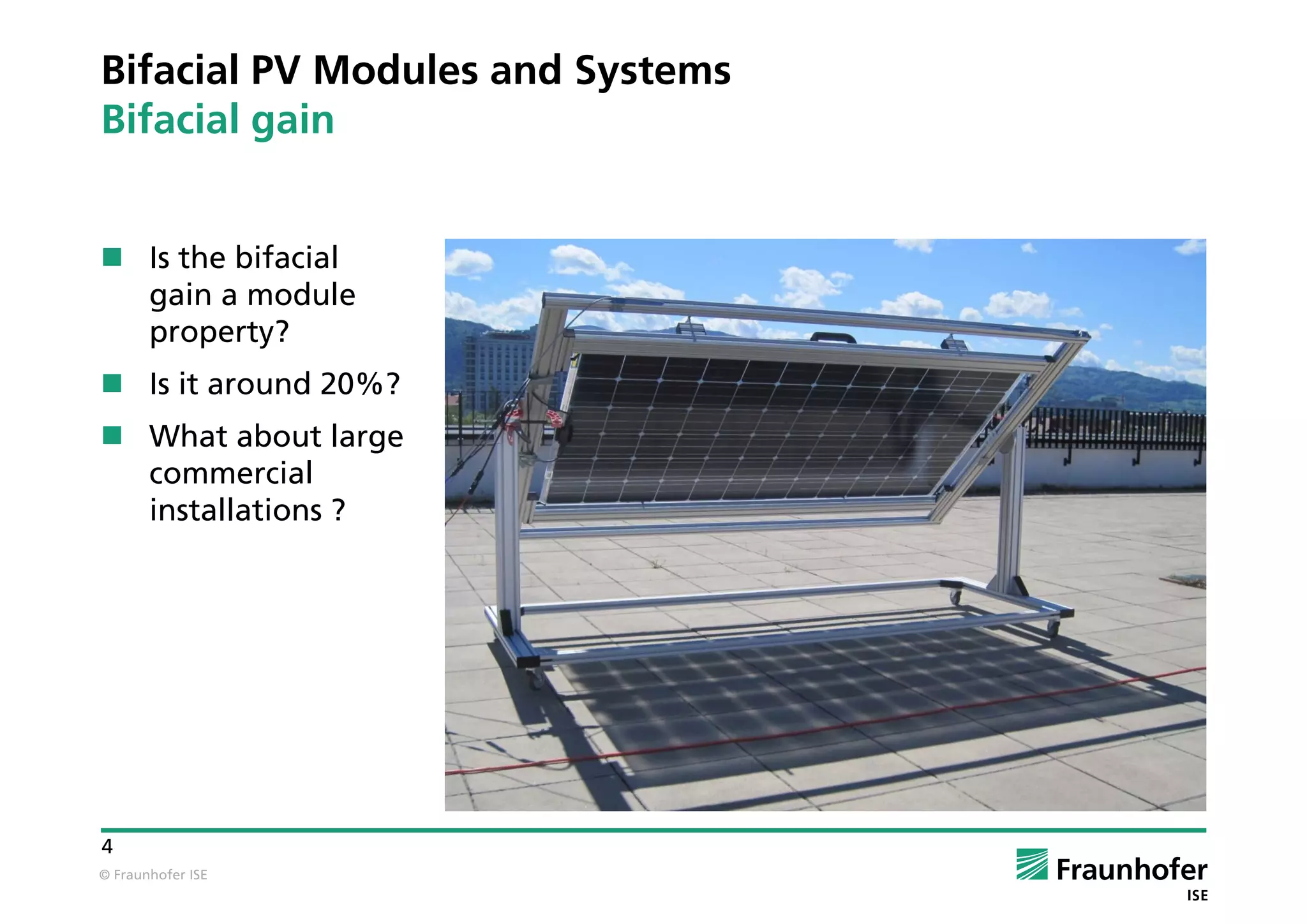
 Is the bifacial
gain a module
property?
 Is it around 20%?
 What about large
commercial
installations ?
© Fraunhofer ISE
5
AGENDA
 Efficiency and Power: Definitions
 Predicting Bifacial Yields
 Exemplary Results
 Conclusion
© Fraunhofer ISE
6
Bifacial PV Modules and Systems
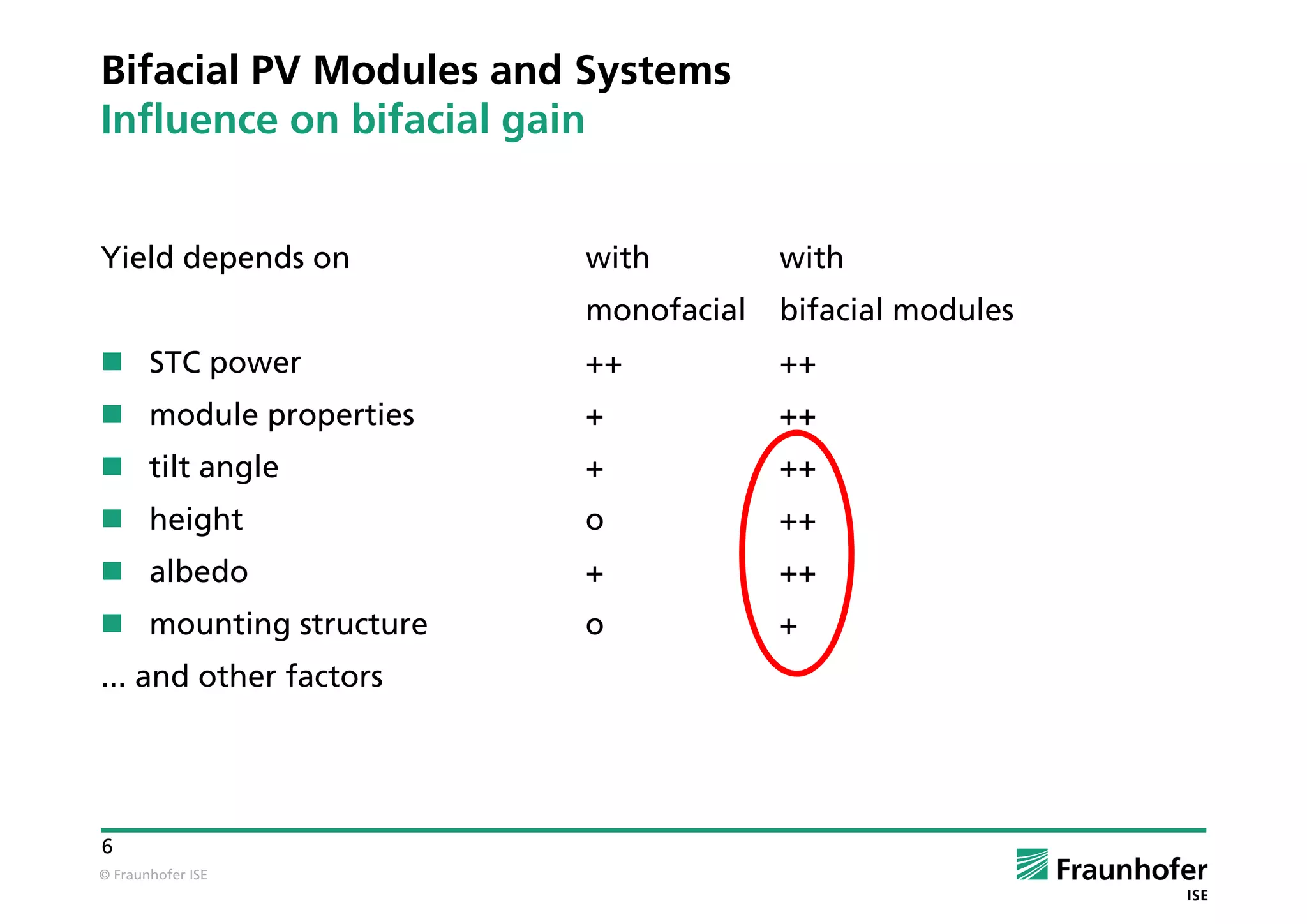
Influence on bifacial gain
Yield depends on with with
monofacial bifacial modules
 STC power ++ ++
 module properties + ++
 tilt angle + ++
 height o ++
 albedo + ++
 mounting structure o +
... and other factors
© Fraunhofer ISE
7
Bifacial Efficiency and Power
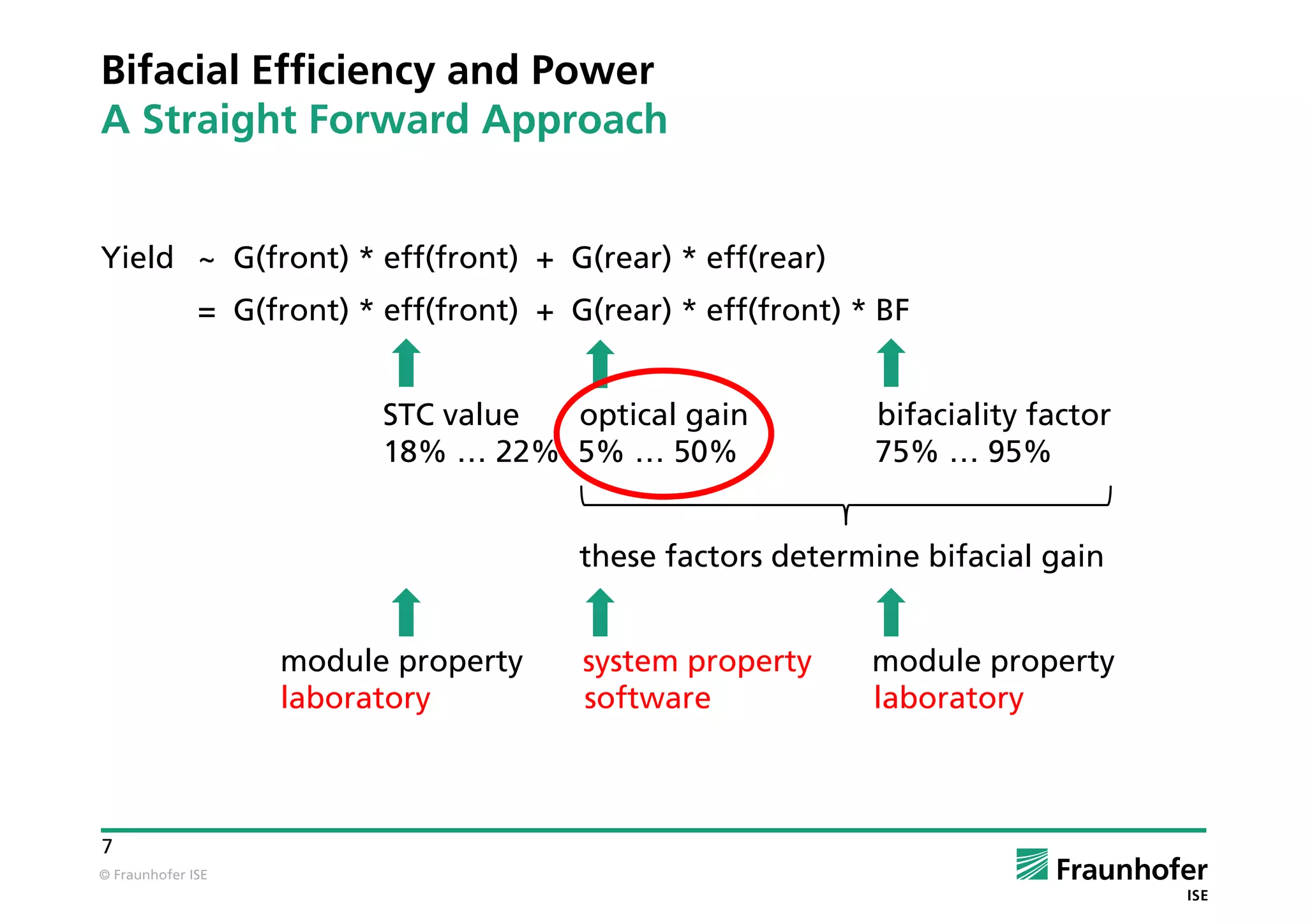
A Straight Forward Approach
Yield ~ G(front) * eff(front) + G(rear) * eff(rear)
= G(front) * eff(front) + G(rear) * eff(front) * BF
STC value optical gain bifaciality factor
18% … 22% 5% … 50% 75% … 95%
these factors determine bifacial gain
module property system property module property
laboratory software laboratory
© Fraunhofer ISE
8
Predicting Bifacial Yields
Predicting Optical Gains
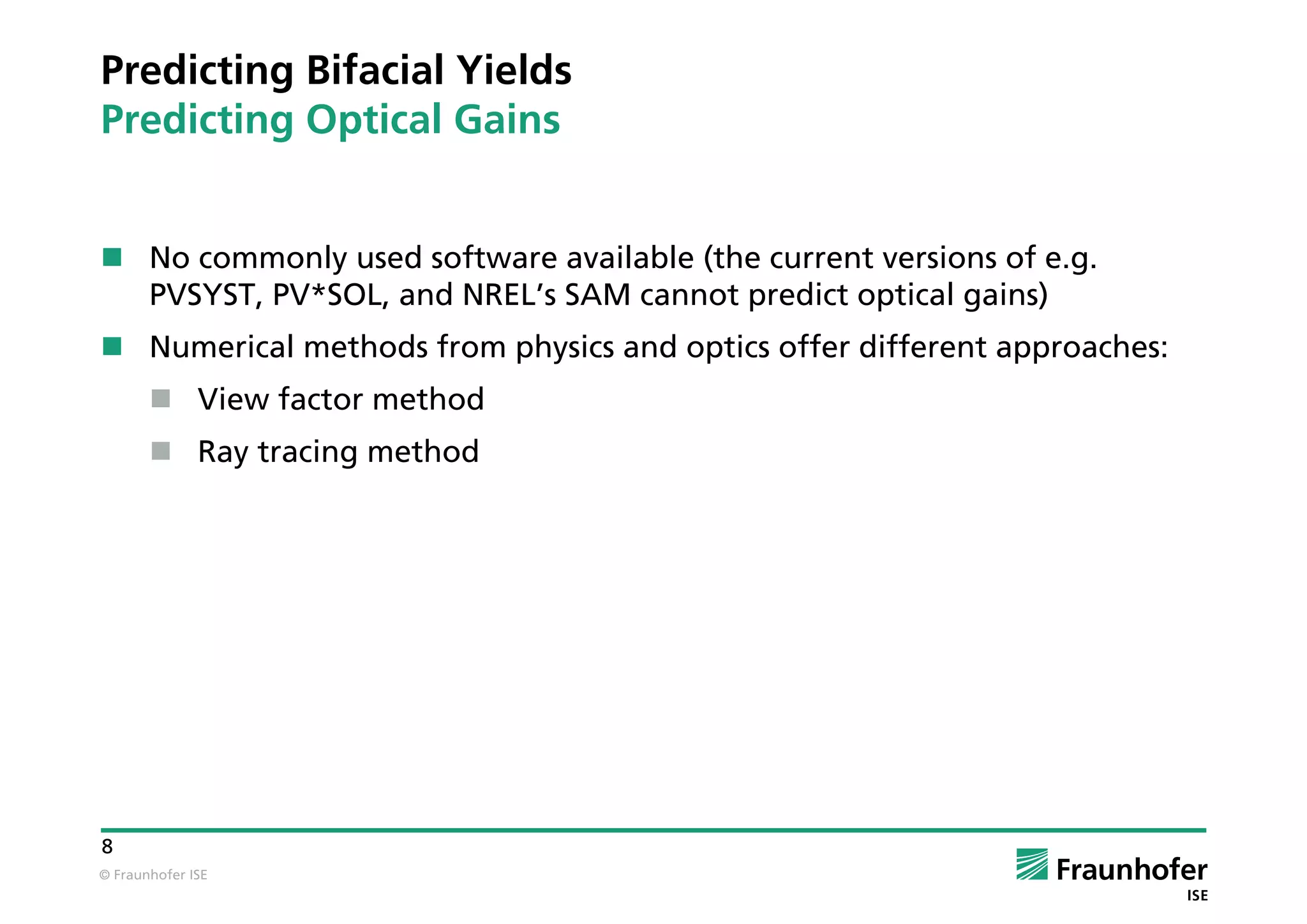
 No commonly used software available (the current versions of e.g.
PVSYST, PV*SOL, and NREL’s SAM cannot predict optical gains)
 Numerical methods from physics and optics offer different approaches:
 View factor method
 Ray tracing method
© Fraunhofer ISE
9
Predicting Bifacial Yields
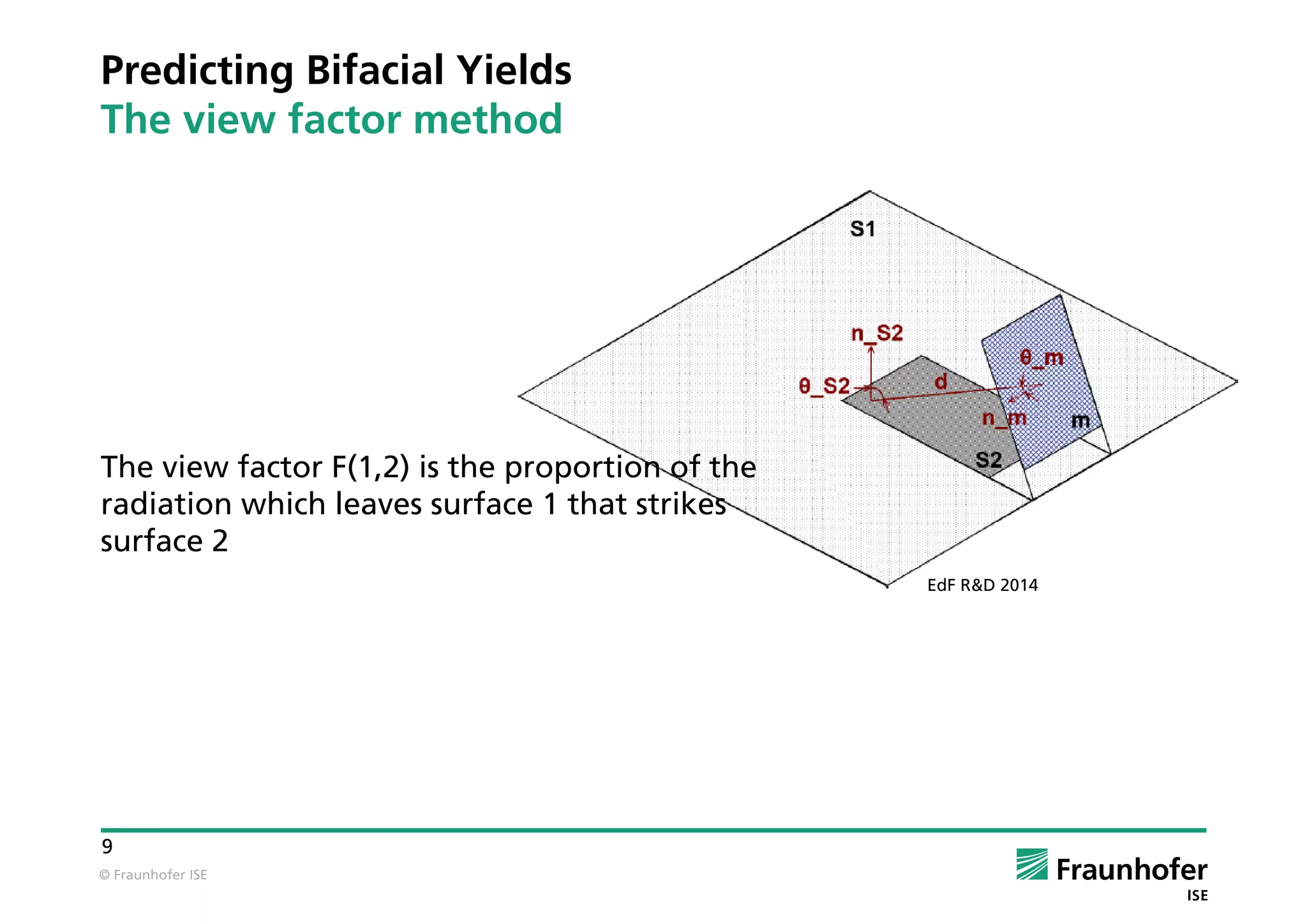
The view factor method
The view factor F(1,2) is the proportion of the
radiation which leaves surface 1 that strikes
surface 2
EdF R&D 2014
© Fraunhofer ISE
10
Predicting Bifacial Yields
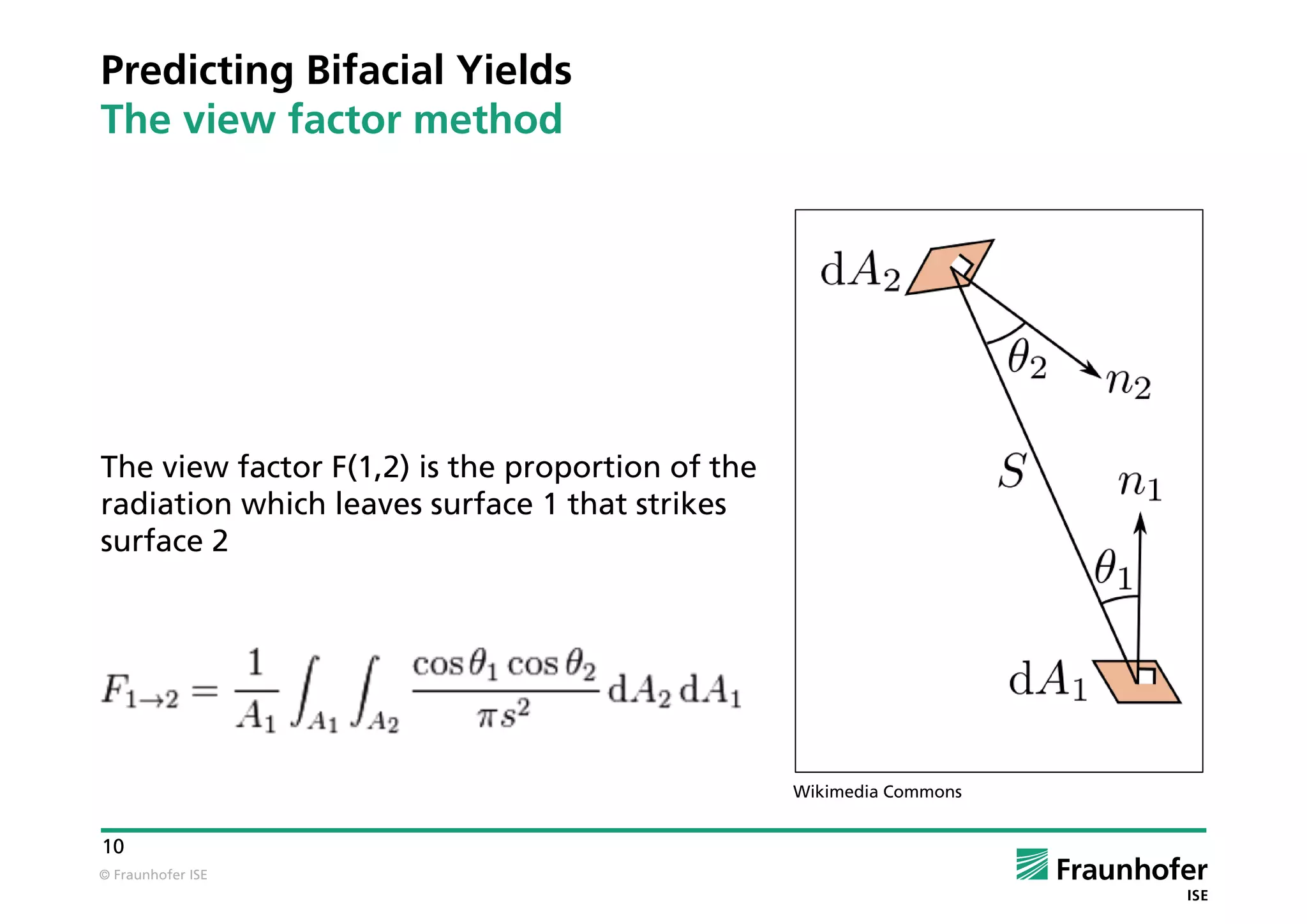
The view factor method
The view factor F(1,2) is the proportion of the
radiation which leaves surface 1 that strikes
surface 2
Wikimedia Commons
© Fraunhofer ISE
11
Predicting Bifacial Yields
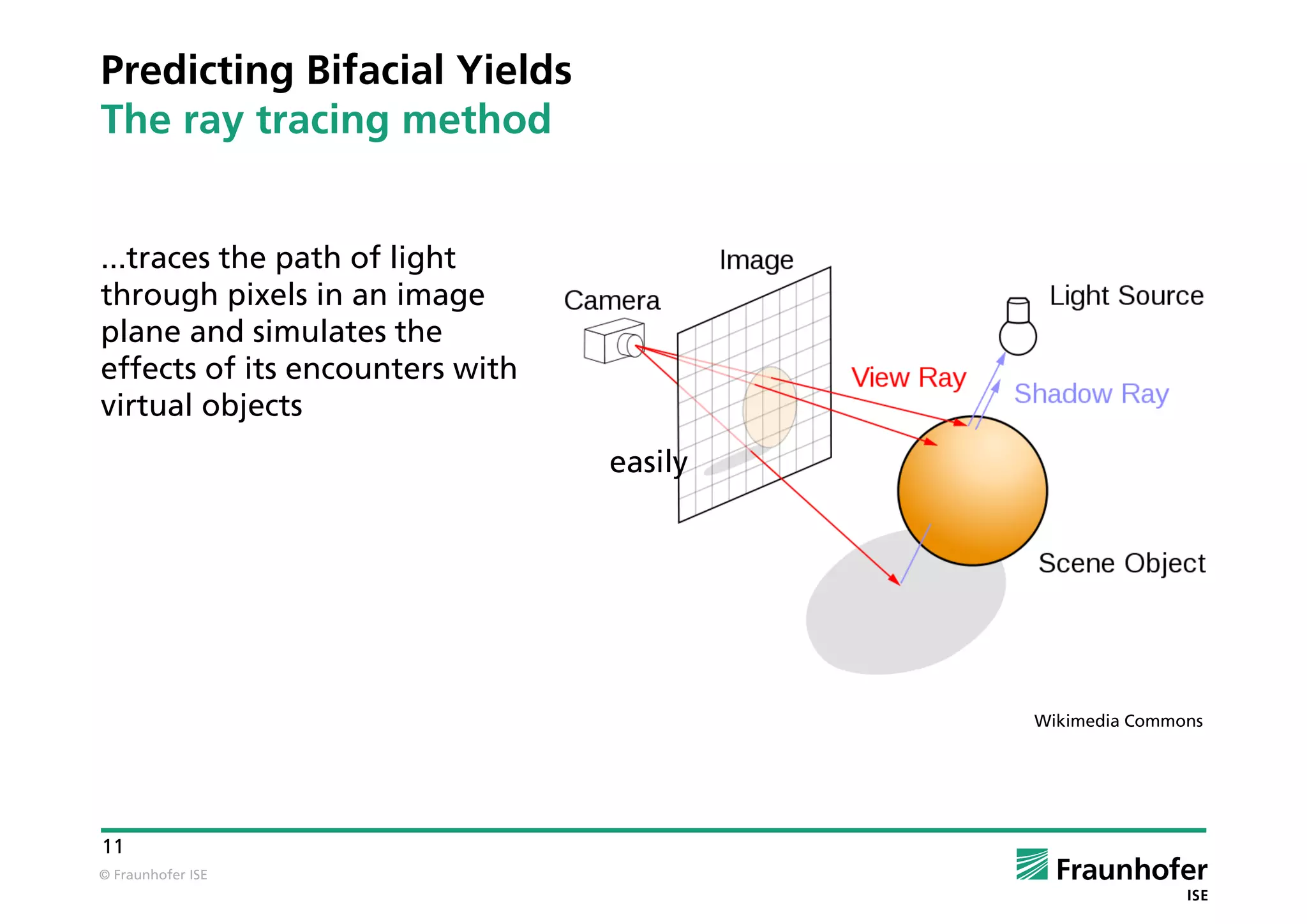
The ray tracing method
...traces the path of light
through pixels in an image
plane and simulates the
effects of its encounters with
virtual objects
Wikimedia Commons
easily
© Fraunhofer ISE
12
Predicting Bifacial Yields
Predicting Optical Gains
 View factor method:
 easy to implement for simple geometries
 becomes complex task for realistic systems
 Ray tracing method:
 less easy to implement
 time consuming
 delivers rear side irradiance, rear side inhomogeneity, mutual (front
side) shading, influence of mounting structure...
© Fraunhofer ISE
13
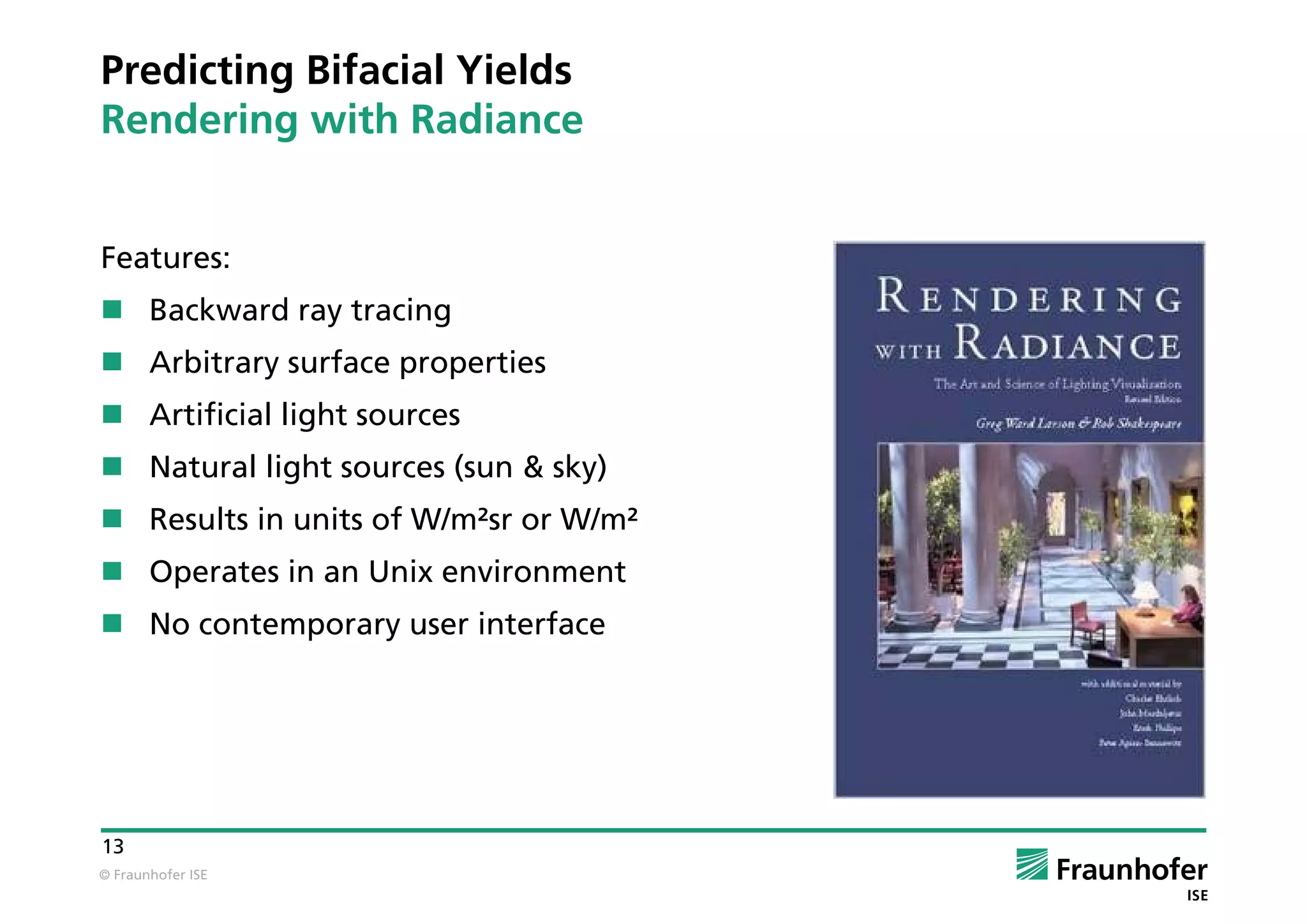
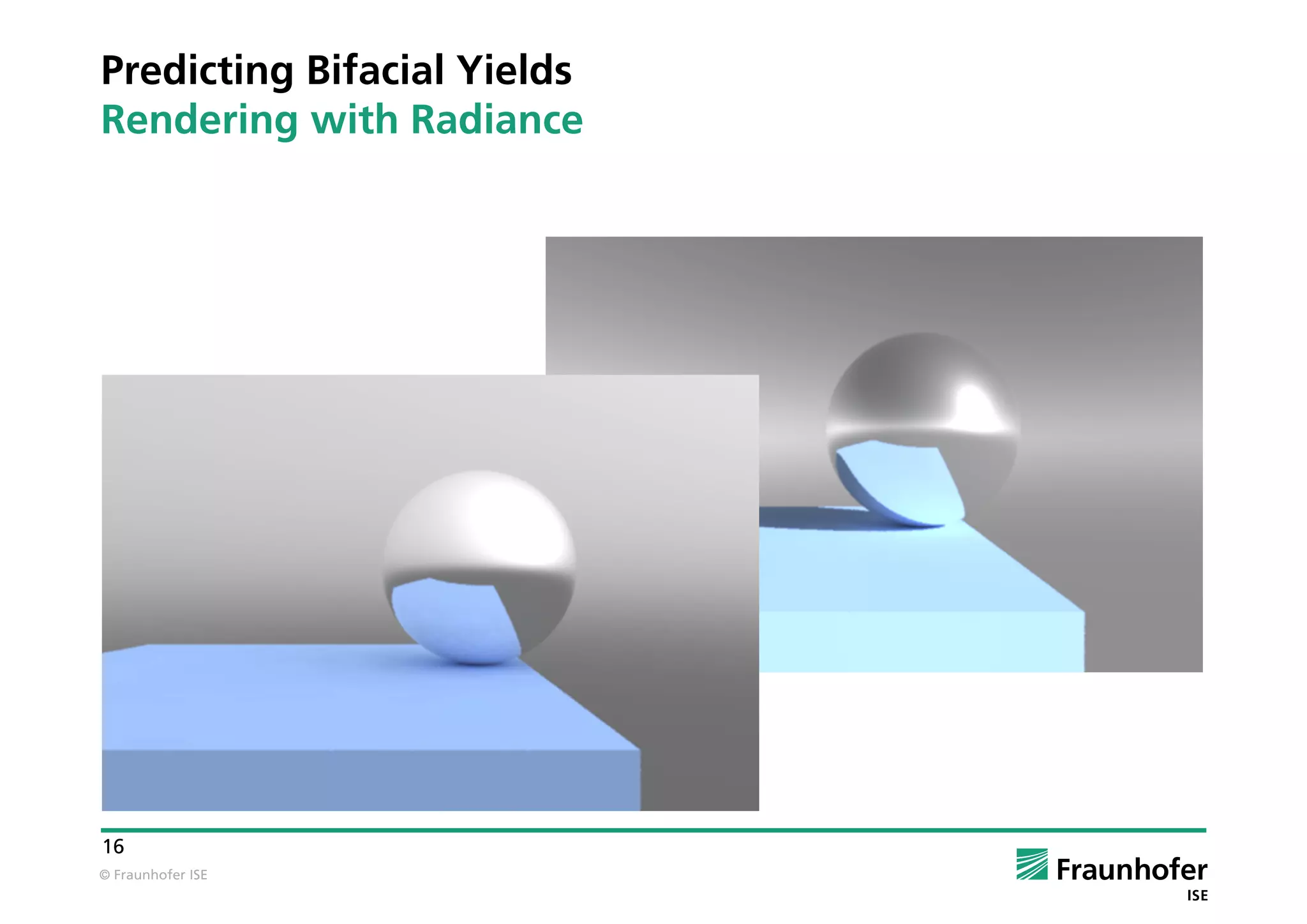
Features:
 Backward ray tracing
 Arbitrary surface properties
 Artificial light sources
 Natural light sources (sun & sky)
 Results in units of W/m²sr or W/m²
 Operates in an Unix environment
 No contemporary user interface
Predicting Bifacial Yields
Rendering with Radiance
© Fraunhofer ISE
14
Predicting Bifacial Yields
Rendering with Radiance
 Artificial light …
© Graeme Watt, Synthesis Design & Visualisation Limited
© Fraunhofer ISE
15
Predicting Bifacial Yields
Rendering with Radiance
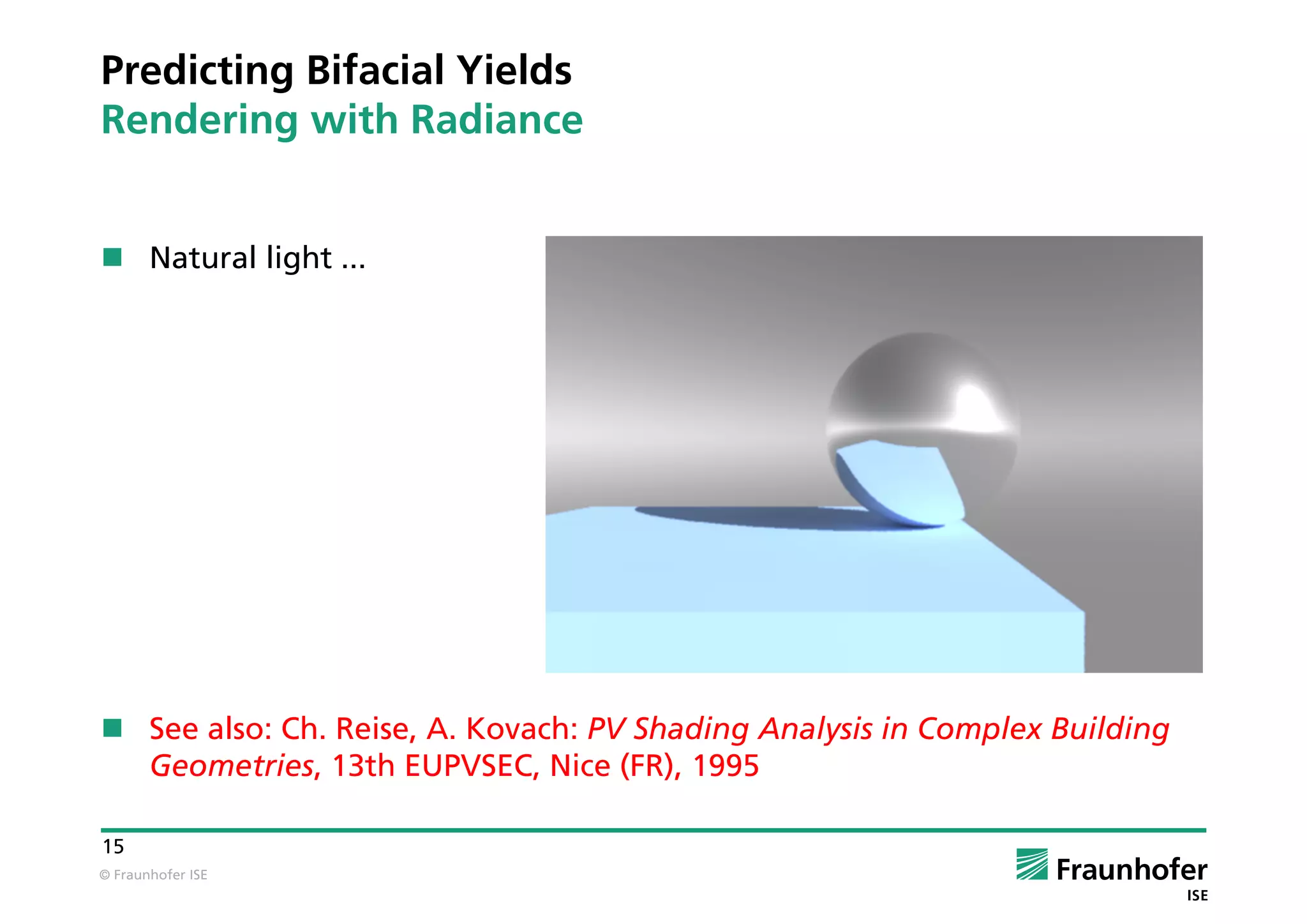
 Natural light ...
 See also: Ch. Reise, A. Kovach: PV Shading Analysis in Complex Building
Geometries, 13th EUPVSEC, Nice (FR), 1995
© Fraunhofer ISE
16
Predicting Bifacial Yields
Rendering with Radiance
© Fraunhofer ISE
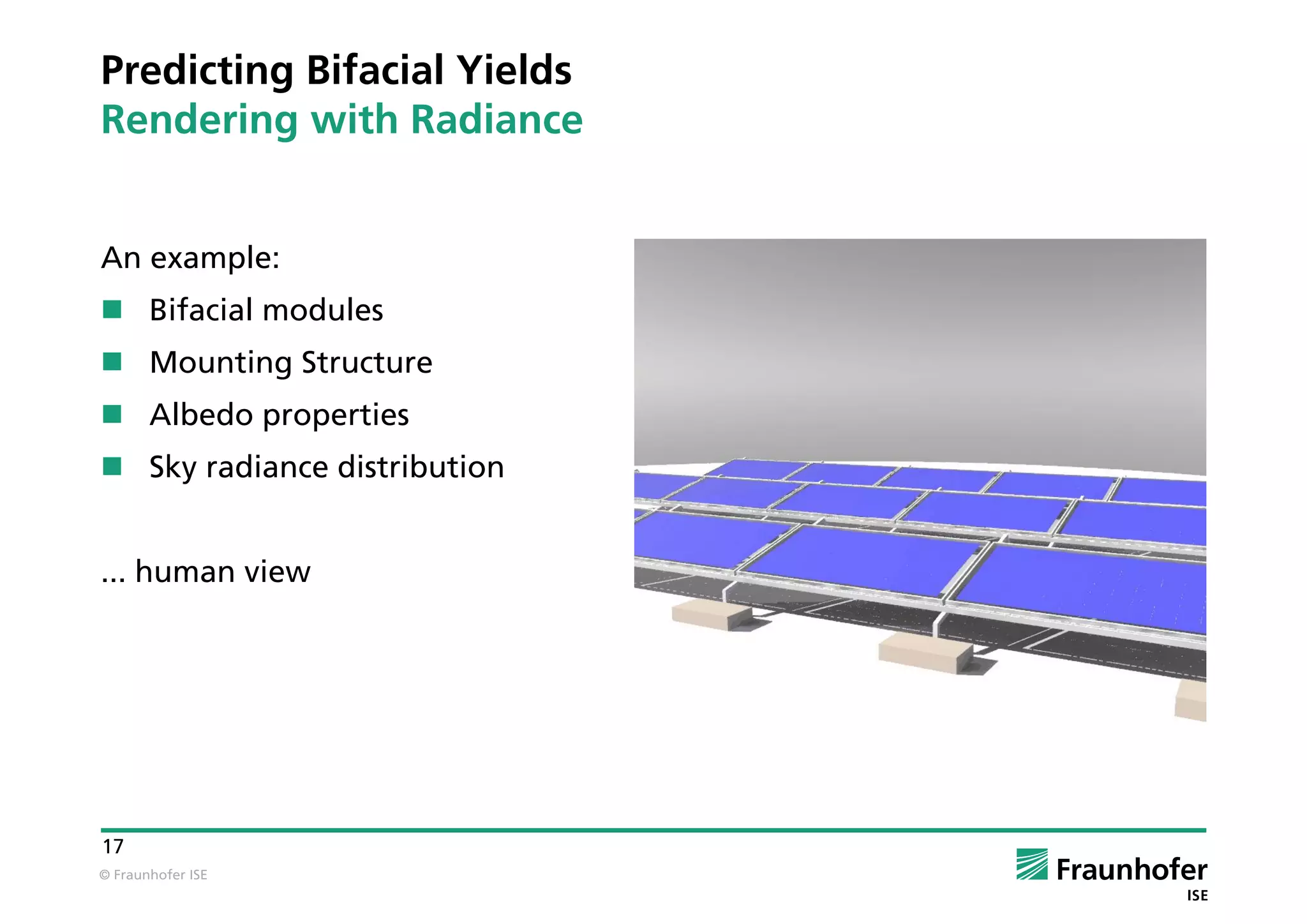
17
Predicting Bifacial Yields
Rendering with Radiance
An example:
 Bifacial modules
 Mounting Structure
 Albedo properties
 Sky radiance distribution
... human view
© Fraunhofer ISE
18
Predicting Bifacial Yields
Rendering with Radiance
An example:
 Bifacial modules
 Mounting Structure
 Albedo properties
 Sky radiance distribution
... aerial view
© Fraunhofer ISE
19
Predicting Bifacial Yields
Rendering with Radiance
An example:
 Bifacial modules
 Mounting Structure
 Albedo properties
 Sky radiance distribution
... mouse view
© Fraunhofer ISE
20
Predicting Bifacial Yields
Validation I
The prototype:
Bifacial module test
installation,
monitored by
Fraunhofer ISE in 2009
© Fraunhofer ISE
21
Predicting Bifacial Yields
Validation I
System model validation results (235 days in 2009):
height tilt angle albedo bifacial Gain
DC
Measurement 0,2 m 15 0,64 21.9%
Model 0,2 m 15 0,64 21.1%
© Fraunhofer ISE
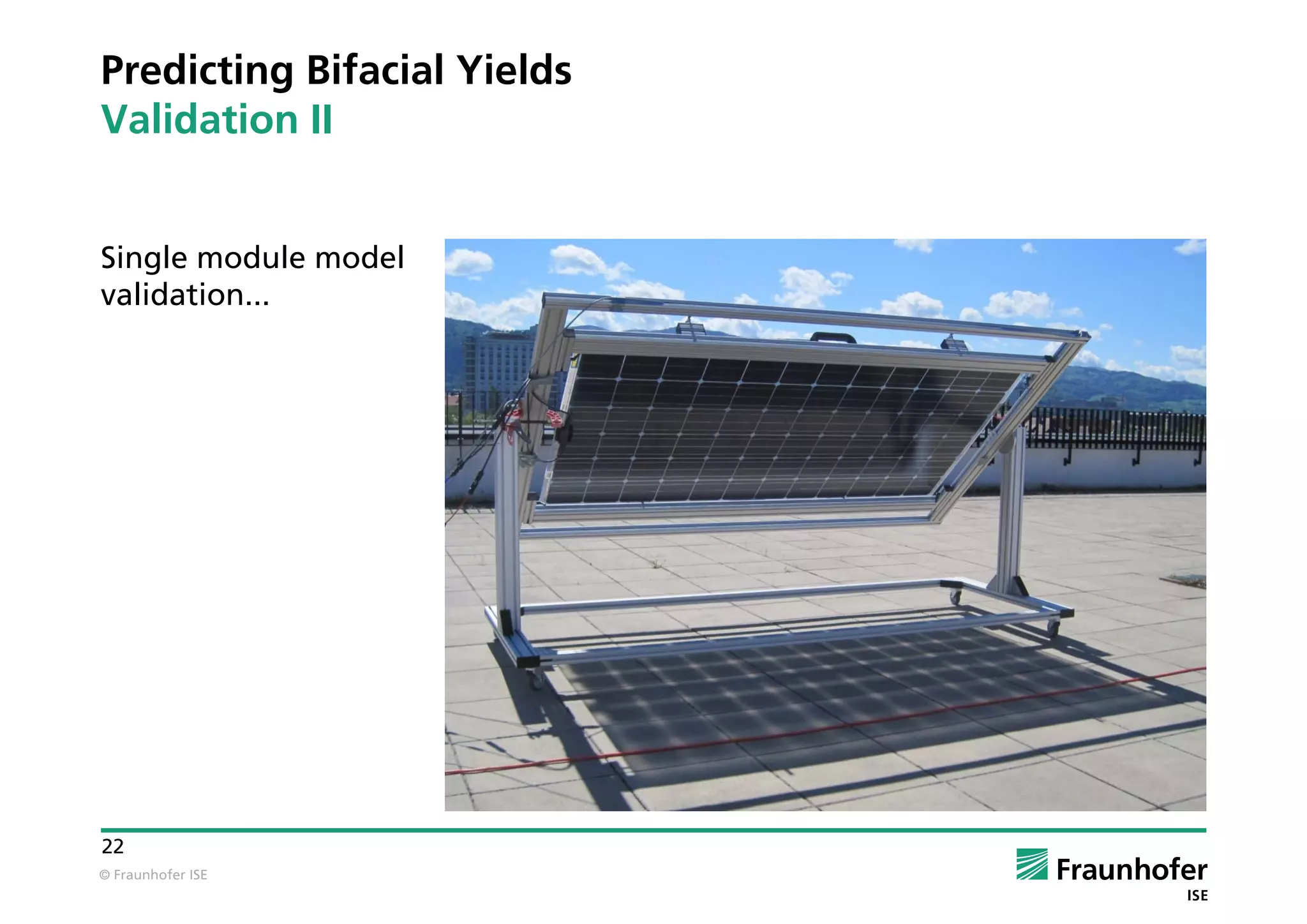
22
Predicting Bifacial Yields
Validation II
Single module model
validation...
© Fraunhofer ISE
23
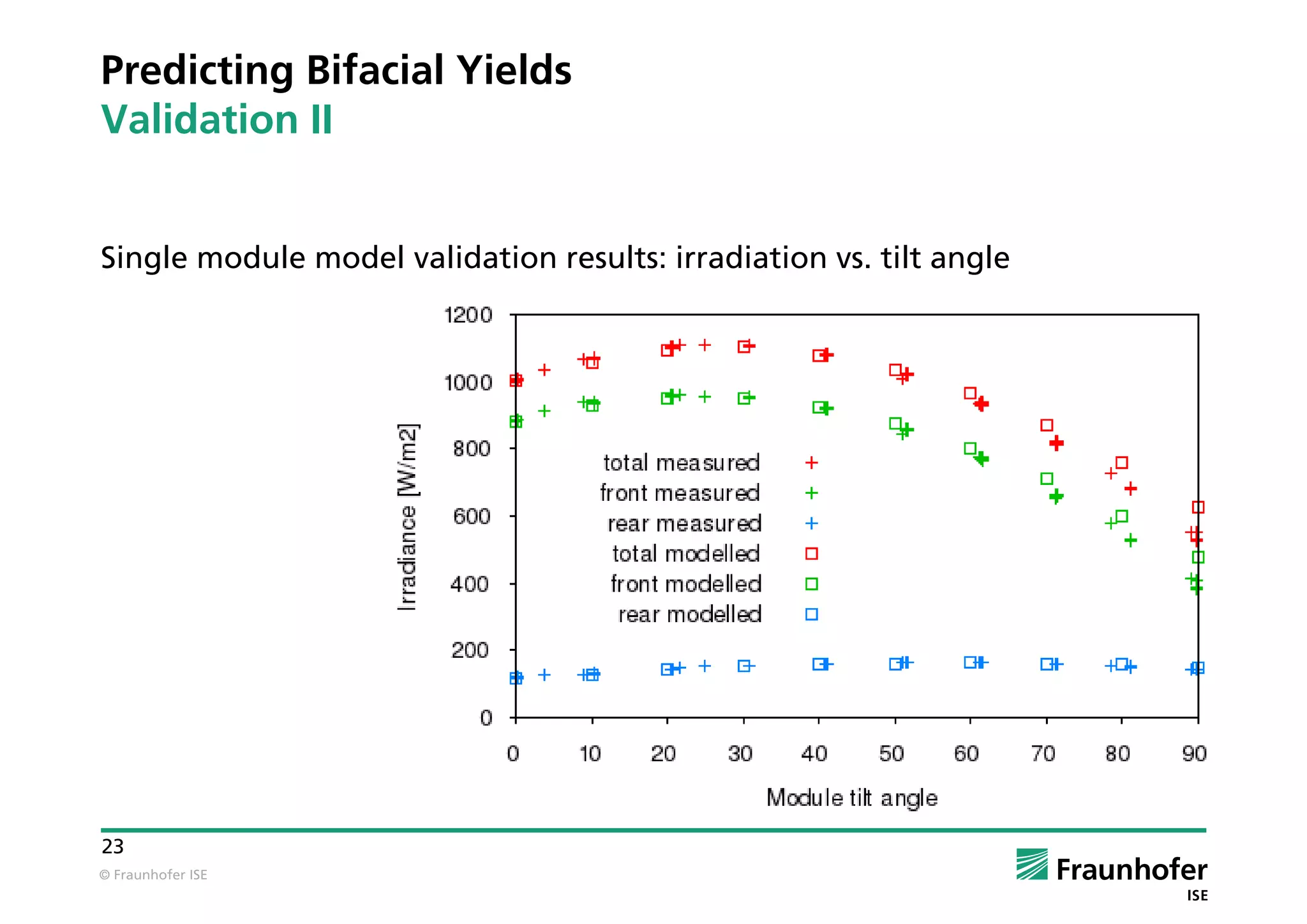
Predicting Bifacial Yields
Validation II
Single module model validation results: irradiation vs. tilt angle
© Fraunhofer ISE
24
Predicting Bifacial Yields
Validation II
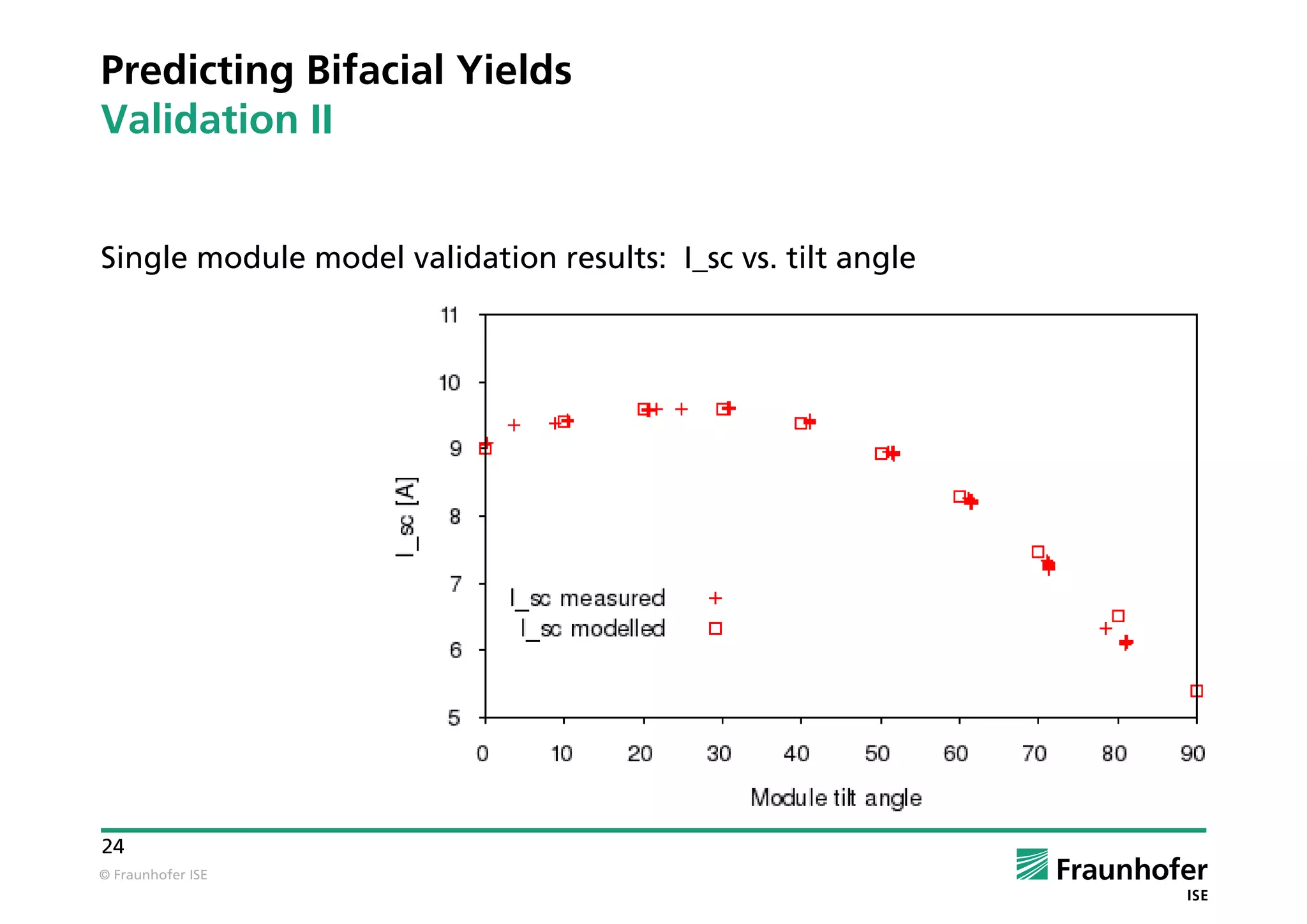
Single module model validation results: I_sc vs. tilt angle
© Fraunhofer ISE
25
Exemplary Results
 Bifacial modules will be installed in commercial PV projects
 Commercial PV projects will follow or extend traditional installation
schemes, therefore, some contradictions will arise:
 module height vs. wind load with rooftop systems
 optical gain vs. space requirements (GCR)
 increased albedo vs. maintenance effort
 Most probably, commercial PV projects will show lower bifacial gains
than test or demonstration installations
© Fraunhofer ISE
26
Exemplary Results
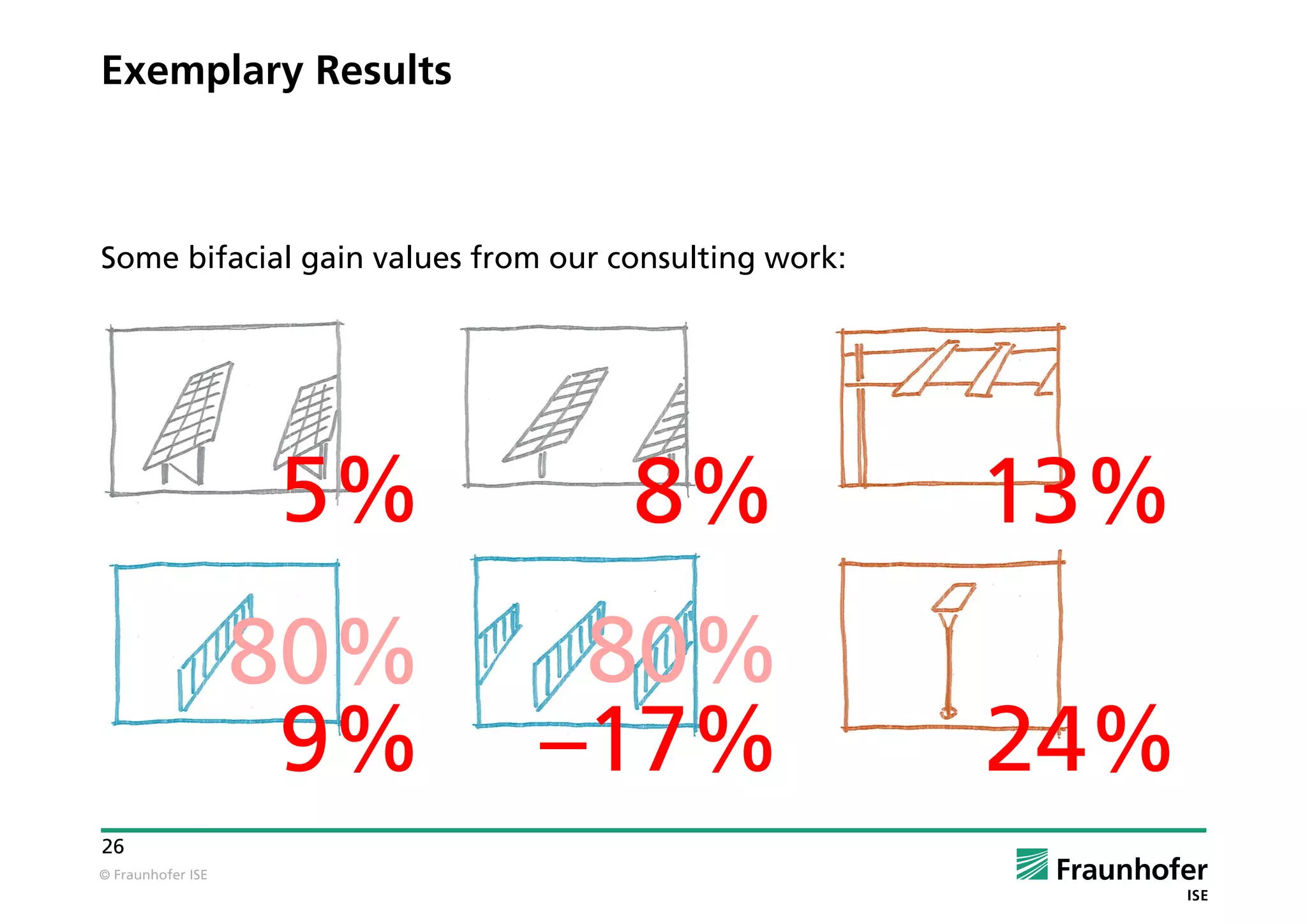
Some bifacial gain values from our consulting work:
5% 8% 13%
9% –17% 24%
80% 80%
© Fraunhofer ISE
27
Exemplary Results
First example values for a rooftop system:
type height tilt angle albedo GCR Country bifacial Gain
rooftop 0.1 m 20 0,40 0,40 DE 6%
rooftop 0.3 m 20 0,40 0,40 DE 11%
rooftop 0.5 m 20 0,40 0,40 DE 14%
rooftop 0.3 m 20 0,20 0,40 DE 6%
rooftop 0.3 m 20 0,40 0,40 DE 11%
rooftop 0.3 m 20 0,60 0,40 DE 16%
© Fraunhofer ISE
28
Summary
 Bifacial modules show a big potential for increased yield and / or reduced
electricity costs
 Bifacial gain is not a module property
 Bifacial module characterization needs some proper definitions
 Each system layout needs an individual assessment
 Small experimental or demonstration systems show bifacial gains of
15% to 25%
 With larger commercial systems, realistic bifacial gains are expected in a
range from 5% to 15%
 Optimization of mounting geometry and mounting structure is essential
in order to draw the full benefits from bifacial PV modules
© Fraunhofer ISE
29
Thank you for your attention!
Fraunhofer Institute for Solar Energy Systems ISE
Dr. Christian Reise
www.ise.fraunhofer.de
christian.reise@ise.fraunhofer.de

42 reise realistic_yield_expectations_for_bifacial_pv_systems

  • 1.
    © Fraunhofer ISE RealisticYield Expectations for Bifacial PV Systems – an Assessment of Announced, Predicted and Observed Benefits Christian Reise Alexandra Schmid Fraunhofer Institute for Solar Energy Systems ISE PV Performance Modelling and Monitoring Workshop Cologne, October 23, 2015
  • 2.
    © Fraunhofer ISE 2 BifacialPV Modules and Systems Bifacial gain Ratio of additional “rear side” kWh to “front only” kWh BG = E_rear / E_front
  • 3.
    © Fraunhofer ISE 3 BifacialPV Modules and Systems Bifacial gain Some bifacial gain values from literature (mainly experimental / test systems): 24% 15% 22% 22% 57% 20% bSolar 2014 Sanyo 2009bSolar 2014 ISC Konstanz 2014 EdF R&D 2014 ECN 2014
  • 4.
    © Fraunhofer ISE 4 BifacialPV Modules and Systems Bifacial gain  Is the bifacial gain a module property?  Is it around 20%?  What about large commercial installations ?
  • 5.
    © Fraunhofer ISE 5 AGENDA Efficiency and Power: Definitions  Predicting Bifacial Yields  Exemplary Results  Conclusion
  • 6.
    © Fraunhofer ISE 6 BifacialPV Modules and Systems Influence on bifacial gain Yield depends on with with monofacial bifacial modules  STC power ++ ++  module properties + ++  tilt angle + ++  height o ++  albedo + ++  mounting structure o + ... and other factors
  • 7.
    © Fraunhofer ISE 7 BifacialEfficiency and Power A Straight Forward Approach Yield ~ G(front) * eff(front) + G(rear) * eff(rear) = G(front) * eff(front) + G(rear) * eff(front) * BF STC value optical gain bifaciality factor 18% … 22% 5% … 50% 75% … 95% these factors determine bifacial gain module property system property module property laboratory software laboratory
  • 8.
    © Fraunhofer ISE 8 PredictingBifacial Yields Predicting Optical Gains  No commonly used software available (the current versions of e.g. PVSYST, PV*SOL, and NREL’s SAM cannot predict optical gains)  Numerical methods from physics and optics offer different approaches:  View factor method  Ray tracing method
  • 9.
    © Fraunhofer ISE 9 PredictingBifacial Yields The view factor method The view factor F(1,2) is the proportion of the radiation which leaves surface 1 that strikes surface 2 EdF R&D 2014
  • 10.
    © Fraunhofer ISE 10 PredictingBifacial Yields The view factor method The view factor F(1,2) is the proportion of the radiation which leaves surface 1 that strikes surface 2 Wikimedia Commons
  • 11.
    © Fraunhofer ISE 11 PredictingBifacial Yields The ray tracing method ...traces the path of light through pixels in an image plane and simulates the effects of its encounters with virtual objects Wikimedia Commons easily
  • 12.
    © Fraunhofer ISE 12 PredictingBifacial Yields Predicting Optical Gains  View factor method:  easy to implement for simple geometries  becomes complex task for realistic systems  Ray tracing method:  less easy to implement  time consuming  delivers rear side irradiance, rear side inhomogeneity, mutual (front side) shading, influence of mounting structure...
  • 13.
    © Fraunhofer ISE 13 Features: Backward ray tracing  Arbitrary surface properties  Artificial light sources  Natural light sources (sun & sky)  Results in units of W/m²sr or W/m²  Operates in an Unix environment  No contemporary user interface Predicting Bifacial Yields Rendering with Radiance
  • 14.
    © Fraunhofer ISE 14 PredictingBifacial Yields Rendering with Radiance  Artificial light … © Graeme Watt, Synthesis Design & Visualisation Limited
  • 15.
    © Fraunhofer ISE 15 PredictingBifacial Yields Rendering with Radiance  Natural light ...  See also: Ch. Reise, A. Kovach: PV Shading Analysis in Complex Building Geometries, 13th EUPVSEC, Nice (FR), 1995
  • 16.
    © Fraunhofer ISE 16 PredictingBifacial Yields Rendering with Radiance
  • 17.
    © Fraunhofer ISE 17 PredictingBifacial Yields Rendering with Radiance An example:  Bifacial modules  Mounting Structure  Albedo properties  Sky radiance distribution ... human view
  • 18.
    © Fraunhofer ISE 18 PredictingBifacial Yields Rendering with Radiance An example:  Bifacial modules  Mounting Structure  Albedo properties  Sky radiance distribution ... aerial view
  • 19.
    © Fraunhofer ISE 19 PredictingBifacial Yields Rendering with Radiance An example:  Bifacial modules  Mounting Structure  Albedo properties  Sky radiance distribution ... mouse view
  • 20.
    © Fraunhofer ISE 20 PredictingBifacial Yields Validation I The prototype: Bifacial module test installation, monitored by Fraunhofer ISE in 2009
  • 21.
    © Fraunhofer ISE 21 PredictingBifacial Yields Validation I System model validation results (235 days in 2009): height tilt angle albedo bifacial Gain DC Measurement 0,2 m 15 0,64 21.9% Model 0,2 m 15 0,64 21.1%
  • 22.
    © Fraunhofer ISE 22 PredictingBifacial Yields Validation II Single module model validation...
  • 23.
    © Fraunhofer ISE 23 PredictingBifacial Yields Validation II Single module model validation results: irradiation vs. tilt angle
  • 24.
    © Fraunhofer ISE 24 PredictingBifacial Yields Validation II Single module model validation results: I_sc vs. tilt angle
  • 25.
    © Fraunhofer ISE 25 ExemplaryResults  Bifacial modules will be installed in commercial PV projects  Commercial PV projects will follow or extend traditional installation schemes, therefore, some contradictions will arise:  module height vs. wind load with rooftop systems  optical gain vs. space requirements (GCR)  increased albedo vs. maintenance effort  Most probably, commercial PV projects will show lower bifacial gains than test or demonstration installations
  • 26.
    © Fraunhofer ISE 26 ExemplaryResults Some bifacial gain values from our consulting work: 5% 8% 13% 9% –17% 24% 80% 80%
  • 27.
    © Fraunhofer ISE 27 ExemplaryResults First example values for a rooftop system: type height tilt angle albedo GCR Country bifacial Gain rooftop 0.1 m 20 0,40 0,40 DE 6% rooftop 0.3 m 20 0,40 0,40 DE 11% rooftop 0.5 m 20 0,40 0,40 DE 14% rooftop 0.3 m 20 0,20 0,40 DE 6% rooftop 0.3 m 20 0,40 0,40 DE 11% rooftop 0.3 m 20 0,60 0,40 DE 16%
  • 28.
    © Fraunhofer ISE 28 Summary Bifacial modules show a big potential for increased yield and / or reduced electricity costs  Bifacial gain is not a module property  Bifacial module characterization needs some proper definitions  Each system layout needs an individual assessment  Small experimental or demonstration systems show bifacial gains of 15% to 25%  With larger commercial systems, realistic bifacial gains are expected in a range from 5% to 15%  Optimization of mounting geometry and mounting structure is essential in order to draw the full benefits from bifacial PV modules
  • 29.
    © Fraunhofer ISE 29 Thankyou for your attention! Fraunhofer Institute for Solar Energy Systems ISE Dr. Christian Reise www.ise.fraunhofer.de christian.reise@ise.fraunhofer.de