
PREDICTING MISMATCH
LOSSES IN UTILITY-SCALE
PHOTOVOLTAIC SYSTEMS
©CopyrightFirstSolar,Inc.October2016
2
• Background: Module and string-level electrical mismatch.
• Motivation
• Model & Methods
• Model validation
• Simulations, Results, & Discussion
• Future Work
• Q & A
OVERVIEW
©CopyrightFirstSolar,Inc.October2016
3
1. For a 1 MW array, mismatch losses increase gradually below a bin width of 6W, and more drastically
at higher distributions. At 5W, a common tolerance for DC arrays, mismatch loss is 0.501 ± 0.003%
of power.
2. For an effective bin distribution of 5W, mismatch loss decreases as the array size increases, with a
diminishing effect. Mismatch loss remains relatively constant for arrays above 1 .5MW.
3. The difference in mismatch losses between two arrays of the same size, one with a central inverter
and the other with 60kW string inverters, remains constant as array size increases. String inverter
designs offer a constant, minimal advantage over central inverters with respect to mismatch.
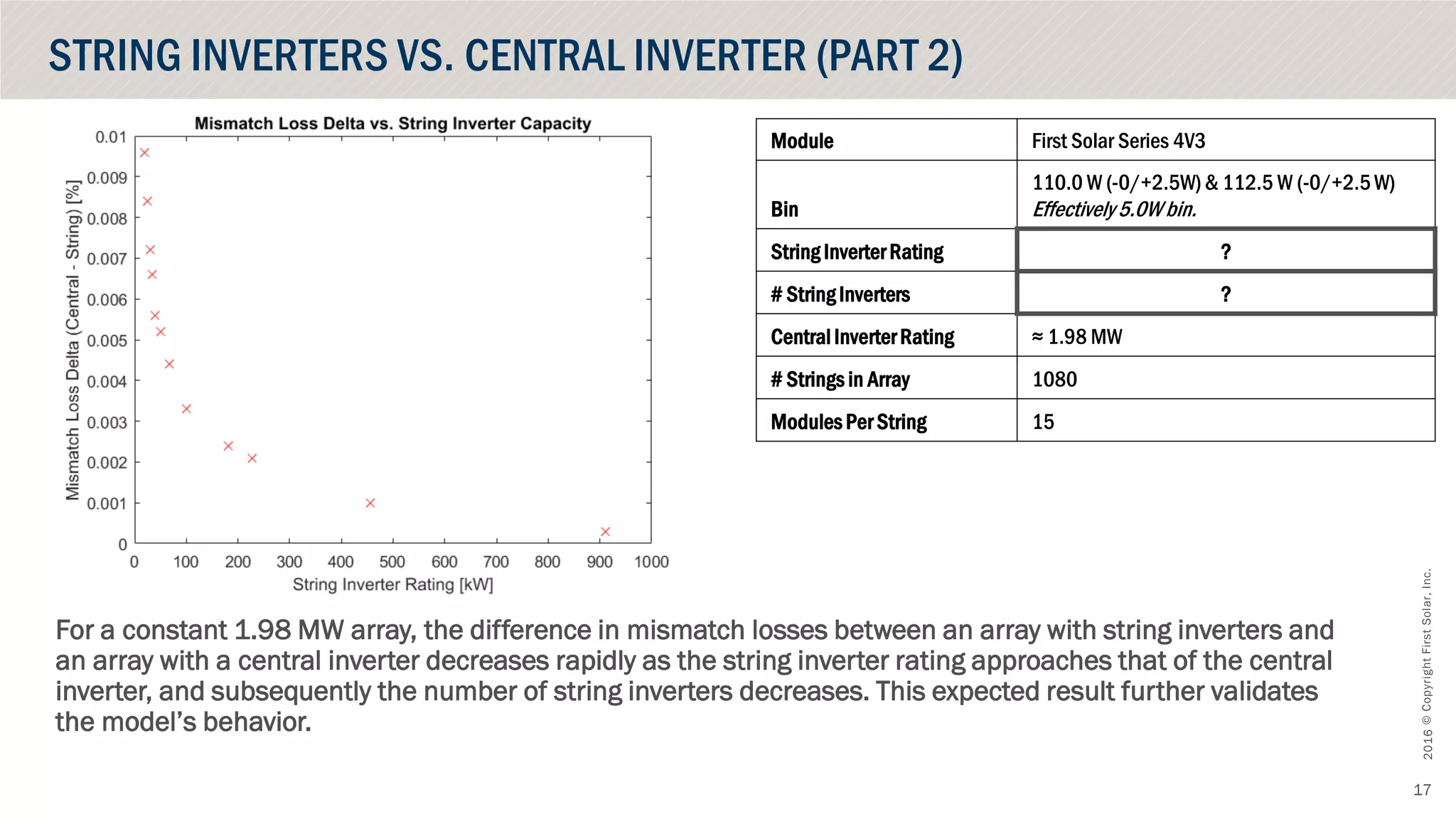
4. For a ~2 MW array, the difference in mismatch losses between an array with string inverters and an
array with a central inverter decreases rapidly as the string inverters rating approaches that of the
central inverter (as the number of string inverters decreases). This is an expected result that further
validates the model’s behavior.
EXECUTIVE SUMMARY
ELECTRICAL MISMATCH
©CopyrightFirstSolar,Inc.October2016
5
Module Mismatch
variations in the current-voltage characteristics of photovoltaic modules
Mismatch Loss [Ploss]
the overall loss in power when modules are connected together in a network, compared to the sum
of their individual maximum power points
𝑃𝑙𝑜𝑠𝑠 % =
𝑃 𝑚𝑎𝑥,𝑚𝑜𝑑𝑢𝑙𝑒 − 𝑃𝑚𝑎𝑥,𝑎𝑟𝑟𝑎𝑦
𝑃𝑚𝑎𝑥,𝑎𝑟𝑟𝑎𝑦
ELECTRICAL MISMATCH: A BRIEF BACKGROUND
SERIES PARALLEL
I = constant
Ploss α σI
V = constant
Ploss α σV
MOTIVATION
©CopyrightFirstSolar,Inc.October2016
7
PREVIOUS WORK
• Bucciarelli’s statistical approach… mismatch loss is
proportional to the variance of module electrical
characteristics within a bin [1]
• F. Iannone et al. Monte Carlo approach…validates
Bucciarelli’s work, especially at low standard deviations [2]
• Chamberlin et al. achieves mismatches of 0.1-0.53% for
randomly arranged small arrays [3]
• S. MacAlpine et al. suggests that 1-2% derate is applicable
for mismatch at the string-level [4]
MOTIVATION
…to study mismatch at the utility-scale with the most recent
technology, and reevaluate industry wide energy prediction
assumptions.
MOTIVATION
[1] L.L. Buciarelli Jr., “Power loss in photovoltaic arrays due to mismatch in cell characteristics,” Solar Energy, vol. 23, no. 4, pp. 277-288, 1979.
[2] F. Iannone, G. Noviello, A. Sarno, “Monte Carlo techniques to analyse the electrical mismatch losses in large-scale photovoltaic generators,” Solar Energy Vol. 62, No. 2, pp. 85-92, 1998.
[3] C.E. Chamberlin, P. Lehman, J. Zoellick, G. Pauletto, “Effects of mismatch losses in photovoltaic arrays,” Solar Energy, Vol. 54, No. 3, 1995.
[4] S. MacAlpine, M. Brandemuehl, R. Erickson, “Beyond the Module Model and Into the Array: Mismatch in Series Strings,” 38th IEEE PVSC, Austin, TX, 2012.
MODELING METHODS
©CopyrightFirstSolar,Inc.October2016
9
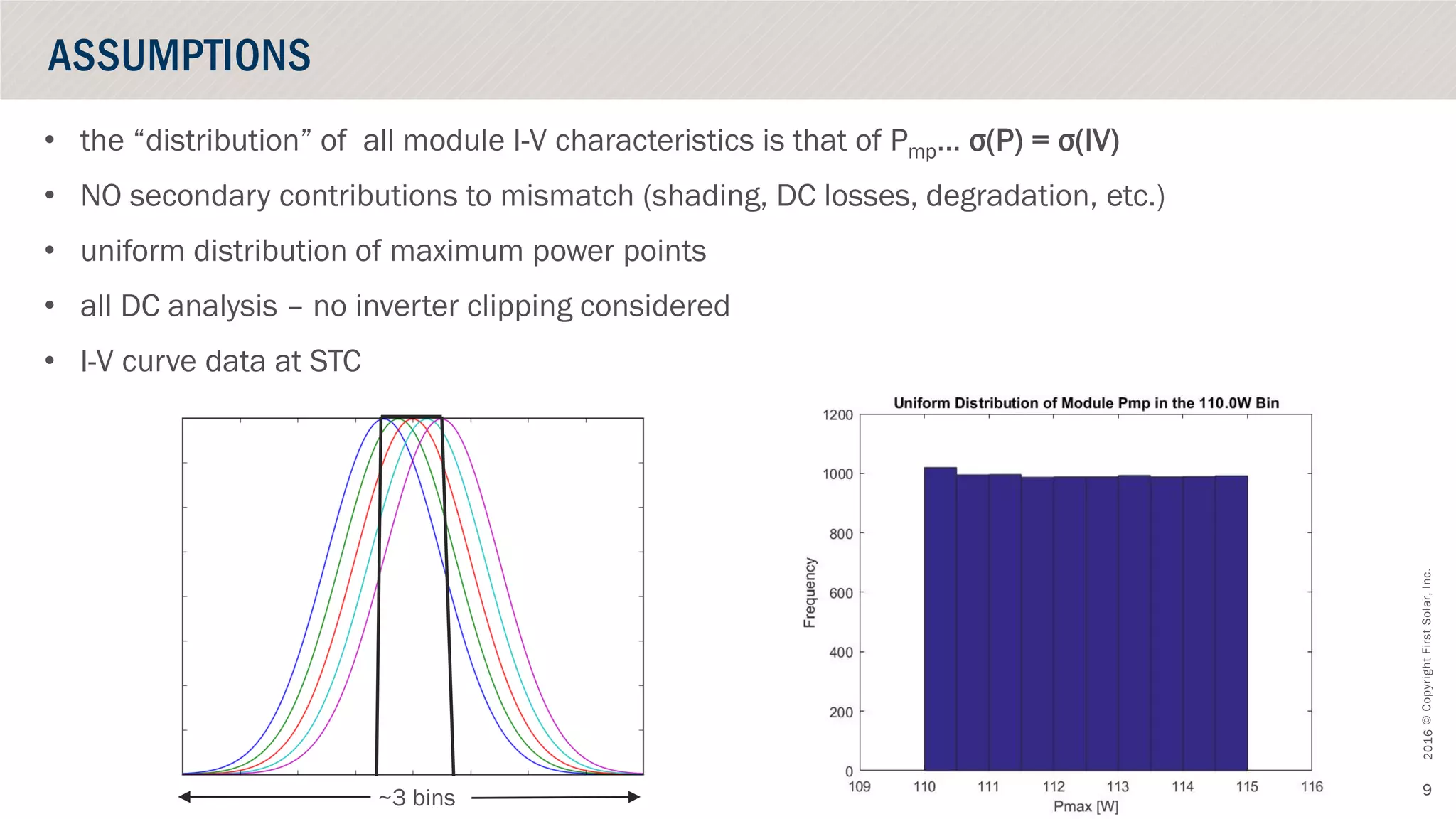
• the “distribution” of all module I-V characteristics is that of Pmp… σ(P) = σ(IV)
• NO secondary contributions to mismatch (shading, DC losses, degradation, etc.)
• uniform distribution of maximum power points
• all DC analysis – no inverter clipping considered
• I-V curve data at STC
ASSUMPTIONS
~3 bins
©CopyrightFirstSolar,Inc.October2016
10
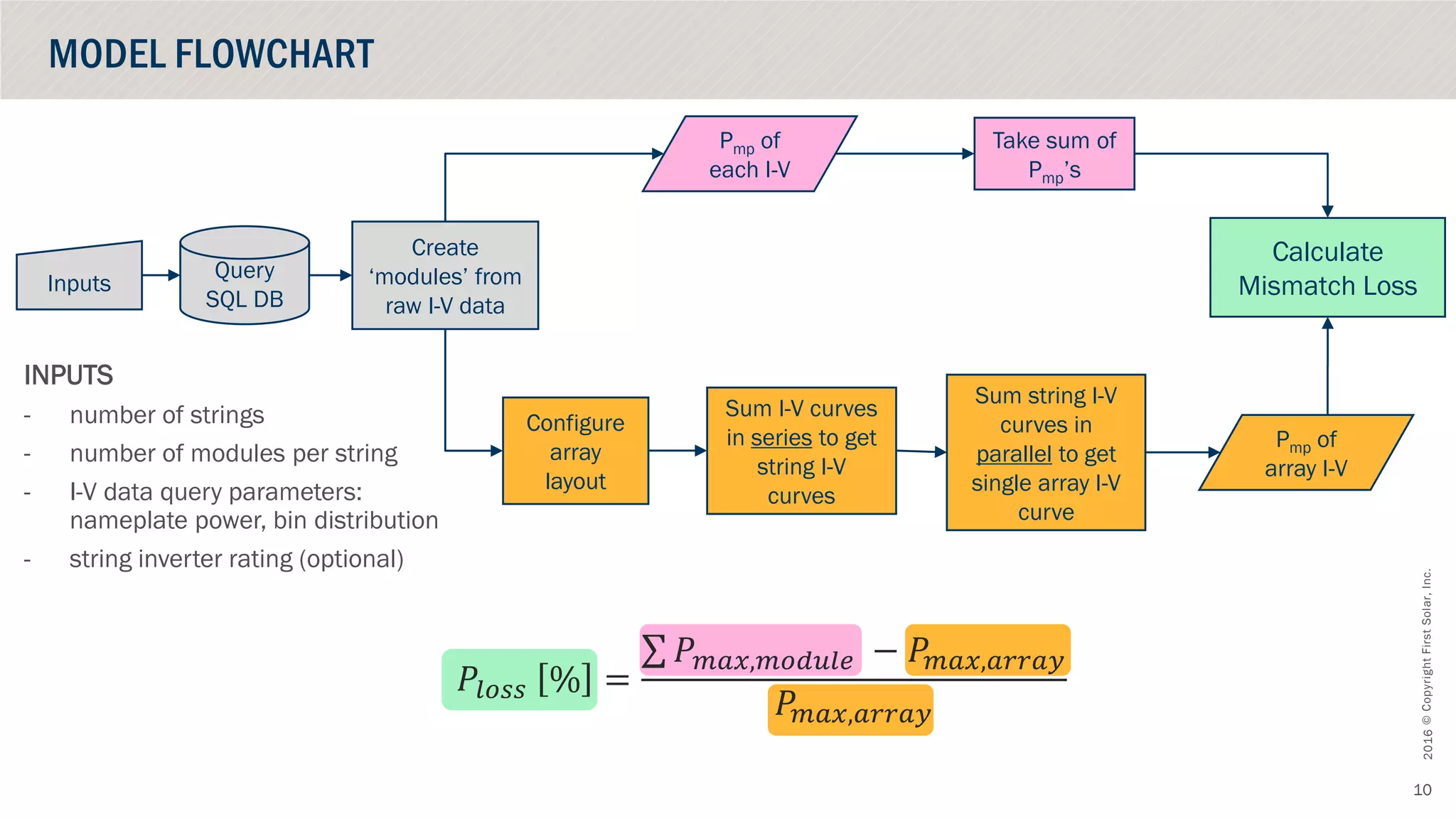
MODEL FLOWCHART
Query
SQL DB
Inputs
Create
‘modules’ from
raw I-V data
Configure
array
layout
Sum I-V curves
in series to get
string I-V
curves
Sum string I-V
curves in
parallel to get
single array I-V
curve
Pmp of
each I-V
Take sum of
Pmp’s
Pmp of
array I-V
Calculate
Mismatch Loss
INPUTS
- number of strings
- number of modules per string
- I-V data query parameters:
nameplate power, bin distribution
- string inverter rating (optional)
𝑃𝑙𝑜𝑠𝑠 % =
𝑃 𝑚𝑎𝑥,𝑚𝑜𝑑𝑢𝑙𝑒 − 𝑃𝑚𝑎𝑥,𝑎𝑟𝑟𝑎𝑦
𝑃𝑚𝑎𝑥,𝑎𝑟𝑟𝑎𝑦
MODEL VALIDATION
©CopyrightFirstSolar,Inc.October2016
12
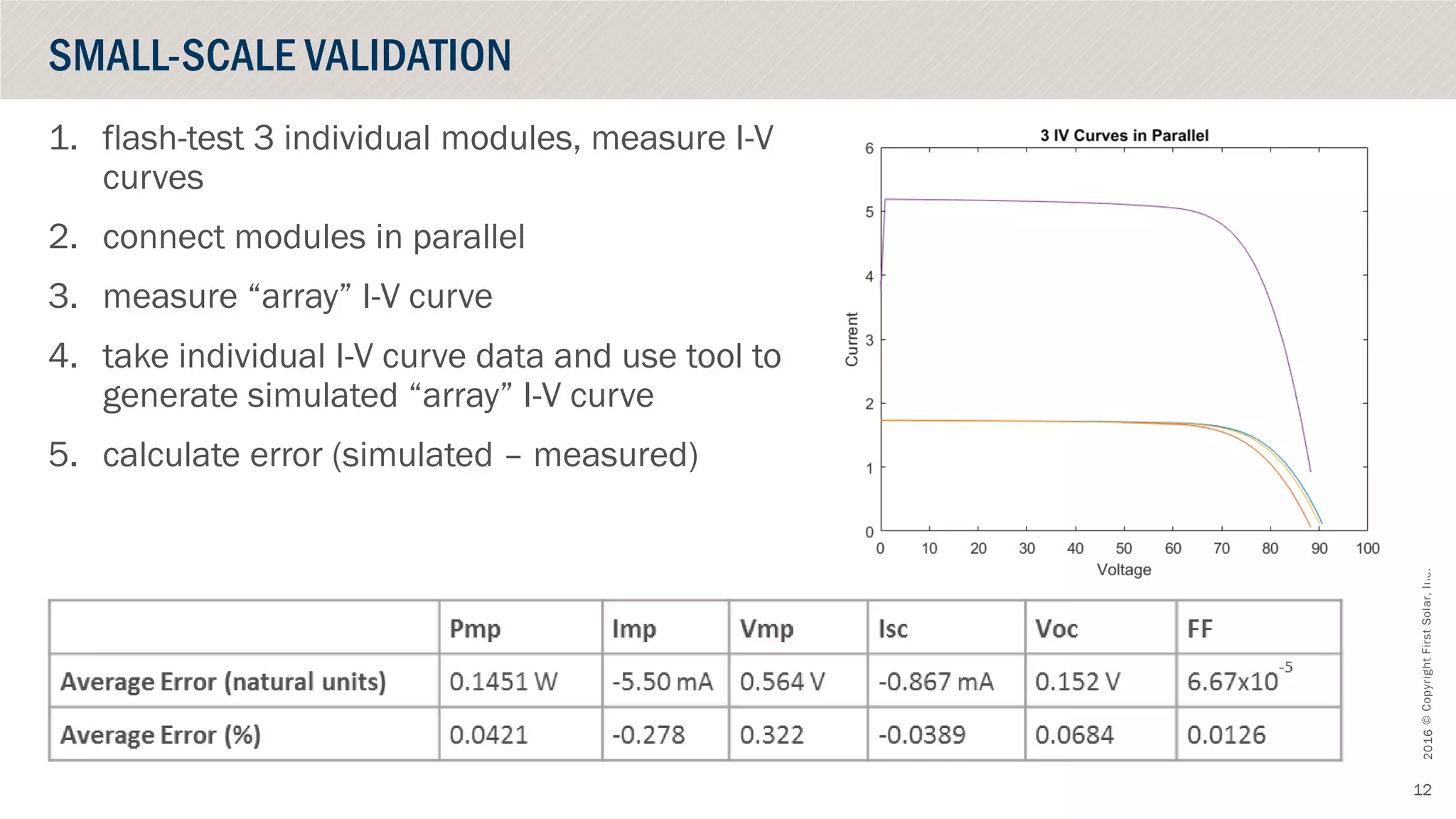
1. flash-test 3 individual modules, measure I-V
curves
2. connect modules in parallel
3. measure “array” I-V curve
4. take individual I-V curve data and use tool to
generate simulated “array” I-V curve
5. calculate error (simulated – measured)
SMALL-SCALE VALIDATION
SIMULATIONS & RESULTS
©CopyrightFirstSolar,Inc.October2016
14
IMPACT OF BIN DISTRIBUTION
Module First Solar Series 4V3
Bin 112.5 W (+/- ? W)
# SimulationRunsAveraged 5
Inverter Rating ≈ 1 MW
# Strings in Array 592
Modules Per String 15
(2 W, 0.211 ± 0.002%)
(5 W, 0.501 ± 0.003%)
For a 1 MW array, mismatch losses increase gradually below a bin width of 6W, and more drastically at higher
distributions. At 5W (a common tolerance within a given array) mismatch loss is 0.501 ± 0.003% of total power.
©CopyrightFirstSolar,Inc.October2016
15
# Strings Inverter Rating [kW]
0 0
100 168.75
200 337.5
300 506.25
400 675
500 843.75
600 1012.5
700 1181.25
800 1350
900 1518.75
1000 1687.5
IMPACT OF DC ARRAY SIZE
Module First Solar Series 4V3
Bin
110.0 W (-0/+2.5W)& 112.5 W (-0/+2.5W)
Effectively5.0W bin.
# SimulationRunsAveraged 5
Inverter Rating ?
# Strings in Array ?
Modules Per String 15
For an effective bin distribution of 5W, mismatch loss decreases as the array size
increases, with a diminishing effect. Mismatch loss remains relatively constant for arrays
above 1.5MW.
©CopyrightFirstSolar,Inc.October2016
16
STRING INVERTERS VS. CENTRAL INVERTER (PART 1)
Module First Solar Series 4V3
Bin
110.0 W (-0/+2.5W)&
112.5 W (-0/+2.5 W)
Effectively5.0W bin.
String Inverter Rating
60 kW
(36 strings)
# StringInverters ?
CentralInverter Rating ?
# Strings in Array ?
Modules Per String 15
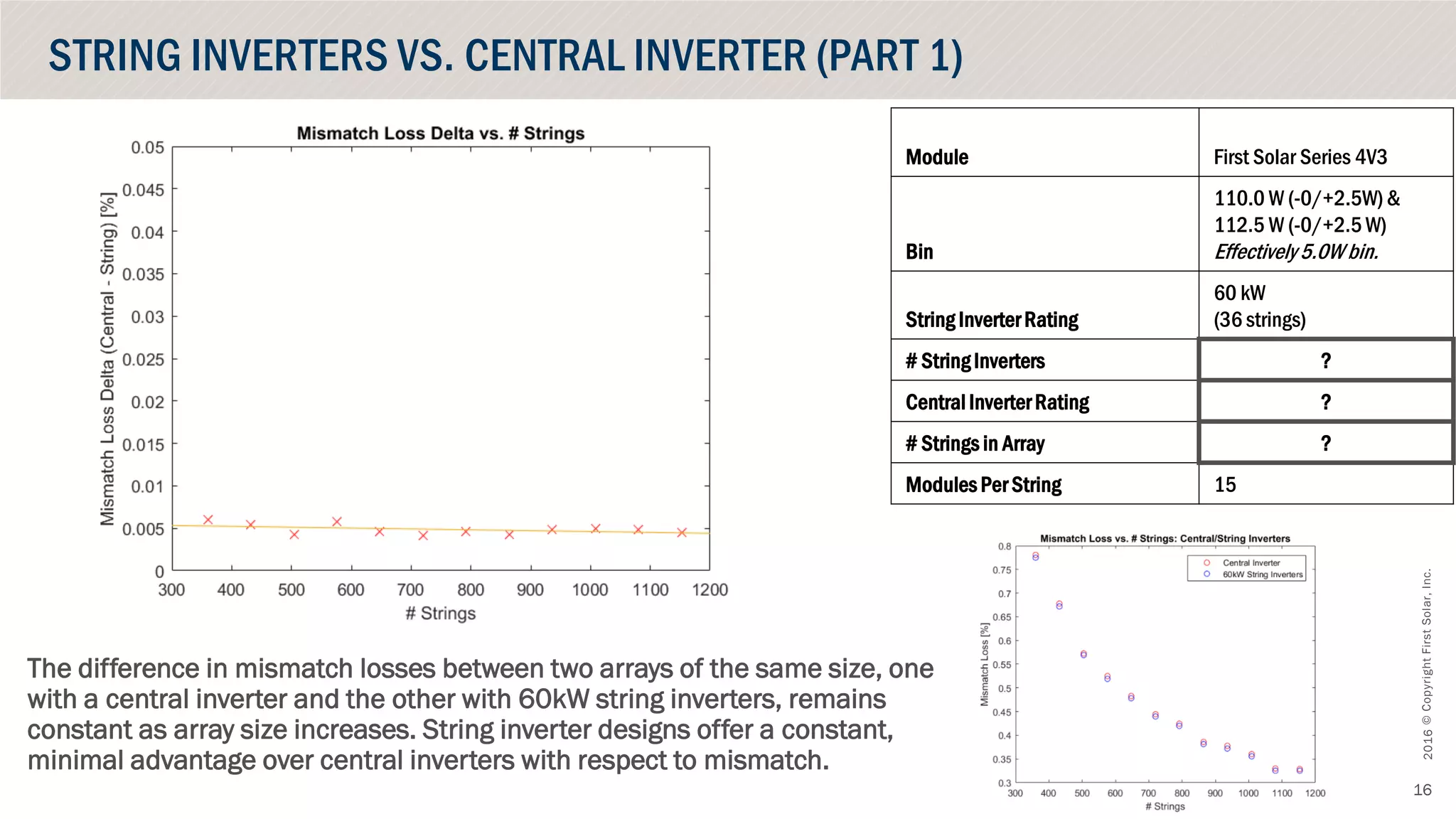
The difference in mismatch losses between two arrays of the same size, one
with a central inverter and the other with 60kW string inverters, remains
constant as array size increases. String inverter designs offer a constant,
minimal advantage over central inverters with respect to mismatch.
©CopyrightFirstSolar,Inc.October2016
17
STRING INVERTERS VS. CENTRAL INVERTER (PART 2)
Module First Solar Series 4V3
Bin
110.0 W (-0/+2.5W)& 112.5 W (-0/+2.5W)
Effectively5.0W bin.
String Inverter Rating ?
# StringInverters ?
CentralInverter Rating ≈ 1.98 MW
# Strings in Array 1080
Modules Per String 15
For a constant 1.98 MW array, the difference in mismatch losses between an array with string inverters and
an array with a central inverter decreases rapidly as the string inverter rating approaches that of the central
inverter, and subsequently the number of string inverters decreases. This expected result further validates
the model’s behavior.
FUTURE WORK
©CopyrightFirstSolar,Inc.October2016
19
• comparative analysis: CdTe vs. c-Si
• utility-scale validation
— measure string currents, and isolate mismatch losses from resistive losses
• secondary mismatch effects
— shading (in progress)
— temperature gradient (and temperature correction in general)
— resistive (DC) losses
— module degradation
• please contact with any thoughts or suggestions … stephen.kaplan@firstsolar.com
-
FUTURE WORK
ACKNOWLEDGEMENTS
©CopyrightFirstSolar,Inc.October2016
21
• Fraunhofer Institute for Solar Energy Systems
• Sandia National Laboratories
• Sara MacAlpine, NREL
• Kendra Passow, Mitchell Lee, Mark Grammatico, & Bodo Littman of First Solar
• Alex Panchula, Tesla Motors (formerly of First Solar)
THANK YOU!
QUESTIONS?
Predicting mismatch losses in utility-scale photovoltaic systems

Predicting mismatch losses in utility-scale photovoltaic systems

  • 1.
    PREDICTING MISMATCH LOSSES INUTILITY-SCALE PHOTOVOLTAIC SYSTEMS
  • 2.
    ©CopyrightFirstSolar,Inc.October2016 2 • Background: Moduleand string-level electrical mismatch. • Motivation • Model & Methods • Model validation • Simulations, Results, & Discussion • Future Work • Q & A OVERVIEW
  • 3.
    ©CopyrightFirstSolar,Inc.October2016 3 1. For a1 MW array, mismatch losses increase gradually below a bin width of 6W, and more drastically at higher distributions. At 5W, a common tolerance for DC arrays, mismatch loss is 0.501 ± 0.003% of power. 2. For an effective bin distribution of 5W, mismatch loss decreases as the array size increases, with a diminishing effect. Mismatch loss remains relatively constant for arrays above 1 .5MW. 3. The difference in mismatch losses between two arrays of the same size, one with a central inverter and the other with 60kW string inverters, remains constant as array size increases. String inverter designs offer a constant, minimal advantage over central inverters with respect to mismatch. 4. For a ~2 MW array, the difference in mismatch losses between an array with string inverters and an array with a central inverter decreases rapidly as the string inverters rating approaches that of the central inverter (as the number of string inverters decreases). This is an expected result that further validates the model’s behavior. EXECUTIVE SUMMARY
  • 4.
  • 5.
    ©CopyrightFirstSolar,Inc.October2016 5 Module Mismatch variations inthe current-voltage characteristics of photovoltaic modules Mismatch Loss [Ploss] the overall loss in power when modules are connected together in a network, compared to the sum of their individual maximum power points 𝑃𝑙𝑜𝑠𝑠 % = 𝑃 𝑚𝑎𝑥,𝑚𝑜𝑑𝑢𝑙𝑒 − 𝑃𝑚𝑎𝑥,𝑎𝑟𝑟𝑎𝑦 𝑃𝑚𝑎𝑥,𝑎𝑟𝑟𝑎𝑦 ELECTRICAL MISMATCH: A BRIEF BACKGROUND SERIES PARALLEL I = constant Ploss α σI V = constant Ploss α σV
  • 6.
  • 7.
    ©CopyrightFirstSolar,Inc.October2016 7 PREVIOUS WORK • Bucciarelli’sstatistical approach… mismatch loss is proportional to the variance of module electrical characteristics within a bin [1] • F. Iannone et al. Monte Carlo approach…validates Bucciarelli’s work, especially at low standard deviations [2] • Chamberlin et al. achieves mismatches of 0.1-0.53% for randomly arranged small arrays [3] • S. MacAlpine et al. suggests that 1-2% derate is applicable for mismatch at the string-level [4] MOTIVATION …to study mismatch at the utility-scale with the most recent technology, and reevaluate industry wide energy prediction assumptions. MOTIVATION [1] L.L. Buciarelli Jr., “Power loss in photovoltaic arrays due to mismatch in cell characteristics,” Solar Energy, vol. 23, no. 4, pp. 277-288, 1979. [2] F. Iannone, G. Noviello, A. Sarno, “Monte Carlo techniques to analyse the electrical mismatch losses in large-scale photovoltaic generators,” Solar Energy Vol. 62, No. 2, pp. 85-92, 1998. [3] C.E. Chamberlin, P. Lehman, J. Zoellick, G. Pauletto, “Effects of mismatch losses in photovoltaic arrays,” Solar Energy, Vol. 54, No. 3, 1995. [4] S. MacAlpine, M. Brandemuehl, R. Erickson, “Beyond the Module Model and Into the Array: Mismatch in Series Strings,” 38th IEEE PVSC, Austin, TX, 2012.
  • 8.
  • 9.
    ©CopyrightFirstSolar,Inc.October2016 9 • the “distribution”of all module I-V characteristics is that of Pmp… σ(P) = σ(IV) • NO secondary contributions to mismatch (shading, DC losses, degradation, etc.) • uniform distribution of maximum power points • all DC analysis – no inverter clipping considered • I-V curve data at STC ASSUMPTIONS ~3 bins
  • 10.
    ©CopyrightFirstSolar,Inc.October2016 10 MODEL FLOWCHART Query SQL DB Inputs Create ‘modules’from raw I-V data Configure array layout Sum I-V curves in series to get string I-V curves Sum string I-V curves in parallel to get single array I-V curve Pmp of each I-V Take sum of Pmp’s Pmp of array I-V Calculate Mismatch Loss INPUTS - number of strings - number of modules per string - I-V data query parameters: nameplate power, bin distribution - string inverter rating (optional) 𝑃𝑙𝑜𝑠𝑠 % = 𝑃 𝑚𝑎𝑥,𝑚𝑜𝑑𝑢𝑙𝑒 − 𝑃𝑚𝑎𝑥,𝑎𝑟𝑟𝑎𝑦 𝑃𝑚𝑎𝑥,𝑎𝑟𝑟𝑎𝑦
  • 11.
  • 12.
    ©CopyrightFirstSolar,Inc.October2016 12 1. flash-test 3individual modules, measure I-V curves 2. connect modules in parallel 3. measure “array” I-V curve 4. take individual I-V curve data and use tool to generate simulated “array” I-V curve 5. calculate error (simulated – measured) SMALL-SCALE VALIDATION
  • 13.
  • 14.
    ©CopyrightFirstSolar,Inc.October2016 14 IMPACT OF BINDISTRIBUTION Module First Solar Series 4V3 Bin 112.5 W (+/- ? W) # SimulationRunsAveraged 5 Inverter Rating ≈ 1 MW # Strings in Array 592 Modules Per String 15 (2 W, 0.211 ± 0.002%) (5 W, 0.501 ± 0.003%) For a 1 MW array, mismatch losses increase gradually below a bin width of 6W, and more drastically at higher distributions. At 5W (a common tolerance within a given array) mismatch loss is 0.501 ± 0.003% of total power.
  • 15.
    ©CopyrightFirstSolar,Inc.October2016 15 # Strings InverterRating [kW] 0 0 100 168.75 200 337.5 300 506.25 400 675 500 843.75 600 1012.5 700 1181.25 800 1350 900 1518.75 1000 1687.5 IMPACT OF DC ARRAY SIZE Module First Solar Series 4V3 Bin 110.0 W (-0/+2.5W)& 112.5 W (-0/+2.5W) Effectively5.0W bin. # SimulationRunsAveraged 5 Inverter Rating ? # Strings in Array ? Modules Per String 15 For an effective bin distribution of 5W, mismatch loss decreases as the array size increases, with a diminishing effect. Mismatch loss remains relatively constant for arrays above 1.5MW.
  • 16.
    ©CopyrightFirstSolar,Inc.October2016 16 STRING INVERTERS VS.CENTRAL INVERTER (PART 1) Module First Solar Series 4V3 Bin 110.0 W (-0/+2.5W)& 112.5 W (-0/+2.5 W) Effectively5.0W bin. String Inverter Rating 60 kW (36 strings) # StringInverters ? CentralInverter Rating ? # Strings in Array ? Modules Per String 15 The difference in mismatch losses between two arrays of the same size, one with a central inverter and the other with 60kW string inverters, remains constant as array size increases. String inverter designs offer a constant, minimal advantage over central inverters with respect to mismatch.
  • 17.
    ©CopyrightFirstSolar,Inc.October2016 17 STRING INVERTERS VS.CENTRAL INVERTER (PART 2) Module First Solar Series 4V3 Bin 110.0 W (-0/+2.5W)& 112.5 W (-0/+2.5W) Effectively5.0W bin. String Inverter Rating ? # StringInverters ? CentralInverter Rating ≈ 1.98 MW # Strings in Array 1080 Modules Per String 15 For a constant 1.98 MW array, the difference in mismatch losses between an array with string inverters and an array with a central inverter decreases rapidly as the string inverter rating approaches that of the central inverter, and subsequently the number of string inverters decreases. This expected result further validates the model’s behavior.
  • 18.
  • 19.
    ©CopyrightFirstSolar,Inc.October2016 19 • comparative analysis:CdTe vs. c-Si • utility-scale validation — measure string currents, and isolate mismatch losses from resistive losses • secondary mismatch effects — shading (in progress) — temperature gradient (and temperature correction in general) — resistive (DC) losses — module degradation • please contact with any thoughts or suggestions … stephen.kaplan@firstsolar.com - FUTURE WORK
  • 20.
  • 21.
    ©CopyrightFirstSolar,Inc.October2016 21 • Fraunhofer Institutefor Solar Energy Systems • Sandia National Laboratories • Sara MacAlpine, NREL • Kendra Passow, Mitchell Lee, Mark Grammatico, & Bodo Littman of First Solar • Alex Panchula, Tesla Motors (formerly of First Solar) THANK YOU!
  • 22.