Torque
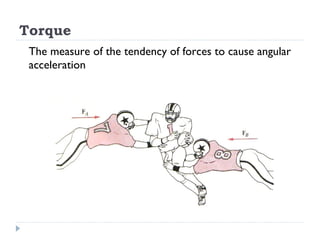
Torque The measure of the tendency of forces to cause angular acceleration
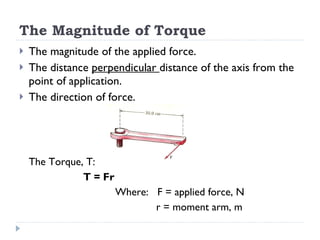
The Magnitude of Torque The magnitude of the applied force. The distance  perpendicular  distance of the axis from the point of application. The direction of force. The Torque, T: T = Fr Where:  F = applied force, N   r = moment arm, m
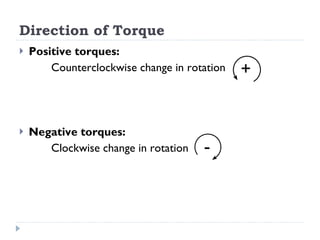
Direction of Torque Positive torques:  Counterclockwise change in rotation Negative torques:  Clockwise change in rotation + -
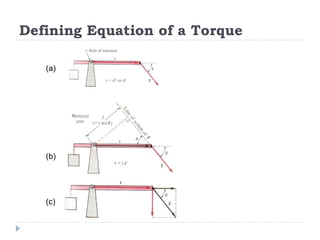
Defining Equation of a Torque (a) (b) (c)
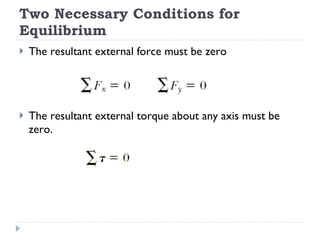
Two Necessary Conditions for Equilibrium The resultant external force must be zero The resultant external torque about any axis must be zero.
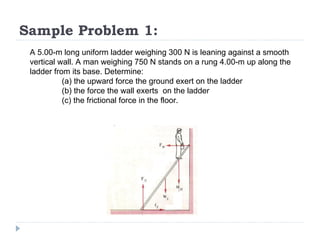
Sample Problem 1: A 5.00-m long uniform ladder weighing 300 N is leaning against a smooth vertical wall. A man weighing 750 N stands on a rung 4.00-m up along the ladder from its base. Determine: (a) the upward force the ground exert on the ladder (b) the force the wall exerts  on the ladder (c) the frictional force in the floor.
Sample Problem 2:
Sample Problem 3:
Center of Mass/Gravity Center of mass (CM, CG) The average point of the weight of an object that may be thought to be concentrated.
Finding the Center of Mass/Gravity
Seatwork:
Assignment:
Questions:
Reference:  Physics for Scientists and Engineers with modern Physics 7 th  Edition by Jewett/Serway © 2008 Thompson Learning Inc.

(3) torque

  • 1.
  • 2.
    Torque The measureof the tendency of forces to cause angular acceleration
  • 3.
    The Magnitude ofTorque The magnitude of the applied force. The distance perpendicular distance of the axis from the point of application. The direction of force. The Torque, T: T = Fr Where: F = applied force, N r = moment arm, m
  • 4.
    Direction of TorquePositive torques: Counterclockwise change in rotation Negative torques: Clockwise change in rotation + -
  • 5.
    Defining Equation ofa Torque (a) (b) (c)
  • 6.
    Two Necessary Conditionsfor Equilibrium The resultant external force must be zero The resultant external torque about any axis must be zero.
  • 7.
    Sample Problem 1:A 5.00-m long uniform ladder weighing 300 N is leaning against a smooth vertical wall. A man weighing 750 N stands on a rung 4.00-m up along the ladder from its base. Determine: (a) the upward force the ground exert on the ladder (b) the force the wall exerts on the ladder (c) the frictional force in the floor.
  • 8.
  • 9.
  • 10.
    Center of Mass/GravityCenter of mass (CM, CG) The average point of the weight of an object that may be thought to be concentrated.
  • 11.
    Finding the Centerof Mass/Gravity
  • 12.
  • 13.
  • 14.
  • 15.
    Reference: Physicsfor Scientists and Engineers with modern Physics 7 th Edition by Jewett/Serway © 2008 Thompson Learning Inc.