JOIN US ON TELEGRAM:-@ETCONP
What is Torque (moment)?
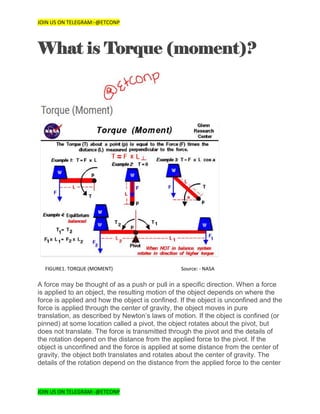
FIGURE1. TORQUE (MOMENT) Source: - NASA
A force may be thought of as a push or pull in a specific direction. When a force
is applied to an object, the resulting motion of the object depends on where the
force is applied and how the object is confined. If the object is unconfined and the
force is applied through the center of gravity, the object moves in pure
translation, as described by Newton’s laws of motion. If the object is confined (or
pinned) at some location called a pivot, the object rotates about the pivot, but
does not translate. The force is transmitted through the pivot and the details of
the rotation depend on the distance from the applied force to the pivot. If the
object is unconfined and the force is applied at some distance from the center of
gravity, the object both translates and rotates about the center of gravity. The
details of the rotation depend on the distance from the applied force to the center
JOIN US ON TELEGRAM:-@ETCONP
of gravity. The motion of flying objects is described by this third type of motion; a
combination of translation and rotation.
A force F is a vector quantity, which means that it has both a magnitude and a
direction associated with it. The direction of the force is important because the
resulting motion of the object is in the same direction as the force. The product of
the force and the perpendicular distance to the center of gravity for an
unconfined object, or to the pivot for a confined object, is^M called the torque or
the moment. A torque is also a vector quantity and produces a rotation in the
same way that a force produces a translation. Namely, an object at rest, or
rotating at a constant angular velocity, will continue to do so until it is subject to
an external torque. A torque produces a change in angular velocity which is
called an angular acceleration.
The distance L used to determine the torque T is the distance from the pivot p to
the force, but measured perpendicular to the direction of the force. On the figure,
we show four examples of torques to illustrate the basic principles governing
torques. In each example a blue weight W is acting on a red bar, which is called
an arm.
In Example 1, the force (weight) is applied perpendicular to the arm. In this case,
the perpendicular distance is the length of the bar and the torque is equal to the
product of the length and the force.
T = F * L
In Example 2, the same force is applied to the arm, but the force now acts right
through the pivot. In this case, the distance from the pivot perpendicular to the
force is zero. So, in this case, the torque is also zero. Think of a hinged door. If
you push on the edge of the door, towards the hinge, the door doesn’t move
because the torque is zero.
Example 3 is the general case in which the force is applied at some angle a to
the arm. The perpendicular distance is given by trigonometry as the length of the
arm (L) times the cosine (cos) of the angle. The torque is then given by:
T = F * L * cos (a)
Examples 1 and 2 can be derived from this general formula, since the cosine of 0
degrees is 1.0 (Example 1), and the cosine of 90 degrees is 0.0 (Example 2).
In Example 4, the pivot has been moved from the end of the bar to a location
near the middle of the bar. Weights are added to both sides of the pivot. To the
right a single weight W produces a force F1 acting at a distance L1 from the
pivot. This creates a torque T1 equal to the product of the force and the distance.
JOIN US ON TELEGRAM:-@ETCONP
T1 = F1 * L1
To the left of the pivot two weights W produce a force F2 at a distance L2. This
produces a torque T2 in a direction opposite from T1 because the distance is in
the opposite direction.
T2 = F2 * L2
If the system were in equilibrium, or balanced, the torques would be equal and no
net torque would act on the system.
T1 = T2 or T1 – T2 = 0
F1 * L1 = F2 * L2
If the system is not in equilibrium, or unbalanced, the bar rotates about the pivot
in the direction of the higher torque. If F2 = 2 * F1, what is the relation between
L1 and L2 to balance the system? If F2 = 2 * F1, and L1 = L2, in which direction
would the system rotate?
Aeronautical engineers use the torque generated by aerodynamic surfaces to
stabilize and control aircraft. On airplanes, the control surfaces produce
aerodynamic forces. These forces are applied at some distance from the aircraft
cg and therefore cause the aircraft to rotate. The elevators produce a pitching
moment, the rudder produce a yawing moment, and the ailerons produce a
rolling moment. The ability to vary the amount of the force and the moment
allows the pilot to maneuver or to trim the aircraft. On model rockets, the fins are
used to generate a torque about the rocket center of gravity to provide stability
during powered flight. On kites, the aerodynamic and weight forces produce a
torque about the bridle point. The distance from the bridle point and the
magnitude of the forces has a strong effect on the performance of the kite.
Source: nasa.gov

torque

  • 1.
    JOIN US ONTELEGRAM:-@ETCONP JOIN US ON TELEGRAM:-@ETCONP What is Torque (moment)? FIGURE1. TORQUE (MOMENT) Source: - NASA A force may be thought of as a push or pull in a specific direction. When a force is applied to an object, the resulting motion of the object depends on where the force is applied and how the object is confined. If the object is unconfined and the force is applied through the center of gravity, the object moves in pure translation, as described by Newton’s laws of motion. If the object is confined (or pinned) at some location called a pivot, the object rotates about the pivot, but does not translate. The force is transmitted through the pivot and the details of the rotation depend on the distance from the applied force to the pivot. If the object is unconfined and the force is applied at some distance from the center of gravity, the object both translates and rotates about the center of gravity. The details of the rotation depend on the distance from the applied force to the center
  • 2.
    JOIN US ONTELEGRAM:-@ETCONP JOIN US ON TELEGRAM:-@ETCONP of gravity. The motion of flying objects is described by this third type of motion; a combination of translation and rotation. A force F is a vector quantity, which means that it has both a magnitude and a direction associated with it. The direction of the force is important because the resulting motion of the object is in the same direction as the force. The product of the force and the perpendicular distance to the center of gravity for an unconfined object, or to the pivot for a confined object, is^M called the torque or the moment. A torque is also a vector quantity and produces a rotation in the same way that a force produces a translation. Namely, an object at rest, or rotating at a constant angular velocity, will continue to do so until it is subject to an external torque. A torque produces a change in angular velocity which is called an angular acceleration. The distance L used to determine the torque T is the distance from the pivot p to the force, but measured perpendicular to the direction of the force. On the figure, we show four examples of torques to illustrate the basic principles governing torques. In each example a blue weight W is acting on a red bar, which is called an arm. In Example 1, the force (weight) is applied perpendicular to the arm. In this case, the perpendicular distance is the length of the bar and the torque is equal to the product of the length and the force. T = F * L In Example 2, the same force is applied to the arm, but the force now acts right through the pivot. In this case, the distance from the pivot perpendicular to the force is zero. So, in this case, the torque is also zero. Think of a hinged door. If you push on the edge of the door, towards the hinge, the door doesn’t move because the torque is zero. Example 3 is the general case in which the force is applied at some angle a to the arm. The perpendicular distance is given by trigonometry as the length of the arm (L) times the cosine (cos) of the angle. The torque is then given by: T = F * L * cos (a) Examples 1 and 2 can be derived from this general formula, since the cosine of 0 degrees is 1.0 (Example 1), and the cosine of 90 degrees is 0.0 (Example 2). In Example 4, the pivot has been moved from the end of the bar to a location near the middle of the bar. Weights are added to both sides of the pivot. To the right a single weight W produces a force F1 acting at a distance L1 from the pivot. This creates a torque T1 equal to the product of the force and the distance.
  • 3.
    JOIN US ONTELEGRAM:-@ETCONP JOIN US ON TELEGRAM:-@ETCONP T1 = F1 * L1 To the left of the pivot two weights W produce a force F2 at a distance L2. This produces a torque T2 in a direction opposite from T1 because the distance is in the opposite direction. T2 = F2 * L2 If the system were in equilibrium, or balanced, the torques would be equal and no net torque would act on the system. T1 = T2 or T1 – T2 = 0 F1 * L1 = F2 * L2 If the system is not in equilibrium, or unbalanced, the bar rotates about the pivot in the direction of the higher torque. If F2 = 2 * F1, what is the relation between L1 and L2 to balance the system? If F2 = 2 * F1, and L1 = L2, in which direction would the system rotate? Aeronautical engineers use the torque generated by aerodynamic surfaces to stabilize and control aircraft. On airplanes, the control surfaces produce aerodynamic forces. These forces are applied at some distance from the aircraft cg and therefore cause the aircraft to rotate. The elevators produce a pitching moment, the rudder produce a yawing moment, and the ailerons produce a rolling moment. The ability to vary the amount of the force and the moment allows the pilot to maneuver or to trim the aircraft. On model rockets, the fins are used to generate a torque about the rocket center of gravity to provide stability during powered flight. On kites, the aerodynamic and weight forces produce a torque about the bridle point. The distance from the bridle point and the magnitude of the forces has a strong effect on the performance of the kite. Source: nasa.gov