EC-111 British Economy
Recent UK Macroeconomic
Trends
Dr Catherine Robinson
F26, Richard Price Building
Office Hours: Mondays 10.30-11.30 and Thursdays 9.30-10.30
Appointments: c.robinson@swansea.ac.uk
Productivity
 Considering trends in economic growth and productivity
 Helps put the UK into context
 Structured around 3 papers
 Muellbauer‟s 1991 paper on competition and productivity
 O‟Mahony and Robinson (2007)
 Disney, Jin and Miller (2013), „The Productivity
Puzzles‟, IFS Green Book, Chapter 3
ALL AVAILABLE ON BLACKBOARD
The Basics:
Economic Growth
 Growth in GDP
 But this stems from
 Increasing labour
 Increasing capital
 Improving the way these two are combined through technology
 PRODUCTIVITY Growth
 Krugman‟s 1991 quote:
 “productivity isn‟t everything, but in the long run, its almost
everything”
 Producing more output from inputs (technology or better
organisation)
 Sectoral perspective
Early Work of Muellbauer
 Focussed on productivity and competitiveness in
manufacturing
 “Manufacturing is the bell-wether for the
economy”(Muellbauer, 1991, p.99)
 International competitiveness, 1966-1990
 relative input prices, relative export prices and relative unit
labour costs (figure 1)
 In all cases, we see a rise in costs/prices over
time, especially from 1978 onwards
 Noticeably worse in the late 1980s than in the late 1970s
 Substantial labour shedding in 1991 expected to stabilise ULC
measure
Productivity growth in UK
manufacturing (1980s-1990s)
 Manufacturing experiences faster productivity growth
than other parts of the economy
 Easier to measure?
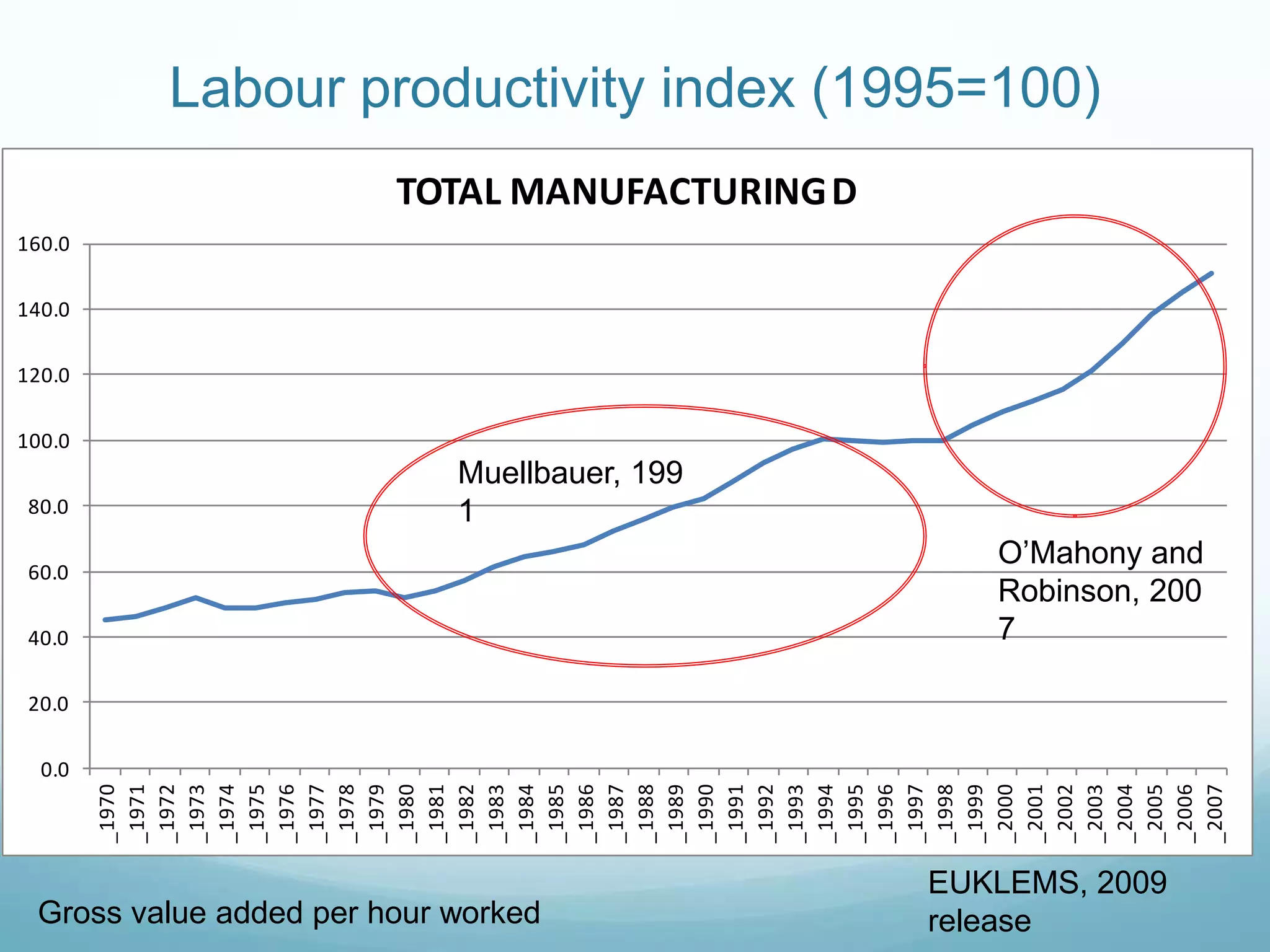
 Noticeable speeding up of labour productivity in the
1980s
 In part yes, a speeding up, but also followed on from a very
slow 1970s period
 Muellbauer looks at the slow-down and the upturn
Labour productivity index (1995=100)
0.0
20.0
40.0
60.0
80.0
100.0
120.0
140.0
160.0
_1970
_1971
_1972
_1973
_1974
_1975
_1976
_1977
_1978
_1979
_1980
_1981
_1982
_1983
_1984
_1985
_1986
_1987
_1988
_1989
_1990
_1991
_1992
_1993
_1994
_1995
_1996
_1997
_1998
_1999
_2000
_2001
_2002
_2003
_2004
_2005
_2006
_2007
TOTAL MANUFACTURINGD
EUKLEMS, 2009
releaseGross value added per hour worked
Muellbauer, 199
1
O‟Mahony and
Robinson, 200
7
Causes for the 1970s
slowdown
 Raw material prices
 Oil crises
 Exacerbated by inappropriate capital
 Suitable for low energy prices
 Became inefficient with the change in prices
 Global recession
 Led to scrapping of plant, machinery, buildings
 ALTERNATIVE VIEWS
 Bruno and Sachs (1982) – all down to measurement
 Labour markets and industrial relations
 Adjustment costs because of the input price shocks
Causes for the 1980s upturn
(Muellbauer)
 Capital productivity and unobserved scrapping of the earlier period
reverses
 UK manufacturing firms were too optimistic and hoarded labour
 Great labour shake-out followed with the Thatcher administration
 Industrial relations
 Over valued exchange rate, high interest rates, withdrawal of
subsidies and state-financed rescues and the SCALE of recession
put managers under pressure to cut costs and improve work
practices
 Improvement in the quality of workers
 New technology
 Catch-up hypothesis (Crafts, 1991)
Muellbauer in conclusion….
 Not just a manufacturing phenomenon but data outside
manufacturing are ropey
 Links it back to macro policy
 Weakening of union power did help to increase productivity
growth in unionised plants more than non-unionised plants
(Metcalf 1989)
 Long run education and training of workers crucial to
productivity growth and competitiveness
 UK housing market hindered labour mobility
 Warnings about interest rates as sole policy response
 Too much faith put in the Thatcher Miracle
 Tax cuts and other improvement in incentives and institutions to
revolutionise the UK economy
Productivity and growth from an
international perspective, 1970-2004
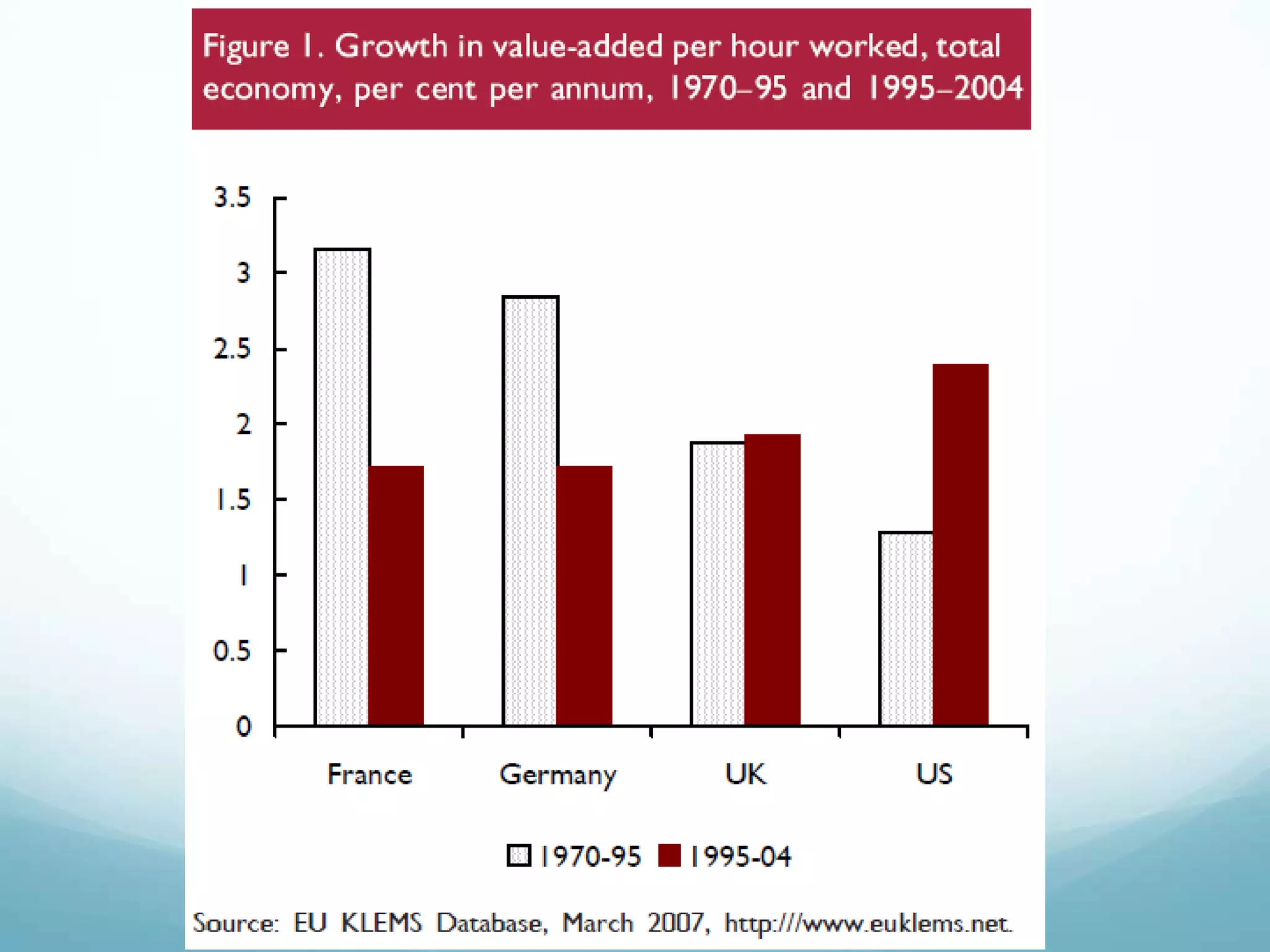
 Data from EUKLEMS
 UK compared with France, Germany and US
 Takes a more whole-economy approach
 Splits the period in two
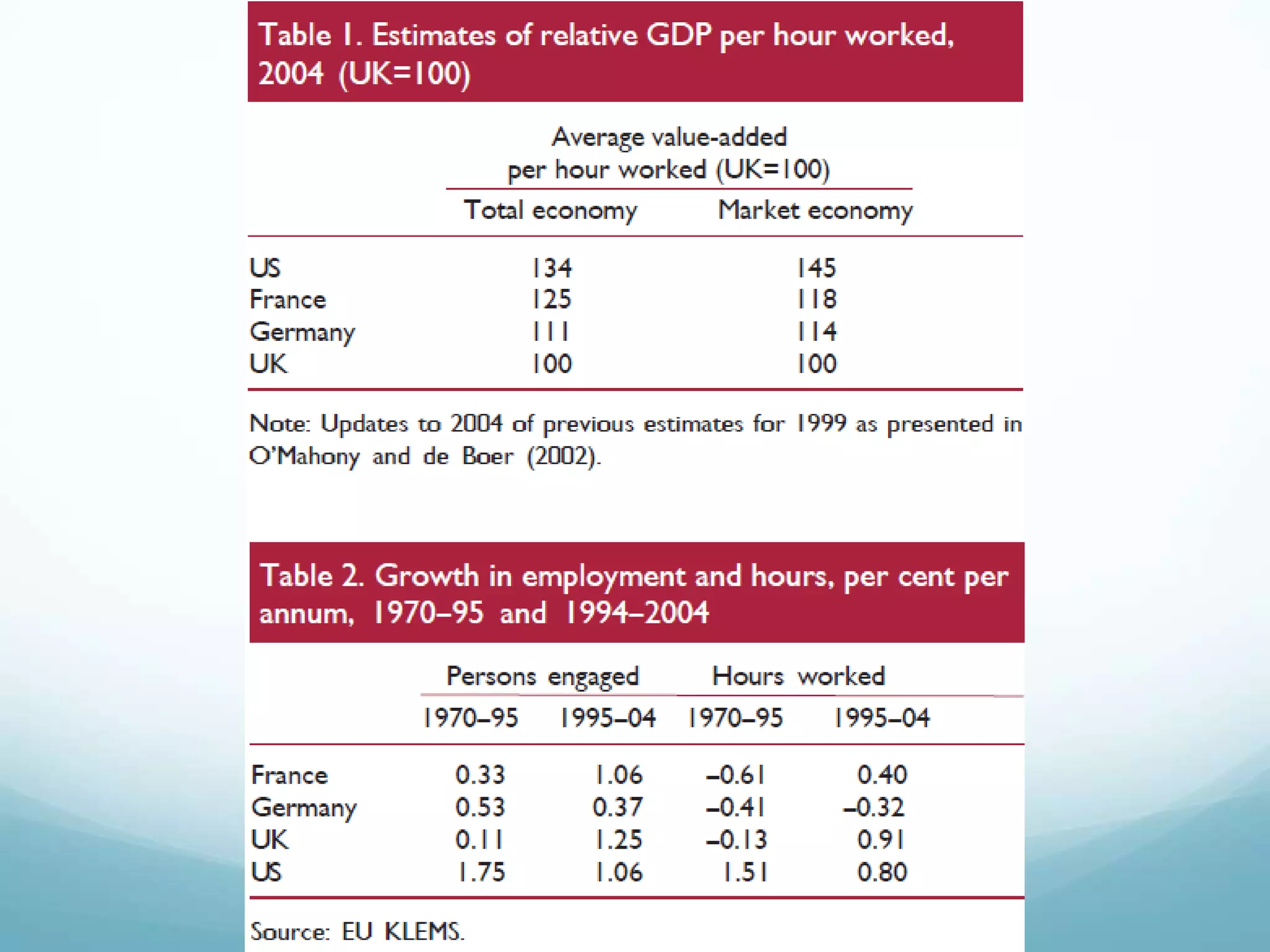
 1970-1995
 1995-2004
 Notes that recent performance shows RLP growth faster than
comparable countries
 BUT a relatively lower starting base (Table 2)
 Still a significant productivity gap
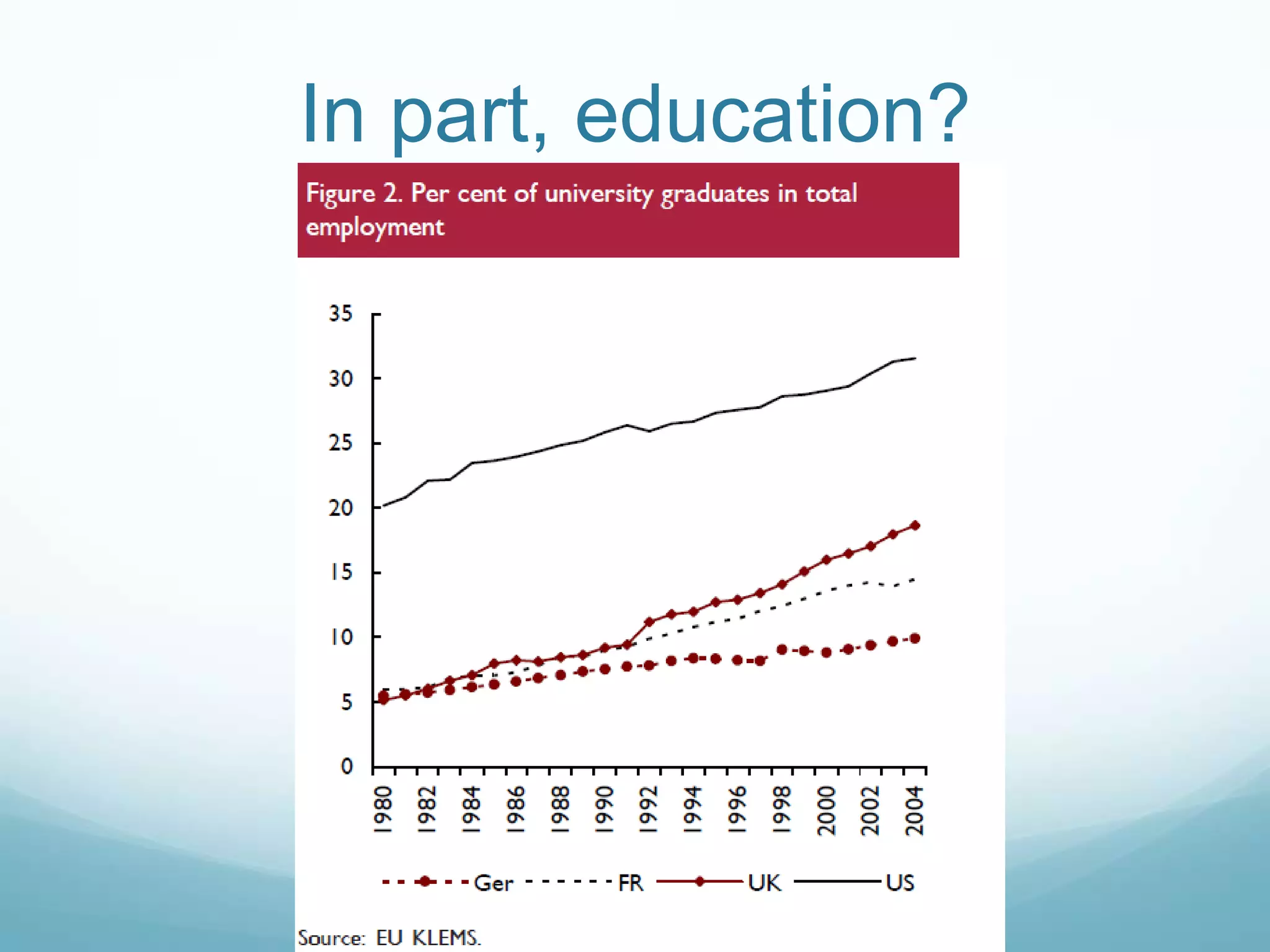
In part, education?
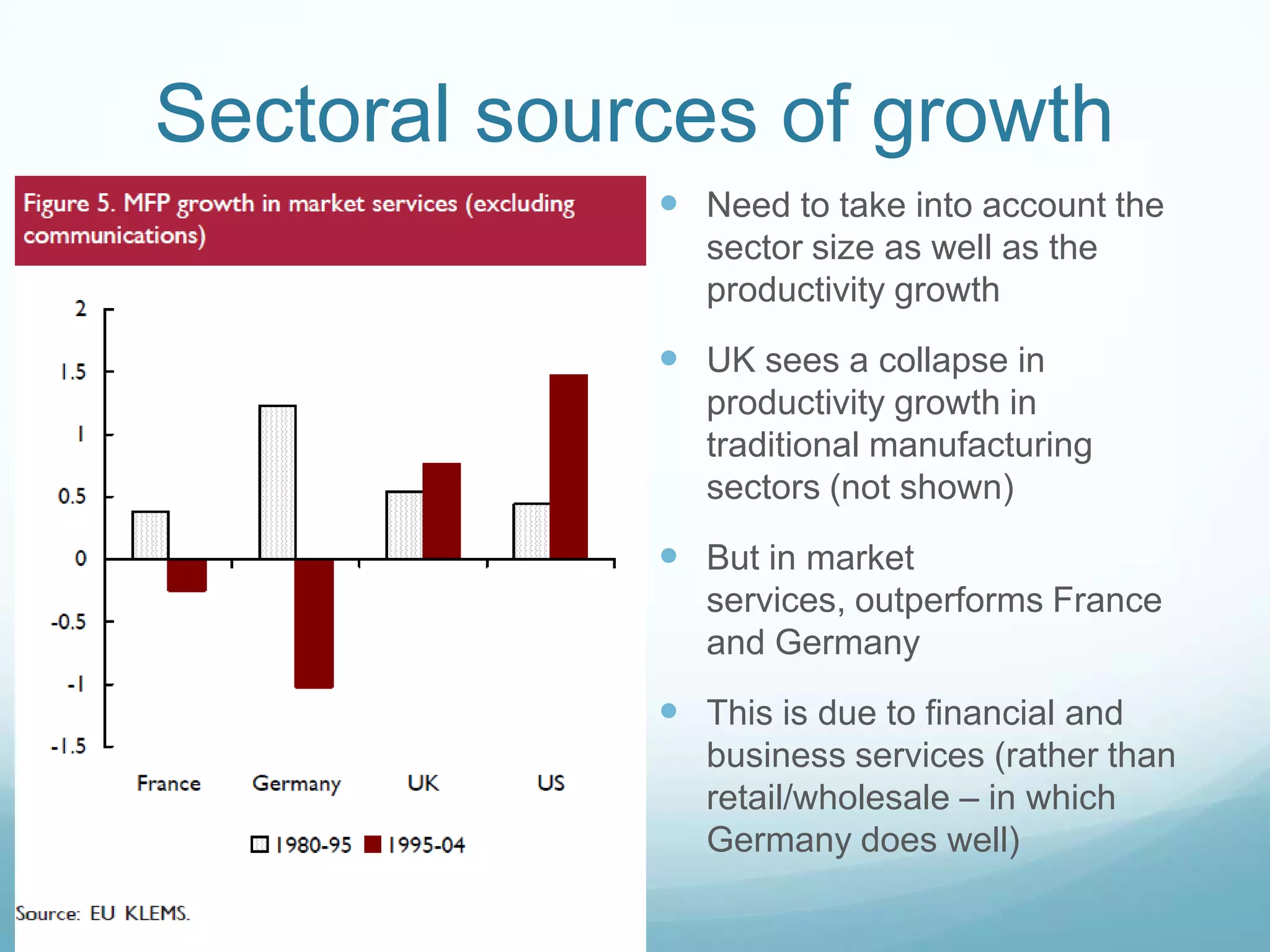
Sectoral sources of growth
 Need to take into account the
sector size as well as the
productivity growth
 UK sees a collapse in
productivity growth in
traditional manufacturing
sectors (not shown)
 But in market
services, outperforms France
and Germany
 This is due to financial and
business services (rather than
retail/wholesale – in which
Germany does well)
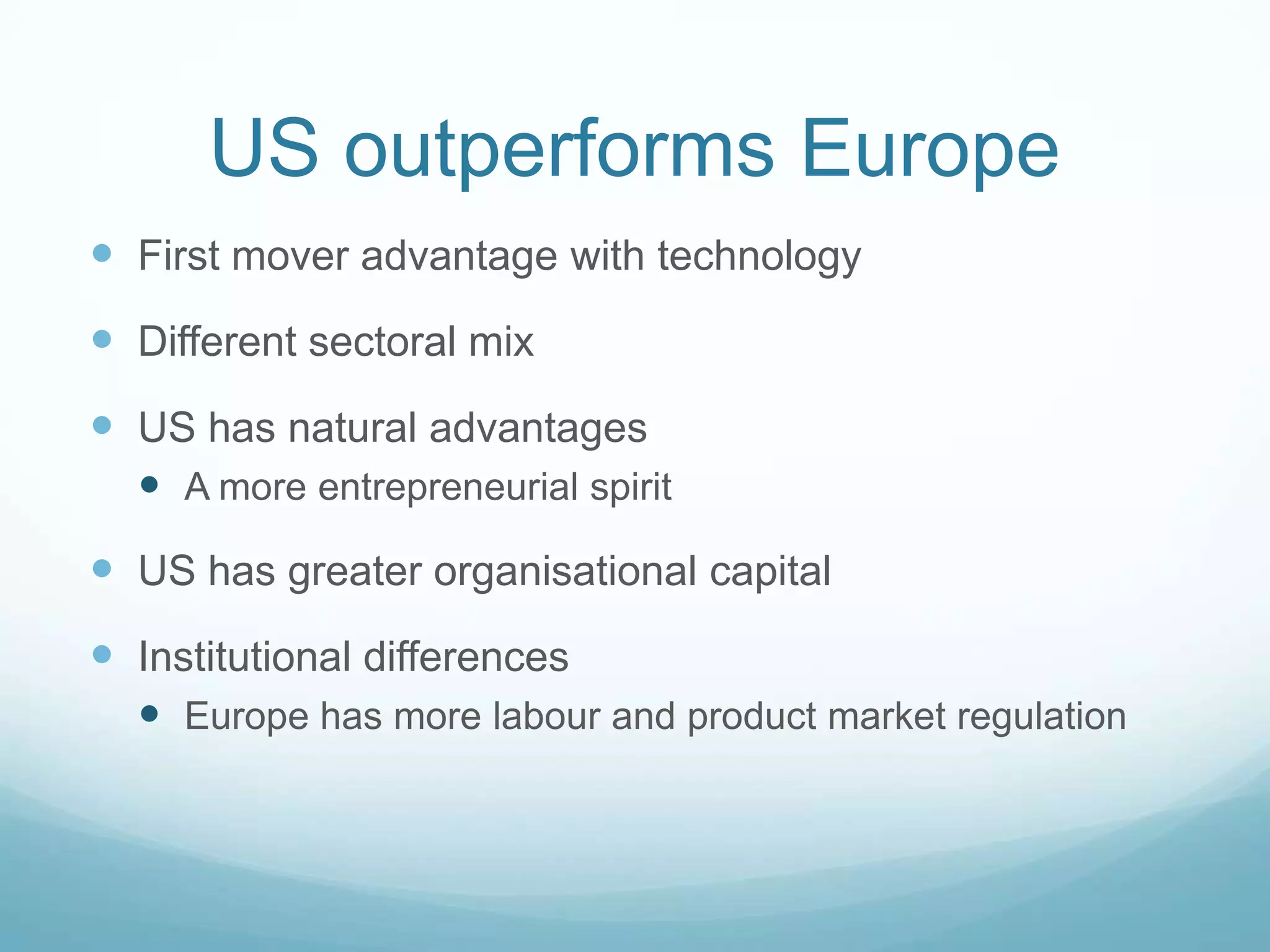
US outperforms Europe
 First mover advantage with technology
 Different sectoral mix
 US has natural advantages
 A more entrepreneurial spirit
 US has greater organisational capital
 Institutional differences
 Europe has more labour and product market regulation
The Current Productivity
Puzzle
 Until this last quarters figures, there were more people
in employment now than before the recession
 BUT Output per worker fell by 3.2% between 2008(Q1)
and 2012(Q3)
 Why?
 ....previous recessions saw smaller drops because
employment fell faster than output
Disney et al (2013) provide some
explanations
 Measurement issues (again)
 Industrial composition…productivity falls in some sectors more
than others
 Changes in workforce composition
 Fall in real wages
 Level and allocation of capital
 Impact of recession has fallen disproportionately on the public
sector (6% decline since 2009)
 While output has increased – productivity gain
 BUT all sorts of problems measuring productivity in the public
sector
Or to put it another way….
 The Economist…
Summary
 Two periods of productivity growth in the UK economy
 The Thatcher Miracle
 Concentrated in the manufacturing sector
 The ICT adoption
 Splits along ICT using and producing lines, not traditional
sectoral breakdowns
 UK, like the rest of Europe, seems to lag the US
 Some cause for optimism in UK performance stemming from
the business and financial services sector
 BUT – 2007 saw the credit crunch and the start of the
financial crisis
 Productivity has fallen and employment held up
 Labour hoarding/capacity utilisation
 Public sector productivity improvements?
References
ONS podcasts – great one on Balance of Payments, and also some on
unemployment etc. Tend to be short term, but informative
nonetheless, especially with current data. http://www.ons.gov.uk/
Muellbauer, J. (1991) ‘Productivity and Competitiveness’, Oxford
Review of Economic Policy, 7(3), 99-117
O’Mahony, M, and C. Robinson (2007) ‘UK Growth and Productivity
in an International Perspective: Evidence from
EUKLEMS’, National Institute Economic Review, 200, 79-85
Disney, R. W. Jin and H. Miller (2013) ‘The Productivity
Puzzles, Chapter 3, IFS Green Budget’, available at
http://www.ifs.org.uk/publications/6560

Ec 111 week 4b(1)

  • 1.
    EC-111 British Economy RecentUK Macroeconomic Trends Dr Catherine Robinson F26, Richard Price Building Office Hours: Mondays 10.30-11.30 and Thursdays 9.30-10.30 Appointments: c.robinson@swansea.ac.uk
  • 2.
    Productivity  Considering trendsin economic growth and productivity  Helps put the UK into context  Structured around 3 papers  Muellbauer‟s 1991 paper on competition and productivity  O‟Mahony and Robinson (2007)  Disney, Jin and Miller (2013), „The Productivity Puzzles‟, IFS Green Book, Chapter 3 ALL AVAILABLE ON BLACKBOARD
  • 3.
    The Basics: Economic Growth Growth in GDP  But this stems from  Increasing labour  Increasing capital  Improving the way these two are combined through technology  PRODUCTIVITY Growth  Krugman‟s 1991 quote:  “productivity isn‟t everything, but in the long run, its almost everything”  Producing more output from inputs (technology or better organisation)  Sectoral perspective
  • 4.
    Early Work ofMuellbauer  Focussed on productivity and competitiveness in manufacturing  “Manufacturing is the bell-wether for the economy”(Muellbauer, 1991, p.99)  International competitiveness, 1966-1990  relative input prices, relative export prices and relative unit labour costs (figure 1)  In all cases, we see a rise in costs/prices over time, especially from 1978 onwards  Noticeably worse in the late 1980s than in the late 1970s  Substantial labour shedding in 1991 expected to stabilise ULC measure
  • 5.
    Productivity growth inUK manufacturing (1980s-1990s)  Manufacturing experiences faster productivity growth than other parts of the economy  Easier to measure?  Noticeable speeding up of labour productivity in the 1980s  In part yes, a speeding up, but also followed on from a very slow 1970s period  Muellbauer looks at the slow-down and the upturn
  • 6.
    Labour productivity index(1995=100) 0.0 20.0 40.0 60.0 80.0 100.0 120.0 140.0 160.0 _1970 _1971 _1972 _1973 _1974 _1975 _1976 _1977 _1978 _1979 _1980 _1981 _1982 _1983 _1984 _1985 _1986 _1987 _1988 _1989 _1990 _1991 _1992 _1993 _1994 _1995 _1996 _1997 _1998 _1999 _2000 _2001 _2002 _2003 _2004 _2005 _2006 _2007 TOTAL MANUFACTURINGD EUKLEMS, 2009 releaseGross value added per hour worked Muellbauer, 199 1 O‟Mahony and Robinson, 200 7
  • 7.
    Causes for the1970s slowdown  Raw material prices  Oil crises  Exacerbated by inappropriate capital  Suitable for low energy prices  Became inefficient with the change in prices  Global recession  Led to scrapping of plant, machinery, buildings  ALTERNATIVE VIEWS  Bruno and Sachs (1982) – all down to measurement  Labour markets and industrial relations  Adjustment costs because of the input price shocks
  • 8.
    Causes for the1980s upturn (Muellbauer)  Capital productivity and unobserved scrapping of the earlier period reverses  UK manufacturing firms were too optimistic and hoarded labour  Great labour shake-out followed with the Thatcher administration  Industrial relations  Over valued exchange rate, high interest rates, withdrawal of subsidies and state-financed rescues and the SCALE of recession put managers under pressure to cut costs and improve work practices  Improvement in the quality of workers  New technology  Catch-up hypothesis (Crafts, 1991)
  • 9.
    Muellbauer in conclusion…. Not just a manufacturing phenomenon but data outside manufacturing are ropey  Links it back to macro policy  Weakening of union power did help to increase productivity growth in unionised plants more than non-unionised plants (Metcalf 1989)  Long run education and training of workers crucial to productivity growth and competitiveness  UK housing market hindered labour mobility  Warnings about interest rates as sole policy response  Too much faith put in the Thatcher Miracle  Tax cuts and other improvement in incentives and institutions to revolutionise the UK economy
  • 10.
    Productivity and growthfrom an international perspective, 1970-2004  Data from EUKLEMS  UK compared with France, Germany and US  Takes a more whole-economy approach  Splits the period in two  1970-1995  1995-2004  Notes that recent performance shows RLP growth faster than comparable countries  BUT a relatively lower starting base (Table 2)  Still a significant productivity gap
  • 13.
  • 14.
    Sectoral sources ofgrowth  Need to take into account the sector size as well as the productivity growth  UK sees a collapse in productivity growth in traditional manufacturing sectors (not shown)  But in market services, outperforms France and Germany  This is due to financial and business services (rather than retail/wholesale – in which Germany does well)
  • 15.
    US outperforms Europe First mover advantage with technology  Different sectoral mix  US has natural advantages  A more entrepreneurial spirit  US has greater organisational capital  Institutional differences  Europe has more labour and product market regulation
  • 16.
    The Current Productivity Puzzle Until this last quarters figures, there were more people in employment now than before the recession  BUT Output per worker fell by 3.2% between 2008(Q1) and 2012(Q3)  Why?  ....previous recessions saw smaller drops because employment fell faster than output
  • 17.
    Disney et al(2013) provide some explanations  Measurement issues (again)  Industrial composition…productivity falls in some sectors more than others  Changes in workforce composition  Fall in real wages  Level and allocation of capital  Impact of recession has fallen disproportionately on the public sector (6% decline since 2009)  While output has increased – productivity gain  BUT all sorts of problems measuring productivity in the public sector
  • 18.
    Or to putit another way….  The Economist…
  • 19.
    Summary  Two periodsof productivity growth in the UK economy  The Thatcher Miracle  Concentrated in the manufacturing sector  The ICT adoption  Splits along ICT using and producing lines, not traditional sectoral breakdowns  UK, like the rest of Europe, seems to lag the US  Some cause for optimism in UK performance stemming from the business and financial services sector  BUT – 2007 saw the credit crunch and the start of the financial crisis  Productivity has fallen and employment held up  Labour hoarding/capacity utilisation  Public sector productivity improvements?
  • 20.
    References ONS podcasts –great one on Balance of Payments, and also some on unemployment etc. Tend to be short term, but informative nonetheless, especially with current data. http://www.ons.gov.uk/ Muellbauer, J. (1991) ‘Productivity and Competitiveness’, Oxford Review of Economic Policy, 7(3), 99-117 O’Mahony, M, and C. Robinson (2007) ‘UK Growth and Productivity in an International Perspective: Evidence from EUKLEMS’, National Institute Economic Review, 200, 79-85 Disney, R. W. Jin and H. Miller (2013) ‘The Productivity Puzzles, Chapter 3, IFS Green Budget’, available at http://www.ifs.org.uk/publications/6560