EC-111 British Economy
Recent UK Macroeconomic
Trends
Dr Catherine Robinson
F26, Richard Price Building
Office Hours: Mondays 10.30-11.30 and Thursdays 9.30-10.30
Appointments: c.robinson@swansea.ac.uk
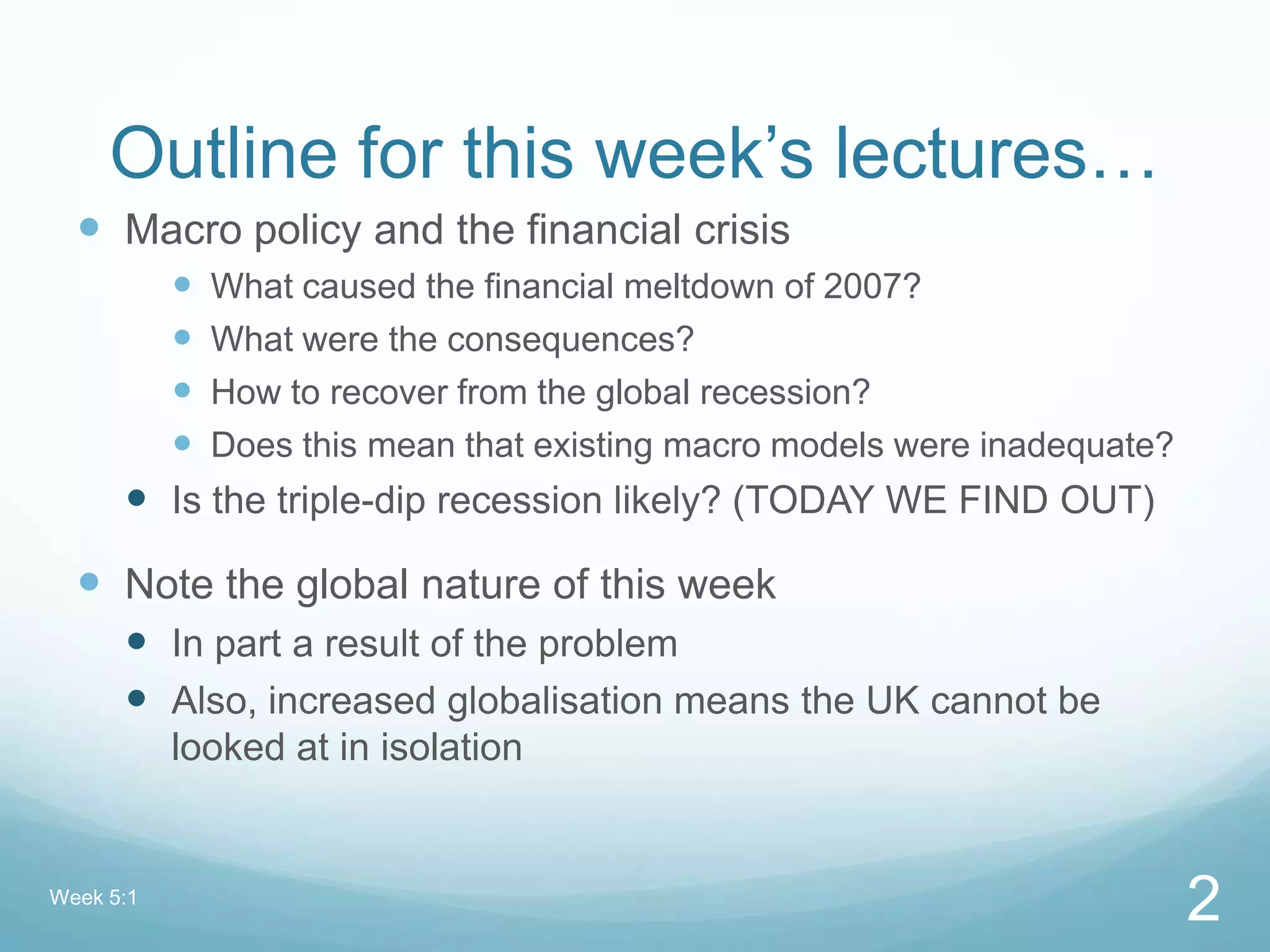
Outline for this week‟s lectures…
 Macro policy and the financial crisis
 What caused the financial meltdown of 2007?
 What were the consequences?
 How to recover from the global recession?
 Does this mean that existing macro models were inadequate?
 Is the triple-dip recession likely? (TODAY WE FIND OUT)
 Note the global nature of this week
 In part a result of the problem
 Also, increased globalisation means the UK cannot be
looked at in isolation
Week 5:1
2
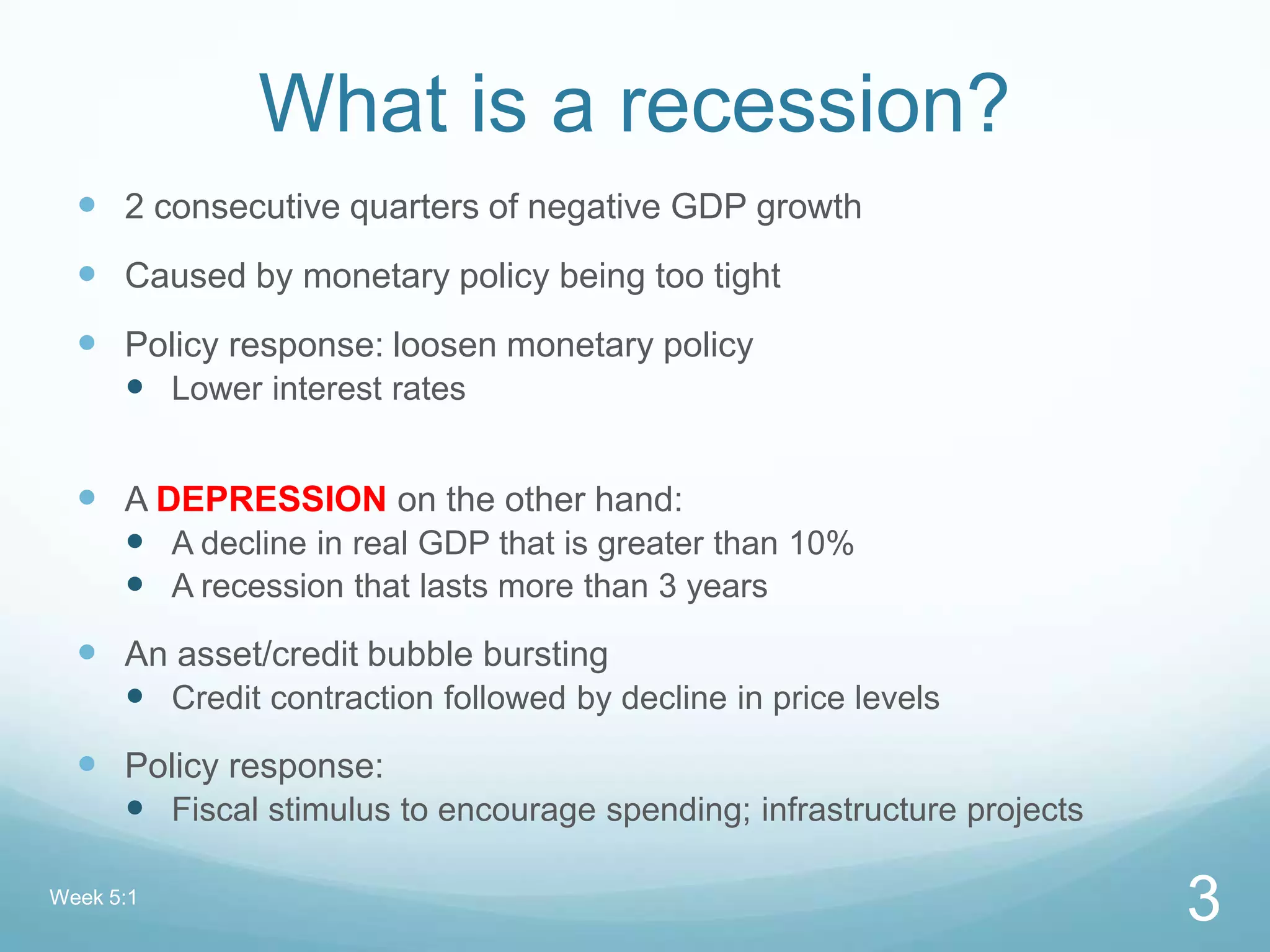
What is a recession?
 2 consecutive quarters of negative GDP growth
 Caused by monetary policy being too tight
 Policy response: loosen monetary policy
 Lower interest rates
 A DEPRESSION on the other hand:
 A decline in real GDP that is greater than 10%
 A recession that lasts more than 3 years
 An asset/credit bubble bursting
 Credit contraction followed by decline in price levels
 Policy response:
 Fiscal stimulus to encourage spending; infrastructure projects
Week 5:1
3
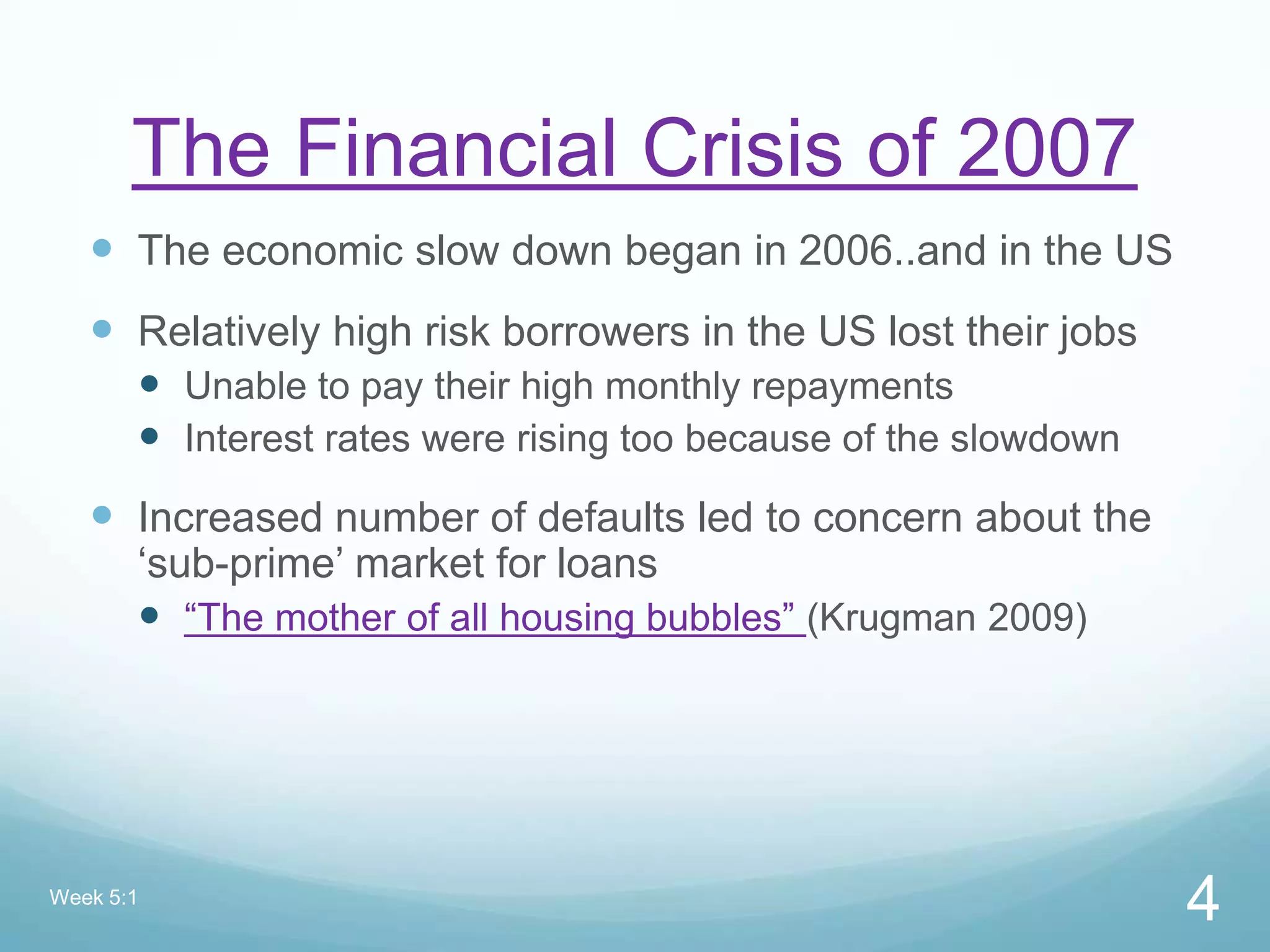
The Financial Crisis of 2007
 The economic slow down began in 2006..and in the US
 Relatively high risk borrowers in the US lost their jobs
 Unable to pay their high monthly repayments
 Interest rates were rising too because of the slowdown
 Increased number of defaults led to concern about the
„sub-prime‟ market for loans
 “The mother of all housing bubbles” (Krugman 2009)
Week 5:1
4
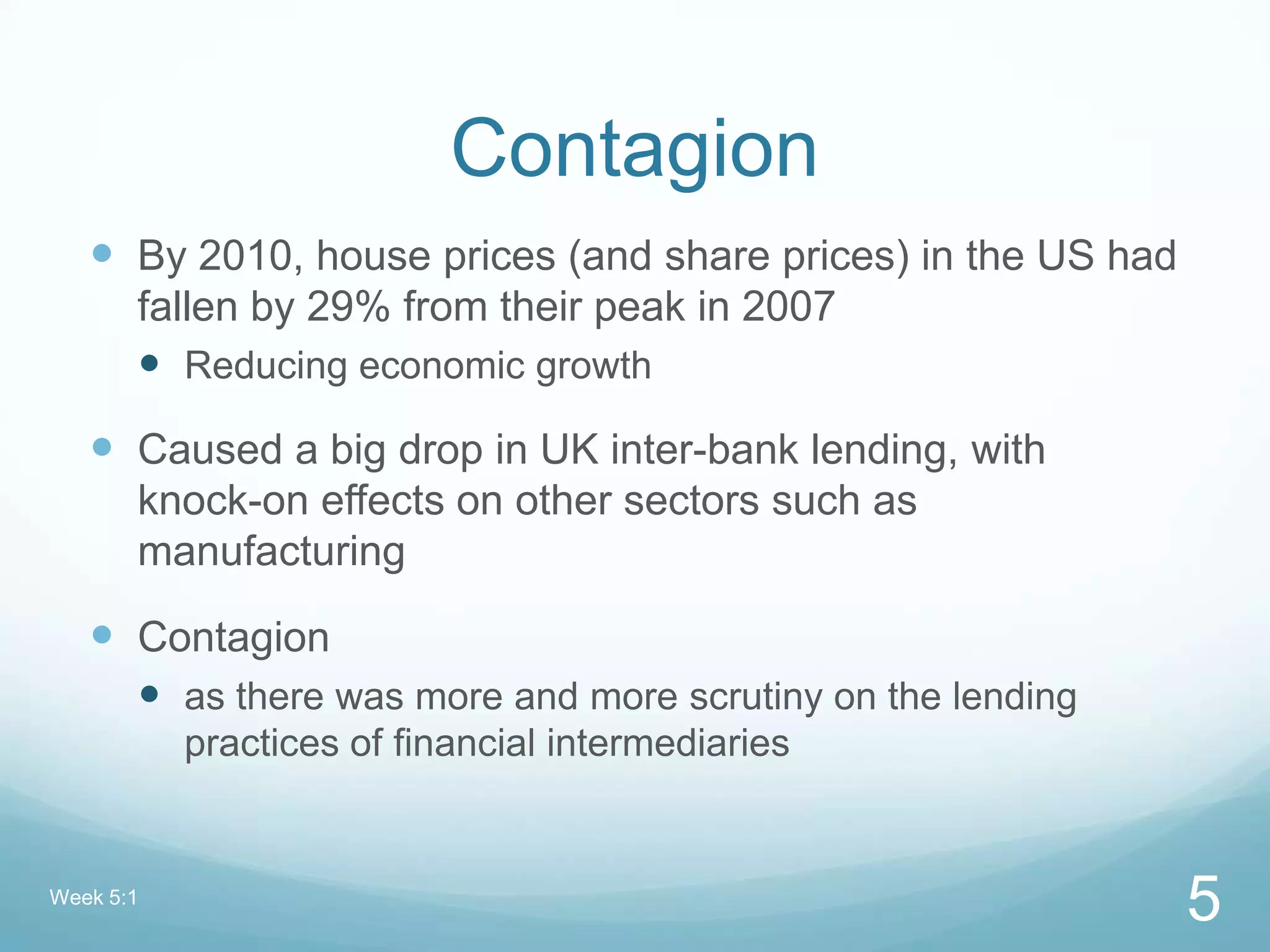
Contagion
 By 2010, house prices (and share prices) in the US had
fallen by 29% from their peak in 2007
 Reducing economic growth
 Caused a big drop in UK inter-bank lending, with
knock-on effects on other sectors such as
manufacturing
 Contagion
 as there was more and more scrutiny on the lending
practices of financial intermediaries
Week 5:1
5
Causes: Financial
„innovations‟
 The Big Bang led to deregulation…
 Deregulation of the financial sector led to innovations in
products:
 Short selling
 Over the counter derivatives
 Securitisation
 Proprietary trading
 Speculation
 SHADOW BANKING
Week 5:1
6
Structured Investment Vehicles
(SIVs)
 innovative ways to package debts
 In such a way as to obscure the risks associated by
creating a portfolio of liabilities
 some of which were the sub-prime mortgages
 Some of which were short term debts (with comparatively
little risk)
Week 5:1
7
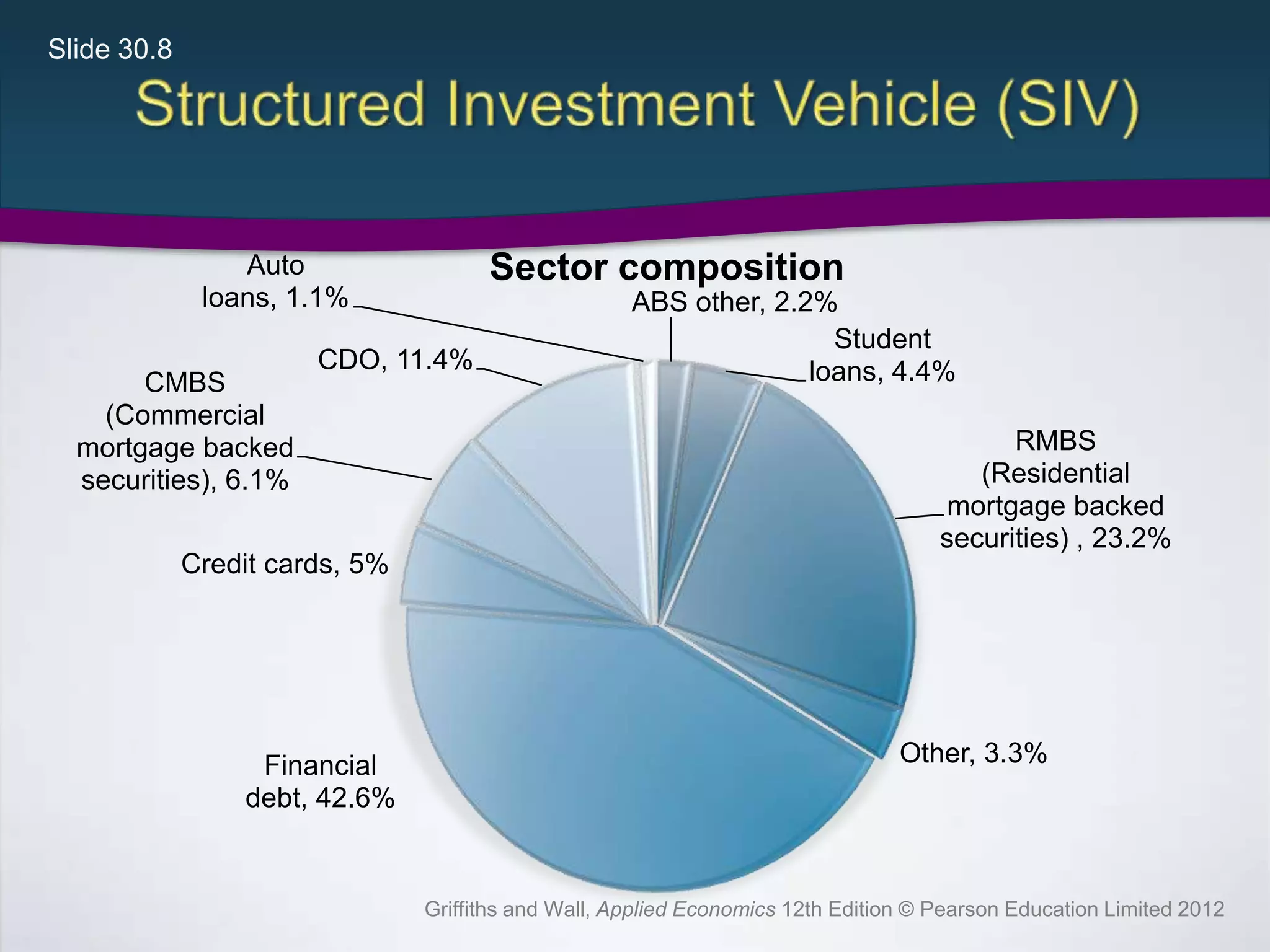
Slide 30.8
Griffiths and Wall, Applied Economics 12th Edition © Pearson Education Limited 2012
ABS other, 2.2%
Student
loans, 4.4%
RMBS
(Residential
mortgage backed
securities) , 23.2%
Other, 3.3%Financial
debt, 42.6%
Credit cards, 5%
CMBS
(Commercial
mortgage backed
securities), 6.1%
CDO, 11.4%
Auto
loans, 1.1%
Sector composition
Realisation – followed by PANIC!
 Early 2007:
 saw 4 mortgage providers in the US file for bankruptcy
 Reported that sub-prime lenders were 5 times more likely to incur
defaults
 Bear Sterns lost 90% of its sub-prime loans and filed for
bankruptcy
 August to November 2007:
 More banks collapsed BNP PARIBUS froze investment funds
 $300bn is pumped into the global system to maintain liquidity
 Northern Rock collapses
 Poor financial announcements in the US
 Freddie Mac and Fannie Mae announce record losses
Week 5:1
9
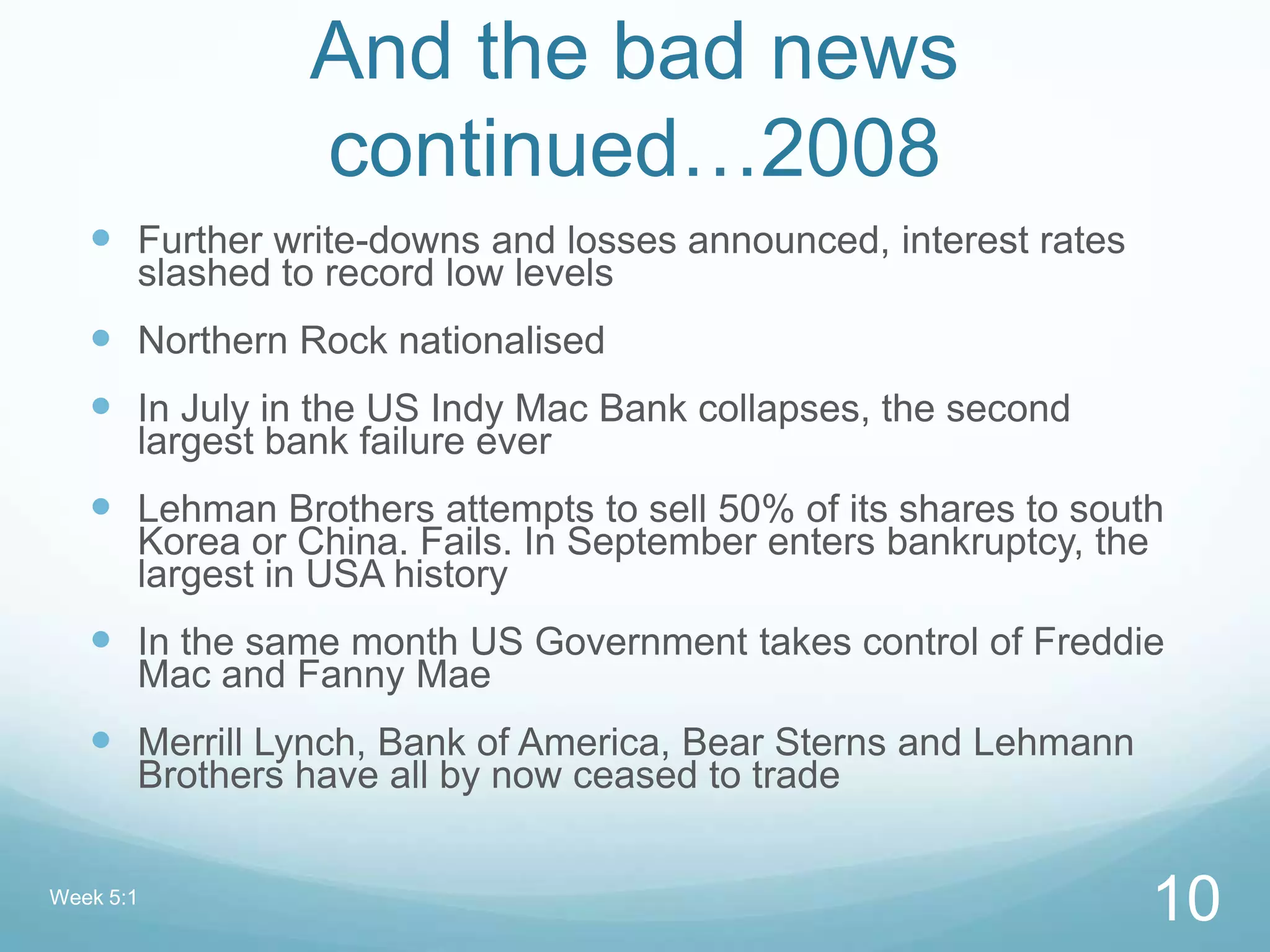
And the bad news
continued…2008
 Further write-downs and losses announced, interest rates
slashed to record low levels
 Northern Rock nationalised
 In July in the US Indy Mac Bank collapses, the second
largest bank failure ever
 Lehman Brothers attempts to sell 50% of its shares to south
Korea or China. Fails. In September enters bankruptcy, the
largest in USA history
 In the same month US Government takes control of Freddie
Mac and Fanny Mae
 Merrill Lynch, Bank of America, Bear Sterns and Lehmann
Brothers have all by now ceased to trade
Week 5:1
10
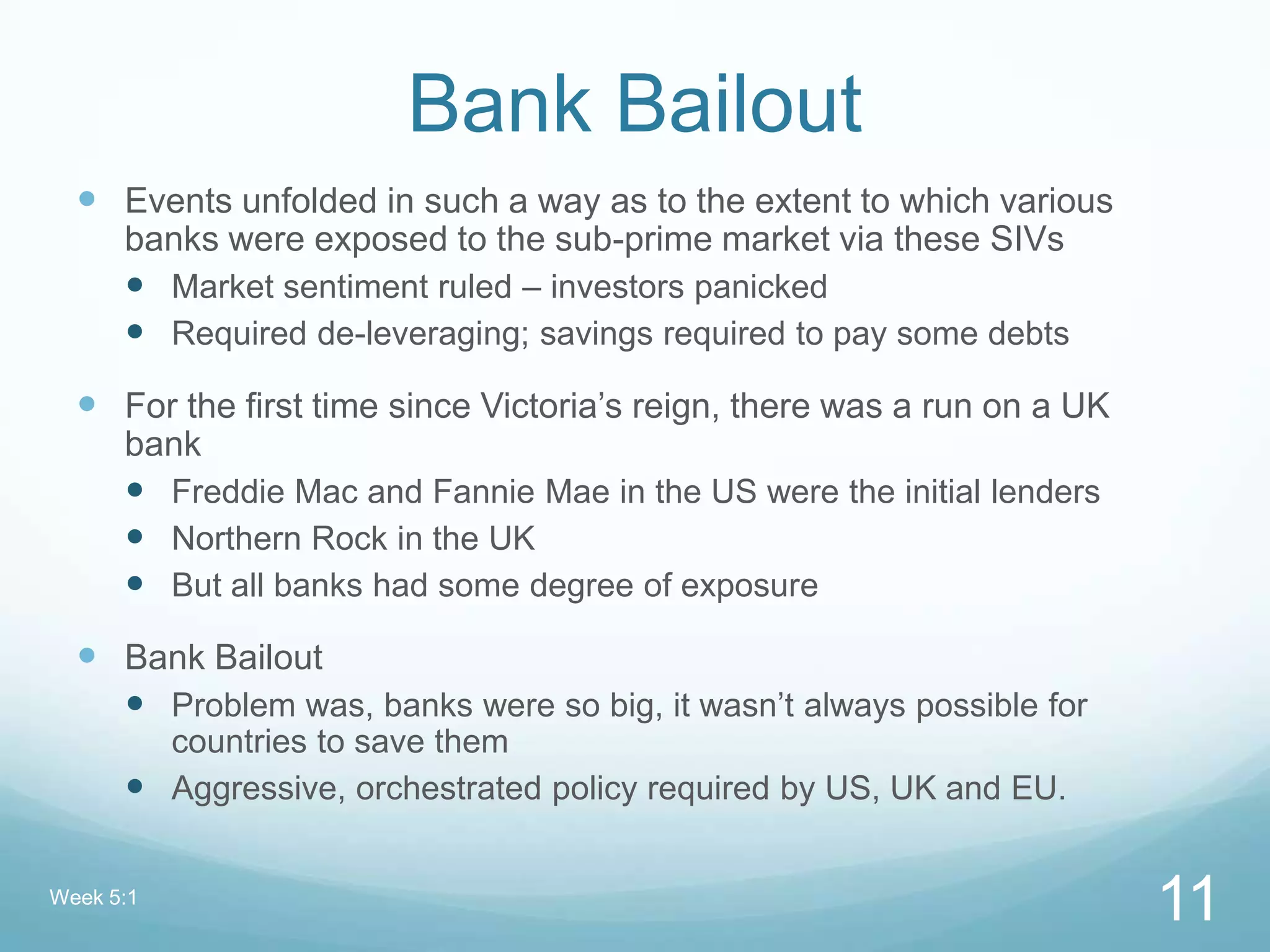
Bank Bailout
 Events unfolded in such a way as to the extent to which various
banks were exposed to the sub-prime market via these SIVs
 Market sentiment ruled – investors panicked
 Required de-leveraging; savings required to pay some debts
 For the first time since Victoria‟s reign, there was a run on a UK
bank
 Freddie Mac and Fannie Mae in the US were the initial lenders
 Northern Rock in the UK
 But all banks had some degree of exposure
 Bank Bailout
 Problem was, banks were so big, it wasn‟t always possible for
countries to save them
 Aggressive, orchestrated policy required by US, UK and EU.
Week 5:1
11
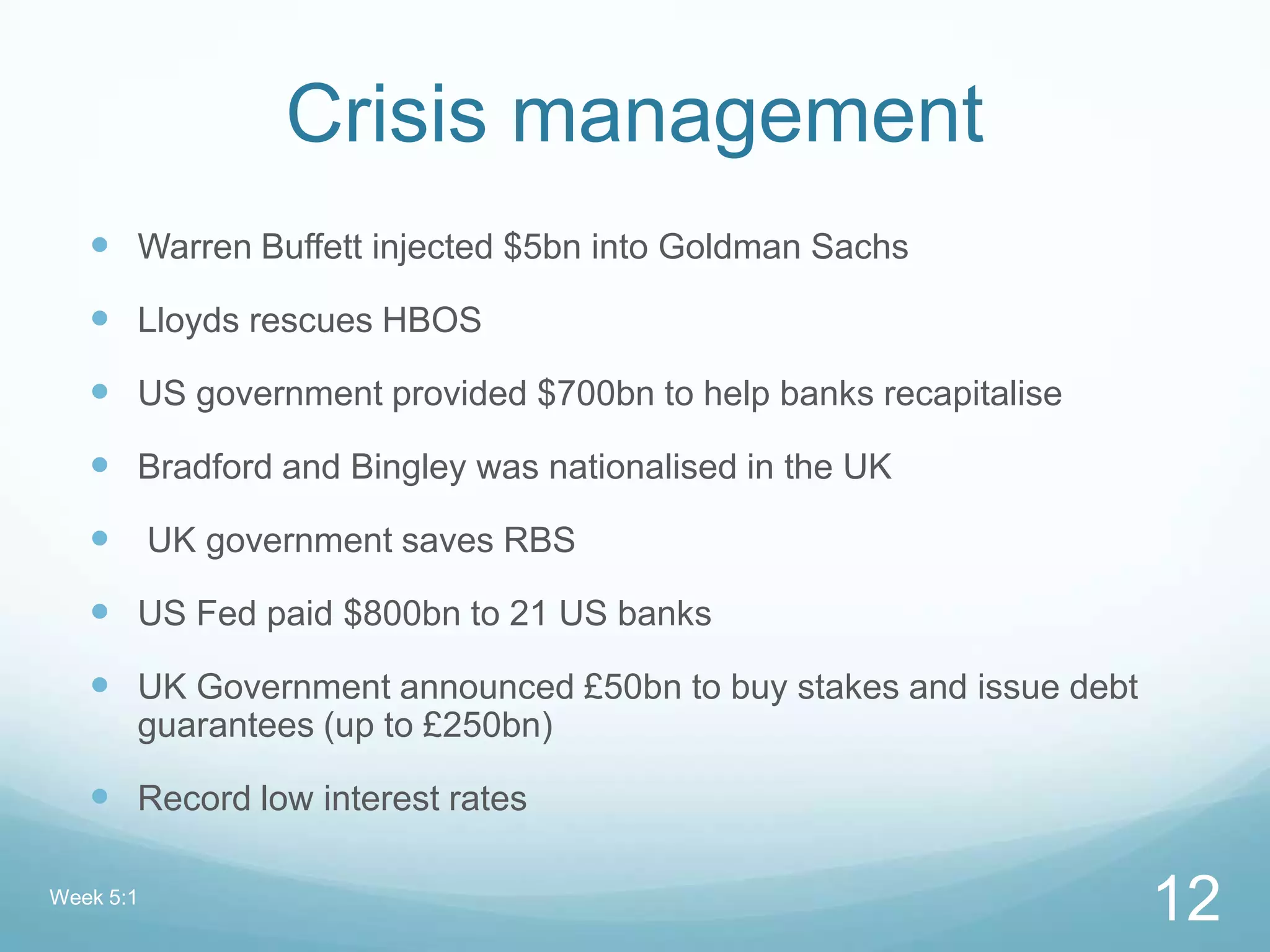
Crisis management
 Warren Buffett injected $5bn into Goldman Sachs
 Lloyds rescues HBOS
 US government provided $700bn to help banks recapitalise
 Bradford and Bingley was nationalised in the UK
 UK government saves RBS
 US Fed paid $800bn to 21 US banks
 UK Government announced £50bn to buy stakes and issue debt
guarantees (up to £250bn)
 Record low interest rates
Week 5:1
12
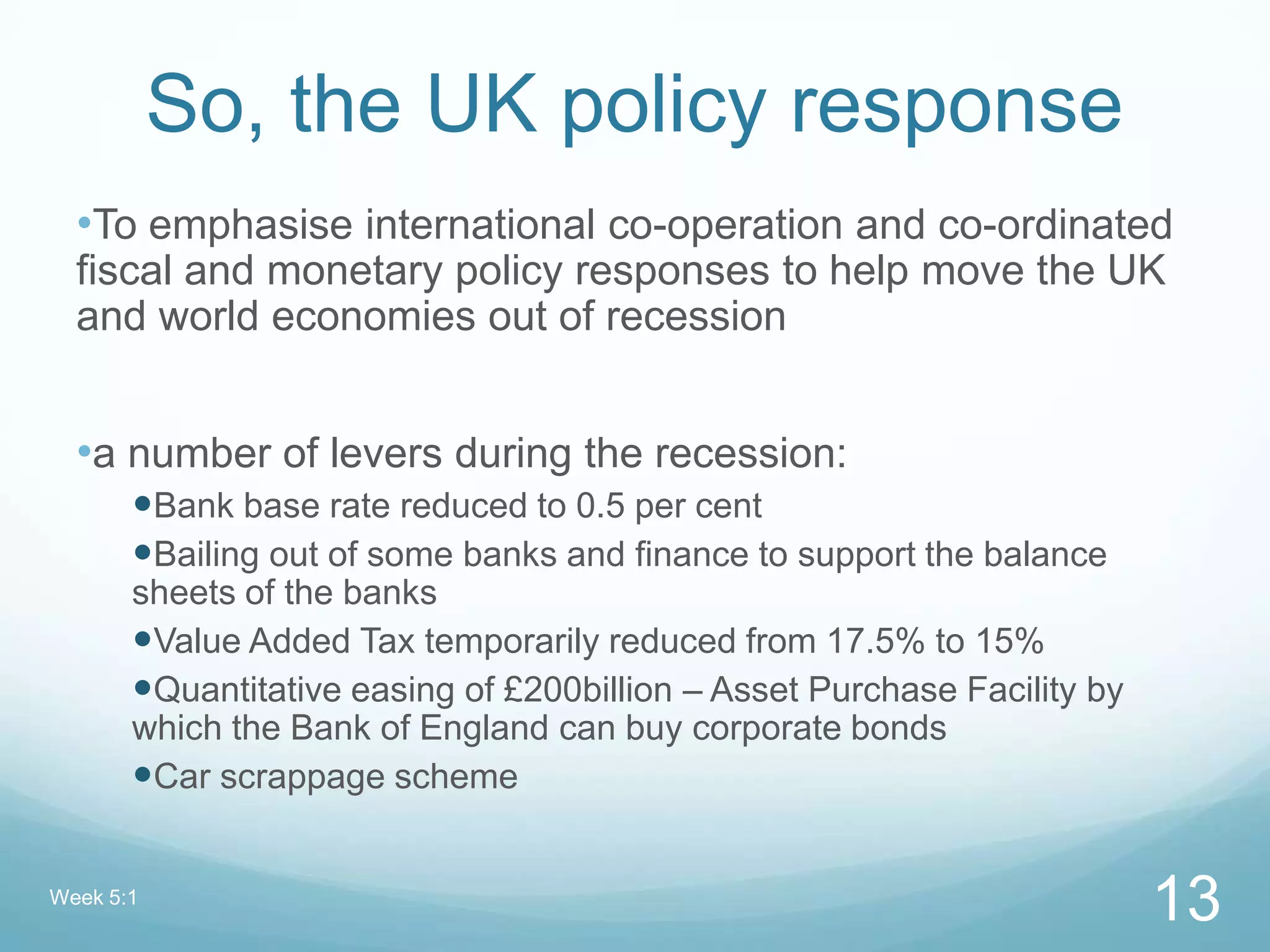
So, the UK policy response
•To emphasise international co-operation and co-ordinated
fiscal and monetary policy responses to help move the UK
and world economies out of recession
•a number of levers during the recession:
Bank base rate reduced to 0.5 per cent
Bailing out of some banks and finance to support the balance
sheets of the banks
Value Added Tax temporarily reduced from 17.5% to 15%
Quantitative easing of £200billion – Asset Purchase Facility by
which the Bank of England can buy corporate bonds
Car scrappage scheme
Week 5:1
13
Into 2009…heading into
double dip…
 But the market is still jittery (Flash crash of the NYSE in
May 2010)
 International organisations meeting to define standards
in banking
 BASEL III
 Contagion means that currencies are suffering
 Euro problems in Ireland, Greece and now Portugal and
Italy…
 Cyprus problems in the news recently
Week 5:1
14
How can we ensure this mistake
doesn‟t happen again?
 Regulate the financial sector more effectively
 Commission a report – the Independent Commission on Banking
 Sir John Vickers
 Report published in September 2011
 recommendations on ring-fencing domestic retail banking, 1/6th to
1/3rd of banking assets to be within the ring-fence
 Competition in banking sector needs to be improved
 “Future of Finance”, 2010
 Report by LSE stars – Adair Turner, Andy Haldane and lots of
others
 Highlights that central banks and governments should shoulder
some of the responsibility for the failure – argue as yet, this hasn‟t
happened
Week 5:1
15
Management of the financial
system
 Increasingly understood that the financial system had
changed beyond recognition from the 1980s
 Many banking investments were obscured, bordering
on illegal (Barclays fined £500m by the UK treasury)
Week 5:1
16
Why are banks regulated in the
first place?
 Goodhart (2010)
 Market failures:
 Monopoly control
 Asymmetric information
 Externalities (social costs to bankruptcies)
Week 5:1
17
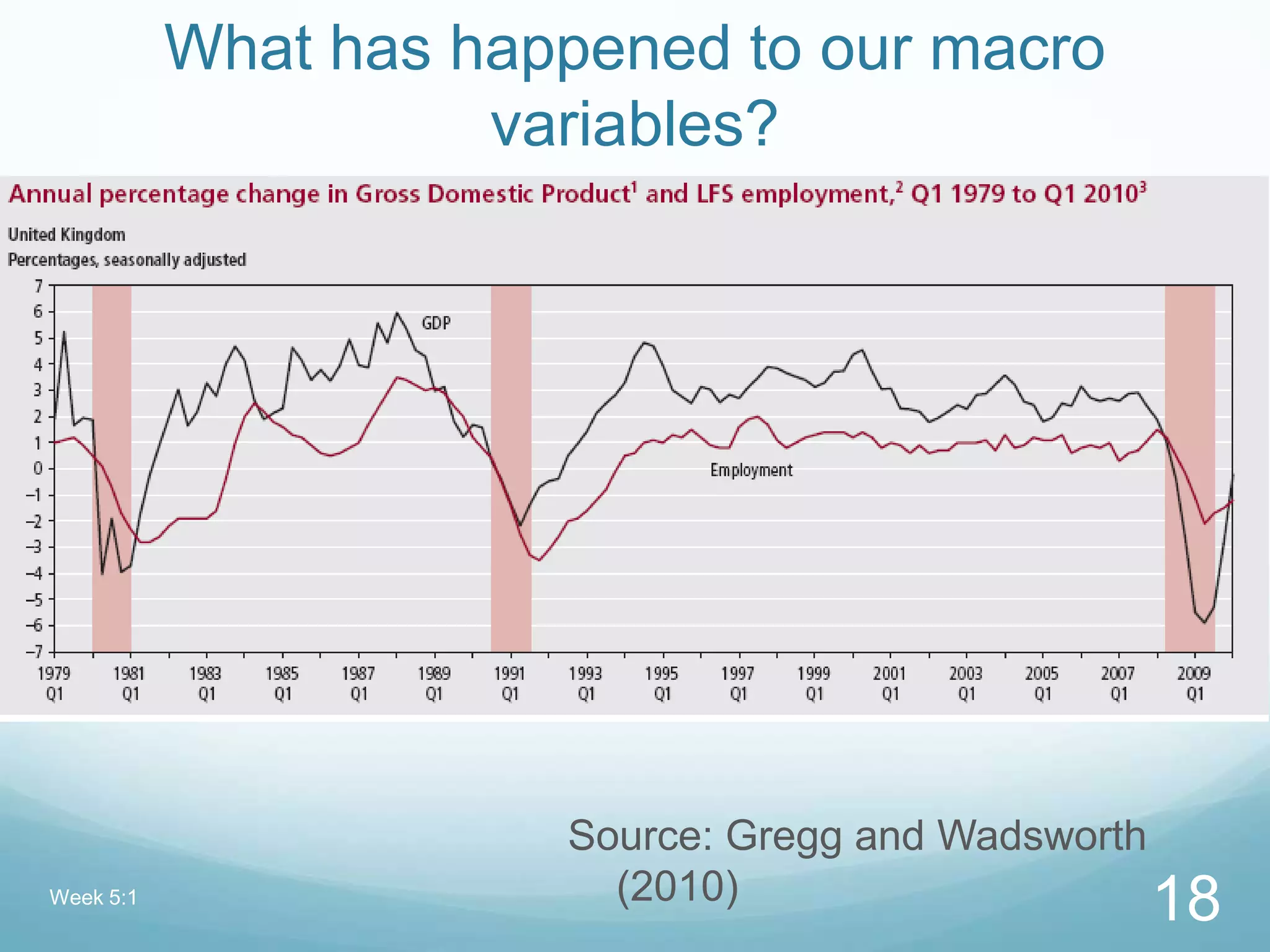
What has happened to our macro
variables?
Source: Gregg and Wadsworth
(2010)Week 5:1
18
International variations
• Gregg and Wadsworth (2010) group countries into 5
categories on the basis of changes in the GDP and
unemployment over the recession:
 Those with small falls in employment relative to GDP (UK
and Sweden)
 Those with small falls in employment relative to
GDP, having introduced employment subsides
(Italy, Germany, Netherlands and Japan)
 Those with similar employment and GDP falls (France)
 Those with larger employment falls than GDP (US, Spain
and Ireland)
 Those with little fall in GDP (Australia)
Week 5:1
19
Why did the UK labour market hold
up?
Employers entered the recession in fairly good financial shape
Able to absorb some of the downturn without shedding jobs
 Total hours worked have fallen sharply and the share of part-timers
risen
 Workers accepted nominal wage moderation early on in the
recession
increased chances of finding work if they are made redundant
• The impact on productivity (and international competitiveness) and
public finances has been large; hence the cuts
Week 5:1
20
Cost of crisis
 The level of debt in most Western Economies is a
direct result of bank bailouts
 Severe recession
 Bank of England policy of “quantitative easing”
 Exchange rate system in Europe under threat
 Greece most obviously
 Irish IMF loan and the austerity measures
 Italy, Spain and Portugal also under pressure
Week 5:1
21
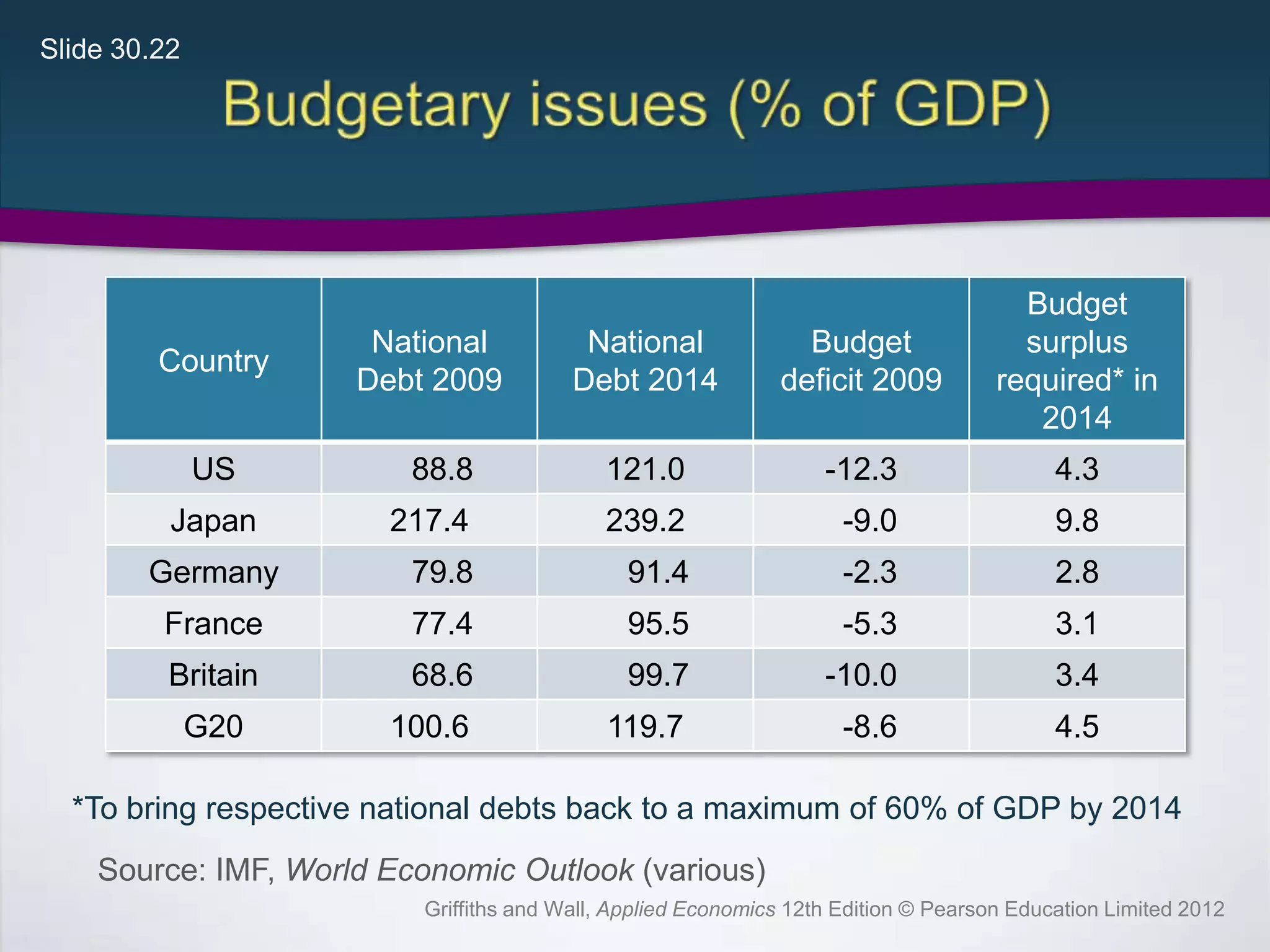
Slide 30.22
Griffiths and Wall, Applied Economics 12th Edition © Pearson Education Limited 2012
Country
National
Debt 2009
National
Debt 2014
Budget
deficit 2009
Budget
surplus
required* in
2014
US 88.8 121.0 -12.3 4.3
Japan 217.4 239.2 -9.0 9.8
Germany 79.8 91.4 -2.3 2.8
France 77.4 95.5 -5.3 3.1
Britain 68.6 99.7 -10.0 3.4
G20 100.6 119.7 -8.6 4.5
*To bring respective national debts back to a maximum of 60% of GDP by 2014
Source: IMF, World Economic Outlook (various)
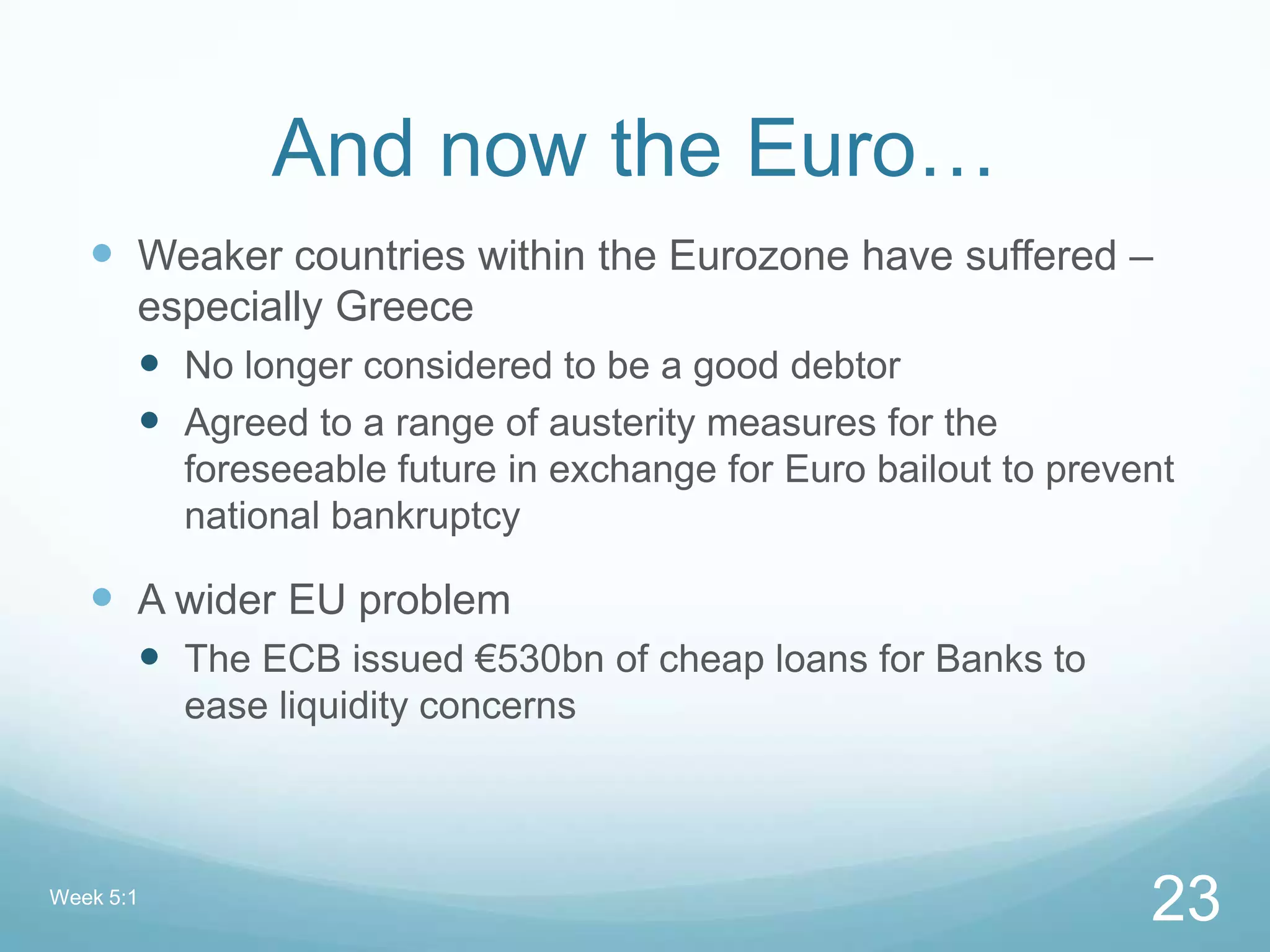
And now the Euro…
 Weaker countries within the Eurozone have suffered –
especially Greece
 No longer considered to be a good debtor
 Agreed to a range of austerity measures for the
foreseeable future in exchange for Euro bailout to prevent
national bankruptcy
 A wider EU problem
 The ECB issued €530bn of cheap loans for Banks to
ease liquidity concerns
Week 5:1
23
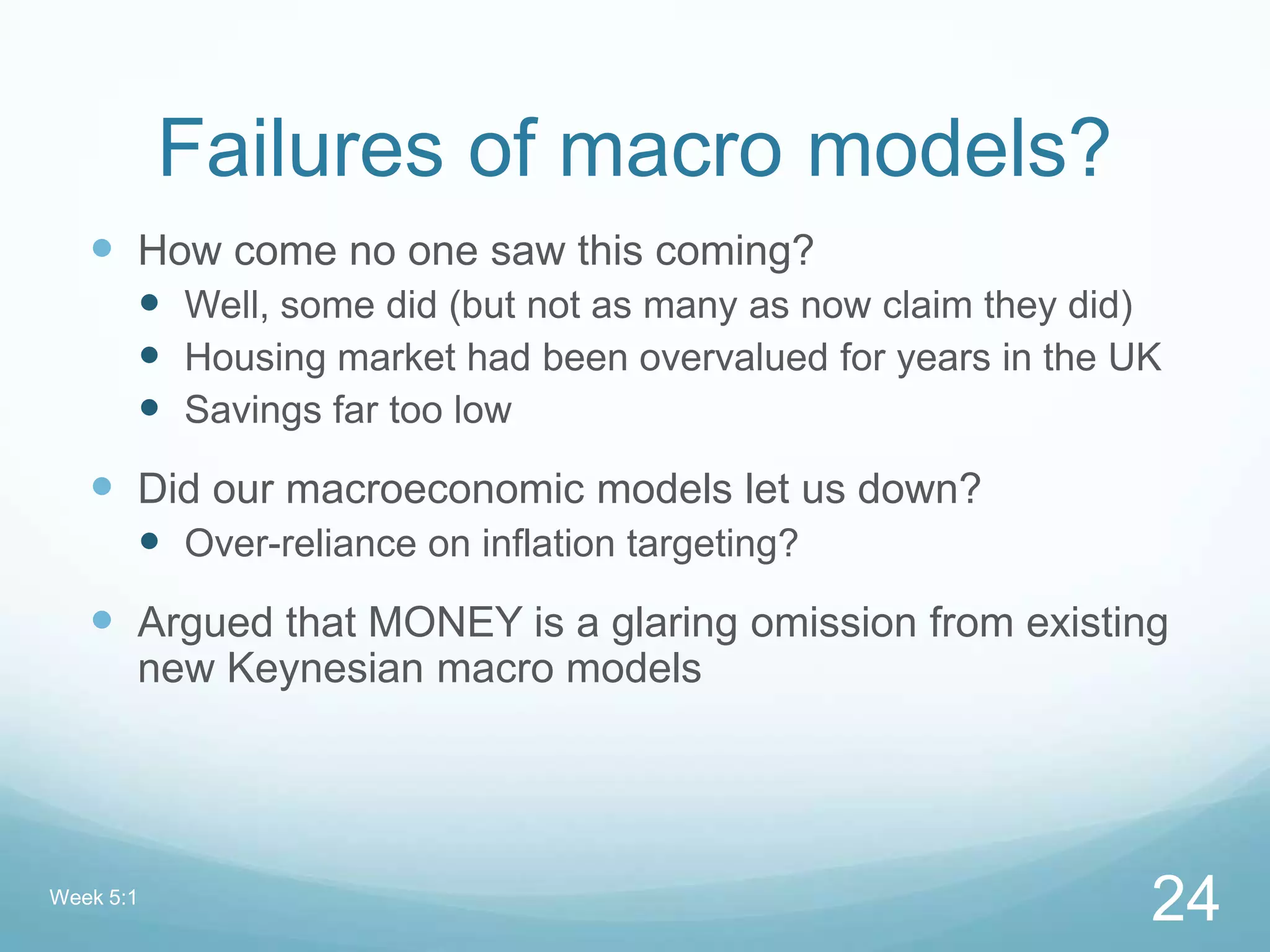
Failures of macro models?
 How come no one saw this coming?
 Well, some did (but not as many as now claim they did)
 Housing market had been overvalued for years in the UK
 Savings far too low
 Did our macroeconomic models let us down?
 Over-reliance on inflation targeting?
 Argued that MONEY is a glaring omission from existing
new Keynesian macro models
Week 5:1
24
There will be other
mistakes…
 Macroeconomic models will not cover all eventualities
 Abstractions from the real world
 Simplifications
 BUT still powerful tools
 A new focus on risk?
 The role of credit ratings are also under scrutiny
Week 5:1
25
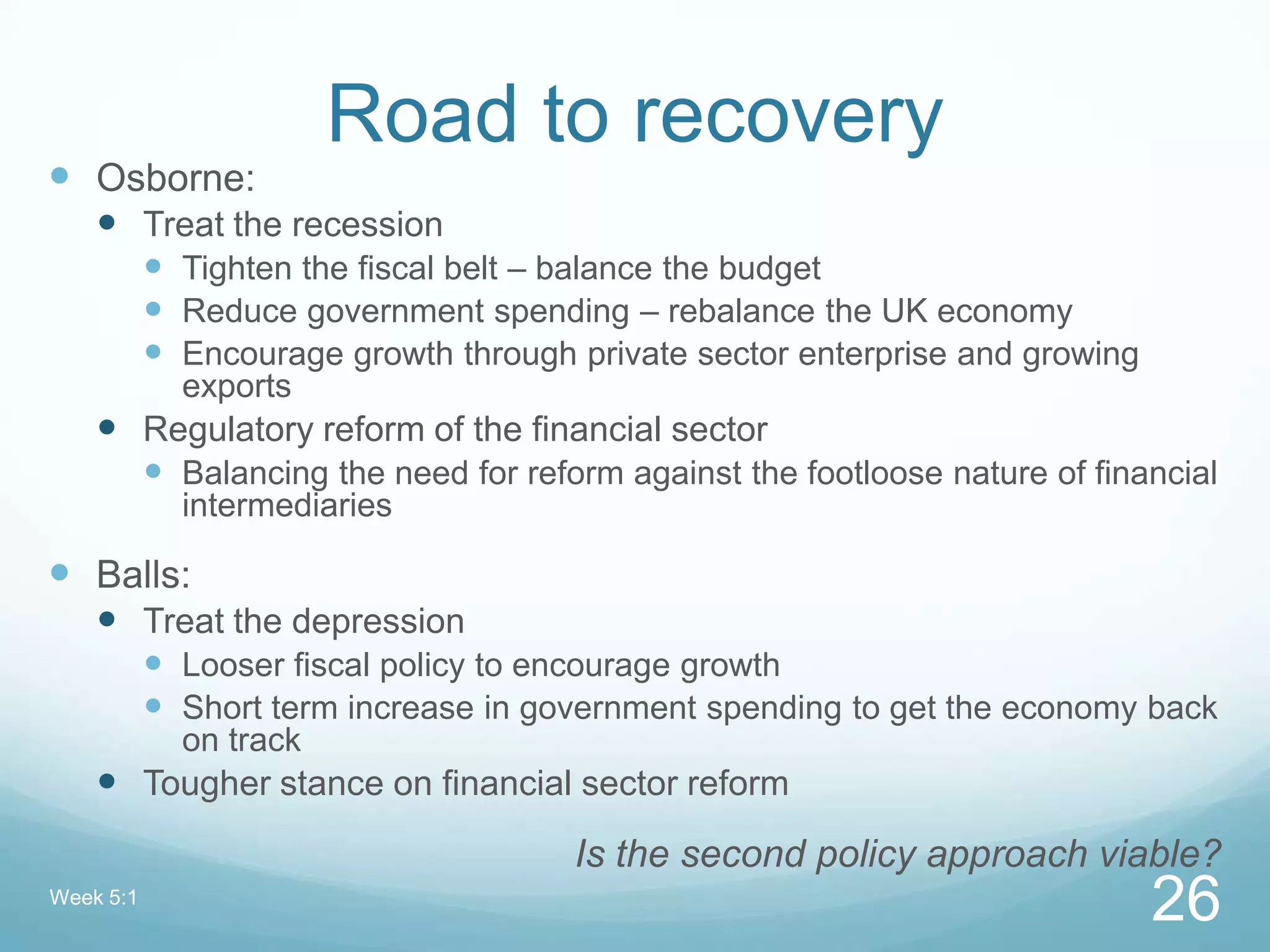
Road to recovery
 Osborne:
 Treat the recession
 Tighten the fiscal belt – balance the budget
 Reduce government spending – rebalance the UK economy
 Encourage growth through private sector enterprise and growing
exports
 Regulatory reform of the financial sector
 Balancing the need for reform against the footloose nature of financial
intermediaries
 Balls:
 Treat the depression
 Looser fiscal policy to encourage growth
 Short term increase in government spending to get the economy back
on track
 Tougher stance on financial sector reform
Is the second policy approach viable?
Week 5:1
26
References
 Griffiths and Wall (2012) Applied Economics, Chapter 30 for the basics
 Crafts and Fearon (2010) ‘Lessons from the 1930s Great Depression’, Oxford
Review of Economic Policy, 26(3), 285-317
 Drinkwater, Blackaby and Murphy (2011) ‘The Welsh Labour Market
Following the Great Recession’, WISERD Policy Brief
 A play by Julian Gough: goat futures explains the housing bubble
 For up to date information, have a look at the Economist blog:
 http://www.economist.com/blogs/blighty
 Deeper understanding in the current debates going on:
 Finance for the Future, LSE Report of 2010, available at
http://www.financeforthefuture.org.uk.
 This is really tough stuff though, so just read the summary!
Week 5:1
27

Ec 111 week 5(2)

  • 1.
    EC-111 British Economy RecentUK Macroeconomic Trends Dr Catherine Robinson F26, Richard Price Building Office Hours: Mondays 10.30-11.30 and Thursdays 9.30-10.30 Appointments: c.robinson@swansea.ac.uk
  • 2.
    Outline for thisweek‟s lectures…  Macro policy and the financial crisis  What caused the financial meltdown of 2007?  What were the consequences?  How to recover from the global recession?  Does this mean that existing macro models were inadequate?  Is the triple-dip recession likely? (TODAY WE FIND OUT)  Note the global nature of this week  In part a result of the problem  Also, increased globalisation means the UK cannot be looked at in isolation Week 5:1 2
  • 3.
    What is arecession?  2 consecutive quarters of negative GDP growth  Caused by monetary policy being too tight  Policy response: loosen monetary policy  Lower interest rates  A DEPRESSION on the other hand:  A decline in real GDP that is greater than 10%  A recession that lasts more than 3 years  An asset/credit bubble bursting  Credit contraction followed by decline in price levels  Policy response:  Fiscal stimulus to encourage spending; infrastructure projects Week 5:1 3
  • 4.
    The Financial Crisisof 2007  The economic slow down began in 2006..and in the US  Relatively high risk borrowers in the US lost their jobs  Unable to pay their high monthly repayments  Interest rates were rising too because of the slowdown  Increased number of defaults led to concern about the „sub-prime‟ market for loans  “The mother of all housing bubbles” (Krugman 2009) Week 5:1 4
  • 5.
    Contagion  By 2010,house prices (and share prices) in the US had fallen by 29% from their peak in 2007  Reducing economic growth  Caused a big drop in UK inter-bank lending, with knock-on effects on other sectors such as manufacturing  Contagion  as there was more and more scrutiny on the lending practices of financial intermediaries Week 5:1 5
  • 6.
    Causes: Financial „innovations‟  TheBig Bang led to deregulation…  Deregulation of the financial sector led to innovations in products:  Short selling  Over the counter derivatives  Securitisation  Proprietary trading  Speculation  SHADOW BANKING Week 5:1 6
  • 7.
    Structured Investment Vehicles (SIVs) innovative ways to package debts  In such a way as to obscure the risks associated by creating a portfolio of liabilities  some of which were the sub-prime mortgages  Some of which were short term debts (with comparatively little risk) Week 5:1 7
  • 8.
    Slide 30.8 Griffiths andWall, Applied Economics 12th Edition © Pearson Education Limited 2012 ABS other, 2.2% Student loans, 4.4% RMBS (Residential mortgage backed securities) , 23.2% Other, 3.3%Financial debt, 42.6% Credit cards, 5% CMBS (Commercial mortgage backed securities), 6.1% CDO, 11.4% Auto loans, 1.1% Sector composition
  • 9.
    Realisation – followedby PANIC!  Early 2007:  saw 4 mortgage providers in the US file for bankruptcy  Reported that sub-prime lenders were 5 times more likely to incur defaults  Bear Sterns lost 90% of its sub-prime loans and filed for bankruptcy  August to November 2007:  More banks collapsed BNP PARIBUS froze investment funds  $300bn is pumped into the global system to maintain liquidity  Northern Rock collapses  Poor financial announcements in the US  Freddie Mac and Fannie Mae announce record losses Week 5:1 9
  • 10.
    And the badnews continued…2008  Further write-downs and losses announced, interest rates slashed to record low levels  Northern Rock nationalised  In July in the US Indy Mac Bank collapses, the second largest bank failure ever  Lehman Brothers attempts to sell 50% of its shares to south Korea or China. Fails. In September enters bankruptcy, the largest in USA history  In the same month US Government takes control of Freddie Mac and Fanny Mae  Merrill Lynch, Bank of America, Bear Sterns and Lehmann Brothers have all by now ceased to trade Week 5:1 10
  • 11.
    Bank Bailout  Eventsunfolded in such a way as to the extent to which various banks were exposed to the sub-prime market via these SIVs  Market sentiment ruled – investors panicked  Required de-leveraging; savings required to pay some debts  For the first time since Victoria‟s reign, there was a run on a UK bank  Freddie Mac and Fannie Mae in the US were the initial lenders  Northern Rock in the UK  But all banks had some degree of exposure  Bank Bailout  Problem was, banks were so big, it wasn‟t always possible for countries to save them  Aggressive, orchestrated policy required by US, UK and EU. Week 5:1 11
  • 12.
    Crisis management  WarrenBuffett injected $5bn into Goldman Sachs  Lloyds rescues HBOS  US government provided $700bn to help banks recapitalise  Bradford and Bingley was nationalised in the UK  UK government saves RBS  US Fed paid $800bn to 21 US banks  UK Government announced £50bn to buy stakes and issue debt guarantees (up to £250bn)  Record low interest rates Week 5:1 12
  • 13.
    So, the UKpolicy response •To emphasise international co-operation and co-ordinated fiscal and monetary policy responses to help move the UK and world economies out of recession •a number of levers during the recession: Bank base rate reduced to 0.5 per cent Bailing out of some banks and finance to support the balance sheets of the banks Value Added Tax temporarily reduced from 17.5% to 15% Quantitative easing of £200billion – Asset Purchase Facility by which the Bank of England can buy corporate bonds Car scrappage scheme Week 5:1 13
  • 14.
    Into 2009…heading into doubledip…  But the market is still jittery (Flash crash of the NYSE in May 2010)  International organisations meeting to define standards in banking  BASEL III  Contagion means that currencies are suffering  Euro problems in Ireland, Greece and now Portugal and Italy…  Cyprus problems in the news recently Week 5:1 14
  • 15.
    How can weensure this mistake doesn‟t happen again?  Regulate the financial sector more effectively  Commission a report – the Independent Commission on Banking  Sir John Vickers  Report published in September 2011  recommendations on ring-fencing domestic retail banking, 1/6th to 1/3rd of banking assets to be within the ring-fence  Competition in banking sector needs to be improved  “Future of Finance”, 2010  Report by LSE stars – Adair Turner, Andy Haldane and lots of others  Highlights that central banks and governments should shoulder some of the responsibility for the failure – argue as yet, this hasn‟t happened Week 5:1 15
  • 16.
    Management of thefinancial system  Increasingly understood that the financial system had changed beyond recognition from the 1980s  Many banking investments were obscured, bordering on illegal (Barclays fined £500m by the UK treasury) Week 5:1 16
  • 17.
    Why are banksregulated in the first place?  Goodhart (2010)  Market failures:  Monopoly control  Asymmetric information  Externalities (social costs to bankruptcies) Week 5:1 17
  • 18.
    What has happenedto our macro variables? Source: Gregg and Wadsworth (2010)Week 5:1 18
  • 19.
    International variations • Greggand Wadsworth (2010) group countries into 5 categories on the basis of changes in the GDP and unemployment over the recession:  Those with small falls in employment relative to GDP (UK and Sweden)  Those with small falls in employment relative to GDP, having introduced employment subsides (Italy, Germany, Netherlands and Japan)  Those with similar employment and GDP falls (France)  Those with larger employment falls than GDP (US, Spain and Ireland)  Those with little fall in GDP (Australia) Week 5:1 19
  • 20.
    Why did theUK labour market hold up? Employers entered the recession in fairly good financial shape Able to absorb some of the downturn without shedding jobs  Total hours worked have fallen sharply and the share of part-timers risen  Workers accepted nominal wage moderation early on in the recession increased chances of finding work if they are made redundant • The impact on productivity (and international competitiveness) and public finances has been large; hence the cuts Week 5:1 20
  • 21.
    Cost of crisis The level of debt in most Western Economies is a direct result of bank bailouts  Severe recession  Bank of England policy of “quantitative easing”  Exchange rate system in Europe under threat  Greece most obviously  Irish IMF loan and the austerity measures  Italy, Spain and Portugal also under pressure Week 5:1 21
  • 22.
    Slide 30.22 Griffiths andWall, Applied Economics 12th Edition © Pearson Education Limited 2012 Country National Debt 2009 National Debt 2014 Budget deficit 2009 Budget surplus required* in 2014 US 88.8 121.0 -12.3 4.3 Japan 217.4 239.2 -9.0 9.8 Germany 79.8 91.4 -2.3 2.8 France 77.4 95.5 -5.3 3.1 Britain 68.6 99.7 -10.0 3.4 G20 100.6 119.7 -8.6 4.5 *To bring respective national debts back to a maximum of 60% of GDP by 2014 Source: IMF, World Economic Outlook (various)
  • 23.
    And now theEuro…  Weaker countries within the Eurozone have suffered – especially Greece  No longer considered to be a good debtor  Agreed to a range of austerity measures for the foreseeable future in exchange for Euro bailout to prevent national bankruptcy  A wider EU problem  The ECB issued €530bn of cheap loans for Banks to ease liquidity concerns Week 5:1 23
  • 24.
    Failures of macromodels?  How come no one saw this coming?  Well, some did (but not as many as now claim they did)  Housing market had been overvalued for years in the UK  Savings far too low  Did our macroeconomic models let us down?  Over-reliance on inflation targeting?  Argued that MONEY is a glaring omission from existing new Keynesian macro models Week 5:1 24
  • 25.
    There will beother mistakes…  Macroeconomic models will not cover all eventualities  Abstractions from the real world  Simplifications  BUT still powerful tools  A new focus on risk?  The role of credit ratings are also under scrutiny Week 5:1 25
  • 26.
    Road to recovery Osborne:  Treat the recession  Tighten the fiscal belt – balance the budget  Reduce government spending – rebalance the UK economy  Encourage growth through private sector enterprise and growing exports  Regulatory reform of the financial sector  Balancing the need for reform against the footloose nature of financial intermediaries  Balls:  Treat the depression  Looser fiscal policy to encourage growth  Short term increase in government spending to get the economy back on track  Tougher stance on financial sector reform Is the second policy approach viable? Week 5:1 26
  • 27.
    References  Griffiths andWall (2012) Applied Economics, Chapter 30 for the basics  Crafts and Fearon (2010) ‘Lessons from the 1930s Great Depression’, Oxford Review of Economic Policy, 26(3), 285-317  Drinkwater, Blackaby and Murphy (2011) ‘The Welsh Labour Market Following the Great Recession’, WISERD Policy Brief  A play by Julian Gough: goat futures explains the housing bubble  For up to date information, have a look at the Economist blog:  http://www.economist.com/blogs/blighty  Deeper understanding in the current debates going on:  Finance for the Future, LSE Report of 2010, available at http://www.financeforthefuture.org.uk.  This is really tough stuff though, so just read the summary! Week 5:1 27