THE EUROPEAN UNION

 CONVERGENCE REGIONAL
       FUNDING
MORE GROWTH AND JOBS FOR
   ALL CITIES OF THE EU

DISTRIBUTION OF EU FUNDING AND HOW
THE LESS PROSPEROUS AREAS OF THE EU
 MIGHT MANIPULATE THE FUNDING TO
          THEIR ADVANTAGE
      BY PIANOS GERALD MANJERA
Outline
• What is the convergence regional funding?
• Aims of the CRF
• First group to benefit and how the funds were
  distributed and the changes towards the targeted
  areas. (overview)
• Case study: Ireland
• Effectiveness of the EU funding(overview)
• Case study: Ireland
What is convergence regional
       funding?(CRF)
• A component of regional policy set up to help transfer
  resources form the rich to the poor areas of the EU
  community.
• In fact it was set up to help those regions in the EU
  whose development was lagging behind.
• The CRF was set up so as to help in the solidarity of the
  EU as it targeted to benefit citizens and areas which are
  economically and socially disadvantaged as against the
  EU averages.
• 10 major dynamic areas of the EU were marked by a
  level of affluence, with GDP almost thrice higher than the
  least, i.e. London, Brussels and Hamburg.
• The EU regions are classified on financial support
  producing three tupes of regions(objectives)
Aims of the CRF
• Aimed at the objective 1
• Under the structural funding, the CRF
  aimed at the following:
  –   Develop infrastructure such as transport and energy.
  –   Aid regions affected by industrial decline
  –   Support the development of rural areas
  –   Extent telecommunication services
  –   Provide training for workers
  –   Combat long term unemployment
  –   Disseminate the tools of know-how and information society
  – Promote research and development.
Changing distribution
•    There have been four programming periods for EU
    structural funds.
     1989-1993
     1994-1999
     2000-2006
     2007-2013
• Spending is determined by member state
  executives
Distribution
1989-1993
•A period in which the structural funds were first distributed all in the name of cohesion policy.
•In this particular CP aimed at reducing disparities between the various regions and the backwardness of
the least-favored regions.”
•Under this period, provision was made to special cases were the member state could influence the
outcome: commission`s ceiling of 15% was exceeded by 1.8% adding 6.3 million people.
•Direct financial transfers to the ‘poor four’ (Greece, Ireland, Portugal and Spain)
1994-1999
•There was more emphasis on the role of the member states to proposes areas eligible.
•This led to other regions above qualifying threshold becoming eligible for support.
•Objective 1 extended its cover to regions of Hainaut, Merseyside, Highlands and Islands, Cantabria,
Flevoland and Abruzzi.(table)
2000-2006
•The move of the EU was towards the simplification of the cohesion policy.
•10 new members(May 2004) entered the EC and all were rightfully deemed eligible into the structural
funding.
•E.g. Cyprus, Czech republic, Estonia, Hungary, Latvia, Lithuania, Malta, Poland, Slovakia, Slovenia.
•The Commission has tried to keep the priority on lagging regions with a per capita GDP less than 75 %
in comparison with the EU average.
•Resulted in the highest concentration of resources on the poorest countries as it shall be clearly noticed
on the 2007-2013 period.
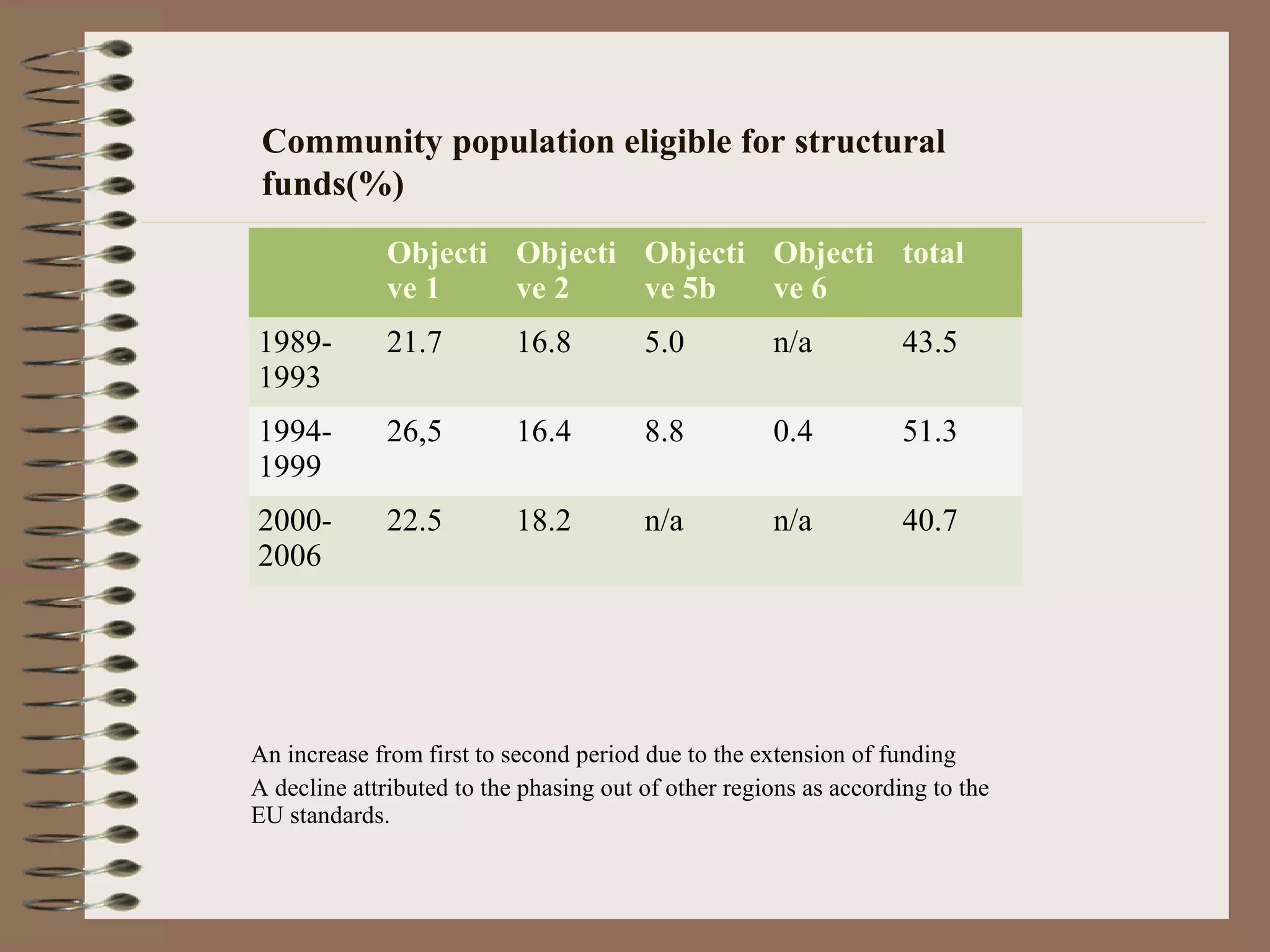
Community population eligible for structural
 funds(%)
             Objecti Objecti Objecti Objecti total
             ve 1    ve 2    ve 5b   ve 6
1989-        21.7          16.8         5.0          n/a           43.5
1993
1994-        26,5          16.4         8.8          0.4           51.3
1999
2000-        22.5          18.2         n/a          n/a           40.7
2006


An increase from first to second period due to the extension of funding
A decline attributed to the phasing out of other regions as according to the
EU standards.
2007-2013
•   The cohesion policy had new structure of objectives (convergence; regional
    competitiveness and employment; European territorial cooperation)
•   Among the EU-27, the period sought to cover 84 regions( 17 member states): a
    population of 154 million people.
•   Eligibility still open to those regions with less than 75% GDP.
•   They fix the level of allocations between objectives, geographical eligibility and the
    allocation method (by region or Member State), including upper transfer limits
•   In addition, the conclusions define several transitional arrangements (e.g. phasing out
    the Cohesion Fund for certain countries, 16 regions with 16.4 million people),
    exceptions (e.g. eligibility; co-financing), and a list of special treatments (e.g.
    additional financial allocations) of several Member States and regions.
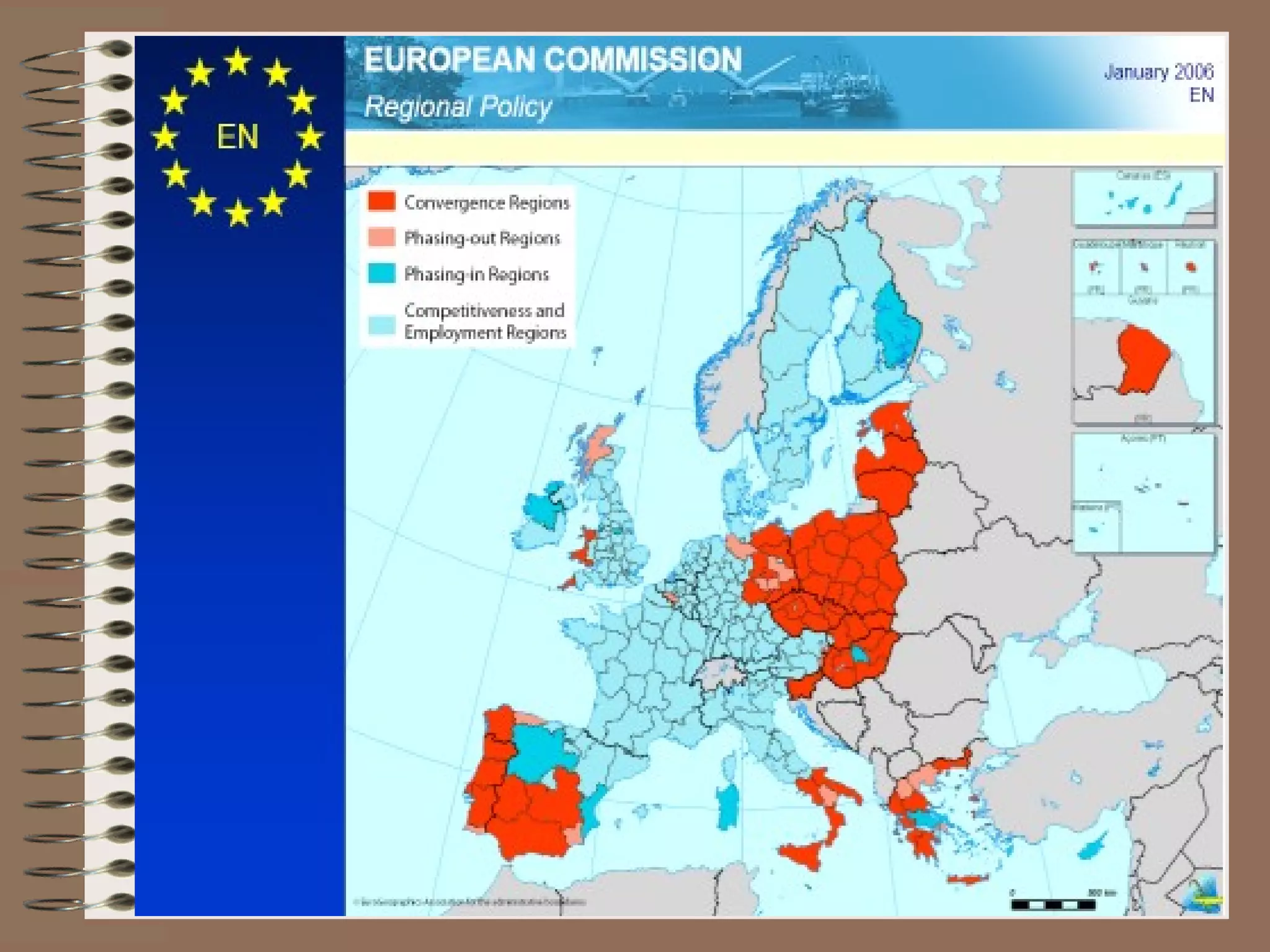
•   Phasing in the cohesion funds to other regions: 13 regions, a population of 19 million
•   Phasing out regions: Asturias, Ceuta, Melilla and Murcia whilst phasing in Canarias,
    Castilla y León and Comunidad Valenciana (Spain), Kentriki Makedonia, Dytiki
    Makedonia whilst
•    Phasing-in: Sterea Ellada, Notio Aigaio(Greece)
2006vs2013 cohesion funding
Case study: Ireland
•   Joined EU in 1973, poorest of the then 12 members
•   Started to avail funds in 1989. and progresses through the four programming periods.
•   1989-1993, 1994-1999, 2000-2006, & 2007-2013
•   Between 1989-1999, Ireland qualified as objective 1 region: got 4.2 billion(1989-
    1993) which accounted for an increase of 2.1% GDP. And 1994-1999 got 7.3 billion
    which accounted for 1.6% GDP.
• During the first decade, its main concern was:
    – Economic convergence
– Raising long-term growth potential
– Addressing labor market imbalance.
• The money was spent on infrastructure(36%), productive sector(35%), human resource
    development(25%) and local development(4%)
2000-2006
• Ineligible for objective 1
• Split into 2 separate for EU
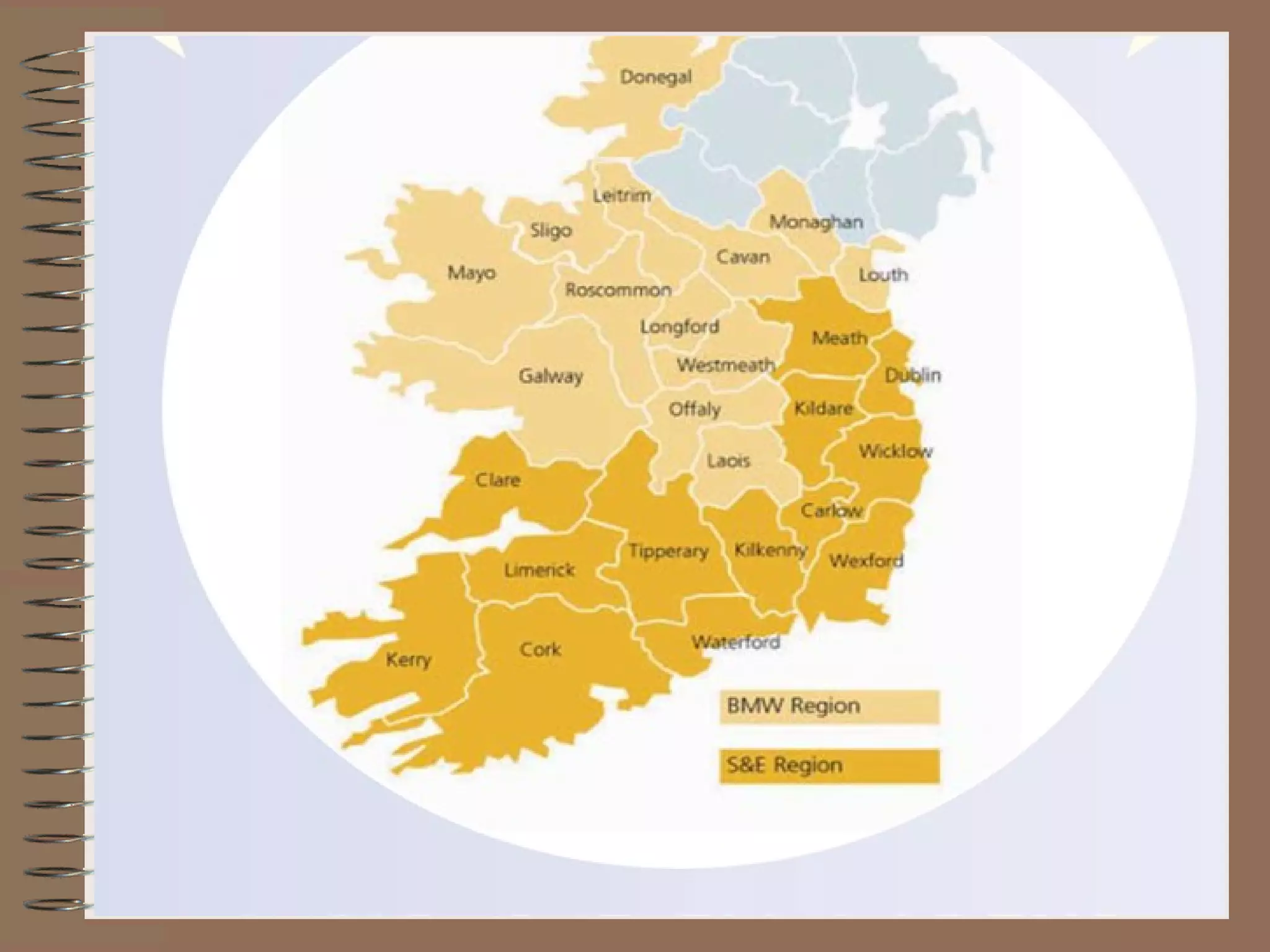
• Purposes Border, Midland and Western Region()BMW Objective 1 Southern and
    Eastern Region(S&E)
Effectiveness of the EU funding


 EU Cohesion Policy can improve the efficiency of national regional policy by ensuring
that:
•spending is concentrated in places where it is most needed;
• EU co-ordination of Member states´ regional policies, through competition policy,
can reduce the scope for costly and inefficient
•competitive outbidding for mobile investments between nations and regions;
• there is a common interest argument that depressed regions benefit nobody and that major
disparities in income and unemployment are unacceptable on social equity grounds; and
• there is dynamic argument that regional disparities may be a barrier to further integration
Success Factors of the Irish Economy


• Social Partnership Agreements industrial stability – National
    Consensus
• European Regional Funding
• Access to EU and Global Markets
• Stable currency and interest rates and inflation
• Inward investment and availability of skilled workforce
• Low rate of Corporation Tax (12.5%)
• Rapid increase in tourist numbers and high cultural interest in Ireland
• Pro-enterprise policies and supports
•   Between 1992-2003 cohesion funding spent 2
                          billion in more than 120 infrastructure projects.
                      •   Last 10 years, 130 Irish projects received
Case study: Ireland       cohesion funds:
                           – Dublin ring road, Bublin-Sligo, Dublin-
                               Limerick, Bublin-Roslaire
                      •   Rural projects included the upgrading of the main
                          rural corridors, cross border routes to Belfast.
                      •   Re0development of Heuston station in Dublin.
                      •   Environmental sector had marked results:
                           – Improved water quality
                           – Improved supply of drinking water
                           – Improvement in quality and conservation
                           – 12 water supply projects were supported.
References

• http://europa.eu.int/comm/regional_policy
• ec.europa.eu/regional policy/cohesion report

• Honohan P., (ed) “EU Structural Funds in
  Ireland: A Midterm Evaluation of the CSF 1994-
  99”, Policy Research Series no. 31, The
  Economic and Social Research Institute, Dublin

Edited version

  • 1.
    THE EUROPEAN UNION CONVERGENCE REGIONAL FUNDING
  • 2.
    MORE GROWTH ANDJOBS FOR ALL CITIES OF THE EU DISTRIBUTION OF EU FUNDING AND HOW THE LESS PROSPEROUS AREAS OF THE EU MIGHT MANIPULATE THE FUNDING TO THEIR ADVANTAGE BY PIANOS GERALD MANJERA
  • 3.
    Outline • What isthe convergence regional funding? • Aims of the CRF • First group to benefit and how the funds were distributed and the changes towards the targeted areas. (overview) • Case study: Ireland • Effectiveness of the EU funding(overview) • Case study: Ireland
  • 4.
    What is convergenceregional funding?(CRF) • A component of regional policy set up to help transfer resources form the rich to the poor areas of the EU community. • In fact it was set up to help those regions in the EU whose development was lagging behind. • The CRF was set up so as to help in the solidarity of the EU as it targeted to benefit citizens and areas which are economically and socially disadvantaged as against the EU averages. • 10 major dynamic areas of the EU were marked by a level of affluence, with GDP almost thrice higher than the least, i.e. London, Brussels and Hamburg. • The EU regions are classified on financial support producing three tupes of regions(objectives)
  • 5.
    Aims of theCRF • Aimed at the objective 1 • Under the structural funding, the CRF aimed at the following: – Develop infrastructure such as transport and energy. – Aid regions affected by industrial decline – Support the development of rural areas – Extent telecommunication services – Provide training for workers – Combat long term unemployment – Disseminate the tools of know-how and information society – Promote research and development.
  • 6.
    Changing distribution • There have been four programming periods for EU structural funds. 1989-1993 1994-1999 2000-2006 2007-2013 • Spending is determined by member state executives
  • 7.
    Distribution 1989-1993 •A period inwhich the structural funds were first distributed all in the name of cohesion policy. •In this particular CP aimed at reducing disparities between the various regions and the backwardness of the least-favored regions.” •Under this period, provision was made to special cases were the member state could influence the outcome: commission`s ceiling of 15% was exceeded by 1.8% adding 6.3 million people. •Direct financial transfers to the ‘poor four’ (Greece, Ireland, Portugal and Spain) 1994-1999 •There was more emphasis on the role of the member states to proposes areas eligible. •This led to other regions above qualifying threshold becoming eligible for support. •Objective 1 extended its cover to regions of Hainaut, Merseyside, Highlands and Islands, Cantabria, Flevoland and Abruzzi.(table) 2000-2006 •The move of the EU was towards the simplification of the cohesion policy. •10 new members(May 2004) entered the EC and all were rightfully deemed eligible into the structural funding. •E.g. Cyprus, Czech republic, Estonia, Hungary, Latvia, Lithuania, Malta, Poland, Slovakia, Slovenia. •The Commission has tried to keep the priority on lagging regions with a per capita GDP less than 75 % in comparison with the EU average. •Resulted in the highest concentration of resources on the poorest countries as it shall be clearly noticed on the 2007-2013 period.
  • 8.
    Community population eligiblefor structural funds(%) Objecti Objecti Objecti Objecti total ve 1 ve 2 ve 5b ve 6 1989- 21.7 16.8 5.0 n/a 43.5 1993 1994- 26,5 16.4 8.8 0.4 51.3 1999 2000- 22.5 18.2 n/a n/a 40.7 2006 An increase from first to second period due to the extension of funding A decline attributed to the phasing out of other regions as according to the EU standards.
  • 9.
    2007-2013 • The cohesion policy had new structure of objectives (convergence; regional competitiveness and employment; European territorial cooperation) • Among the EU-27, the period sought to cover 84 regions( 17 member states): a population of 154 million people. • Eligibility still open to those regions with less than 75% GDP. • They fix the level of allocations between objectives, geographical eligibility and the allocation method (by region or Member State), including upper transfer limits • In addition, the conclusions define several transitional arrangements (e.g. phasing out the Cohesion Fund for certain countries, 16 regions with 16.4 million people), exceptions (e.g. eligibility; co-financing), and a list of special treatments (e.g. additional financial allocations) of several Member States and regions. • Phasing in the cohesion funds to other regions: 13 regions, a population of 19 million • Phasing out regions: Asturias, Ceuta, Melilla and Murcia whilst phasing in Canarias, Castilla y León and Comunidad Valenciana (Spain), Kentriki Makedonia, Dytiki Makedonia whilst • Phasing-in: Sterea Ellada, Notio Aigaio(Greece)
  • 10.
  • 12.
    Case study: Ireland • Joined EU in 1973, poorest of the then 12 members • Started to avail funds in 1989. and progresses through the four programming periods. • 1989-1993, 1994-1999, 2000-2006, & 2007-2013 • Between 1989-1999, Ireland qualified as objective 1 region: got 4.2 billion(1989- 1993) which accounted for an increase of 2.1% GDP. And 1994-1999 got 7.3 billion which accounted for 1.6% GDP. • During the first decade, its main concern was: – Economic convergence – Raising long-term growth potential – Addressing labor market imbalance. • The money was spent on infrastructure(36%), productive sector(35%), human resource development(25%) and local development(4%) 2000-2006 • Ineligible for objective 1 • Split into 2 separate for EU • Purposes Border, Midland and Western Region()BMW Objective 1 Southern and Eastern Region(S&E)
  • 14.
    Effectiveness of theEU funding EU Cohesion Policy can improve the efficiency of national regional policy by ensuring that: •spending is concentrated in places where it is most needed; • EU co-ordination of Member states´ regional policies, through competition policy, can reduce the scope for costly and inefficient •competitive outbidding for mobile investments between nations and regions; • there is a common interest argument that depressed regions benefit nobody and that major disparities in income and unemployment are unacceptable on social equity grounds; and • there is dynamic argument that regional disparities may be a barrier to further integration
  • 15.
    Success Factors ofthe Irish Economy • Social Partnership Agreements industrial stability – National Consensus • European Regional Funding • Access to EU and Global Markets • Stable currency and interest rates and inflation • Inward investment and availability of skilled workforce • Low rate of Corporation Tax (12.5%) • Rapid increase in tourist numbers and high cultural interest in Ireland • Pro-enterprise policies and supports
  • 16.
    Between 1992-2003 cohesion funding spent 2 billion in more than 120 infrastructure projects. • Last 10 years, 130 Irish projects received Case study: Ireland cohesion funds: – Dublin ring road, Bublin-Sligo, Dublin- Limerick, Bublin-Roslaire • Rural projects included the upgrading of the main rural corridors, cross border routes to Belfast. • Re0development of Heuston station in Dublin. • Environmental sector had marked results: – Improved water quality – Improved supply of drinking water – Improvement in quality and conservation – 12 water supply projects were supported.
  • 17.
    References • http://europa.eu.int/comm/regional_policy • ec.europa.eu/regionalpolicy/cohesion report • Honohan P., (ed) “EU Structural Funds in Ireland: A Midterm Evaluation of the CSF 1994- 99”, Policy Research Series no. 31, The Economic and Social Research Institute, Dublin