EC-111: British Economy
Recent Macro Economic
Policy and Trends
Dr Catherine Robinson
F35, Richard Price
Office hours: Monday 10.30-11.30 and Thursday 9.30-10.30
Appointments: c.robinson@swansea.ac.uk
Week 1:1 1
Introduction
 Aim of this section of the course
 Outline key texts and structure of the next 5 weeks
 Defining the macro-economy
 What variables are we looking at?
 Assessment:
 2 hour written examination at the end of semester 2 (45%) 5
questions in total – split between me and John’s regional
topic
 I’ll go over some pointers in the last week
Week 1:1
2
Aim of the course
 To provide an understanding of the macroeconomic
fortunes of the UK in the post war period
 Discuss some policies
 ideological influences
 Identifying different schools of economic thought
 Bit of economic history, but bringing it up to date with the
financial crisis and the ‘great recession’
 Show you some data on UK performance
 But not just about the UK – need to look at it in context
 Empirically driven – not too much theory, but designed to
put your theory into (a UK) context
Week 1:1
3
Attendance
1. Click 1 on your keypad and hold it down until a
appears.
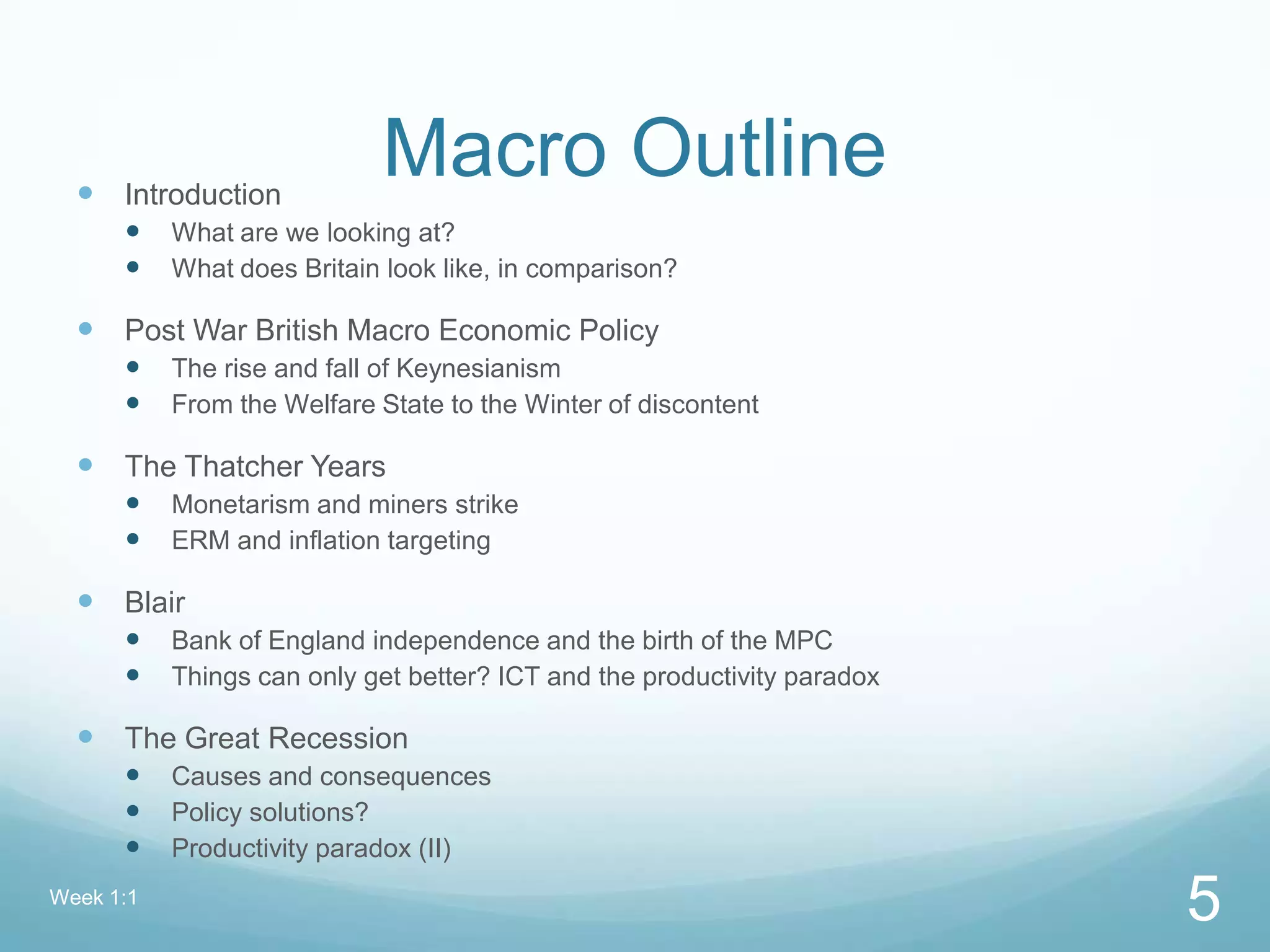
Macro Outline Introduction
 What are we looking at?
 What does Britain look like, in comparison?
 Post War British Macro Economic Policy
 The rise and fall of Keynesianism
 From the Welfare State to the Winter of discontent
 The Thatcher Years
 Monetarism and miners strike
 ERM and inflation targeting
 Blair
 Bank of England independence and the birth of the MPC
 Things can only get better? ICT and the productivity paradox
 The Great Recession
 Causes and consequences
 Policy solutions?
 Productivity paradox (II)
Week 1:1
5
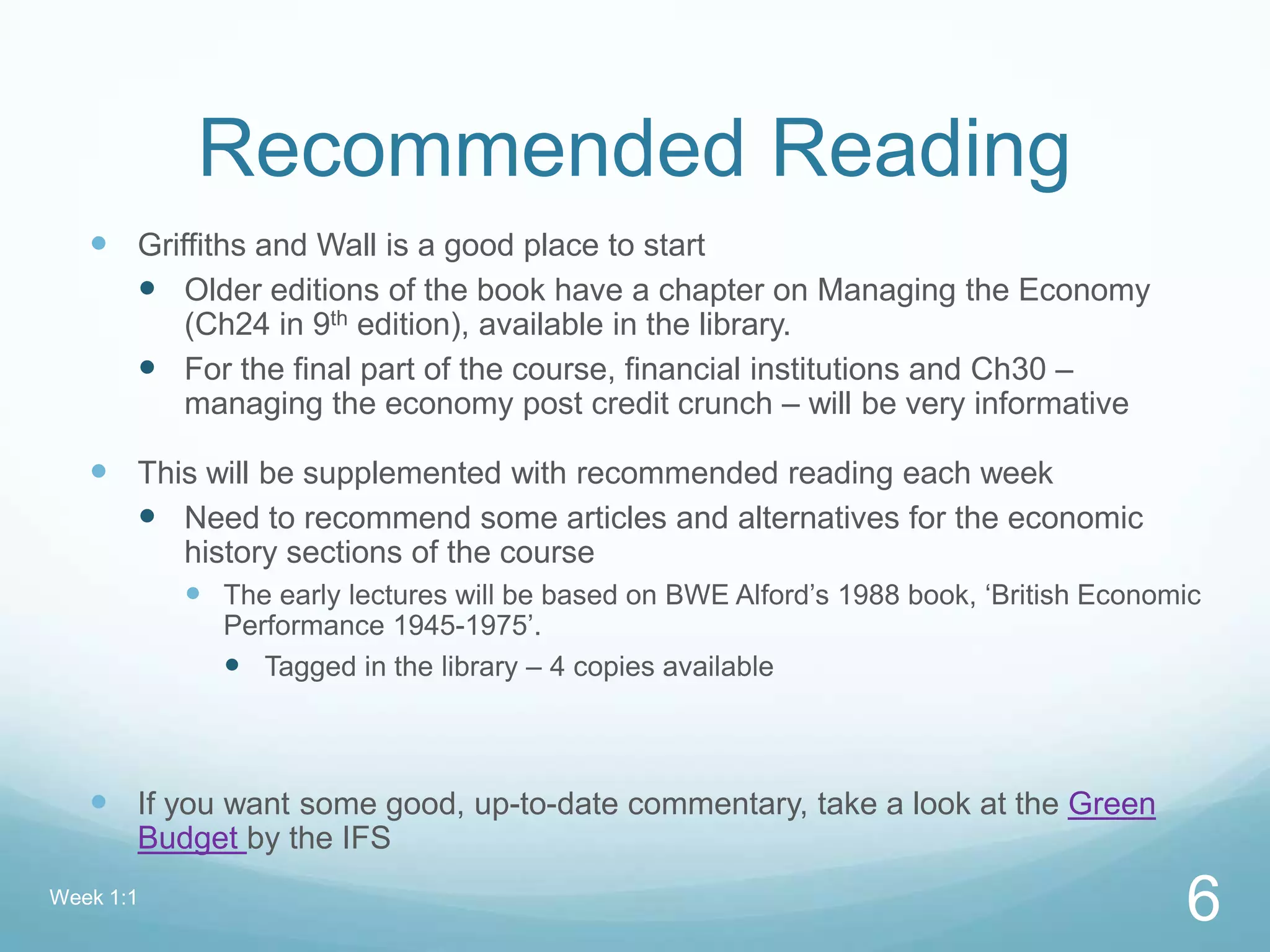
Recommended Reading
 Griffiths and Wall is a good place to start
 Older editions of the book have a chapter on Managing the Economy
(Ch24 in 9th edition), available in the library.
 For the final part of the course, financial institutions and Ch30 –
managing the economy post credit crunch – will be very informative
 This will be supplemented with recommended reading each week
 Need to recommend some articles and alternatives for the economic
history sections of the course
 The early lectures will be based on BWE Alford’s 1988 book, ‘British Economic
Performance 1945-1975’.
 Tagged in the library – 4 copies available
 If you want some good, up-to-date commentary, take a look at the Green
Budget by the IFS
Week 1:1
6
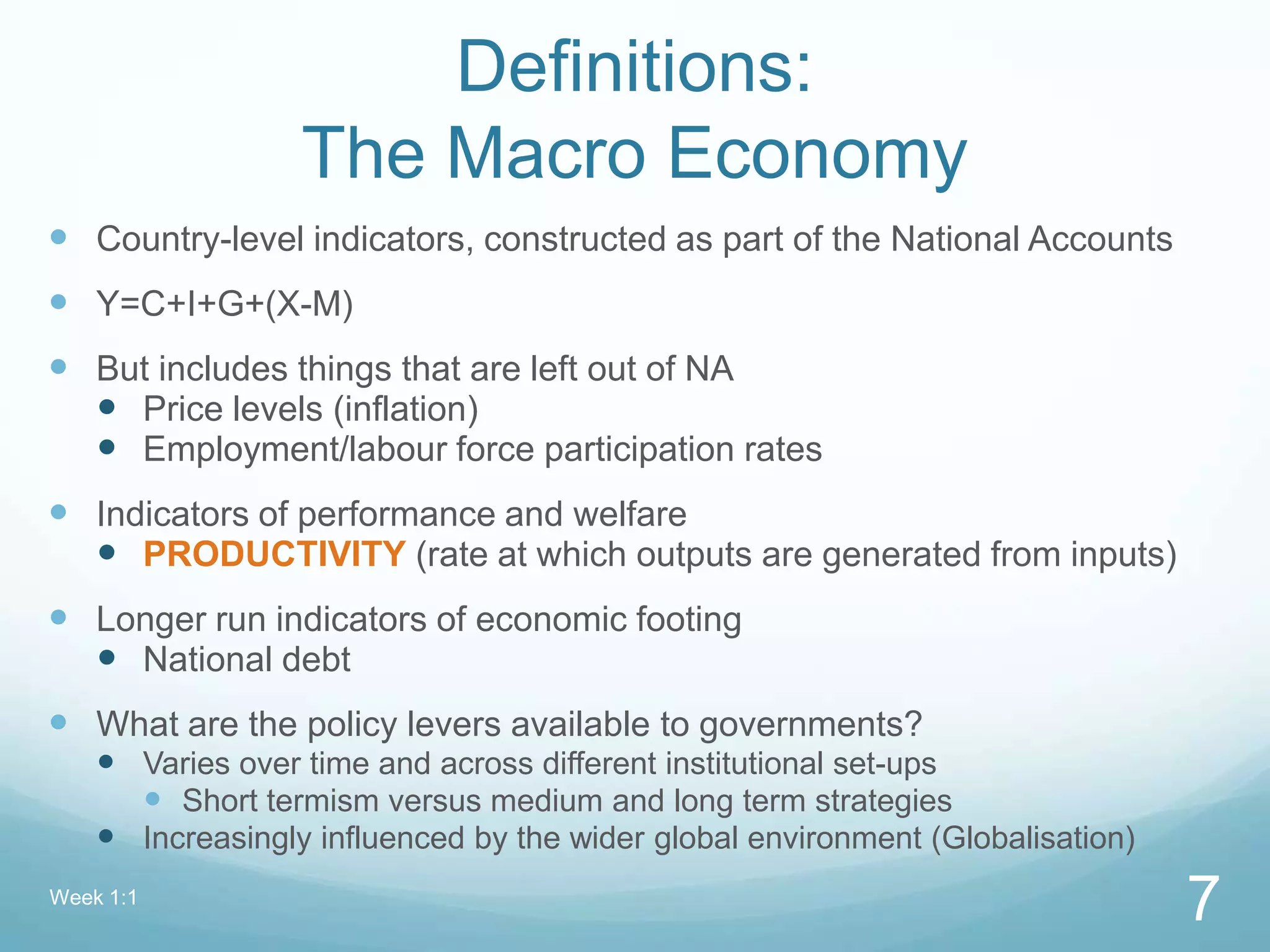
Definitions:
The Macro Economy
 Country-level indicators, constructed as part of the National Accounts
 Y=C+I+G+(X-M)
 But includes things that are left out of NA
 Price levels (inflation)
 Employment/labour force participation rates
 Indicators of performance and welfare
 PRODUCTIVITY (rate at which outputs are generated from inputs)
 Longer run indicators of economic footing
 National debt
 What are the policy levers available to governments?
 Varies over time and across different institutional set-ups
 Short termism versus medium and long term strategies
 Increasingly influenced by the wider global environment (Globalisation)
Week 1:1
7
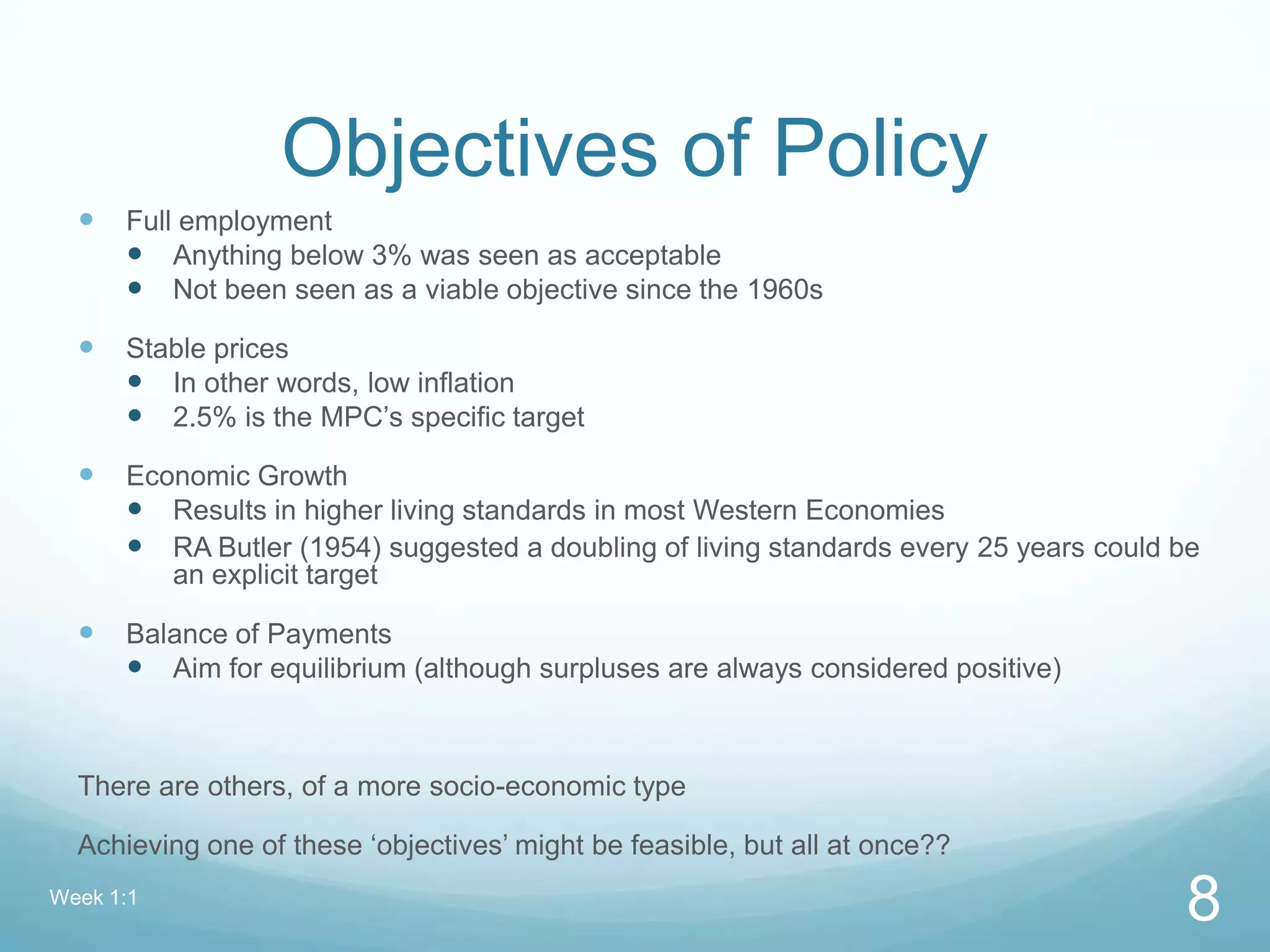
Objectives of Policy
 Full employment
 Anything below 3% was seen as acceptable
 Not been seen as a viable objective since the 1960s
 Stable prices
 In other words, low inflation
 2.5% is the MPC’s specific target
 Economic Growth
 Results in higher living standards in most Western Economies
 RA Butler (1954) suggested a doubling of living standards every 25 years could be
an explicit target
 Balance of Payments
 Aim for equilibrium (although surpluses are always considered positive)
There are others, of a more socio-economic type
Achieving one of these ‘objectives’ might be feasible, but all at once??
Week 1:1
8
Instruments of policy
 Why isn’t this the equilibrium situation?
 Market Failure rationale
 Almost all government subsidies/industrial support have to
reason with the Treasury that the market has in some way
‘failed’ before they can intervene
 How do governments go about it?
 Policy instruments:
 Fiscal policy
 Monetary policy
 Prices and incomes policy
 Exchange rate or import controls
Week 1:1
9
Fiscal Policy
 Taxation and government spending
 Aim is to affect the composition and the level of
Aggregate Demand in the economy
 Addresses redistribution of wealth – sort of…
 Higher taxes and lower spending is likely to lower AD
 Conversely – lower tax and higher spending should
encourage AD
 Concerns about the Public Sector Borrowing Deficit (the
PSBR) <<more next week>>
Week 1:1
10
Monetary Policy
 The interest rate
 Affects the cost of borrowing
 And the returns to lending
 both long and short term investment decisions
 Leads consumers to change their behaviour also
 Low rates of interest offer little incentive to save
 Affects the balance of payments also
 Capital flows between countries
 Money Supply
 Monetarists versus Keynesians
 Monetarists see MS as affecting prices
 Keynesians see its impact on output and employment
 These two are linked, clearly….
 expansionary or contractionary strategy will typically use the two together
Week 1:1
11
Prices and Incomes Policy
 Direct attempts to control inflation
 EG public Sector pay freeze
 Regarded as irrelevant to monetarists
 But an important tool in periods of expansion to
Keynesians
 Not been extensively used since 1979 although limits on
public sector spending have in effect constrained wages
Week 1:1
12
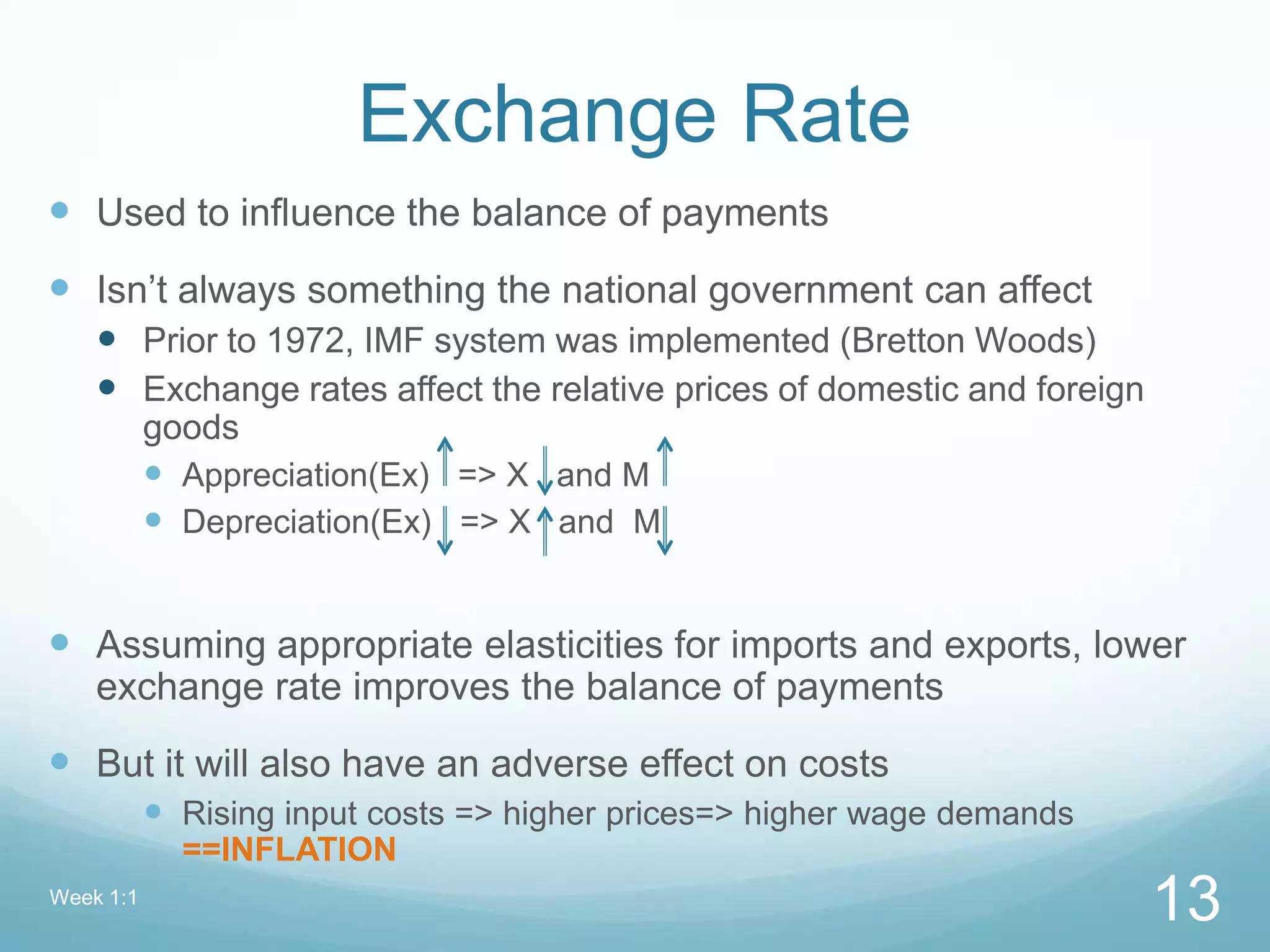
Exchange Rate
 Used to influence the balance of payments
 Isn’t always something the national government can affect
 Prior to 1972, IMF system was implemented (Bretton Woods)
 Exchange rates affect the relative prices of domestic and foreign
goods
 Appreciation(Ex) => X and M
 Depreciation(Ex) => X and M
 Assuming appropriate elasticities for imports and exports, lower
exchange rate improves the balance of payments
 But it will also have an adverse effect on costs
 Rising input costs => higher prices=> higher wage demands
==INFLATION
Week 1:1
13
Import Controls
 Not used much in the UK as a policy instrument
 In fact, membership of EU (and its commitment to the
freedom of movement of goods and services) and long-
standing Commonwealth links, trade has been
relatively unhindered by government intervention for
decades (excluding WWII)
 The UK does participate in GATT (general agreement
on tariff & trade) reductions for goods that have
traditionally carried a levy
Week 1:1
14
There are trade-offs
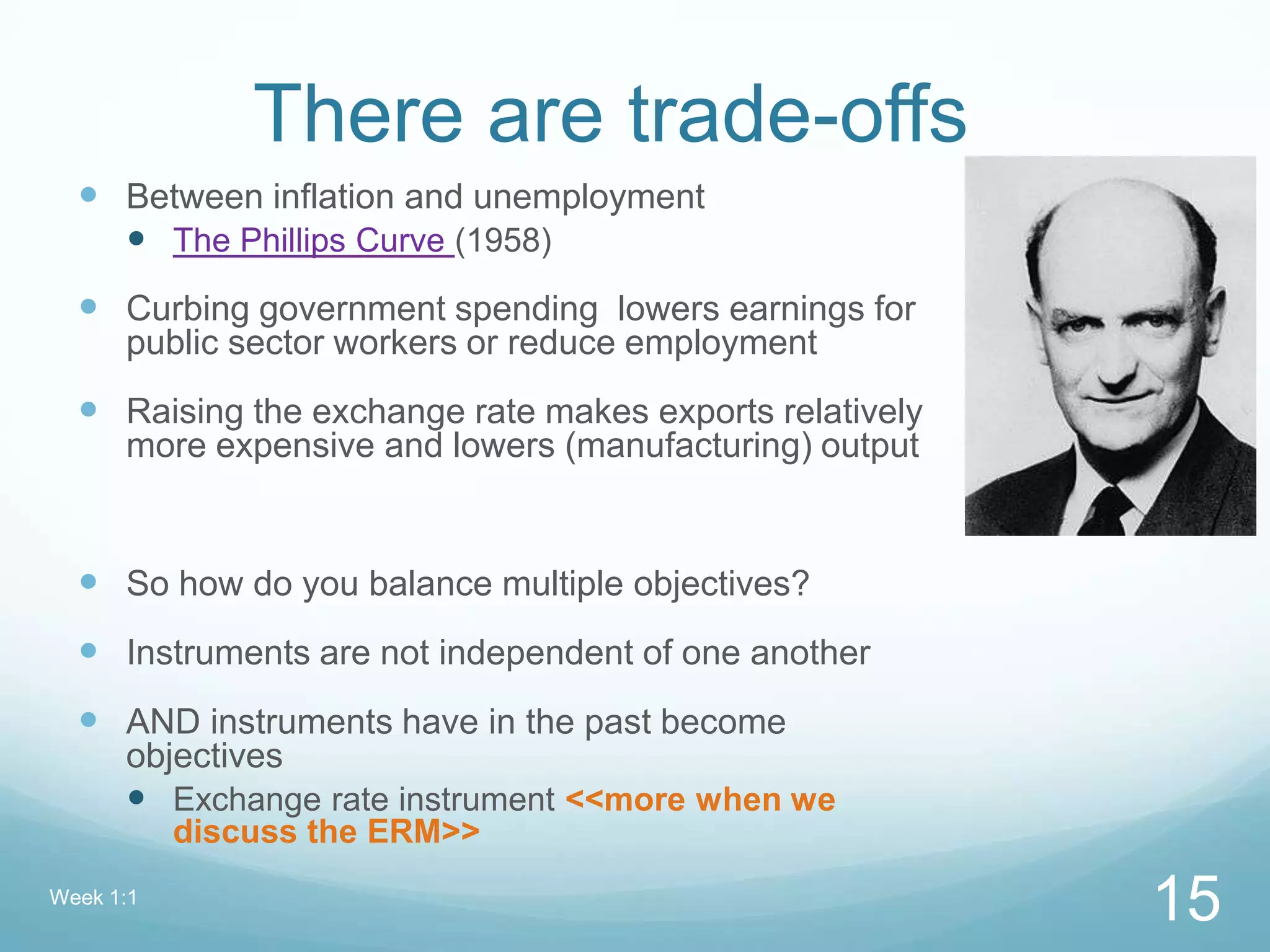
 Between inflation and unemployment
 The Phillips Curve (1958)
 Curbing government spending lowers earnings for
public sector workers or reduce employment
 Raising the exchange rate makes exports relatively
more expensive and lowers (manufacturing) output
 So how do you balance multiple objectives?
 Instruments are not independent of one another
 AND instruments have in the past become
objectives
 Exchange rate instrument <<more when we
discuss the ERM>>
Week 1:1
15
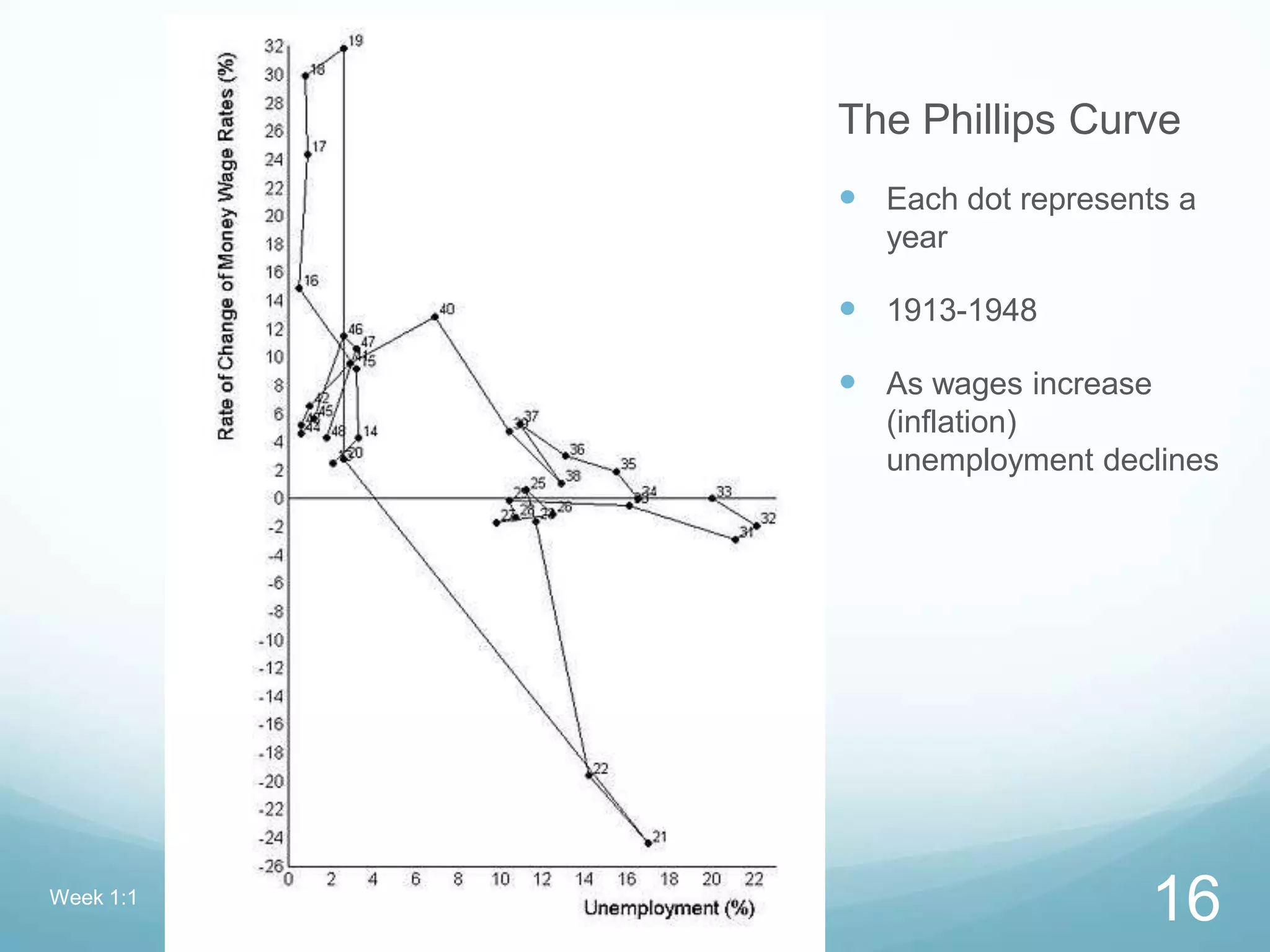
The Phillips Curve
 Each dot represents a
year
 1913-1948
 As wages increase
(inflation)
unemployment declines
Week 1:1
16
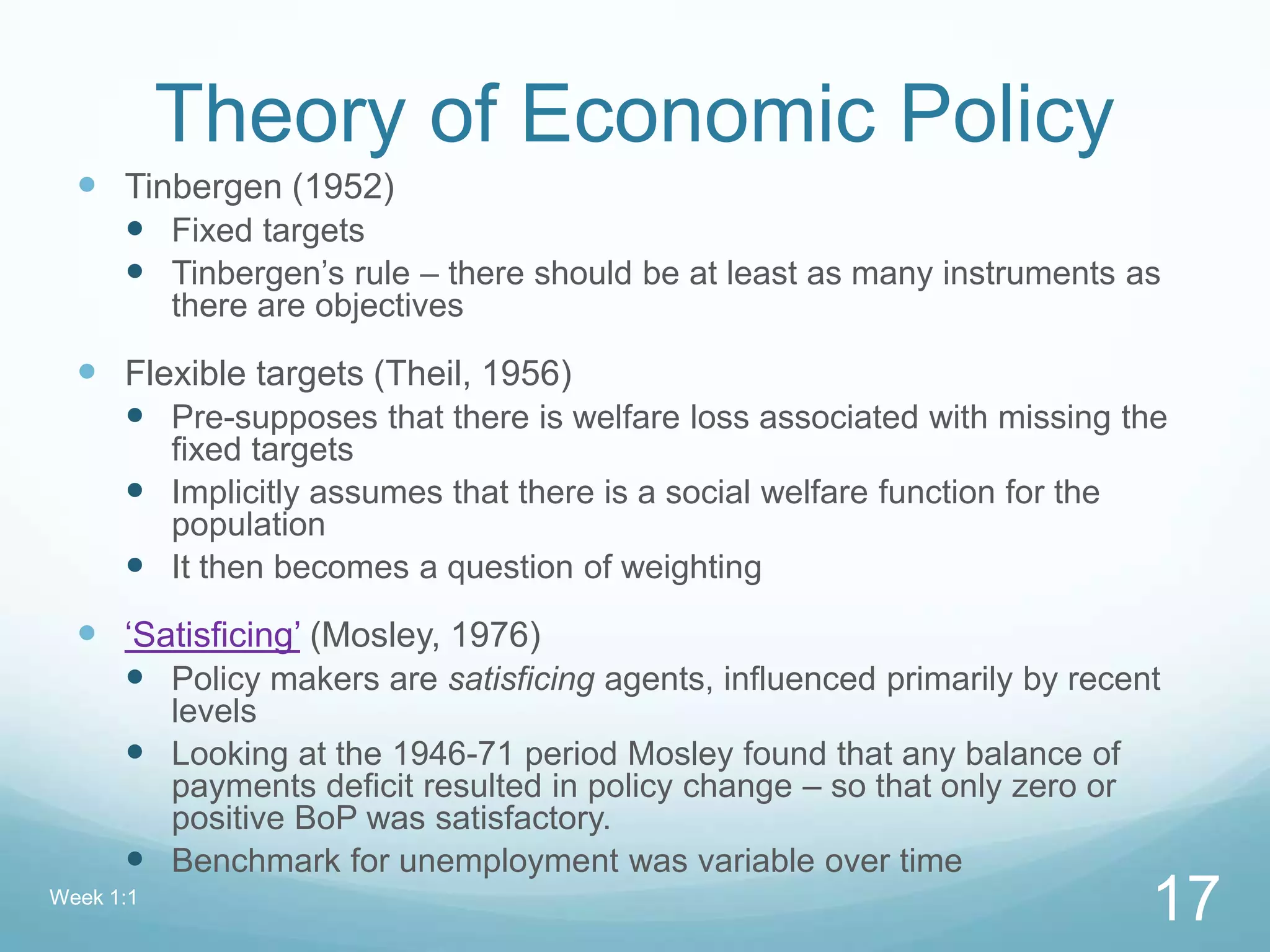
Theory of Economic Policy
 Tinbergen (1952)
 Fixed targets
 Tinbergen’s rule – there should be at least as many instruments as
there are objectives
 Flexible targets (Theil, 1956)
 Pre-supposes that there is welfare loss associated with missing the
fixed targets
 Implicitly assumes that there is a social welfare function for the
population
 It then becomes a question of weighting
 ‘Satisficing’ (Mosley, 1976)
 Policy makers are satisficing agents, influenced primarily by recent
levels
 Looking at the 1946-71 period Mosley found that any balance of
payments deficit resulted in policy change – so that only zero or
positive BoP was satisfactory.
 Benchmark for unemployment was variable over time
Week 1:1
17
Which of these definitions best
describes the term ‘satisficing’?
18
1. Bureaucratic organisations
maximise profits
2. Bureaucratic organisations
continually strive for the best
possible outcomes
3. Bureaucratic organisations
react only when welfare
reaches an unsatisfactory
level
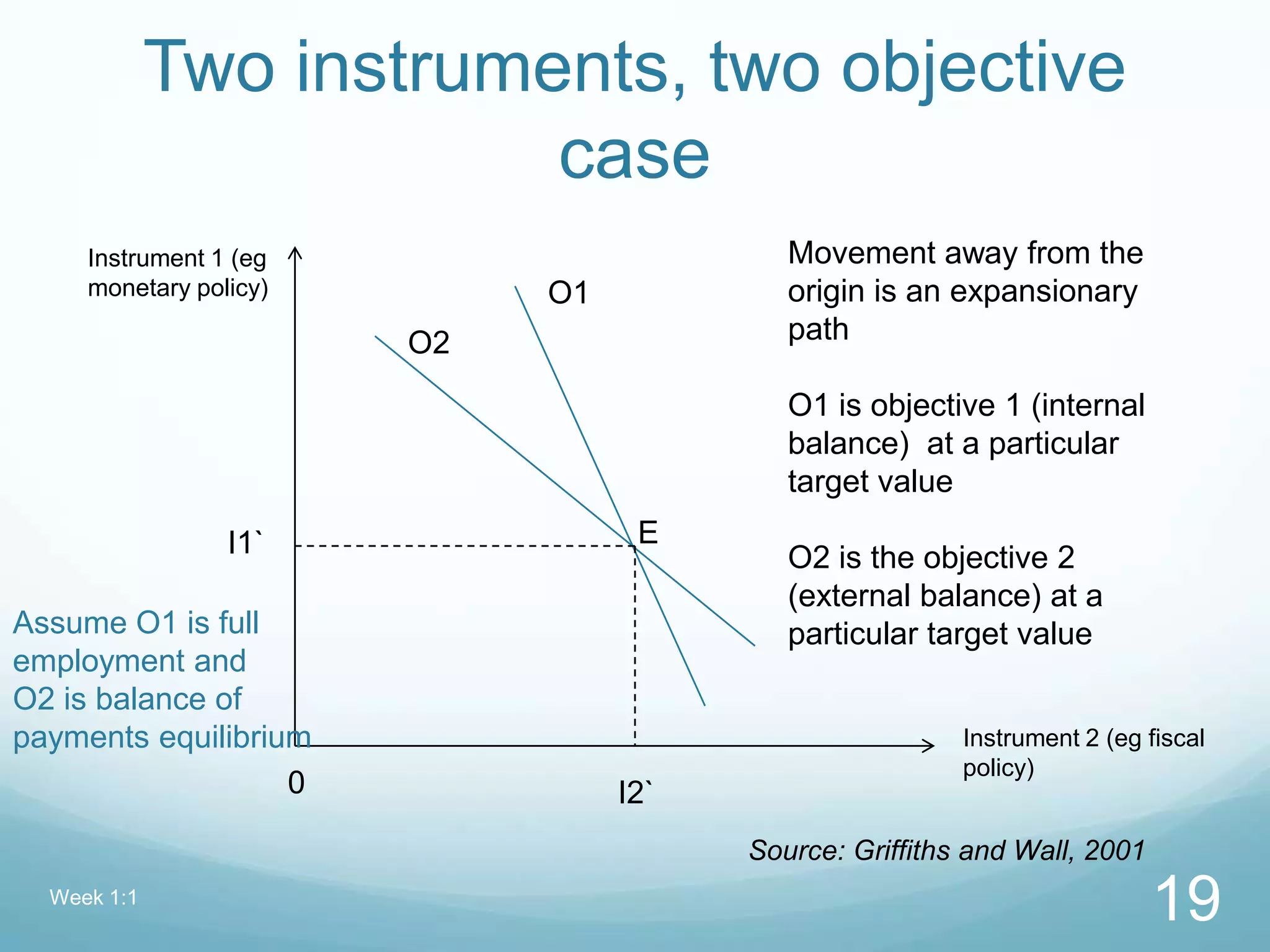
Two instruments, two objective
case
Week 1:1
19
O1
O2
Instrument 1 (eg
monetary policy)
Instrument 2 (eg fiscal
policy)
0
I1`
I2`
Source: Griffiths and Wall, 2001
Movement away from the
origin is an expansionary
path
O1 is objective 1 (internal
balance) at a particular
target value
O2 is the objective 2
(external balance) at a
particular target value
E
Assume O1 is full
employment and
O2 is balance of
payments equilibrium
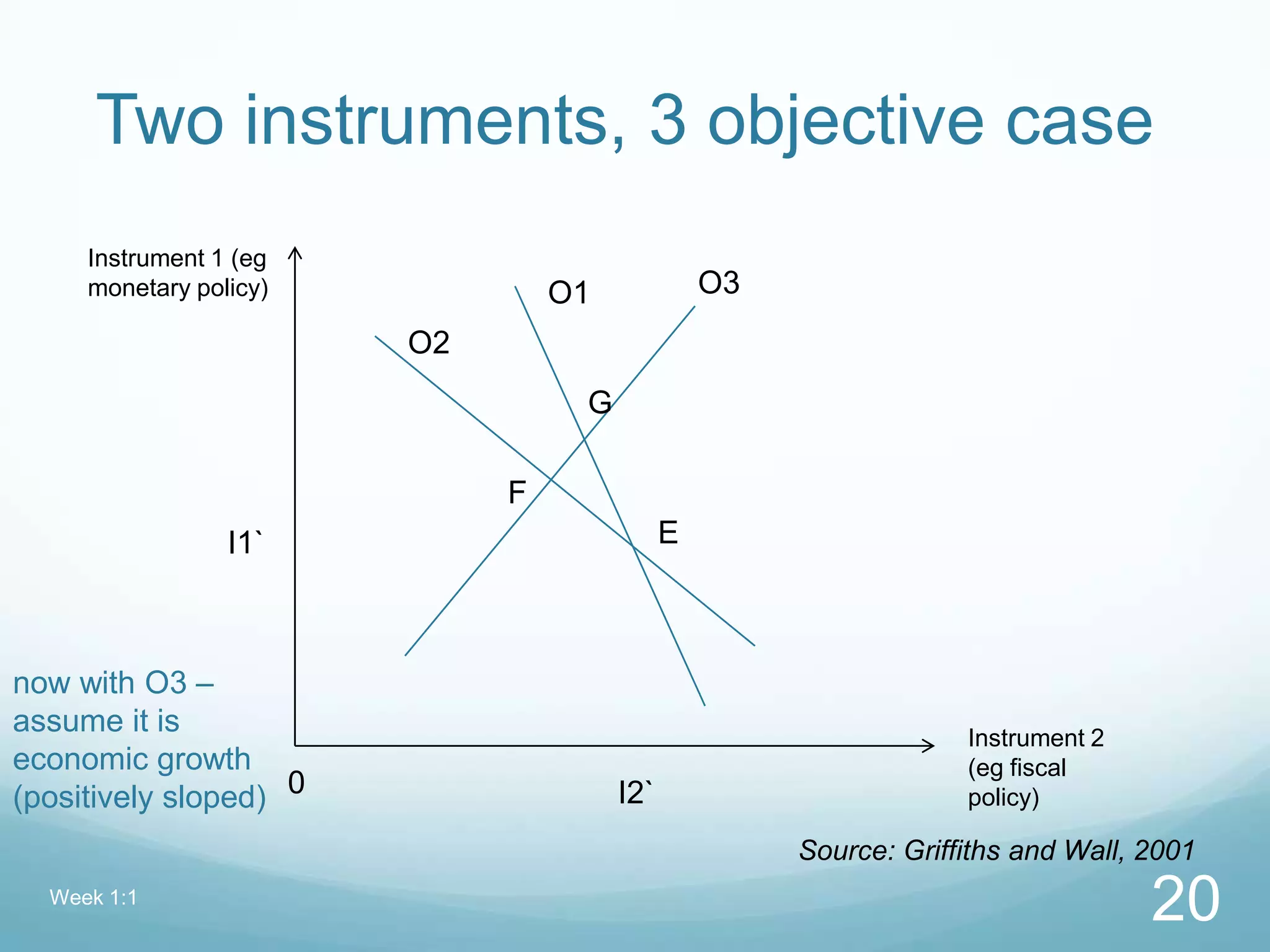
Two instruments, 3 objective case
Week 1:1
20
O1
O2
Instrument 1 (eg
monetary policy)
Instrument 2
(eg fiscal
policy)0
I1`
I2`
Source: Griffiths and Wall, 2001
O3
G
F
E
now with O3 –
assume it is
economic growth
(positively sloped)
So, now you know…
 What we plan to cover over the next few weeks
 What the macro economy is, specifically concerned
with
 What are the chief objectives of government economic
policy
 The tools available to governments who wish to
influence the economy
Week 1:1
21
Tomorrow…
 We will look at Britain in context
 Plotting some of these key variables over time and
across countries that might reasonably be compared to
Britain
 Discussing some of the reasons put forward for the UK
position
Week 1:1
22
References used this week:
 Griffiths and Wall (2011) 12th Edition – handy for the
Tinbergen theory
 Mosley (1976) Towards a Satisficing theory of
Economic Policy’, The Economic Journal, 86(341), 59-
72 (available on JSTOR)
Week 1:1
23

Ec 111 week 1(1)

  • 1.
    EC-111: British Economy RecentMacro Economic Policy and Trends Dr Catherine Robinson F35, Richard Price Office hours: Monday 10.30-11.30 and Thursday 9.30-10.30 Appointments: c.robinson@swansea.ac.uk Week 1:1 1
  • 2.
    Introduction  Aim ofthis section of the course  Outline key texts and structure of the next 5 weeks  Defining the macro-economy  What variables are we looking at?  Assessment:  2 hour written examination at the end of semester 2 (45%) 5 questions in total – split between me and John’s regional topic  I’ll go over some pointers in the last week Week 1:1 2
  • 3.
    Aim of thecourse  To provide an understanding of the macroeconomic fortunes of the UK in the post war period  Discuss some policies  ideological influences  Identifying different schools of economic thought  Bit of economic history, but bringing it up to date with the financial crisis and the ‘great recession’  Show you some data on UK performance  But not just about the UK – need to look at it in context  Empirically driven – not too much theory, but designed to put your theory into (a UK) context Week 1:1 3
  • 4.
    Attendance 1. Click 1on your keypad and hold it down until a appears.
  • 5.
    Macro Outline Introduction What are we looking at?  What does Britain look like, in comparison?  Post War British Macro Economic Policy  The rise and fall of Keynesianism  From the Welfare State to the Winter of discontent  The Thatcher Years  Monetarism and miners strike  ERM and inflation targeting  Blair  Bank of England independence and the birth of the MPC  Things can only get better? ICT and the productivity paradox  The Great Recession  Causes and consequences  Policy solutions?  Productivity paradox (II) Week 1:1 5
  • 6.
    Recommended Reading  Griffithsand Wall is a good place to start  Older editions of the book have a chapter on Managing the Economy (Ch24 in 9th edition), available in the library.  For the final part of the course, financial institutions and Ch30 – managing the economy post credit crunch – will be very informative  This will be supplemented with recommended reading each week  Need to recommend some articles and alternatives for the economic history sections of the course  The early lectures will be based on BWE Alford’s 1988 book, ‘British Economic Performance 1945-1975’.  Tagged in the library – 4 copies available  If you want some good, up-to-date commentary, take a look at the Green Budget by the IFS Week 1:1 6
  • 7.
    Definitions: The Macro Economy Country-level indicators, constructed as part of the National Accounts  Y=C+I+G+(X-M)  But includes things that are left out of NA  Price levels (inflation)  Employment/labour force participation rates  Indicators of performance and welfare  PRODUCTIVITY (rate at which outputs are generated from inputs)  Longer run indicators of economic footing  National debt  What are the policy levers available to governments?  Varies over time and across different institutional set-ups  Short termism versus medium and long term strategies  Increasingly influenced by the wider global environment (Globalisation) Week 1:1 7
  • 8.
    Objectives of Policy Full employment  Anything below 3% was seen as acceptable  Not been seen as a viable objective since the 1960s  Stable prices  In other words, low inflation  2.5% is the MPC’s specific target  Economic Growth  Results in higher living standards in most Western Economies  RA Butler (1954) suggested a doubling of living standards every 25 years could be an explicit target  Balance of Payments  Aim for equilibrium (although surpluses are always considered positive) There are others, of a more socio-economic type Achieving one of these ‘objectives’ might be feasible, but all at once?? Week 1:1 8
  • 9.
    Instruments of policy Why isn’t this the equilibrium situation?  Market Failure rationale  Almost all government subsidies/industrial support have to reason with the Treasury that the market has in some way ‘failed’ before they can intervene  How do governments go about it?  Policy instruments:  Fiscal policy  Monetary policy  Prices and incomes policy  Exchange rate or import controls Week 1:1 9
  • 10.
    Fiscal Policy  Taxationand government spending  Aim is to affect the composition and the level of Aggregate Demand in the economy  Addresses redistribution of wealth – sort of…  Higher taxes and lower spending is likely to lower AD  Conversely – lower tax and higher spending should encourage AD  Concerns about the Public Sector Borrowing Deficit (the PSBR) <<more next week>> Week 1:1 10
  • 11.
    Monetary Policy  Theinterest rate  Affects the cost of borrowing  And the returns to lending  both long and short term investment decisions  Leads consumers to change their behaviour also  Low rates of interest offer little incentive to save  Affects the balance of payments also  Capital flows between countries  Money Supply  Monetarists versus Keynesians  Monetarists see MS as affecting prices  Keynesians see its impact on output and employment  These two are linked, clearly….  expansionary or contractionary strategy will typically use the two together Week 1:1 11
  • 12.
    Prices and IncomesPolicy  Direct attempts to control inflation  EG public Sector pay freeze  Regarded as irrelevant to monetarists  But an important tool in periods of expansion to Keynesians  Not been extensively used since 1979 although limits on public sector spending have in effect constrained wages Week 1:1 12
  • 13.
    Exchange Rate  Usedto influence the balance of payments  Isn’t always something the national government can affect  Prior to 1972, IMF system was implemented (Bretton Woods)  Exchange rates affect the relative prices of domestic and foreign goods  Appreciation(Ex) => X and M  Depreciation(Ex) => X and M  Assuming appropriate elasticities for imports and exports, lower exchange rate improves the balance of payments  But it will also have an adverse effect on costs  Rising input costs => higher prices=> higher wage demands ==INFLATION Week 1:1 13
  • 14.
    Import Controls  Notused much in the UK as a policy instrument  In fact, membership of EU (and its commitment to the freedom of movement of goods and services) and long- standing Commonwealth links, trade has been relatively unhindered by government intervention for decades (excluding WWII)  The UK does participate in GATT (general agreement on tariff & trade) reductions for goods that have traditionally carried a levy Week 1:1 14
  • 15.
    There are trade-offs Between inflation and unemployment  The Phillips Curve (1958)  Curbing government spending lowers earnings for public sector workers or reduce employment  Raising the exchange rate makes exports relatively more expensive and lowers (manufacturing) output  So how do you balance multiple objectives?  Instruments are not independent of one another  AND instruments have in the past become objectives  Exchange rate instrument <<more when we discuss the ERM>> Week 1:1 15
  • 16.
    The Phillips Curve Each dot represents a year  1913-1948  As wages increase (inflation) unemployment declines Week 1:1 16
  • 17.
    Theory of EconomicPolicy  Tinbergen (1952)  Fixed targets  Tinbergen’s rule – there should be at least as many instruments as there are objectives  Flexible targets (Theil, 1956)  Pre-supposes that there is welfare loss associated with missing the fixed targets  Implicitly assumes that there is a social welfare function for the population  It then becomes a question of weighting  ‘Satisficing’ (Mosley, 1976)  Policy makers are satisficing agents, influenced primarily by recent levels  Looking at the 1946-71 period Mosley found that any balance of payments deficit resulted in policy change – so that only zero or positive BoP was satisfactory.  Benchmark for unemployment was variable over time Week 1:1 17
  • 18.
    Which of thesedefinitions best describes the term ‘satisficing’? 18 1. Bureaucratic organisations maximise profits 2. Bureaucratic organisations continually strive for the best possible outcomes 3. Bureaucratic organisations react only when welfare reaches an unsatisfactory level
  • 19.
    Two instruments, twoobjective case Week 1:1 19 O1 O2 Instrument 1 (eg monetary policy) Instrument 2 (eg fiscal policy) 0 I1` I2` Source: Griffiths and Wall, 2001 Movement away from the origin is an expansionary path O1 is objective 1 (internal balance) at a particular target value O2 is the objective 2 (external balance) at a particular target value E Assume O1 is full employment and O2 is balance of payments equilibrium
  • 20.
    Two instruments, 3objective case Week 1:1 20 O1 O2 Instrument 1 (eg monetary policy) Instrument 2 (eg fiscal policy)0 I1` I2` Source: Griffiths and Wall, 2001 O3 G F E now with O3 – assume it is economic growth (positively sloped)
  • 21.
    So, now youknow…  What we plan to cover over the next few weeks  What the macro economy is, specifically concerned with  What are the chief objectives of government economic policy  The tools available to governments who wish to influence the economy Week 1:1 21
  • 22.
    Tomorrow…  We willlook at Britain in context  Plotting some of these key variables over time and across countries that might reasonably be compared to Britain  Discussing some of the reasons put forward for the UK position Week 1:1 22
  • 23.
    References used thisweek:  Griffiths and Wall (2011) 12th Edition – handy for the Tinbergen theory  Mosley (1976) Towards a Satisficing theory of Economic Policy’, The Economic Journal, 86(341), 59- 72 (available on JSTOR) Week 1:1 23

Editor's Notes

  • #8 Consumption – affected by: you will have looked at this – the Keynesian view – what determines consumption? (mpc). Post Keynesian views…permanent income hypothesis (wealth rather than income); life cycle hypothesis..builds on Friedmans theory (PIH) but appreciates the importance of age in determining consumption and rational expectationsInvestment, affected by: the rate of interest, profitability, uncertainty, public policies, capital market imperfections, Skills and the labour market, depreciation rate,