“BUSINESS ENVIRONMENT”

Prepared under the supervision of
Dr. Iqbal, Lecturer in East End Computing & Business College.

Submitted/ Prepared by,
Md. Kamruzzaman Juel
Student ID-0202101408
HND in Business
ACKNOWLEDGEMENT
I am grateful to all teachers of FM Business School for their massive cooperation. Moreover,
I am really gratitude and grateful to my teacher, Dr. Iqbal who is conducted this course
“Business Environment” he has given a lot of support as well as guide to prepare this
assignment.

Thanks,
Md. Kamruzzaman Juel
OBJECTIVES

As a student of Higher Diploma, it is essential to prepare assignment as a part of the course.
The assignment has been designed to provide student with the course material necessary to
complete the module. By preparing this assignment a student will be able to understand and
contrast a Business environment and identify vision, mission, objectives and responsibility of
an organisation. Moreover, a student can understand the social welfare and micro
environment and their impact on organisation
CONTENTS

Q1.1-----------------------------------------------------------------------Page 5-7

Q1.2-----------------------------------------------------------------------Page 8

Q1.3------------------------------------------------------------------------Page 9-10

Q2.1-------------------------------------------------------------------------Page 11-12

Q2.2-------------------------------------------------------------------------Page 13

Reference-------------------------------------------------------------------Page 14
Body and description
LO1
Tata Motors Ltd is a multinational Corporation headquartered in Mumbai, India. Part of the
Tata Group, it was formerly known as TELCO (TATA Engineering and Locomotive
Company). Established in 1945, Tata Motors' presence indeed cuts across the length and
breadth of India.
Q1.1

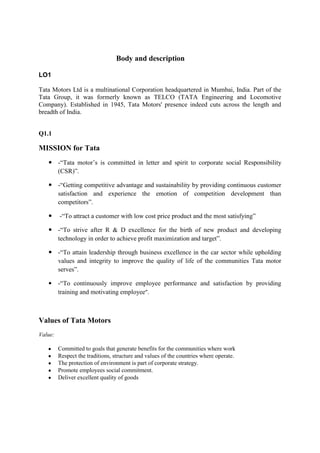
MISSION for Tata
 -“Tata motor‟s is committed in letter and spirit to corporate social Responsibility
(CSR)”.
 -“Getting competitive advantage and sustainability by providing continuous customer
satisfaction and experience the emotion of competition development than
competitors”.


-“To attract a customer with low cost price product and the most satisfying”

 -“To strive after R & D excellence for the birth of new product and developing
technology in order to achieve profit maximization and target”.
 -“To attain leadership through business excellence in the car sector while upholding
values and integrity to improve the quality of life of the communities Tata motor
serves”.


-“To continuously improve employee performance and satisfaction by providing
training and motivating employee”.

Values of Tata Motors
Value:
Committed to goals that generate benefits for the communities where work
Respect the traditions, structure and values of the countries where operate.
The protection of environment is part of corporate strategy.
Promote employees social commitment.
Deliver excellent quality of goods
Key Objectives of Tata
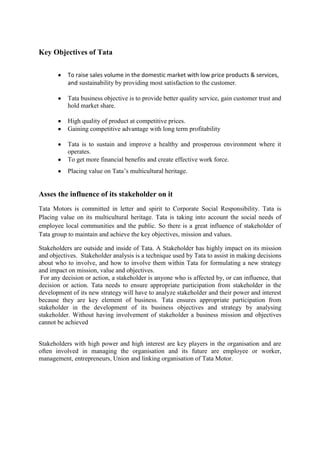
To raise sales volume in the domestic market with low price products & services,
and sustainability by providing most satisfaction to the customer.
Tata business objective is to provide better quality service, gain customer trust and
hold market share.
High quality of product at competitive prices.
Gaining competitive advantage with long term profitability
Tata is to sustain and improve a healthy and prosperous environment where it
operates.
To get more financial benefits and create effective work force.
Placing value on Tata‟s multicultural heritage.

Asses the influence of its stakeholder on it
Tata Motors is committed in letter and spirit to Corporate Social Responsibility. Tata is
Placing value on its multicultural heritage. Tata is taking into account the social needs of
employee local communities and the public. So there is a great influence of stakeholder of
Tata group to maintain and achieve the key objectives, mission and values.
Stakeholders are outside and inside of Tata. A Stakeholder has highly impact on its mission
and objectives. Stakeholder analysis is a technique used by Tata to assist in making decisions
about who to involve, and how to involve them within Tata for formulating a new strategy
and impact on mission, value and objectives.
For any decision or action, a stakeholder is anyone who is affected by, or can influence, that
decision or action. Tata needs to ensure appropriate participation from stakeholder in the
development of its new strategy will have to analyze stakeholder and their power and interest
because they are key element of business. Tata ensures appropriate participation from
stakeholder in the development of its business objectives and strategy by analysing
stakeholder. Without having involvement of stakeholder a business mission and objectives
cannot be achieved
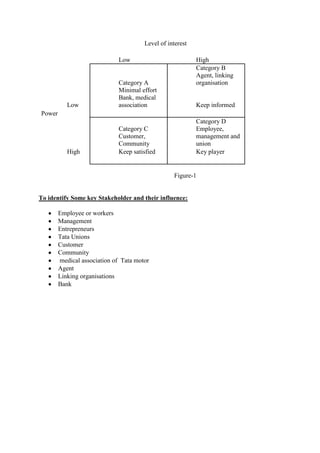
Stakeholders with high power and high interest are key players in the organisation and are
often involved in managing the organisation and its future are employee or worker,
management, entrepreneurs, Union and linking organisation of Tata Motor.
Level of interest
Low

Low

Category A
Minimal effort
Bank, medical
association

High

High
Category B
Agent, linking
organisation

Category C
Customer,
Community
Keep satisfied

Keep informed

Power
Category D
Employee,
management and
union
Key player

Figure-1

To identify Some key Stakeholder and their influence:
Employee or workers
Management
Entrepreneurs
Tata Unions
Customer
Community
medical association of Tata motor
Agent
Linking organisations
Bank
Q1.2 the following extent to which the company achieves the objectives of
its three Stakeholder. The three stakeholders are customer, community and
employee.
To raise sales volume in the domestic market with low price products & services,
and sustainability by providing most satisfaction to the customer. Tata business is
to provide better quality service, gain customer trust. By this way Tata is trying to
achieve the objectives of customers.
Proper management system is the key to the success of the business. So proper
management system will be able to gain the objectives of its three stakeholders of
customer, employee and community.
Tata concerned with ethics. Tata is concerned with truth and justice and has a
variety of aspects such as fair business, air competition, advertising, public
relation, corporate behavior and Placing value on its multicultural heritage. By
this way Tata is trying to achieve the objectives of community and public.
Tata is introducing major culture change programmes in order to improve their
competitive edge and survive in a dynamic business environment. Tata will be
gained profit through the ability and willingness of employees to constantly learn
by training.
HRM issues at productivity salaries benefits, recruiting training & development,
maintenance, rewards on benefits program, absenteeism, overseas relocation,
layoffs, meeting and attitude survey.
Tata motor‟s is committed in letter and spirit to corporate social responsibility.
Tata motor Ltd CSR objectives are vital as with this objective Tata wants to get
sustainability and gain the objectives of its three stakeholders of customer,
employee and community.
Q1.3 The following Responsibilities and strategies of Tata which has
employed to meet them.
Responsibilities
Health and safety of customer
Diversity and equal Opportunity
Corporate social responsibility:
Tata motor‟s is committed in letter and spirit to corporate social Responsibility
Ethical responsibility:
Tata is concerned with ethics. Tata is concerned with truth and justice and has a variety of
aspects such as fair business, air competition, advertising, public relation, corporate
behaviour.
Cultural responsibility:
Tata is Placing value on its multicultural heritage.
Environment responsibility:
Tata is to sustain and improve a healthy and prosperous environment where it operates. Tata
is responsible for Protecting the environment- Go green.
Social responsibility:
Tata is taking into account the social needs of employee local communities and the public.
Business responsibility:
DHL business objective is to provide better quality service, gain customer trust and hold
market share.

Strategies
Corporate Social responsibility CSR Strategy:
CSR- focused business would proactively promote the public interest by encouraging
community growth and development, and voluntary eliminating practices that harm the
public sphere, regardless of legality. Tata CSR strategy the primary purpose of a business is
to improve the quality of life of the people of the area it‟s operating. Tata Motors is
committed in letter and spirit to Corporate Social Responsibility. Tata CSR strategy
initiatives must not be viewed as costs, but as investments, which serve as the foundation of
its competitive advantage and long term profitability. Already Tata Motor is invested for
Value of Tata brand over CSR investment is $ 3.89 and Value of brand equity due to CSR is
$ 1.94.Tata‟s CSR investment has contributed nearly $ 2B to the firm‟s value and brought a
32 % return in perpetuity. Now Tata motor primary concern is sustainability journey to 2020.
Tata CSR strategy will be able to attain objectives.

Differentiation Strategy:
This implies that the organization pursues a strategy where it offers a product or service
which is uniquely different from those of its competitors. Further, this differentia on must be
valued above the offer of others. Differentiation can be achieved through a totally different
product or it can be achieved by the way in which the product or service is offered. It seeking
to differentiate the company‟s product offering broad range of buyer.
Differentiation strategy is based on;
Providing products unique or different from those of competitor
Increasing the buyer‟s satisfaction
Increasing the buyer „s perceived value
Differentiation can be achieved by;
Create products or services superior to competitors , e.g. design, performance,
reliability
Offer superior after sales services.
Superior customer services.
Create superior supply chain
Create a strong brand image.
Offer superior product or service packaging.
Strong advertising campaign
Product engineering.
Strong research capability
Special feature of product
Technological leadership
A complete line of the product
If Tata can format appropriate differentiation strategy for its local market to improve sales
and brand image of product it should be kept continuous unique from those of competitor that
ultimate result is sustainable competitive advantage.
Q2.1 How economic systems prevalent in that country attempt to allocate
and make effective use of its resources:
Economics is the social science that analyzes the production, distribution, and consumption
of goods and services.
Economic systems have developed over time for the express purpose of allocating resources.
Techniques for allocating resources have emerged like a process of natural selection, with
those that work becoming incorporated into the economic system and those that fail being
eventually rejected.
This process has been a major factor in the gradual improvement in living standards.
Nowadays, the most highly developed nations enjoy material standards inconceivable to their
forebears at the turn of the century, and still well beyond much of the rest of the world.
Much of this is due, not simply to greater exploitation of the world's resources, but to more
efficient systems of exchange, leading to better allocation of resources.
So efficient systems of exchange are central to economic and social well-being. Owning a lot
of resources will not ensure prosperity, unless at the same time there is a system of resource
allocation available to make efficient use of these.
We need to reconsider some of the ways in which we allocate resources because of concerns
about long term sustainability of environmental resources
Despite rapid improvements in material well-being, which are rapidly spreading across the
world, the rates of economic growth which have supported these improvements since the 2nd
World War have drawn attention to the demands we now place on our environmental
resources.
Economic system in the environment to produce them, how much to produce, and how to
distribute them. There are four types of resources that go into creating an economic system.
Therefore resources have to be allocated in terms of what to produce, how to produce, and for
whom to produce. Fundamental allocation of resources in different types of economy.
Demand-and-supply analysis is used to explain the behaviour of perfectly competitive
markets, but as a standard of comparison it can be extended to any type of market. Economic
theory may also specify conditions such that supply and demand through the market is an
efficient mechanism for allocating resources.
Q2.2 The impact of social welfare and industrial policy initiatives of that
country on its organisation and the winder community
Social welfare: There are few social welfare like environment policy, employment, health and
safety, equal opportunity, education, Customer safety and infrastructure etc of that country
impact on business decision of Tata.
Keep environment sound and safe
Create employment equal opportunity
Maintain healthy and safe production
Industrial policy:
Small and Large industry location would be the different area.
Creation of a favourable investment environment
Create maximum employment opportunities
Industrially more developed areas
Large scale production with low cost and prices
Social welfare and industrial policy of that country impact on business operation, business
decision and objectives of Tata.
Impact on business operation
Its Large scale production with low cost and price. For the social welfare and industrial
policy, Tata is concerned with ethics. Tata is taking into account the social needs of employee
local communities and the public.
Impact on business decision
Tata motor‟s is committed in letter and spirit to corporate social Responsibility (CSR). To
raise sales volume in the domestic market with low price products & services.
Impact on Business objectives

Tata is to strive after R & D excellence for the birth of new product and developing
technology in order to achieve profit maximization and target
Impact on organisation functions
Tata is to continuously improve employee performance and satisfaction by providing training
and motivating employee for the Industrial policy.
Impact on Organisation responsibility
Tata is responsible for Protecting the environment- Go green. Tata is taking into account the
social needs of employee local communities and the public. Tata is placing value into
multicultural heritage.
Q2.3 Evaluate the impact of Macroeconomic policy measures and the
influence of the global economy on UK base organisation and stakeholder
Macro economy Policy:
Macro economics Policy of the government towards the level of the exchange rate of its
currency, it may want to influence the exchange rate by using its gold and foreign currency
reserves held by its central bank to buy and sell its currency. It can also use interest rate to
alter the value of the currency. A fall in the exchange rate will mean that the price of imports
will rise while exporters can choose either to lower prices for their buyers or leave them the
same and increase their profit margin. As a result domestic producers should become more
internationally competitive. However, higher import price may fuel a rise in inflation in the
economy as a result the pricing of products could be high which positively impact on
business.
Government has increasingly passed fiscal policy and regulation that affect the operation of
business.
State growth and fiscal regulation influence the hiring and firing of employees, influence
advertising practices and global economy.
In addition, government increased tax policies influence the financial structure and
investment decisions of UK base organisation and the influence of the global economy on
UK base organisation and stakeholder
Global Economy:
The economic cycle can significantly affect buying decision of customer. 2009 has seen a
downturn in the UK. Massive recession was in the UK.
International economy and a consequence is slowing down in large customer‟s commitment
to long term investment and purchasing power. Harsh economic condition batters UK
business.
Deflation and recession which influence of the global economy on UK base organisation and
stakeholder
Economy recovery is clouded by uncertainty as credit remains hard to obtain and public
spending is slashed but inflation remains too high, then eventually customers will have to
invest and increase purchasing power. Domestic producers should become more
internationally competitive. Higher import price may fuel a rise in inflation in the economy
as a result the pricing of products could be high which positively impact on business.
Reference
1. Resource Development International (2007) strategic planning and implementation.
Coventry: RDI consultant‟s
2. Strategy by Dominic Houlder & Nigle Nicholson
3. Target setting and goal achievement by Richard Hale and Peter Whitlam

Business Environment Assignment

  • 1.
    “BUSINESS ENVIRONMENT” Prepared underthe supervision of Dr. Iqbal, Lecturer in East End Computing & Business College. Submitted/ Prepared by, Md. Kamruzzaman Juel Student ID-0202101408 HND in Business
  • 2.
    ACKNOWLEDGEMENT I am gratefulto all teachers of FM Business School for their massive cooperation. Moreover, I am really gratitude and grateful to my teacher, Dr. Iqbal who is conducted this course “Business Environment” he has given a lot of support as well as guide to prepare this assignment. Thanks, Md. Kamruzzaman Juel
  • 3.
    OBJECTIVES As a studentof Higher Diploma, it is essential to prepare assignment as a part of the course. The assignment has been designed to provide student with the course material necessary to complete the module. By preparing this assignment a student will be able to understand and contrast a Business environment and identify vision, mission, objectives and responsibility of an organisation. Moreover, a student can understand the social welfare and micro environment and their impact on organisation
  • 4.
    CONTENTS Q1.1-----------------------------------------------------------------------Page 5-7 Q1.2-----------------------------------------------------------------------Page 8 Q1.3------------------------------------------------------------------------Page9-10 Q2.1-------------------------------------------------------------------------Page 11-12 Q2.2-------------------------------------------------------------------------Page 13 Reference-------------------------------------------------------------------Page 14
  • 5.
    Body and description LO1 TataMotors Ltd is a multinational Corporation headquartered in Mumbai, India. Part of the Tata Group, it was formerly known as TELCO (TATA Engineering and Locomotive Company). Established in 1945, Tata Motors' presence indeed cuts across the length and breadth of India. Q1.1 MISSION for Tata  -“Tata motor‟s is committed in letter and spirit to corporate social Responsibility (CSR)”.  -“Getting competitive advantage and sustainability by providing continuous customer satisfaction and experience the emotion of competition development than competitors”.  -“To attract a customer with low cost price product and the most satisfying”  -“To strive after R & D excellence for the birth of new product and developing technology in order to achieve profit maximization and target”.  -“To attain leadership through business excellence in the car sector while upholding values and integrity to improve the quality of life of the communities Tata motor serves”.  -“To continuously improve employee performance and satisfaction by providing training and motivating employee”. Values of Tata Motors Value: Committed to goals that generate benefits for the communities where work Respect the traditions, structure and values of the countries where operate. The protection of environment is part of corporate strategy. Promote employees social commitment. Deliver excellent quality of goods
  • 6.
    Key Objectives ofTata To raise sales volume in the domestic market with low price products & services, and sustainability by providing most satisfaction to the customer. Tata business objective is to provide better quality service, gain customer trust and hold market share. High quality of product at competitive prices. Gaining competitive advantage with long term profitability Tata is to sustain and improve a healthy and prosperous environment where it operates. To get more financial benefits and create effective work force. Placing value on Tata‟s multicultural heritage. Asses the influence of its stakeholder on it Tata Motors is committed in letter and spirit to Corporate Social Responsibility. Tata is Placing value on its multicultural heritage. Tata is taking into account the social needs of employee local communities and the public. So there is a great influence of stakeholder of Tata group to maintain and achieve the key objectives, mission and values. Stakeholders are outside and inside of Tata. A Stakeholder has highly impact on its mission and objectives. Stakeholder analysis is a technique used by Tata to assist in making decisions about who to involve, and how to involve them within Tata for formulating a new strategy and impact on mission, value and objectives. For any decision or action, a stakeholder is anyone who is affected by, or can influence, that decision or action. Tata needs to ensure appropriate participation from stakeholder in the development of its new strategy will have to analyze stakeholder and their power and interest because they are key element of business. Tata ensures appropriate participation from stakeholder in the development of its business objectives and strategy by analysing stakeholder. Without having involvement of stakeholder a business mission and objectives cannot be achieved Stakeholders with high power and high interest are key players in the organisation and are often involved in managing the organisation and its future are employee or worker, management, entrepreneurs, Union and linking organisation of Tata Motor.
  • 7.
    Level of interest Low Low CategoryA Minimal effort Bank, medical association High High Category B Agent, linking organisation Category C Customer, Community Keep satisfied Keep informed Power Category D Employee, management and union Key player Figure-1 To identify Some key Stakeholder and their influence: Employee or workers Management Entrepreneurs Tata Unions Customer Community medical association of Tata motor Agent Linking organisations Bank
  • 8.
    Q1.2 the followingextent to which the company achieves the objectives of its three Stakeholder. The three stakeholders are customer, community and employee. To raise sales volume in the domestic market with low price products & services, and sustainability by providing most satisfaction to the customer. Tata business is to provide better quality service, gain customer trust. By this way Tata is trying to achieve the objectives of customers. Proper management system is the key to the success of the business. So proper management system will be able to gain the objectives of its three stakeholders of customer, employee and community. Tata concerned with ethics. Tata is concerned with truth and justice and has a variety of aspects such as fair business, air competition, advertising, public relation, corporate behavior and Placing value on its multicultural heritage. By this way Tata is trying to achieve the objectives of community and public. Tata is introducing major culture change programmes in order to improve their competitive edge and survive in a dynamic business environment. Tata will be gained profit through the ability and willingness of employees to constantly learn by training. HRM issues at productivity salaries benefits, recruiting training & development, maintenance, rewards on benefits program, absenteeism, overseas relocation, layoffs, meeting and attitude survey. Tata motor‟s is committed in letter and spirit to corporate social responsibility. Tata motor Ltd CSR objectives are vital as with this objective Tata wants to get sustainability and gain the objectives of its three stakeholders of customer, employee and community.
  • 9.
    Q1.3 The followingResponsibilities and strategies of Tata which has employed to meet them. Responsibilities Health and safety of customer Diversity and equal Opportunity Corporate social responsibility: Tata motor‟s is committed in letter and spirit to corporate social Responsibility Ethical responsibility: Tata is concerned with ethics. Tata is concerned with truth and justice and has a variety of aspects such as fair business, air competition, advertising, public relation, corporate behaviour. Cultural responsibility: Tata is Placing value on its multicultural heritage. Environment responsibility: Tata is to sustain and improve a healthy and prosperous environment where it operates. Tata is responsible for Protecting the environment- Go green. Social responsibility: Tata is taking into account the social needs of employee local communities and the public. Business responsibility: DHL business objective is to provide better quality service, gain customer trust and hold market share. Strategies Corporate Social responsibility CSR Strategy: CSR- focused business would proactively promote the public interest by encouraging community growth and development, and voluntary eliminating practices that harm the public sphere, regardless of legality. Tata CSR strategy the primary purpose of a business is to improve the quality of life of the people of the area it‟s operating. Tata Motors is committed in letter and spirit to Corporate Social Responsibility. Tata CSR strategy initiatives must not be viewed as costs, but as investments, which serve as the foundation of its competitive advantage and long term profitability. Already Tata Motor is invested for Value of Tata brand over CSR investment is $ 3.89 and Value of brand equity due to CSR is
  • 10.
    $ 1.94.Tata‟s CSRinvestment has contributed nearly $ 2B to the firm‟s value and brought a 32 % return in perpetuity. Now Tata motor primary concern is sustainability journey to 2020. Tata CSR strategy will be able to attain objectives. Differentiation Strategy: This implies that the organization pursues a strategy where it offers a product or service which is uniquely different from those of its competitors. Further, this differentia on must be valued above the offer of others. Differentiation can be achieved through a totally different product or it can be achieved by the way in which the product or service is offered. It seeking to differentiate the company‟s product offering broad range of buyer. Differentiation strategy is based on; Providing products unique or different from those of competitor Increasing the buyer‟s satisfaction Increasing the buyer „s perceived value Differentiation can be achieved by; Create products or services superior to competitors , e.g. design, performance, reliability Offer superior after sales services. Superior customer services. Create superior supply chain Create a strong brand image. Offer superior product or service packaging. Strong advertising campaign Product engineering. Strong research capability Special feature of product Technological leadership A complete line of the product If Tata can format appropriate differentiation strategy for its local market to improve sales and brand image of product it should be kept continuous unique from those of competitor that ultimate result is sustainable competitive advantage.
  • 11.
    Q2.1 How economicsystems prevalent in that country attempt to allocate and make effective use of its resources: Economics is the social science that analyzes the production, distribution, and consumption of goods and services. Economic systems have developed over time for the express purpose of allocating resources. Techniques for allocating resources have emerged like a process of natural selection, with those that work becoming incorporated into the economic system and those that fail being eventually rejected. This process has been a major factor in the gradual improvement in living standards. Nowadays, the most highly developed nations enjoy material standards inconceivable to their forebears at the turn of the century, and still well beyond much of the rest of the world. Much of this is due, not simply to greater exploitation of the world's resources, but to more efficient systems of exchange, leading to better allocation of resources. So efficient systems of exchange are central to economic and social well-being. Owning a lot of resources will not ensure prosperity, unless at the same time there is a system of resource allocation available to make efficient use of these. We need to reconsider some of the ways in which we allocate resources because of concerns about long term sustainability of environmental resources Despite rapid improvements in material well-being, which are rapidly spreading across the world, the rates of economic growth which have supported these improvements since the 2nd World War have drawn attention to the demands we now place on our environmental resources. Economic system in the environment to produce them, how much to produce, and how to distribute them. There are four types of resources that go into creating an economic system. Therefore resources have to be allocated in terms of what to produce, how to produce, and for whom to produce. Fundamental allocation of resources in different types of economy. Demand-and-supply analysis is used to explain the behaviour of perfectly competitive markets, but as a standard of comparison it can be extended to any type of market. Economic theory may also specify conditions such that supply and demand through the market is an efficient mechanism for allocating resources.
  • 12.
    Q2.2 The impactof social welfare and industrial policy initiatives of that country on its organisation and the winder community Social welfare: There are few social welfare like environment policy, employment, health and safety, equal opportunity, education, Customer safety and infrastructure etc of that country impact on business decision of Tata. Keep environment sound and safe Create employment equal opportunity Maintain healthy and safe production Industrial policy: Small and Large industry location would be the different area. Creation of a favourable investment environment Create maximum employment opportunities Industrially more developed areas Large scale production with low cost and prices Social welfare and industrial policy of that country impact on business operation, business decision and objectives of Tata. Impact on business operation Its Large scale production with low cost and price. For the social welfare and industrial policy, Tata is concerned with ethics. Tata is taking into account the social needs of employee local communities and the public. Impact on business decision Tata motor‟s is committed in letter and spirit to corporate social Responsibility (CSR). To raise sales volume in the domestic market with low price products & services. Impact on Business objectives Tata is to strive after R & D excellence for the birth of new product and developing technology in order to achieve profit maximization and target Impact on organisation functions Tata is to continuously improve employee performance and satisfaction by providing training and motivating employee for the Industrial policy. Impact on Organisation responsibility Tata is responsible for Protecting the environment- Go green. Tata is taking into account the social needs of employee local communities and the public. Tata is placing value into multicultural heritage.
  • 13.
    Q2.3 Evaluate theimpact of Macroeconomic policy measures and the influence of the global economy on UK base organisation and stakeholder Macro economy Policy: Macro economics Policy of the government towards the level of the exchange rate of its currency, it may want to influence the exchange rate by using its gold and foreign currency reserves held by its central bank to buy and sell its currency. It can also use interest rate to alter the value of the currency. A fall in the exchange rate will mean that the price of imports will rise while exporters can choose either to lower prices for their buyers or leave them the same and increase their profit margin. As a result domestic producers should become more internationally competitive. However, higher import price may fuel a rise in inflation in the economy as a result the pricing of products could be high which positively impact on business. Government has increasingly passed fiscal policy and regulation that affect the operation of business. State growth and fiscal regulation influence the hiring and firing of employees, influence advertising practices and global economy. In addition, government increased tax policies influence the financial structure and investment decisions of UK base organisation and the influence of the global economy on UK base organisation and stakeholder Global Economy: The economic cycle can significantly affect buying decision of customer. 2009 has seen a downturn in the UK. Massive recession was in the UK. International economy and a consequence is slowing down in large customer‟s commitment to long term investment and purchasing power. Harsh economic condition batters UK business. Deflation and recession which influence of the global economy on UK base organisation and stakeholder Economy recovery is clouded by uncertainty as credit remains hard to obtain and public spending is slashed but inflation remains too high, then eventually customers will have to invest and increase purchasing power. Domestic producers should become more internationally competitive. Higher import price may fuel a rise in inflation in the economy as a result the pricing of products could be high which positively impact on business.
  • 14.
    Reference 1. Resource DevelopmentInternational (2007) strategic planning and implementation. Coventry: RDI consultant‟s 2. Strategy by Dominic Houlder & Nigle Nicholson 3. Target setting and goal achievement by Richard Hale and Peter Whitlam