3D
PRINTING
SUBMITTED BY :
GAURAV
M.PHARMA 2ND SEM
(PHARMACEUTICS)
JAMIA HAMDARD
CONTENT
 WHAT IS 3D PRINTING
 HISTORY
 SOME PRODUCTS
 BASIC STEPS
 METHODS
 ADVANTAGES OF 3D PRINTING
 FORMULATIONS
WHAT IS 3D PRINTING?
 It is a method of converting a virtual 3d model into a physical objective and also known as additive
manufacturing process
 3D printing can be defined as a process used to fabricate a 3D object by deposition of successive layers
in different shapes taken directly from computer aided design data (Liu et al., 2013).
 The term three-dimensional printing was defined by ISO as: “fabrication of objects through the
deposition of a material using a print head, nozzle, or another printer technology”.
HISTORY
HISTORY
 3D printing was first described by Charles Hull in 1986 and called it as “stereolithography”. Hull later
founded his own company as “3D system” where he designed a stereolithography based 3D printer and
was commercially available in market in 1988 .
 In 1987, Carl Deckard filed a patent for the selective laser sintering (SLS) and was isseued in 1989.
 In 1989, Scott Crump, filed a patent for fused deposition modelling (FDM) and was issued in 1992
 In 1989, Hans Langer founded the EOS GmbH in Germany and further focused on the laser sintering
(LS) process
 From 90’s to 2000 host of new technologies like
1. solid scape and Zcorporation (1996)
2. Arcam (1997)
3. Object geometries (1998)
4. MCP technologiess (2000)
5. EnvisionTechnology (2002)
 The 1st small kit 3d printer was commercially available in 2009 for the application bases on RepRap
concept
SOME PRODUCTS
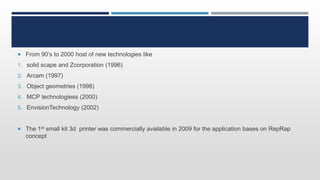
Richard Van As, a South African carpenter, assembles a
robohand and fit it . Liam was born without fingers on his right
hand. Makerbot provided them with the 3d printing technology
that they used to print the parts for the robohand.
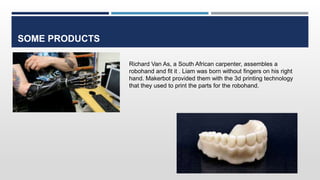
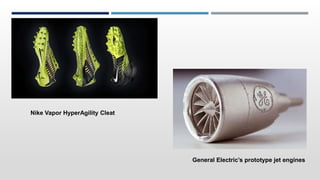
Nike Vapor HyperAgility Cleat
General Electric’s prototype jet engines
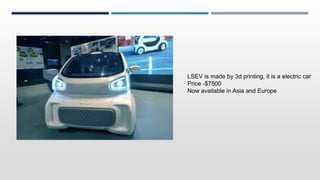
LSEV is made by 3d printing, it is a electric car
Price -$7500
Now available in Asia and Europe
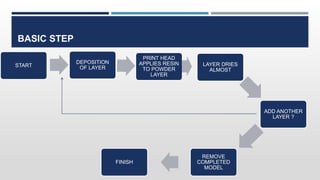
BASIC STEP
START
DEPOSITION
OF LAYER
PRINT HEAD
APPLIES RESIN
TO POWDER
LAYER
LAYER DRIES
ALMOST
ADD ANOTHER
LAYER ?
REMOVE
COMPLETED
MODEL
FINISH
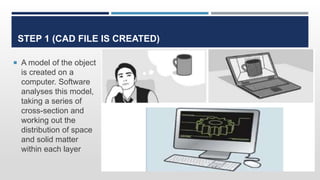
STEP 1 (CAD FILE IS CREATED)
 A model of the object
is created on a
computer. Software
analyses this model,
taking a series of
cross-section and
working out the
distribution of space
and solid matter
within each layer
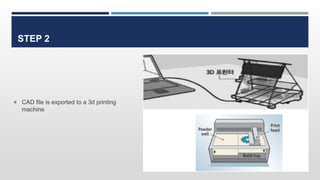
STEP 2
 CAD file is exported to a 3d printing
machine
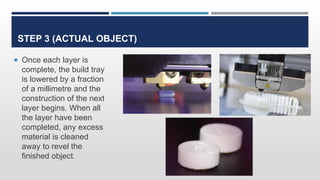
STEP 3 (ACTUAL OBJECT)
 Once each layer is
complete, the build tray
is lowered by a fraction
of a millimetre and the
construction of the next
layer begins. When all
the layer have been
completed, any excess
material is cleaned
away to revel the
finished object.
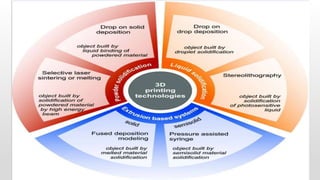
3D PRINTING TECHNOLOGIES
 Main technologies are based on :
1.POWDER SOLIDIFICATION
2.LIQUID SOLIDIFICATION
3.EXTRUSION
1.POWDER SOLIDIFICATION
a) DROP ON SOLID
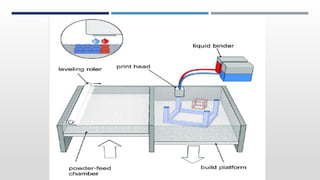
 The printing process mode of action is similar to desktop inkjet printers and is called drop on solid
deposition. Droplets of ink sprayed from print head bind the layer of free powder bed while unbound
powder particles act as a support material preventing from collapsing of overhang or porous structures.
After each step the formed object is lowered and a layer of free powder is applied by roller or powder
jetting system and process is proceeded.
 The first printers were equipped with commercially available thermal or piezoelectric print heads that
delivered bonding agent. Active pharmaceutical ingredients as well as modifying agents can be either
dissolved or dispersed in ink or distributed in powder bed.
 This method was used due to its similarity to classical formulation processes as wet granulation.
 The layer height is mainly influenced by particle size and flowability of powder bed as well as cohesion
force between particles and part of the printer or powder wettability.
 The ink constituents as solvents, APIs or modifying excipients can change viscosity, droplet size and
influence the efficiency of powder binding. The process parameters as printing speed, droplet volume,
distance from powder bed also play an important role in the product development and can have an
impact on the powder bonding especially between layers in Z axis.
 The DOS method is suitable for preparation of easily disintegrating tablet with porous structure. The
development in this filed have led to the commercialization of ZipDose technology by APRECIA
PHARMACEUTICAL
•Post-printing drying is required
•The friability and hardness are
compromised for fast disintegrating tablets
•Requires a specialized powder facility
b) SELECTIVE LAZER SINTERING
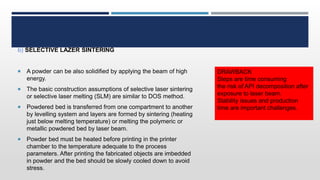
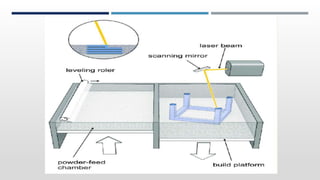
 A powder can be also solidified by applying the beam of high
energy.
 The basic construction assumptions of selective laser sintering
or selective laser melting (SLM) are similar to DOS method.
 Powdered bed is transferred from one compartment to another
by levelling system and layers are formed by sintering (heating
just below melting temperature) or melting the polymeric or
metallic powdered bed by laser beam.
 Powder bed must be heated before printing in the printer
chamber to the temperature adequate to the process
parameters. After printing the fabricated objects are imbedded
in powder and the bed should be slowly cooled down to avoid
stress.
DRAWBACK
Steps are time consuming
the risk of API decomposition after
exposure to laser beam.
Stability issues and production
time are important challenges.
2. LIQUID SOLIDIFICATION
a) DROP ON DROP
 The idea of object manufacturing by solidification of liquid is similar to powder solidification technique.
Droplets of “ink” sprayed from the nozzle are deposited on the thin layers and cured by cooling air.
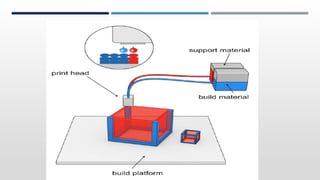
 Due to the absence of powdered bed the drop on drop (DOD) or Polyjet technology requires the use of
additional material to create support for overhang geometries.
 The print head moves along X and Y axes during printing, the print platform bed is lowered along Z axis
by the height of the layer after the deposition of each layer of the material. Different technical solutions
applied in this technique resulted in possibility of multi-material fullcolor printing.
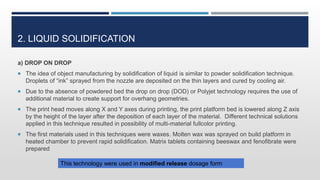
 The first materials used in this techniques were waxes. Molten wax was sprayed on build platform in
heated chamber to prevent rapid solidification. Matrix tablets containing beeswax and fenofibrate were
prepared
This technology were used in modified release dosage form
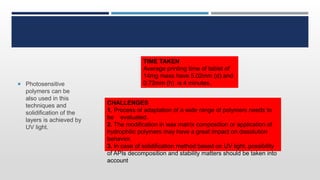
 Photosensitive
polymers can be
also used in this
techniques and
solidification of the
layers is achieved by
UV light.
TIME TAKEN
Average printing time of tablet of
14mg mass have 5.02mm (d) and
0.72mm (h) is 4 minutes.
CHALLENGES
1. Process of adaptation of a wide range of polymers needs to
be evaluated.
2. The modification in wax matrix composition or application of
hydrophilic polymers may have a great impact on dissolution
behavior.
3. In case of solidification method based on UV light, possibility
of APIs decomposition and stability matters should be taken into
account
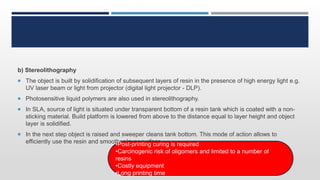
b) Stereolithography
 The object is built by solidification of subsequent layers of resin in the presence of high energy light e.g.
UV laser beam or light from projector (digital light projector - DLP).
 Photosensitive liquid polymers are also used in stereolithography.
 In SLA, source of light is situated under transparent bottom of a resin tank which is coated with a non-
sticking material. Build platform is lowered from above to the distance equal to layer height and object
layer is solidified.
 In the next step object is raised and sweeper cleans tank bottom. This mode of action allows to
efficiently use the resin and smoother layer surface.•Post-printing curing is required
•Carcinogenic risk of oligomers and limited to a number of
resins
•Costly equipment
•Long printing time
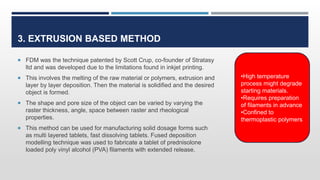
3. EXTRUSION BASED METHOD
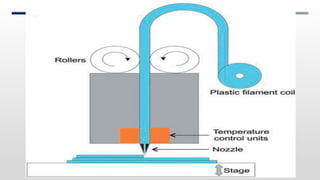
 FDM was the technique patented by Scott Crup, co-founder of Stratasy
ltd and was developed due to the limitations found in inkjet printing.
 This involves the melting of the raw material or polymers, extrusion and
layer by layer deposition. Then the material is solidified and the desired
object is formed.
 The shape and pore size of the object can be varied by varying the
raster thickness, angle, space between raster and rheological
properties.
 This method can be used for manufacturing solid dosage forms such
as multi layered tablets, fast dissolving tablets. Fused deposition
modelling technique was used to fabricate a tablet of prednisolone
loaded poly vinyl alcohol (PVA) filaments with extended release.
•High temperature
process might degrade
starting materials.
•Requires preparation
of filaments in advance
•Confined to
thermoplastic polymers
ADVANTAGES
The processes that are traditionally adopted by pharmaceutical industries such as milling, mixing, granulation and compression
sometimes results in uneven qualities of the final products depending on the factors such as drug loading, drug release, drug stability
and pharmaceutical dosage form stability. On the other hand, 3D printing, as a powerful tool technology, has competitive advantages
such as improved R and D productivity, improved safety, efficacy and accessibility of medicine.
1. Personalised medication
2. Create complex shapes
3. Reduce time
4. Stay ahead of competition
5. Reduce errors
6. Production on demand
7. Reduce cost ( Less machine, Labour, Less waste)
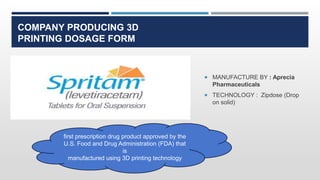
COMPANY PRODUCING 3D
PRINTING DOSAGE FORM
 MANUFACTURE BY : Aprecia
Pharmaceuticals
 TECHNOLOGY : Zipdose (Drop
on solid)
first prescription drug product approved by the
U.S. Food and Drug Administration (FDA) that
is
manufactured using 3D printing technology
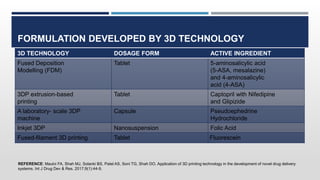
FORMULATION DEVELOPED BY 3D TECHNOLOGY
3D TECHNOLOGY DOSAGE FORM ACTIVE INGREDIENT
Fused Deposition
Modelling (FDM)
Tablet 5-aminosalicylic acid
(5-ASA, mesalazine)
and 4-aminosalicylic
acid (4-ASA)
3DP extrusion-based
printing
Tablet Captopril with Nifedipine
and Glipizide
A laboratory- scale 3DP
machine
Capsule Pseudoephedrine
Hydrochloride
Inkjet 3DP Nanosuspension Folic Acid
Fused-filament 3D printing Tablet Fluorescein
REFERENCE: Maulvi FA, Shah MJ, Solanki BS, Patel AS, Soni TG, Shah DO. Application of 3D printing technology in the development of novel drug delivery
systems. Int J Drug Dev & Res. 2017;9(1):44-9.
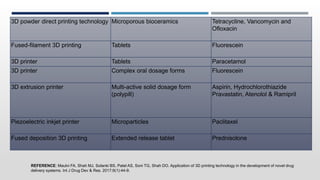
3D powder direct printing technology Microporous bioceramics Tetracycline, Vancomycin and
Ofloxacin
Fused-filament 3D printing Tablets Fluorescein
3D printer Tablets Paracetamol
3D printer Complex oral dosage forms Fluorescein
3D extrusion printer Multi-active solid dosage form
(polypill)
Aspirin, Hydrochlorothiazide
Pravastatin, Atenolol & Ramipril
Piezoelectric inkjet printer Microparticles Paclitaxel
Fused deposition 3D printing Extended release tablet Prednisolone
REFERENCE: Maulvi FA, Shah MJ, Solanki BS, Patel AS, Soni TG, Shah DO. Application of 3D printing technology in the development of novel drug
delivery systems. Int J Drug Dev & Res. 2017;9(1):44-9.
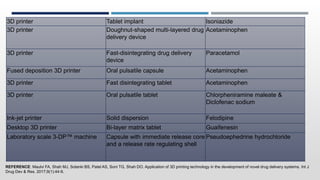
3D printer Tablet implant Isoniazide
3D printer Doughnut-shaped multi-layered drug
delivery device
Acetaminophen
3D printer Fast-disintegrating drug delivery
device
Paracetamol
Fused deposition 3D printer Oral pulsatile capsule Acetaminophen
3D printer Fast disintegrating tablet Acetaminophen
3D printer Oral pulsatile tablet Chlorpheniramine maleate &
Diclofenac sodium
Ink-jet printer Solid dispersion Felodipine
Desktop 3D printer Bi-layer matrix tablet Guaifenesin
Laboratory scale 3-DP™ machine Capsule with immediate release core
and a release rate regulating shell
Pseudoephedrine hydrochloride
REFERENCE: Maulvi FA, Shah MJ, Solanki BS, Patel AS, Soni TG, Shah DO. Application of 3D printing technology in the development of novel drug delivery systems. Int J
Drug Dev & Res. 2017;9(1):44-9.
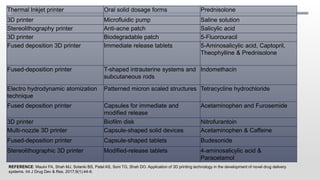
Thermal Inkjet printer Oral solid dosage forms Prednisolone
3D printer Microfluidic pump Saline solution
Stereolithography printer Anti-acne patch Salicylic acid
3D printer Biodegradable patch 5-Fluorouracil
Fused deposition 3D printer Immediate release tablets 5-Aminosalicylic acid, Captopril,
Theophylline & Prednisolone
Fused-deposition printer T-shaped intrauterine systems and
subcutaneous rods
Indomethacin
Electro hydrodynamic atomization
technique
Patterned micron scaled structures Tetracycline hydrochloride
Fused deposition printer Capsules for immediate and
modified release
Acetaminophen and Furosemide
3D printer Biofilm disk Nitrofurantoin
Multi-nozzle 3D printer Capsule-shaped solid devices Acetaminophen & Caffeine
Fused-deposition printer Capsule-shaped tablets Budesonide
Stereolithographic 3D printer Modified-release tablets 4-aminosalicylic acid &
Paracetamol
REFERENCE: Maulvi FA, Shah MJ, Solanki BS, Patel AS, Soni TG, Shah DO. Application of 3D printing technology in the development of novel drug delivery
systems. Int J Drug Dev & Res. 2017;9(1):44-9.

IM
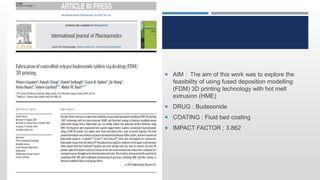
 AIM : The aim of this work was to explore the
feasibility of using fused deposition modelling
(FDM) 3D printing technology with hot melt
extrusion (HME)
 DRUG : Budesonide
 COATING : Fluid bed coating
 IMPACT FACTOR : 3.862
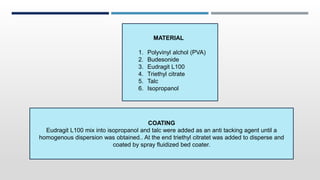
MATERIAL
1. Polyvinyl alchol (PVA)
2. Budesonide
3. Eudragit L100
4. Triethyl citrate
5. Talc
6. Isopropanol
COATING
Eudragit L100 mix into isopropanol and talc were added as an anti tacking agent until a
homogenous dispersion was obtained.. At the end triethyl citratet was added to disperse and
coated by spray fluidized bed coater.
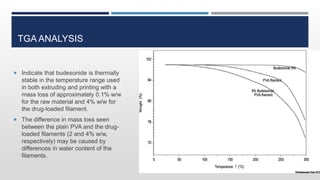
TGA ANALYSIS
 Indicate that budesonide is thermally
stable in the temperature range used
in both extruding and printing with a
mass loss of approximately 0.1% w/w
for the raw material and 4% w/w for
the drug-loaded filament.
 The difference in mass loss seen
between the plain PVA and the drug-
loaded filaments (2 and 4% w/w,
respectively) may be caused by
differences in water content of the
filaments.
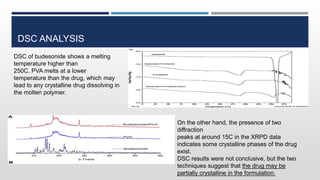
DSC ANALYSIS
DSC of budesonide shows a melting
temperature higher than
250C. PVA melts at a lower
temperature than the drug, which may
lead to any crystalline drug dissolving in
the molten polymer.
On the other hand, the presence of two
diffraction
peaks at around 15C in the XRPD data
indicates some crystalline phases of the drug
exist.
DSC results were not conclusive, but the two
techniques suggest that the drug may be
partially crystalline in the formulation.
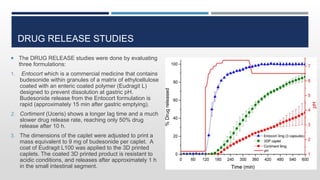
DRUG RELEASE STUDIES
 The DRUG RELEASE studies were done by evaluating
three formulations:
1. Entocort which is a commercial medicine that contains
budesonide within granules of a matrix of ethylcellulose
coated with an enteric coated polymer (Eudragit L)
designed to prevent dissolution at gastric pH.
Budesonide release from the Entocort formulation is
rapid (approximately 15 min after gastric emptying).
2. Cortiment (Uceris) shows a longer lag time and a much
slower drug release rate, reaching only 50% drug
release after 10 h.
3. The dimensions of the caplet were adjusted to print a
mass equivalent to 9 mg of budesonide per caplet. A
coat of Eudragit L100 was applied to the 3D printed
caplets. The coated 3D printed product is resistant to
acidic conditions, and releases after approximately 1 h
in the small intestinal segment.
CONCLUSION
 A new modified release 9 mg budesonide product was created by combining 3D printing with HME and
film coating.
 The release characteristics of the new product are such that it has potential in the treatment of
inflammatory bowel disease.
REFERENCES
1. Jamróz W, Szafraniec J, Kurek M, Jachowicz R.; “3D printing in pharmaceutical and
medical applications–recent achievements and challenges” Pharmaceutical research; 2018
Sep1;35:176.
2. Goyanes A, Chang H, Sedough D, Hatton GB, Wang J, Buanz A, Gaisford S, Basit AW;
“Fabrication of controlled - release budesonide tablets via desktop (FDM) 3D printing”;
International journal of pharmaceutics. 2015 Dec 30;496(2):414-20.
3. Bhusnure OG, Gholve VS, Sugave BK, Dongre RC, Gore SA, Giram PS; “3D Printing &
Pharmaceutical Manufacturing: Opportunities and Challenges”; International Journal of
Bioassays. 2016 Jan 1;5(1):4723-38.
4. Maulvi FA, Shah MJ, Solanki BS, Patel AS, Soni TG, Shah DO; “Application of 3D printing
technology in the development of novel drug delivery systems” Int J Drug Dev & Res.
2017;9(1):44-9.
5. 5. Bansal M, Sharma V, Singh G, Harikumar S.L.; “3D printing for the future of
pharmaceutical dosage forms” Int J App Pharm, Vol 10, Issue 3, 2018, 1-7
3 d printing

3 d printing

  • 1.
    3D PRINTING SUBMITTED BY : GAURAV M.PHARMA2ND SEM (PHARMACEUTICS) JAMIA HAMDARD
  • 2.
    CONTENT  WHAT IS3D PRINTING  HISTORY  SOME PRODUCTS  BASIC STEPS  METHODS  ADVANTAGES OF 3D PRINTING  FORMULATIONS
  • 3.
    WHAT IS 3DPRINTING?  It is a method of converting a virtual 3d model into a physical objective and also known as additive manufacturing process  3D printing can be defined as a process used to fabricate a 3D object by deposition of successive layers in different shapes taken directly from computer aided design data (Liu et al., 2013).  The term three-dimensional printing was defined by ISO as: “fabrication of objects through the deposition of a material using a print head, nozzle, or another printer technology”.
  • 4.
  • 5.
    HISTORY  3D printingwas first described by Charles Hull in 1986 and called it as “stereolithography”. Hull later founded his own company as “3D system” where he designed a stereolithography based 3D printer and was commercially available in market in 1988 .  In 1987, Carl Deckard filed a patent for the selective laser sintering (SLS) and was isseued in 1989.  In 1989, Scott Crump, filed a patent for fused deposition modelling (FDM) and was issued in 1992  In 1989, Hans Langer founded the EOS GmbH in Germany and further focused on the laser sintering (LS) process
  • 6.
     From 90’sto 2000 host of new technologies like 1. solid scape and Zcorporation (1996) 2. Arcam (1997) 3. Object geometries (1998) 4. MCP technologiess (2000) 5. EnvisionTechnology (2002)  The 1st small kit 3d printer was commercially available in 2009 for the application bases on RepRap concept
  • 7.
    SOME PRODUCTS Richard VanAs, a South African carpenter, assembles a robohand and fit it . Liam was born without fingers on his right hand. Makerbot provided them with the 3d printing technology that they used to print the parts for the robohand.
  • 8.
    Nike Vapor HyperAgilityCleat General Electric’s prototype jet engines
  • 9.
    LSEV is madeby 3d printing, it is a electric car Price -$7500 Now available in Asia and Europe
  • 10.
    BASIC STEP START DEPOSITION OF LAYER PRINTHEAD APPLIES RESIN TO POWDER LAYER LAYER DRIES ALMOST ADD ANOTHER LAYER ? REMOVE COMPLETED MODEL FINISH
  • 11.
    STEP 1 (CADFILE IS CREATED)  A model of the object is created on a computer. Software analyses this model, taking a series of cross-section and working out the distribution of space and solid matter within each layer
  • 12.
    STEP 2  CADfile is exported to a 3d printing machine
  • 13.
    STEP 3 (ACTUALOBJECT)  Once each layer is complete, the build tray is lowered by a fraction of a millimetre and the construction of the next layer begins. When all the layer have been completed, any excess material is cleaned away to revel the finished object.
  • 14.
    3D PRINTING TECHNOLOGIES Main technologies are based on : 1.POWDER SOLIDIFICATION 2.LIQUID SOLIDIFICATION 3.EXTRUSION
  • 16.
    1.POWDER SOLIDIFICATION a) DROPON SOLID  The printing process mode of action is similar to desktop inkjet printers and is called drop on solid deposition. Droplets of ink sprayed from print head bind the layer of free powder bed while unbound powder particles act as a support material preventing from collapsing of overhang or porous structures. After each step the formed object is lowered and a layer of free powder is applied by roller or powder jetting system and process is proceeded.  The first printers were equipped with commercially available thermal or piezoelectric print heads that delivered bonding agent. Active pharmaceutical ingredients as well as modifying agents can be either dissolved or dispersed in ink or distributed in powder bed.  This method was used due to its similarity to classical formulation processes as wet granulation.
  • 17.
     The layerheight is mainly influenced by particle size and flowability of powder bed as well as cohesion force between particles and part of the printer or powder wettability.  The ink constituents as solvents, APIs or modifying excipients can change viscosity, droplet size and influence the efficiency of powder binding. The process parameters as printing speed, droplet volume, distance from powder bed also play an important role in the product development and can have an impact on the powder bonding especially between layers in Z axis.  The DOS method is suitable for preparation of easily disintegrating tablet with porous structure. The development in this filed have led to the commercialization of ZipDose technology by APRECIA PHARMACEUTICAL •Post-printing drying is required •The friability and hardness are compromised for fast disintegrating tablets •Requires a specialized powder facility
  • 20.
    b) SELECTIVE LAZERSINTERING  A powder can be also solidified by applying the beam of high energy.  The basic construction assumptions of selective laser sintering or selective laser melting (SLM) are similar to DOS method.  Powdered bed is transferred from one compartment to another by levelling system and layers are formed by sintering (heating just below melting temperature) or melting the polymeric or metallic powdered bed by laser beam.  Powder bed must be heated before printing in the printer chamber to the temperature adequate to the process parameters. After printing the fabricated objects are imbedded in powder and the bed should be slowly cooled down to avoid stress. DRAWBACK Steps are time consuming the risk of API decomposition after exposure to laser beam. Stability issues and production time are important challenges.
  • 23.
    2. LIQUID SOLIDIFICATION a)DROP ON DROP  The idea of object manufacturing by solidification of liquid is similar to powder solidification technique. Droplets of “ink” sprayed from the nozzle are deposited on the thin layers and cured by cooling air.  Due to the absence of powdered bed the drop on drop (DOD) or Polyjet technology requires the use of additional material to create support for overhang geometries.  The print head moves along X and Y axes during printing, the print platform bed is lowered along Z axis by the height of the layer after the deposition of each layer of the material. Different technical solutions applied in this technique resulted in possibility of multi-material fullcolor printing.  The first materials used in this techniques were waxes. Molten wax was sprayed on build platform in heated chamber to prevent rapid solidification. Matrix tablets containing beeswax and fenofibrate were prepared This technology were used in modified release dosage form
  • 24.
     Photosensitive polymers canbe also used in this techniques and solidification of the layers is achieved by UV light. TIME TAKEN Average printing time of tablet of 14mg mass have 5.02mm (d) and 0.72mm (h) is 4 minutes. CHALLENGES 1. Process of adaptation of a wide range of polymers needs to be evaluated. 2. The modification in wax matrix composition or application of hydrophilic polymers may have a great impact on dissolution behavior. 3. In case of solidification method based on UV light, possibility of APIs decomposition and stability matters should be taken into account
  • 26.
    b) Stereolithography  Theobject is built by solidification of subsequent layers of resin in the presence of high energy light e.g. UV laser beam or light from projector (digital light projector - DLP).  Photosensitive liquid polymers are also used in stereolithography.  In SLA, source of light is situated under transparent bottom of a resin tank which is coated with a non- sticking material. Build platform is lowered from above to the distance equal to layer height and object layer is solidified.  In the next step object is raised and sweeper cleans tank bottom. This mode of action allows to efficiently use the resin and smoother layer surface.•Post-printing curing is required •Carcinogenic risk of oligomers and limited to a number of resins •Costly equipment •Long printing time
  • 28.
    3. EXTRUSION BASEDMETHOD  FDM was the technique patented by Scott Crup, co-founder of Stratasy ltd and was developed due to the limitations found in inkjet printing.  This involves the melting of the raw material or polymers, extrusion and layer by layer deposition. Then the material is solidified and the desired object is formed.  The shape and pore size of the object can be varied by varying the raster thickness, angle, space between raster and rheological properties.  This method can be used for manufacturing solid dosage forms such as multi layered tablets, fast dissolving tablets. Fused deposition modelling technique was used to fabricate a tablet of prednisolone loaded poly vinyl alcohol (PVA) filaments with extended release. •High temperature process might degrade starting materials. •Requires preparation of filaments in advance •Confined to thermoplastic polymers
  • 31.
    ADVANTAGES The processes thatare traditionally adopted by pharmaceutical industries such as milling, mixing, granulation and compression sometimes results in uneven qualities of the final products depending on the factors such as drug loading, drug release, drug stability and pharmaceutical dosage form stability. On the other hand, 3D printing, as a powerful tool technology, has competitive advantages such as improved R and D productivity, improved safety, efficacy and accessibility of medicine. 1. Personalised medication 2. Create complex shapes 3. Reduce time 4. Stay ahead of competition 5. Reduce errors 6. Production on demand 7. Reduce cost ( Less machine, Labour, Less waste)
  • 32.
    COMPANY PRODUCING 3D PRINTINGDOSAGE FORM  MANUFACTURE BY : Aprecia Pharmaceuticals  TECHNOLOGY : Zipdose (Drop on solid) first prescription drug product approved by the U.S. Food and Drug Administration (FDA) that is manufactured using 3D printing technology
  • 33.
    FORMULATION DEVELOPED BY3D TECHNOLOGY 3D TECHNOLOGY DOSAGE FORM ACTIVE INGREDIENT Fused Deposition Modelling (FDM) Tablet 5-aminosalicylic acid (5-ASA, mesalazine) and 4-aminosalicylic acid (4-ASA) 3DP extrusion-based printing Tablet Captopril with Nifedipine and Glipizide A laboratory- scale 3DP machine Capsule Pseudoephedrine Hydrochloride Inkjet 3DP Nanosuspension Folic Acid Fused-filament 3D printing Tablet Fluorescein REFERENCE: Maulvi FA, Shah MJ, Solanki BS, Patel AS, Soni TG, Shah DO. Application of 3D printing technology in the development of novel drug delivery systems. Int J Drug Dev & Res. 2017;9(1):44-9.
  • 34.
    3D powder directprinting technology Microporous bioceramics Tetracycline, Vancomycin and Ofloxacin Fused-filament 3D printing Tablets Fluorescein 3D printer Tablets Paracetamol 3D printer Complex oral dosage forms Fluorescein 3D extrusion printer Multi-active solid dosage form (polypill) Aspirin, Hydrochlorothiazide Pravastatin, Atenolol & Ramipril Piezoelectric inkjet printer Microparticles Paclitaxel Fused deposition 3D printing Extended release tablet Prednisolone REFERENCE: Maulvi FA, Shah MJ, Solanki BS, Patel AS, Soni TG, Shah DO. Application of 3D printing technology in the development of novel drug delivery systems. Int J Drug Dev & Res. 2017;9(1):44-9.
  • 35.
    3D printer Tabletimplant Isoniazide 3D printer Doughnut-shaped multi-layered drug delivery device Acetaminophen 3D printer Fast-disintegrating drug delivery device Paracetamol Fused deposition 3D printer Oral pulsatile capsule Acetaminophen 3D printer Fast disintegrating tablet Acetaminophen 3D printer Oral pulsatile tablet Chlorpheniramine maleate & Diclofenac sodium Ink-jet printer Solid dispersion Felodipine Desktop 3D printer Bi-layer matrix tablet Guaifenesin Laboratory scale 3-DP™ machine Capsule with immediate release core and a release rate regulating shell Pseudoephedrine hydrochloride REFERENCE: Maulvi FA, Shah MJ, Solanki BS, Patel AS, Soni TG, Shah DO. Application of 3D printing technology in the development of novel drug delivery systems. Int J Drug Dev & Res. 2017;9(1):44-9.

  • 36.
    Thermal Inkjet printerOral solid dosage forms Prednisolone 3D printer Microfluidic pump Saline solution Stereolithography printer Anti-acne patch Salicylic acid 3D printer Biodegradable patch 5-Fluorouracil Fused deposition 3D printer Immediate release tablets 5-Aminosalicylic acid, Captopril, Theophylline & Prednisolone Fused-deposition printer T-shaped intrauterine systems and subcutaneous rods Indomethacin Electro hydrodynamic atomization technique Patterned micron scaled structures Tetracycline hydrochloride Fused deposition printer Capsules for immediate and modified release Acetaminophen and Furosemide 3D printer Biofilm disk Nitrofurantoin Multi-nozzle 3D printer Capsule-shaped solid devices Acetaminophen & Caffeine Fused-deposition printer Capsule-shaped tablets Budesonide Stereolithographic 3D printer Modified-release tablets 4-aminosalicylic acid & Paracetamol REFERENCE: Maulvi FA, Shah MJ, Solanki BS, Patel AS, Soni TG, Shah DO. Application of 3D printing technology in the development of novel drug delivery systems. Int J Drug Dev & Res. 2017;9(1):44-9.
  • 37.
    IM  AIM :The aim of this work was to explore the feasibility of using fused deposition modelling (FDM) 3D printing technology with hot melt extrusion (HME)  DRUG : Budesonide  COATING : Fluid bed coating  IMPACT FACTOR : 3.862
  • 38.
    MATERIAL 1. Polyvinyl alchol(PVA) 2. Budesonide 3. Eudragit L100 4. Triethyl citrate 5. Talc 6. Isopropanol COATING Eudragit L100 mix into isopropanol and talc were added as an anti tacking agent until a homogenous dispersion was obtained.. At the end triethyl citratet was added to disperse and coated by spray fluidized bed coater.
  • 39.
    TGA ANALYSIS  Indicatethat budesonide is thermally stable in the temperature range used in both extruding and printing with a mass loss of approximately 0.1% w/w for the raw material and 4% w/w for the drug-loaded filament.  The difference in mass loss seen between the plain PVA and the drug- loaded filaments (2 and 4% w/w, respectively) may be caused by differences in water content of the filaments.
  • 40.
    DSC ANALYSIS DSC ofbudesonide shows a melting temperature higher than 250C. PVA melts at a lower temperature than the drug, which may lead to any crystalline drug dissolving in the molten polymer. On the other hand, the presence of two diffraction peaks at around 15C in the XRPD data indicates some crystalline phases of the drug exist. DSC results were not conclusive, but the two techniques suggest that the drug may be partially crystalline in the formulation.
  • 41.
    DRUG RELEASE STUDIES The DRUG RELEASE studies were done by evaluating three formulations: 1. Entocort which is a commercial medicine that contains budesonide within granules of a matrix of ethylcellulose coated with an enteric coated polymer (Eudragit L) designed to prevent dissolution at gastric pH. Budesonide release from the Entocort formulation is rapid (approximately 15 min after gastric emptying). 2. Cortiment (Uceris) shows a longer lag time and a much slower drug release rate, reaching only 50% drug release after 10 h. 3. The dimensions of the caplet were adjusted to print a mass equivalent to 9 mg of budesonide per caplet. A coat of Eudragit L100 was applied to the 3D printed caplets. The coated 3D printed product is resistant to acidic conditions, and releases after approximately 1 h in the small intestinal segment.
  • 42.
    CONCLUSION  A newmodified release 9 mg budesonide product was created by combining 3D printing with HME and film coating.  The release characteristics of the new product are such that it has potential in the treatment of inflammatory bowel disease.
  • 43.
    REFERENCES 1. Jamróz W,Szafraniec J, Kurek M, Jachowicz R.; “3D printing in pharmaceutical and medical applications–recent achievements and challenges” Pharmaceutical research; 2018 Sep1;35:176. 2. Goyanes A, Chang H, Sedough D, Hatton GB, Wang J, Buanz A, Gaisford S, Basit AW; “Fabrication of controlled - release budesonide tablets via desktop (FDM) 3D printing”; International journal of pharmaceutics. 2015 Dec 30;496(2):414-20. 3. Bhusnure OG, Gholve VS, Sugave BK, Dongre RC, Gore SA, Giram PS; “3D Printing & Pharmaceutical Manufacturing: Opportunities and Challenges”; International Journal of Bioassays. 2016 Jan 1;5(1):4723-38. 4. Maulvi FA, Shah MJ, Solanki BS, Patel AS, Soni TG, Shah DO; “Application of 3D printing technology in the development of novel drug delivery systems” Int J Drug Dev & Res. 2017;9(1):44-9. 5. 5. Bansal M, Sharma V, Singh G, Harikumar S.L.; “3D printing for the future of pharmaceutical dosage forms” Int J App Pharm, Vol 10, Issue 3, 2018, 1-7