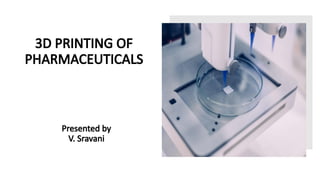
3D PRINTING OF
PHARMACEUTICALS
Presented by
V. Sravani
What is 3D printing?​
How it is started?​
Why do we need it?​
How it works?​
What are the applications and
challenges ?​
Who are doing it?​
What are the products of this
technology?​
What is 3D Printing?
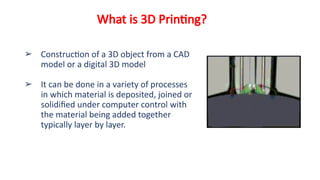
➢ Construction of a 3D object from a CAD
model or a digital 3D model
➢ It can be done in a variety of processes
in which material is deposited, joined or
solidified under computer control with
the material being added together
typically layer by layer.
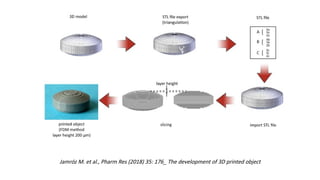
How does it works?
➢ Design of 3D object with computer-aided design software and
optimization of the geometry according to printer specification
➢ Generation of an printer recognizable format like STL file
➢ Processing of STL file in slicer software which converts model into a
series of thin layers and produce G-Code file containing
instructions tailored to a specific type of 3d printer
➢ Printing G-Code file with 3D printing software
Jamróz M. et al., Pharm Res (2018) 35: 176_ The development of 3D printed object
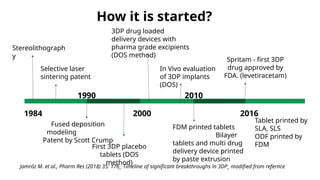
How it is started?
Fused deposition
modeling
Patent by Scott Crump
1990
2000
3DP drug loaded
delivery devices with
pharma grade excipients
(DOS method)
2010
FDM printed tablets
Bilayer
tablets and multi drug
delivery device printed
by paste extrusion
2016
Spritam - first 3DP
drug approved by
FDA. (levetiracetam)
Selective laser
sintering patent
Tablet printed by
SLA, SLS
ODF printed by
FDM
In Vivo evaluation
of 3DP implants
(DOS)
1984
Stereolithograph
y
First 3DP placebo
tablets (DOS
method)
Jamróz M. et al., Pharm Res (2018) 35: 176_ Timeline of significant breakthroughs in 3DP_ modified from refernce
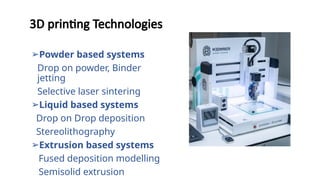
3D printing Technologies
➢Powder based systems
Drop on powder, Binder
jetting
Selective laser sintering
➢Liquid based systems
Drop on Drop deposition
Stereolithography
➢Extrusion based systems
Fused deposition modelling
Semisolid extrusion
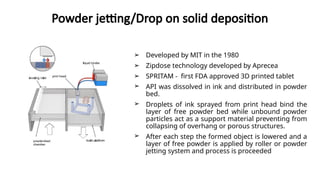
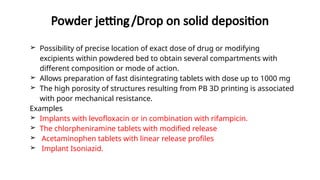
Powder jetting/Drop on solid deposition
➢ Developed by MIT in the 1980
➢ Zipdose technology developed by Aprecea
➢ SPRITAM - first FDA approved 3D printed tablet
➢ API was dissolved in ink and distributed in powder
bed.
➢ Droplets of ink sprayed from print head bind the
layer of free powder bed while unbound powder
particles act as a support material preventing from
collapsing of overhang or porous structures.
➢ After each step the formed object is lowered and a
layer of free powder is applied by roller or powder
jetting system and process is proceeded
Powder jetting/Drop on solid deposition
➢ Possibility of precise location of exact dose of drug or modifying
excipients within powdered bed to obtain several compartments with
different composition or mode of action.
➢ Allows preparation of fast disintegrating tablets with dose up to 1000 mg
➢ The high porosity of structures resulting from PB 3D printing is associated
with poor mechanical resistance.
Examples
➢ Implants with levofloxacin or in combination with rifampicin.
➢ The chlorpheniramine tablets with modified release
➢ Acetaminophen tablets with linear release profiles
➢ Implant Isoniazid.
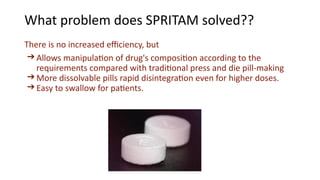
What problem does SPRITAM solved??
There is no increased efficiency, but
➔ Allows manipulation of drug's composition according to the
requirements compared with traditional press and die pill-making
➔ More dissolvable pills rapid disintegration even for higher doses.
➔ Easy to swallow for patients.
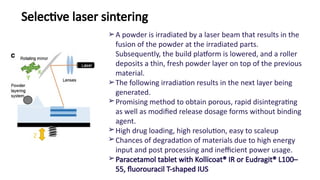
Selective laser sintering
➢A powder is irradiated by a laser beam that results in the
fusion of the powder at the irradiated parts.
Subsequently, the build platform is lowered, and a roller
deposits a thin, fresh powder layer on top of the previous
material.
➢The following irradiation results in the next layer being
generated.
➢Promising method to obtain porous, rapid disintegrating
as well as modified release dosage forms without binding
agent.
➢High drug loading, high resolution, easy to scaleup
➢Chances of degradation of materials due to high energy
input and post processing and inefficient power usage.
➢Paracetamol tablet with Kollicoat® IR or Eudragit® L100–
55, fluorouracil T-shaped IUS
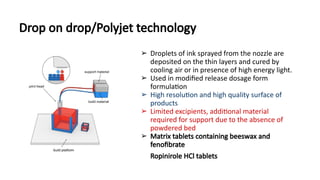
Drop on drop/Polyjet technology
➢ Droplets of ink sprayed from the nozzle are
deposited on the thin layers and cured by
cooling air or in presence of high energy light.
➢ Used in modified release dosage form
formulation
➢ High resolution and high quality surface of
products
➢ Limited excipients, additional material
required for support due to the absence of
powdered bed
➢ Matrix tablets containing beeswax and
fenofibrate
Ropinirole HCl tablets
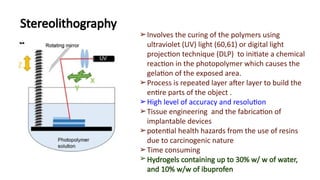
Stereolithography
➢Involves the curing of the polymers using
ultraviolet (UV) light (60,61) or digital light
projection technique (DLP) to initiate a chemical
reaction in the photopolymer which causes the
gelation of the exposed area.
➢Process is repeated layer after layer to build the
entire parts of the object .
➢High level of accuracy and resolution
➢Tissue engineering and the fabrication of
implantable devices
➢potential health hazards from the use of resins
due to carcinogenic nature
➢Time consuming
➢Hydrogels containing up to 30% w/ w of water,
and 10% w/w of ibuprofen
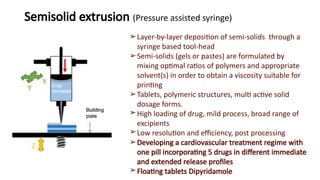
Semisolid extrusion (Pressure assisted syringe)
➢Layer-by-layer deposition of semi-solids through a
syringe based tool-head
➢Semi-solids (gels or pastes) are formulated by
mixing optimal ratios of polymers and appropriate
solvent(s) in order to obtain a viscosity suitable for
printing
➢Tablets, polymeric structures, multi active solid
dosage forms.
➢High loading of drug, mild process, broad range of
excipients
➢Low resolution and efficiency, post processing
➢Developing a cardiovascular treatment regime with
one pill incorporating 5 drugs in different immediate
and extended release profiles
➢Floating tablets Dipyridamole
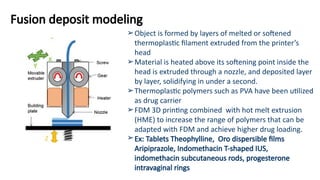
Fusion deposit modeling
➢Object is formed by layers of melted or softened
thermoplastic filament extruded from the printer’s
head
➢Material is heated above its softening point inside the
head is extruded through a nozzle, and deposited layer
by layer, solidifying in under a second.
➢Thermoplastic polymers such as PVA have been utilized
as drug carrier
➢FDM 3D printing combined with hot melt extrusion
(HME) to increase the range of polymers that can be
adapted with FDM and achieve higher drug loading.
➢Ex: Tablets Theophylline, Oro dispersible films
Aripiprazole, Indomethacin T-shaped IUS,
indomethacin subcutaneous rods, progesterone
intravaginal rings
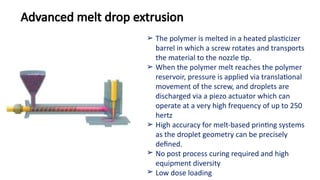
Advanced melt drop extrusion
➢ The polymer is melted in a heated plasticizer
barrel in which a screw rotates and transports
the material to the nozzle tip.
➢ When the polymer melt reaches the polymer
reservoir, pressure is applied via translational
movement of the screw, and droplets are
discharged via a piezo actuator which can
operate at a very high frequency of up to 250
hertz
➢ High accuracy for melt-based printing systems
as the droplet geometry can be precisely
defined.
➢ No post process curing required and high
equipment diversity
➢ Low dose loading
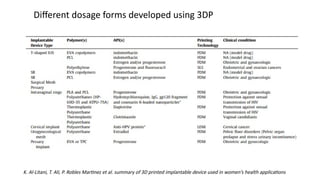
Different dosage forms developed using 3DP
K. Al-Litani, T. Ali, P. Robles Martinez et al. summary of 3D printed implantable device used in women’s health applications
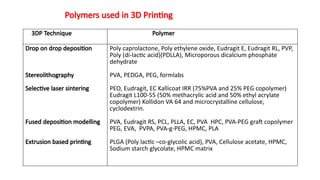
3DP Technique Polymer
Drop on drop deposition
Stereolithography
Selective laser sintering
Fused deposition modelling
Extrusion based printing
Poly caprolactone, Poly ethylene oxide, Eudragit E, Eudragit RL, PVP,
Poly (di-lactic acid)(PDLLA), Microporous dicalcium phosphate
dehydrate
PVA, PEDGA, PEG, formlabs
PEO, Eudragit, EC Kallicoat IRR (75%PVA and 25% PEG copolymer)
Eudragit L100-55 (50% methacrylic acid and 50% ethyl acrylate
copolymer) Kollidon VA 64 and microcrystalline cellulose,
cyclodextrin.
PVA, Eudragit RS, PCL, PLLA, EC, PVA HPC, PVA-PEG graft copolymer
PEG, EVA, PVPA, PVA-g-PEG, HPMC, PLA
PLGA (Poly lactic –co-glycolic acid), PVA, Cellulose acetate, HPMC,
Sodium starch glycolate, HPMC matrix
Polymers used in 3D Printing
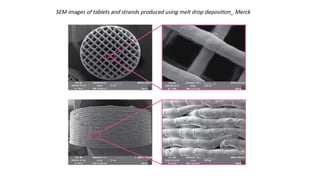
SEM images of tablets and strands produced using melt drop deposition_ Merck
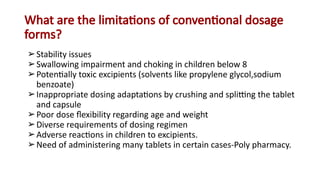
What are the limitations of conventional dosage
forms?
➢Stability issues
➢Swallowing impairment and choking in children below 8
➢Potentially toxic excipients (solvents like propylene glycol,sodium
benzoate)
➢Inappropriate dosing adaptations by crushing and splitting the tablet
and capsule
➢Poor dose flexibility regarding age and weight
➢Diverse requirements of dosing regimen
➢Adverse reactions in children to excipients.
➢Need of administering many tablets in certain cases-Poly pharmacy.
What we can do with 3D printing?
Increased Product complexity
On demand manufacturing
Personalized medicine
Increased product complexity
➢A drug product’s structure can affect drug release, complex 3D
structures create new opportunities for drug delivery.
Ex: SPRITAM®, has a unitary porous structure produced by a 3D
printing process that binds powders without compression which
allows tablets with up to 1000 mg of levetiracetam to disintegrate
within seconds when taken with a sip of water.
➢Dissolution rates can be increased by printing high-surface-area
shapes and amorphous dispersions by hot melt extrusion
➢Problems associated with occupational exposure to potent APIs, can
be solved by powder-free printing processes that encapsulate API in
multiple layers of excipients
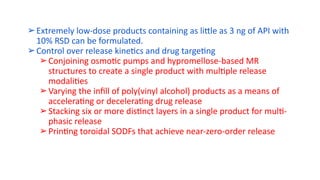
➢Extremely low-dose products containing as little as 3 ng of API with
10% RSD can be formulated.
➢Control over release kinetics and drug targeting
➢Conjoining osmotic pumps and hypromellose-based MR
structures to create a single product with multiple release
modalities
➢Varying the infill of poly(vinyl alcohol) products as a means of
accelerating or decelerating drug release
➢Stacking six or more distinct layers in a single product for multi-
phasic release
➢Printing toroidal SODFs that achieve near-zero-order release
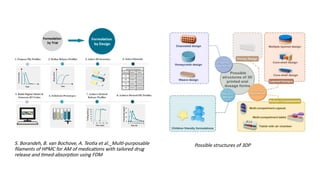
S. Borandeh, B. van Bochove, A. Teotia et al._Multi-purposable
filaments of HPMC for AM of medications with tailored drug
release and timed-absorption using FDM
Possible structures of 3DP
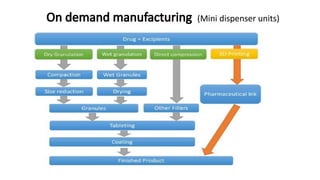
On demand manufacturing (Mini dispenser units)
➢ Rapid printing from digital designs- no intermediate machining
➢ Flexibility in changing design and composition without need of changing
the entire setup or machinery
➢ Printing at the point of care
➢ Reducing the barriers to experimentation during drug product
development
➢ Drugs with low stability and limited shelf life can be manufactured at the
time of need directly
➢ Accelerating the drug development process
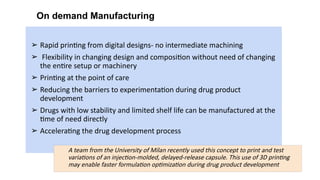
A team from the University of Milan recently used this concept to print and test
variations of an injection-molded, delayed-release capsule. This use of 3D printing
may enable faster formulation optimization during drug product development
On demand Manufacturing
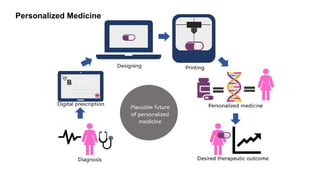
Personalized Medicine
➢ Tailored doses and dosage forms
for potent drugs, growing
children.
➢ Drug loaded implants to match
the anatomy of patient
➢ Polypills that combine different
drugs into single pill (with varying
doses)
➢ Hallow products with variable
infill to control the drug release
rate
➢ Reduced side effects
➢ Reduced complications after
implantation
➢ Increased adherence
➢ Reduced metabolic burden for
elderly
➢ Appropriate drug release
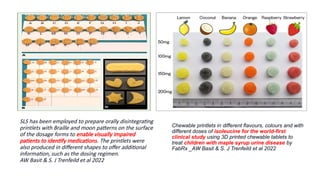
SLS has been employed to prepare orally disintegrating
printlets with Braille and moon patterns on the surface
of the dosage forms to enable visually impaired
patients to identify medications. The printlets were
also produced in different shapes to offer additional
information, such as the dosing regimen.
AW Basit & S. J Trenfeild et al 2022
Chewable printlets in different flavours, colours and with
different doses of isoleucine for the world-first
clinical study using 3D printed chewable tablets to
treat children with maple syrup urine disease by
FabRx _AW Basit & S. J Trenfeild et al 2022
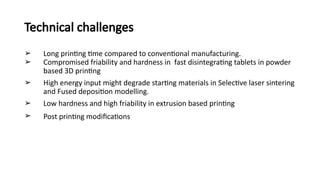
Technical challenges
➢ Long printing time compared to conventional manufacturing.
➢ Compromised friability and hardness in fast disintegrating tablets in powder
based 3D printing
➢ High energy input might degrade starting materials in Selective laser sintering
and Fused deposition modelling.
➢ Low hardness and high friability in extrusion based printing
➢ Post printing modifications
Regulatory Challenges
➢ what are the critical parameters affecting the printability of various
materials into drug products?
➢ What are the critical process parameters for each 3D printing technology?
➢ How can we assess the performance of 3D printed drug products?
➢ Can we use traditional in vitro testing methods for 3D printed drug
products?
➢ How can we determine when and how a certain 3D geometric design may
not perform as it should?
➢ What are the critical factors in 3D-printed design that affect the drug release
rates and mechanisms?
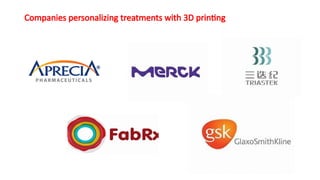
Companies personalizing treatments with 3D printing
References
➢ Abdul W Basit & Sarah J Trenfield 3D printing of pharmaceuticals and the role of pharmacy,
drug discovery and development.
➢ Jamroz et al., (2018)-3D Printing in Pharmaceutical and Medical Applications – Recent
Achievements and Challenges
➢ James Norman et al., A new chapter in pharmaceutical manufacturing: 3D- printed drug
products, Adv Drug Deliv Rev. 2017 Jan 1:108:39-50
➢ Ahmed Zidan, 2017, CDER Researchers Explore the Promise and Potential of 3D Printed
Pharmaceuticals
➢ Jonathan, Goole, Karim, Amighi, 3D printing in pharmaceutics: A new tool for designing
customized drug delivery systems.International Journal of Pharmaceutics
➢ K. Al-Litani, T. Ali, P. Robles Martinez et al. 3D printed implantable drug delivery devices for
women’s health:Formulation challenges and regulatory perspective Advanced Drug Delivery
Reviews 198 (2023) 114859
➢ T. Tracy et al.3D printing: Innovative solutions for patients and pharmaceutical industry,
International Journal of Pharmaceutics 631 (2023) 122480
➢ S. Borandeh, B. van Bochove, A. Teotia et al, Polymeric drug delivery systems by additive
manufacturingAdvanced Drug Delivery Reviews 173 (2021) 349–373.
Learn to ask questions, because there is no other
path to wisdom and change
Thank you