2 INTRODUCTION:
Powder-liquidthree-dimensional printing (3DP) technology was developed at the
Massachusetts Institute of Technology (MIT) in the late 1980s as a rapid-prototyping technique.
This technology uses an aqueous fluid to bind together multiple layers of powder using a
unique, patent-protected process to create a wide range of products.
3D printing is expected to modernize medicine.
The first 3D printed pill, an anti-epilepsy drug called SPRITAM, was approved by the FDA.
3.
3 DEFINITION:
Three-dimensional(3D) printing is a manufacturing method in which objects are made by
fusing or depositing materials in layers to produce a 3D object.
This process involves 3D prototyping of layer-by-layer fabrication (via Computer Aided
Design- CAD) to formulate drug materials into the desired dosage form.
This process is also referred to as additive manufacturing (AM), rapid prototyping (RP), or
solid free-form technology.
4.
4 ADVANTAGES OF3D PRINTING:
Personalized Medicine: Customizes drugs for individual patients.
Complex Drug Designs: Enables controlled or extended release formulations.
Cost-Effective: Reduces production costs for small batches.
Reduced Waste: Uses only necessary materials.
Improved Compliance: Creates more patient-friendly drug forms.
5.
5 DISADVANTAGES OF3D PRINTING:
Regulatory Challenges: Requires complex validation and approval.
Material limitations: Not all drugs can be printed, and materials may lack stability.
Scalability Issues: Difficult to scale for mass production.
Quality Control: Ensuring consistency across batches is challenging.
Slow for Large-Scale Production: Less efficient for high-volume manufacturing.
6.
6
TYPES OF 3DPRINTING:
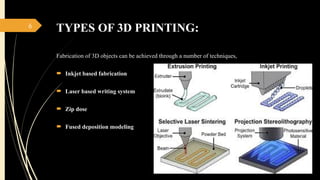
Fabrication of 3D objects can be achieved through a number of techniques,
Inkjet based fabrication
Laser based writing system
Zip dose
Fused deposition modeling
7.
7 INKJET BASEDFABRICATION:
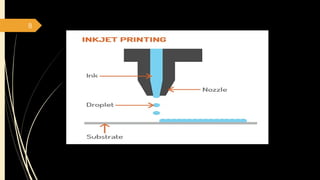
Different combinations of active ingredients and excipients (ink) are precisely sprayed in
small droplets (via drug on demand) or continuous jet method in varying sizes layer by
layer into a non-powder substrate.
Powder based 3D printing that uses a powder substrate for the sprayed ink, it solidifies into
a solid dosage form.
Ex: levofloxacin implants, acetaminophen tablet
9 LASER BASEDWRITING SYSTEM:
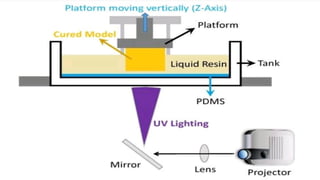
Based on the principle of photo- polymerisation, in which the free radicals are released
after the photo initiator and UV light.
UV light is aided by baffles, axes x and y, to traverse the surface of liquid resin, in order to
accurately represent the 3D model.
When a layer solidifies, the lifting platform descends its position to the height of a new
layer of liquid resin, again beginning the procedure, until the manufacture of the 3D
product is finished in a layer-by-layer way
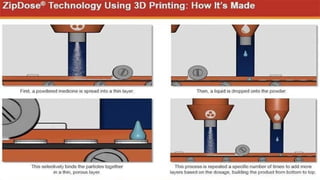
11 ZIP DOSE:
Aprecia developed the zip dose platform, which is designed to enable delivery of high dose
medications in a rapidly disintegrating form.
It produces a product layer by layer without using compression forces, punches or dies.
First, a powder blend is deposited as a single layer. Then an aqueous binding fluid is
applied and interaction between the powder and liquid bind these material together.
This process is repeated several times to produce solid, yet highly porous formulations,
even at high dose loading.
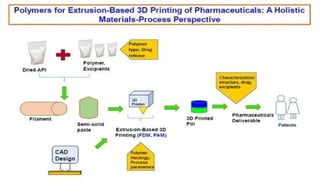
13 FUSED DEPOSITIONMODELING:
The polymer of interest is melted and extruded through a movable heated nozzle.
The layer-by-layer ejection of the polymer is repeated along x-y-z stage, followed by
solidification to create a shape previously defined by the CAD models.
This process can be applied multiple dosage forms that apply polymers as part of the
framework such as implants, zero order release tablets, multilayered tablets and fast
dissolving devices.
EX: 5-amino salicylic acid tablet
15 Case studyof 3D printing
Company: FabRx ( UK-based pharmaceutical company)
Year: 2021
Overview:
FabRx , in collaboration with UCL ( university college London) has developed a 3d printing platform for creating
multi drug combination tablets.
This technology uses FDM(fused deposition modelling) printing to create tablets that contain multiple drugs, each
with a distinct release profile.
The primary aim is to reduce polypharmacy ( the use of multiple medications) and improve patient adherence.
16.
16 Key features:
Multi drug formulation : FabRx demonstrated the ability to print tablets containing two or more drugs with
different release profiles.
For example, one part of the tablet might release a antibiotic rapidly, while other part could release a slow-
release anti inflammatory drug.
Layer by layer printing: the multi drug formulation is achieved by printing each layer of the tablet with a
different drug or excipient, ensuring that each component is released at its own pace.
Patient – centered design: the ability to customise the dosage forms for specific patients needs, such as
reduced pill burden or specific timing of drug release.
17.
17 IMPACT OFTHE CASE STUDY
This case highlights the promise of 3D printing in reducing the pill burden for patients, especially those on
complex drug regimens.
By combination multiple drugs into a single tablet, 3D printing can improve patients adherence, reduce
medication errors and enhance therapeutic efficacy.
18.
18
MEDICALAPPLICATIONS OF 3DPRINTING:
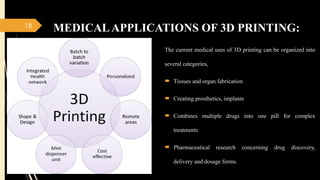
The current medical uses of 3D printing can be organized into
several categories,
Tissues and organ fabrication
Creating prosthetics, implants
Combines multiple drugs into one pill for complex
treatments
Pharmaceutical research concerning drug discovery,
delivery and dosage forms.
 Most read
 Most read
 Most read