NITHISH KUMARAN G.K
M.PHARM,1stYR
SRIHER
 Introduction
 3d printing
 History
 Working of 3d printer
 3d printing in pharmaceutical
 3d printing innovations
 Types of 3d printer
 3d bio printing
 Process of bio printing
 Advantages
 Disadvantages
 Conclusion
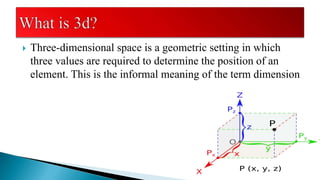
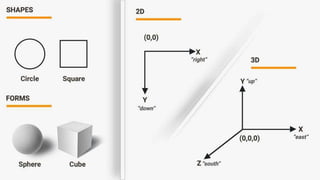
 Three-dimensional space is a geometric setting in which
three values are required to determine the position of an
element. This is the informal meaning of the term dimension
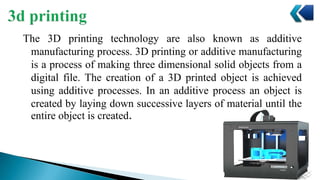
The 3D printing technology are also known as additive
manufacturing process. 3D printing or additive manufacturing
is a process of making three dimensional solid objects from a
digital file. The creation of a 3D printed object is achieved
using additive processes. In an additive process an object is
created by laying down successive layers of material until the
entire object is created.
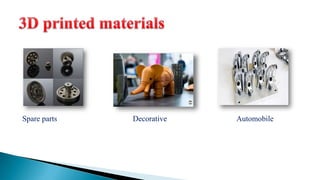
Spare parts Decorative Automobile
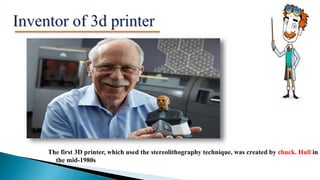
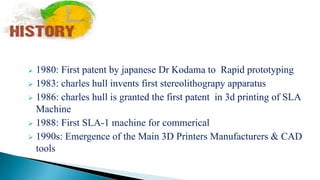
The first 3D printer, which used the stereolithography technique, was created by chuck. Hull in
the mid-1980s
 1980: First patent by japanese Dr Kodama to Rapid prototyping
 1983: charles hull invents first stereolithograpy apparatus
 1986: charles hull is granted the first patent in 3d printing of SLA
Machine
 1988: First SLA-1 machine for commerical
 1990s: Emergence of the Main 3D Printers Manufacturers & CAD
tools
PROCESS
It all starts with making a virtual design of the object you want to create.
This virtual design is for instance a CAD (Computer Aided Design) file.
This CAD file is created using a 3D modeling application or with a 3D
scanner (to copy an existing object). A 3D scanner can make a 3D digital
copy of an object.
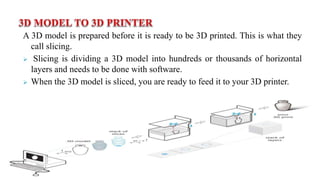
A 3D model is prepared before it is ready to be 3D printed. This is what they
call slicing.
 Slicing is dividing a 3D model into hundreds or thousands of horizontal
layers and needs to be done with software.
 When the 3D model is sliced, you are ready to feed it to your 3D printer.
 3D printing technology is a new chapter in pharmaceutical manufacturing and
has gained vast interest in the recent past as it offers significant advantages
over traditional pharmaceutical processes. Advances in technologies can lead
to the design of suitable 3D printing device capable of producing formulations
with intended drug release.
 The application of 3D printers is one of the most revolutionary and powerful
tool for customization and personalization of pharmaceutical formulations.
 3D printers have many advantages over the conventional manufacturing
technologies for tablets
PERSONALIZED DRUG DOSING
 3D printing could add a whole new dimension of possibilities to personalized
medicine.
 In its most simplistic form, the idea of experts and researchers is to produce
personalized 3D printed oral tablets.
 doctor or a pharmacist would be able to use each patient’s individual information such
as age, race and gender to produce their optimal medication dose, rather than relying
on a standard set of dosages. PERSONALIZED DRUG DOSING
 SPRITAM ZipDose® Technology platform, a groundbreaking advance that uses three-dimensional
printing to produce a porous formulation that rapidly disintegrates with a sip of liquid ZipDose
Technology enables the delivery of a high drug load, up to 1,000 mg in a single dose.
 SPRITAM enhances the patient experience - administration of even the largest strengths of
levetiracetam with just a sip of liquid. Aprecia developed its ZipDose Technology platform using the
3DP technology that originated at Massachusetts Institute of Technology
 The ZipDose technique is based on layer-by-layer powder bed fusion system. The first layer consists
of the active pharmaceutical ingredient and excipients required for the matrix tablet. Subsequently, a
binder liquid is deposited for perfect integration and aggregation between all of the successive and
identical layers
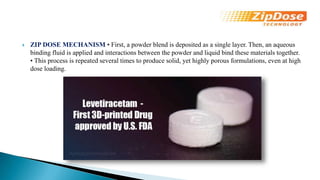
 ZIP DOSE MECHANISM • First, a powder blend is deposited as a single layer. Then, an aqueous
binding fluid is applied and interactions between the powder and liquid bind these materials together.
• This process is repeated several times to produce solid, yet highly porous formulations, even at high
dose loading.
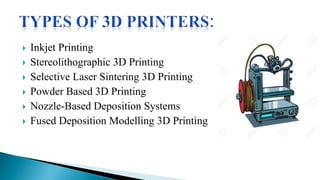
 Inkjet Printing
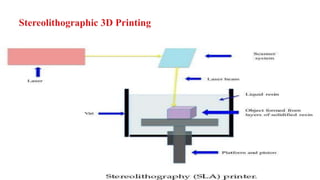
 Stereolithographic 3D Printing
 Selective Laser Sintering 3D Printing
 Powder Based 3D Printing
 Nozzle-Based Deposition Systems
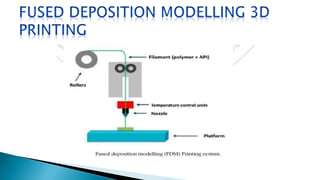
 Fused Deposition Modelling 3D Printing
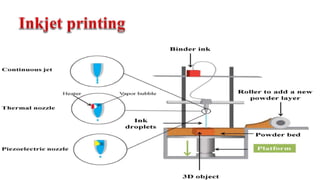
 Printing-based inkjet systems encompass two types of techniques: continuous inkjet
printing (CIJ) and drop-on-demand (DOD) printing. In continuous inkjet printing, the
liquid ink is directed through an orifice of 50-80 μm diameter creating a continuous
ink flow.
 The liquid is caused to flow and break into drops at a specified speed and size at
regular intervals using a piezoelectric crystal. These parameters are controlled by
creating an electrostatic field.
 Thus, the droplets are charged and separated by “droplets of guard” to minimize the
electrostatic repulsion between them. The electrostatic field created directs the charged
droplets to the substrate
 Stereolithographic 3D Printing This technique involves the curing of
photosensitive material/s (photo-polymerization) to produces a 3D object.
 Scanning a focused Ultraviolet (UV) laser over the top of a photo
polymerizable liquid in a layer by layer fashion, SLA employs a digital
mirroring device to initiate a chemical reaction in the photopolymer which
causes the gelation of the exposed area.
 This process is repeated layer after layer to build the entire parts of the
object.
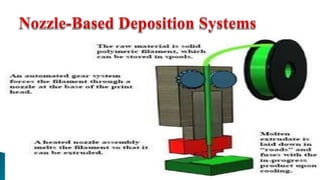
 Nozzle-based deposition systems consist on the mixing of drugs and polymers and other
solid elements prior to 3D printing.
 The mixture is passed through a nozzle that definitely originates, layer by layer, the
three-dimensional product.
 There are two types of printings according to the type of material used: Fused Deposition
Modeling, which uses melted components, and Pressure-Assisted Micro syringes, which
does not require the use of melted materials
 This is the extruding a thermoplastic filament through high temperature
nozzle into semi-solid fused state filament in layer by layer fashion.
 The object is formed by layers of melted or softened thermoplastic filament
extruded from the printer’s head at specific directions as dictated by computer
software.
 The material is heated to just above its softening point which is then extruded
through a nozzle, and deposited layer by layer, solidifying in a second
 Fabrication Drug loading in the filament is usually achieved through
incubation in organic solvents
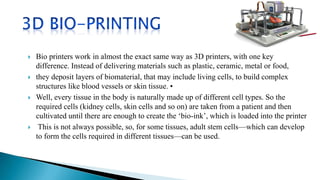
 Bio printers work in almost the exact same way as 3D printers, with one key
difference. Instead of delivering materials such as plastic, ceramic, metal or food,
 they deposit layers of biomaterial, that may include living cells, to build complex
structures like blood vessels or skin tissue. •
 Well, every tissue in the body is naturally made up of different cell types. So the
required cells (kidney cells, skin cells and so on) are taken from a patient and then
cultivated until there are enough to create the ‘bio-ink’, which is loaded into the printer
 This is not always possible, so, for some tissues, adult stem cells—which can develop
to form the cells required in different tissues—can be used.
 https://vimeo.com/316848296
 High drug loading ability when compared to conventional dosage forms
 Accurate and precise dosing of potent drugs which are administered at small doses
 Reduces cost of production due to lesser material wastage
 Suitable drug delivery for difficult to formulate active ingredients like poor water solubility, drugs with
narrow therapeutic window
 Medication can be tailored to a patient in particular based on genetic variations, ethnic differences, age,
gender and environment.
 In case of multi drug therapy with multiple dosing regimen, treatment can be customized to improve
patient adherence.
 As immediate and controlled release layers can be incorporated due to the flexible design and manufacture
of this dosage form, it helps in choosing the best therapeutic regime for an individual
 Avoids batch-to-batch variations seen in bulk manufacturing of conventional dosage forms (25).
 3D printers occupy minimal space and are affordable.
 Manufacture of small batch is feasible and the process can be completed in a single run.
 Integration of Personalized Medicine with Healthcare
CyberRisk:
The proliferation of counterfeit medicines is perhaps the industry’s greatest concern with 3D printing.
Printers are much more vulnerable to hackers than traditional manufacturing processes, and the incredibly
short production time magnifies the risk of counterfeits.
Safety and efficiency of 3D printers:
The traditional way of mass-producing medicines is subject to intense supervision from authorised agencies
such as FDA. This guarantees the company and the consumers that the products are manufactured
carefully.
 Limited use of Materials
 Post Processing
 Design Inaccuracies
 Cost and reliability of hardware
 Speed
 3D printing has become a useful and potential tool for the pharmaceutical sector, leading to
personalized medicine focused on the patients’ needs. 3D Printing technology is emerging as a new
horizon for advanced drug delivery with built-in flexibility that is well suited for
personalized/customized medication. 3D Printing technology will revolutionize the pharmaceutical
manufacturing style and formulation techniques.
 the near future 3D printing approach will be utilized to fabricate and engineer various novel dosage
forms. Although commercial production of such novel dosage forms is still challenging; developing
personalized medication, optimized drug release from dosage form, compacting or avoiding drug-
drug incompatibilities, protection of biomolecules during manufacture, construction of multiple drug
dosage form and multiple release dosage forms will be taken to a new era through 3D printing
technology
 1. Jose PA, GV PC. 3D printing of pharmaceuticals–a potential technology in
developing personalized medicine. Asian journal of pharmaceutical research and
development. 2018 Jul 10;6(3):46-54.
 2.Jacob S, Nair AB, Patel V, Shah J. 3D Printing Technologies: Recent Development
and Emerging Applications in Various Drug Delivery Systems. AAPS PharmSciTech.
2020 Aug;21(6):1-6.
 3. Alhnan MA, Okwuosa TC, Sadia M, Wan KW, Ahmed W, Arafat B. Emergence of
3D printed dosage forms: opportunities and challenges. Pharmaceutical research. 2016
Aug;33(8):1817-32.
3d printing in pharmaceuticals