3D Printing in Pharmaceuticals
& Telepharmacy
Prepared By:- Vishal Bhuva
Drug Delivery System
Content
⮚ 3D PRINTING
❖ What is 3D Printing?
❖ 3D Printing in Pharmaceuticals
❖ Methods and Technologies
❖ Working
❖ Advantage & Disadvantage
❖ Application
⮚ TELEPHARMACY
❖ What is Telepharmacy?
❖ Types of Telepharmacy
❖ Implementation
❖ Advantage & Disadvantage
❖ Conclusion
What is 3D Printing?
⮚ 3D printing is a process of making a three dimensional solid object of
virtually any shape from a digital model.
⮚ Also Known as:
1. Additive manufacturing (AM)
2. Solid freeform Fabrication (SFF)
3. Rapid prototyping (RP)
⮚ An object is created by laying down successive layers of material until the
entire object is created
3D Printing in Pharmaceuticals
⮚ It’s opened new horizons in the research and development of printed
materials and devices
⮚ The manufacture of medicines in this way may finally lead to the concept
of personalized medicines becoming a reality.
⮚ The main benefits of 3D printing technology in the production of small
batches of medicines, each with tailored dosages, shapes, sizes, and release
characteristics
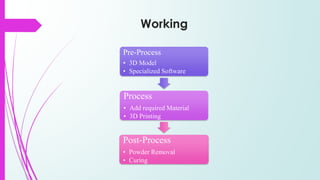
Working
Pre-Process
• 3D Model
• Specialized Software
Process
• Add required Material
• 3D Printing
Post-Process
• Powder Removal
• Curing
Methods and Technologies
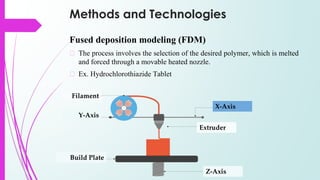
Fused deposition modeling (FDM)
⮚ The process involves the selection of the desired polymer, which is melted
and forced through a movable heated nozzle.
⮚ Ex. Hydrochlorothiazide Tablet
Filament
Y-Axis
Build Plate
X-Axis
Z-Axis
Extruder
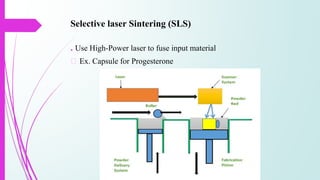
Selective laser Sintering (SLS)
. Use High-Power laser to fuse input material
⮚ Ex. Capsule for Progesterone
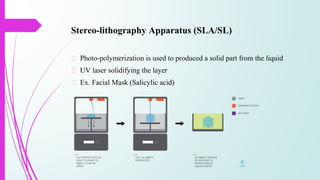
Stereo-lithography Apparatus (SLA/SL)
⮚ Photo-polymerization is used to produced a solid part from the liquid
⮚ UV laser solidifying the layer
⮚ Ex. Facial Mask (Salicylic acid)
Advantages
⮚ Clean Process
⮚ Low waste of materials, which can
save cost of production
⮚ Require only Material , Blueprint and
3D Printer
⮚ It can print any design , no matter how
complex it be
⮚ Customization and personalization
⮚ Faster product delivery
⮚ New Shape and Structure
⮚ Greater creativity
Disadvantages
⮚ High cost of Printer
⮚ Unsuitable for Large production
⮚ Difficult to install/remove
manually
⮚ Limited raw material
⮚ Production of dangerous item
⮚ Intellectual property issue
Application
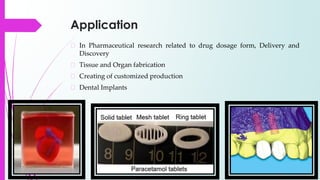
⮚ In Pharmaceutical research related to drug dosage form, Delivery and
Discovery
⮚ Tissue and Organ fabrication
⮚ Creating of customized production
⮚ Dental Implants
TELEPHARMACY
Telepharmacy
⮚ Telepharmacy is the delivery of pharmaceutical care via telecommunications to
patients in locations where they may not have direct contact with a pharmacist.
⮚ Telepharmacy services include,
• Drug therapy monitoring
• Patient counseling, prior authorization and refill authorization for
Prescription drugs
• Monitoring of formulary compliance with the aid of teleconferencing /
Videoconferencing
Types of Telepharmacy
1.Inpatient
� Inpatient telepharmacy refers to a pharmacist at a remote location performing
remote order-entry services for an inpatient pharmacy at a hospital. The remote
pharmacist reviews medication orders before the hospital staff administers the
drugs to the patient.
2. Remote Dispensing
� A remote-dispensing site, or retail community telepharmacy, is a licensed brick-
and-mortar pharmacy staffed by a certified pharmacy technician (or two,
depending on volume).
� A pharmacist supervises the technician, reviews prescriptions and performs his or
her duties from a remote location via technology. Imagine a traditional pharmacy,
except the pharmacist is located off-site.
3. IV admixture
� The Joint Commission on Accreditation of Healthcare Organizations (JCAHO)
defines IV admixture as, “the preparation of pharmaceutical product which requires
the measured addition of a medication to a 50 mL or greater bag or bottle of
intravenous fluid.”
� In layman's terms, IV admixture is the mixing of IV solution administered to patients
in a hospital setting.
4. Remote counseling
� Remote-patient counseling equates to pharmacists providing patient counseling via a
live-and-interactive video session, or by some means through telecommunications.
Implementation
⮚ Australia – Royal Flying Doctor service -1942
(Queensland – 21,470 Teleheath consultants – In 1 Year)
⮚ United States – 2000
⮚ Canada – 2003
⮚ United Kingdom – 2010
⮚ Italy, Japan, Spain, Venezuela, Cuba, Germany -2013
Advantage
⮚ Expand access to pharmacy care
in smaller rural communities.
⮚ High level of quality pharmacy
service
⮚ Reduced operating cost
⮚ Improve patient adherence
⮚ Effective patient counselling
Disadvantage
⮚ Increase chance of error
⮚ Lack of complete control
dispensing drugs to patients
⮚ Operational difficulties
⮚ More money
(North Dakota (USA)
telepharmacy estimated cost around
$130,000)
⮚ Reluctance of use technology
Conclusion
⮚ Rural communities lack easy access to healthcare service often due to
geographical and demographical factors.
⮚ Telepharmacy holds significant promise as a technology to improve access
to pharmaceutical care for people living in rural communities
⮚ A well developed system, however can change the practice of pharmacy
that is beneficial to both the rural communities and hospital or retail
pharmacies that deliver this service
References
� https://link.springer.com/article/10.1208/s12249-020-01905-8#Tab1
� https://blog.telepharm.com/the-4-different-types-of-telepharmacy
THANK YOU