3D PRINTING
INSTITUTE OF PHARMACEUTICAL EDUCATION
AND RESEARCH BORGAON (MEGHE)
PRESENTED BY
AKASH .V.CHOUTMAL
CONTENTS:
1. What is 3D Printing?
2. How 3D Printing Works?
3. 3D PRINTING IN PHARMACEUTICAL
4. Current and Projected Uses
5. 3D PRINTING INNOVATIONS
6. ADVANTAGES &DISADVANTAGES
7. RISKS IN 3D PRINTING
8. SAFETY AND EFFICACY OF 3D PRINTERS
9. CONCLUSION
10. REFERENCES
What is 3D Printing?
The basics of the technology.
1
1
3D PRINTING
• 3D printing or additive manufacturing
is a process of making three
dimensional solid objects from a
digital file.
2
3D PRINTING
• The creation of a 3D printed object
is achieved using additive
processes. In an additive process
an object is created by laying
down successive layers of material
until the object is created. Each of
these layers can be seen as a thinly
sliced horizontal cross-section of the
eventual object.
3
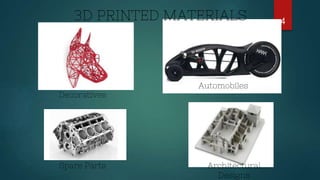
3D PRINTED MATERIALS
Decoratives
Architectural
Designs
Spare Parts
Automobiles
4
How 3D Printing Works?
A step by step process.
2
PROCESS
It all starts with making a virtual design of the object you want to
create. This virtual design is for instance a CAD (Computer Aided
Design) file. This CAD file is created using a 3D modeling
application or with a 3D scanner (to copy an existing object).
A 3D scanner can make a 3D digital copy of an object. 3D
printing (3DP) is unique technology that was first described by
Charles Hull in 1986. In its most basic setup, 3DP uses
computer aided drafting technology and programming to produce
a 3D object by layering material onto
substrate
The material is first ejected from a printer head onto an x-y plane
to create the foundation of the object. The printer then moves
along the z-axis, and a liquid binder is ejected onto the base of
the object to a certain thickness. This process is repeated
following the computer-aided drafting instructions until the
object is built layer by layer. After treatment to remove the
unbound substrate, the object is complete. This process is also
referred to as additive manufacturing (AM), rapid prototyping
(RP), or solid freeform technology (SFF) .
3D PRINTING IN
PHARMACEUTICALS
The latest innovations
3
Imagine a pediatrician talking to a four-year-old child
who is having trouble adjusting to taking daily doses of
steroids after being diagnosed with Duchene muscular
dystrophy “. What is your favorite animal pedtrician ask
him? He replyed a zebra but with more confidence not a
black and white stripes but blue and green one.Later,
the toddler watches with eyes as the uniquely colored,
zebra-like tablets appear from a three-dimensional (3D)
printer in the hospital pharmacy.
8
THE CHANGE...
• The role of medicines in healthcare systems
globally is becoming more important.
Innovative treatments become available to
address unmet clinical needs.
• In 2014 it is estimated that the global
spending on medicines exceeded $1 trillion
for the first time. The amount is projected to
reach $1.2 trillion in 2019.
TECH AND INNOVATION
• New possibilities in 3D printing may
open up a whole new chapter of
opportunities for pharmaceutical
research and bio-technology
applications.
• There are a number of ways it could
be used — drug dosage forms,
supporting delivery, or helping to
research cures.
10
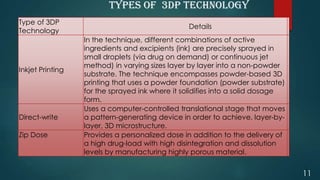
TYPES OF 3DP TECHNOLOGY
11
Type of 3DP
Technology
Details
Inkjet Printing
In the technique, different combinations of active
ingredients and excipients (ink) are precisely sprayed in
small droplets (via drug on demand) or continuous jet
method) in varying sizes layer by layer into a non-powder
substrate. The technique encompasses powder-based 3D
printing that uses a powder foundation (powder substrate)
for the sprayed ink where it solidifies into a solid dosage
form.
Direct-write
Uses a computer-controlled translational stage that moves
a pattern-generating device in order to achieve, layer-by-
layer, 3D microstructure.
Zip Dose Provides a personalized dose in addition to the delivery of
a high drug-load with high disintegration and dissolution
levels by manufacturing highly porous material.
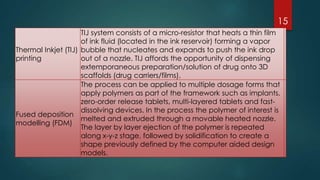
15
Thermal Inkjet (TIJ)
printing
TIJ system consists of a micro-resistor that heats a thin film
of ink fluid (located in the ink reservoir) forming a vapor
bubble that nucleates and expands to push the ink drop
out of a nozzle. TIJ affords the opportunity of dispensing
extemporaneous preparation/solution of drug onto 3D
scaffolds (drug carriers/films).
Fused deposition
modelling (FDM)
The process can be applied to multiple dosage forms that
apply polymers as part of the framework such as implants,
zero-order release tablets, multi-layered tablets and fast-
dissolving devices. In the process the polymer of interest is
melted and extruded through a movable heated nozzle.
The layer by layer ejection of the polymer is repeated
along x-y-z stage, followed by solidification to create a
shape previously defined by the computer aided design
models.
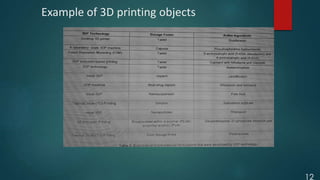
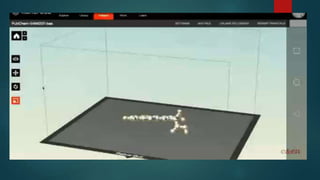
Example of 3D printing objects
12
13
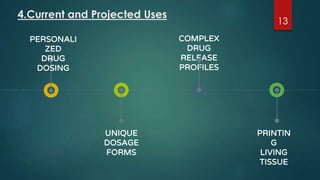
4.Current and Projected Uses
PERSONALI
ZED
DRUG
DOSING
UNIQUE
DOSAGE
FORMS
COMPLEX
DRUG
RELEASE
PROFILES
PRINTIN
G
LIVING
TISSUE
PERSONALIZED DRUG
DOSING
• 3D printing could add a whole new
dimension of possibilities to
personalized medicine.
• In its most simplistic form, the idea of
experts and researchers is to
produce personalized 3D printed
oral tablets.
14
• A doctor or a pharmacist would be able
to use each patient’s individual
information such as age, race and
gender to produce their optimal
medication dose, rather than relying on
a standard set of dosages.
PERSONALIZED DRUG
DOSING
15
.
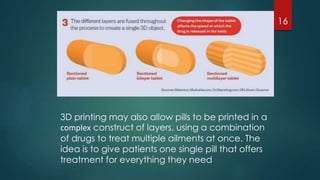
3D printing may also allow pills to be printed in a
complex construct of layers, using a combination
of drugs to treat multiple ailments at once. The
idea is to give patients one single pill that offers
treatment for everything they need
16
COMPLEX DRUG RELEASE PROFILES
• Designing and printing drugs first and
makes it much easier to understand their
release profiles. 3D printing makes it
possible to print personalized drugs that
facilitate targeted and controlled drug
release by printing a binder onto a matrix
powder bed in layers.
• This creates a barrier between the active
ingredients, allowing researchers to study
the variations of the release more closely.
17
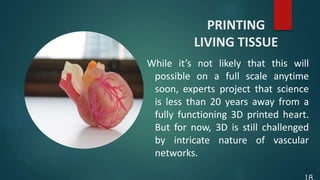
PRINTING
LIVING TISSUE
While it’s not likely that this will
possible on a full scale anytime
soon, experts project that science
is less than 20 years away from a
fully functioning 3D printed heart.
But for now, 3D is still challenged
by intricate nature of vascular
networks.
3D PRINTING INNOVATIONS
Products now in use.
5
19
APRECIA ZIP DOSE
• Powder-liquid three-dimensional printing
(3DP) technology was developed at the
Massachusetts Institute of Technology
(MIT) in the late 1980s as a rapid-
prototyping technique. This technology
uses an aqueous fluid to bind together
multiple layers of powder using a unique,
patent-protected process to create a
wide range of products.
BRINGING ZIP DOSE®
TECHNOLOGY TO LIFE
• Aprecia developed the ZipDose® platform, which is
designed to enable delivery of high-dose
medications in a rapidly disintegrating form.
• ZipDose® Technology produces a product layer-by-
layer without using compression forces, punches,
or dies.
ZIP DOSE MECHANISM
• First, a powder blend is deposited as a single
layer. Then, an aqueous binding fluid is
applied and interactions between the
powder and liquid bind these materials
together.
• This process is repeated several times to
produce solid, yet highly porous
formulations, even at high dose loading.
22
KEY FEATURES
Aprecia’s ZipDose® products are designed to:
• Rapidly disintegrate on contact with liquid
by breaking the bonds created during the
3DP process.
• Support dosing upto 1000mg/1gm.
• Allow the application of enhanced taste-
masking techniques.
Advantages
1. Ability to customize products.
2. Rapid production of prototypes.
3. Low cost of production.
4. Improves the safety, efficacy, and
accessibility of medicines.
5. Decrease storage cost Disadvantages
1. Intellectual property issues.
2. Unchecked production of
dangerous items.
3. Limitations of size.
4. Limitations of raw material.
5. Cost of printers is high.
6
RISKS IN 3D PRINTING
Threats in moving forward.
7
PRODUCT
LIABILITY RISK
• Pharmaceutical companies need to
consider the potential product liability
implications. Based on its role in providing
the product blueprint alone, the firm may be
partially responsible if an adverse incident or
product defect claim arises.
• In fact, parties across the manufacturing
spectrum could be liable for the fallout. This
might also include the printer manufacturer,
the software designer, the material suppliers
and the product manufacturer.
30
CYBER RISK
A hacker gaining access to a drug maker’s
proprietary blueprint could bring the
instructions to a manufacturing plant
overseas to mass produce the drug. This
exploitation of intellectual property could
have a significant impact on a company’s
bottom line. Plus, improperly made drugs
may go to market and cause harm to patients
– hitting the company’s financials and
reputation.
32
SAFETY AND EFFICACY
OF 3D PRINTERS
The idea of individualized medicine – whereby
a patient’s age, weight, race or organ function
could inform doses and production – has
attracted medical community since 3D
printing became a reality. But the possibility
of a printer defect or manufacturing
malfunction remains a concern, as does
placing responsibility for such an incident.
8
SAFETY AND EFFICACY
OF 3D PRINTERS
Importantly, 3D printing manufacturers must be
diligent about vetting their suppliers, as
contaminated or defective materials may yield
a faulty product and pose an even larger
threat than the printers themselves.
CONCLUSION
• 3DP technology opens the door to a new
era of advanced drug delivery with built-in
flexibility that is well suited for
personalized/customized medicines. We
believe that with patience and
perseverance, 3DP will continue to
revolutionize the development of new
generations of pharmaceutical
formulations that are safe and effective.
9.
35
35
REFERENCES
• https://3dprinting.com/what-is-3d-printing
• http://blog.ispe.org/3d-printing-pharmaceutical-manufacturing
• https://redshift.autodesk.com/3d-printed-pharmaceuticals/
• https://www.aprecia.com/zipdose-platform/3d-printing.php
• http://www.pharmaceutical-journal.com/news-and-analysis/features/3d-printing-the-
future-of-manufacturing-medicine/20068625.article
• YouTube links embedded.
• Ursan ID, Chiu L, Pierce A (2013) Three-dimensional drug printing: a structured review. J
Am Pharm Assoc 53: 136-144.
• Yu DG, Zhu LM, Branford-White CJ, Yang XL (2008) Three-dimensional printing in
pharmaceutics: promises and problems. J Pharm Sci 97: 3666-3690.
• Wang CC, Tejwani Motwani MR, Roach WJ, Kay JL, Yoo J, et al. (2006) Development of
near zero-order release dosage forms using three-dimensional printing (3-DP)
technology. Drug Dev Ind Pharm 32: 367-376.
• Rowe CW, Katstra WE, Palazzolo RD, Giritlioglu B, Teung P, et al. (2000) Multimechanism
oral dosage forms fabricated by three dimensional printing. J Control Release 66: 11-17.
10.
36
37
THANK YOU