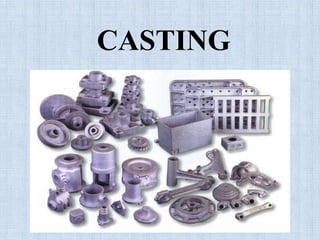
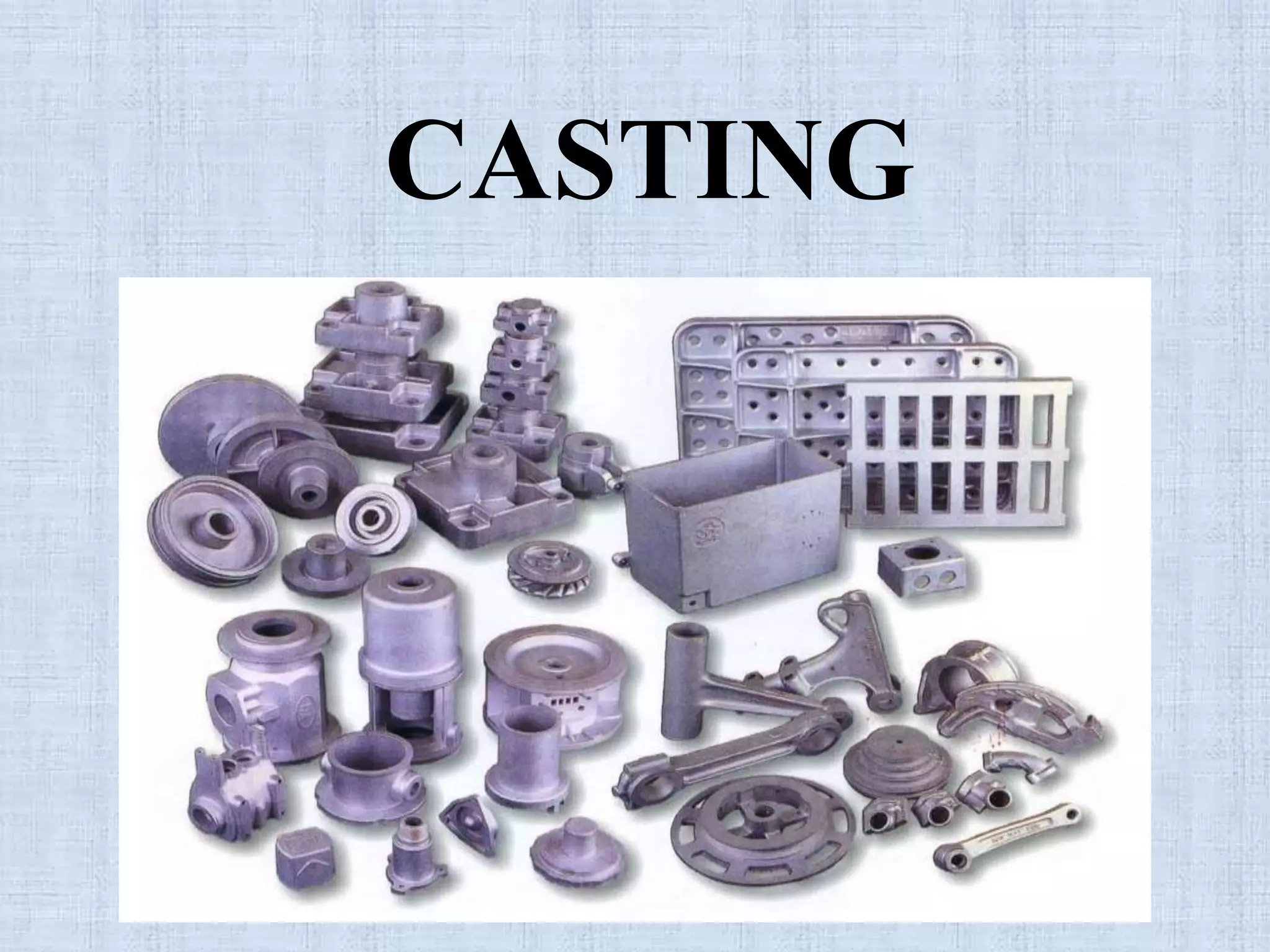
CASTING
Definition
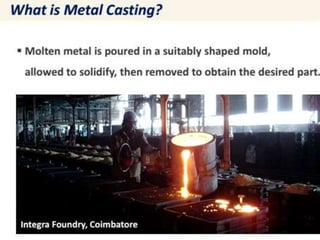
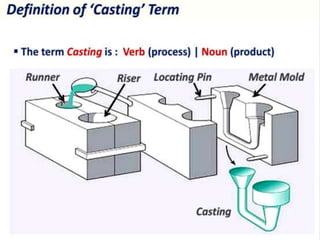
The casting process basically involves (a)
pouring molten metal into a mold patterned
after the part to be manufactured, (b)
allowing it to solidify, and (c) removing the
part from the mold.
• Important considerations in casting operations are as
follows:
1. Flow of the molten metal into the mold cavity
2. Solidification and cooling of the metal in the mold
3. Influence of the type of mold material.
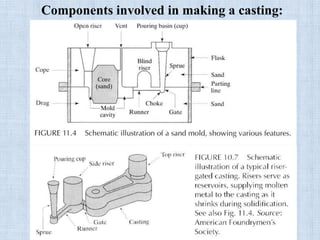
Components involved in making a casting:
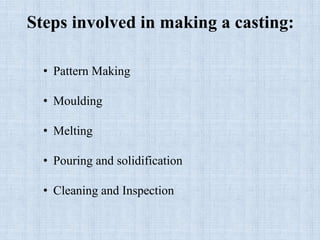
Steps involved in making a casting:
• Pattern Making
• Moulding
• Melting
• Pouring and solidification
• Cleaning and Inspection
Pattern
A Pattern is a model or the replica of the
object to be cast with some modifications.
Modifications are:
Pattern Allowances
Provision for core prints
Elimination of fine details
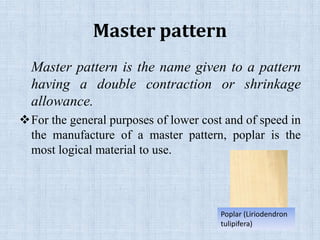
Master pattern
Master pattern is the name given to a pattern
having a double contraction or shrinkage
allowance.
For the general purposes of lower cost and of speed in
the manufacture of a master pattern, poplar is the
most logical material to use.
Poplar (Liriodendron
tulipifera)
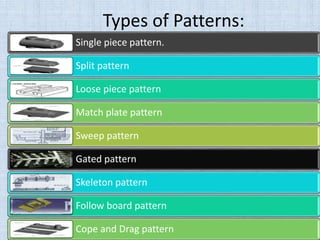
Types of Patterns:
Single piece pattern.
Split pattern
Loose piece pattern
Match plate pattern
Sweep pattern
Gated pattern
Skeleton pattern
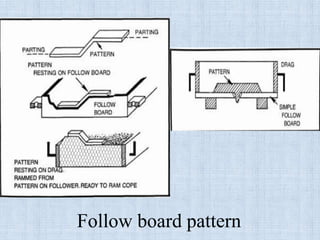
Follow board pattern
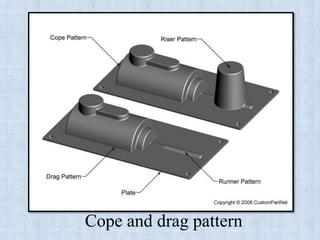
Cope and Drag pattern
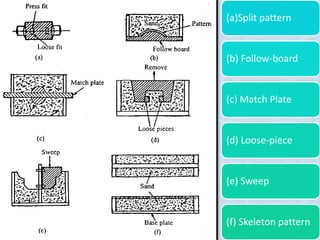
(a)Split pattern
(b) Follow-board
(c) Match Plate
(d) Loose-piece
(e) Sweep
(f) Skeleton pattern
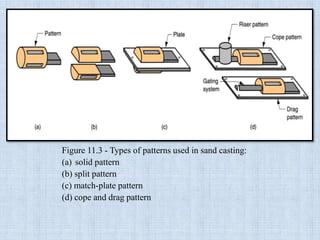
Figure 11.3 - Types of patterns used in sand casting:
(a) solid pattern
(b) split pattern
(c) match-plate pattern
(d) cope and drag pattern
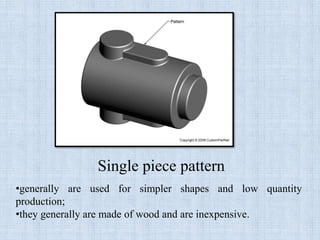
Single piece pattern
•generally are used for simpler shapes and low quantity
production;
•they generally are made of wood and are inexpensive.
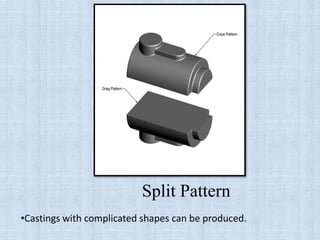
Split Pattern
•Castings with complicated shapes can be produced.
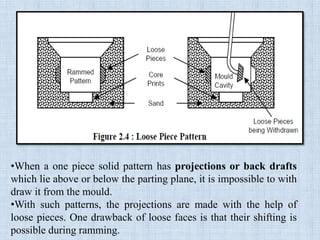
•When a one piece solid pattern has projections or back drafts
which lie above or below the parting plane, it is impossible to with
draw it from the mould.
•With such patterns, the projections are made with the help of
loose pieces. One drawback of loose faces is that their shifting is
possible during ramming.
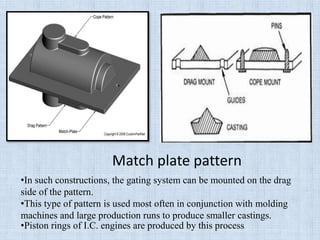
Match plate pattern
•In such constructions, the gating system can be mounted on the drag
side of the pattern.
•This type of pattern is used most often in conjunction with molding
machines and large production runs to produce smaller castings.
•Piston rings of I.C. engines are produced by this process
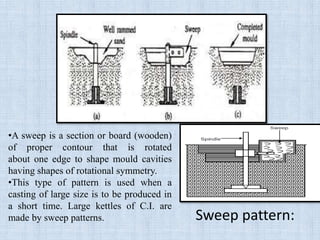
Sweep pattern:
•A sweep is a section or board (wooden)
of proper contour that is rotated
about one edge to shape mould cavities
having shapes of rotational symmetry.
•This type of pattern is used when a
casting of large size is to be produced in
a short time. Large kettles of C.I. are
made by sweep patterns.
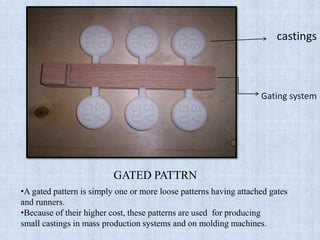
castings
Gating system
GATED PATTRN
•A gated pattern is simply one or more loose patterns having attached gates
and runners.
•Because of their higher cost, these patterns are used for producing
small castings in mass production systems and on molding machines.
Cope and drag pattern
Follow board pattern
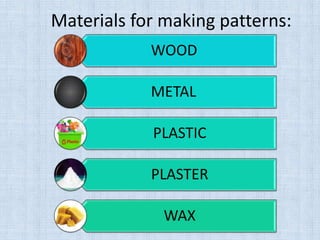
Materials for making patterns:
WOOD
METAL
PLASTIC
PLASTER
WAX
The pattern material should be:
1. Easily worked, shaped and joined.
2. Light in weight.
3. Strong, hard and durable.
4. Resistant to wear and abrasion .
5. Resistant to corrosion, and to chemical
reactions.
6. Dimensionally stable and unaffected by
variations in temperature and humidity.
7. Available at low cost.
Types of Pattern Allowances:
The various pattern allowances are:
1. Shrinkage or contraction allowance.
2. Machining or finish allowance.
3. Draft of tapper allowances.
4. Distortion or chamber allowance.
5. Shake or rapping allowance.
1.Shrinkage Allowance:
All most all cast metals shrink or contract
volumetrically on cooling.
The metal shrinkage is of two types:
1. Liquid Shrinkage:
2. Solid Shrinkage:
2. Machining Allowance:
A Casting is given an allowance for machining, because:
i. Castings get oxidized in the mold and during
heat treatment; scales etc., thus formed need to
be removed.
ii. It is the intended to remove surface roughness
and other imperfections from the castings.
iii. It is required to achieve exact casting
dimensions.
iv. Surface finish is required on the casting.
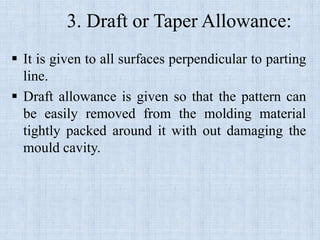
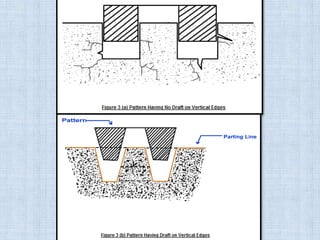
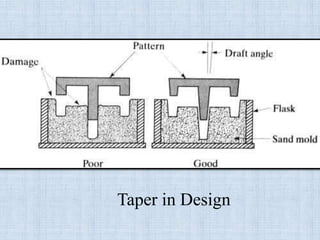
3. Draft or Taper Allowance:
 It is given to all surfaces perpendicular to parting
line.
 Draft allowance is given so that the pattern can
be easily removed from the molding material
tightly packed around it with out damaging the
mould cavity.
Taper in Design
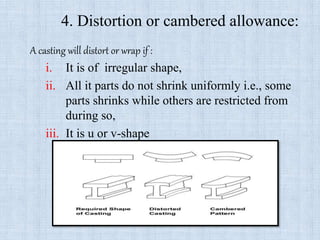
4. Distortion or cambered allowance:
A casting will distort or wrap if :
i. It is of irregular shape,
ii. All it parts do not shrink uniformly i.e., some
parts shrinks while others are restricted from
during so,
iii. It is u or v-shape
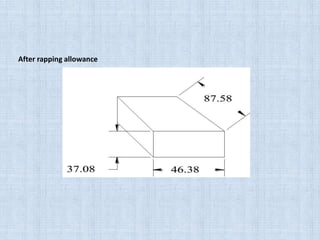
5. Shake allowance:
A pattern is shaken or rapped by striking the same
with a wooden piece from side to side. This is done
so that the pattern a little is loosened in the mold
cavity and can be easily removed.
In turn, therefore, rapping enlarges the mould cavity
which results in a bigger sized casting.
Hence, a –ve allowance is provided on the pattern
i.e., the pattern dimensions are kept smaller in order
to compensate the enlargement of mould cavity due
to rapping.
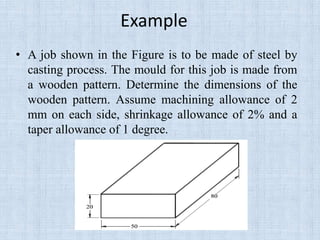
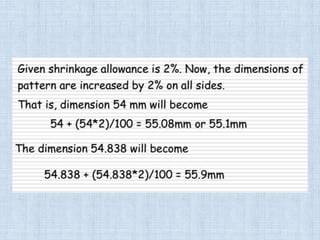
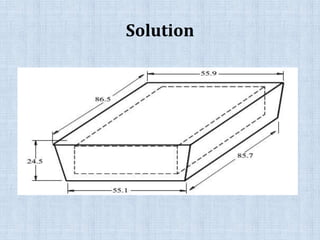
Example
• A job shown in the Figure is to be made of steel by
casting process. The mould for this job is made from
a wooden pattern. Determine the dimensions of the
wooden pattern. Assume machining allowance of 2
mm on each side, shrinkage allowance of 2% and a
taper allowance of 1 degree.
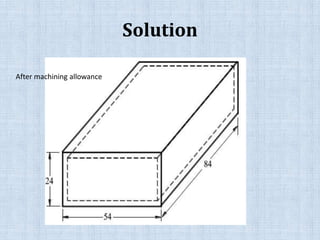
Solution
After machining allowance
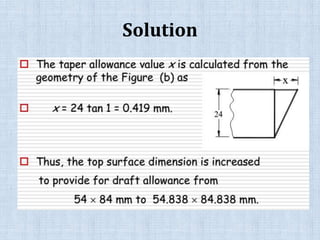
Solution
Solution
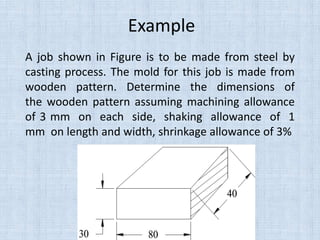
Example
A job shown in Figure is to be made from steel by
casting process. The mold for this job is made from
wooden pattern. Determine the dimensions of
the wooden pattern assuming machining allowance
of 3 mm on each side, shaking allowance of 1
mm on length and width, shrinkage allowance of 3%
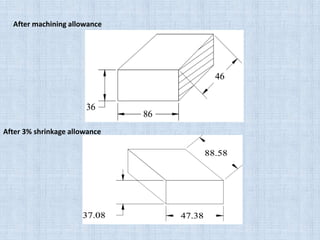
After machining allowance
After 3% shrinkage allowance
After rapping allowance
Classification
Of
Moulding Sands
A)Natural sand is the one which is available from natural
deposits. Only additives and water need be added to it to make it
satisfactory for molding.
B)Synthetic sand is prepared by mixing a relatively clay free
sand having specified type of sand grain, with specified type
of clay binder as well as water and other additives.
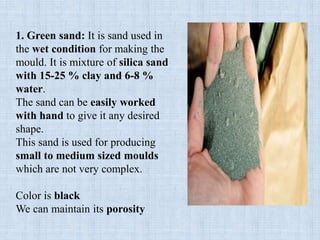
1. Green sand: It is sand used in
the wet condition for making the
mould. It is mixture of silica sand
with 15-25 % clay and 6-8 %
water.
The sand can be easily worked
with hand to give it any desired
shape.
This sand is used for producing
small to medium sized moulds
which are not very complex.
Color is black
We can maintain its porosity
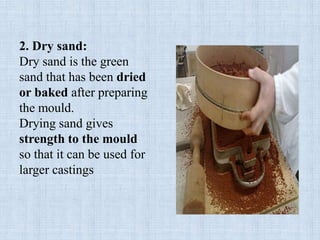
2. Dry sand:
Dry sand is the green
sand that has been dried
or baked after preparing
the mould.
Drying sand gives
strength to the mould
so that it can be used for
larger castings
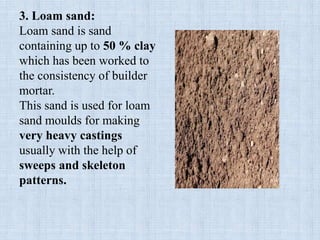
3. Loam sand:
Loam sand is sand
containing up to 50 % clay
which has been worked to
the consistency of builder
mortar.
This sand is used for loam
sand moulds for making
very heavy castings
usually with the help of
sweeps and skeleton
patterns.
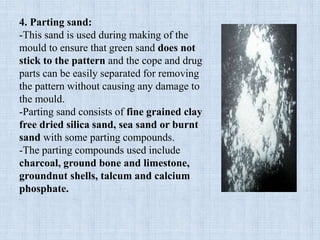
4. Parting sand:
-This sand is used during making of the
mould to ensure that green sand does not
stick to the pattern and the cope and drug
parts can be easily separated for removing
the pattern without causing any damage to
the mould.
-Parting sand consists of fine grained clay
free dried silica sand, sea sand or burnt
sand with some parting compounds.
-The parting compounds used include
charcoal, ground bone and limestone,
groundnut shells, talcum and calcium
phosphate.
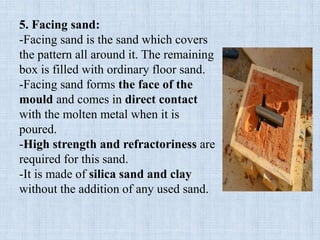
5. Facing sand:
-Facing sand is the sand which covers
the pattern all around it. The remaining
box is filled with ordinary floor sand.
-Facing sand forms the face of the
mould and comes in direct contact
with the molten metal when it is
poured.
-High strength and refractoriness are
required for this sand.
-It is made of silica sand and clay
without the addition of any used sand.
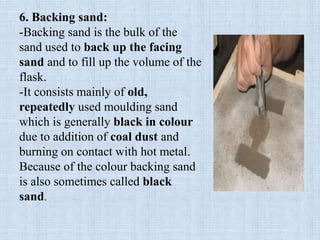
6. Backing sand:
-Backing sand is the bulk of the
sand used to back up the facing
sand and to fill up the volume of the
flask.
-It consists mainly of old,
repeatedly used moulding sand
which is generally black in colour
due to addition of coal dust and
burning on contact with hot metal.
Because of the colour backing sand
is also sometimes called black
sand.
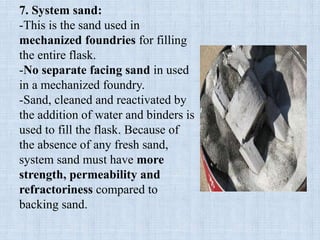
7. System sand:
-This is the sand used in
mechanized foundries for filling
the entire flask.
-No separate facing sand in used
in a mechanized foundry.
-Sand, cleaned and reactivated by
the addition of water and binders is
used to fill the flask. Because of
the absence of any fresh sand,
system sand must have more
strength, permeability and
refractoriness compared to
backing sand.
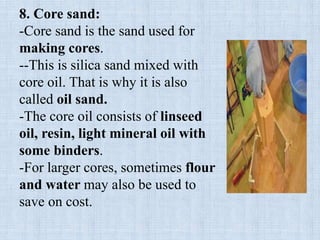
8. Core sand:
-Core sand is the sand used for
making cores.
--This is silica sand mixed with
core oil. That is why it is also
called oil sand.
-The core oil consists of linseed
oil, resin, light mineral oil with
some binders.
-For larger cores, sometimes flour
and water may also be used to
save on cost.
GENERAL PROPERTIES
OF
MOLDING SANDS
1. Green strength: The green sand, after water has been
mixed into it, must have adequate strength and
plasticity for making and handling of the mold.
2. Dry strength: As a casting is poured, sand adjacent
to the hot metal quickly loses its water as steam. The
dry sand must have strength to resist erosion, and also
the pressure of the molten metal, or else the mold may
enlarge.
3. Hot strength. After the moisture has evaporated, the
sand may be required to possess strength at some
elevated temperature.
4. Permeability/Porosity. Heat from the casting causes a
green‐sand mold to evolve a great deal of steam and other
gases. The mold must be permeable, i.e. porous, to
permit the gases to pass off, or the casting will contain
gas holes.
5. Thermal stability. Heat from the casting causes rapid
expansion of the sand surface at the mold‐ metal
interface. The mold surface may then crack, buckle, or
flake off (scab) unless the molding sand is relatively
stable dimensionally under rapid heating.
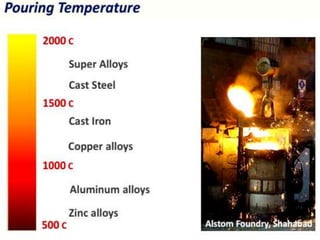
6. Refractoriness. Higher pouring temperatures, such as those
for ferrous alloys at 2400 to 3200 F, require greater refractoriness
of the sand. Low‐ pouring‐temperature metals, for example,
aluminum, poured at 1300 F, do not require a high degree of
refractoriness from the sand.
7. Plasticity or flow-ability : It is the measure of the molding
sand to flow around and over a pattern during ramming and to
uniformly fill the flask.
8. Cohesiveness: It is the property of sand which hold grains
together.
9. Collapsibility: Heated sand which becomes hard and rock like
is difficult to remove from the casting and may cause the
contracting metal to tear or crack.
10. Adhesiveness: This is the property of sand mixture to
adhere to another body (here, the molding flasks). The
molding sand should stick to the sides of the molding boxes
so that it does not fall out when the flasks are lifted and turned
over.
11. Offers ease of sand preparation and control.
12. Removes heat from the cooling casting.
13.Produces good casting finish
14.It is reusable.
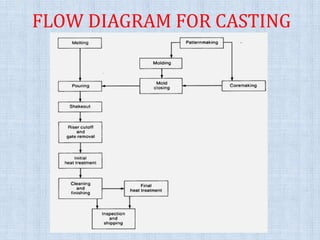
FLOW DIAGRAM FOR CASTING
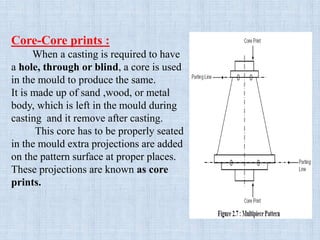
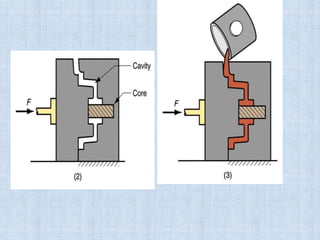
Core-Core prints :
When a casting is required to have
a hole, through or blind, a core is used
in the mould to produce the same.
It is made up of sand ,wood, or metal
body, which is left in the mould during
casting and it remove after casting.
This core has to be properly seated
in the mould extra projections are added
on the pattern surface at proper places.
These projections are known as core
prints.
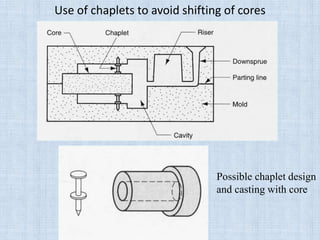
Use of chaplets to avoid shifting of cores
Possible chaplet design
and casting with core
•It must be strong to retain the shape while
handling,
•It must resist erosion by molten metal,
• It must be permeable to gases,
•It must have high refractoriness,
•It must have good surface finish to replicate it
on to the casting.
Core properties
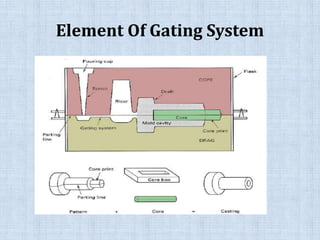
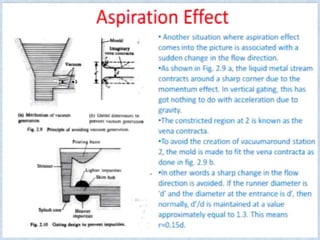
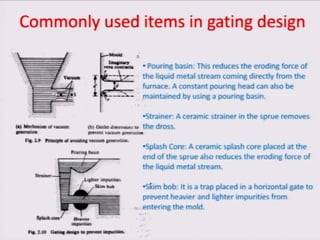
Element Of Gating System
Casting Terms:
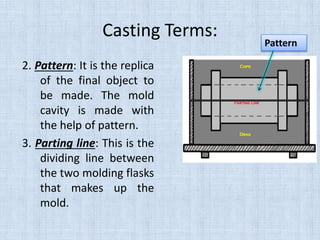
2. Pattern: It is the replica
of the final object to
be made. The mold
cavity is made with
the help of pattern.
3. Parting line: This is the
dividing line between
the two molding flasks
that makes up the
mold.
Pattern
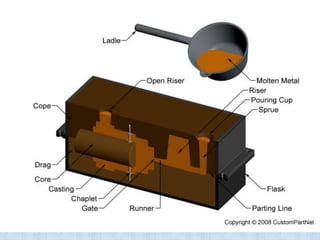
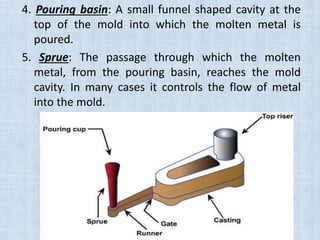
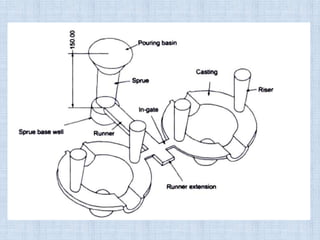
4. Pouring basin: A small funnel shaped cavity at the
top of the mold into which the molten metal is
poured.
5. Sprue: The passage through which the molten
metal, from the pouring basin, reaches the mold
cavity. In many cases it controls the flow of metal
into the mold.
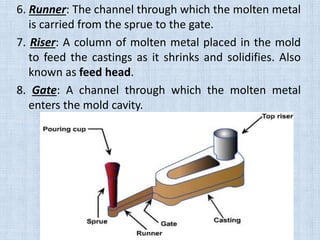
6. Runner: The channel through which the molten metal
is carried from the sprue to the gate.
7. Riser: A column of molten metal placed in the mold
to feed the castings as it shrinks and solidifies. Also
known as feed head.
8. Gate: A channel through which the molten metal
enters the mold cavity.
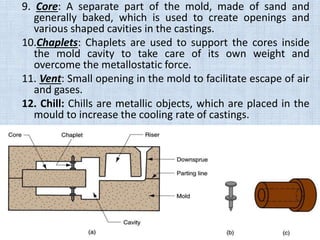
9. Core: A separate part of the mold, made of sand and
generally baked, which is used to create openings and
various shaped cavities in the castings.
10.Chaplets: Chaplets are used to support the cores inside
the mold cavity to take care of its own weight and
overcome the metallostatic force.
11. Vent: Small opening in the mold to facilitate escape of air
and gases.
12. Chill: Chills are metallic objects, which are placed in the
mould to increase the cooling rate of castings.
Types of Gate or In-gate
Top gate: Causes turbulence in the mould cavity, it is prone to
form dross, favourable temperature gradient towards the gate, only
for ferrous alloys.
Bottom gate: No mould erosion, used for very deep moulds,
higher pouring time, Causes unfavorable temperature gradients.
Parting Gate: most widely used gate, easiest and most economical
in preparation.
Step Gate: Used for heavy and large castings, size of ingates are
normally increased from top to bottom.
The goals for the gating system
• To minimize turbulence to avoid trapping gasses into the
mold
• To get enough metal into the mold cavity before the metal
starts to solidify
• To avoid shrinkage
• Establish the best possible temperature gradient in the
solidifying casting so that the shrinkage if occurs must be
in the gating system not in the required cast part.
• Incorporates a system for trapping the non-metallic
inclusions.
Types of Gating Systems
The gating systems are of two types:
–Pressurized gating system
–Un-pressurized gating system
Pressurized Gating System
• The total cross sectional area decreases towards the mold
cavity
• Back pressure is maintained by the restrictions in the
metal flow
• Flow of liquid (volume) is almost equal from all gates
• Back pressure helps in reducing the aspiration as the sprue
always runs full
• Because of the restrictions the metal flows at high velocity
leading to more turbulence and chances of mold erosion.
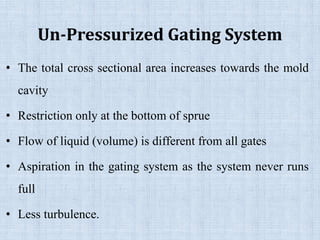
Un-Pressurized Gating System
• The total cross sectional area increases towards the mold
cavity
• Restriction only at the bottom of sprue
• Flow of liquid (volume) is different from all gates
• Aspiration in the gating system as the system never runs
full
• Less turbulence.
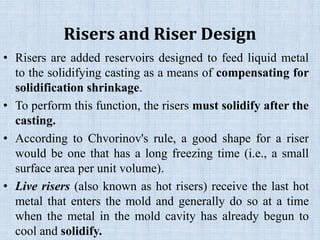
Risers and Riser Design
• Risers are added reservoirs designed to feed liquid metal
to the solidifying casting as a means of compensating for
solidification shrinkage.
• To perform this function, the risers must solidify after the
casting.
• According to Chvorinov's rule, a good shape for a riser
would be one that has a long freezing time (i.e., a small
surface area per unit volume).
• Live risers (also known as hot risers) receive the last hot
metal that enters the mold and generally do so at a time
when the metal in the mold cavity has already begun to
cool and solidify.
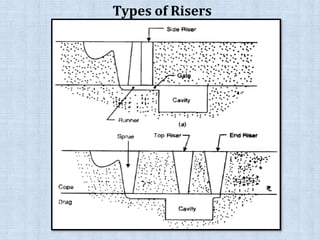
Types of Risers
Gating ratio
• Gating ratio is defined as: Sprue area: Runner area:
Ingate area.
• For high quality steel castings, a gating ratio of 1: 2: 2 or
1: 2: 1.5 will produce castings nearly free from erosion,
will minimize oxidation, and will produce uniform flow.
• A gating ratio of 1: 4: 4 might favour the formation of
oxidation defects.
Chvorinov’s rule
• Total solidification time (ts) = B (V/A) n
where n = 1.5 to 2.0
[Where, B = mould constant and is a function of (mould
material, casting material, and condition of casting]
n = 2 and triser = 1.25 tcasting
   
   
   
2 2
riser casting
V V
1.25
A A
 
 
  
2
2
V D H / 4
DA DH 2
4
For cylinder of
diameter D
and height H
or
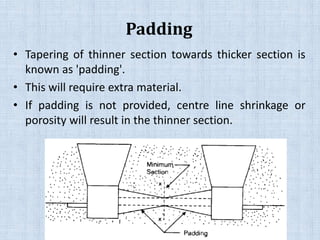
Padding
• Tapering of thinner section towards thicker section is
known as 'padding'.
• This will require extra material.
• If padding is not provided, centre line shrinkage or
porosity will result in the thinner section.
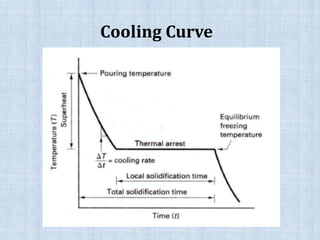
Cooling Curve
Self study
• Moulding practices:
• Green, dry and loam sand moulding, pit
and floor moulding; shell moulding;
permanent moulding; carbon dioxide
moulding.
Furnaces
• Melting is an equally important parameter for obtaining a
quality castings. A number of furnaces can be used for melting
the metal, to be used, to make a metal casting. The choice of
furnace depends on the type of metal to be melted. Some of the
furnaces used in metal casting are as following:
1. Crucible furnaces
2. Cupola
3. Induction furnace
4. Electric arc furnace
5. Rotary furnace
6. Pit electric
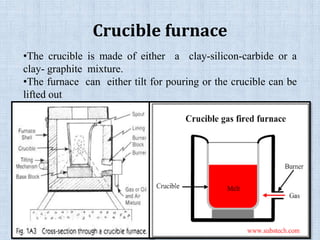
Crucible furnace
•The crucible is made of either a clay-silicon-carbide or a
clay- graphite mixture.
•The furnace can either tilt for pouring or the crucible can be
lifted out
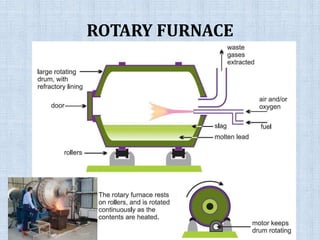
ROTARY FURNACE
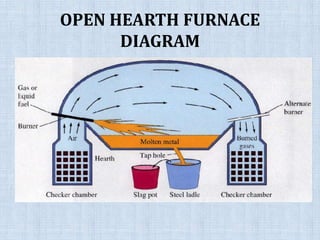
OPEN HEARTH FURNACE
DIAGRAM
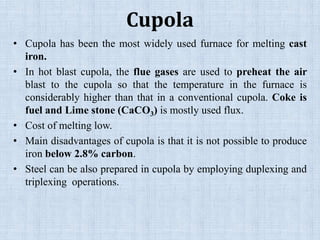
Cupola
• Cupola has been the most widely used furnace for melting cast
iron.
• In hot blast cupola, the flue gases are used to preheat the air
blast to the cupola so that the temperature in the furnace is
considerably higher than that in a conventional cupola. Coke is
fuel and Lime stone (CaCO3) is mostly used flux.
• Cost of melting low.
• Main disadvantages of cupola is that it is not possible to produce
iron below 2.8% carbon.
• Steel can be also prepared in cupola by employing duplexing and
triplexing operations.
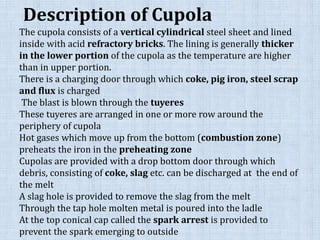
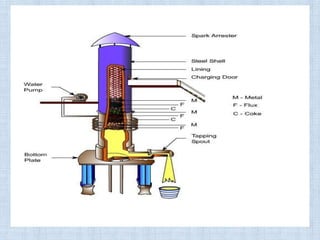
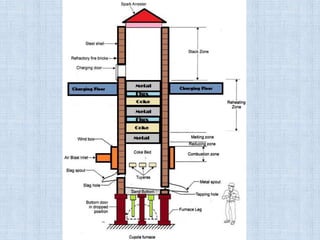
Description of Cupola
The cupola consists of a vertical cylindrical steel sheet and lined
inside with acid refractory bricks. The lining is generally thicker
in the lower portion of the cupola as the temperature are higher
than in upper portion.
There is a charging door through which coke, pig iron, steel scrap
and flux is charged
The blast is blown through the tuyeres
These tuyeres are arranged in one or more row around the
periphery of cupola
Hot gases which move up from the bottom (combustion zone)
preheats the iron in the preheating zone
Cupolas are provided with a drop bottom door through which
debris, consisting of coke, slag etc. can be discharged at the end of
the melt
A slag hole is provided to remove the slag from the melt
Through the tap hole molten metal is poured into the ladle
At the top conical cap called the spark arrest is provided to
prevent the spark emerging to outside
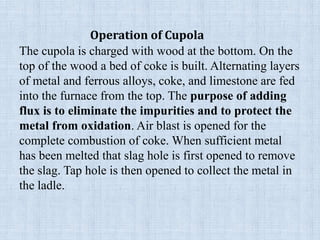
Operation of Cupola
The cupola is charged with wood at the bottom. On the
top of the wood a bed of coke is built. Alternating layers
of metal and ferrous alloys, coke, and limestone are fed
into the furnace from the top. The purpose of adding
flux is to eliminate the impurities and to protect the
metal from oxidation. Air blast is opened for the
complete combustion of coke. When sufficient metal
has been melted that slag hole is first opened to remove
the slag. Tap hole is then opened to collect the metal in
the ladle.
The
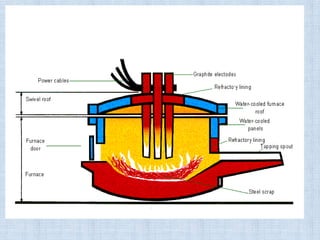
Electric Arc
Furnace (EAF)
•The Electric Arc Furnace (EAF) uses only scrap metal.
•The process was originally used solely for making high quality
steel. Modern electric arc furnaces can make up to 150 tones of steel
in a single melt.
•The electric arc furnace consists of a circular bath with a movable
roof, through which three graphite electrodes can be raised or
lowered.
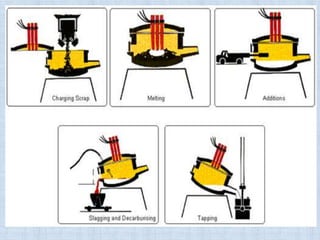
• At the start of the process, the electrodes are withdrawn and the
roof swung. The steel scrap is then charged into the furnace from a
large steel basket lowered from an overhead travelling crane. When
charging is complete, the roof is swung back into position and the
electrodes lowered into the furnace.
•A powerful electric current is passed through the charge, an arc
is created, and the heat generated melts the scrap.
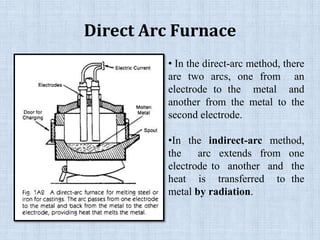
Direct Arc Furnace
• In the direct-arc method, there
are two arcs, one from an
electrode to the metal and
another from the metal to the
second electrode.
•In the indirect-arc method,
the arc extends from one
electrode to another and the
heat is transferred to the
metal by radiation.
Casting Processes
Investment Casting (Lost Wax Process)
A pattern made of wax is coated with a refractory
material to make mold, after which wax is melted
away prior to pouring molten metal
• "Investment" comes from a less familiar
definition of "invest" - "to cover completely,"
which refers to coating of refractory material
around wax pattern.
• It is a precision casting process - capable of
producing castings of high accuracy and intricate
detail
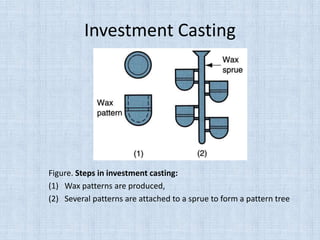
Investment Casting
Figure. Steps in investment casting:
(1) Wax patterns are produced,
(2) Several patterns are attached to a sprue to form a pattern tree
Investment Casting
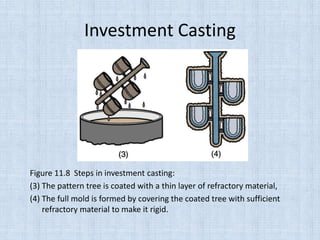
Figure 11.8 Steps in investment casting:
(3) The pattern tree is coated with a thin layer of refractory material,
(4) The full mold is formed by covering the coated tree with sufficient
refractory material to make it rigid.
Investment Casting
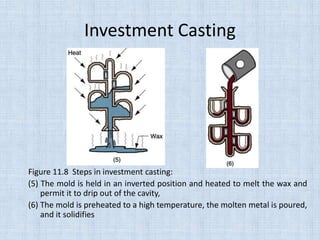
Figure 11.8 Steps in investment casting:
(5) The mold is held in an inverted position and heated to melt the wax and
permit it to drip out of the cavity,
(6) The mold is preheated to a high temperature, the molten metal is poured,
and it solidifies
Investment Casting
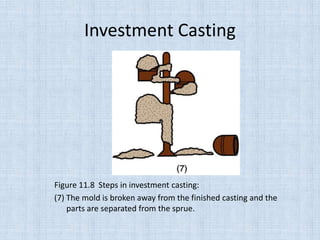
Figure 11.8 Steps in investment casting:
(7) The mold is broken away from the finished casting and the
parts are separated from the sprue.
Investment Casting
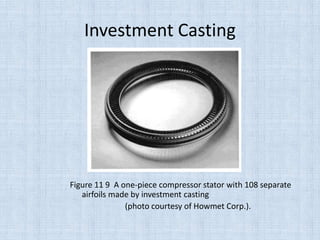
Figure 11 9 A one-piece compressor stator with 108 separate
airfoils made by investment casting
(photo courtesy of Howmet Corp.).
Advantages and Disadvantages
• Advantages of investment casting:
– Parts of great complexity and intricacy can be cast
– Close dimensional control and good surface finish
– Wax can usually be recovered for reuse
– Additional machining is not normally required - this is a net
shape process
• Disadvantages
– Many processing steps are required
– Relatively expensive process
CONTINNOUS CASTING
• In this process the molten metal is
continuously poured in to a mold cavity
around which a facility for quick cooling the
molten metal to the point of solidification.
• The solidified metal is then continuously
extracted from the mold at predetermined
rate.
 In reciprocating process, molten metal is poured into
a holding furnace. At the bottom of this furnace,
there is a valve by which the quantity of flow can be
changed.
 The molten metal is poured into the mold at a
uniform speed. The water cooled mold is
reciprocated up and down. The solidified portion of
the casting is withdrawn by the rolls at a constant
speed.
 The movement of the rolls and the reciprocating
motion of the rolls are fully mechanized and properly
controlled by means of cams and follower
arrangements.
CONTINNOUS CASTING
CONTINNOUS CASTING
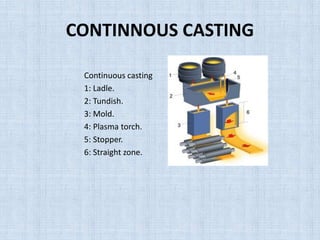
Continuous casting
1: Ladle.
2: Tundish.
3: Mold.
4: Plasma torch.
5: Stopper.
6: Straight zone.
Advantages & Application
 Advantages
• The process is cheaper than rolling
• 100% casting yield.
• The process can be easily mechanized and thus unit labor cost is
less.
• Casting surfaces are better.
• Grain size and structure of the casting can be easily controlled
 Application
• It is used for casting materials such as brass, bronzes, zinc,
copper, aluminium and its alloys, magnesium, carbon and alloys
etc.
• Production of blooms, billets, slabs, sheets, copper bar etc.
• It can produce any shape of uniform cross-section such as round,
rectangular, square, hexagonal, fluted or gear toothed etc.
Centrifugal Casting
• In centrifugal casting process, molten metal is
poured into a revolving mold and allowed to
solidify molten metal by pressure of centrifugal
force.
• It is employed for mass production of circular
casting as the castings produced by this process
are free from impurities.
• Due to centrifugal force, the castings produced
will be of high density type and of good
strength.
Centrifugal Casting
• The castings produced promote directional
solidification as the colder metal (less temperature
molten metal) is thrown to outside of casting and
molten metal near the axis or rotation.
• The cylindrical parts and pipes for handling gases are
most adoptable to this process.
• Centrifugal casting processes are mainly of three types
which are discussed as under.
(1) True centrifugal casting
(2) Semi-centrifugal casting and
(3) Centrifuged casting
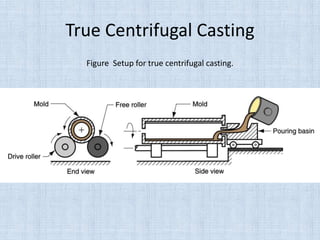
True Centrifugal Casting
• In true centrifugal casting process, the axis of
rotation of mold can be horizontal, vertical or
inclined. Usually it is horizontal.
• Molten metal is poured into rotating mold to
produce a tubular part
• In some operations, mold rotation commences
after pouring rather than before
• Parts: pipes, tubes, bushings, and rings
• Outside shape of casting can be round, octagonal,
hexagonal, etc , but inside shape is (theoretically)
perfectly round, due to radially symmetric forces
True Centrifugal Casting
Figure Setup for true centrifugal casting.
Semicentrifugal Casting
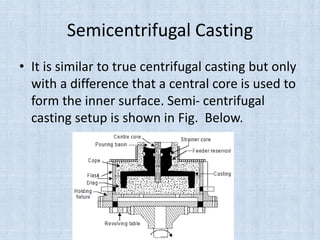
• It is similar to true centrifugal casting but only
with a difference that a central core is used to
form the inner surface. Semi- centrifugal
casting setup is shown in Fig. Below.
Semicentrifugal Casting
• This casting process is generally used for articles
which are more complicated than those possible
in true centrifugal casting, but are axi-symmetric
in nature.
• A particular shape of the casting is produced by
mold and core and not by centrifugal force. The
centrifugal force aids proper feeding and helps in
producing the castings free from porosity.
• Symmetrical objects namely wheel having arms
like flywheel,gears and back wheels are produced
by this process.
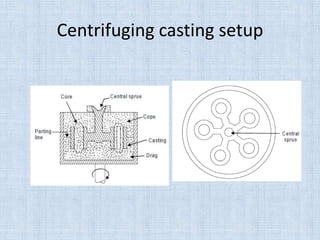
Centrifuge Casting
Mold is designed with part cavities located away
from axis of rotation, so that molten metal
poured into mold is distributed to these
cavities by centrifugal force
• Used for smaller parts
• Radial symmetry of part is not required as in
other centrifugal casting methods
Centrifuging casting setup
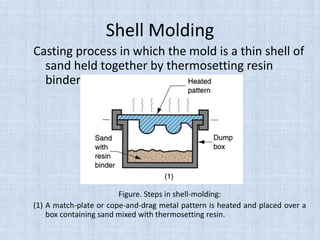
Shell Molding
Casting process in which the mold is a thin shell of
sand held together by thermosetting resin
binder
Figure. Steps in shell-molding:
(1) A match-plate or cope-and-drag metal pattern is heated and placed over a
box containing sand mixed with thermosetting resin.
Shell Molding
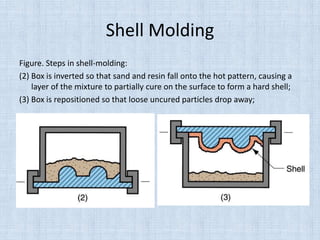
Figure. Steps in shell-molding:
(2) Box is inverted so that sand and resin fall onto the hot pattern, causing a
layer of the mixture to partially cure on the surface to form a hard shell;
(3) Box is repositioned so that loose uncured particles drop away;
Shell Molding
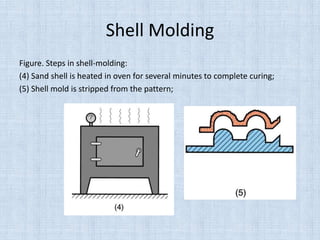
Figure. Steps in shell-molding:
(4) Sand shell is heated in oven for several minutes to complete curing;
(5) Shell mold is stripped from the pattern;
Shell Molding
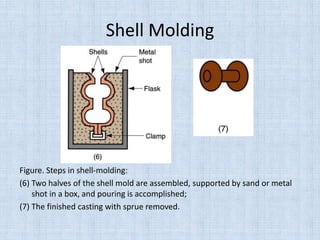
Figure. Steps in shell-molding:
(6) Two halves of the shell mold are assembled, supported by sand or metal
shot in a box, and pouring is accomplished;
(7) The finished casting with sprue removed.
Advantages and Disadvantages
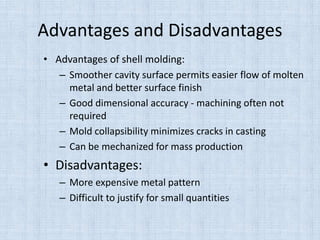
• Advantages of shell molding:
– Smoother cavity surface permits easier flow of molten
metal and better surface finish
– Good dimensional accuracy - machining often not
required
– Mold collapsibility minimizes cracks in casting
– Can be mechanized for mass production
• Disadvantages:
– More expensive metal pattern
– Difficult to justify for small quantities
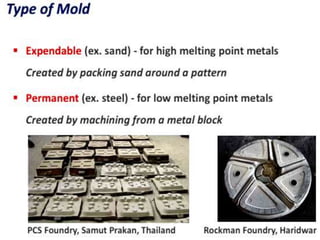
Permanent Mold Casting Processes
• Economic disadvantage of expendable
mold casting: a new mold is required for
every casting
• In permanent mold casting, the mold is
reused many times.
• The processes include:
– Basic permanent mold casting
– Die casting
– Centrifugal casting
The Basic Permanent Mold Process
Uses a metal mold constructed of two
sections designed for easy, precise opening
and closing
• Molds used for casting lower melting point
alloys are commonly made of steel or cast iron
• Molds used for casting steel must be made of
refractory material, due to the very high
pouring temperatures.
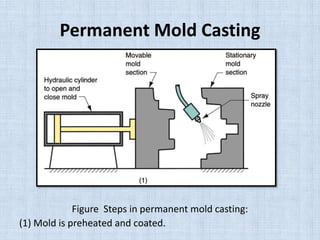
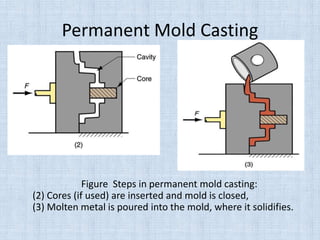
Permanent Mold Casting
Figure Steps in permanent mold casting:
(1) Mold is preheated and coated.
Permanent Mold Casting
Figure Steps in permanent mold casting:
(2) Cores (if used) are inserted and mold is closed,
(3) Molten metal is poured into the mold, where it solidifies.
Advantages
 Advantages of permanent mold casting:
• Good dimensional control and surface finish
• More rapid solidification caused by the cold metal mold results
in a finer grain structure, so castings are stronger
• No blow holes exist in castings produced by this method.
• The process is economical for mass production.
• Close dimensional tolerance or job accuracy is possible to
achieve on the cast product.
• Casting defects observed in sand castings are eliminated.
• Fast rate of production can be attained.
• The process requires less labor.
Limitations
– Generally limited to metals of lower melting point
– Simpler part geometries compared to sand casting
because of need to open the mold
– High cost of mold
Applications of Permanent Mold
Casting
• Due to high mold cost, process is best suited
to high volume production and can be
automated accordingly
• Typical parts: automotive pistons, pump
bodies, and certain castings for aircraft and
missiles
• Metals commonly cast: aluminum,
magnesium, copper-base alloys, and cast iron
Die Casting
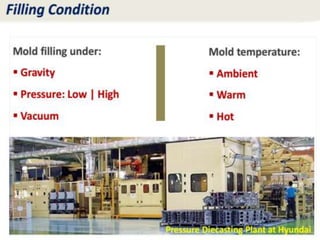
A permanent mold casting process in which
molten metal is injected into mold cavity
under high pressure
• Pressure is maintained during solidification,
then mold is opened and part is removed
• Molds in this casting operation are called dies;
hence the name die casting
• Use of high pressure to force metal into die
cavity is what distinguishes this from other
permanent mold processes
Die Casting Machines
• Designed to hold and accurately close two
mold halves and keep them closed while
liquid metal is forced into cavity
• Two main types:
1. Hot-chamber machine
2. Cold-chamber machine
Hot-Chamber Die Casting
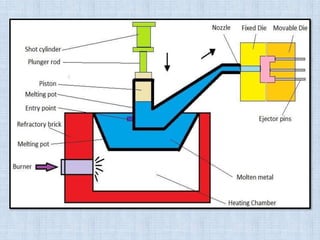
Metal is melted in a container, and a piston injects
liquid metal under high pressure into the die
• High production rates - 500 parts per hour not
uncommon
• Applications limited to low melting point metals
that do not chemically attack plunger and other
mechanical components
• Casting metals: zinc, tin, lead, and magnesium
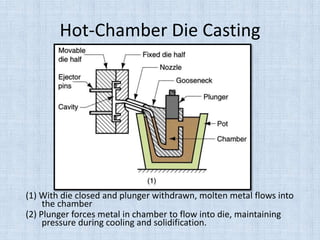
Hot-Chamber Die Casting
Figure Cycle in Hot-chamber casting:
(1) With die closed and plunger withdrawn, molten metal flows into
the chamber
(2) Plunger forces metal in chamber to flow into die, maintaining
pressure during cooling and solidification.
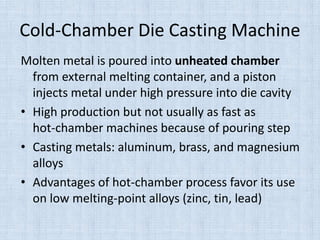
Cold-Chamber Die Casting Machine
Molten metal is poured into unheated chamber
from external melting container, and a piston
injects metal under high pressure into die cavity
• High production but not usually as fast as
hot-chamber machines because of pouring step
• Casting metals: aluminum, brass, and magnesium
alloys
• Advantages of hot-chamber process favor its use
on low melting-point alloys (zinc, tin, lead)
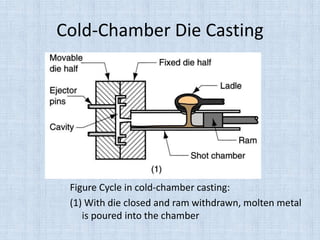
Cold-Chamber Die Casting
Figure Cycle in cold-chamber casting:
(1) With die closed and ram withdrawn, molten metal
is poured into the chamber
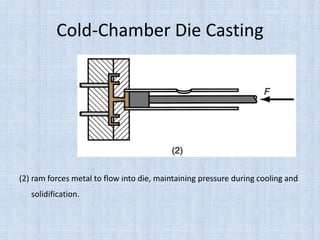
Cold-Chamber Die Casting
(2) ram forces metal to flow into die, maintaining pressure during cooling and
solidification.
Molds for Die Casting
• Usually made of tool steel, mold steel, or
maraging steel (carbon free iron-nickel alloy with
additional of cobalt, molybdenum titanium and
aluminum)
• Tungsten and molybdenum (good refractory
qualities) used to die cast steel and cast iron
• Ejector pins required to remove part from die
when it opens
• Lubricants must be sprayed into cavities to
prevent sticking
Advantages and Limitations
• Advantages of die casting:
– Economical for large production quantities
– Good accuracy and surface finish
– Thin sections are possible
– Rapid cooling provides small grain size and good strength
to casting
• Disadvantages:
– Generally limited to metals with low metal points
– Part geometry must allow removal from die
Applications
1. Carburetor bodies
2. Hydraulic brake cylinders
3. Refrigeration castings
4. Washing machine
5. Connecting rods and automotive pistons
6. Oil pump bodies
7. Gears and gear covers
8. Aircraft and missile castings, and
9. Typewriter segments
ADVANTAGES OF DIE CASTING OVER SAND CASTING
1. Die casting requires less floor space in comparison to sand
casting.
2. It helps in providing precision dimensional control with a
subsequent reduction in machining cost.
3. It provides greater improved surface finish.
4. More true shape can be produced with close tolerance in die
casting.
5. Castings produced by die casting are usually less defective.
6. It produces more sound casting than sand casting.
7. It is very quick process.
8. Its rate of production is high as much as 800 casting / hour.
Casting Quality
• There are numerous opportunities for things
to go wrong in a casting operation, resulting in
quality defects in the product
• The defects can be classified as follows:
– General defects common to all casting processes
– Defects related to sand casting process
Probable Causes and
Suggested Remedies of
Various Casting Defects
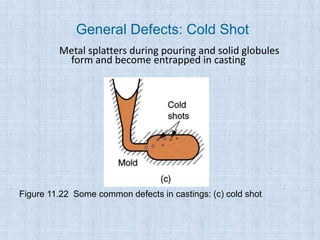
Metal splatters during pouring and solid globules
form and become entrapped in casting
Figure 11.22 Some common defects in castings: (c) cold shot
General Defects: Cold Shot
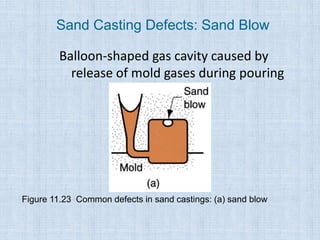
Balloon-shaped gas cavity caused by
release of mold gases during pouring
Figure 11.23 Common defects in sand castings: (a) sand blow
Sand Casting Defects: Sand Blow
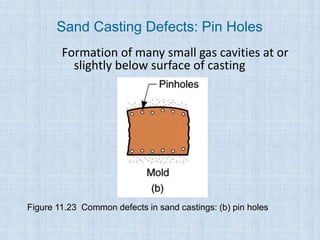
Formation of many small gas cavities at or
slightly below surface of casting
Figure 11.23 Common defects in sand castings: (b) pin holes
Sand Casting Defects: Pin Holes
Probable Causes and Suggested Remedies of Various Casting Defects
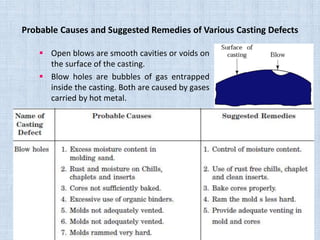
 Open blows are smooth cavities or voids on
the surface of the casting.
 Blow holes are bubbles of gas entrapped
inside the casting. Both are caused by gases
carried by hot metal.
Probable Causes and Suggested Remedies of Various Casting Defects
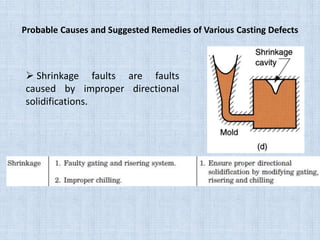
 Shrinkage faults are faults
caused by improper directional
solidifications.
Probable Causes and Suggested Remedies of Various
Casting Defects
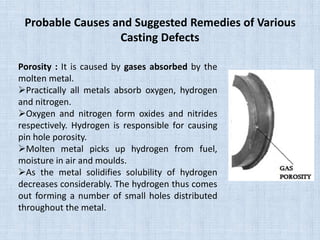
Porosity : It is caused by gases absorbed by the
molten metal.
Practically all metals absorb oxygen, hydrogen
and nitrogen.
Oxygen and nitrogen form oxides and nitrides
respectively. Hydrogen is responsible for causing
pin hole porosity.
Molten metal picks up hydrogen from fuel,
moisture in air and moulds.
As the metal solidifies solubility of hydrogen
decreases considerably. The hydrogen thus comes
out forming a number of small holes distributed
throughout the metal.
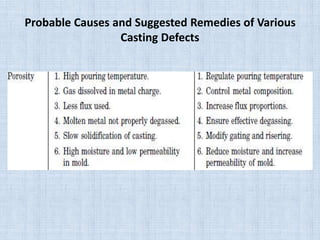
Probable Causes and Suggested Remedies of Various
Casting Defects
Probable Causes and Suggested Remedies of Various
Casting Defects
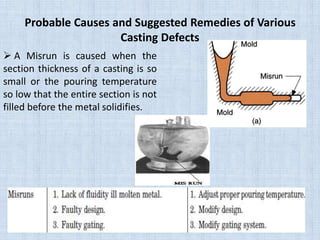
 A Misrun is caused when the
section thickness of a casting is so
small or the pouring temperature
so low that the entire section is not
filled before the metal solidifies.
Probable Causes and Suggested Remedies of Various
Casting Defects
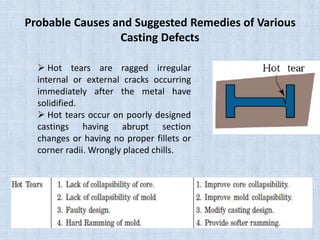
 Hot tears are ragged irregular
internal or external cracks occurring
immediately after the metal have
solidified.
 Hot tears occur on poorly designed
castings having abrupt section
changes or having no proper fillets or
corner radii. Wrongly placed chills.
Probable Causes and Suggested Remedies of Various
Casting Defects
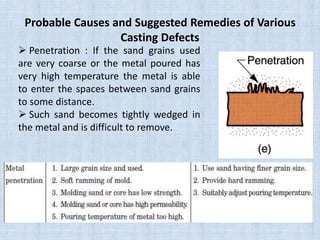
 Penetration : If the sand grains used
are very coarse or the metal poured has
very high temperature the metal is able
to enter the spaces between sand grains
to some distance.
 Such sand becomes tightly wedged in
the metal and is difficult to remove.
Probable Causes and Suggested Remedies of Various
Casting Defects
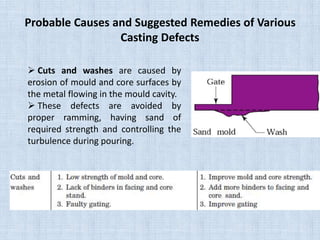
 Cuts and washes are caused by
erosion of mould and core surfaces by
the metal flowing in the mould cavity.
 These defects are avoided by
proper ramming, having sand of
required strength and controlling the
turbulence during pouring.
Probable Causes and Suggested Remedies of Various
Casting Defects
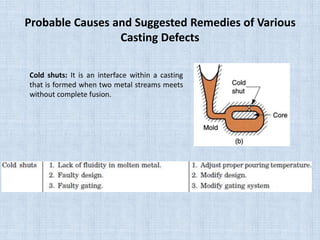
Cold shuts: It is an interface within a casting
that is formed when two metal streams meets
without complete fusion.
Probable Causes and Suggested Remedies of Various
Casting Defects
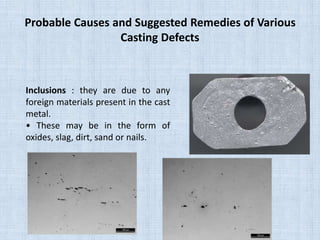
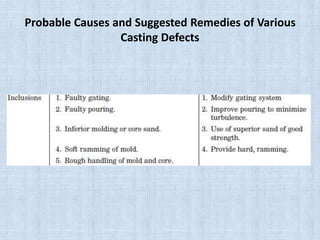
Inclusions : they are due to any
foreign materials present in the cast
metal.
• These may be in the form of
oxides, slag, dirt, sand or nails.
Probable Causes and Suggested Remedies of Various
Casting Defects
Probable Causes and Suggested Remedies of Various
Casting Defects
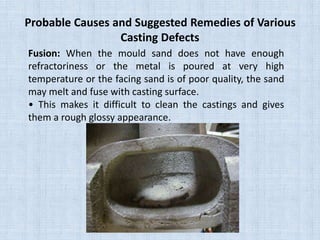
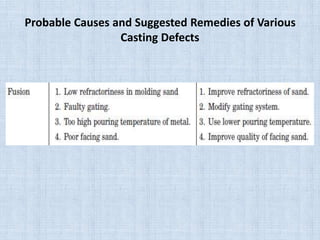
Fusion: When the mould sand does not have enough
refractoriness or the metal is poured at very high
temperature or the facing sand is of poor quality, the sand
may melt and fuse with casting surface.
• This makes it difficult to clean the castings and gives
them a rough glossy appearance.
Probable Causes and Suggested Remedies of Various
Casting Defects
Probable Causes and Suggested Remedies of Various
Casting Defects
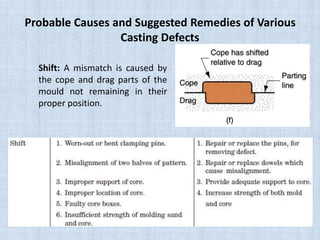
Shift: A mismatch is caused by
the cope and drag parts of the
mould not remaining in their
proper position.
Probable Causes and Suggested Remedies of Various
Casting Defects
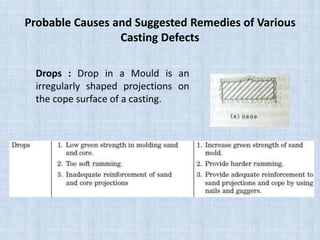
Drops : Drop in a Mould is an
irregularly shaped projections on
the cope surface of a casting.
Rat tails and buckles are caused by the expansion of a thin
outer layer of moulding sand on the surface of the mould
cavity due to metal heat.
• A rat tail is caused by depression of a part of the mould
under compression which appears as an irregular line on
the surface of the casting.
• A buckle is a more severe failure of the sand surface
under compression.
• The mould must provide for proper expansion instead of
forming compressed layers to avoid this defect.
Probable Causes and Suggested Remedies of
Various Casting Defects
Probable Causes and Suggested Remedies of Various
Casting Defects
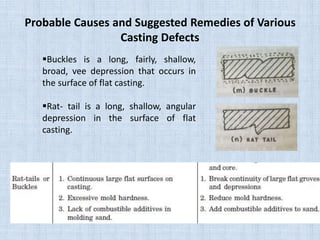
Buckles is a long, fairly, shallow,
broad, vee depression that occurs in
the surface of flat casting.
Rat- tail is a long, shallow, angular
depression in the surface of flat
casting.
Probable Causes and Suggested
Remedies of Various Casting Defects
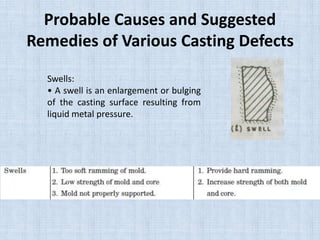
Swells:
• A swell is an enlargement or bulging
of the casting surface resulting from
liquid metal pressure.
Additional Steps After Solidification
• Trimming
• Removing the core
• Surface cleaning
• Inspection
• Repair, if required
• Heat treatment
Trimming
Removal of sprues, runners, risers, parting-line
flash, fins, chaplets, and any other excess metal
from the cast part
• For brittle casting alloys and when cross sections
are relatively small, appendages can be broken
off
• Otherwise, hammering, shearing, hack-sawing,
band-sawing, abrasive wheel cutting, or various
torch cutting methods are used
Removing the Core
If cores have been used, they must be removed
• Most cores are bonded, and they often fall out
of casting as the binder deteriorates.
• In some cases, they are removed by shaking
casting, either manually or mechanically
• In rare cases, cores are removed by chemically
dissolving bonding agent
• Solid cores must be hammered or pressed out
Surface Cleaning
Removal of sand from casting surface and
otherwise enhancing appearance of surface
• Cleaning methods: tumbling, air-blasting with
coarse sand grit or metal shot, wire brushing,
buffing, and chemical pickling
• Surface cleaning is most important for sand
casting
– In many permanent mold processes, this step can be avoided
• Defects are possible in casting, and inspection is
needed to detect their presence
Heat Treatment
• Castings are often heat treated to enhance
properties
• Reasons for heat treating a casting:
– For subsequent processing operations such as machining
– To bring out the desired properties for the application of
the part in service
Foundry Inspection Methods
• Visual inspection to detect obvious defects
such as misruns, cold shuts, and severe
surface flaws
• Dimensional measurements to insure that
tolerances have been met
• Metallurgical, chemical, physical, and other
tests concerned with quality of cast metal.

Lecture 2 casting full

  • 1.
  • 11.
    Definition The casting processbasically involves (a) pouring molten metal into a mold patterned after the part to be manufactured, (b) allowing it to solidify, and (c) removing the part from the mold. • Important considerations in casting operations are as follows: 1. Flow of the molten metal into the mold cavity 2. Solidification and cooling of the metal in the mold 3. Influence of the type of mold material.
  • 12.
    Components involved inmaking a casting:
  • 27.
    Steps involved inmaking a casting: • Pattern Making • Moulding • Melting • Pouring and solidification • Cleaning and Inspection
  • 28.
    Pattern A Pattern isa model or the replica of the object to be cast with some modifications. Modifications are: Pattern Allowances Provision for core prints Elimination of fine details
  • 29.
    Master pattern Master patternis the name given to a pattern having a double contraction or shrinkage allowance. For the general purposes of lower cost and of speed in the manufacture of a master pattern, poplar is the most logical material to use. Poplar (Liriodendron tulipifera)
  • 30.
    Types of Patterns: Singlepiece pattern. Split pattern Loose piece pattern Match plate pattern Sweep pattern Gated pattern Skeleton pattern Follow board pattern Cope and Drag pattern
  • 31.
    (a)Split pattern (b) Follow-board (c)Match Plate (d) Loose-piece (e) Sweep (f) Skeleton pattern
  • 32.
    Figure 11.3 -Types of patterns used in sand casting: (a) solid pattern (b) split pattern (c) match-plate pattern (d) cope and drag pattern
  • 33.
    Single piece pattern •generallyare used for simpler shapes and low quantity production; •they generally are made of wood and are inexpensive.
  • 34.
    Split Pattern •Castings withcomplicated shapes can be produced.
  • 35.
    •When a onepiece solid pattern has projections or back drafts which lie above or below the parting plane, it is impossible to with draw it from the mould. •With such patterns, the projections are made with the help of loose pieces. One drawback of loose faces is that their shifting is possible during ramming.
  • 36.
    Match plate pattern •Insuch constructions, the gating system can be mounted on the drag side of the pattern. •This type of pattern is used most often in conjunction with molding machines and large production runs to produce smaller castings. •Piston rings of I.C. engines are produced by this process
  • 37.
    Sweep pattern: •A sweepis a section or board (wooden) of proper contour that is rotated about one edge to shape mould cavities having shapes of rotational symmetry. •This type of pattern is used when a casting of large size is to be produced in a short time. Large kettles of C.I. are made by sweep patterns.
  • 38.
    castings Gating system GATED PATTRN •Agated pattern is simply one or more loose patterns having attached gates and runners. •Because of their higher cost, these patterns are used for producing small castings in mass production systems and on molding machines.
  • 39.
  • 40.
  • 41.
    Materials for makingpatterns: WOOD METAL PLASTIC PLASTER WAX
  • 42.
    The pattern materialshould be: 1. Easily worked, shaped and joined. 2. Light in weight. 3. Strong, hard and durable. 4. Resistant to wear and abrasion . 5. Resistant to corrosion, and to chemical reactions. 6. Dimensionally stable and unaffected by variations in temperature and humidity. 7. Available at low cost.
  • 43.
    Types of PatternAllowances: The various pattern allowances are: 1. Shrinkage or contraction allowance. 2. Machining or finish allowance. 3. Draft of tapper allowances. 4. Distortion or chamber allowance. 5. Shake or rapping allowance.
  • 44.
    1.Shrinkage Allowance: All mostall cast metals shrink or contract volumetrically on cooling. The metal shrinkage is of two types: 1. Liquid Shrinkage: 2. Solid Shrinkage:
  • 45.
    2. Machining Allowance: ACasting is given an allowance for machining, because: i. Castings get oxidized in the mold and during heat treatment; scales etc., thus formed need to be removed. ii. It is the intended to remove surface roughness and other imperfections from the castings. iii. It is required to achieve exact casting dimensions. iv. Surface finish is required on the casting.
  • 46.
    3. Draft orTaper Allowance:  It is given to all surfaces perpendicular to parting line.  Draft allowance is given so that the pattern can be easily removed from the molding material tightly packed around it with out damaging the mould cavity.
  • 48.
  • 49.
    4. Distortion orcambered allowance: A casting will distort or wrap if : i. It is of irregular shape, ii. All it parts do not shrink uniformly i.e., some parts shrinks while others are restricted from during so, iii. It is u or v-shape
  • 50.
    5. Shake allowance: Apattern is shaken or rapped by striking the same with a wooden piece from side to side. This is done so that the pattern a little is loosened in the mold cavity and can be easily removed. In turn, therefore, rapping enlarges the mould cavity which results in a bigger sized casting. Hence, a –ve allowance is provided on the pattern i.e., the pattern dimensions are kept smaller in order to compensate the enlargement of mould cavity due to rapping.
  • 51.
    Example • A jobshown in the Figure is to be made of steel by casting process. The mould for this job is made from a wooden pattern. Determine the dimensions of the wooden pattern. Assume machining allowance of 2 mm on each side, shrinkage allowance of 2% and a taper allowance of 1 degree.
  • 52.
  • 53.
  • 55.
  • 56.
    Example A job shownin Figure is to be made from steel by casting process. The mold for this job is made from wooden pattern. Determine the dimensions of the wooden pattern assuming machining allowance of 3 mm on each side, shaking allowance of 1 mm on length and width, shrinkage allowance of 3%
  • 57.
    After machining allowance After3% shrinkage allowance
  • 58.
  • 62.
  • 63.
    A)Natural sand isthe one which is available from natural deposits. Only additives and water need be added to it to make it satisfactory for molding. B)Synthetic sand is prepared by mixing a relatively clay free sand having specified type of sand grain, with specified type of clay binder as well as water and other additives.
  • 64.
    1. Green sand:It is sand used in the wet condition for making the mould. It is mixture of silica sand with 15-25 % clay and 6-8 % water. The sand can be easily worked with hand to give it any desired shape. This sand is used for producing small to medium sized moulds which are not very complex. Color is black We can maintain its porosity
  • 65.
    2. Dry sand: Drysand is the green sand that has been dried or baked after preparing the mould. Drying sand gives strength to the mould so that it can be used for larger castings
  • 66.
    3. Loam sand: Loamsand is sand containing up to 50 % clay which has been worked to the consistency of builder mortar. This sand is used for loam sand moulds for making very heavy castings usually with the help of sweeps and skeleton patterns.
  • 67.
    4. Parting sand: -Thissand is used during making of the mould to ensure that green sand does not stick to the pattern and the cope and drug parts can be easily separated for removing the pattern without causing any damage to the mould. -Parting sand consists of fine grained clay free dried silica sand, sea sand or burnt sand with some parting compounds. -The parting compounds used include charcoal, ground bone and limestone, groundnut shells, talcum and calcium phosphate.
  • 68.
    5. Facing sand: -Facingsand is the sand which covers the pattern all around it. The remaining box is filled with ordinary floor sand. -Facing sand forms the face of the mould and comes in direct contact with the molten metal when it is poured. -High strength and refractoriness are required for this sand. -It is made of silica sand and clay without the addition of any used sand.
  • 69.
    6. Backing sand: -Backingsand is the bulk of the sand used to back up the facing sand and to fill up the volume of the flask. -It consists mainly of old, repeatedly used moulding sand which is generally black in colour due to addition of coal dust and burning on contact with hot metal. Because of the colour backing sand is also sometimes called black sand.
  • 70.
    7. System sand: -Thisis the sand used in mechanized foundries for filling the entire flask. -No separate facing sand in used in a mechanized foundry. -Sand, cleaned and reactivated by the addition of water and binders is used to fill the flask. Because of the absence of any fresh sand, system sand must have more strength, permeability and refractoriness compared to backing sand.
  • 71.
    8. Core sand: -Coresand is the sand used for making cores. --This is silica sand mixed with core oil. That is why it is also called oil sand. -The core oil consists of linseed oil, resin, light mineral oil with some binders. -For larger cores, sometimes flour and water may also be used to save on cost.
  • 72.
  • 73.
    1. Green strength:The green sand, after water has been mixed into it, must have adequate strength and plasticity for making and handling of the mold. 2. Dry strength: As a casting is poured, sand adjacent to the hot metal quickly loses its water as steam. The dry sand must have strength to resist erosion, and also the pressure of the molten metal, or else the mold may enlarge. 3. Hot strength. After the moisture has evaporated, the sand may be required to possess strength at some elevated temperature.
  • 74.
    4. Permeability/Porosity. Heatfrom the casting causes a green‐sand mold to evolve a great deal of steam and other gases. The mold must be permeable, i.e. porous, to permit the gases to pass off, or the casting will contain gas holes. 5. Thermal stability. Heat from the casting causes rapid expansion of the sand surface at the mold‐ metal interface. The mold surface may then crack, buckle, or flake off (scab) unless the molding sand is relatively stable dimensionally under rapid heating.
  • 75.
    6. Refractoriness. Higherpouring temperatures, such as those for ferrous alloys at 2400 to 3200 F, require greater refractoriness of the sand. Low‐ pouring‐temperature metals, for example, aluminum, poured at 1300 F, do not require a high degree of refractoriness from the sand. 7. Plasticity or flow-ability : It is the measure of the molding sand to flow around and over a pattern during ramming and to uniformly fill the flask. 8. Cohesiveness: It is the property of sand which hold grains together. 9. Collapsibility: Heated sand which becomes hard and rock like is difficult to remove from the casting and may cause the contracting metal to tear or crack.
  • 76.
    10. Adhesiveness: Thisis the property of sand mixture to adhere to another body (here, the molding flasks). The molding sand should stick to the sides of the molding boxes so that it does not fall out when the flasks are lifted and turned over. 11. Offers ease of sand preparation and control. 12. Removes heat from the cooling casting. 13.Produces good casting finish 14.It is reusable.
  • 77.
  • 78.
    Core-Core prints : Whena casting is required to have a hole, through or blind, a core is used in the mould to produce the same. It is made up of sand ,wood, or metal body, which is left in the mould during casting and it remove after casting. This core has to be properly seated in the mould extra projections are added on the pattern surface at proper places. These projections are known as core prints.
  • 79.
    Use of chapletsto avoid shifting of cores Possible chaplet design and casting with core
  • 81.
    •It must bestrong to retain the shape while handling, •It must resist erosion by molten metal, • It must be permeable to gases, •It must have high refractoriness, •It must have good surface finish to replicate it on to the casting. Core properties
  • 83.
  • 85.
    Casting Terms: 2. Pattern:It is the replica of the final object to be made. The mold cavity is made with the help of pattern. 3. Parting line: This is the dividing line between the two molding flasks that makes up the mold. Pattern
  • 86.
    4. Pouring basin:A small funnel shaped cavity at the top of the mold into which the molten metal is poured. 5. Sprue: The passage through which the molten metal, from the pouring basin, reaches the mold cavity. In many cases it controls the flow of metal into the mold.
  • 87.
    6. Runner: Thechannel through which the molten metal is carried from the sprue to the gate. 7. Riser: A column of molten metal placed in the mold to feed the castings as it shrinks and solidifies. Also known as feed head. 8. Gate: A channel through which the molten metal enters the mold cavity.
  • 88.
    9. Core: Aseparate part of the mold, made of sand and generally baked, which is used to create openings and various shaped cavities in the castings. 10.Chaplets: Chaplets are used to support the cores inside the mold cavity to take care of its own weight and overcome the metallostatic force. 11. Vent: Small opening in the mold to facilitate escape of air and gases. 12. Chill: Chills are metallic objects, which are placed in the mould to increase the cooling rate of castings.
  • 90.
    Types of Gateor In-gate Top gate: Causes turbulence in the mould cavity, it is prone to form dross, favourable temperature gradient towards the gate, only for ferrous alloys. Bottom gate: No mould erosion, used for very deep moulds, higher pouring time, Causes unfavorable temperature gradients. Parting Gate: most widely used gate, easiest and most economical in preparation. Step Gate: Used for heavy and large castings, size of ingates are normally increased from top to bottom.
  • 91.
    The goals forthe gating system • To minimize turbulence to avoid trapping gasses into the mold • To get enough metal into the mold cavity before the metal starts to solidify • To avoid shrinkage • Establish the best possible temperature gradient in the solidifying casting so that the shrinkage if occurs must be in the gating system not in the required cast part. • Incorporates a system for trapping the non-metallic inclusions.
  • 92.
    Types of GatingSystems The gating systems are of two types: –Pressurized gating system –Un-pressurized gating system
  • 93.
    Pressurized Gating System •The total cross sectional area decreases towards the mold cavity • Back pressure is maintained by the restrictions in the metal flow • Flow of liquid (volume) is almost equal from all gates • Back pressure helps in reducing the aspiration as the sprue always runs full • Because of the restrictions the metal flows at high velocity leading to more turbulence and chances of mold erosion.
  • 94.
    Un-Pressurized Gating System •The total cross sectional area increases towards the mold cavity • Restriction only at the bottom of sprue • Flow of liquid (volume) is different from all gates • Aspiration in the gating system as the system never runs full • Less turbulence.
  • 95.
    Risers and RiserDesign • Risers are added reservoirs designed to feed liquid metal to the solidifying casting as a means of compensating for solidification shrinkage. • To perform this function, the risers must solidify after the casting. • According to Chvorinov's rule, a good shape for a riser would be one that has a long freezing time (i.e., a small surface area per unit volume). • Live risers (also known as hot risers) receive the last hot metal that enters the mold and generally do so at a time when the metal in the mold cavity has already begun to cool and solidify.
  • 96.
  • 97.
    Gating ratio • Gatingratio is defined as: Sprue area: Runner area: Ingate area. • For high quality steel castings, a gating ratio of 1: 2: 2 or 1: 2: 1.5 will produce castings nearly free from erosion, will minimize oxidation, and will produce uniform flow. • A gating ratio of 1: 4: 4 might favour the formation of oxidation defects.
  • 98.
    Chvorinov’s rule • Totalsolidification time (ts) = B (V/A) n where n = 1.5 to 2.0 [Where, B = mould constant and is a function of (mould material, casting material, and condition of casting] n = 2 and triser = 1.25 tcasting             2 2 riser casting V V 1.25 A A        2 2 V D H / 4 DA DH 2 4 For cylinder of diameter D and height H or
  • 99.
    Padding • Tapering ofthinner section towards thicker section is known as 'padding'. • This will require extra material. • If padding is not provided, centre line shrinkage or porosity will result in the thinner section.
  • 100.
  • 103.
    Self study • Mouldingpractices: • Green, dry and loam sand moulding, pit and floor moulding; shell moulding; permanent moulding; carbon dioxide moulding.
  • 104.
    Furnaces • Melting isan equally important parameter for obtaining a quality castings. A number of furnaces can be used for melting the metal, to be used, to make a metal casting. The choice of furnace depends on the type of metal to be melted. Some of the furnaces used in metal casting are as following: 1. Crucible furnaces 2. Cupola 3. Induction furnace 4. Electric arc furnace 5. Rotary furnace 6. Pit electric
  • 105.
    Crucible furnace •The crucibleis made of either a clay-silicon-carbide or a clay- graphite mixture. •The furnace can either tilt for pouring or the crucible can be lifted out
  • 106.
  • 107.
  • 108.
    Cupola • Cupola hasbeen the most widely used furnace for melting cast iron. • In hot blast cupola, the flue gases are used to preheat the air blast to the cupola so that the temperature in the furnace is considerably higher than that in a conventional cupola. Coke is fuel and Lime stone (CaCO3) is mostly used flux. • Cost of melting low. • Main disadvantages of cupola is that it is not possible to produce iron below 2.8% carbon. • Steel can be also prepared in cupola by employing duplexing and triplexing operations.
  • 109.
    Description of Cupola Thecupola consists of a vertical cylindrical steel sheet and lined inside with acid refractory bricks. The lining is generally thicker in the lower portion of the cupola as the temperature are higher than in upper portion. There is a charging door through which coke, pig iron, steel scrap and flux is charged The blast is blown through the tuyeres These tuyeres are arranged in one or more row around the periphery of cupola Hot gases which move up from the bottom (combustion zone) preheats the iron in the preheating zone Cupolas are provided with a drop bottom door through which debris, consisting of coke, slag etc. can be discharged at the end of the melt A slag hole is provided to remove the slag from the melt Through the tap hole molten metal is poured into the ladle At the top conical cap called the spark arrest is provided to prevent the spark emerging to outside
  • 110.
    Operation of Cupola Thecupola is charged with wood at the bottom. On the top of the wood a bed of coke is built. Alternating layers of metal and ferrous alloys, coke, and limestone are fed into the furnace from the top. The purpose of adding flux is to eliminate the impurities and to protect the metal from oxidation. Air blast is opened for the complete combustion of coke. When sufficient metal has been melted that slag hole is first opened to remove the slag. Tap hole is then opened to collect the metal in the ladle.
  • 113.
  • 114.
    •The Electric ArcFurnace (EAF) uses only scrap metal. •The process was originally used solely for making high quality steel. Modern electric arc furnaces can make up to 150 tones of steel in a single melt. •The electric arc furnace consists of a circular bath with a movable roof, through which three graphite electrodes can be raised or lowered. • At the start of the process, the electrodes are withdrawn and the roof swung. The steel scrap is then charged into the furnace from a large steel basket lowered from an overhead travelling crane. When charging is complete, the roof is swung back into position and the electrodes lowered into the furnace. •A powerful electric current is passed through the charge, an arc is created, and the heat generated melts the scrap.
  • 115.
    Direct Arc Furnace •In the direct-arc method, there are two arcs, one from an electrode to the metal and another from the metal to the second electrode. •In the indirect-arc method, the arc extends from one electrode to another and the heat is transferred to the metal by radiation.
  • 118.
  • 119.
    Investment Casting (LostWax Process) A pattern made of wax is coated with a refractory material to make mold, after which wax is melted away prior to pouring molten metal • "Investment" comes from a less familiar definition of "invest" - "to cover completely," which refers to coating of refractory material around wax pattern. • It is a precision casting process - capable of producing castings of high accuracy and intricate detail
  • 120.
    Investment Casting Figure. Stepsin investment casting: (1) Wax patterns are produced, (2) Several patterns are attached to a sprue to form a pattern tree
  • 121.
    Investment Casting Figure 11.8Steps in investment casting: (3) The pattern tree is coated with a thin layer of refractory material, (4) The full mold is formed by covering the coated tree with sufficient refractory material to make it rigid.
  • 122.
    Investment Casting Figure 11.8Steps in investment casting: (5) The mold is held in an inverted position and heated to melt the wax and permit it to drip out of the cavity, (6) The mold is preheated to a high temperature, the molten metal is poured, and it solidifies
  • 123.
    Investment Casting Figure 11.8Steps in investment casting: (7) The mold is broken away from the finished casting and the parts are separated from the sprue.
  • 124.
    Investment Casting Figure 119 A one-piece compressor stator with 108 separate airfoils made by investment casting (photo courtesy of Howmet Corp.).
  • 125.
    Advantages and Disadvantages •Advantages of investment casting: – Parts of great complexity and intricacy can be cast – Close dimensional control and good surface finish – Wax can usually be recovered for reuse – Additional machining is not normally required - this is a net shape process • Disadvantages – Many processing steps are required – Relatively expensive process
  • 126.
    CONTINNOUS CASTING • Inthis process the molten metal is continuously poured in to a mold cavity around which a facility for quick cooling the molten metal to the point of solidification. • The solidified metal is then continuously extracted from the mold at predetermined rate.
  • 127.
     In reciprocatingprocess, molten metal is poured into a holding furnace. At the bottom of this furnace, there is a valve by which the quantity of flow can be changed.  The molten metal is poured into the mold at a uniform speed. The water cooled mold is reciprocated up and down. The solidified portion of the casting is withdrawn by the rolls at a constant speed.  The movement of the rolls and the reciprocating motion of the rolls are fully mechanized and properly controlled by means of cams and follower arrangements. CONTINNOUS CASTING
  • 128.
    CONTINNOUS CASTING Continuous casting 1:Ladle. 2: Tundish. 3: Mold. 4: Plasma torch. 5: Stopper. 6: Straight zone.
  • 129.
    Advantages & Application Advantages • The process is cheaper than rolling • 100% casting yield. • The process can be easily mechanized and thus unit labor cost is less. • Casting surfaces are better. • Grain size and structure of the casting can be easily controlled  Application • It is used for casting materials such as brass, bronzes, zinc, copper, aluminium and its alloys, magnesium, carbon and alloys etc. • Production of blooms, billets, slabs, sheets, copper bar etc. • It can produce any shape of uniform cross-section such as round, rectangular, square, hexagonal, fluted or gear toothed etc.
  • 130.
    Centrifugal Casting • Incentrifugal casting process, molten metal is poured into a revolving mold and allowed to solidify molten metal by pressure of centrifugal force. • It is employed for mass production of circular casting as the castings produced by this process are free from impurities. • Due to centrifugal force, the castings produced will be of high density type and of good strength.
  • 131.
    Centrifugal Casting • Thecastings produced promote directional solidification as the colder metal (less temperature molten metal) is thrown to outside of casting and molten metal near the axis or rotation. • The cylindrical parts and pipes for handling gases are most adoptable to this process. • Centrifugal casting processes are mainly of three types which are discussed as under. (1) True centrifugal casting (2) Semi-centrifugal casting and (3) Centrifuged casting
  • 132.
    True Centrifugal Casting •In true centrifugal casting process, the axis of rotation of mold can be horizontal, vertical or inclined. Usually it is horizontal. • Molten metal is poured into rotating mold to produce a tubular part • In some operations, mold rotation commences after pouring rather than before • Parts: pipes, tubes, bushings, and rings • Outside shape of casting can be round, octagonal, hexagonal, etc , but inside shape is (theoretically) perfectly round, due to radially symmetric forces
  • 133.
    True Centrifugal Casting FigureSetup for true centrifugal casting.
  • 134.
    Semicentrifugal Casting • Itis similar to true centrifugal casting but only with a difference that a central core is used to form the inner surface. Semi- centrifugal casting setup is shown in Fig. Below.
  • 135.
    Semicentrifugal Casting • Thiscasting process is generally used for articles which are more complicated than those possible in true centrifugal casting, but are axi-symmetric in nature. • A particular shape of the casting is produced by mold and core and not by centrifugal force. The centrifugal force aids proper feeding and helps in producing the castings free from porosity. • Symmetrical objects namely wheel having arms like flywheel,gears and back wheels are produced by this process.
  • 136.
    Centrifuge Casting Mold isdesigned with part cavities located away from axis of rotation, so that molten metal poured into mold is distributed to these cavities by centrifugal force • Used for smaller parts • Radial symmetry of part is not required as in other centrifugal casting methods
  • 137.
  • 138.
    Shell Molding Casting processin which the mold is a thin shell of sand held together by thermosetting resin binder Figure. Steps in shell-molding: (1) A match-plate or cope-and-drag metal pattern is heated and placed over a box containing sand mixed with thermosetting resin.
  • 139.
    Shell Molding Figure. Stepsin shell-molding: (2) Box is inverted so that sand and resin fall onto the hot pattern, causing a layer of the mixture to partially cure on the surface to form a hard shell; (3) Box is repositioned so that loose uncured particles drop away;
  • 140.
    Shell Molding Figure. Stepsin shell-molding: (4) Sand shell is heated in oven for several minutes to complete curing; (5) Shell mold is stripped from the pattern;
  • 141.
    Shell Molding Figure. Stepsin shell-molding: (6) Two halves of the shell mold are assembled, supported by sand or metal shot in a box, and pouring is accomplished; (7) The finished casting with sprue removed.
  • 142.
    Advantages and Disadvantages •Advantages of shell molding: – Smoother cavity surface permits easier flow of molten metal and better surface finish – Good dimensional accuracy - machining often not required – Mold collapsibility minimizes cracks in casting – Can be mechanized for mass production • Disadvantages: – More expensive metal pattern – Difficult to justify for small quantities
  • 143.
    Permanent Mold CastingProcesses • Economic disadvantage of expendable mold casting: a new mold is required for every casting • In permanent mold casting, the mold is reused many times. • The processes include: – Basic permanent mold casting – Die casting – Centrifugal casting
  • 144.
    The Basic PermanentMold Process Uses a metal mold constructed of two sections designed for easy, precise opening and closing • Molds used for casting lower melting point alloys are commonly made of steel or cast iron • Molds used for casting steel must be made of refractory material, due to the very high pouring temperatures.
  • 145.
    Permanent Mold Casting FigureSteps in permanent mold casting: (1) Mold is preheated and coated.
  • 146.
    Permanent Mold Casting FigureSteps in permanent mold casting: (2) Cores (if used) are inserted and mold is closed, (3) Molten metal is poured into the mold, where it solidifies.
  • 147.
    Advantages  Advantages ofpermanent mold casting: • Good dimensional control and surface finish • More rapid solidification caused by the cold metal mold results in a finer grain structure, so castings are stronger • No blow holes exist in castings produced by this method. • The process is economical for mass production. • Close dimensional tolerance or job accuracy is possible to achieve on the cast product. • Casting defects observed in sand castings are eliminated. • Fast rate of production can be attained. • The process requires less labor.
  • 148.
    Limitations – Generally limitedto metals of lower melting point – Simpler part geometries compared to sand casting because of need to open the mold – High cost of mold
  • 149.
    Applications of PermanentMold Casting • Due to high mold cost, process is best suited to high volume production and can be automated accordingly • Typical parts: automotive pistons, pump bodies, and certain castings for aircraft and missiles • Metals commonly cast: aluminum, magnesium, copper-base alloys, and cast iron
  • 150.
    Die Casting A permanentmold casting process in which molten metal is injected into mold cavity under high pressure • Pressure is maintained during solidification, then mold is opened and part is removed • Molds in this casting operation are called dies; hence the name die casting • Use of high pressure to force metal into die cavity is what distinguishes this from other permanent mold processes
  • 151.
    Die Casting Machines •Designed to hold and accurately close two mold halves and keep them closed while liquid metal is forced into cavity • Two main types: 1. Hot-chamber machine 2. Cold-chamber machine
  • 152.
    Hot-Chamber Die Casting Metalis melted in a container, and a piston injects liquid metal under high pressure into the die • High production rates - 500 parts per hour not uncommon • Applications limited to low melting point metals that do not chemically attack plunger and other mechanical components • Casting metals: zinc, tin, lead, and magnesium
  • 153.
    Hot-Chamber Die Casting FigureCycle in Hot-chamber casting: (1) With die closed and plunger withdrawn, molten metal flows into the chamber (2) Plunger forces metal in chamber to flow into die, maintaining pressure during cooling and solidification.
  • 155.
    Cold-Chamber Die CastingMachine Molten metal is poured into unheated chamber from external melting container, and a piston injects metal under high pressure into die cavity • High production but not usually as fast as hot-chamber machines because of pouring step • Casting metals: aluminum, brass, and magnesium alloys • Advantages of hot-chamber process favor its use on low melting-point alloys (zinc, tin, lead)
  • 156.
    Cold-Chamber Die Casting FigureCycle in cold-chamber casting: (1) With die closed and ram withdrawn, molten metal is poured into the chamber
  • 157.
    Cold-Chamber Die Casting (2)ram forces metal to flow into die, maintaining pressure during cooling and solidification.
  • 158.
    Molds for DieCasting • Usually made of tool steel, mold steel, or maraging steel (carbon free iron-nickel alloy with additional of cobalt, molybdenum titanium and aluminum) • Tungsten and molybdenum (good refractory qualities) used to die cast steel and cast iron • Ejector pins required to remove part from die when it opens • Lubricants must be sprayed into cavities to prevent sticking
  • 159.
    Advantages and Limitations •Advantages of die casting: – Economical for large production quantities – Good accuracy and surface finish – Thin sections are possible – Rapid cooling provides small grain size and good strength to casting • Disadvantages: – Generally limited to metals with low metal points – Part geometry must allow removal from die
  • 160.
    Applications 1. Carburetor bodies 2.Hydraulic brake cylinders 3. Refrigeration castings 4. Washing machine 5. Connecting rods and automotive pistons 6. Oil pump bodies 7. Gears and gear covers 8. Aircraft and missile castings, and 9. Typewriter segments
  • 161.
    ADVANTAGES OF DIECASTING OVER SAND CASTING 1. Die casting requires less floor space in comparison to sand casting. 2. It helps in providing precision dimensional control with a subsequent reduction in machining cost. 3. It provides greater improved surface finish. 4. More true shape can be produced with close tolerance in die casting. 5. Castings produced by die casting are usually less defective. 6. It produces more sound casting than sand casting. 7. It is very quick process. 8. Its rate of production is high as much as 800 casting / hour.
  • 162.
    Casting Quality • Thereare numerous opportunities for things to go wrong in a casting operation, resulting in quality defects in the product • The defects can be classified as follows: – General defects common to all casting processes – Defects related to sand casting process
  • 163.
    Probable Causes and SuggestedRemedies of Various Casting Defects
  • 164.
    Metal splatters duringpouring and solid globules form and become entrapped in casting Figure 11.22 Some common defects in castings: (c) cold shot General Defects: Cold Shot
  • 165.
    Balloon-shaped gas cavitycaused by release of mold gases during pouring Figure 11.23 Common defects in sand castings: (a) sand blow Sand Casting Defects: Sand Blow
  • 166.
    Formation of manysmall gas cavities at or slightly below surface of casting Figure 11.23 Common defects in sand castings: (b) pin holes Sand Casting Defects: Pin Holes
  • 167.
    Probable Causes andSuggested Remedies of Various Casting Defects  Open blows are smooth cavities or voids on the surface of the casting.  Blow holes are bubbles of gas entrapped inside the casting. Both are caused by gases carried by hot metal.
  • 168.
    Probable Causes andSuggested Remedies of Various Casting Defects  Shrinkage faults are faults caused by improper directional solidifications.
  • 169.
    Probable Causes andSuggested Remedies of Various Casting Defects Porosity : It is caused by gases absorbed by the molten metal. Practically all metals absorb oxygen, hydrogen and nitrogen. Oxygen and nitrogen form oxides and nitrides respectively. Hydrogen is responsible for causing pin hole porosity. Molten metal picks up hydrogen from fuel, moisture in air and moulds. As the metal solidifies solubility of hydrogen decreases considerably. The hydrogen thus comes out forming a number of small holes distributed throughout the metal.
  • 170.
    Probable Causes andSuggested Remedies of Various Casting Defects
  • 171.
    Probable Causes andSuggested Remedies of Various Casting Defects  A Misrun is caused when the section thickness of a casting is so small or the pouring temperature so low that the entire section is not filled before the metal solidifies.
  • 172.
    Probable Causes andSuggested Remedies of Various Casting Defects  Hot tears are ragged irregular internal or external cracks occurring immediately after the metal have solidified.  Hot tears occur on poorly designed castings having abrupt section changes or having no proper fillets or corner radii. Wrongly placed chills.
  • 173.
    Probable Causes andSuggested Remedies of Various Casting Defects  Penetration : If the sand grains used are very coarse or the metal poured has very high temperature the metal is able to enter the spaces between sand grains to some distance.  Such sand becomes tightly wedged in the metal and is difficult to remove.
  • 174.
    Probable Causes andSuggested Remedies of Various Casting Defects  Cuts and washes are caused by erosion of mould and core surfaces by the metal flowing in the mould cavity.  These defects are avoided by proper ramming, having sand of required strength and controlling the turbulence during pouring.
  • 175.
    Probable Causes andSuggested Remedies of Various Casting Defects Cold shuts: It is an interface within a casting that is formed when two metal streams meets without complete fusion.
  • 176.
    Probable Causes andSuggested Remedies of Various Casting Defects Inclusions : they are due to any foreign materials present in the cast metal. • These may be in the form of oxides, slag, dirt, sand or nails.
  • 177.
    Probable Causes andSuggested Remedies of Various Casting Defects
  • 178.
    Probable Causes andSuggested Remedies of Various Casting Defects Fusion: When the mould sand does not have enough refractoriness or the metal is poured at very high temperature or the facing sand is of poor quality, the sand may melt and fuse with casting surface. • This makes it difficult to clean the castings and gives them a rough glossy appearance.
  • 179.
    Probable Causes andSuggested Remedies of Various Casting Defects
  • 180.
    Probable Causes andSuggested Remedies of Various Casting Defects Shift: A mismatch is caused by the cope and drag parts of the mould not remaining in their proper position.
  • 181.
    Probable Causes andSuggested Remedies of Various Casting Defects Drops : Drop in a Mould is an irregularly shaped projections on the cope surface of a casting.
  • 182.
    Rat tails andbuckles are caused by the expansion of a thin outer layer of moulding sand on the surface of the mould cavity due to metal heat. • A rat tail is caused by depression of a part of the mould under compression which appears as an irregular line on the surface of the casting. • A buckle is a more severe failure of the sand surface under compression. • The mould must provide for proper expansion instead of forming compressed layers to avoid this defect. Probable Causes and Suggested Remedies of Various Casting Defects
  • 183.
    Probable Causes andSuggested Remedies of Various Casting Defects Buckles is a long, fairly, shallow, broad, vee depression that occurs in the surface of flat casting. Rat- tail is a long, shallow, angular depression in the surface of flat casting.
  • 184.
    Probable Causes andSuggested Remedies of Various Casting Defects Swells: • A swell is an enlargement or bulging of the casting surface resulting from liquid metal pressure.
  • 185.
    Additional Steps AfterSolidification • Trimming • Removing the core • Surface cleaning • Inspection • Repair, if required • Heat treatment
  • 186.
    Trimming Removal of sprues,runners, risers, parting-line flash, fins, chaplets, and any other excess metal from the cast part • For brittle casting alloys and when cross sections are relatively small, appendages can be broken off • Otherwise, hammering, shearing, hack-sawing, band-sawing, abrasive wheel cutting, or various torch cutting methods are used
  • 187.
    Removing the Core Ifcores have been used, they must be removed • Most cores are bonded, and they often fall out of casting as the binder deteriorates. • In some cases, they are removed by shaking casting, either manually or mechanically • In rare cases, cores are removed by chemically dissolving bonding agent • Solid cores must be hammered or pressed out
  • 188.
    Surface Cleaning Removal ofsand from casting surface and otherwise enhancing appearance of surface • Cleaning methods: tumbling, air-blasting with coarse sand grit or metal shot, wire brushing, buffing, and chemical pickling • Surface cleaning is most important for sand casting – In many permanent mold processes, this step can be avoided • Defects are possible in casting, and inspection is needed to detect their presence
  • 189.
    Heat Treatment • Castingsare often heat treated to enhance properties • Reasons for heat treating a casting: – For subsequent processing operations such as machining – To bring out the desired properties for the application of the part in service
  • 190.
    Foundry Inspection Methods •Visual inspection to detect obvious defects such as misruns, cold shuts, and severe surface flaws • Dimensional measurements to insure that tolerances have been met • Metallurgical, chemical, physical, and other tests concerned with quality of cast metal.

Editor's Notes

  • #29 core print: the part of a foundry pattern which makes an opening in a mold to receive a core and to support it while the metal is being poured
  • #99 Note: If the riser and casting share a surface, as with a blind top riser, the common surface area should be subtracted from both components since it will not be a surface of heat loss to either.
  • #100 The two thick portions of the casting have been provided with risers. The cooling of this casting will initiate from thin section and move towards the heavier sections. For the production of a sound casting, the temperature gradients should be such that no part of the casting remains without metal during the full solidification cycle. For this, the thinner section should be tapered towards heavier sections to change the progressive solidification to directional solidification. This tapering of thinner section towards thicker section is known as 'padding'. However, this will require extra material. If padding is not provided, centre line shrinkage or porosity will result in the thinner section.
  • #109 Steel can be also prepared in cupola by employing duplexing and triplexing operations. In duplexing melting operation two furnaces are used, and triplexing operations, three furnaces are employed.
  • #120 intricate = having a great deal
  • #127 Resin- A solid or liquid synthetic organic polymer used as the basis of plastics, adhesives, varnishes, etc.
  • #128 Resin- A solid or liquid synthetic organic polymer used as the basis of plastics, adhesives, varnishes, etc.
  • #129 Resin- A solid or liquid synthetic organic polymer used as the basis of plastics, adhesives, varnishes, etc.
  • #130 Resin- A solid or liquid synthetic organic polymer used as the basis of plastics, adhesives, varnishes, etc.
  • #139 Resin- A solid or liquid synthetic organic polymer used as the basis of plastics, adhesives, varnishes, etc.
  • #159 maraging steel = carbon free iron-nickel alloy with additional of cobalt, molybdenum titanium and aluminum
  • #171 Flux = act of flowing.
  • #173 Rag= to cut or dress roughly, Abrupt = without any notification Collapsibility = Fall down suddenly, Ramming = The sand is packed in through a vibratory process called ramming.
  • #178 Inferior = Lower Quality
  • #182 Inadequate = insufficient
  • #184 Shallow means = Little Depth
  • #187 appendages : A thing attached to something is large and more important.
  • #189 Enhance = Improve Tumbling = To roll over