Objectives of caries diagnosis
To identify
 lesions that require restorative treatment,
 lesions that require non restorative treatment,
 persons who are at high risk for developing
carious lesions.

Assessment tools
Stepwise progression towards diagnosis and treatment
planning depends on thorough asssessment of the
following
 Patient history
 Clinical examination
 Nutritional analysis.
 Salivary analysis
 Radiographic assessment
History
Factors to be considered are
 age
 fluoride exposure
 medications .
 dietary habits
 general health
 past caries experience.
Examination
1.Visual examination
o Inspection
o Transillumination, magnification.
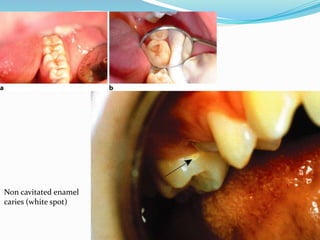
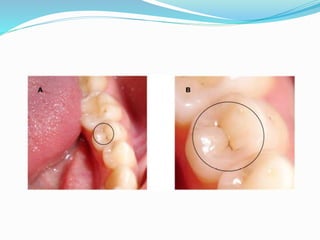
 Visual evidence of caries includes white spot ,cavitation,
or discoloration.
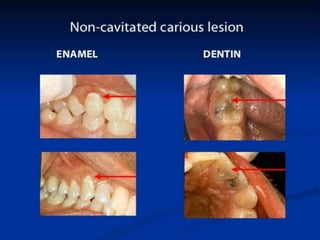
Non cavitated enamel
caries (white spot)
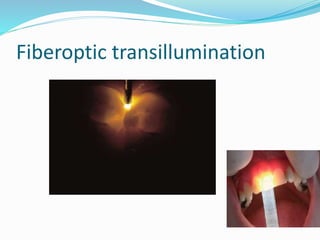
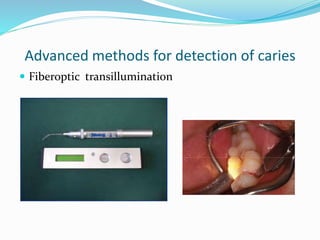
Fiberoptic transillumination
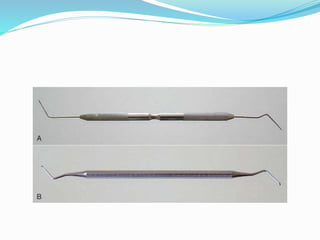
2.Tactile examination ;
 Tactile evidence of caries includes roughness and softness
of the tooth surface , using explorers (or dental floss)
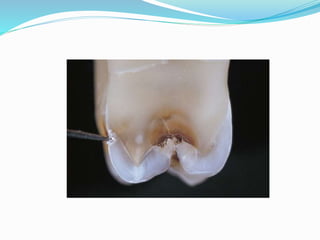
 Injudicious use of sharp dental explorers on
noncavitated,subsurface lesions could cause a cavitation
3.Dyes
o Selectively complex with carious tooth structure which is
later disclosed with the help of fluorescence.
Investigations
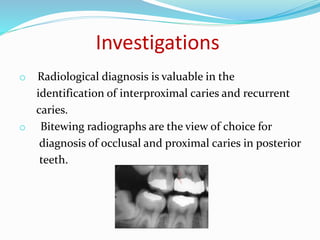
o Radiological diagnosis is valuable in the
identification of interproximal caries and recurrent
caries.
o Bitewing radiographs are the view of choice for
diagnosis of occlusal and proximal caries in posterior
teeth.
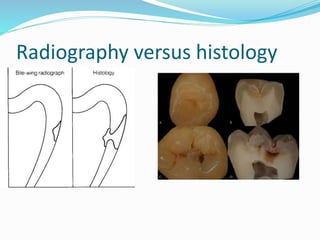
Radiography versus histology
Radiographs have limitations in diagnosing caries
1. cannot detect occlusal carious lesions that are
confined to enamel
2. Radiography taken on one occasion is unable to
distinguish an actively progressing from a passive
lesion,.
3. Occlusal caries has to be quite advanced in dentin
before enamel radiolucency and cavitation are seen on
the radiograph.
4. False-positive radiological diagnoses of caries occur
with cervical “burnout”
Investigations
Additional investigations may include
 Dietary analysis
 Salivary analysis
bacterial count
flow rate
buffering capacity
Caries diagnosis for pits and
fissures
 Discoloration of pits and grooves, limited to the depth
of the fissure or pit, is almost a universal finding in
normal healthy teeth of adults
 Additional criteria include
(1) opacity surrounding the pit or fissure, indicating
undermining or demineralization of the enamel;
(2) softened enamel that may be flaked away by the
explorer.
Caries diagnosis for pits and
fissures
Mechanical binding of an explorer in the pits or
fissures may be due to noncarious causes, such as
o the shape of the fissure,
o sharpness of the explorer, or
o force of application.
Caries diagnosis for pits and
fissures
 Porous enamel (resulting from demineralization)
appears chalky, or opaque, when dried with
compressed air.
 The diagnosis is confirmed when the affected area is
rehydrated (wetted) and the chalky area partially or
totally disappears.
Caries diagnosis for smooth
surfaces
 Proximal smooth surfaces are not readily assessed
visually or tactilely
 Bitewing radiographs are used.
 Lesions on buccal and ligual surfaces are almost always
seen in individuals with high caries activity.
Caries diagnosis for smooth surfaces
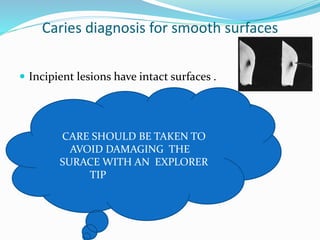
 Incipient lesions have intact surfaces .
CARE SHOULD BE TAKEN TO
AVOID DAMAGING THE
SURACE WITH AN EXPLORER
TIP
Caries diagnosis for root surfaces
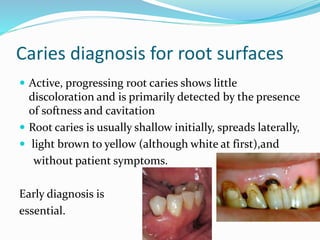
 Active, progressing root caries shows little
discoloration and is primarily detected by the presence
of softness and cavitation
 Root caries is usually shallow initially, spreads laterally,
 light brown to yellow (although white at first),and
without patient symptoms.
Early diagnosis is
essential.
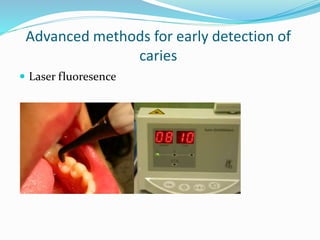
Advanced methods for early detection of
caries
 Laser fluoresence
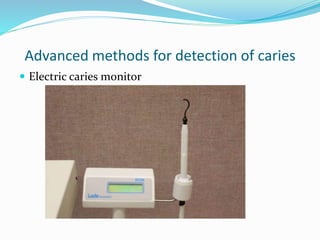
Advanced methods for detection of caries
 Electric caries monitor
Advanced methods for detection of caries
 Fiberoptic transillumination
 The primary goal of a caries prevention should
be to reduce the numbers of cariogenic bacteria.
 Preventive treatment methods are designed to limit
tooth demineralization caused by cariogenic bacteria
Risk factors

General health of the patient

Fluoride exposure history

Frequent sugar containing diet

Poor oral hygiene

Low salivary flow

Deep pits and fissures

Modifying the carious process

Can be influenced by factors such as oral hygiene ,diet
, fluoride and salivary flow .

In addition a number of other variables are important
such as social class, income, education, knowledge
,attitudes and behavior .
Prevention and control

The primary goal of caries prevention should be to
reduce the numbers of cariogenic bacteria

Caries control methods are operative procedures used
both to stop the advance of individual lesions and to
prevent the spread of pathogenic bacteria.
Important factord in caries
prevention are :

Plaque control

Use of fluoride

Salivary stimulation or replacement

Dietary modification

Pit and fissure sealants

Caries control restorations
Plaque control

Brushing , flossing

Brushing and flossing And rinsing after every meal is
indicated for high risk patients .

Antimicrobial agents e.g chlorhexidine

Chlorhexidine varnish enhance remineralization and
decreases MS presence

Immunization

Fluoride use
Fluoride in trace amounts increases the resistance of tooth
structure to demineralization
Forms of administration :
1- fluoridated community water systems (1ppm)
2- tooth paste
3- mouth rinses
4- professional topical application
Acidulated phosphate fluoride , sodium fluoride, stannous
fluoride .
•
Indication for fluoridated mouth rinses are high risk
patients e.g pt with orthodontic appliances , dry mouth .
Levels of caries prevention
 There are various levels for prevention of dental
caries .
1. Primary prevention(maintaining a disease free
state)
2. Secondary prevention (reverse, arrest incipient
caries)
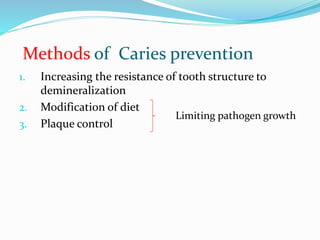
Methods of Caries prevention
1. Increasing the resistance of tooth structure to
demineralization
2. Modification of diet
3. Plaque control
Limiting pathogen growth
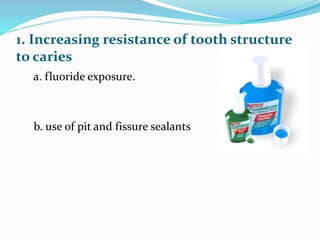
1. Increasing resistance of tooth structure
to caries
a. fluoride exposure.
b. use of pit and fissure sealants
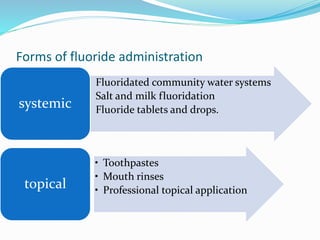
Forms of fluoride administration
• Fluoridated community water systems
• Salt and milk fluoridation
• Fluoride tablets and drops.
systemic
• Toothpastes
• Mouth rinses
• Professional topical application
topical
Protective role of fluoride
Fluoride exerts its anticaries effect by three different
mechanisms.
 The presence of fluoride ion greatly enhances the
precipitation into tooth structure of fluorapatite .
This insoluble precipitate replaces the soluble salts
containing manganese and carbonate that were lost
because of bacteria-mediated demineralization
 Incipient, noncavitated , carious lesions are
remineralized by the same process.
 Fluoride has antimicrobial activity
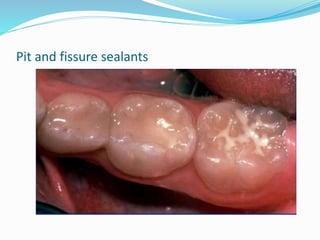
Pit and fissure sealants
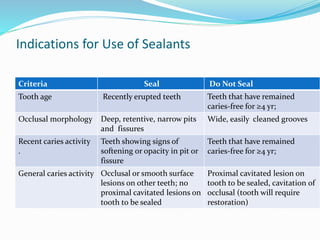
Indications for Use of Sealants
Do Not Seal
Seal
Criteria
Teeth that have remained
caries-free for ≥4 yr;
Recently erupted teeth
Tooth age
Wide, easily cleaned grooves
Deep, retentive, narrow pits
and fissures
Occlusal morphology
Teeth that have remained
caries-free for ≥4 yr;
Teeth showing signs of
softening or opacity in pit or
fissure
Recent caries activity
.
Proximal cavitated lesion on
tooth to be sealed, cavitation of
occlusal (tooth will require
restoration)
Occlusal or smooth surface
lesions on other teeth; no
proximal cavitated lesions on
tooth to be sealed
General caries activity
2.Modification of diet
 Limitation of sucrose to meal times
 Replacement of sucrose by other sweeteners(xylitol,
sorbitol)
 Addition of caries inhibiting agents(ca, p, f)
Modification of diet
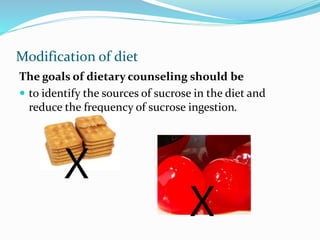
The goals of dietary counseling should be
 to identify the sources of sucrose in the diet and
reduce the frequency of sucrose ingestion.
ꓫ
ꓫ
Saliva stimulation or replacement

Saliva may be stimulated by chewing gum (xylitol)

Xylitol is a natural sugar it keeps the sucrose molecule
from binding with MS .

MS can not ferment (metabolize ) xylitol

In case of Sjogren’s syndrome or postdadiotherapy to
head and neck , a saliva substitute may be required.

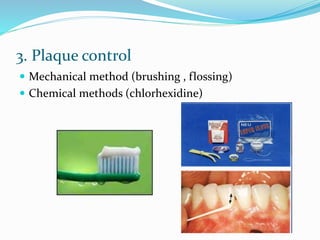
3. Plaque control
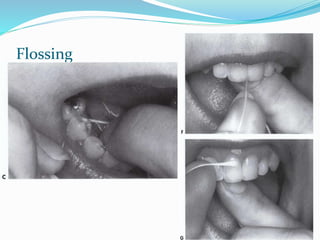
 Mechanical method (brushing , flossing)
 Chemical methods (chlorhexidine)
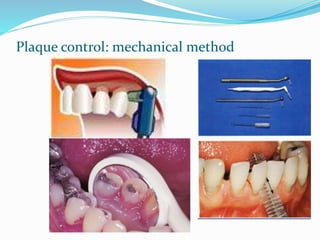
Plaque control: mechanical method
Flossing
Plaque control: chemical method
 Antimicrobial agents e.g.chlorhexidine, xylitol
 Chlorhexidine( varnish , rinse) enhances
remineralization and decreases MS presence.
Xylitol
 Xylitol is a natural sugar .
 It seems to have several mechanisms of action to
reduce caries incidence.
 It keeps the sucrose
molecule from binding with MS. MS cannot ferment
(metabolize) xylitol, so no acid is produced.
Xylitol reduces MS by altering the metabolic pathways.
xylitol chewing gum is effective in reducing caries
Recent prevention methods
Amorphous calcium – phosphates(ACP) compounds:
 Have the potential to remineralize tooth structure.
Probiotics :
 The fundamental concept is to inoculate the oral cavity
with bacteria that will compete with cariogenic
bacteria and eventually replace them
Caries control restorations

Caries control is an intermediate step in restorative
treatment .

Temporary restorative materials (intermediate restorative
Material (IRM) are usually the treatment materials of
choice .

Indications :

Teeth with questionable pulpal prognosis

When a tooth is unexpectedly found to have extensive
caries

The goal of treatment is to remove the nidus of caries
infection in the patient’s mouth .

2-Caries diagnosis+prevention.pptx

  • 2.
    Objectives of cariesdiagnosis To identify  lesions that require restorative treatment,  lesions that require non restorative treatment,  persons who are at high risk for developing carious lesions.
  • 3.
    Assessment tools Stepwise progressiontowards diagnosis and treatment planning depends on thorough asssessment of the following  Patient history  Clinical examination  Nutritional analysis.  Salivary analysis  Radiographic assessment
  • 4.
    History Factors to beconsidered are  age  fluoride exposure  medications .  dietary habits  general health  past caries experience.
  • 5.
    Examination 1.Visual examination o Inspection oTransillumination, magnification.  Visual evidence of caries includes white spot ,cavitation, or discoloration.
  • 6.
  • 9.
  • 10.
    2.Tactile examination ; Tactile evidence of caries includes roughness and softness of the tooth surface , using explorers (or dental floss)  Injudicious use of sharp dental explorers on noncavitated,subsurface lesions could cause a cavitation 3.Dyes o Selectively complex with carious tooth structure which is later disclosed with the help of fluorescence.
  • 12.
    Investigations o Radiological diagnosisis valuable in the identification of interproximal caries and recurrent caries. o Bitewing radiographs are the view of choice for diagnosis of occlusal and proximal caries in posterior teeth.
  • 13.
  • 14.
    Radiographs have limitationsin diagnosing caries 1. cannot detect occlusal carious lesions that are confined to enamel 2. Radiography taken on one occasion is unable to distinguish an actively progressing from a passive lesion,. 3. Occlusal caries has to be quite advanced in dentin before enamel radiolucency and cavitation are seen on the radiograph. 4. False-positive radiological diagnoses of caries occur with cervical “burnout”
  • 15.
    Investigations Additional investigations mayinclude  Dietary analysis  Salivary analysis bacterial count flow rate buffering capacity
  • 16.
    Caries diagnosis forpits and fissures  Discoloration of pits and grooves, limited to the depth of the fissure or pit, is almost a universal finding in normal healthy teeth of adults  Additional criteria include (1) opacity surrounding the pit or fissure, indicating undermining or demineralization of the enamel; (2) softened enamel that may be flaked away by the explorer.
  • 19.
    Caries diagnosis forpits and fissures Mechanical binding of an explorer in the pits or fissures may be due to noncarious causes, such as o the shape of the fissure, o sharpness of the explorer, or o force of application.
  • 20.
    Caries diagnosis forpits and fissures  Porous enamel (resulting from demineralization) appears chalky, or opaque, when dried with compressed air.  The diagnosis is confirmed when the affected area is rehydrated (wetted) and the chalky area partially or totally disappears.
  • 21.
    Caries diagnosis forsmooth surfaces  Proximal smooth surfaces are not readily assessed visually or tactilely  Bitewing radiographs are used.  Lesions on buccal and ligual surfaces are almost always seen in individuals with high caries activity.
  • 22.
    Caries diagnosis forsmooth surfaces  Incipient lesions have intact surfaces . CARE SHOULD BE TAKEN TO AVOID DAMAGING THE SURACE WITH AN EXPLORER TIP
  • 24.
    Caries diagnosis forroot surfaces  Active, progressing root caries shows little discoloration and is primarily detected by the presence of softness and cavitation  Root caries is usually shallow initially, spreads laterally,  light brown to yellow (although white at first),and without patient symptoms. Early diagnosis is essential.
  • 27.
    Advanced methods forearly detection of caries  Laser fluoresence
  • 28.
    Advanced methods fordetection of caries  Electric caries monitor
  • 29.
    Advanced methods fordetection of caries  Fiberoptic transillumination
  • 31.
     The primarygoal of a caries prevention should be to reduce the numbers of cariogenic bacteria.  Preventive treatment methods are designed to limit tooth demineralization caused by cariogenic bacteria
  • 32.
    Risk factors  General healthof the patient  Fluoride exposure history  Frequent sugar containing diet  Poor oral hygiene  Low salivary flow  Deep pits and fissures 
  • 33.
    Modifying the cariousprocess  Can be influenced by factors such as oral hygiene ,diet , fluoride and salivary flow .  In addition a number of other variables are important such as social class, income, education, knowledge ,attitudes and behavior .
  • 34.
    Prevention and control  Theprimary goal of caries prevention should be to reduce the numbers of cariogenic bacteria  Caries control methods are operative procedures used both to stop the advance of individual lesions and to prevent the spread of pathogenic bacteria.
  • 35.
    Important factord incaries prevention are :  Plaque control  Use of fluoride  Salivary stimulation or replacement  Dietary modification  Pit and fissure sealants  Caries control restorations
  • 36.
    Plaque control  Brushing ,flossing  Brushing and flossing And rinsing after every meal is indicated for high risk patients .  Antimicrobial agents e.g chlorhexidine  Chlorhexidine varnish enhance remineralization and decreases MS presence  Immunization 
  • 37.
    Fluoride use Fluoride intrace amounts increases the resistance of tooth structure to demineralization Forms of administration : 1- fluoridated community water systems (1ppm) 2- tooth paste 3- mouth rinses 4- professional topical application Acidulated phosphate fluoride , sodium fluoride, stannous fluoride . • Indication for fluoridated mouth rinses are high risk patients e.g pt with orthodontic appliances , dry mouth .
  • 38.
    Levels of cariesprevention  There are various levels for prevention of dental caries . 1. Primary prevention(maintaining a disease free state) 2. Secondary prevention (reverse, arrest incipient caries)
  • 39.
    Methods of Cariesprevention 1. Increasing the resistance of tooth structure to demineralization 2. Modification of diet 3. Plaque control Limiting pathogen growth
  • 40.
    1. Increasing resistanceof tooth structure to caries a. fluoride exposure. b. use of pit and fissure sealants
  • 41.
    Forms of fluorideadministration • Fluoridated community water systems • Salt and milk fluoridation • Fluoride tablets and drops. systemic • Toothpastes • Mouth rinses • Professional topical application topical
  • 42.
    Protective role offluoride Fluoride exerts its anticaries effect by three different mechanisms.  The presence of fluoride ion greatly enhances the precipitation into tooth structure of fluorapatite . This insoluble precipitate replaces the soluble salts containing manganese and carbonate that were lost because of bacteria-mediated demineralization  Incipient, noncavitated , carious lesions are remineralized by the same process.  Fluoride has antimicrobial activity
  • 43.
  • 44.
    Indications for Useof Sealants Do Not Seal Seal Criteria Teeth that have remained caries-free for ≥4 yr; Recently erupted teeth Tooth age Wide, easily cleaned grooves Deep, retentive, narrow pits and fissures Occlusal morphology Teeth that have remained caries-free for ≥4 yr; Teeth showing signs of softening or opacity in pit or fissure Recent caries activity . Proximal cavitated lesion on tooth to be sealed, cavitation of occlusal (tooth will require restoration) Occlusal or smooth surface lesions on other teeth; no proximal cavitated lesions on tooth to be sealed General caries activity
  • 45.
    2.Modification of diet Limitation of sucrose to meal times  Replacement of sucrose by other sweeteners(xylitol, sorbitol)  Addition of caries inhibiting agents(ca, p, f)
  • 46.
    Modification of diet Thegoals of dietary counseling should be  to identify the sources of sucrose in the diet and reduce the frequency of sucrose ingestion. ꓫ ꓫ
  • 47.
    Saliva stimulation orreplacement  Saliva may be stimulated by chewing gum (xylitol)  Xylitol is a natural sugar it keeps the sucrose molecule from binding with MS .  MS can not ferment (metabolize ) xylitol  In case of Sjogren’s syndrome or postdadiotherapy to head and neck , a saliva substitute may be required. 
  • 48.
    3. Plaque control Mechanical method (brushing , flossing)  Chemical methods (chlorhexidine)
  • 49.
  • 50.
  • 51.
    Plaque control: chemicalmethod  Antimicrobial agents e.g.chlorhexidine, xylitol  Chlorhexidine( varnish , rinse) enhances remineralization and decreases MS presence.
  • 52.
    Xylitol  Xylitol isa natural sugar .  It seems to have several mechanisms of action to reduce caries incidence.  It keeps the sucrose molecule from binding with MS. MS cannot ferment (metabolize) xylitol, so no acid is produced. Xylitol reduces MS by altering the metabolic pathways. xylitol chewing gum is effective in reducing caries
  • 53.
    Recent prevention methods Amorphouscalcium – phosphates(ACP) compounds:  Have the potential to remineralize tooth structure. Probiotics :  The fundamental concept is to inoculate the oral cavity with bacteria that will compete with cariogenic bacteria and eventually replace them
  • 54.
    Caries control restorations  Cariescontrol is an intermediate step in restorative treatment .  Temporary restorative materials (intermediate restorative Material (IRM) are usually the treatment materials of choice .  Indications :  Teeth with questionable pulpal prognosis  When a tooth is unexpectedly found to have extensive caries  The goal of treatment is to remove the nidus of caries infection in the patient’s mouth .