D R : N A I F
A S I R I
Silver Diamine Fluoride
e Conclusion
•
Introduction
History
Definition
•
Indications
•
Contraindications
Application technique
Advantages
Disadvantages
Conclusion
Reference
D
R
/
N
A
I
F
A
S
I
R
I
 Introduction
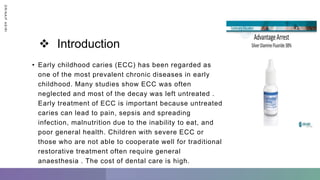
• Early childhood caries (ECC) has been regarded as
one of the most prevalent chronic diseases in early
childhood. Many studies show ECC was often
neglected and most of the decay was left untreated .
Early treatment of ECC is important because untreated
caries can lead to pain, sepsis and spreading
infection, malnutrition due to the inability to eat, and
poor general health. Children with severe ECC or
those who are not able to cooperate well for traditional
restorative treatment often require general
anaesthesia . The cost of dental care is high.
D
R
/
N
A
I
F
A
S
I
R
I
 H i s t o r y - S D F
• About 1000 years ago, in Japan, there was a custom among the ladies to dye their
teeth black called “Ohaguro,” for expressing married. Although, it was tooth
cosmetics, at the same time, it is conceived to prevent the dental caries.
• Ammoniacal silver fluoride for the arrest of dental caries- Nishino and Yamaga in
Japan, 1969
• SDF is also used in other countries such as Australia, China, Cuba, and Nepal
.Studies suggested that SDF is effective in preventing new caries and arresting
caries both in primary teeth and permanent teeth ,A recent systematic review
concluded that topical application of SDF is more effective in caries prevention
than fluoride varnish.
• 2014 SDF was finally approved by the US Food and Drug Administration authority
as a class II medical device
D
R
/
N
A
I
F
A
S
I
R
I
 W h a t i s S D F - S i l v e r D i a m i n e F l u o r i d e
❓
• SDF is made of:
• silver: helps kill bacteria
• water: provides a liquid base for the mixture
• fluoride: helps your teeth rebuild the materials
• ammonia: helps the solution remain concentrated so that it’s maximally
effective against cavity resonance
SDF is a 38% silver diamine fluoride ,SDF (AgF[NH3]2) is a colorless solution
with alkaline pH (pH 8–10). Its main components are silver, fluoride and
ammonia. Basically, the silver is an antimicrobial agent, the ammonia
stabilizes the solution, while the fluoride aids remineralization..
D
R
/
N
A
I
F
A
S
I
R
I
I n d i c a t i o n s
• Patient.
• With severe caries risk due to xerostomia
• Early Childhood Caries.
• Pre-cooperative children, to slow down the progress of the disease
• prior to building cooperation for treatment
• Patients with physical or cognitive disabilities or dental phobia
• With no or limited access
D
R
/
N
A
I
F
A
S
I
R
I
C o n t r a i n d i c a t i o n s
• Patients
• With an allergy to Silver or compounds containing silver
• With ulcerative gingivitis or stomatitis;
• due to pain, can be managed with cautious use of a mucosal covering.
• Unable to tolerate treatment.
• Teeth.
• With irreversible pulpitis
• or direct pulp exposure.
• Where it is not possible to achieve adequate isolation of tooth and oral tissues.
D
R
/
N
A
I
F
A
S
I
R
I
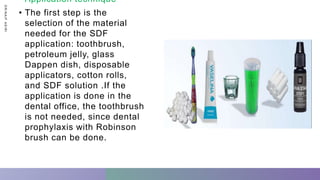
• Application technique
• The first step is the
selection of the material
needed for the SDF
application: toothbrush,
petroleum jelly, glass
Dappen dish, disposable
applicators, cotton rolls,
and SDF solution .If the
application is done in the
dental office, the toothbrush
is not needed, since dental
prophylaxis with Robinson
brush can be done.
D
R
/
N
A
I
F
A
S
I
R
I
• The application technique of the SDF is a very simple procedure
and is exemplified ،The steps involved are described below:
• Dental prophylaxis: the biofilm must be removed from the dental
surface (enamel or dentin). For this purpose, the professional
may use toothbrush, wet cotton pellets or, if dental office is
available, a dental prophylaxis with Robinson brush and
pumice/water paste;
• Soft tissues must be protected with petroleum jelly, including
lips, gums, and perioral soft tissues to avoid direct contact with
SDF solution;
• The operation field must be isolated with cotton rolls.
D
R
/
N
A
I
F
A
S
I
R
I
• Before dispensing a drop of SDF solution in a glass Dappen
dish, the solution must be agitated for homogenization;
• The tooth surface or cavity that will receive the SDF treatment
must be dried with dry cotton pellets or a gentle flow of
compressed air;
• SDF solution must be actively applied with disposable tips;
application time should be about 1 minute.
• A gentle flow of compressed air can be applied to help the
solution to dry; during this process, the isolation of the operatory
field must be on place.
• After approximately 3 minutes, if possible, the isolation can be
removed.
D
R
/
N
A
I
F
A
S
I
R
I
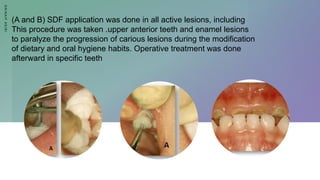
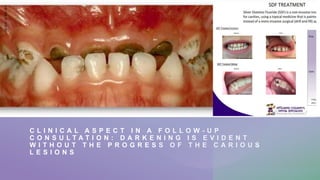
(A and B) SDF application was done in all active lesions, including
upper anterior teeth and enamel lesions
.
This procedure was taken
to paralyze the progression of carious lesions during the modification
of dietary and oral hygiene habits. Operative treatment was done
afterward in specific teeth
D
R
/
N
A
I
F
A
S
I
R
I
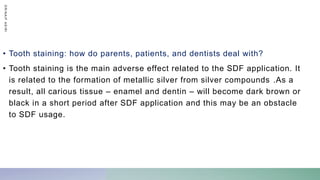
C L I N I C A L A S P E C T I N A F O L L O W - U P
C O N S U L T A T I O N : D A R K E N I N G I S E V I D E N T
W I T H O U T T H E P R O G R E S S O F T H E C A R I O U S
L E S I O N S
D
R
/
N
A
I
F
A
S
I
R
I
• Tooth staining: how do parents, patients, and dentists deal with?
• Tooth staining is the main adverse effect related to the SDF application. It
is related to the formation of metallic silver from silver compounds .As a
result, all carious tissue – enamel and dentin – will become dark brown or
black in a short period after SDF application and this may be an obstacle
to SDF usage.
D
R
/
N
A
I
F
A
S
I
R
I
• The dental literature shows that distinct factors can influence the
parent’s acceptance. Between these factors included the type of
tooth (anterior or posterior), family income, parental schooling,
ethnicity, and need for advanced behavior control methods .
• Parents of uncooperative children tend to better accept the tooth
staining to avoid more advanced behavior guidance, like
sedation or general anesthesia.
• The possibility of pain-free treatment is considered the most
important factor when choosing a treatment by 74% of the
parents; esthetics were considered the main goal only by 26% of
the parents
D
R
/
N
A
I
F
A
S
I
R
I
•
results came from studies developed in Saudi Arabia and Brazil and may
not reflect the reality in other countries
•
There is a trend toward high-income parents to choose esthetics.
Parents with high or middle income and with a higher educational level
are less likely to accept the use of SDF and the staining
D
R
/
N
A
I
F
A
S
I
R
I
•
it is important for the professional to fully understand the
advantages and disadvantages of SDF treatment and the clinical
situations that SDF can be a valuable resource. At the same
time, the parent’s and patient’s opinions must be taken into
account when deciding a treatment plan for a child. This should
be done after a conversation about all the available treatment
methods, considering not only the dentist’s personal preferences
but mainly the needs and wishes of the patient and his/her
parents.
D
R
/
N
A
I
F
A
S
I
R
I
• Teeth
• Carious primary teeth showing radiographic evidence of being
close to exfoliation;
• Non-restorable asymptomatic teeth where extraction is contra-
indicated;[
• With symptomatic Molar-Incisal Hypomineralization(MIH) to ease
dentin hypersensitivity and slow down disease progress;
• With active root surface carious lesions;
• No symptoms of an irreversible inflammation of the dental pulp.
D
R
/
N
A
I
F
A
S
I
R
I
A d v a n t a g e
• SDF assists in getting rid of the bacteria that damage and break down your
teeth.
• The substance is a far more comfortable option when compared to drilling
caries.
• SDF provides a great alternate option to those nervous about dental
instruments.
• SDF is able to effectively minimise cavities and even prevent them.
• SDF treatments only need to be performed around once a year in order for
D
R
/
N
A
I
F
A
S
I
R
I
D i s a d v a n t a g e
• SDF should not be used if you have oral ulcers, gum diseases, major
tooth decay or a silver allergy. This could all cause the treatment to be
very painful
• black stain around the treated area which some patients experience. But
new research has found ways to keep staining to a minimum through the
use of potassium iodide.
D
R
/
N
A
I
F
A
S
I
R
I
S i l v e r M o d i f i e d A t r a u m a t i c R e s t o r a t i v e
D
R
/
N
A
I
F
A
S
I
R
I
The US market in 2015 shortly after it was cleared by the United States Food and Drug Administration
(FDA) in 2014 to treat tooth sensitivity. It is being used off-label to treat and prevent caries, using CDT
billing code D1354. The case presentation showcases a technique called Silver Modified Atraumatic
Restorative Technique (SMART) in which SDF is applied and immediately restored or sealed with
conventional GIC. Placement of SDF and GIC on the same appointment is especially useful when, for
whatever reason,
Technique
the patient will not be able to return for subsequent dental treatment and it is deemed advantageous to use a
minimally invasive procedure rather than nothing at all. By placing SMART restorations you kill bacteria and cut off
the nutrient source for any remaining bacteria by placing a chemically sealed restoration that will arrest and
remineralize the caries lesion, preserving tooth structure and enhancing pulp vitality. The following case study
showcases a different approach to using GIC material in combination with SDF.
S M A R T Te c h n i q u e
• SDF + GIC – Silver modified ART (atraumatic restorative
treatment) Glass Ionomer cements (GIC)
• ◦ Seals the SDF in place
• ◦ Has sustained fluoride release
• ◦ May use composite sandwich technique for esthetics
• ◦ PROTOCOL:
• ◦ SDF + Standard GIC
• ◦ May darken over time. ◦ Can be done same day or later ◦ Assess
cavitation, hygiene, ability to provide care
D
R
/
N
A
I
F
A
S
I
R
I
C o n c l u s i o n
•
SDF is a non-invasive, painless, and effective treatment for the
management of carious lesions in children. Considering the
simplicity and safety of its use, it is a strategy that can be
applied in individual or collective levels and can be associated
with other non-invasive, micro-invasive or minimally invasive
strategies.
•
The use of SDF fulfills the World Health Organization (WHO)
D
R
/
N
A
I
F
A
S
I
R
I
• Arresting Early Childhood Caries with Silver Diamine Fluoride-A Literature Review
Marcus HT Fung, May CM Wong, Edward CM Lo and CH Chu* Department of
Dentistry, The University of Hong Kong, 1B30, Prince Philip Dental Hospital, 34
Hospital Road, Hong Kong SAR
• Published: November 3, 2020
• https://doi.org/10.1371/journal.pone.0241519
• The antibacterial efficacy of silver diamine fluoride (SDF) is not modulated by
potassium iodide (KI) supplements: A study on in-situ plaque biofilms using
viability real-time PCR with propidium monoazide
American Academy of Pediatric Dentistry. Policy on the use of silver diamine fluoride
for pediatric dental patients. The Reference Manual of Pediatric Dentistry. Chicago,
Ill.: American Academy of Pediatric Dentistry; 2020:66-9.
Reference ;
D
R
/
N
A
I
F
A
S
I
R
I
Efficacy of Silver
Silver Diamine Fluoride: A Caries ”Silver-Fluoride Bullet”
Effectiveness of silver diamine fluoride and sodium fluoride varnish in arresting dentin caries in Chinese pre-school
children
The Use of Silver Diamine Fluoride in Pediatric Dentistry
By Ana Cláudia Rodrigues Chibinski
Submitted: November 27th 2019Reviewed: July 30th 2020Published: August 31st 2020
The antibacterial efficacy of silver diamine fluoride (SDF) is not modulated by potassium iodide (KI)
supplements: A study on in-situ plaque biofilms using viability real-time PCR with propidium monoazide
https://kidsteethandbraces.com/silver-diamine-fluoride
MMC Library
UCSF Protocol for Caries Arrest Using Silver Diamine Fluoride: Rationale, Indications, and Consent
Medically reviewed by Christine Frank, DDS — Written by Tim Jewell — Updated on November 6, 2018
D
R
/
N
A
I
F
A
S
I
R
I
Cite this article: Alvear Fa B, Jew JA, Wong A, Young D. Silver Modified Atraumatic Restorative Technique (SMART):
an alternative caries prevention tool. StomaEduJ. 2016;3(2):
T H A N K Y O U V E R Y M U C H F O R L I S T E N I N G
D
R
/
N
A
I
F
A
S
I
R
I

silver diamine fluoride -SDF -Pediatric dentistry

  • 1.
    D R :N A I F A S I R I Silver Diamine Fluoride
  • 2.
  • 3.
     Introduction • Earlychildhood caries (ECC) has been regarded as one of the most prevalent chronic diseases in early childhood. Many studies show ECC was often neglected and most of the decay was left untreated . Early treatment of ECC is important because untreated caries can lead to pain, sepsis and spreading infection, malnutrition due to the inability to eat, and poor general health. Children with severe ECC or those who are not able to cooperate well for traditional restorative treatment often require general anaesthesia . The cost of dental care is high. D R / N A I F A S I R I
  • 4.
     H is t o r y - S D F • About 1000 years ago, in Japan, there was a custom among the ladies to dye their teeth black called “Ohaguro,” for expressing married. Although, it was tooth cosmetics, at the same time, it is conceived to prevent the dental caries. • Ammoniacal silver fluoride for the arrest of dental caries- Nishino and Yamaga in Japan, 1969 • SDF is also used in other countries such as Australia, China, Cuba, and Nepal .Studies suggested that SDF is effective in preventing new caries and arresting caries both in primary teeth and permanent teeth ,A recent systematic review concluded that topical application of SDF is more effective in caries prevention than fluoride varnish. • 2014 SDF was finally approved by the US Food and Drug Administration authority as a class II medical device D R / N A I F A S I R I
  • 5.
     W ha t i s S D F - S i l v e r D i a m i n e F l u o r i d e ❓ • SDF is made of: • silver: helps kill bacteria • water: provides a liquid base for the mixture • fluoride: helps your teeth rebuild the materials • ammonia: helps the solution remain concentrated so that it’s maximally effective against cavity resonance SDF is a 38% silver diamine fluoride ,SDF (AgF[NH3]2) is a colorless solution with alkaline pH (pH 8–10). Its main components are silver, fluoride and ammonia. Basically, the silver is an antimicrobial agent, the ammonia stabilizes the solution, while the fluoride aids remineralization.. D R / N A I F A S I R I
  • 6.
    I n di c a t i o n s • Patient. • With severe caries risk due to xerostomia • Early Childhood Caries. • Pre-cooperative children, to slow down the progress of the disease • prior to building cooperation for treatment • Patients with physical or cognitive disabilities or dental phobia • With no or limited access D R / N A I F A S I R I
  • 7.
    C o nt r a i n d i c a t i o n s • Patients • With an allergy to Silver or compounds containing silver • With ulcerative gingivitis or stomatitis; • due to pain, can be managed with cautious use of a mucosal covering. • Unable to tolerate treatment. • Teeth. • With irreversible pulpitis • or direct pulp exposure. • Where it is not possible to achieve adequate isolation of tooth and oral tissues. D R / N A I F A S I R I
  • 8.
    • Application technique •The first step is the selection of the material needed for the SDF application: toothbrush, petroleum jelly, glass Dappen dish, disposable applicators, cotton rolls, and SDF solution .If the application is done in the dental office, the toothbrush is not needed, since dental prophylaxis with Robinson brush can be done. D R / N A I F A S I R I
  • 9.
    • The applicationtechnique of the SDF is a very simple procedure and is exemplified ،The steps involved are described below: • Dental prophylaxis: the biofilm must be removed from the dental surface (enamel or dentin). For this purpose, the professional may use toothbrush, wet cotton pellets or, if dental office is available, a dental prophylaxis with Robinson brush and pumice/water paste; • Soft tissues must be protected with petroleum jelly, including lips, gums, and perioral soft tissues to avoid direct contact with SDF solution; • The operation field must be isolated with cotton rolls. D R / N A I F A S I R I
  • 10.
    • Before dispensinga drop of SDF solution in a glass Dappen dish, the solution must be agitated for homogenization; • The tooth surface or cavity that will receive the SDF treatment must be dried with dry cotton pellets or a gentle flow of compressed air; • SDF solution must be actively applied with disposable tips; application time should be about 1 minute. • A gentle flow of compressed air can be applied to help the solution to dry; during this process, the isolation of the operatory field must be on place. • After approximately 3 minutes, if possible, the isolation can be removed. D R / N A I F A S I R I
  • 11.
    (A and B)SDF application was done in all active lesions, including upper anterior teeth and enamel lesions . This procedure was taken to paralyze the progression of carious lesions during the modification of dietary and oral hygiene habits. Operative treatment was done afterward in specific teeth D R / N A I F A S I R I
  • 12.
    C L IN I C A L A S P E C T I N A F O L L O W - U P C O N S U L T A T I O N : D A R K E N I N G I S E V I D E N T W I T H O U T T H E P R O G R E S S O F T H E C A R I O U S L E S I O N S D R / N A I F A S I R I
  • 13.
    • Tooth staining:how do parents, patients, and dentists deal with? • Tooth staining is the main adverse effect related to the SDF application. It is related to the formation of metallic silver from silver compounds .As a result, all carious tissue – enamel and dentin – will become dark brown or black in a short period after SDF application and this may be an obstacle to SDF usage. D R / N A I F A S I R I
  • 14.
    • The dentalliterature shows that distinct factors can influence the parent’s acceptance. Between these factors included the type of tooth (anterior or posterior), family income, parental schooling, ethnicity, and need for advanced behavior control methods . • Parents of uncooperative children tend to better accept the tooth staining to avoid more advanced behavior guidance, like sedation or general anesthesia. • The possibility of pain-free treatment is considered the most important factor when choosing a treatment by 74% of the parents; esthetics were considered the main goal only by 26% of the parents D R / N A I F A S I R I
  • 15.
    • results came fromstudies developed in Saudi Arabia and Brazil and may not reflect the reality in other countries • There is a trend toward high-income parents to choose esthetics. Parents with high or middle income and with a higher educational level are less likely to accept the use of SDF and the staining D R / N A I F A S I R I
  • 16.
    • it is importantfor the professional to fully understand the advantages and disadvantages of SDF treatment and the clinical situations that SDF can be a valuable resource. At the same time, the parent’s and patient’s opinions must be taken into account when deciding a treatment plan for a child. This should be done after a conversation about all the available treatment methods, considering not only the dentist’s personal preferences but mainly the needs and wishes of the patient and his/her parents. D R / N A I F A S I R I
  • 17.
    • Teeth • Cariousprimary teeth showing radiographic evidence of being close to exfoliation; • Non-restorable asymptomatic teeth where extraction is contra- indicated;[ • With symptomatic Molar-Incisal Hypomineralization(MIH) to ease dentin hypersensitivity and slow down disease progress; • With active root surface carious lesions; • No symptoms of an irreversible inflammation of the dental pulp. D R / N A I F A S I R I
  • 18.
    A d va n t a g e • SDF assists in getting rid of the bacteria that damage and break down your teeth. • The substance is a far more comfortable option when compared to drilling caries. • SDF provides a great alternate option to those nervous about dental instruments. • SDF is able to effectively minimise cavities and even prevent them. • SDF treatments only need to be performed around once a year in order for D R / N A I F A S I R I
  • 19.
    D i sa d v a n t a g e • SDF should not be used if you have oral ulcers, gum diseases, major tooth decay or a silver allergy. This could all cause the treatment to be very painful • black stain around the treated area which some patients experience. But new research has found ways to keep staining to a minimum through the use of potassium iodide. D R / N A I F A S I R I
  • 20.
    S i lv e r M o d i f i e d A t r a u m a t i c R e s t o r a t i v e D R / N A I F A S I R I The US market in 2015 shortly after it was cleared by the United States Food and Drug Administration (FDA) in 2014 to treat tooth sensitivity. It is being used off-label to treat and prevent caries, using CDT billing code D1354. The case presentation showcases a technique called Silver Modified Atraumatic Restorative Technique (SMART) in which SDF is applied and immediately restored or sealed with conventional GIC. Placement of SDF and GIC on the same appointment is especially useful when, for whatever reason, Technique the patient will not be able to return for subsequent dental treatment and it is deemed advantageous to use a minimally invasive procedure rather than nothing at all. By placing SMART restorations you kill bacteria and cut off the nutrient source for any remaining bacteria by placing a chemically sealed restoration that will arrest and remineralize the caries lesion, preserving tooth structure and enhancing pulp vitality. The following case study showcases a different approach to using GIC material in combination with SDF.
  • 21.
    S M AR T Te c h n i q u e • SDF + GIC – Silver modified ART (atraumatic restorative treatment) Glass Ionomer cements (GIC) • ◦ Seals the SDF in place • ◦ Has sustained fluoride release • ◦ May use composite sandwich technique for esthetics • ◦ PROTOCOL: • ◦ SDF + Standard GIC • ◦ May darken over time. ◦ Can be done same day or later ◦ Assess cavitation, hygiene, ability to provide care D R / N A I F A S I R I
  • 22.
    C o nc l u s i o n • SDF is a non-invasive, painless, and effective treatment for the management of carious lesions in children. Considering the simplicity and safety of its use, it is a strategy that can be applied in individual or collective levels and can be associated with other non-invasive, micro-invasive or minimally invasive strategies. • The use of SDF fulfills the World Health Organization (WHO) D R / N A I F A S I R I
  • 23.
    • Arresting EarlyChildhood Caries with Silver Diamine Fluoride-A Literature Review Marcus HT Fung, May CM Wong, Edward CM Lo and CH Chu* Department of Dentistry, The University of Hong Kong, 1B30, Prince Philip Dental Hospital, 34 Hospital Road, Hong Kong SAR • Published: November 3, 2020 • https://doi.org/10.1371/journal.pone.0241519 • The antibacterial efficacy of silver diamine fluoride (SDF) is not modulated by potassium iodide (KI) supplements: A study on in-situ plaque biofilms using viability real-time PCR with propidium monoazide American Academy of Pediatric Dentistry. Policy on the use of silver diamine fluoride for pediatric dental patients. The Reference Manual of Pediatric Dentistry. Chicago, Ill.: American Academy of Pediatric Dentistry; 2020:66-9. Reference ; D R / N A I F A S I R I
  • 24.
    Efficacy of Silver SilverDiamine Fluoride: A Caries ”Silver-Fluoride Bullet” Effectiveness of silver diamine fluoride and sodium fluoride varnish in arresting dentin caries in Chinese pre-school children The Use of Silver Diamine Fluoride in Pediatric Dentistry By Ana Cláudia Rodrigues Chibinski Submitted: November 27th 2019Reviewed: July 30th 2020Published: August 31st 2020 The antibacterial efficacy of silver diamine fluoride (SDF) is not modulated by potassium iodide (KI) supplements: A study on in-situ plaque biofilms using viability real-time PCR with propidium monoazide https://kidsteethandbraces.com/silver-diamine-fluoride MMC Library UCSF Protocol for Caries Arrest Using Silver Diamine Fluoride: Rationale, Indications, and Consent Medically reviewed by Christine Frank, DDS — Written by Tim Jewell — Updated on November 6, 2018 D R / N A I F A S I R I Cite this article: Alvear Fa B, Jew JA, Wong A, Young D. Silver Modified Atraumatic Restorative Technique (SMART): an alternative caries prevention tool. StomaEduJ. 2016;3(2):
  • 25.
    T H AN K Y O U V E R Y M U C H F O R L I S T E N I N G D R / N A I F A S I R I