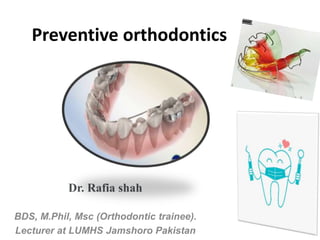
Preventive orthodontics
Dr. Rafia shah
BDS, M.Phil, Msc (Orthodontic trainee).
Lecturer at LUMHS Jamshoro Pakistan
What is Preventive
orthodontics
• It is that branch of orthodontic which is
concerned with;
 patient’s and parents education,
 supervision of the growth and development of the
dentition and the cranio-facial structures,
 it is the diagnostic procedures undertaken to
predict the appearance of malocclusion.
 Treatment begins near the begging of variation
from the normal.
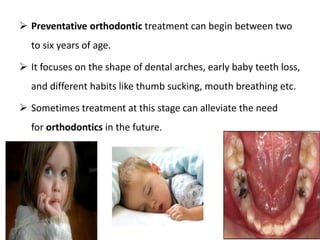
 Preventative orthodontic treatment can begin between two
to six years of age.
 It focuses on the shape of dental arches, early baby teeth loss,
and different habits like thumb sucking, mouth breathing etc.
 Sometimes treatment at this stage can alleviate the need
for orthodontics in the future.
Definition:
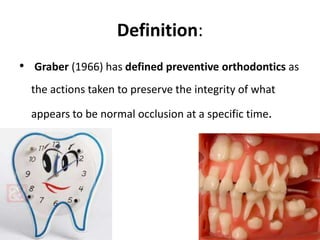
• Graber (1966) has defined preventive orthodontics as
the actions taken to preserve the integrity of what
appears to be normal occlusion at a specific time.
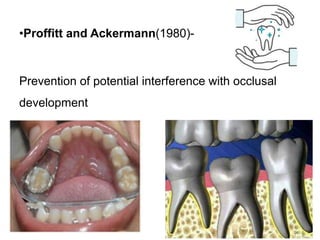
•Proffitt and Ackermann(1980)-
Prevention of potential interference with occlusal
development
Procedure taken in preventive
orthodontic
1. Parental education
2. Caries control
3. Exfoliation of deciduous teeth
4. Abnormal frenal attachment
5. Abnormal oral musculature related habits
6. Treatment of locked permanent first molars
7. Space maintenance
1. Parental education
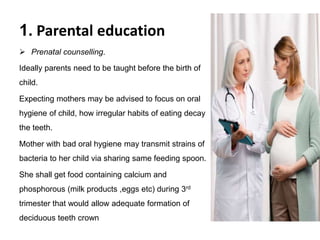
 Prenatal counselling.
Ideally parents need to be taught before the birth of
child.
Expecting mothers may be advised to focus on oral
hygiene of child, how irregular habits of eating decay
the teeth.
Mother with bad oral hygiene may transmit strains of
bacteria to her child via sharing same feeding spoon.
She shall get food containing calcium and
phosphorous (milk products ,eggs etc) during 3rd
trimester that would allow adequate formation of
deciduous teeth crown
 post natal counselling
Mother may be advocated to have child along
for clinical examination from 6th months of age
6th year.
1. Mother feed should be preferred and continued at least for 1st
year age, to avoid TMJ problem and tongue thrusting habit.
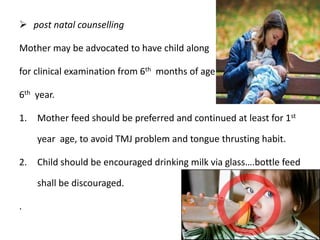
2. Child should be encouraged drinking milk via glass….bottle feed
shall be discouraged.
.
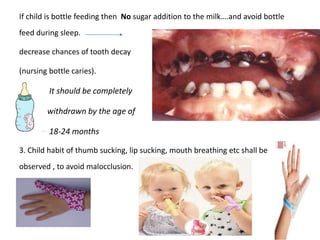
If child is bottle feeding then No sugar addition to the milk….and avoid bottle
feed during sleep.
decrease chances of tooth decay
(nursing bottle caries).
It should be completely
withdrawn by the age of
18-24 months
3. Child habit of thumb sucking, lip sucking, mouth breathing etc shall be
observed , to avoid malocclusion.
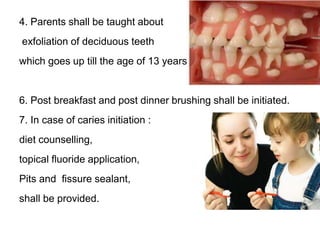
4. Parents shall be taught about
exfoliation of deciduous teeth
which goes up till the age of 13 years.
6. Post breakfast and post dinner brushing shall be initiated.
7. In case of caries initiation :
diet counselling,
topical fluoride application,
Pits and fissure sealant,
shall be provided.
2. Caries control of deciduous
dentition
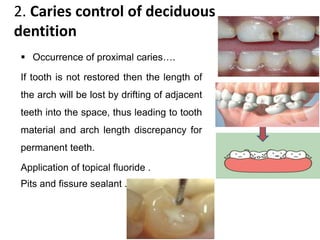
 Occurrence of proximal caries….
If tooth is not restored then the length of
the arch will be lost by drifting of adjacent
teeth into the space, thus leading to tooth
material and arch length discrepancy for
permanent teeth.
Application of topical fluoride .
Pits and fissure sealant .
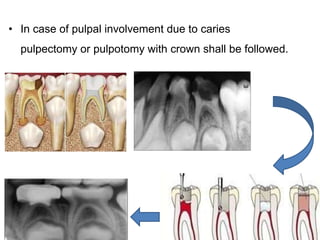
• In case of pulpal involvement due to caries
pulpectomy or pulpotomy with crown shall be followed.
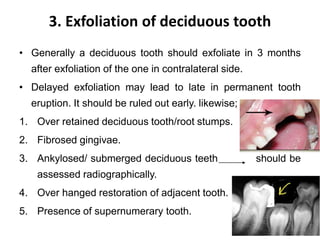
3. Exfoliation of deciduous tooth
• Generally a deciduous tooth should exfoliate in 3 months
after exfoliation of the one in contralateral side.
• Delayed exfoliation may lead to late in permanent tooth
eruption. It should be ruled out early. likewise;
1. Over retained deciduous tooth/root stumps.
2. Fibrosed gingivae.
3. Ankylosed/ submerged deciduous teeth should be
assessed radiographically.
4. Over hanged restoration of adjacent tooth.
5. Presence of supernumerary tooth.
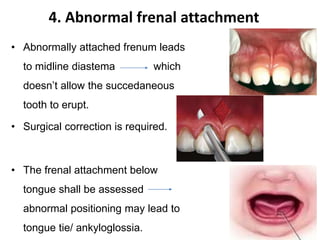
4. Abnormal frenal attachment
• Abnormally attached frenum leads
to midline diastema which
doesn’t allow the succedaneous
tooth to erupt.
• Surgical correction is required.
• The frenal attachment below
tongue shall be assessed
abnormal positioning may lead to
tongue tie/ ankyloglossia.
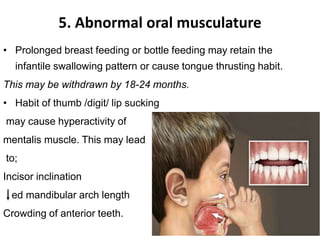
5. Abnormal oral musculature
• Prolonged breast feeding or bottle feeding may retain the
infantile swallowing pattern or cause tongue thrusting habit.
This may be withdrawn by 18-24 months.
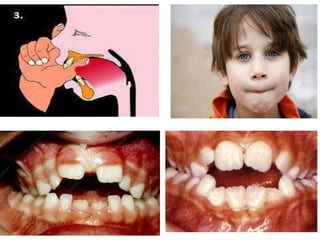
• Habit of thumb /digit/ lip sucking
may cause hyperactivity of
mentalis muscle. This may lead
to;
Incisor inclination
ed mandibular arch length
Crowding of anterior teeth.
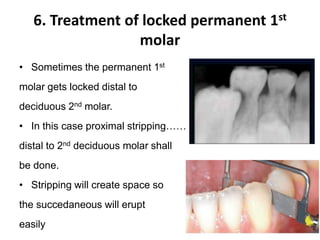
6. Treatment of locked permanent 1st
molar
• Sometimes the permanent 1st
molar gets locked distal to
deciduous 2nd molar.
• In this case proximal stripping……
distal to 2nd deciduous molar shall
be done.
• Stripping will create space so
the succedaneous will erupt
easily
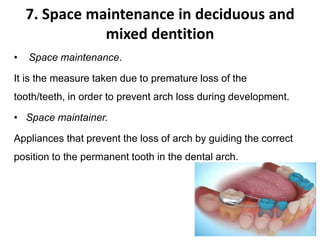
7. Space maintenance in deciduous and
mixed dentition
• Space maintenance.
It is the measure taken due to premature loss of the
tooth/teeth, in order to prevent arch loss during development.
• Space maintainer.
Appliances that prevent the loss of arch by guiding the correct
position to the permanent tooth in the dental arch.
Factors to be considered for
space maintenance
1. Time elapsed since tooth loss:
max. loss of space occur b/w 2 weeks -6months
of tooth loss (extraction/ premature exfoliation).
2. Dental age of patient:
Important than chronological age.
Premature loss of deciduous molar less than 7
year of age, generally leads to delayed eruption
by more than 1 year.
Premature loss of deciduous molar after 7 years
may lead to premature eruption.
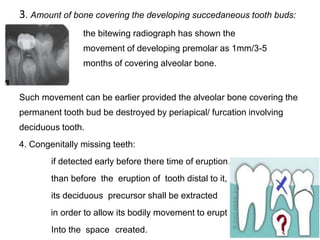
3. Amount of bone covering the developing succedaneous tooth buds:
the bitewing radiograph has shown the
movement of developing premolar as 1mm/3-5
months of covering alveolar bone.
Such movement can be earlier provided the alveolar bone covering the
permanent tooth bud be destroyed by periapical/ furcation involving
deciduous tooth.
4. Congenitally missing teeth:
if detected early before there time of eruption….
than before the eruption of tooth distal to it,
its deciduous precursor shall be extracted
in order to allow its bodily movement to erupt
Into the space created.
5. Sequence of teeth eruption:
The status of developing tooth bud that is suppose to erupt at
the space created for it due to premature loss of deciduous tooth
shall have 2 important clinical conditions.
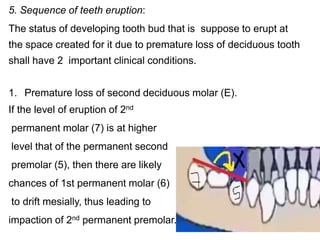
1. Premature loss of second deciduous molar (E).
If the level of eruption of 2nd
permanent molar (7) is at higher
level that of the permanent second
premolar (5), then there are likely
chances of 1st permanent molar (6)
to drift mesially, thus leading to
impaction of 2nd permanent premolar.
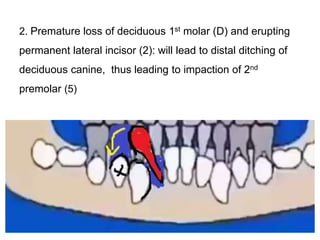
2. Premature loss of deciduous 1st molar (D) and erupting
permanent lateral incisor (2): will lead to distal ditching of
deciduous canine, thus leading to impaction of 2nd
premolar (5)
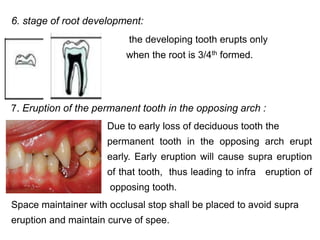
6. stage of root development:
the developing tooth erupts only
when the root is 3/4th formed.
7. Eruption of the permanent tooth in the opposing arch :
Due to early loss of deciduous tooth the
permanent tooth in the opposing arch erupt
early. Early eruption will cause supra eruption
of that tooth, thus leading to infra eruption of
an opposing tooth.
Space maintainer with occlusal stop shall be placed to avoid supra
eruption and maintain curve of spee.
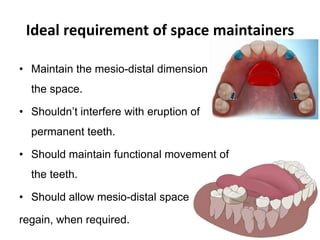
Ideal requirement of space maintainers
• Maintain the mesio-distal dimension of
the space.
• Shouldn’t interfere with eruption of
permanent teeth.
• Should maintain functional movement of
the teeth.
• Should allow mesio-distal space
regain, when required.
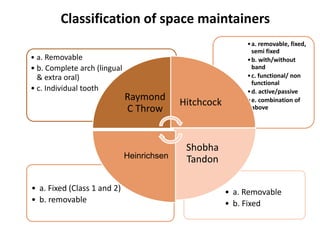
Classification of space maintainers
• a. Removable
• b. Fixed
• a. Fixed (Class 1 and 2)
• b. removable
•a. removable, fixed,
semi fixed
•b. with/without
band
•c. functional/ non
functional
•d. active/passive
•e. combination of
above
• a. Removable
• b. Complete arch (lingual
& extra oral)
• c. Individual tooth
Raymond
C Throw
Hitchcock
Shobha
TandonHeinrichsen
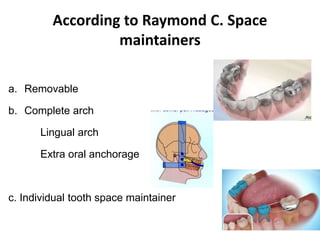
According to Raymond C. Space
maintainers
a. Removable
b. Complete arch
Lingual arch
Extra oral anchorage
c. Individual tooth space maintainer
According to Heinrichsen Space
maintainers
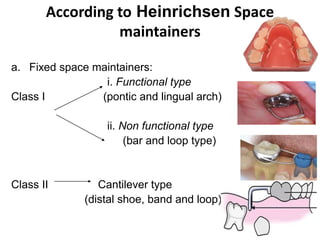
a. Fixed space maintainers:
i. Functional type
Class I (pontic and lingual arch)
ii. Non functional type
(bar and loop type)
Class II Cantilever type
(distal shoe, band and loop)
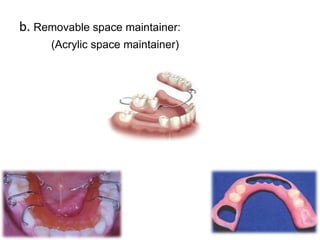
b. Removable space maintainer:
(Acrylic space maintainer)
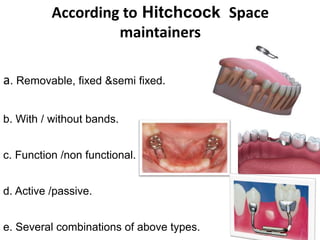
According to Hitchcock Space
maintainers
a. Removable, fixed &semi fixed.
b. With / without bands.
c. Function /non functional.
d. Active /passive.
e. Several combinations of above types.
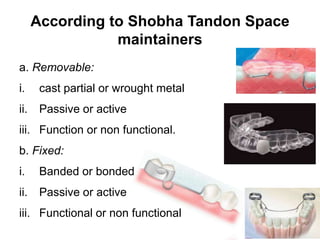
According to Shobha Tandon Space
maintainers
a. Removable:
i. cast partial or wrought metal
ii. Passive or active
iii. Function or non functional.
b. Fixed:
i. Banded or bonded
ii. Passive or active
iii. Functional or non functional
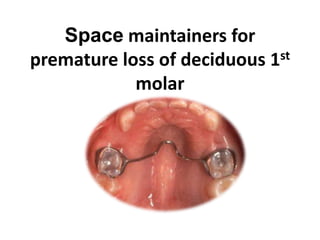
Space maintainers for
premature loss of deciduous 1st
molar
Space maintainers for premature loss of
deciduous 1st molar
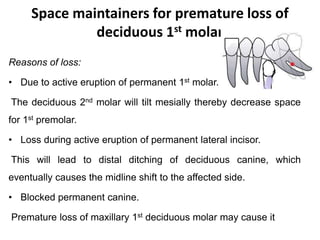
Reasons of loss:
• Due to active eruption of permanent 1st molar.
The deciduous 2nd molar will tilt mesially thereby decrease space
for 1st premolar.
• Loss during active eruption of permanent lateral incisor.
This will lead to distal ditching of deciduous canine, which
eventually causes the midline shift to the affected side.
• Blocked permanent canine.
Premature loss of maxillary 1st deciduous molar may cause it
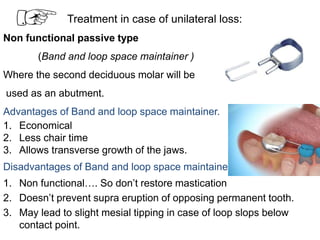
Treatment in case of unilateral loss:
Non functional passive type
(Band and loop space maintainer )
Where the second deciduous molar will be
used as an abutment.
Advantages of Band and loop space maintainer.
1. Economical
2. Less chair time
3. Allows transverse growth of the jaws.
Disadvantages of Band and loop space maintainer.
1. Non functional…. So don’t restore mastication
2. Doesn’t prevent supra eruption of opposing permanent tooth.
3. May lead to slight mesial tipping in case of loop slops below
contact point.
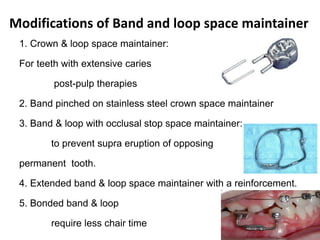
Modifications of Band and loop space maintainer
1. Crown & loop space maintainer:
For teeth with extensive caries
post-pulp therapies
2. Band pinched on stainless steel crown space maintainer
3. Band & loop with occlusal stop space maintainer:
to prevent supra eruption of opposing
permanent tooth.
4. Extended band & loop space maintainer with a reinforcement.
5. Bonded band & loop
require less chair time
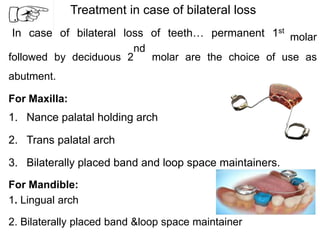
Treatment in case of bilateral loss
In case of bilateral loss of teeth… permanent 1st
molar
followed by deciduous 2
nd
molar are the choice of use as
abutment.
For Maxilla:
1. Nance palatal holding arch
2. Trans palatal arch
3. Bilaterally placed band and loop space maintainers.
For Mandible:
1. Lingual arch
2. Bilaterally placed band &loop space maintainer
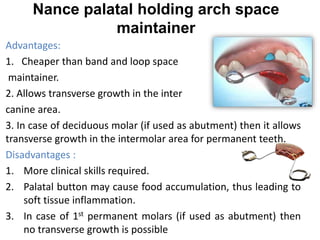
Nance palatal holding arch space
maintainer
Advantages:
1. Cheaper than band and loop space
maintainer.
2. Allows transverse growth in the inter
canine area.
3. In case of deciduous molar (if used as abutment) then it allows
transverse growth in the intermolar area for permanent teeth.
Disadvantages :
1. More clinical skills required.
2. Palatal button may cause food accumulation, thus leading to
soft tissue inflammation.
3. In case of 1st permanent molars (if used as abutment) then
no transverse growth is possible
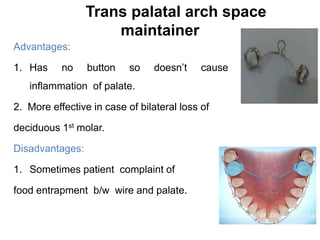
Trans palatal arch space
maintainer
Advantages:
1. Has no button so doesn’t cause
inflammation of palate.
2. More effective in case of bilateral loss of
deciduous 1st molar.
Disadvantages:
1. Sometimes patient complaint of
food entrapment b/w wire and palate.
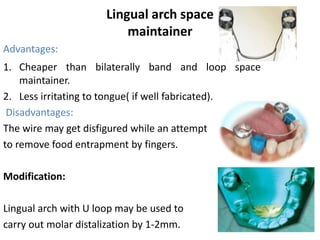
Lingual arch space
maintainer
Advantages:
1. Cheaper than bilaterally band and loop space
maintainer.
2. Less irritating to tongue( if well fabricated).
Disadvantages:
The wire may get disfigured while an attempt
to remove food entrapment by fingers.
Modification:
Lingual arch with U loop may be used to
carry out molar distalization by 1-2mm.
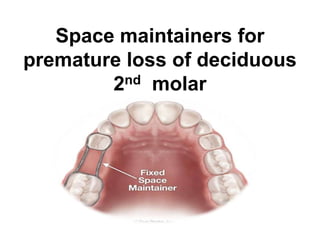
Space maintainers for
premature loss of deciduous
2nd molar
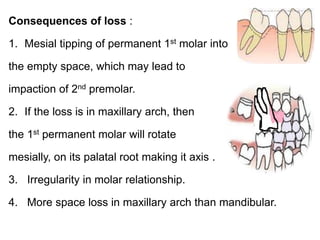
Consequences of loss :
1. Mesial tipping of permanent 1st molar into
the empty space, which may lead to
impaction of 2nd premolar.
2. If the loss is in maxillary arch, then
the 1st permanent molar will rotate
mesially, on its palatal root making it axis .
3. Irregularity in molar relationship.
4. More space loss in maxillary arch than mandibular.
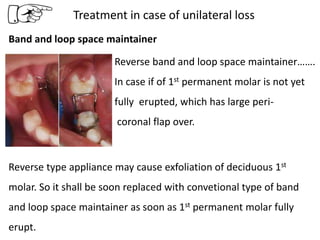
Treatment in case of unilateral loss
Band and loop space maintainer
Reverse band and loop space maintainer…….
In case if of 1st permanent molar is not yet
fully erupted, which has large peri-
coronal flap over.
Reverse type appliance may cause exfoliation of deciduous 1st
molar. So it shall be soon replaced with convetional type of band
and loop space maintainer as soon as 1st permanent molar fully
erupt.
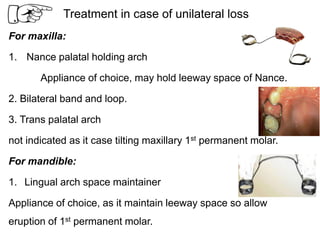
Treatment in case of unilateral loss
For maxilla:
1. Nance palatal holding arch
Appliance of choice, may hold leeway space of Nance.
2. Bilateral band and loop.
3. Trans palatal arch
not indicated as it case tilting maxillary 1st permanent molar.
For mandible:
1. Lingual arch space maintainer
Appliance of choice, as it maintain leeway space so allow
eruption of 1st permanent molar.
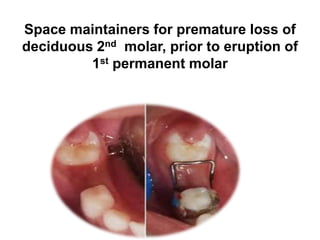
Space maintainers for premature loss of
deciduous 2nd molar, prior to eruption of
1st permanent molar
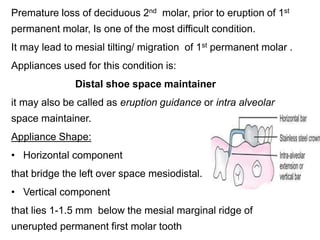
Premature loss of deciduous 2nd molar, prior to eruption of 1st
permanent molar, Is one of the most difficult condition.
It may lead to mesial tilting/ migration of 1st permanent molar .
Appliances used for this condition is:
Distal shoe space maintainer
it may also be called as eruption guidance or intra alveolar
space maintainer.
Appliance Shape:
• Horizontal component
that bridge the left over space mesiodistal.
• Vertical component
that lies 1-1.5 mm below the mesial marginal ridge of
unerupted permanent first molar tooth
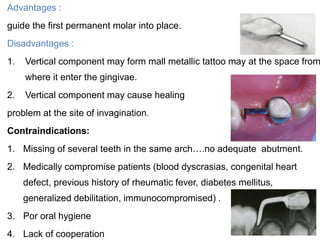
Advantages :
guide the first permanent molar into place.
Disadvantages :
1. Vertical component may form mall metallic tattoo may at the space from
where it enter the gingivae.
2. Vertical component may cause healing
problem at the site of invagination.
Contraindications:
1. Missing of several teeth in the same arch….no adequate abutment.
2. Medically compromise patients (blood dyscrasias, congenital heart
defect, previous history of rheumatic fever, diabetes mellitus,
generalized debilitation, immunocompromised) .
3. Por oral hygiene
4. Lack of cooperation
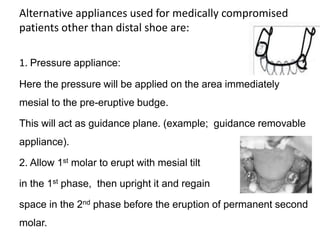
Alternative appliances used for medically compromised
patients other than distal shoe are:
1. Pressure appliance:
Here the pressure will be applied on the area immediately
mesial to the pre-eruptive budge.
This will act as guidance plane. (example; guidance removable
appliance).
2. Allow 1st molar to erupt with mesial tilt
in the 1st phase, then upright it and regain
space in the 2nd phase before the eruption of permanent second
molar.
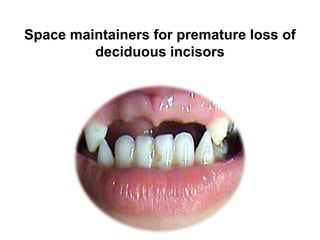
Space maintainers for premature loss of
deciduous incisors
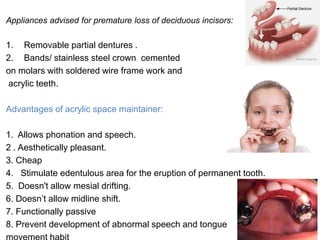
Appliances advised for premature loss of deciduous incisors:
1. Removable partial dentures .
2. Bands/ stainless steel crown cemented
on molars with soldered wire frame work and
acrylic teeth.
Advantages of acrylic space maintainer:
1. Allows phonation and speech.
2 . Aesthetically pleasant.
3. Cheap
4. Stimulate edentulous area for the eruption of permanent tooth.
5. Doesn't allow mesial drifting.
6. Doesn’t allow midline shift.
7. Functionally passive
8. Prevent development of abnormal speech and tongue
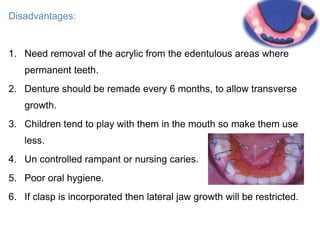
Disadvantages:
1. Need removal of the acrylic from the edentulous areas where
permanent teeth.
2. Denture should be remade every 6 months, to allow transverse
growth.
3. Children tend to play with them in the mouth so make them use
less.
4. Un controlled rampant or nursing caries.
5. Poor oral hygiene.
6. If clasp is incorporated then lateral jaw growth will be restricted.
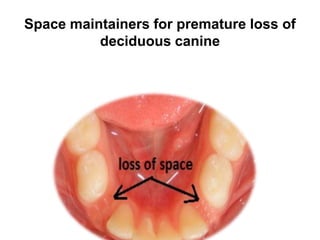
Space maintainers for premature loss of
deciduous canine
Consequences of premature loss of deciduous canine:
1. Delayed eruption of permanent canine.
2. Tilting of permanent incisors lingually .
3. Ditching of lateral incisors leading to impaction of canine.
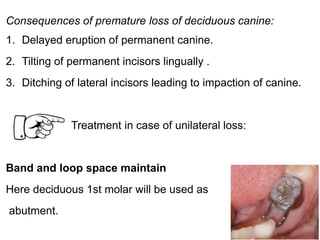
Treatment in case of unilateral loss:
Band and loop space maintain
Here deciduous 1st molar will be used as
abutment.
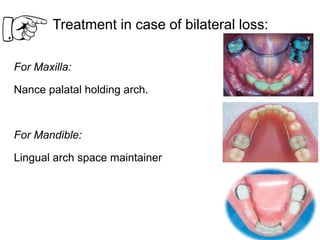
Treatment in case of bilateral loss:
For Maxilla:
Nance palatal holding arch.
For Mandible:
Lingual arch space maintainer
Thank you

Preventive orthodontics

  • 1.
    Preventive orthodontics Dr. Rafiashah BDS, M.Phil, Msc (Orthodontic trainee). Lecturer at LUMHS Jamshoro Pakistan
  • 2.
    What is Preventive orthodontics •It is that branch of orthodontic which is concerned with;  patient’s and parents education,  supervision of the growth and development of the dentition and the cranio-facial structures,  it is the diagnostic procedures undertaken to predict the appearance of malocclusion.  Treatment begins near the begging of variation from the normal.
  • 3.
     Preventative orthodontictreatment can begin between two to six years of age.  It focuses on the shape of dental arches, early baby teeth loss, and different habits like thumb sucking, mouth breathing etc.  Sometimes treatment at this stage can alleviate the need for orthodontics in the future.
  • 4.
    Definition: • Graber (1966)has defined preventive orthodontics as the actions taken to preserve the integrity of what appears to be normal occlusion at a specific time.
  • 5.
    •Proffitt and Ackermann(1980)- Preventionof potential interference with occlusal development
  • 6.
    Procedure taken inpreventive orthodontic 1. Parental education 2. Caries control 3. Exfoliation of deciduous teeth 4. Abnormal frenal attachment 5. Abnormal oral musculature related habits 6. Treatment of locked permanent first molars 7. Space maintenance
  • 7.
    1. Parental education Prenatal counselling. Ideally parents need to be taught before the birth of child. Expecting mothers may be advised to focus on oral hygiene of child, how irregular habits of eating decay the teeth. Mother with bad oral hygiene may transmit strains of bacteria to her child via sharing same feeding spoon. She shall get food containing calcium and phosphorous (milk products ,eggs etc) during 3rd trimester that would allow adequate formation of deciduous teeth crown
  • 8.
     post natalcounselling Mother may be advocated to have child along for clinical examination from 6th months of age 6th year. 1. Mother feed should be preferred and continued at least for 1st year age, to avoid TMJ problem and tongue thrusting habit. 2. Child should be encouraged drinking milk via glass….bottle feed shall be discouraged. .
  • 9.
    If child isbottle feeding then No sugar addition to the milk….and avoid bottle feed during sleep. decrease chances of tooth decay (nursing bottle caries). It should be completely withdrawn by the age of 18-24 months 3. Child habit of thumb sucking, lip sucking, mouth breathing etc shall be observed , to avoid malocclusion.
  • 10.
    4. Parents shallbe taught about exfoliation of deciduous teeth which goes up till the age of 13 years. 6. Post breakfast and post dinner brushing shall be initiated. 7. In case of caries initiation : diet counselling, topical fluoride application, Pits and fissure sealant, shall be provided.
  • 11.
    2. Caries controlof deciduous dentition  Occurrence of proximal caries…. If tooth is not restored then the length of the arch will be lost by drifting of adjacent teeth into the space, thus leading to tooth material and arch length discrepancy for permanent teeth. Application of topical fluoride . Pits and fissure sealant .
  • 12.
    • In caseof pulpal involvement due to caries pulpectomy or pulpotomy with crown shall be followed.
  • 13.
    3. Exfoliation ofdeciduous tooth • Generally a deciduous tooth should exfoliate in 3 months after exfoliation of the one in contralateral side. • Delayed exfoliation may lead to late in permanent tooth eruption. It should be ruled out early. likewise; 1. Over retained deciduous tooth/root stumps. 2. Fibrosed gingivae. 3. Ankylosed/ submerged deciduous teeth should be assessed radiographically. 4. Over hanged restoration of adjacent tooth. 5. Presence of supernumerary tooth.
  • 14.
    4. Abnormal frenalattachment • Abnormally attached frenum leads to midline diastema which doesn’t allow the succedaneous tooth to erupt. • Surgical correction is required. • The frenal attachment below tongue shall be assessed abnormal positioning may lead to tongue tie/ ankyloglossia.
  • 15.
    5. Abnormal oralmusculature • Prolonged breast feeding or bottle feeding may retain the infantile swallowing pattern or cause tongue thrusting habit. This may be withdrawn by 18-24 months. • Habit of thumb /digit/ lip sucking may cause hyperactivity of mentalis muscle. This may lead to; Incisor inclination ed mandibular arch length Crowding of anterior teeth.
  • 17.
    6. Treatment oflocked permanent 1st molar • Sometimes the permanent 1st molar gets locked distal to deciduous 2nd molar. • In this case proximal stripping…… distal to 2nd deciduous molar shall be done. • Stripping will create space so the succedaneous will erupt easily
  • 18.
    7. Space maintenancein deciduous and mixed dentition • Space maintenance. It is the measure taken due to premature loss of the tooth/teeth, in order to prevent arch loss during development. • Space maintainer. Appliances that prevent the loss of arch by guiding the correct position to the permanent tooth in the dental arch.
  • 19.
    Factors to beconsidered for space maintenance 1. Time elapsed since tooth loss: max. loss of space occur b/w 2 weeks -6months of tooth loss (extraction/ premature exfoliation). 2. Dental age of patient: Important than chronological age. Premature loss of deciduous molar less than 7 year of age, generally leads to delayed eruption by more than 1 year. Premature loss of deciduous molar after 7 years may lead to premature eruption.
  • 20.
    3. Amount ofbone covering the developing succedaneous tooth buds: the bitewing radiograph has shown the movement of developing premolar as 1mm/3-5 months of covering alveolar bone. Such movement can be earlier provided the alveolar bone covering the permanent tooth bud be destroyed by periapical/ furcation involving deciduous tooth. 4. Congenitally missing teeth: if detected early before there time of eruption…. than before the eruption of tooth distal to it, its deciduous precursor shall be extracted in order to allow its bodily movement to erupt Into the space created.
  • 21.
    5. Sequence ofteeth eruption: The status of developing tooth bud that is suppose to erupt at the space created for it due to premature loss of deciduous tooth shall have 2 important clinical conditions. 1. Premature loss of second deciduous molar (E). If the level of eruption of 2nd permanent molar (7) is at higher level that of the permanent second premolar (5), then there are likely chances of 1st permanent molar (6) to drift mesially, thus leading to impaction of 2nd permanent premolar.
  • 22.
    2. Premature lossof deciduous 1st molar (D) and erupting permanent lateral incisor (2): will lead to distal ditching of deciduous canine, thus leading to impaction of 2nd premolar (5)
  • 23.
    6. stage ofroot development: the developing tooth erupts only when the root is 3/4th formed. 7. Eruption of the permanent tooth in the opposing arch : Due to early loss of deciduous tooth the permanent tooth in the opposing arch erupt early. Early eruption will cause supra eruption of that tooth, thus leading to infra eruption of an opposing tooth. Space maintainer with occlusal stop shall be placed to avoid supra eruption and maintain curve of spee.
  • 24.
    Ideal requirement ofspace maintainers • Maintain the mesio-distal dimension of the space. • Shouldn’t interfere with eruption of permanent teeth. • Should maintain functional movement of the teeth. • Should allow mesio-distal space regain, when required.
  • 25.
    Classification of spacemaintainers • a. Removable • b. Fixed • a. Fixed (Class 1 and 2) • b. removable •a. removable, fixed, semi fixed •b. with/without band •c. functional/ non functional •d. active/passive •e. combination of above • a. Removable • b. Complete arch (lingual & extra oral) • c. Individual tooth Raymond C Throw Hitchcock Shobha TandonHeinrichsen
  • 26.
    According to RaymondC. Space maintainers a. Removable b. Complete arch Lingual arch Extra oral anchorage c. Individual tooth space maintainer
  • 27.
    According to HeinrichsenSpace maintainers a. Fixed space maintainers: i. Functional type Class I (pontic and lingual arch) ii. Non functional type (bar and loop type) Class II Cantilever type (distal shoe, band and loop)
  • 28.
    b. Removable spacemaintainer: (Acrylic space maintainer)
  • 29.
    According to HitchcockSpace maintainers a. Removable, fixed &semi fixed. b. With / without bands. c. Function /non functional. d. Active /passive. e. Several combinations of above types.
  • 30.
    According to ShobhaTandon Space maintainers a. Removable: i. cast partial or wrought metal ii. Passive or active iii. Function or non functional. b. Fixed: i. Banded or bonded ii. Passive or active iii. Functional or non functional
  • 31.
    Space maintainers for prematureloss of deciduous 1st molar
  • 32.
    Space maintainers forpremature loss of deciduous 1st molar Reasons of loss: • Due to active eruption of permanent 1st molar. The deciduous 2nd molar will tilt mesially thereby decrease space for 1st premolar. • Loss during active eruption of permanent lateral incisor. This will lead to distal ditching of deciduous canine, which eventually causes the midline shift to the affected side. • Blocked permanent canine. Premature loss of maxillary 1st deciduous molar may cause it
  • 33.
    Treatment in caseof unilateral loss: Non functional passive type (Band and loop space maintainer ) Where the second deciduous molar will be used as an abutment. Advantages of Band and loop space maintainer. 1. Economical 2. Less chair time 3. Allows transverse growth of the jaws. Disadvantages of Band and loop space maintainer. 1. Non functional…. So don’t restore mastication 2. Doesn’t prevent supra eruption of opposing permanent tooth. 3. May lead to slight mesial tipping in case of loop slops below contact point.
  • 34.
    Modifications of Bandand loop space maintainer 1. Crown & loop space maintainer: For teeth with extensive caries post-pulp therapies 2. Band pinched on stainless steel crown space maintainer 3. Band & loop with occlusal stop space maintainer: to prevent supra eruption of opposing permanent tooth. 4. Extended band & loop space maintainer with a reinforcement. 5. Bonded band & loop require less chair time
  • 35.
    Treatment in caseof bilateral loss In case of bilateral loss of teeth… permanent 1st molar followed by deciduous 2 nd molar are the choice of use as abutment. For Maxilla: 1. Nance palatal holding arch 2. Trans palatal arch 3. Bilaterally placed band and loop space maintainers. For Mandible: 1. Lingual arch 2. Bilaterally placed band &loop space maintainer
  • 36.
    Nance palatal holdingarch space maintainer Advantages: 1. Cheaper than band and loop space maintainer. 2. Allows transverse growth in the inter canine area. 3. In case of deciduous molar (if used as abutment) then it allows transverse growth in the intermolar area for permanent teeth. Disadvantages : 1. More clinical skills required. 2. Palatal button may cause food accumulation, thus leading to soft tissue inflammation. 3. In case of 1st permanent molars (if used as abutment) then no transverse growth is possible
  • 37.
    Trans palatal archspace maintainer Advantages: 1. Has no button so doesn’t cause inflammation of palate. 2. More effective in case of bilateral loss of deciduous 1st molar. Disadvantages: 1. Sometimes patient complaint of food entrapment b/w wire and palate.
  • 38.
    Lingual arch space maintainer Advantages: 1.Cheaper than bilaterally band and loop space maintainer. 2. Less irritating to tongue( if well fabricated). Disadvantages: The wire may get disfigured while an attempt to remove food entrapment by fingers. Modification: Lingual arch with U loop may be used to carry out molar distalization by 1-2mm.
  • 39.
    Space maintainers for prematureloss of deciduous 2nd molar
  • 40.
    Consequences of loss: 1. Mesial tipping of permanent 1st molar into the empty space, which may lead to impaction of 2nd premolar. 2. If the loss is in maxillary arch, then the 1st permanent molar will rotate mesially, on its palatal root making it axis . 3. Irregularity in molar relationship. 4. More space loss in maxillary arch than mandibular.
  • 41.
    Treatment in caseof unilateral loss Band and loop space maintainer Reverse band and loop space maintainer……. In case if of 1st permanent molar is not yet fully erupted, which has large peri- coronal flap over. Reverse type appliance may cause exfoliation of deciduous 1st molar. So it shall be soon replaced with convetional type of band and loop space maintainer as soon as 1st permanent molar fully erupt.
  • 42.
    Treatment in caseof unilateral loss For maxilla: 1. Nance palatal holding arch Appliance of choice, may hold leeway space of Nance. 2. Bilateral band and loop. 3. Trans palatal arch not indicated as it case tilting maxillary 1st permanent molar. For mandible: 1. Lingual arch space maintainer Appliance of choice, as it maintain leeway space so allow eruption of 1st permanent molar.
  • 43.
    Space maintainers forpremature loss of deciduous 2nd molar, prior to eruption of 1st permanent molar
  • 44.
    Premature loss ofdeciduous 2nd molar, prior to eruption of 1st permanent molar, Is one of the most difficult condition. It may lead to mesial tilting/ migration of 1st permanent molar . Appliances used for this condition is: Distal shoe space maintainer it may also be called as eruption guidance or intra alveolar space maintainer. Appliance Shape: • Horizontal component that bridge the left over space mesiodistal. • Vertical component that lies 1-1.5 mm below the mesial marginal ridge of unerupted permanent first molar tooth
  • 45.
    Advantages : guide thefirst permanent molar into place. Disadvantages : 1. Vertical component may form mall metallic tattoo may at the space from where it enter the gingivae. 2. Vertical component may cause healing problem at the site of invagination. Contraindications: 1. Missing of several teeth in the same arch….no adequate abutment. 2. Medically compromise patients (blood dyscrasias, congenital heart defect, previous history of rheumatic fever, diabetes mellitus, generalized debilitation, immunocompromised) . 3. Por oral hygiene 4. Lack of cooperation
  • 46.
    Alternative appliances usedfor medically compromised patients other than distal shoe are: 1. Pressure appliance: Here the pressure will be applied on the area immediately mesial to the pre-eruptive budge. This will act as guidance plane. (example; guidance removable appliance). 2. Allow 1st molar to erupt with mesial tilt in the 1st phase, then upright it and regain space in the 2nd phase before the eruption of permanent second molar.
  • 47.
    Space maintainers forpremature loss of deciduous incisors
  • 48.
    Appliances advised forpremature loss of deciduous incisors: 1. Removable partial dentures . 2. Bands/ stainless steel crown cemented on molars with soldered wire frame work and acrylic teeth. Advantages of acrylic space maintainer: 1. Allows phonation and speech. 2 . Aesthetically pleasant. 3. Cheap 4. Stimulate edentulous area for the eruption of permanent tooth. 5. Doesn't allow mesial drifting. 6. Doesn’t allow midline shift. 7. Functionally passive 8. Prevent development of abnormal speech and tongue
  • 49.
    Disadvantages: 1. Need removalof the acrylic from the edentulous areas where permanent teeth. 2. Denture should be remade every 6 months, to allow transverse growth. 3. Children tend to play with them in the mouth so make them use less. 4. Un controlled rampant or nursing caries. 5. Poor oral hygiene. 6. If clasp is incorporated then lateral jaw growth will be restricted.
  • 50.
    Space maintainers forpremature loss of deciduous canine
  • 51.
    Consequences of prematureloss of deciduous canine: 1. Delayed eruption of permanent canine. 2. Tilting of permanent incisors lingually . 3. Ditching of lateral incisors leading to impaction of canine. Treatment in case of unilateral loss: Band and loop space maintain Here deciduous 1st molar will be used as abutment.
  • 52.
    Treatment in caseof bilateral loss: For Maxilla: Nance palatal holding arch. For Mandible: Lingual arch space maintainer
  • 53.