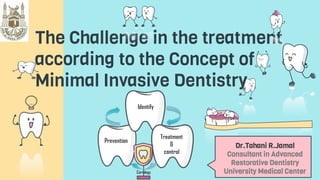
The Challenge in the treatment
according to the Concept of
Minimal Invasive Dentistry
Dr.Tahani R.Jamal
Consultant in Advanced
Restorative Dentistry
University Medical Center
Identify
Prevention
Treatment
&
control
Cariology
CONTENTS
Introduction
2. Timeline Of Minimal Invasive Dentistry.
3. Golden Triangle Of Minimal Invasive Dentistry
4. Plan Of Minimal Invasive Dentistry
5. Goals Of Minimal Invasive Dentistry
6. Concept Of Minimal Invasive Dentistry
I. Caries Diagnosis Ii. Caries Removal Or Early
Restoration Iii. Caries Control . cariogram
interpretation .CAMBRA
7. Advantages Of Minimal Invasive Dentistry
8. Conclusion.
9. References.
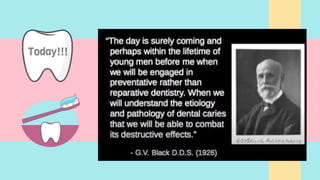
Every thing you do to the
tooth has consequence ;
short term or long ,its
cascade of events
determines the survival
of the tooth .
INTRODUCTION
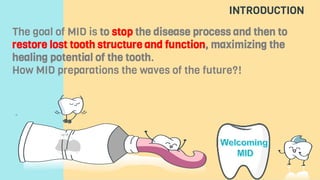
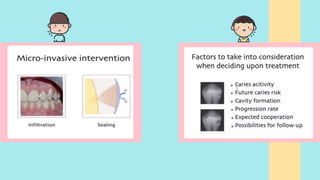
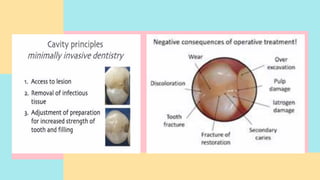
The goal of MID is to stop the disease process and then to
restore lost tooth structure and function, maximizing the
healing potential of the tooth.
How MID preparations the waves of the future?!
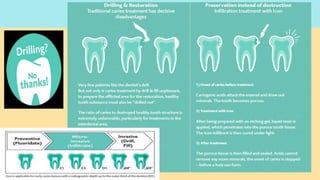
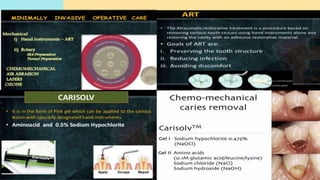
process of removing only minimal
carious tooth structure and
attempting to re- mineralize and
restore the remaining tooth
structure
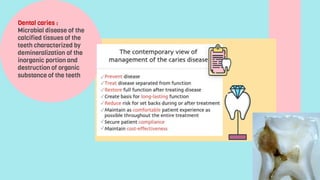
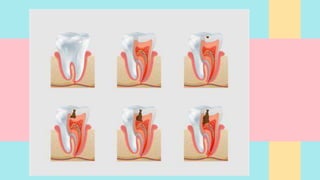
Dental caries :
Microbial disease of the
calcified tissues of the
teeth characterized by
demineralization of the
inorganic portion and
destruction of organic
substance of the teeth
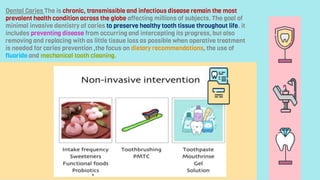
Dental Caries The is chronic, transmissible and infectious disease remain the most
prevalent health condition across the globe affecting millions of subjects. The goal of
minimal invasive dentistry of caries to preserve healthy tooth tissue throughout life. it
includes preventing disease from occurring and intercepting its progress, but also
removing and replacing with as little tissue loss as possible when operative treatment
is needed for caries prevention ,the focus on dietary recommendations, the use of
fluoride and mechanical tooth cleaning.
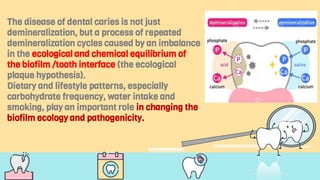
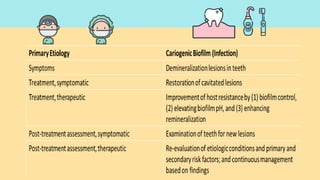
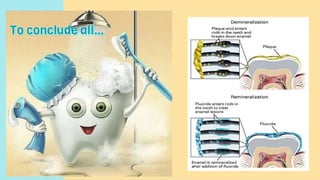
The disease of dental caries is not just
demineralization, but a process of repeated
demineralization cycles caused by an imbalance
in the ecological and chemical equilibrium of
the biofilm /tooth interface (the ecological
plaque hypothesis).
Dietary and lifestyle patterns, especially
carbohydrate frequency, water intake and
smoking, play an important role in changing the
biofilm ecology and pathogenicity.
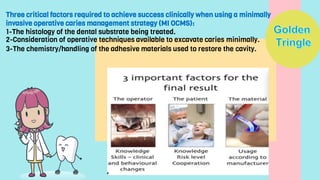
Three critical factors required to achieve success clinically when using a minimally
invasive operative caries management strategy (MI OCMS):
1-The histology of the dental substrate being treated.
2-Consideration of operative techniques available to excavate caries minimally.
3-The chemistry/handling of the adhesive materials used to restore the cavity.
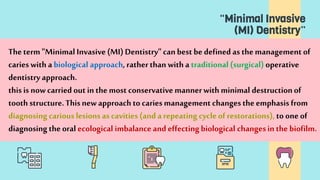
"Minimal Invasive
(MI) Dentistry”
Theterm "Minimal Invasive (MI) Dentistry" canbest be defined as the management of
caries with a biological approach, ratherthan with a traditional (surgical) operative
dentistry approach.
this is nowcarried out in the most conservative mannerwith minimal destructionof
tooth structure.Thisnew approach to caries management changesthe emphasis from
diagnosing carious lesions as cavities (and a repeating cycle of restorations), to one of
diagnosing the oral ecological imbalance and effectingbiological changesin the biofilm.
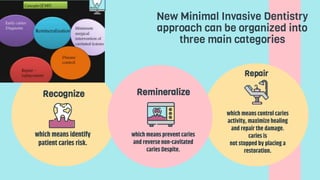
New Minimal Invasive Dentistry
approach can be organized into
three main categories
Recognize
which means identify
patient caries risk.
Remineralize
which means prevent caries
and reverse non-cavitated
caries Despite.
Repair
which means control caries
activity, maximize healing
and repair the damage.
caries is
not stopped by placing a
restoration.
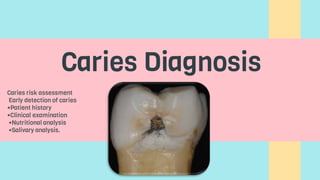
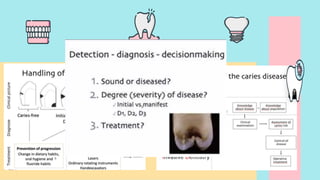
Caries Diagnosis
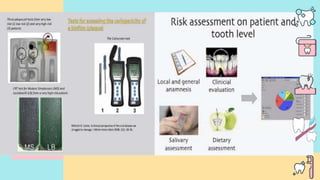
Caries risk assessment
Early detection of caries
•Patient history
•Clinical examination
•Nutritional analysis
•Salivary analysis.
19
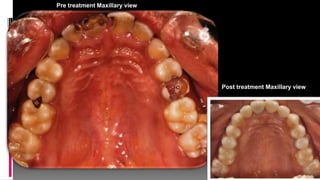
Pre treatment Maxillary view
Post treatment Maxillary view
20
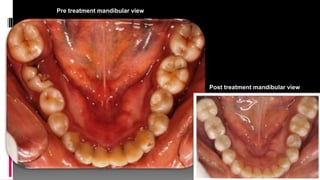
Pre treatment mandibular view
Post treatment mandibular view
22
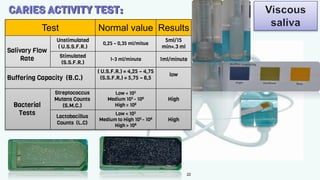
Test Normal value Results
Salivary Flow
Rate
Unstimulated
( U.S.S.F.R.)
0,25 – 0,35 ml/mitue
5ml/15
min=.3 ml
Stimulated
(S.S.F.R.)
1-3 ml/minute 1ml/minute
Buffering Capacity (B.C.)
( U.S.F.R.) = 4,25 – 4,75
(S.S.F.R.) = 5,75 – 6,5
low
Bacterial
Tests
Streptococcus
Mutans Counts
(S.M.C.)
Low < 105
Medium 105 - 106
High > 106
High
Lactobacillus
Counts (L.C)
Low < 105
Medium to High 105 - 106
High > 106
High
CARIES ACTIVITY TEST:
Diet Analysis
&
Dietary Advice
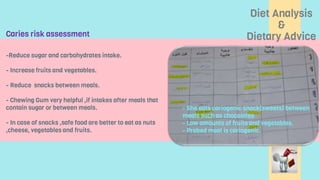
- She eats cariogenic snack(sweets) between
meals such as chocolates
- Low amounts of fruits and vegetables.
- Prebed meal is cariogenic.
-Reduce sugar and carbohydrates intake.
- Increase fruits and vegetables.
- Reduce snacks between meals.
- Chewing Gum very helpful ,if intakes after meals that
contain sugar or between meals.
- In case of snacks ,safe food are better to eat as nuts
,cheese, vegetables and fruits.
Caries risk assessment
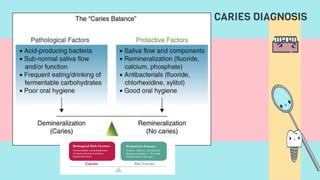
CARIES DIAGNOSIS
Page 25
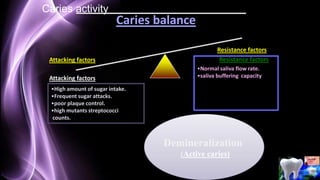
•High amount of sugar intake.
•Frequent sugar attacks.
•poor plaque control.
•high mutants streptococci
counts.
Caries balance
Attacking factors
Resistance factors
•Normal saliva flow rate.
•saliva buffering capacity
Demineralization
(Active caries)
Attacking factors Resistance factors
Caries activity
Dr.Tahani 26
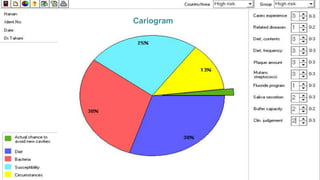
Cariogram
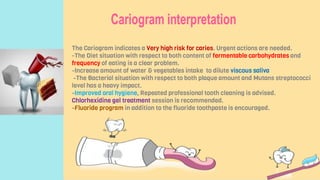
The Cariogram indicates a Very high risk for caries. Urgent actions are needed.
-The Diet situation with respect to both content of fermentable carbohydrates and
frequency of eating is a clear problem.
-Increase amount of water & vegetables intake to dilute viscous saliva
-The Bacterial situation with respect to both plaque amount and Mutans streptococci
level has a heavy impact.
-Improved oral hygiene, Repeated professional tooth cleaning is advised.
Chlorhexidine gel treatment session is recommended.
-Fluoride program in addition to the fluoride toothpaste is encouraged.
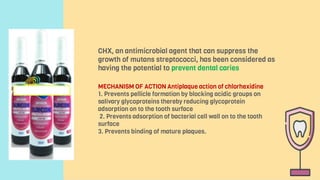
MECHANISM OF ACTION Antiplaque action of chlorhexidine
1. Prevents pellicle formation by blocking acidic groups on
salivary glycoproteins thereby reducing glycoprotein
adsorption on to the tooth surface
2. Prevents adsorption of bacterial cell wall on to the tooth
surface
3. Prevents binding of mature plaques.
CHX, an antimicrobial agent that can suppress the
growth of mutans streptococci, has been considered as
having the potential to prevent dental caries
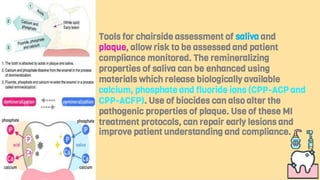
Tools for chairside assessment of saliva and
plaque, allow risk to be assessed and patient
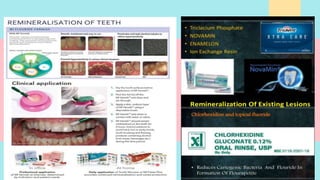
compliance monitored. The remineralizing
properties of saliva can be enhanced using
materials which release biologically available
calcium, phosphate and fluoride ions (CPP-ACP and
CPP-ACFP). Use of biocides can also alter the
pathogenic properties of plaque. Use of these MI
treatment protocols, can repair early lesions and
improve patient understanding and compliance.
This guide were
originally published in the
January 2019
issue of the Journal of the
California Dental
Association.
CAMBRA protocols facilitate
integration of caries
management by risk
assessment into everyday
practice.
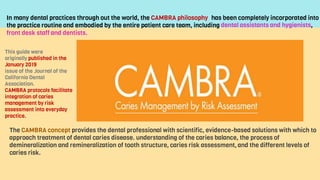
In many dental practices through out the world, the CAMBRA philosophy
the practice routine and embodied by the entire patient care team, including
front desk staff and dentists.
has been completely incorporated into
dental assistants and hygienists,
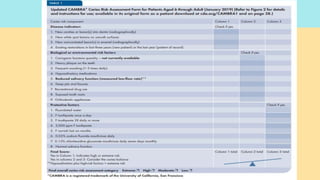
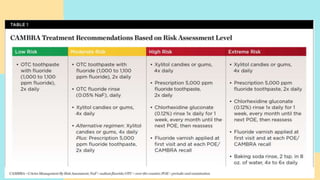
The CAMBRA concept provides the dental professional with scientific, evidence-based solutions with which to
approach treatment of dental caries disease. understanding of the caries balance, the process of
demineralization and remineralization of tooth structure, caries risk assessment, and the different levels of
caries risk.
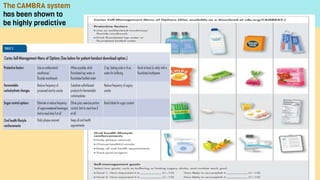
The CAMBRA system
has been shown to
be highly predictive
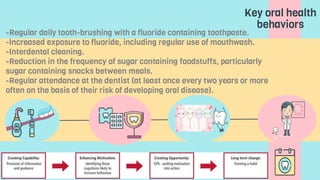
Key oral health
behaviors
-Regular daily tooth-brushing with a fluoride containing toothpaste.
-Increased exposure to fluoride, including regular use of mouthwash.
-Interdental cleaning.
-Reduction in the frequency of sugar containing foodstuffs, particularly
sugar containing snacks between meals.
-Regular attendance at the dentist (at least once every two years or more
often on the basis of their risk of developing oral disease).
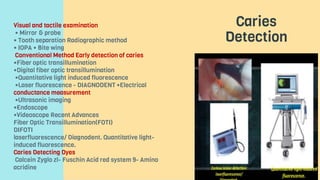
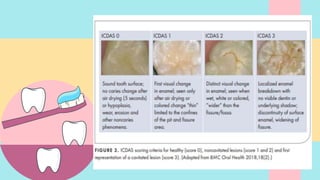
Caries
Detection
Visual and tactile examination
• Mirror & probe
• Tooth separation Radiographic method
• IOPA • Bite wing
Conventional Method Early detection of caries
•Fiber optic transillumination
•Digital fiber optic transillumination
•Quantitative light induced fluorescence
•Laser fluorescence - DIAGNODENT •Electrical
conductance measurement
•Ultrasonic imaging
•Endoscope
•Videoscope Recent Advances
Fiber Optic Transillumination(FOTI)
DIFOTI
laserfluorescence/ Diagnodent. Quantitative light-
induced fluorescence.
Caries Detecting Dyes
Calcein Zyglo zl- Fuschin Acid red system 9- Amino
acridine
http://oralhealth.ro/volumes/2015/volume-6/Paper-
856.pdf
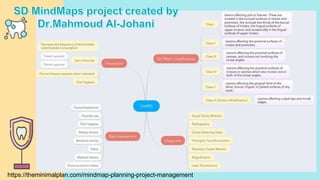
https://theminimalplan.com/mindmap-planning-project-management
Today!!!
When people act with arrogant complacency (hubris)
towards the earth, we suffer. When we ignore others’
pleas for help, people suffer and the earth suffers. On
the other side, when people act with care and
responsibility, suffering is erased. The Titanic is every
person’s story and it is the story of people interacting
with nature. It is a tragic reminder that mindlessness
sinks us, and yet it’s possible to rise above the odds and
express a higher form of humanity.
The Titanic is
the story of
human
struggle, and
yet it’s also
the story of
overcoming
struggle
Reference
References • Tyas MJ, Anusavice KJ, Frencken JE,Mount GJ. Minimal intervention dentistry-a review. FDI Commission Project 1-97.
Int Dent J. 2000;50:1–12. • Vimal k sikri. Textbook of operative dentistry.2nd edition. • Ramya raghu, clinical operative dentistry,
principles and practice. • Graham j mount, an atlas of glass ionomer cements. A clinicians guide. • White JM, Stephan EW,
Rationale and treatment approach in minimally invasive dentistry. J Am Dent Assoc. 2000;131: 13s- 19s. • Mount GJ, Hume WR. A
new cavity classification. Australian Dental Journal.1998;43(3):153-159.
. • Roberson TM, Lundeen TF. Sturdvent’s Art & Science of Operative Dentistry, 4th edition, Cariology: The Lesion,
Etiology,Prevention, and Control; 2002. • Walsh LJ. The current status of laser application in dentistry. Aust Dent J 2003;48:146-. •
A.Banerjee . Minimal intervention dentistry: part 7. Minimally invasive operative caries management: rationale and
techniques. BRITISH DENTAL JOURNAL VOLUME 214 NO. 3 FEB 9 2013. • Shefally Garg. Minimal Invasive Dentistry- A Comprehensive
Review BJMMR, 17(5): 1-9, 2016; Article no.BJMMR.27526. • Avijit Banerjee The contemporary practice of minimally invasive
dentistry FACULTY DENTAL JOURNAL April 2015 • Volume 6 • Issue 2 • Simonsen RJ. Preventive resin restorations (PRR) and
Sealants In Light Of Current Evidence: DCNA. 2005;49:815-823.Did you like the resources on this template? Get them for free at
our other websites.
THANKS!
Does anyone have any questions?

Mid

  • 2.
    The Challenge inthe treatment according to the Concept of Minimal Invasive Dentistry Dr.Tahani R.Jamal Consultant in Advanced Restorative Dentistry University Medical Center Identify Prevention Treatment & control Cariology
  • 4.
    CONTENTS Introduction 2. Timeline OfMinimal Invasive Dentistry. 3. Golden Triangle Of Minimal Invasive Dentistry 4. Plan Of Minimal Invasive Dentistry 5. Goals Of Minimal Invasive Dentistry 6. Concept Of Minimal Invasive Dentistry I. Caries Diagnosis Ii. Caries Removal Or Early Restoration Iii. Caries Control . cariogram interpretation .CAMBRA 7. Advantages Of Minimal Invasive Dentistry 8. Conclusion. 9. References.
  • 5.
    Every thing youdo to the tooth has consequence ; short term or long ,its cascade of events determines the survival of the tooth .
  • 7.
    INTRODUCTION The goal ofMID is to stop the disease process and then to restore lost tooth structure and function, maximizing the healing potential of the tooth. How MID preparations the waves of the future?!
  • 8.
    process of removingonly minimal carious tooth structure and attempting to re- mineralize and restore the remaining tooth structure
  • 11.
    Dental caries : Microbialdisease of the calcified tissues of the teeth characterized by demineralization of the inorganic portion and destruction of organic substance of the teeth
  • 12.
    Dental Caries Theis chronic, transmissible and infectious disease remain the most prevalent health condition across the globe affecting millions of subjects. The goal of minimal invasive dentistry of caries to preserve healthy tooth tissue throughout life. it includes preventing disease from occurring and intercepting its progress, but also removing and replacing with as little tissue loss as possible when operative treatment is needed for caries prevention ,the focus on dietary recommendations, the use of fluoride and mechanical tooth cleaning.
  • 13.
    The disease ofdental caries is not just demineralization, but a process of repeated demineralization cycles caused by an imbalance in the ecological and chemical equilibrium of the biofilm /tooth interface (the ecological plaque hypothesis). Dietary and lifestyle patterns, especially carbohydrate frequency, water intake and smoking, play an important role in changing the biofilm ecology and pathogenicity.
  • 14.
    Three critical factorsrequired to achieve success clinically when using a minimally invasive operative caries management strategy (MI OCMS): 1-The histology of the dental substrate being treated. 2-Consideration of operative techniques available to excavate caries minimally. 3-The chemistry/handling of the adhesive materials used to restore the cavity.
  • 15.
    "Minimal Invasive (MI) Dentistry” Theterm"Minimal Invasive (MI) Dentistry" canbest be defined as the management of caries with a biological approach, ratherthan with a traditional (surgical) operative dentistry approach. this is nowcarried out in the most conservative mannerwith minimal destructionof tooth structure.Thisnew approach to caries management changesthe emphasis from diagnosing carious lesions as cavities (and a repeating cycle of restorations), to one of diagnosing the oral ecological imbalance and effectingbiological changesin the biofilm.
  • 16.
    New Minimal InvasiveDentistry approach can be organized into three main categories Recognize which means identify patient caries risk. Remineralize which means prevent caries and reverse non-cavitated caries Despite. Repair which means control caries activity, maximize healing and repair the damage. caries is not stopped by placing a restoration.
  • 18.
    Caries Diagnosis Caries riskassessment Early detection of caries •Patient history •Clinical examination •Nutritional analysis •Salivary analysis.
  • 19.
    19 Pre treatment Maxillaryview Post treatment Maxillary view
  • 20.
    20 Pre treatment mandibularview Post treatment mandibular view
  • 22.
    22 Test Normal valueResults Salivary Flow Rate Unstimulated ( U.S.S.F.R.) 0,25 – 0,35 ml/mitue 5ml/15 min=.3 ml Stimulated (S.S.F.R.) 1-3 ml/minute 1ml/minute Buffering Capacity (B.C.) ( U.S.F.R.) = 4,25 – 4,75 (S.S.F.R.) = 5,75 – 6,5 low Bacterial Tests Streptococcus Mutans Counts (S.M.C.) Low < 105 Medium 105 - 106 High > 106 High Lactobacillus Counts (L.C) Low < 105 Medium to High 105 - 106 High > 106 High CARIES ACTIVITY TEST:
  • 23.
    Diet Analysis & Dietary Advice -She eats cariogenic snack(sweets) between meals such as chocolates - Low amounts of fruits and vegetables. - Prebed meal is cariogenic. -Reduce sugar and carbohydrates intake. - Increase fruits and vegetables. - Reduce snacks between meals. - Chewing Gum very helpful ,if intakes after meals that contain sugar or between meals. - In case of snacks ,safe food are better to eat as nuts ,cheese, vegetables and fruits. Caries risk assessment
  • 24.
  • 25.
    Page 25 •High amountof sugar intake. •Frequent sugar attacks. •poor plaque control. •high mutants streptococci counts. Caries balance Attacking factors Resistance factors •Normal saliva flow rate. •saliva buffering capacity Demineralization (Active caries) Attacking factors Resistance factors Caries activity
  • 26.
  • 27.
    The Cariogram indicatesa Very high risk for caries. Urgent actions are needed. -The Diet situation with respect to both content of fermentable carbohydrates and frequency of eating is a clear problem. -Increase amount of water & vegetables intake to dilute viscous saliva -The Bacterial situation with respect to both plaque amount and Mutans streptococci level has a heavy impact. -Improved oral hygiene, Repeated professional tooth cleaning is advised. Chlorhexidine gel treatment session is recommended. -Fluoride program in addition to the fluoride toothpaste is encouraged.
  • 30.
    MECHANISM OF ACTIONAntiplaque action of chlorhexidine 1. Prevents pellicle formation by blocking acidic groups on salivary glycoproteins thereby reducing glycoprotein adsorption on to the tooth surface 2. Prevents adsorption of bacterial cell wall on to the tooth surface 3. Prevents binding of mature plaques. CHX, an antimicrobial agent that can suppress the growth of mutans streptococci, has been considered as having the potential to prevent dental caries
  • 34.
    Tools for chairsideassessment of saliva and plaque, allow risk to be assessed and patient compliance monitored. The remineralizing properties of saliva can be enhanced using materials which release biologically available calcium, phosphate and fluoride ions (CPP-ACP and CPP-ACFP). Use of biocides can also alter the pathogenic properties of plaque. Use of these MI treatment protocols, can repair early lesions and improve patient understanding and compliance.
  • 36.
    This guide were originallypublished in the January 2019 issue of the Journal of the California Dental Association. CAMBRA protocols facilitate integration of caries management by risk assessment into everyday practice. In many dental practices through out the world, the CAMBRA philosophy the practice routine and embodied by the entire patient care team, including front desk staff and dentists. has been completely incorporated into dental assistants and hygienists, The CAMBRA concept provides the dental professional with scientific, evidence-based solutions with which to approach treatment of dental caries disease. understanding of the caries balance, the process of demineralization and remineralization of tooth structure, caries risk assessment, and the different levels of caries risk.
  • 38.
    The CAMBRA system hasbeen shown to be highly predictive
  • 41.
    Key oral health behaviors -Regulardaily tooth-brushing with a fluoride containing toothpaste. -Increased exposure to fluoride, including regular use of mouthwash. -Interdental cleaning. -Reduction in the frequency of sugar containing foodstuffs, particularly sugar containing snacks between meals. -Regular attendance at the dentist (at least once every two years or more often on the basis of their risk of developing oral disease).
  • 42.
    Caries Detection Visual and tactileexamination • Mirror & probe • Tooth separation Radiographic method • IOPA • Bite wing Conventional Method Early detection of caries •Fiber optic transillumination •Digital fiber optic transillumination •Quantitative light induced fluorescence •Laser fluorescence - DIAGNODENT •Electrical conductance measurement •Ultrasonic imaging •Endoscope •Videoscope Recent Advances Fiber Optic Transillumination(FOTI) DIFOTI laserfluorescence/ Diagnodent. Quantitative light- induced fluorescence. Caries Detecting Dyes Calcein Zyglo zl- Fuschin Acid red system 9- Amino acridine
  • 47.
  • 49.
  • 51.
  • 52.
    When people actwith arrogant complacency (hubris) towards the earth, we suffer. When we ignore others’ pleas for help, people suffer and the earth suffers. On the other side, when people act with care and responsibility, suffering is erased. The Titanic is every person’s story and it is the story of people interacting with nature. It is a tragic reminder that mindlessness sinks us, and yet it’s possible to rise above the odds and express a higher form of humanity. The Titanic is the story of human struggle, and yet it’s also the story of overcoming struggle
  • 53.
    Reference References • TyasMJ, Anusavice KJ, Frencken JE,Mount GJ. Minimal intervention dentistry-a review. FDI Commission Project 1-97. Int Dent J. 2000;50:1–12. • Vimal k sikri. Textbook of operative dentistry.2nd edition. • Ramya raghu, clinical operative dentistry, principles and practice. • Graham j mount, an atlas of glass ionomer cements. A clinicians guide. • White JM, Stephan EW, Rationale and treatment approach in minimally invasive dentistry. J Am Dent Assoc. 2000;131: 13s- 19s. • Mount GJ, Hume WR. A new cavity classification. Australian Dental Journal.1998;43(3):153-159. . • Roberson TM, Lundeen TF. Sturdvent’s Art & Science of Operative Dentistry, 4th edition, Cariology: The Lesion, Etiology,Prevention, and Control; 2002. • Walsh LJ. The current status of laser application in dentistry. Aust Dent J 2003;48:146-. • A.Banerjee . Minimal intervention dentistry: part 7. Minimally invasive operative caries management: rationale and techniques. BRITISH DENTAL JOURNAL VOLUME 214 NO. 3 FEB 9 2013. • Shefally Garg. Minimal Invasive Dentistry- A Comprehensive Review BJMMR, 17(5): 1-9, 2016; Article no.BJMMR.27526. • Avijit Banerjee The contemporary practice of minimally invasive dentistry FACULTY DENTAL JOURNAL April 2015 • Volume 6 • Issue 2 • Simonsen RJ. Preventive resin restorations (PRR) and Sealants In Light Of Current Evidence: DCNA. 2005;49:815-823.Did you like the resources on this template? Get them for free at our other websites.
  • 54.