University of Aden
Faculty of Dentistry
Conservative Dentistry Department
Prepared by :
Supervised by : Ass. prof. Dr. Mohammed Alsakkaf
Introduction:
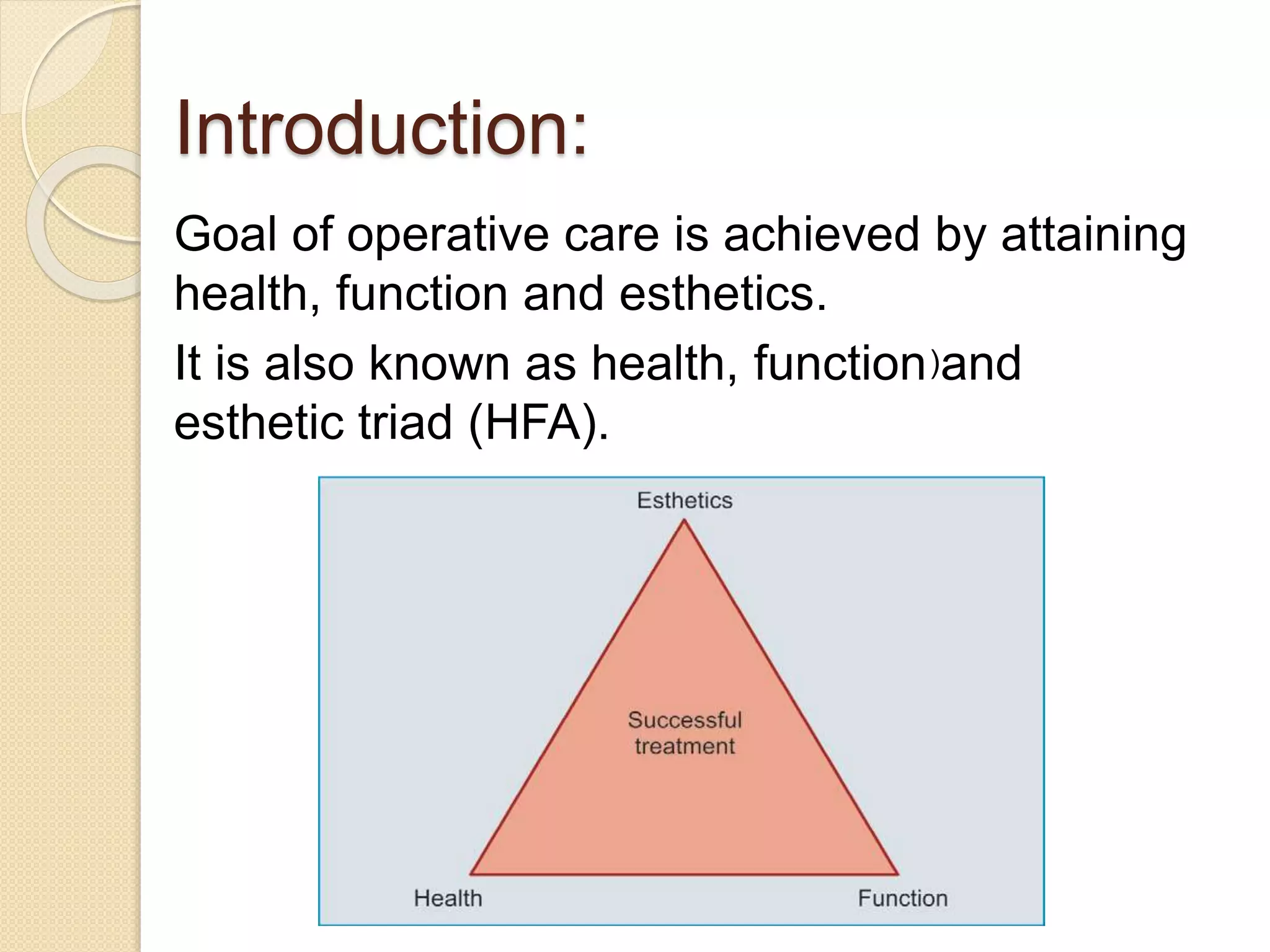
Goal of operative care is achieved by attaining
health, function and esthetics.
It is also known as health, function and
esthetic triad (HFA).
)
Definition :
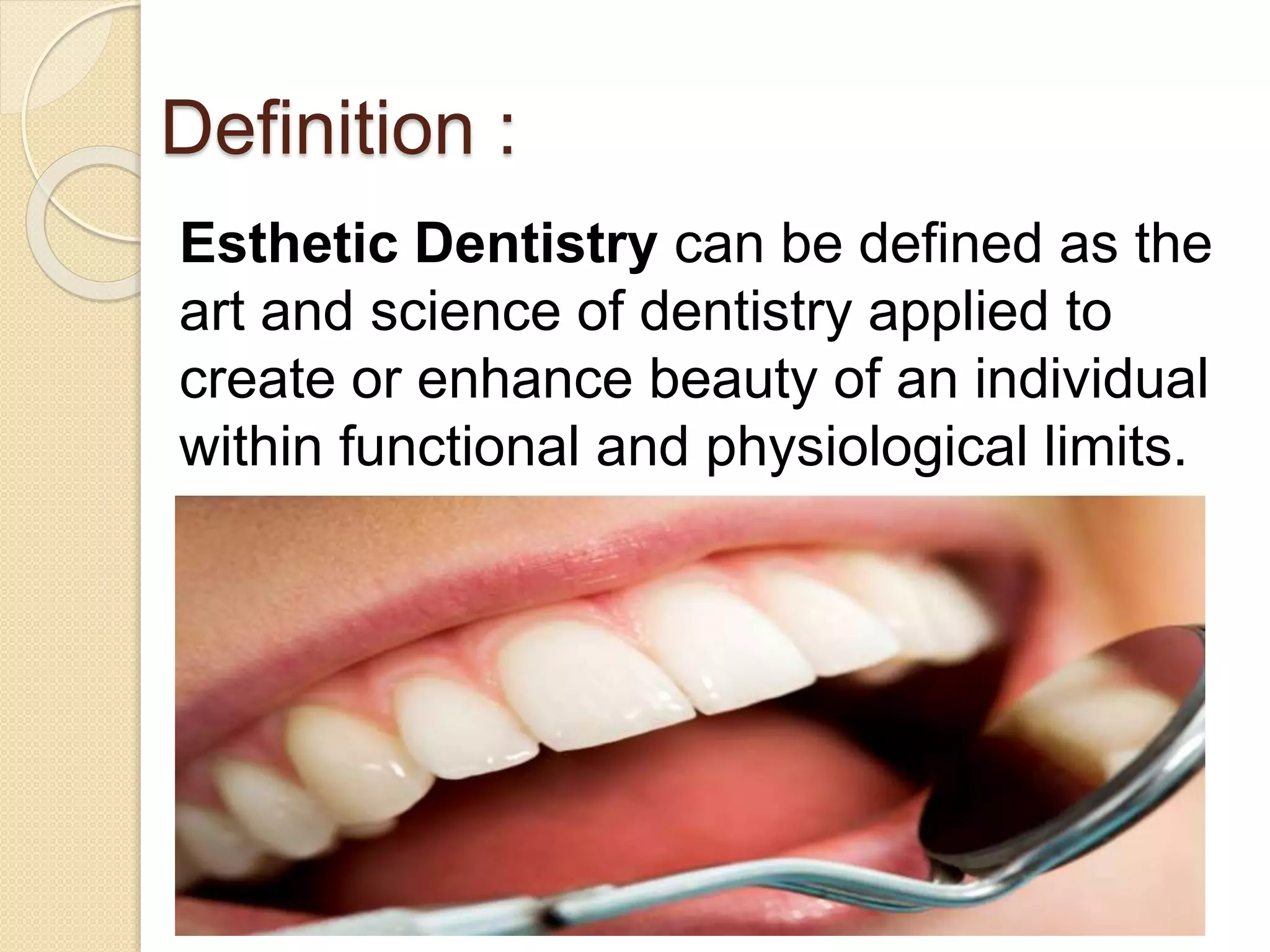
Esthetic Dentistry can be defined as the
art and science of dentistry applied to
create or enhance beauty of an individual
within functional and physiological limits.
What is cosmetic dentistry?
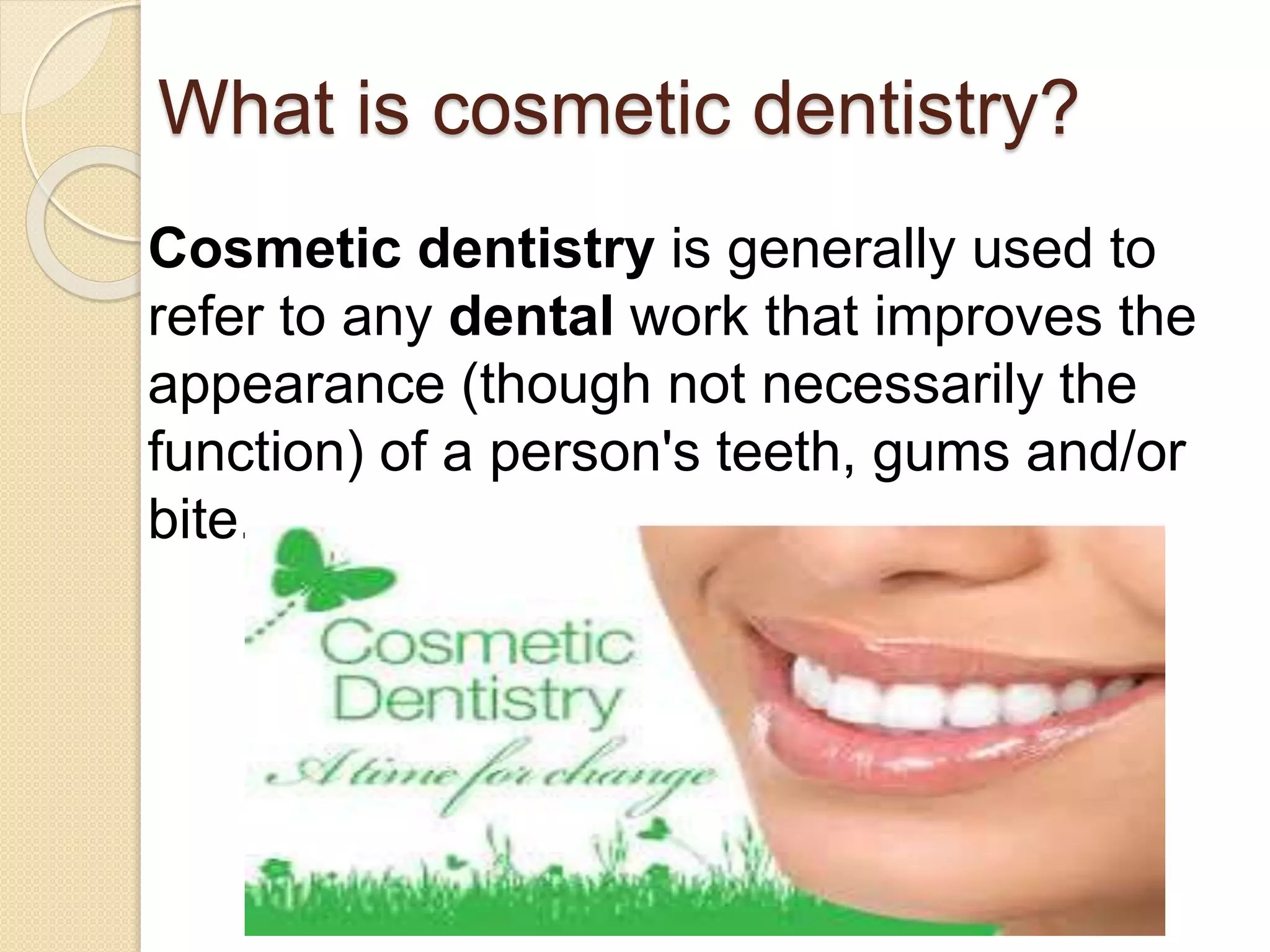
Cosmetic dentistry is generally used to
refer to any dental work that improves the
appearance (though not necessarily the
function) of a person's teeth, gums and/or
bite.
The Smile :
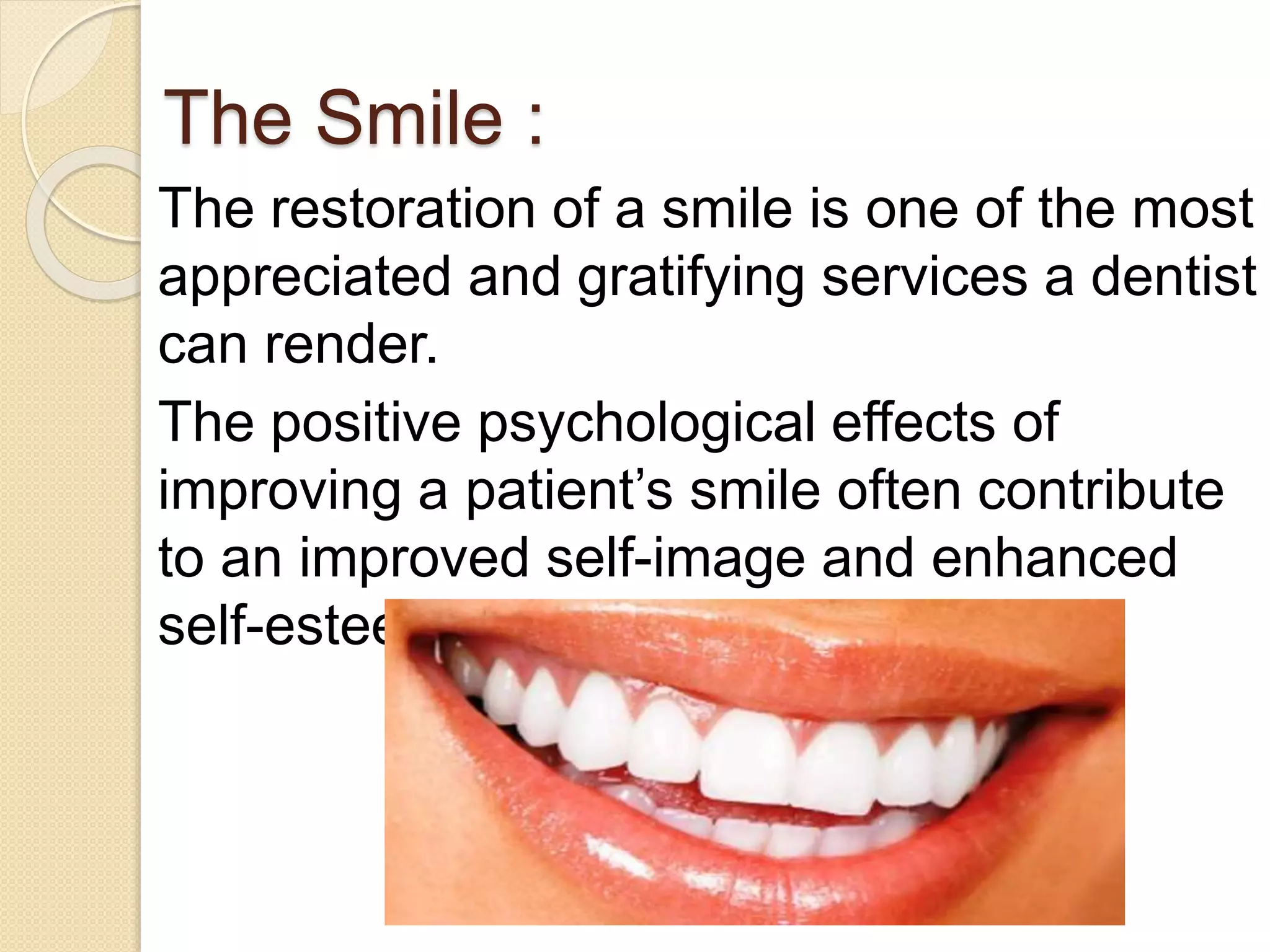
The restoration of a smile is one of the most
appreciated and gratifying services a dentist
can render.
The positive psychological effects of
improving a patient’s smile often contribute
to an improved self-image and enhanced
self-esteem
Smile design :
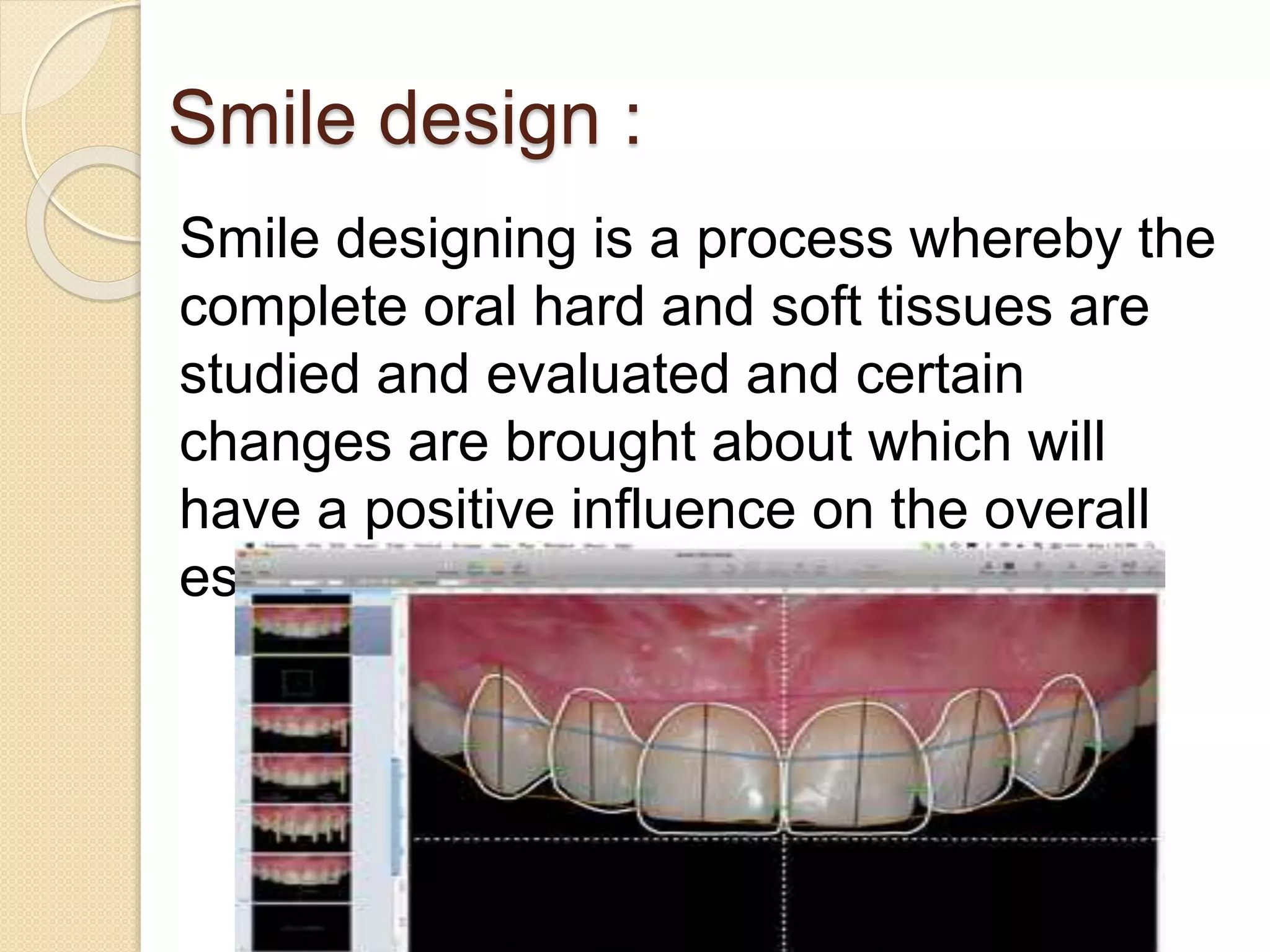
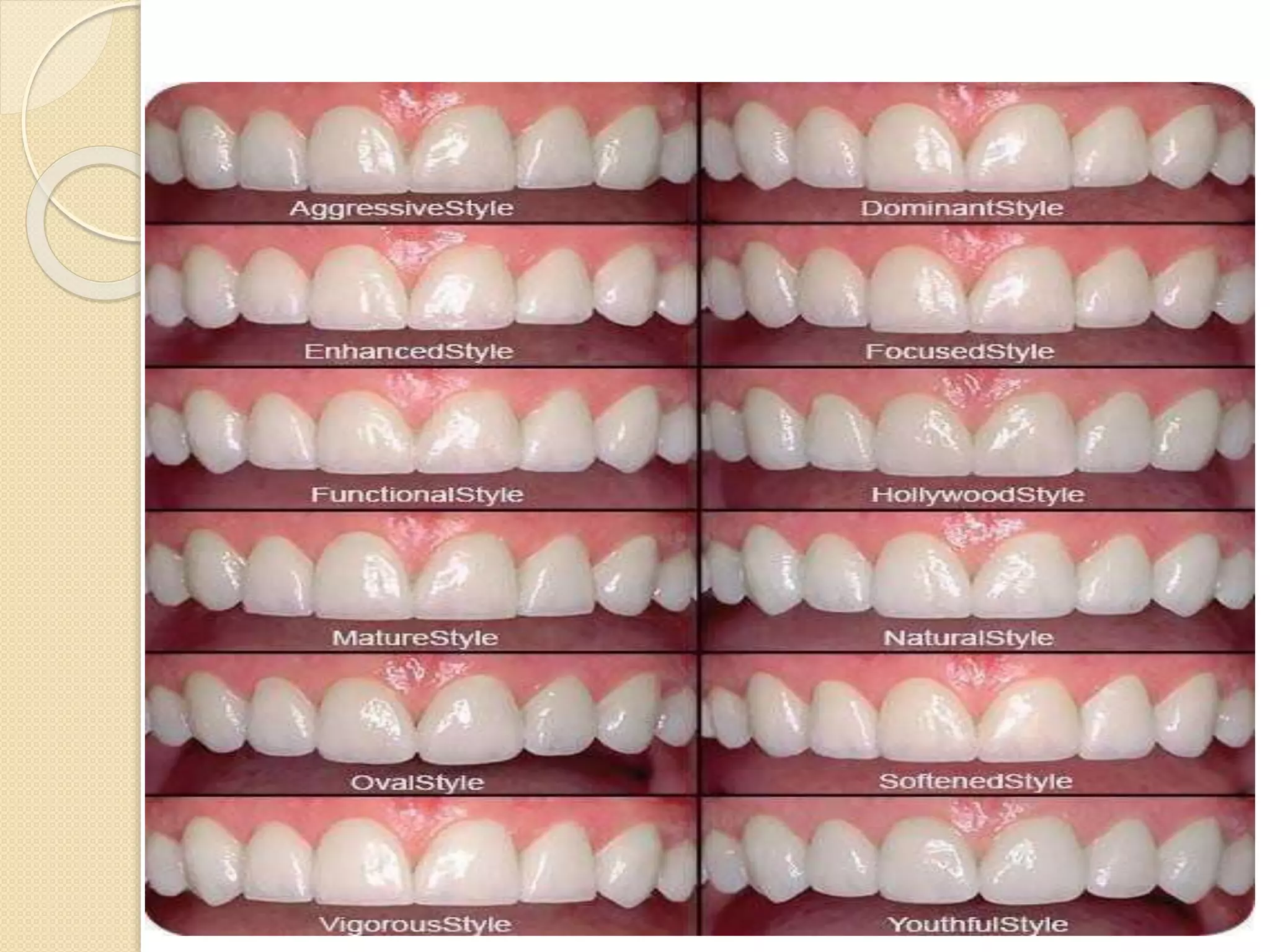
Smile designing is a process whereby the
complete oral hard and soft tissues are
studied and evaluated and certain
changes are brought about which will
have a positive influence on the overall
esthetics of the face.
ELEMENTS OF DENTAL ESTHETICS
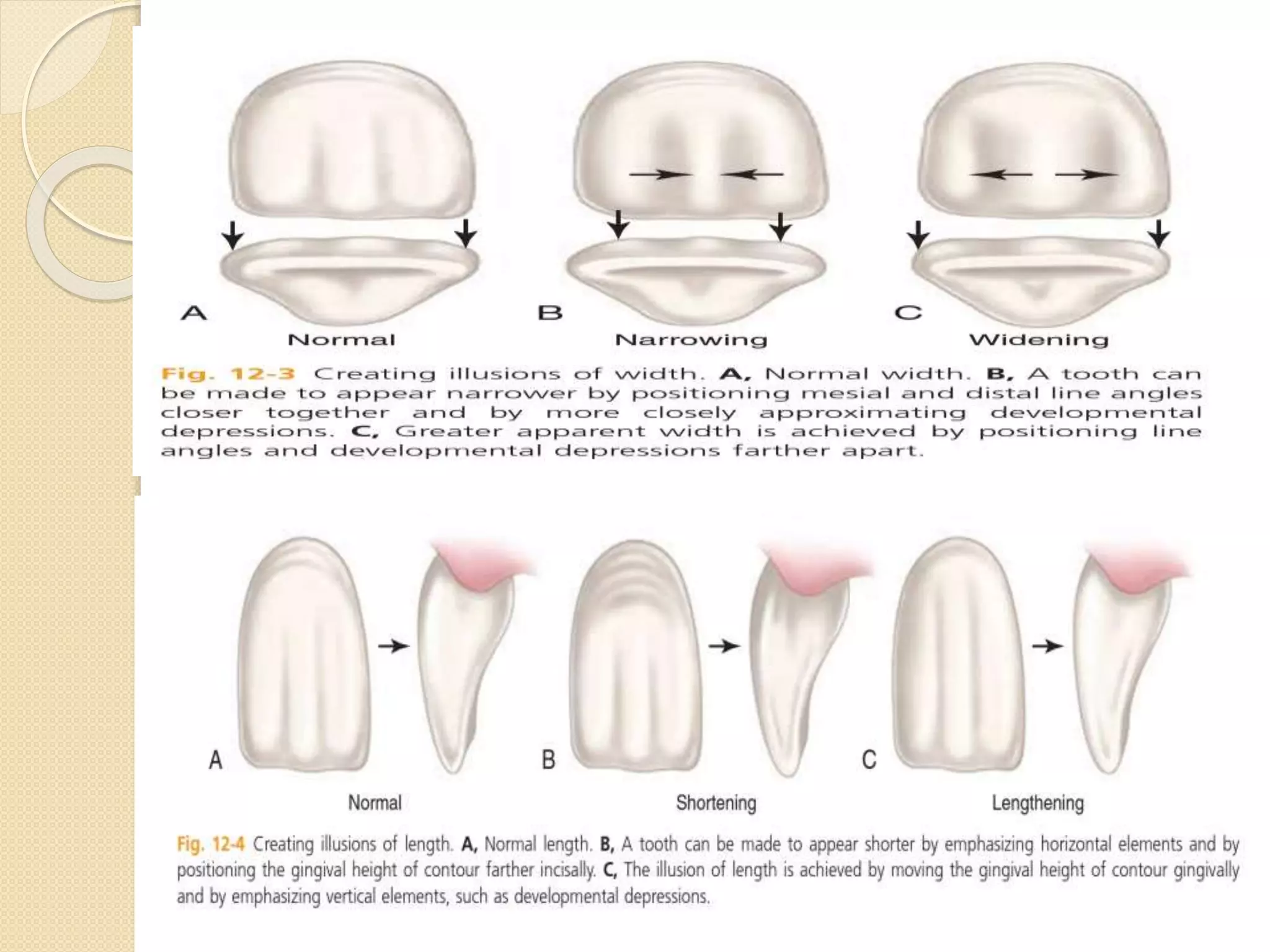
• Size, shape and width of teeth
• Symmetry and proportionality of teeth
• Alignment of teeth
• Contacts and embrasure form
• Color and translucency.
• Surface texture
• Gingival aesthetic
Size, Shape and Width of
Teeth
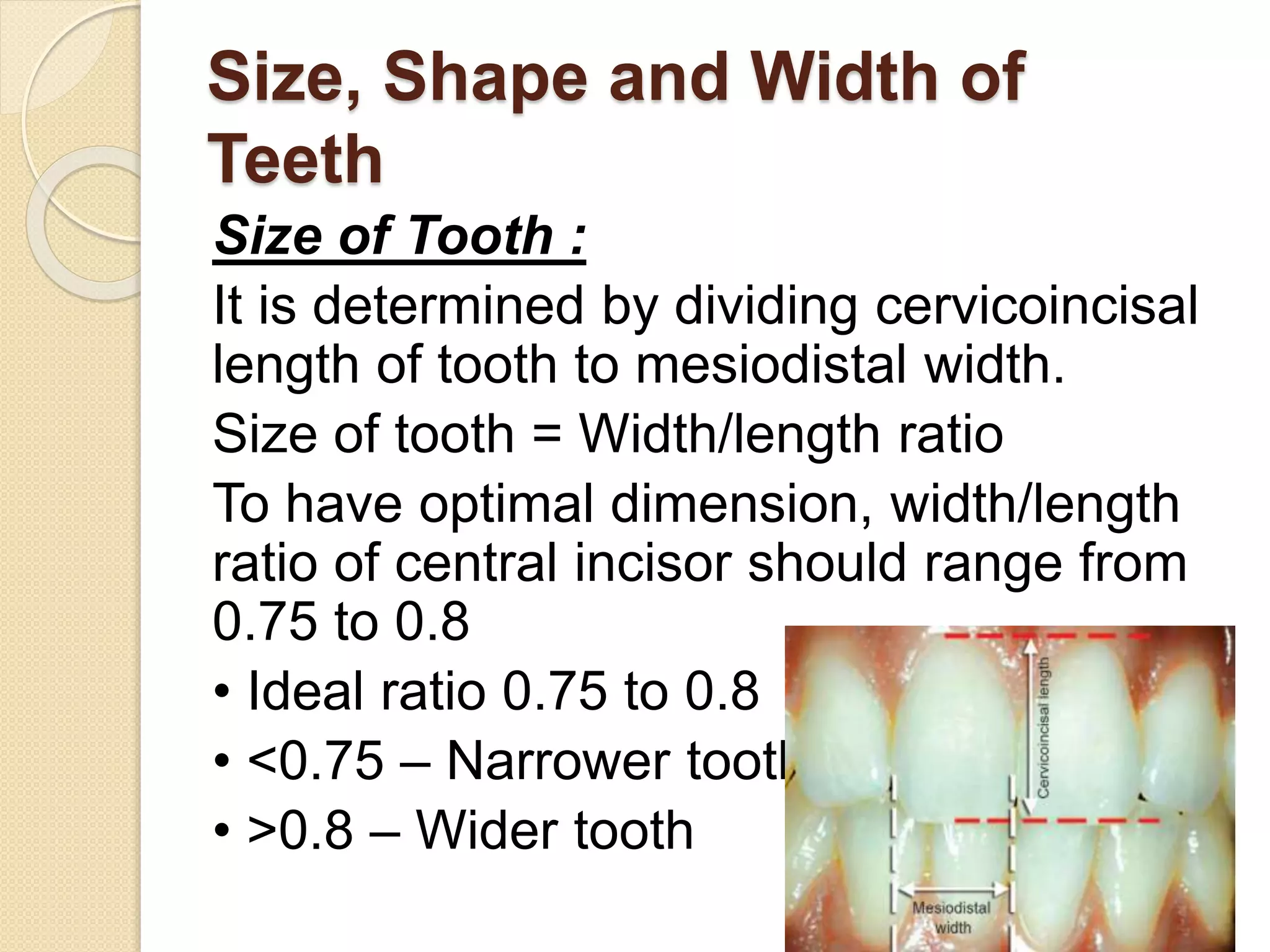
Size of Tooth :
It is determined by dividing cervicoincisal
length of tooth to mesiodistal width.
Size of tooth = Width/length ratio
To have optimal dimension, width/length
ratio of central incisor should range from
0.75 to 0.8
• Ideal ratio 0.75 to 0.8
• <0.75 – Narrower tooth
• >0.8 – Wider tooth
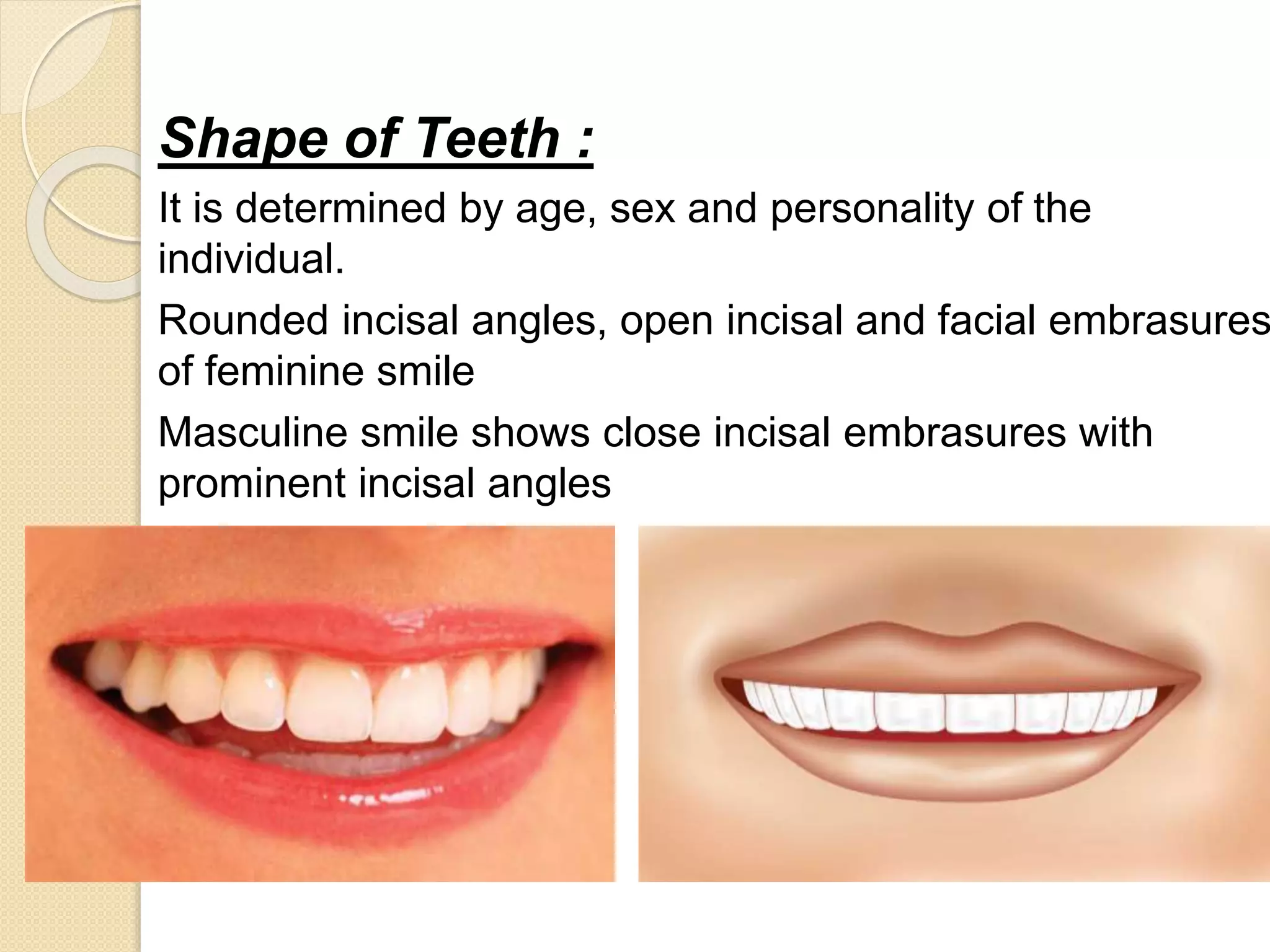
Shape of Teeth :
It is determined by age, sex and personality of the
individual.
Rounded incisal angles, open incisal and facial embrasures
of feminine smile
Masculine smile shows close incisal embrasures with
prominent incisal angles
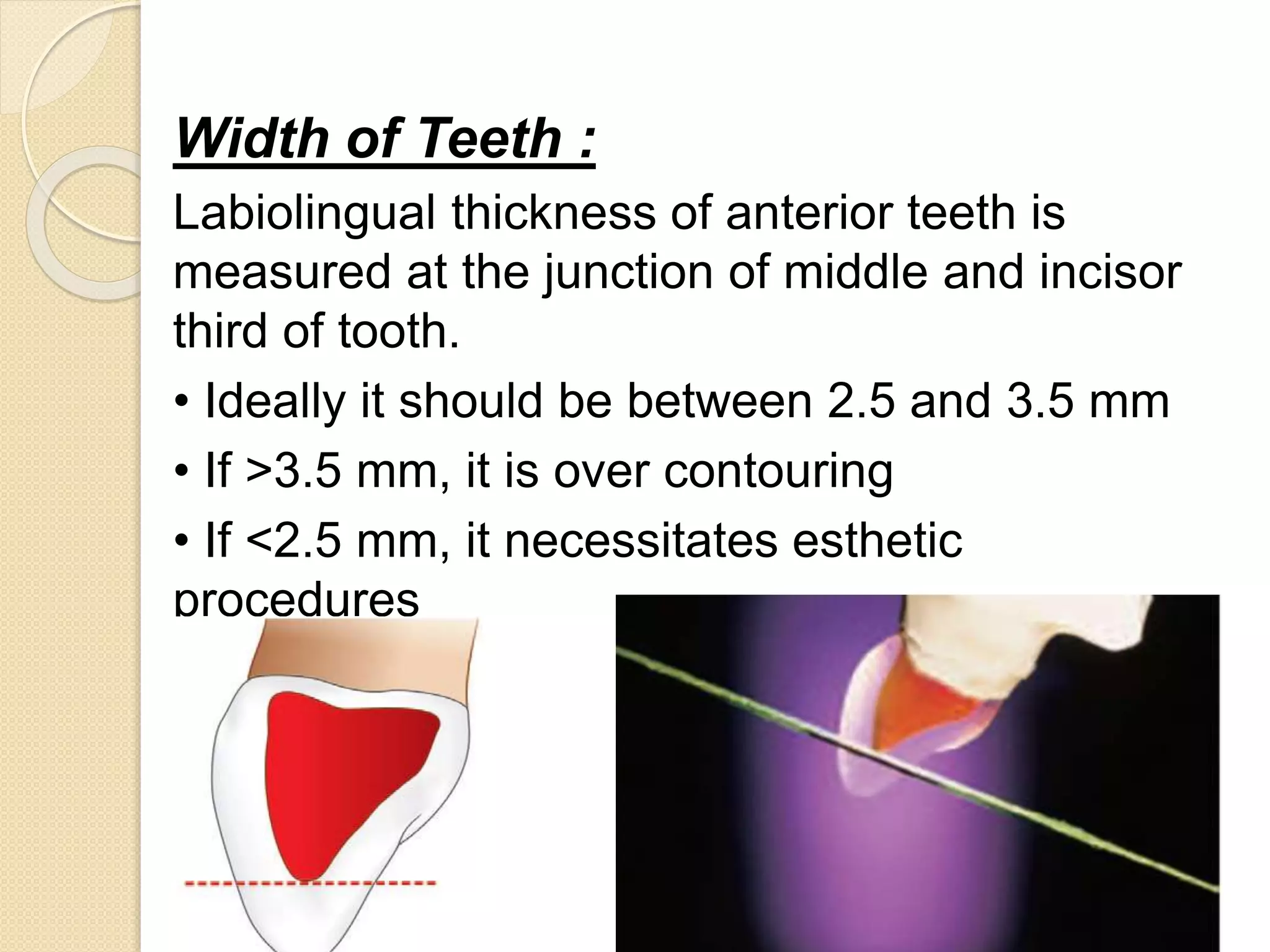
Width of Teeth :
Labiolingual thickness of anterior teeth is
measured at the junction of middle and incisor
third of tooth.
• Ideally it should be between 2.5 and 3.5 mm
• If >3.5 mm, it is over contouring
• If <2.5 mm, it necessitates esthetic
procedures
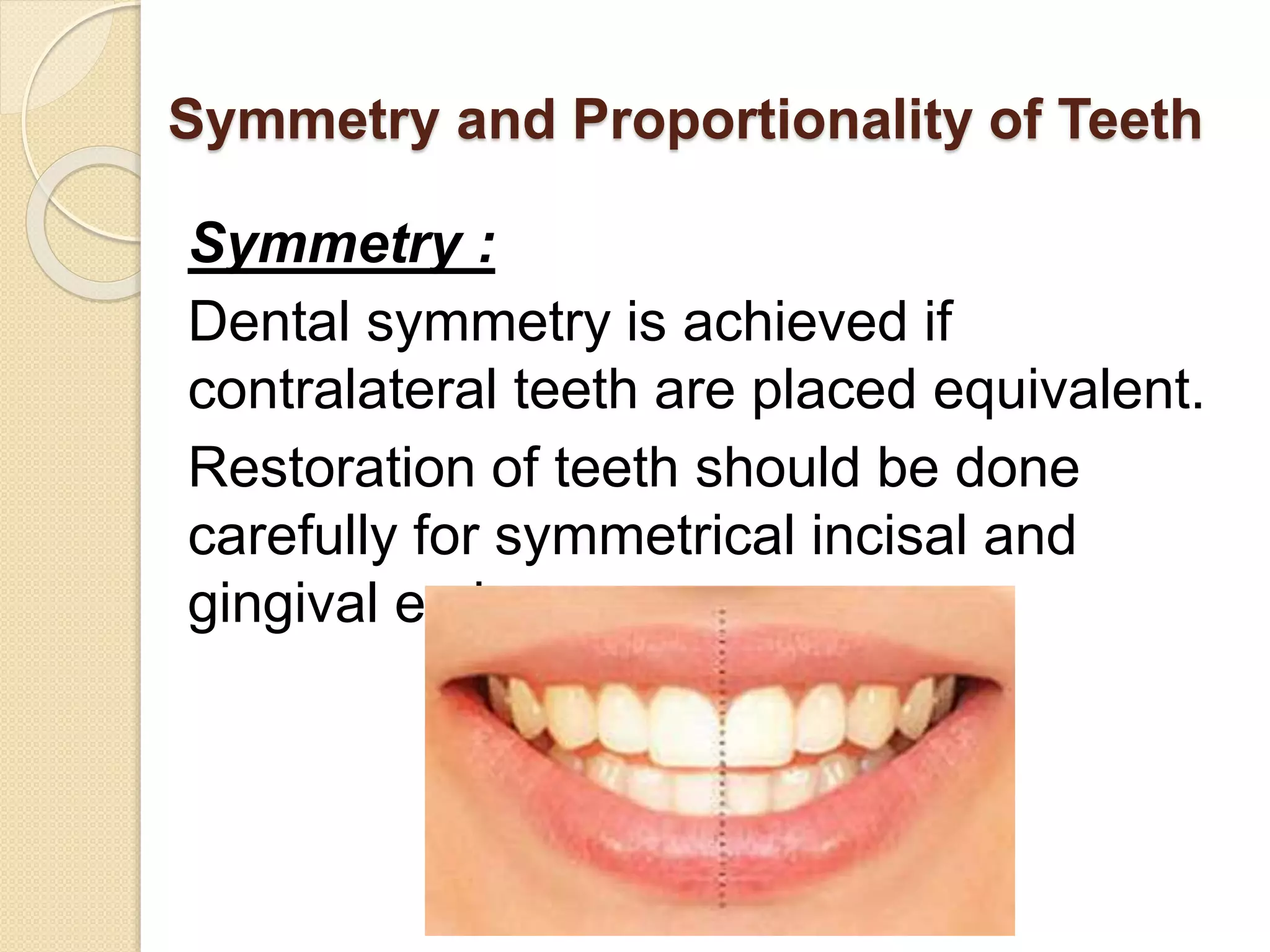
Symmetry and Proportionality of Teeth
Symmetry :
Dental symmetry is achieved if
contralateral teeth are placed equivalent.
Restoration of teeth should be done
carefully for symmetrical incisal and
gingival embrasure.
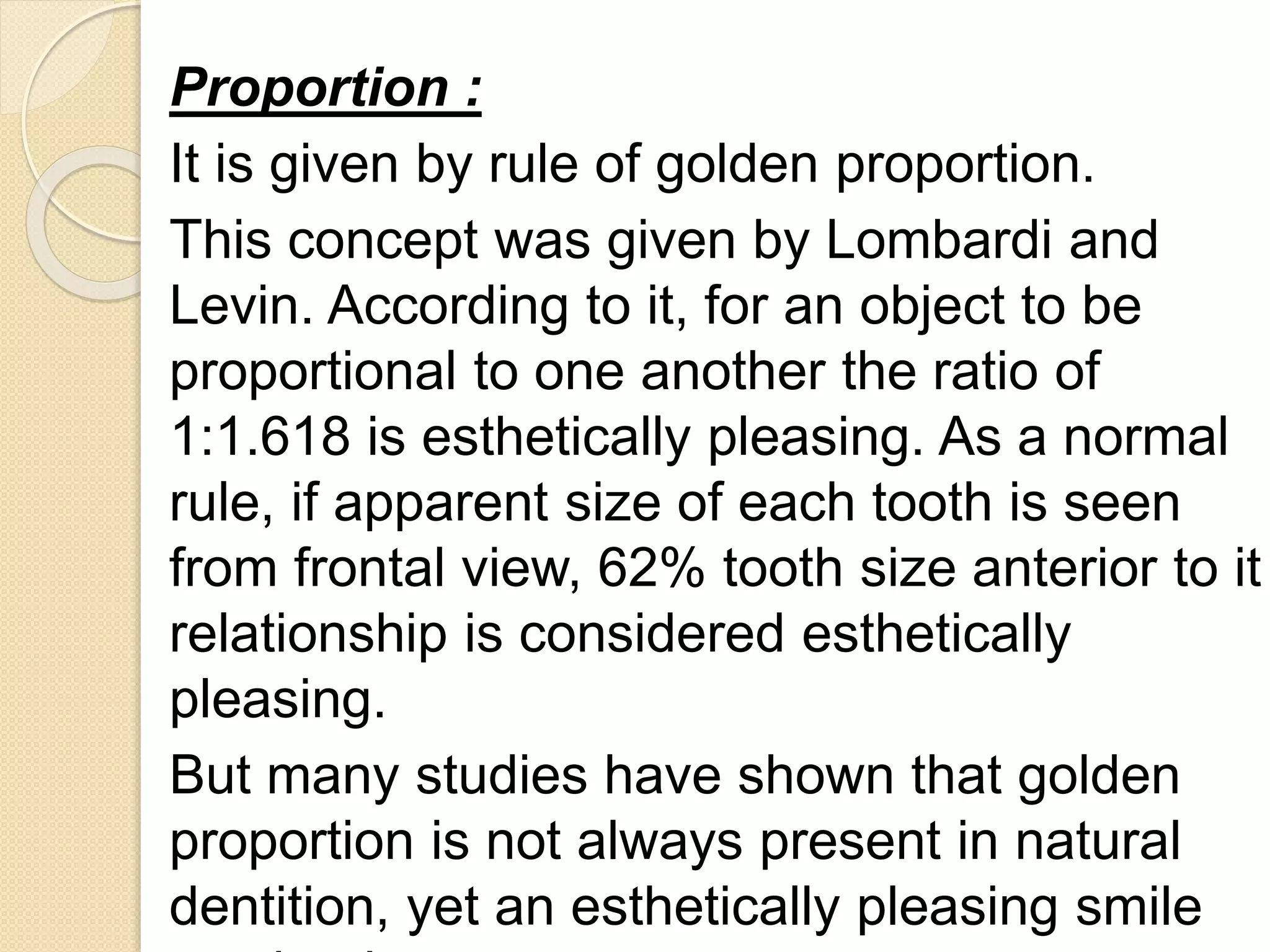
Proportion :
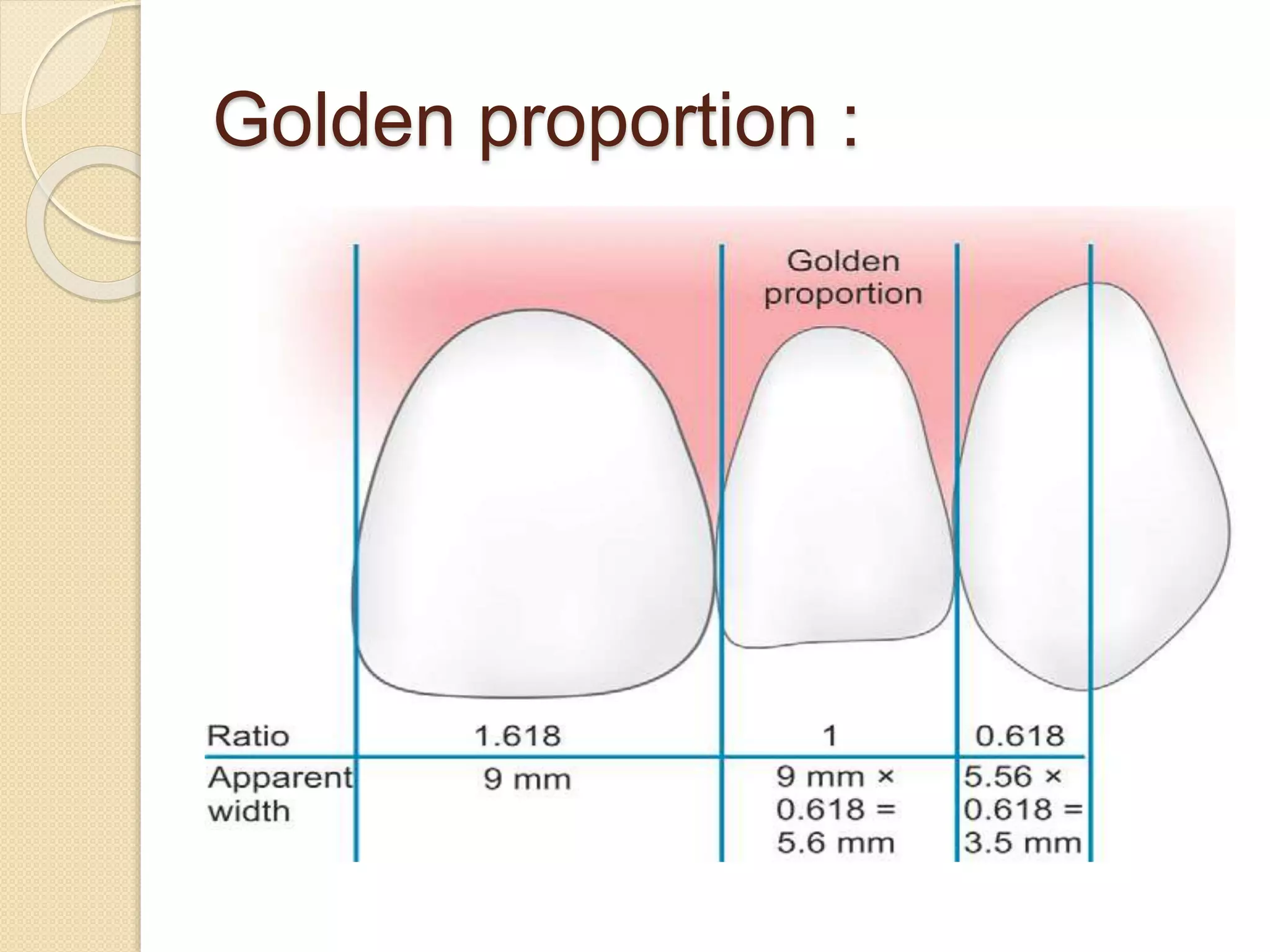
It is given by rule of golden proportion.
This concept was given by Lombardi and
Levin. According to it, for an object to be
proportional to one another the ratio of
1:1.618 is esthetically pleasing. As a normal
rule, if apparent size of each tooth is seen
from frontal view, 62% tooth size anterior to it
relationship is considered esthetically
pleasing.
But many studies have shown that golden
proportion is not always present in natural
dentition, yet an esthetically pleasing smile
Golden proportion :
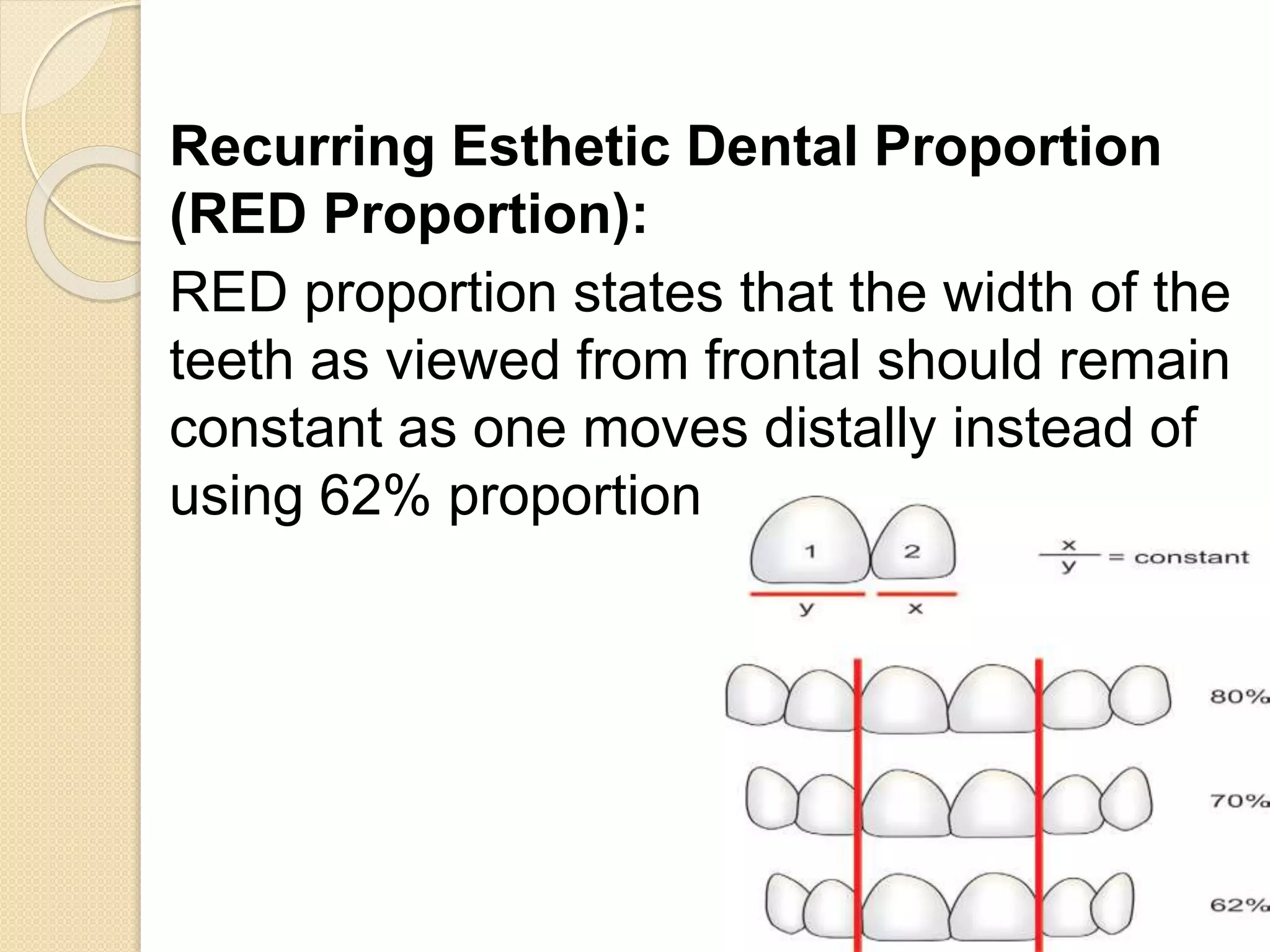
Recurring Esthetic Dental Proportion
(RED Proportion):
RED proportion states that the width of the
teeth as viewed from frontal should remain
constant as one moves distally instead of
using 62% proportion
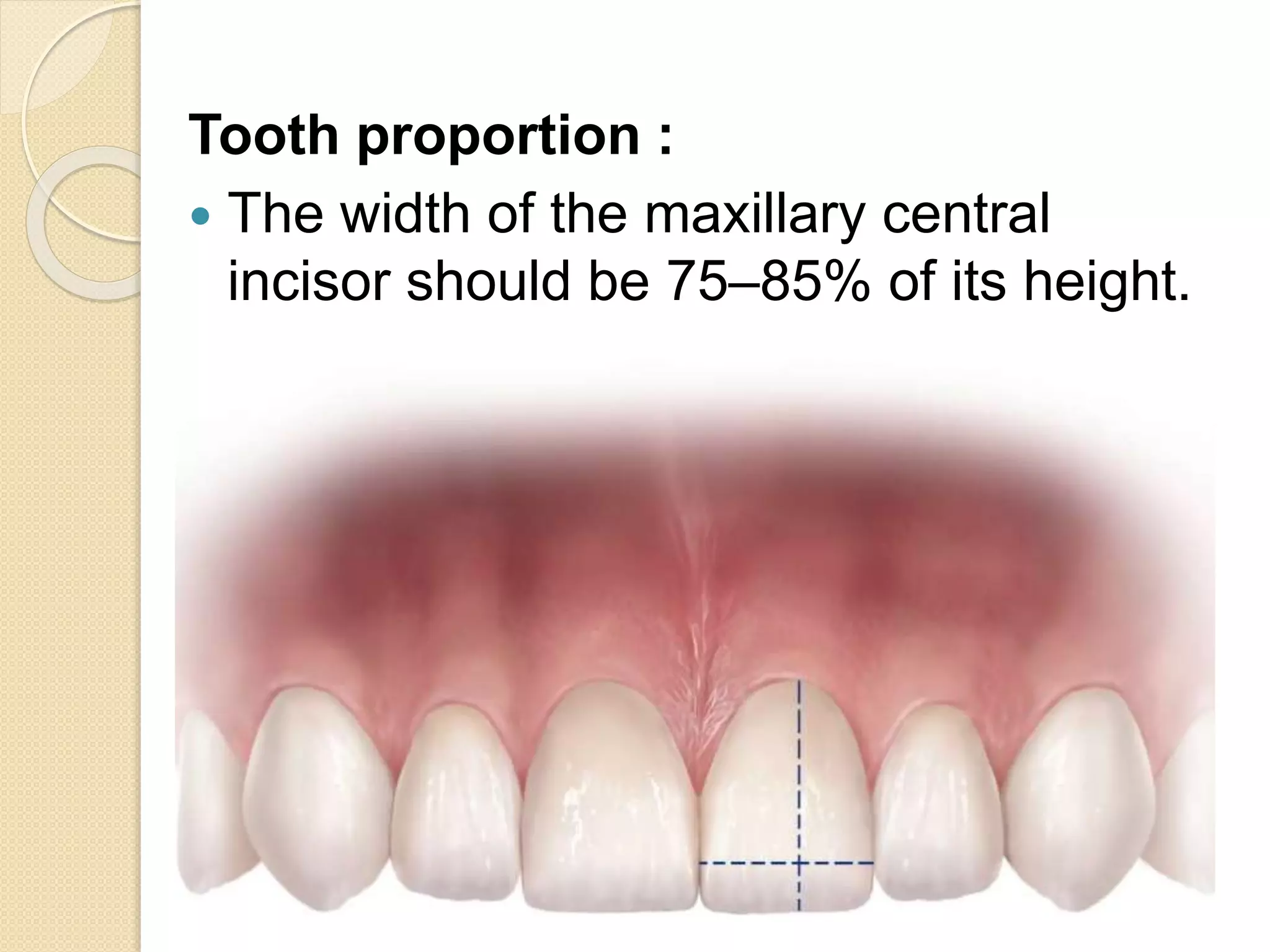
Tooth proportion :
 The width of the maxillary central
incisor should be 75–85% of its height.
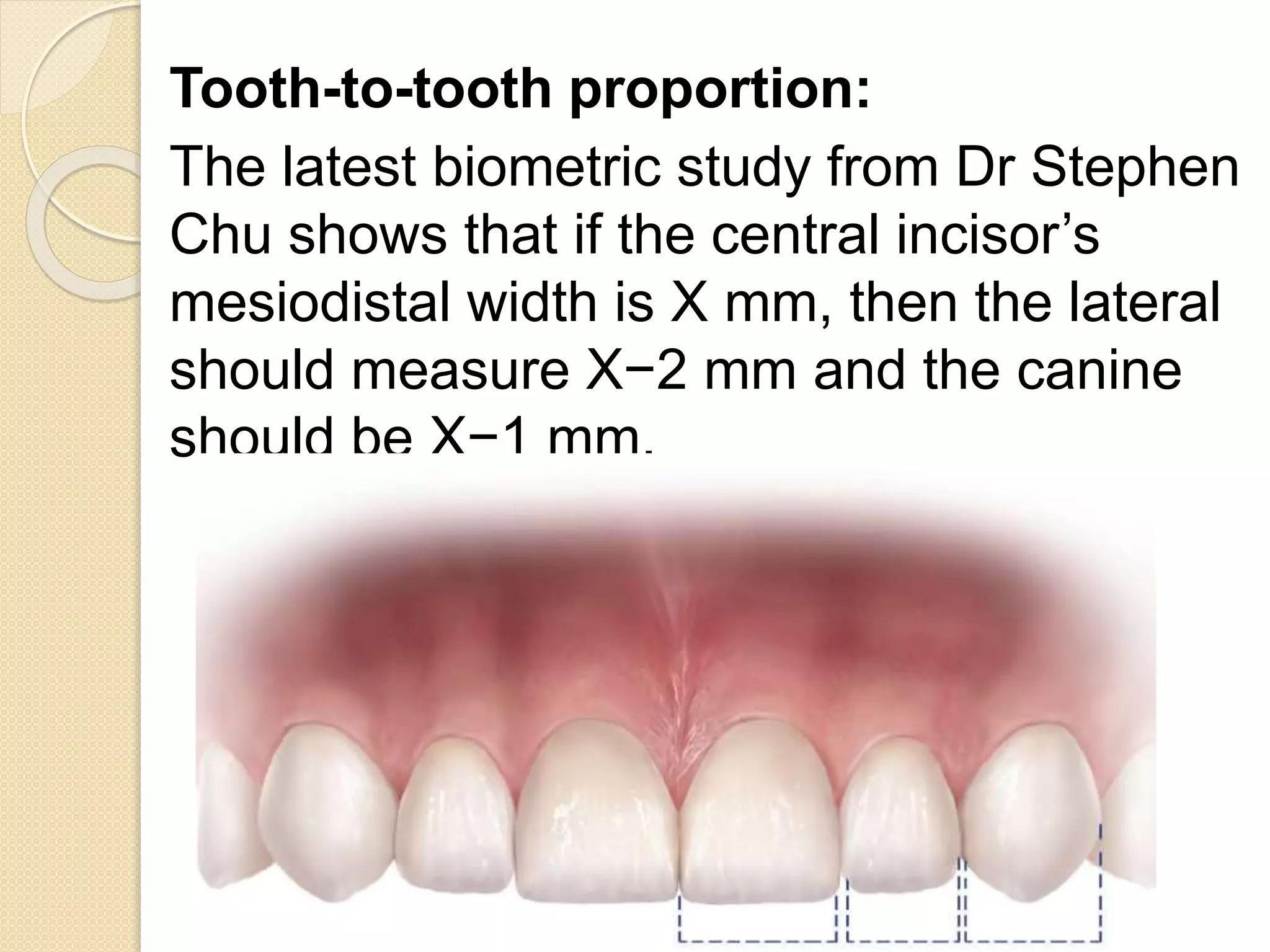
Tooth-to-tooth proportion:
The latest biometric study from Dr Stephen
Chu shows that if the central incisor’s
mesiodistal width is X mm, then the lateral
should measure X−2 mm and the canine
should be X−1 mm.
Tooth Alignment
Axial Inclination of the Tooth :
A line extending from height of the tooth
from free gingival margin to center of
the incisal edge implies axis inclination
of each tooth.
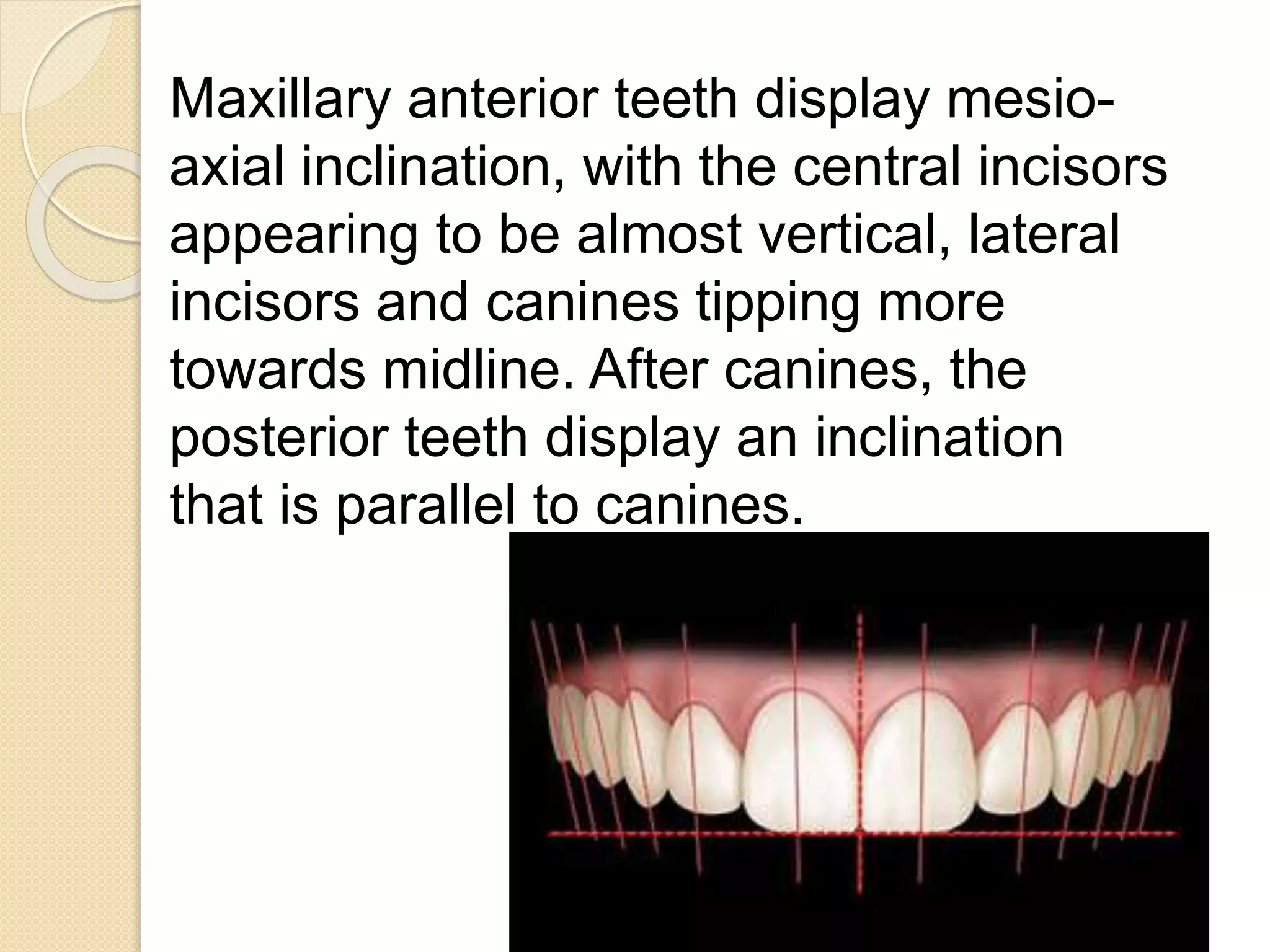
Maxillary anterior teeth display mesio-
axial inclination, with the central incisors
appearing to be almost vertical, lateral
incisors and canines tipping more
towards midline. After canines, the
posterior teeth display an inclination
that is parallel to canines.
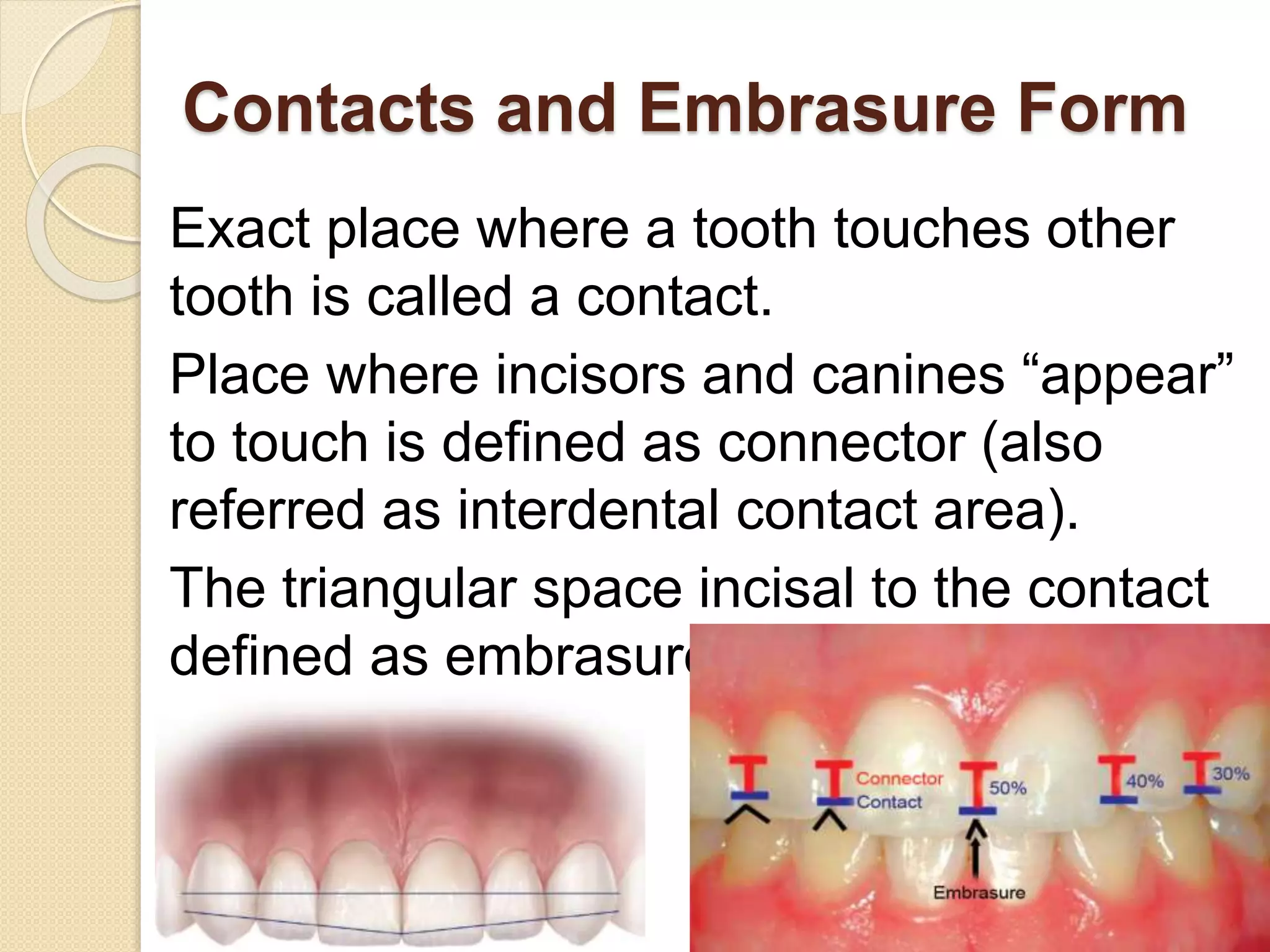
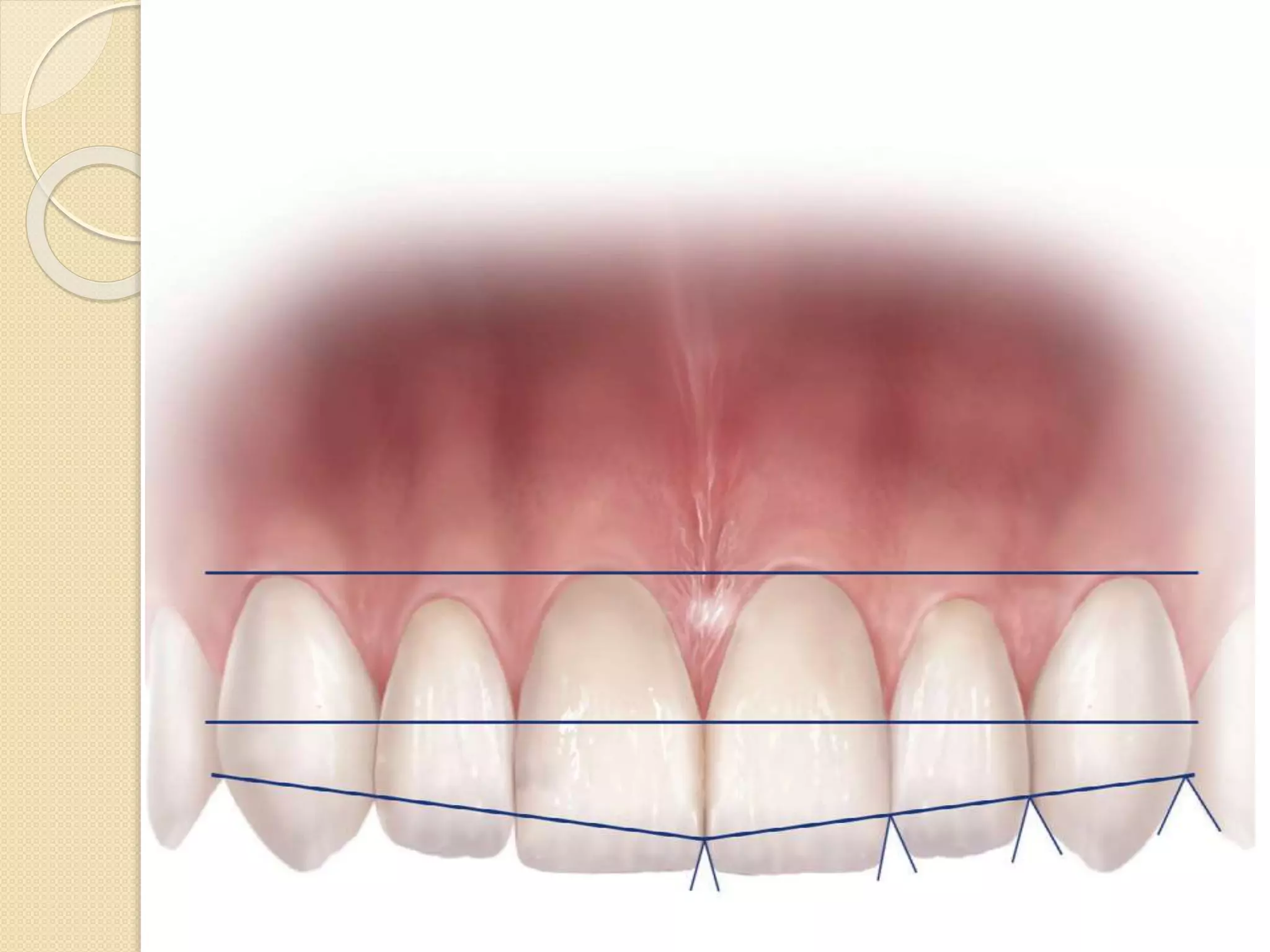
Contacts and Embrasure Form
Exact place where a tooth touches other
tooth is called a contact.
Place where incisors and canines “appear”
to touch is defined as connector (also
referred as interdental contact area).
The triangular space incisal to the contact
defined as embrasures.
Color and Translucency
Color :
Color is defined as property of surface or
object as a result of absorption of certain
light rays and reflection of others, which
excite the photosensitive receptors of an eye.
Color is the most complex and least
understood artistic element.
Three fundamental elements of color are
hue, value, and chroma.
Hue is the intrinsic quality or shade of the color.
Value refers to the relative lightness or darkness
of a hue.
It is determined by the amount of white or black
in a hue.
chroma is the intensity of any particular hue.
some current shade guides are based first on
value because of the importance of this element
of color
General Considerations :
• Different hues of colors are seen in cervical
and incisal areas , Cervical areas are slightly
darker than incisal areas.
• Young individuals have lighter appearance
(due to thick enamel) than older individuals.
• Canines have darker shade than incisors.
• Teeth become darker due to aging and
irritants like attrition. In these, due to wearing
off the enamel, the underlying dentin
becomes more apparent.
• Teeth appear lighter in individuals with dark
complexion and females with dark shade of
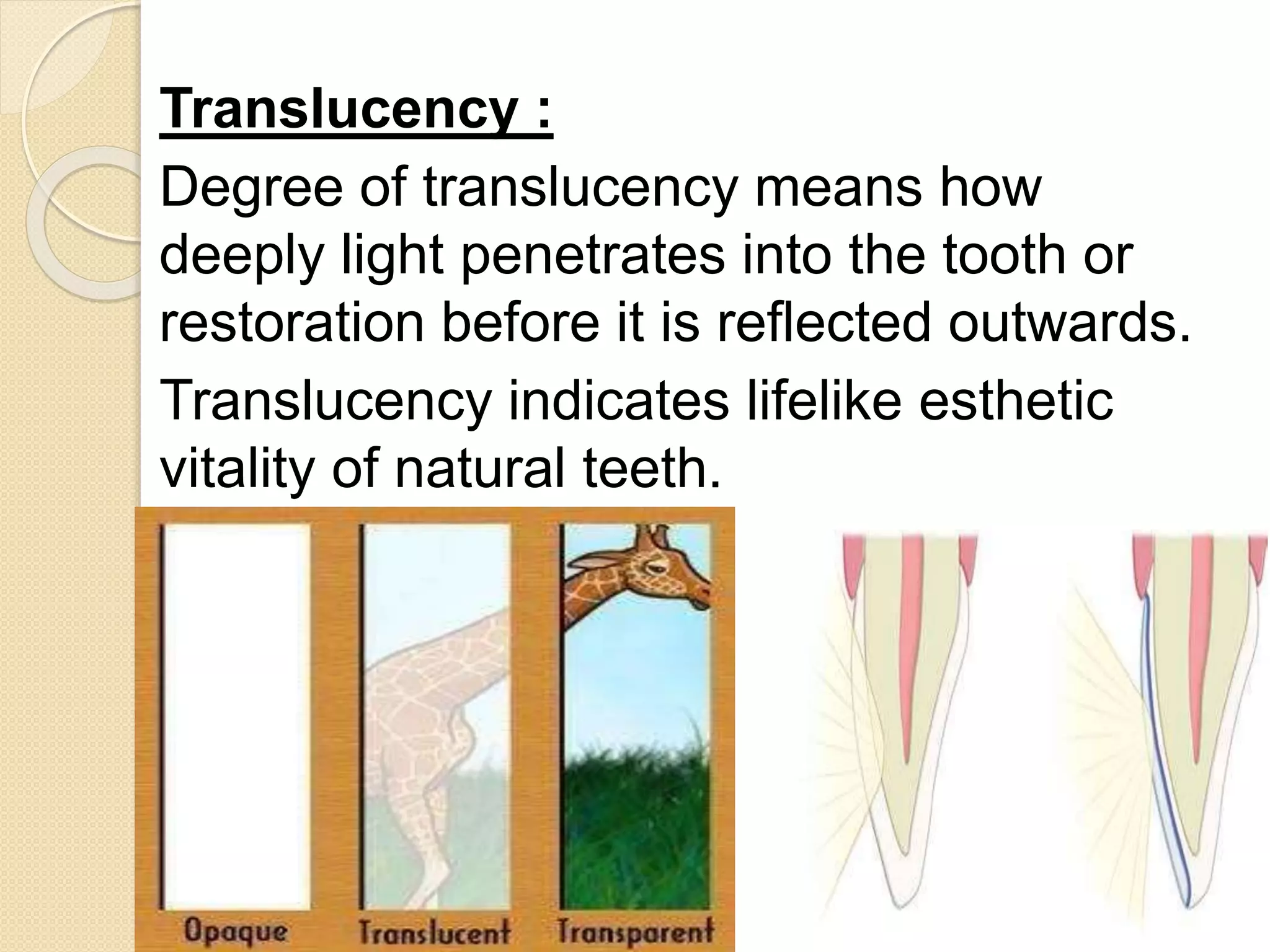
Translucency :
Degree of translucency means how
deeply light penetrates into the tooth or
restoration before it is reflected outwards.
Translucency indicates lifelike esthetic
vitality of natural teeth.
Surface texture
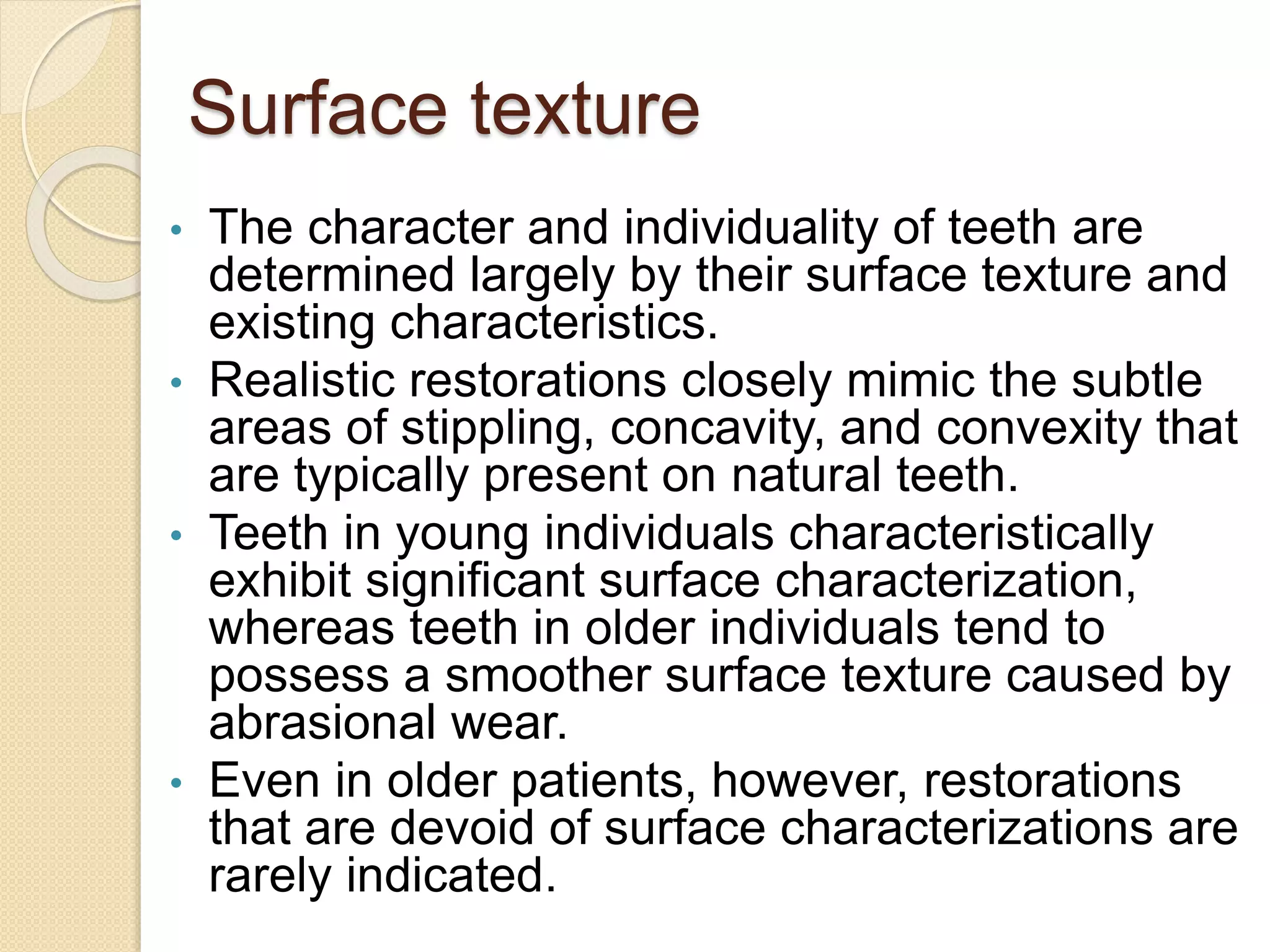
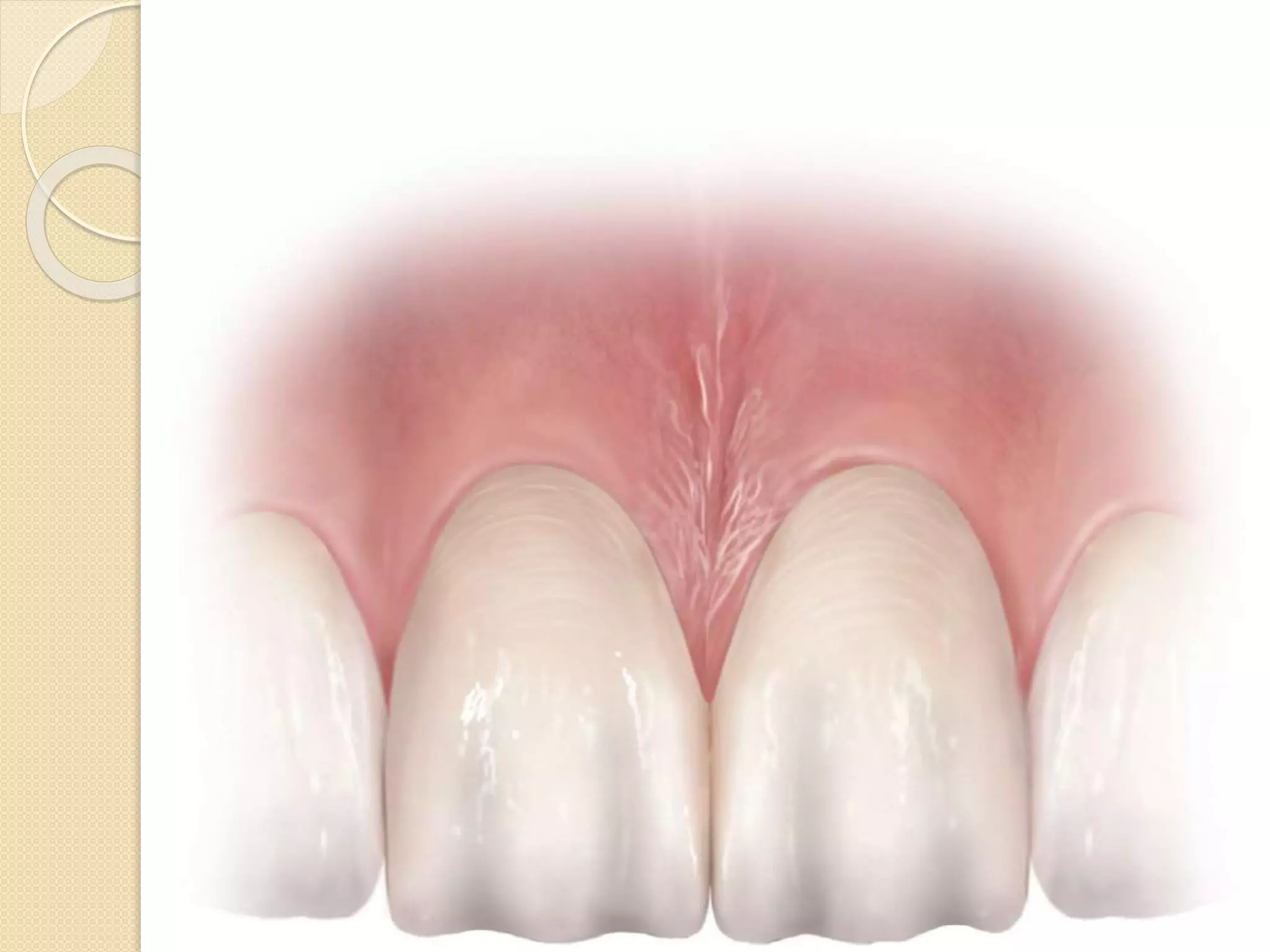
• The character and individuality of teeth are
determined largely by their surface texture and
existing characteristics.
• Realistic restorations closely mimic the subtle
areas of stippling, concavity, and convexity that
are typically present on natural teeth.
• Teeth in young individuals characteristically
exhibit significant surface characterization,
whereas teeth in older individuals tend to
possess a smoother surface texture caused by
abrasional wear.
• Even in older patients, however, restorations
that are devoid of surface characterizations are
rarely indicated.
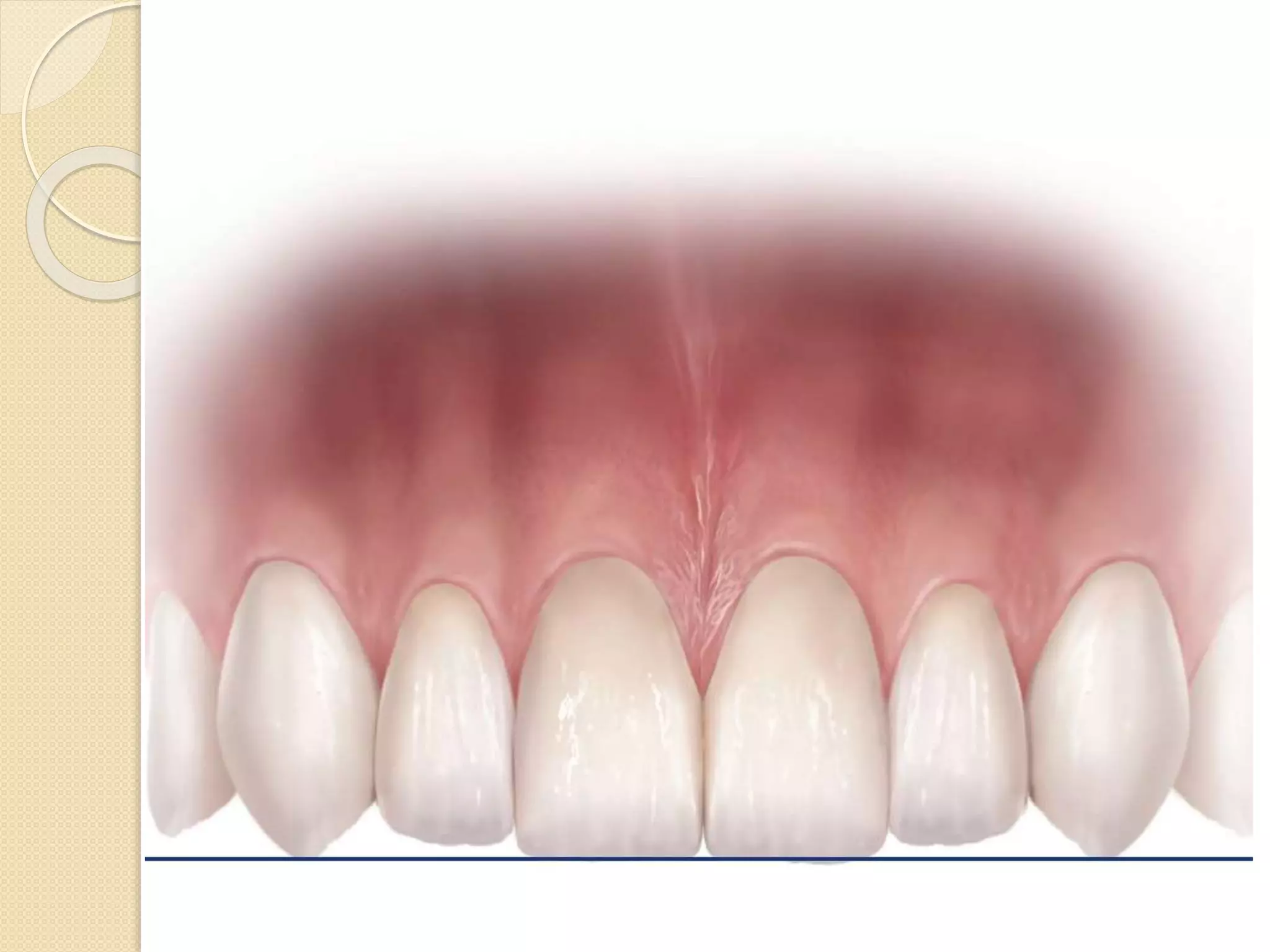
Gingival aesthetic
The gingival zenith represents the most apical
point at which each tooth emerges from the
free gingival margin. For an esthetically
pleasing smile, it should be positioned distally
to the center of each tooth within the maxillary
anterior segment. The distal position gradually
increases from the central incisor to the
canine.
Esthetic and Operative Dentistry
There are a number of problems which can
alter the esthetics of anterior teeth like:
• Caries
• Tooth discoloration because of trauma,
hypoplasia and other factors
• Tooth malformations
• Diastema between teeth
• Malalignment of teeth
• Fracture of tooth
• Cervical lesions like erosion, abrasion and
abfraction
• Attrition of teeth
Treatment options for achieving esthetics:
• Ameloplasty / enameloplasty
• Bleaching of teeth
• Restorations with composite resins
• Veneering
– Composite
– Porcelain
• Full coverage crown.
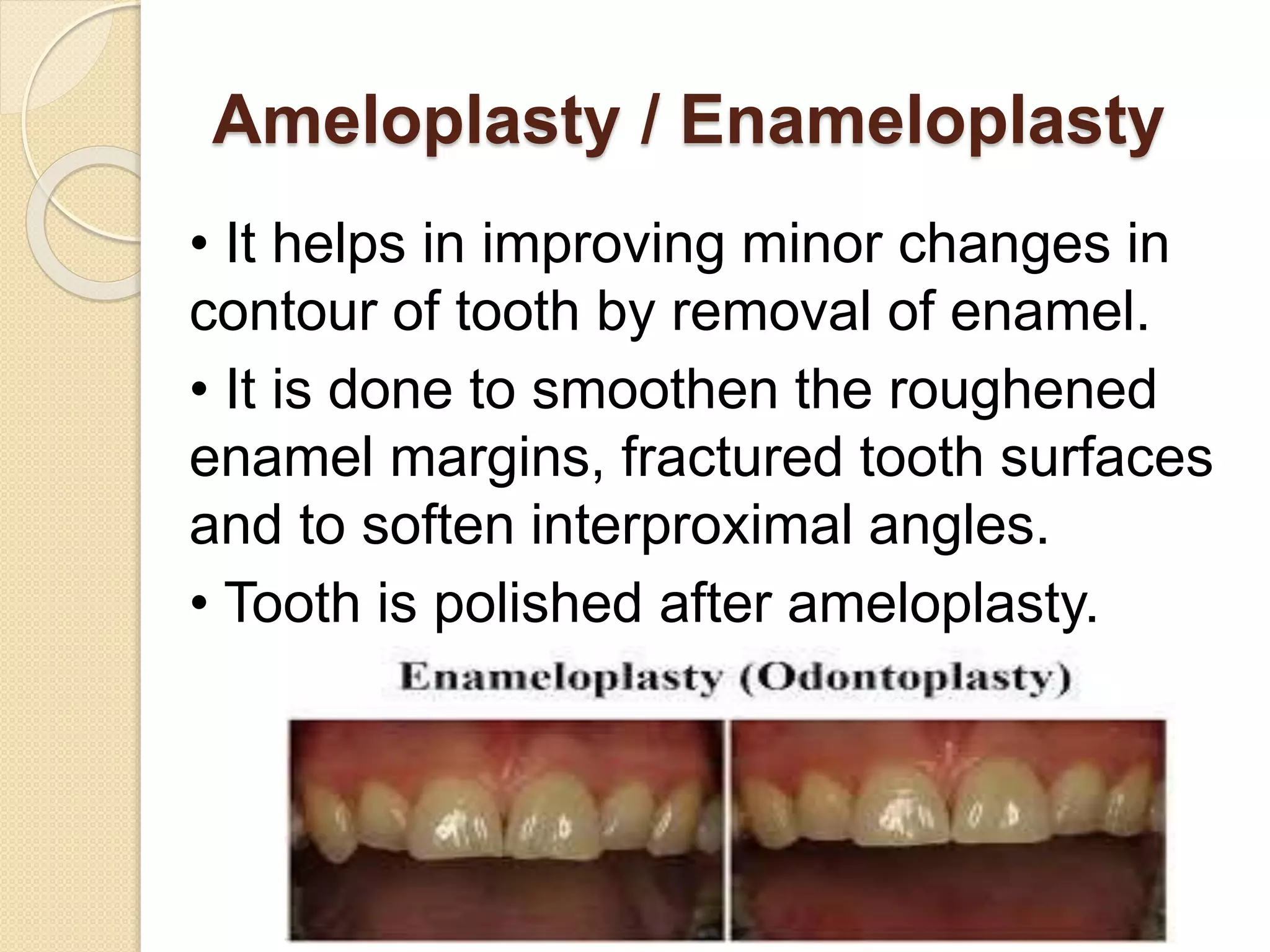
Ameloplasty / Enameloplasty
• It helps in improving minor changes in
contour of tooth by removal of enamel.
• It is done to smoothen the roughened
enamel margins, fractured tooth surfaces
and to soften interproximal angles.
• Tooth is polished after ameloplasty.
Bleaching
Teeth with mild to moderate
discolorations can be treated by
bleaching
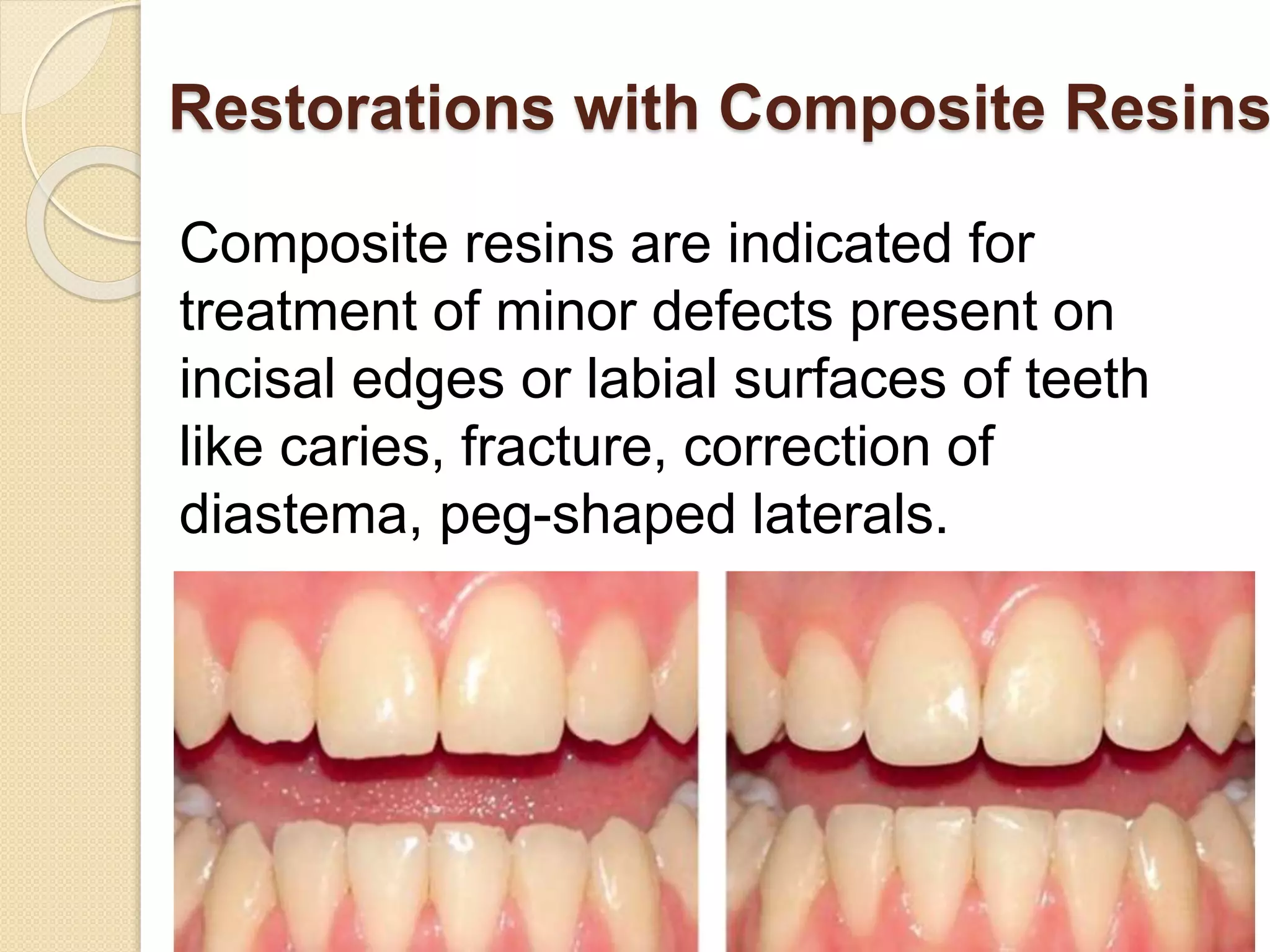
Restorations with Composite Resins
Composite resins are indicated for
treatment of minor defects present on
incisal edges or labial surfaces of teeth
like caries, fracture, correction of
diastema, peg-shaped laterals.
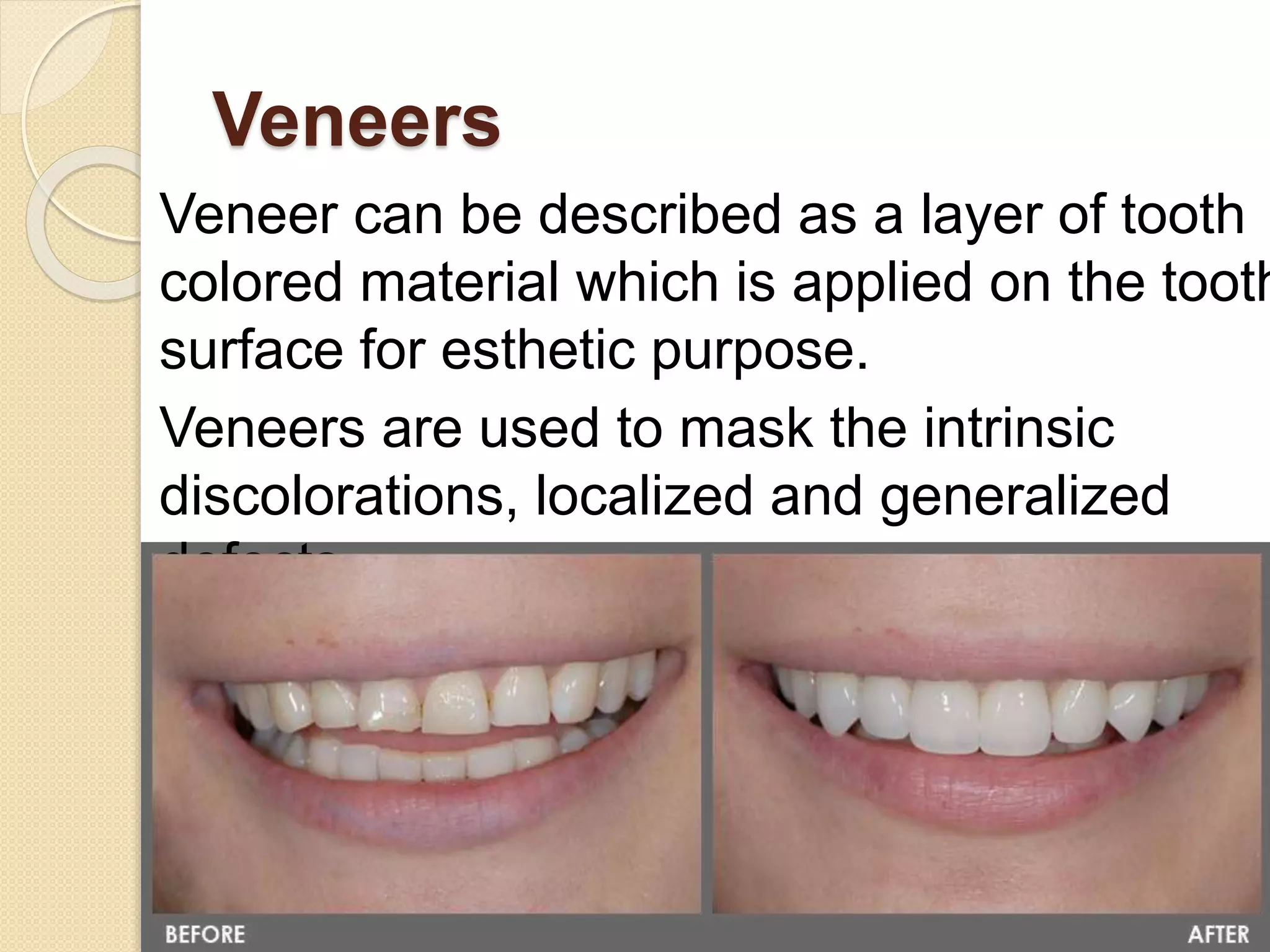
Veneers
Veneer can be described as a layer of tooth
colored material which is applied on the tooth
surface for esthetic purpose.
Veneers are used to mask the intrinsic
discolorations, localized and generalized
defects.
There are three types of veneers :
(1) Conventional Porcelain Veneers.
(2) Lumineers.
(3) Composite Resin Veneers
(1)Conventional Porcelain Veneers
 A conventional porcelain veneer is a thin
piece of porcelain that is bonded to the
front of a tooth. Porcelain is a durable,
translucent, strong, natural-looking, and
beautiful material.
 In most cases, Conventional Porcelain Veneers will
create the most beautiful results, and are thus the most
common type of veneer used
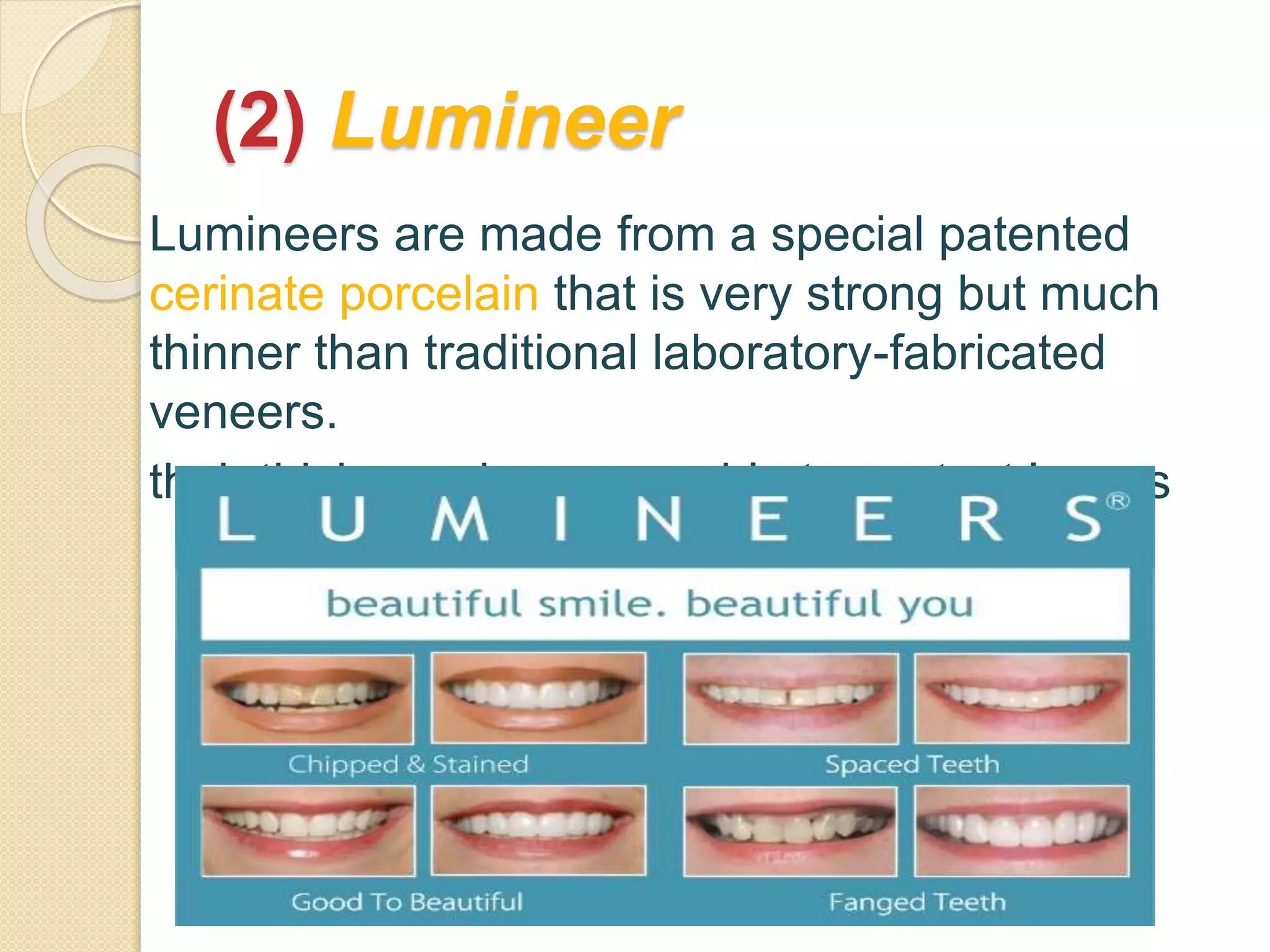
(2) Lumineer
Lumineers are made from a special patented
cerinate porcelain that is very strong but much
thinner than traditional laboratory-fabricated
veneers.
their thickness is comparable to contact lenses
(3) Composite Resin Veneers
Refrences :
 Sturtevant art and science of operative
dentistry sixth edition
 Contemporary Esthetic Dentistry, 1st
Edition, By George A. Freedman
 Textbook of operative dentistry 3ed
edition
Thank you for your attention

Introduction to esthetic dentistry

  • 1.
    University of Aden Facultyof Dentistry Conservative Dentistry Department Prepared by : Supervised by : Ass. prof. Dr. Mohammed Alsakkaf
  • 2.
    Introduction: Goal of operativecare is achieved by attaining health, function and esthetics. It is also known as health, function and esthetic triad (HFA). )
  • 3.
    Definition : Esthetic Dentistrycan be defined as the art and science of dentistry applied to create or enhance beauty of an individual within functional and physiological limits.
  • 4.
    What is cosmeticdentistry? Cosmetic dentistry is generally used to refer to any dental work that improves the appearance (though not necessarily the function) of a person's teeth, gums and/or bite.
  • 5.
    The Smile : Therestoration of a smile is one of the most appreciated and gratifying services a dentist can render. The positive psychological effects of improving a patient’s smile often contribute to an improved self-image and enhanced self-esteem
  • 7.
    Smile design : Smiledesigning is a process whereby the complete oral hard and soft tissues are studied and evaluated and certain changes are brought about which will have a positive influence on the overall esthetics of the face.
  • 9.
    ELEMENTS OF DENTALESTHETICS • Size, shape and width of teeth • Symmetry and proportionality of teeth • Alignment of teeth • Contacts and embrasure form • Color and translucency. • Surface texture • Gingival aesthetic
  • 10.
    Size, Shape andWidth of Teeth Size of Tooth : It is determined by dividing cervicoincisal length of tooth to mesiodistal width. Size of tooth = Width/length ratio To have optimal dimension, width/length ratio of central incisor should range from 0.75 to 0.8 • Ideal ratio 0.75 to 0.8 • <0.75 – Narrower tooth • >0.8 – Wider tooth
  • 12.
    Shape of Teeth: It is determined by age, sex and personality of the individual. Rounded incisal angles, open incisal and facial embrasures of feminine smile Masculine smile shows close incisal embrasures with prominent incisal angles
  • 13.
    Width of Teeth: Labiolingual thickness of anterior teeth is measured at the junction of middle and incisor third of tooth. • Ideally it should be between 2.5 and 3.5 mm • If >3.5 mm, it is over contouring • If <2.5 mm, it necessitates esthetic procedures
  • 14.
    Symmetry and Proportionalityof Teeth Symmetry : Dental symmetry is achieved if contralateral teeth are placed equivalent. Restoration of teeth should be done carefully for symmetrical incisal and gingival embrasure.
  • 15.
    Proportion : It isgiven by rule of golden proportion. This concept was given by Lombardi and Levin. According to it, for an object to be proportional to one another the ratio of 1:1.618 is esthetically pleasing. As a normal rule, if apparent size of each tooth is seen from frontal view, 62% tooth size anterior to it relationship is considered esthetically pleasing. But many studies have shown that golden proportion is not always present in natural dentition, yet an esthetically pleasing smile
  • 16.
  • 18.
    Recurring Esthetic DentalProportion (RED Proportion): RED proportion states that the width of the teeth as viewed from frontal should remain constant as one moves distally instead of using 62% proportion
  • 19.
    Tooth proportion : The width of the maxillary central incisor should be 75–85% of its height.
  • 20.
    Tooth-to-tooth proportion: The latestbiometric study from Dr Stephen Chu shows that if the central incisor’s mesiodistal width is X mm, then the lateral should measure X−2 mm and the canine should be X−1 mm.
  • 21.
    Tooth Alignment Axial Inclinationof the Tooth : A line extending from height of the tooth from free gingival margin to center of the incisal edge implies axis inclination of each tooth.
  • 22.
    Maxillary anterior teethdisplay mesio- axial inclination, with the central incisors appearing to be almost vertical, lateral incisors and canines tipping more towards midline. After canines, the posterior teeth display an inclination that is parallel to canines.
  • 24.
    Contacts and EmbrasureForm Exact place where a tooth touches other tooth is called a contact. Place where incisors and canines “appear” to touch is defined as connector (also referred as interdental contact area). The triangular space incisal to the contact defined as embrasures.
  • 26.
    Color and Translucency Color: Color is defined as property of surface or object as a result of absorption of certain light rays and reflection of others, which excite the photosensitive receptors of an eye. Color is the most complex and least understood artistic element. Three fundamental elements of color are hue, value, and chroma.
  • 27.
    Hue is theintrinsic quality or shade of the color. Value refers to the relative lightness or darkness of a hue. It is determined by the amount of white or black in a hue. chroma is the intensity of any particular hue. some current shade guides are based first on value because of the importance of this element of color
  • 28.
    General Considerations : •Different hues of colors are seen in cervical and incisal areas , Cervical areas are slightly darker than incisal areas. • Young individuals have lighter appearance (due to thick enamel) than older individuals. • Canines have darker shade than incisors. • Teeth become darker due to aging and irritants like attrition. In these, due to wearing off the enamel, the underlying dentin becomes more apparent. • Teeth appear lighter in individuals with dark complexion and females with dark shade of
  • 29.
    Translucency : Degree oftranslucency means how deeply light penetrates into the tooth or restoration before it is reflected outwards. Translucency indicates lifelike esthetic vitality of natural teeth.
  • 30.
    Surface texture • Thecharacter and individuality of teeth are determined largely by their surface texture and existing characteristics. • Realistic restorations closely mimic the subtle areas of stippling, concavity, and convexity that are typically present on natural teeth. • Teeth in young individuals characteristically exhibit significant surface characterization, whereas teeth in older individuals tend to possess a smoother surface texture caused by abrasional wear. • Even in older patients, however, restorations that are devoid of surface characterizations are rarely indicated.
  • 33.
    Gingival aesthetic The gingivalzenith represents the most apical point at which each tooth emerges from the free gingival margin. For an esthetically pleasing smile, it should be positioned distally to the center of each tooth within the maxillary anterior segment. The distal position gradually increases from the central incisor to the canine.
  • 35.
    Esthetic and OperativeDentistry There are a number of problems which can alter the esthetics of anterior teeth like: • Caries • Tooth discoloration because of trauma, hypoplasia and other factors • Tooth malformations • Diastema between teeth • Malalignment of teeth • Fracture of tooth • Cervical lesions like erosion, abrasion and abfraction • Attrition of teeth
  • 36.
    Treatment options forachieving esthetics: • Ameloplasty / enameloplasty • Bleaching of teeth • Restorations with composite resins • Veneering – Composite – Porcelain • Full coverage crown.
  • 37.
    Ameloplasty / Enameloplasty •It helps in improving minor changes in contour of tooth by removal of enamel. • It is done to smoothen the roughened enamel margins, fractured tooth surfaces and to soften interproximal angles. • Tooth is polished after ameloplasty.
  • 38.
    Bleaching Teeth with mildto moderate discolorations can be treated by bleaching
  • 39.
    Restorations with CompositeResins Composite resins are indicated for treatment of minor defects present on incisal edges or labial surfaces of teeth like caries, fracture, correction of diastema, peg-shaped laterals.
  • 40.
    Veneers Veneer can bedescribed as a layer of tooth colored material which is applied on the tooth surface for esthetic purpose. Veneers are used to mask the intrinsic discolorations, localized and generalized defects.
  • 41.
    There are threetypes of veneers : (1) Conventional Porcelain Veneers. (2) Lumineers. (3) Composite Resin Veneers
  • 42.
    (1)Conventional Porcelain Veneers A conventional porcelain veneer is a thin piece of porcelain that is bonded to the front of a tooth. Porcelain is a durable, translucent, strong, natural-looking, and beautiful material.  In most cases, Conventional Porcelain Veneers will create the most beautiful results, and are thus the most common type of veneer used
  • 43.
    (2) Lumineer Lumineers aremade from a special patented cerinate porcelain that is very strong but much thinner than traditional laboratory-fabricated veneers. their thickness is comparable to contact lenses
  • 44.
  • 45.
    Refrences :  Sturtevantart and science of operative dentistry sixth edition  Contemporary Esthetic Dentistry, 1st Edition, By George A. Freedman  Textbook of operative dentistry 3ed edition
  • 46.
    Thank you foryour attention