Steering System- Part-II
Steering Linkages
ď‚— Depends on the type of vehicle having Independent
Front Suspension or Rigid axle type front suspension.
ď‚— Steering linkage for vehicle with rigid axle front
suspension.
ď‚— Steering linkage for vehicle with rigid Independent
front suspension.
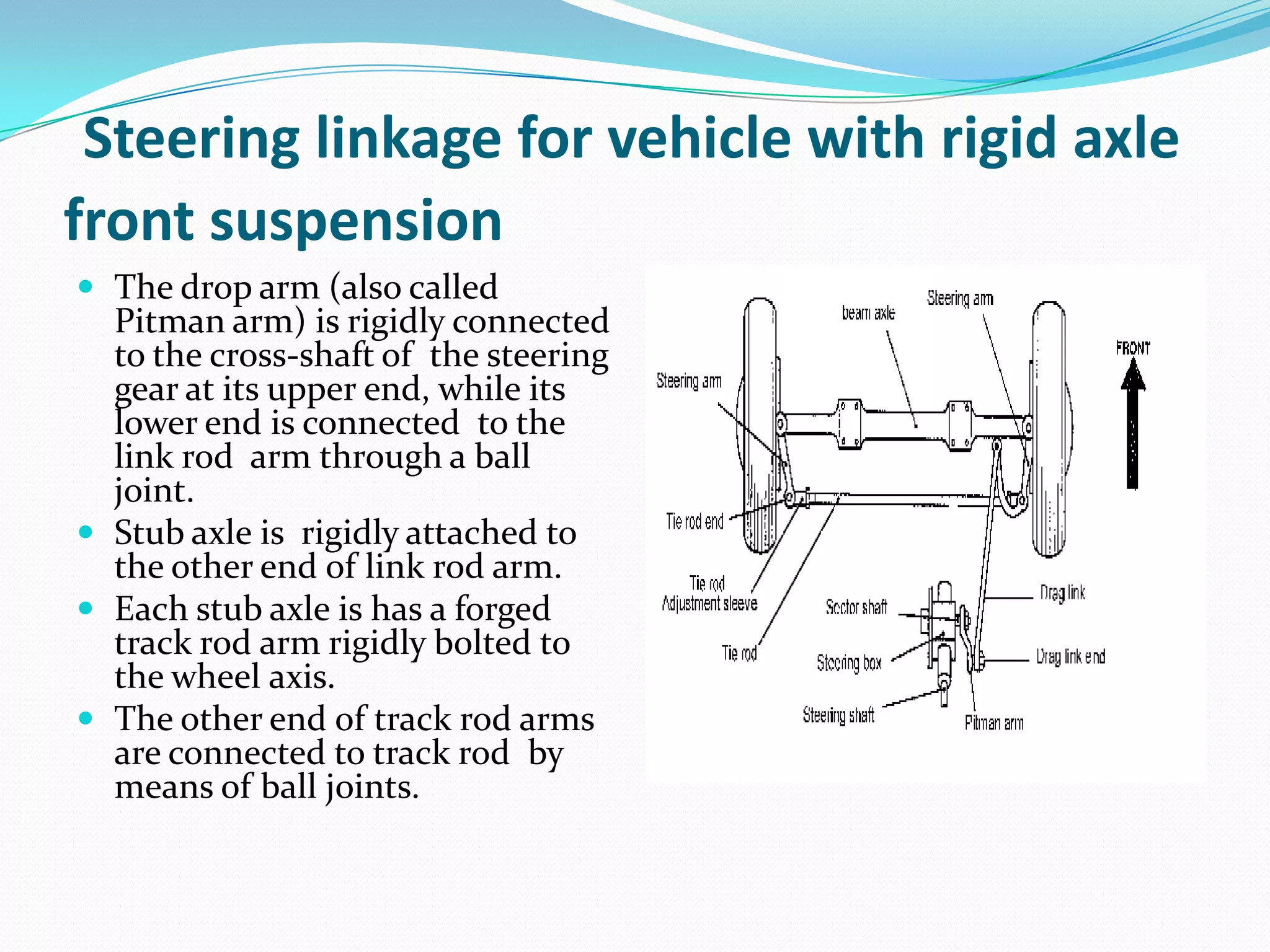
ď‚— The drop arm (also called Pitman arm) is rigidly
connected to the cross-shaft of the steering gear at its
upper end, while its lower end is connected to the link
rod arm through a ball joint.
ď‚— Stub axle is rigidly attached to the other end of link
rod arm.
ď‚— Each stub axle is has a forged track rod arm rigidly
bolted to the wheel axis.
ď‚— The other end of track rod arms are connected to track
rod by means of ball joints.
ď‚— The design of these ball joints is such that the
expanding spring compensate for wear or
maladjustments.
ď‚— An adjuster is also provided in the track rod to change
its length for adjusting wheel alignment.
Steering linkage for vehicle with rigid axle
front suspension
ď‚— The drop arm (also called
Pitman arm) is rigidly connected
to the cross-shaft of the steering
gear at its upper end, while its
lower end is connected to the
link rod arm through a ball
joint.
ď‚— Stub axle is rigidly attached to
the other end of link rod arm.
ď‚— Each stub axle is has a forged
track rod arm rigidly bolted to
the wheel axis.
ď‚— The other end of track rod arms
are connected to track rod by
means of ball joints.
Steering linkage for vehicle with rigid
Independent front suspension
ď‚— In case of conventional rigid axle suspension , the main
axle beam ensures the movement of stub axle in the
horizontal plane only , there is no vertical deflection of the
suspension and hence there is no change in the effective
track-rod length.
ď‚— In case of Independent suspension , the two stub axles can
move up or down independent of each other due to which
distance between ball-joint ends of the two track rod arms
is continuously varying.
ď‚— Here three piece track rod is used , the centre portion
being called relay rod is used , which is connected at one
end to the idler arm supported on body structure and to
drop arm of steering gear at the other end through ball
joints
Steering gear
ď‚— The steering gear converts the turning motion of the
steering wheel into the to-and –fro motion of the link
rod of the steering linkage.
ď‚— Types:
1) Worm and wheel steering gear
2) Cam and double roller steering gear
3) Worm and nut steering gear
4) Recirculating ball type steering gear
5) Rack and pinion steering gear
Rack and Pinion steering gear
ď‚— This type of steering gear is use on
light vehicles like cars and in power
steering.
ď‚— It occupies very small space and
uses lesser number of linkage
components compared to worm and
wheel type of gear
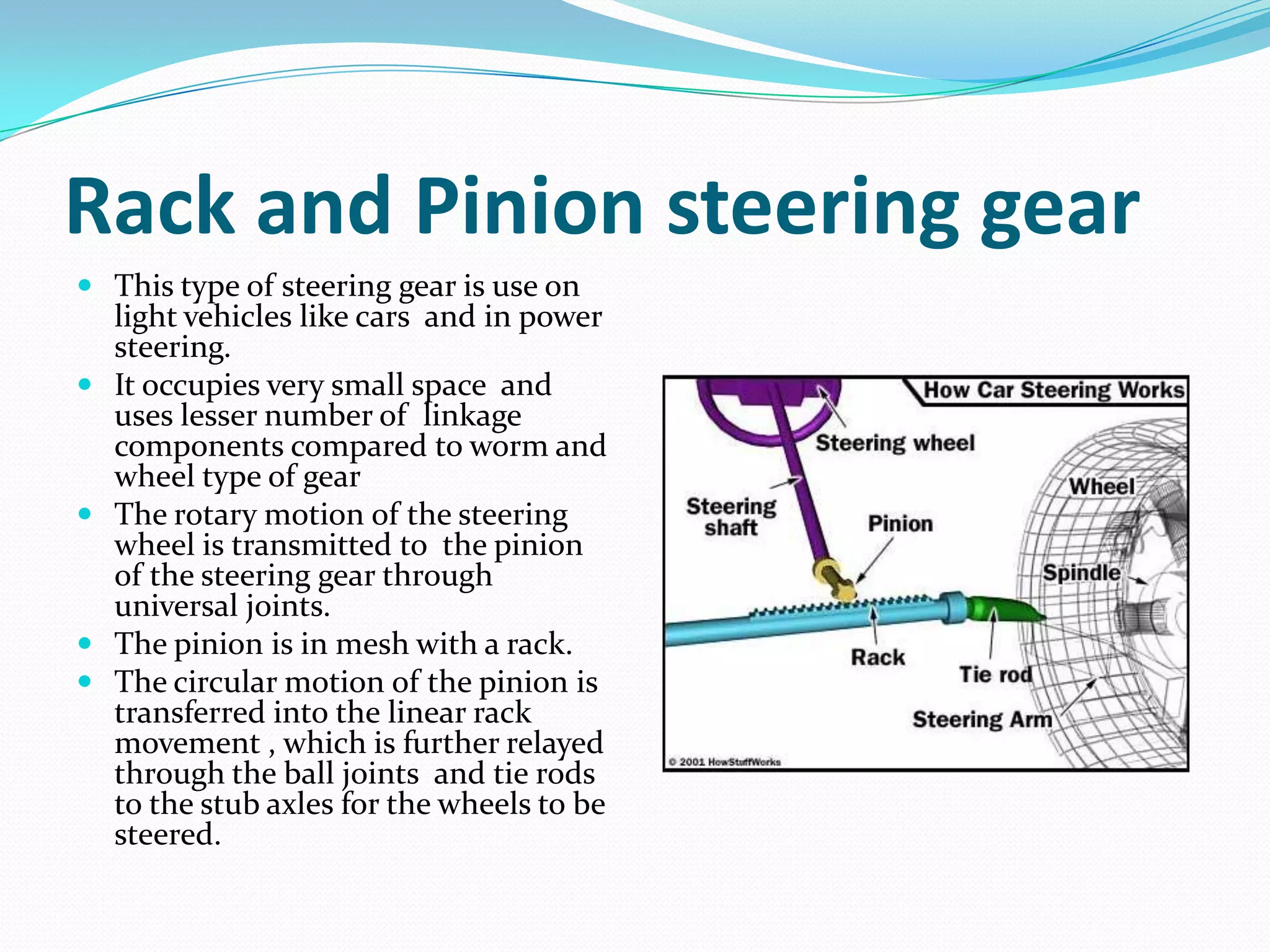
ď‚— The rotary motion of the steering
wheel is transmitted to the pinion
of the steering gear through
universal joints.
ď‚— The pinion is in mesh with a rack.
ď‚— The circular motion of the pinion is
transferred into the linear rack
movement , which is further relayed
through the ball joints and tie rods
to the stub axles for the wheels to be
steered.
ď‚— The rack-and-pinion gear set does two things:
ď‚— It converts the rotational motion of the steering wheel
into the linear motion needed to turn the wheels.
ď‚— It provides a gear reduction, making it easier to turn
the wheels.
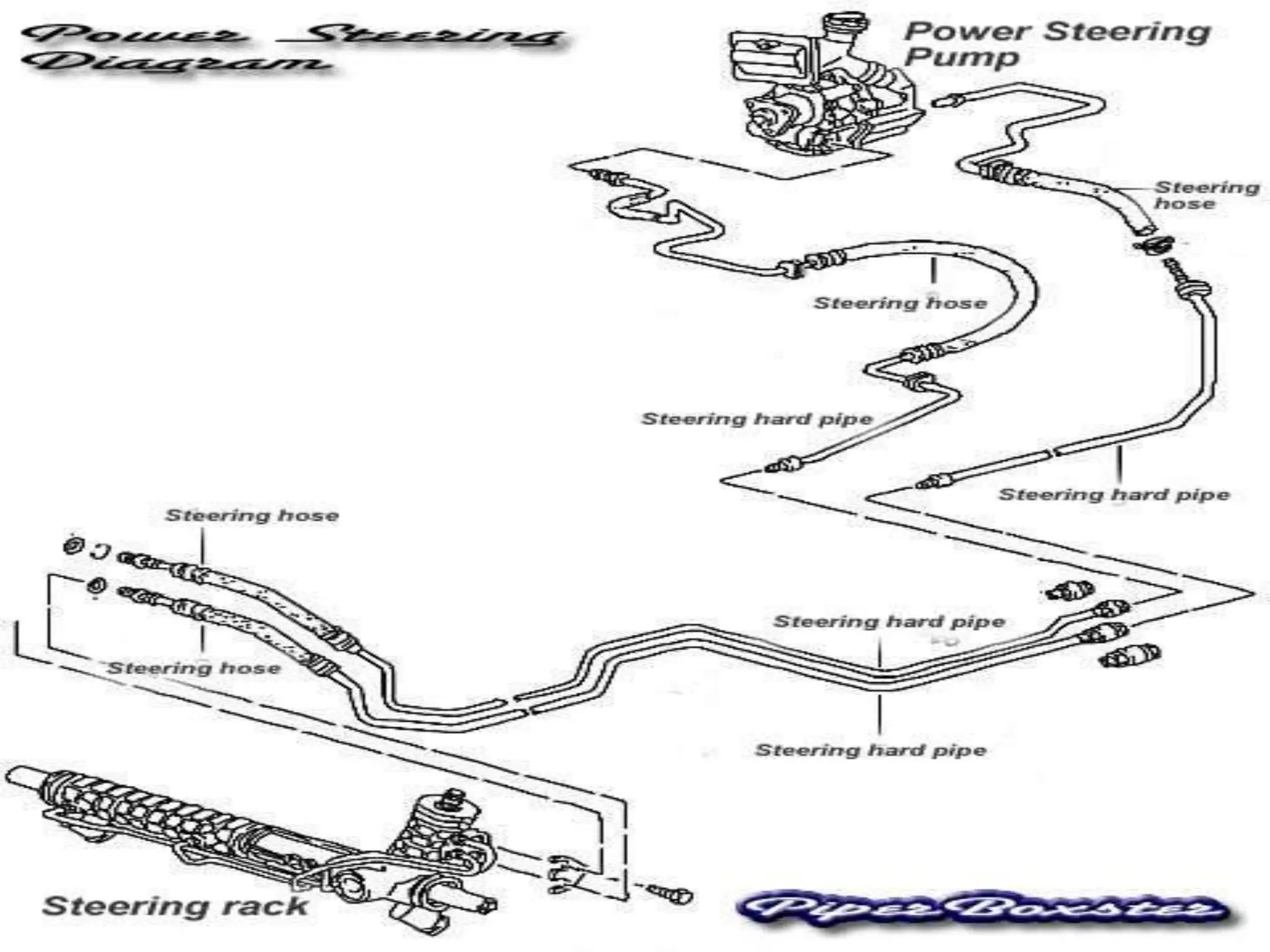
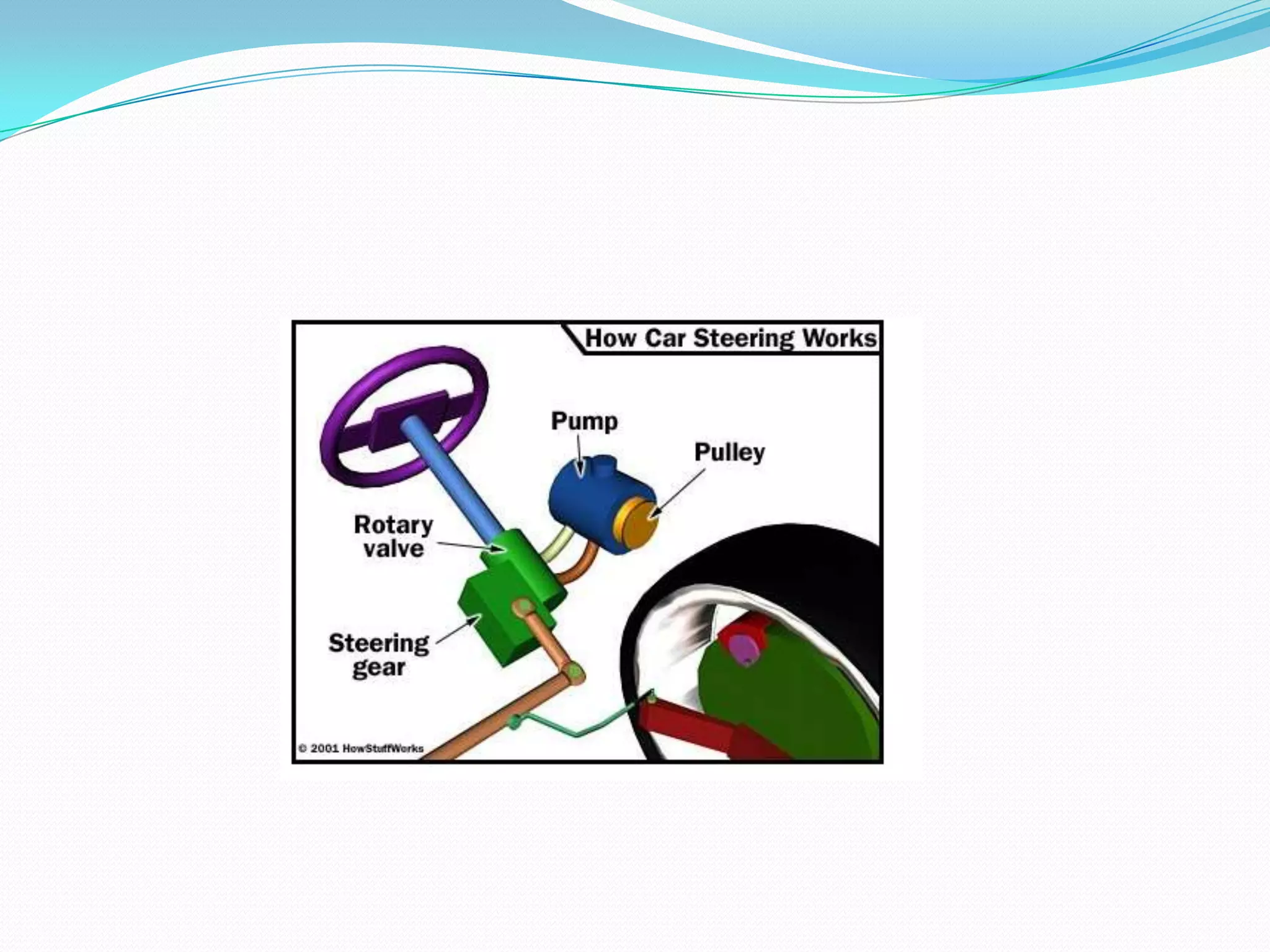
Power steering
ď‚— Larger amount of torque is required to be applied by
driver for steering of medium and heavy vehicles.
ď‚— The power steering system provides automatic
hydraulic assistance to the turning effort applied to
the manual steering system.
ď‚— The system is so designed that in case of failure of the
power system , the driver is able to steer manually with
increased effort.
ď‚— The power steering system are operated by fluid under
pressure.
ď‚— The principle of working of all steering system is same.
ď‚— The slight movement of the steering wheel actuates a
valve so that fluid under pressure from the reservoir
enters on the appropriate side of the cylinder, thereby
applying pressure on one side of a piston to operate the
steering linkage , which steers the wheel in
appropriate direction
Electronic power steering
ď‚— Advantages over currently used hydraulic power
steering:
ď‚— No problem of leakage of fluid
ď‚— Energy being consumed only while steering.
ď‚— Steering assistance available even when the engine is
not running
ď‚— While steering manually lesser force is required
compared to hydraulic system since there is no fluid
to be forced through valves.
STEERING MECHANISM
ď‚— The main function of the steering system of a vehicle is
to convert the rotary movement of the steering wheel
into angular turn of the wheels.
ď‚— For perfect steering we must always have an
instantaneous centre about which all the wheels must
rotate
ď‚— For this purpose inner wheel has to turn more than the
outer wheel. To achieve two types of mechanisms, fate
been devised.
ď‚— Straight the Davis and ackerman steering mechanism
ď‚— Out of these Ackermann mechanism it almost
universally used.
Davis Steering Gear
ď‚— The slotted links AM and BH are attached to the front
wheel axle, which turn on pivots A and B respectively.
The rod CD is constrained to move in the direction of
its length, by the sliding members at P and Q. These
constraints are connected to the slotted link AM and
BH by a sliding and a turning pair at each end. The
steering is affected by moving CD to the right or left of
its nominal position.
Ackerman Steering Gear
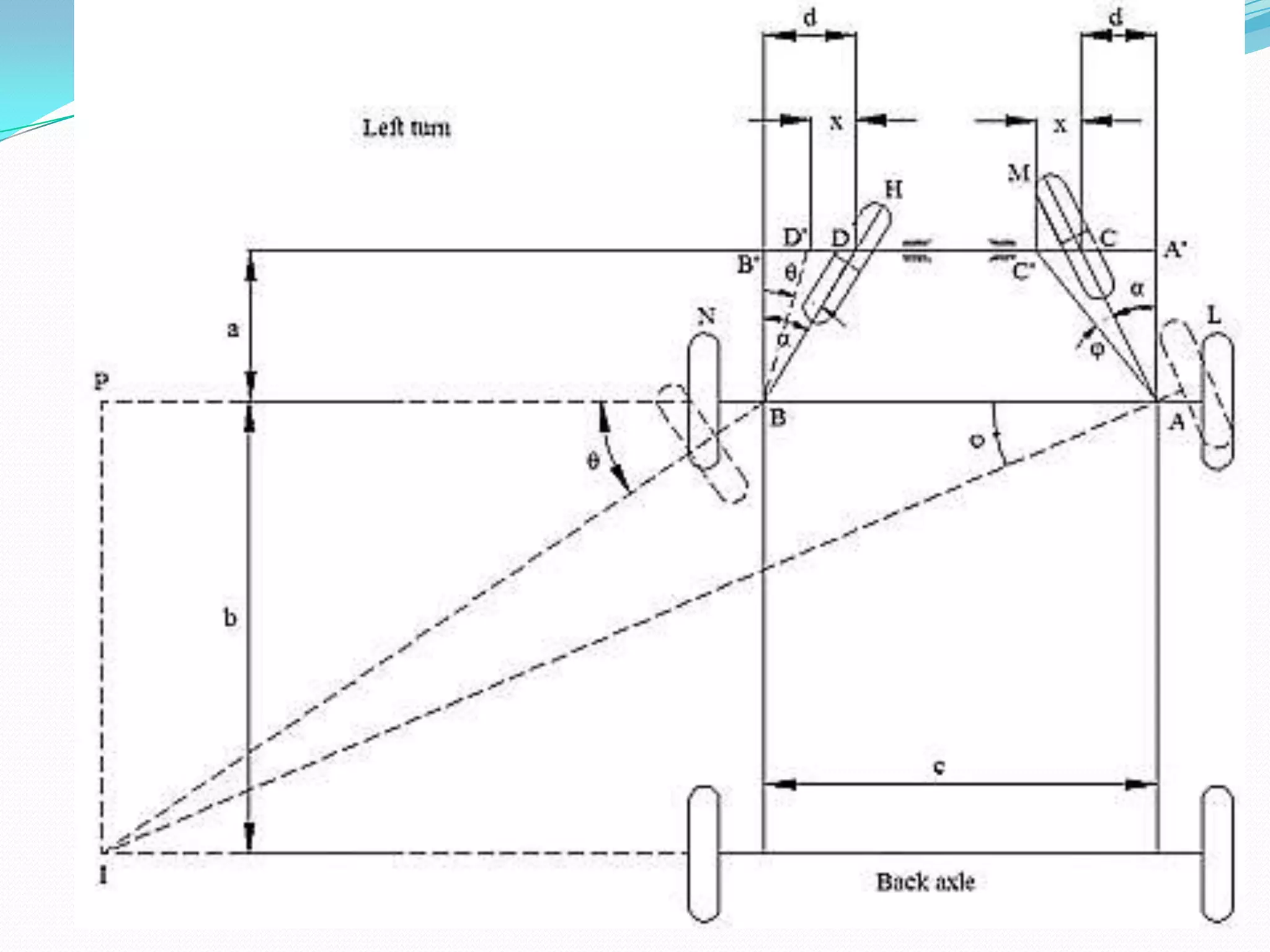
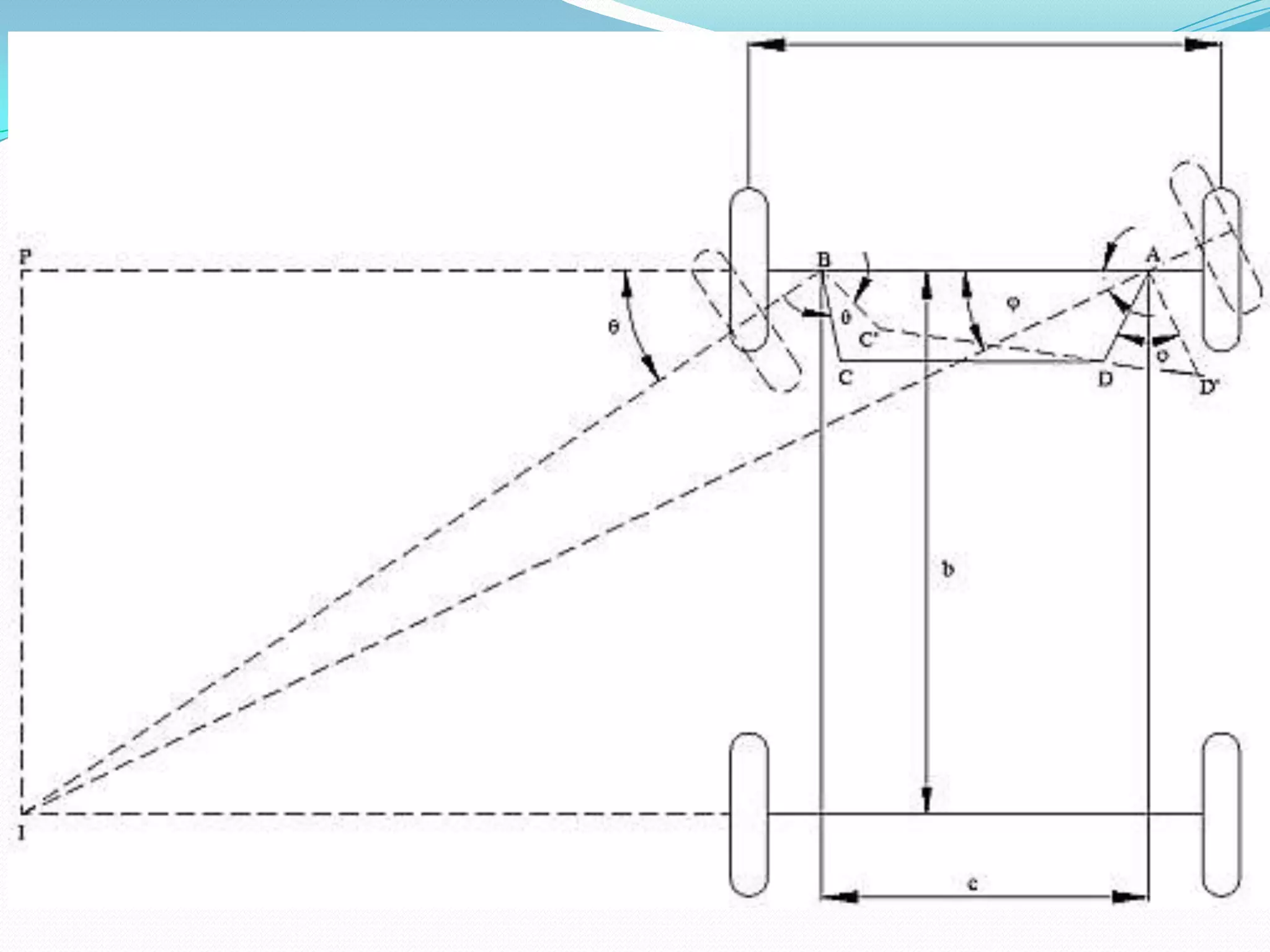
The Ackerman steering gear consists of turning pairs rather than sliding pairs.
The whole of the mechanism is placed on the back of the front wheels.
In Ackerman steering gear, the mechanism ABCD is a four bar crank chain. The
shorter links BC and AD are equally inclined to the longitudinal axis of the
vehicle. For the correct steering the following three positions are obtained.
1. When the vehicle moves along a straight path, the longer links AB and CD
are parallel and the shorter links BC and AD are equally inclined to the
longitudinal axis of the vehicle.
2. When the vehicle is moving to the left, the lines of the front wheel axle
intersect on the back wheel axle at I for correct steering.
2b9fc module iii steering system_ part-ii (2)

2b9fc module iii steering system_ part-ii (2)

  • 1.
  • 2.
    Steering Linkages ď‚— Dependson the type of vehicle having Independent Front Suspension or Rigid axle type front suspension. ď‚— Steering linkage for vehicle with rigid axle front suspension. ď‚— Steering linkage for vehicle with rigid Independent front suspension.
  • 3.
    ď‚— The droparm (also called Pitman arm) is rigidly connected to the cross-shaft of the steering gear at its upper end, while its lower end is connected to the link rod arm through a ball joint. ď‚— Stub axle is rigidly attached to the other end of link rod arm. ď‚— Each stub axle is has a forged track rod arm rigidly bolted to the wheel axis. ď‚— The other end of track rod arms are connected to track rod by means of ball joints.
  • 4.
    ď‚— The designof these ball joints is such that the expanding spring compensate for wear or maladjustments. ď‚— An adjuster is also provided in the track rod to change its length for adjusting wheel alignment.
  • 5.
    Steering linkage forvehicle with rigid axle front suspension ď‚— The drop arm (also called Pitman arm) is rigidly connected to the cross-shaft of the steering gear at its upper end, while its lower end is connected to the link rod arm through a ball joint. ď‚— Stub axle is rigidly attached to the other end of link rod arm. ď‚— Each stub axle is has a forged track rod arm rigidly bolted to the wheel axis. ď‚— The other end of track rod arms are connected to track rod by means of ball joints.
  • 6.
    Steering linkage forvehicle with rigid Independent front suspension ď‚— In case of conventional rigid axle suspension , the main axle beam ensures the movement of stub axle in the horizontal plane only , there is no vertical deflection of the suspension and hence there is no change in the effective track-rod length. ď‚— In case of Independent suspension , the two stub axles can move up or down independent of each other due to which distance between ball-joint ends of the two track rod arms is continuously varying. ď‚— Here three piece track rod is used , the centre portion being called relay rod is used , which is connected at one end to the idler arm supported on body structure and to drop arm of steering gear at the other end through ball joints
  • 7.
    Steering gear  Thesteering gear converts the turning motion of the steering wheel into the to-and –fro motion of the link rod of the steering linkage.  Types: 1) Worm and wheel steering gear 2) Cam and double roller steering gear 3) Worm and nut steering gear 4) Recirculating ball type steering gear 5) Rack and pinion steering gear
  • 8.
    Rack and Pinionsteering gear ď‚— This type of steering gear is use on light vehicles like cars and in power steering. ď‚— It occupies very small space and uses lesser number of linkage components compared to worm and wheel type of gear ď‚— The rotary motion of the steering wheel is transmitted to the pinion of the steering gear through universal joints. ď‚— The pinion is in mesh with a rack. ď‚— The circular motion of the pinion is transferred into the linear rack movement , which is further relayed through the ball joints and tie rods to the stub axles for the wheels to be steered.
  • 9.
    ď‚— The rack-and-piniongear set does two things: ď‚— It converts the rotational motion of the steering wheel into the linear motion needed to turn the wheels. ď‚— It provides a gear reduction, making it easier to turn the wheels.
  • 10.
    Power steering ď‚— Largeramount of torque is required to be applied by driver for steering of medium and heavy vehicles. ď‚— The power steering system provides automatic hydraulic assistance to the turning effort applied to the manual steering system. ď‚— The system is so designed that in case of failure of the power system , the driver is able to steer manually with increased effort.
  • 11.
    ď‚— The powersteering system are operated by fluid under pressure. ď‚— The principle of working of all steering system is same. ď‚— The slight movement of the steering wheel actuates a valve so that fluid under pressure from the reservoir enters on the appropriate side of the cylinder, thereby applying pressure on one side of a piston to operate the steering linkage , which steers the wheel in appropriate direction
  • 14.
    Electronic power steering ď‚—Advantages over currently used hydraulic power steering: ď‚— No problem of leakage of fluid ď‚— Energy being consumed only while steering. ď‚— Steering assistance available even when the engine is not running ď‚— While steering manually lesser force is required compared to hydraulic system since there is no fluid to be forced through valves.
  • 15.
    STEERING MECHANISM ď‚— Themain function of the steering system of a vehicle is to convert the rotary movement of the steering wheel into angular turn of the wheels. ď‚— For perfect steering we must always have an instantaneous centre about which all the wheels must rotate ď‚— For this purpose inner wheel has to turn more than the outer wheel. To achieve two types of mechanisms, fate been devised. ď‚— Straight the Davis and ackerman steering mechanism ď‚— Out of these Ackermann mechanism it almost universally used.
  • 16.
    Davis Steering Gear ď‚—The slotted links AM and BH are attached to the front wheel axle, which turn on pivots A and B respectively. The rod CD is constrained to move in the direction of its length, by the sliding members at P and Q. These constraints are connected to the slotted link AM and BH by a sliding and a turning pair at each end. The steering is affected by moving CD to the right or left of its nominal position.
  • 18.
    Ackerman Steering Gear TheAckerman steering gear consists of turning pairs rather than sliding pairs. The whole of the mechanism is placed on the back of the front wheels. In Ackerman steering gear, the mechanism ABCD is a four bar crank chain. The shorter links BC and AD are equally inclined to the longitudinal axis of the vehicle. For the correct steering the following three positions are obtained. 1. When the vehicle moves along a straight path, the longer links AB and CD are parallel and the shorter links BC and AD are equally inclined to the longitudinal axis of the vehicle. 2. When the vehicle is moving to the left, the lines of the front wheel axle intersect on the back wheel axle at I for correct steering.