Future Directions: Strategy for Human and Robotic ExplorationGary L. MartinSpace ArchitectNovember 2003
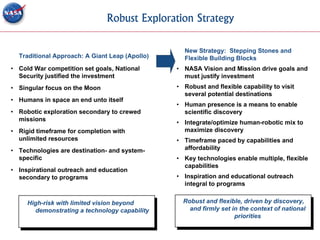
Robust Exploration StrategyNew Strategy: Stepping Stones and Flexible Building Blocks•NASA Vision and Mission drive goals and must justify investment•Robust and flexible capability to visit several potential destinations•Human presence is a means to enable scientific discovery•Integrate/optimize human-robotic mix to maximize discovery•Timeframe paced by capabilities and affordability•Key technologies enable multiple, flexible capabilities•Inspiration and educational outreach integral to programsHigh-risk with limited vision beyond demonstrating a technology capabilityRobust and flexible, driven by discovery, and firmly set in the context of national priorities 
Traditional Approach: A Giant Leap (Apollo) 
•Cold War competition set goals, National Security justified the investment 
•Singular focus on the Moon 
•Humans in space an end unto itself 
•Robotic exploration secondary to crewed missions 
•Rigid timeframe for completion with unlimited resources 
•Technologies are destination-and system- specific 
•Inspirational outreach and education secondary to programs
Science Drivers Determine Destinations 
(Selected Examples) • History of major Solar System events• Effects of deep space on cells• Impact of human and natural events upon Earth• Origin of life in the Solar System• Planetary sample analysis: absolute age determination “calibrating the clocks” • Measurement of genomic responses to radiation• Measurement of Earth’s vital signs “taking the pulse” • Detection of bio- markers and hospitable environments•Asteroids•Moon•Mars•Venus•Beyond Van Allen belts•Earth orbits•Libration points•Cometary nuclei•Europa•Libration points•Mars•Titan• How did the Solar Systemevolve? • How do humans adapt to space? • What is Earth’s sustainability and habitability? • Is there Life beyond the planet of origin?• Origin of life in the UniversePursuitsActivitiesScience QuestionsDestinationsHow did we get here? Where are we going? Are we alone?
Stepping Stone Strategy
Stepping Stone Approach 
Current CapabilitiesEARTH’S NEIGHBORHOODACCESSIBLE PLANETARY SURFACESLow Earth Orbit•Crew Health and Performance•Systems and Technology Performance•Engineering Test bed•Crew transportationHubble Space TelescopeLibration PointsMars Mars Exploration Rovers Space Infrared Telescope FacilityEarth Sensing•Understand Earth as a system•Develop predictive capabilities
Stepping Stone Approach 
Near-term Next Steps for Human and Robotic ExplorationHigh Earth Orbit/High Inclination (above the Van Allen Belts) EARTH’S NEIGHBORHOODACCESSIBLE PLANETARY SURFACESLibration Points (60-100 day missions)•Assembly, Maintenance, and Servicing•Initial Deep Space Crew Transfer•Breakthrough Science Capabilities•Deep Space Systems DevelopmentMoon (14 day + missions) •Surface Systems•Operations•Resource Utilization•High Power SystemsLow Earth Orbit•Crew Health and Performance•Systems and Technology Performance•Engineering Test bed•Crew transportation •Heavy Lift Earth Sensing•Understand Earth as a system•Develop predictive capabilitiesMars 
Potential Sites for Operations Above Low Earth Orbit
Page 8 
Stepping Stone Approach 
Far-Term Next Steps for Human and Robotic ExplorationEARTH’S NEIGHBORHOODACCESSIBLE PLANETARY SURFACESHigh Earth Orbit/High Inclination (above the Van Allen Belts) Moon (14 day + missions) Libration Points (60-90 day missions) •Assembly, Maintenance, and Servicing•Initial Deep Space Crew Transfer•Surface Systems•Operations•Resource Utilization•High Power Systems•Breakthrough Science Capabilities•Deep Space Systems Development•Explore a New World •Search for Life•Resource Utilization•High Power SystemsMars (365 day + missions) AsteroidsLow Earth Orbit•Crew Health and Performance•Systems and Technology Performance•Engineering Test bed•Crew transportation •Heavy Lift] Earth Sensing•Understand Earth as a system•Develop predictive capabilities 
Potential Sites for Operations Above Low Earth Orbit
Page 9 
Sun-Earth L1 , L2Mars Earth’s NeighborhoodAccessible Planetary Surfaces Outer Planets and beyond 
Progression in Capability Development 
Exploration Metro Map 
Sun, Mercury, Venus Low Earth Orbit 
High Earth Orbit 
Earth-Moon L1, L2 
Moon 
Earth
Human and Robotic ConceptsMarsMoonLEO/GEOLibration Points 
Earth-to-Orbit 
40 mT 
100mT 
Transportation 
Transfer Vehicle 
Upper Stage 
Lander 
Space Power 
Habitation ‘ 
EVA/Robotics
Systematic Investment Strategy 
Space Act & NASA Strategic Plan 
Science : Questions, Pursuits, Activities 
Requirements and Systems Engineering 
Programmatic and Technology Road Maps 
Gap Analysis 
Architectural Studies & Technology TradesIntegrated Space Plan, Technology Requirements, Priorities, and New InitiativesProducts: 
Space Architect Focus
Page 12 
Key Technology Challenges 
•Space Transportation 
–Safe, fast, and efficient 
•Affordable, Abundant Power 
–Solar and nuclear 
•Crew Health and Safety 
–Counter measures and medical autonomy 
•Optimized Robotic and Human Operations 
–Dramatically higher productivity; on-site intelligence 
•Space Systems Performance 
–Advanced materials, low-mass, self-healing, self-assembly, self- sufficiency… 
NanotubeSpace Elevator 
Space Solar Power 
Invariant Manifolds 
RLV 
Aerobraking 
NEP 
Artificial Gravity 
M2P2 
L1Outpost 
RobonautGossamer Telescopes
Strategic Building Block InvestmentsFY 2003 FY 2004 Nuclear Systems Initiative ¾Greatly increased power for space science and explorationTechnological BarriersPower: Providing ample power for propulsion and science Transportation: Providing safe, reliable and economical transportation to and from space and throughout the solar systemHuman Capabilities: Understanding and overcoming human limitations in spaceCommunications: Providing efficient data transfer across the solar systemBioastronautics Program ¾Roadmap to address human limitationsIntegrated Space Transportation Plan ¾Orbital Space Plane ¾Extended Shuttle Operations ¾Next Generation Launch SystemsProject Prometheus ¾Nuclear power and propulsion for revolutionary science and orbital capabilities ¾First mission to Jupiter’s MoonsHuman Research Initiative ¾Accelerate research to expand capabilities ¾Enable 100-plus day missions beyond low-Earth orbit In-Space Propulsion Program ¾Efficient Solar System TransportationSpace Station Restructuring ¾Research Priority Focused ¾Management Reforms ¾Sound Financial BaseOptical Communications ¾Vastly improve communication to transform science capability ¾First demonstration from Mars
Update: 10/24/02 
Integrated Space Transportation Plan1stFlightOSP BridgeTo New Launcher02SpaceShuttle0304050607080910111213141516171819202122OrbitalSpacePlaneOperationsDesignHypersonicFSD? US Core CompleteIP Core CompleteISS Extend?International Space StationISS Crew ReturnCapable OrbitalTech DemoCrew Transfer on Human- Rated EELVOperationsOSP PrimaryCrew Vehicle? Future Exploration beyond LEO? FSDDecisionNext Generation Launch Technology 
Competition Decisions 
Further Extend as Crew and/or Cargo Vehicle? 
Operate Thru Mid Next Decade 
Extend? 
Extend Until 2020+ 
Development 
Tech 
Long-Term Technology Program 
Launch System Decision 
(Based onReqt, $, DoD) 
Risk Reduction 
FSD 
Decision 
Development
Orbital Space PlaneThe Orbital Space Plane (OSP) will: •Support NASA’s strategic goals and science objectives by achieving assured access to the International Space Station (ISS) and Low Earth Orbit (LEO) –Crew return capability from the International Space Station as soon as practical but no later than 2010 (Goal is now 2008) –Crew transfer to and from the ISS as soon as practical but no later than 2012 (Goal is now 2010) •Provide the basis for future exploration beyond Low Earth Orbit
OSP Primary Earth-to-LEO TransportationEarth SurfaceLow Earth OrbitHigh Earth Orbit / Low Lunar OrbitEarth SurfaceCrew Transfer from OSP to XTV* Crew Transfer to OSPXTV* RefuelsXTV Fuels in LEOXTVXTVXTV40 MT NLGT Launch VehicleLunar Lander (wet) Propellant TankerLunar Lander (dry) XTVXTV 
LEO Tanker 
Propulsive Capture 
LEO Tanker and OSP 
XTV 
OSP Crew Launch 
OSP Crew Landing 
Propellant Launches 
(Qty TBD) 
Contingency Return
Page 17 
Power 
Project Prometheus 
•Revolutionary capabilities for nuclear propulsion and power 
–Much greater ability to power instruments, change speed, and transmit science data 
–No launch constraint to use gravity assists 
–Can orbit multiple objects or moons with vastly greater, persistent observation time 
–Can change target mid-mission (to support change in priorities) 
•First use: Jupiter Icy Moon Orbiter 
–Search for evidence of global subsurface oceans on Jupiter’s three icy Galilean moons: Europa, Ganymede, andCallisto. These oceans may harbor organic material. 
–Nuclear technology will enable unprecedented science data return through high power science instruments and advanced communications tech
Page 18 
Crew Health and SafetyArtificial Gravity NEP Vehicle System Concepts 
•Mission Needs 
–1-g, 4 rpm system –consistent with human centrifugation tests 
–Minimize AG vehicle mass “penalties” & complexity 
–18-month Mars roundtrip, nuclear electric propulsion 
•Assessments 
–AG crew hab module design assessment 
–Power/propulsion/trajectory trades 
–Angular momentum management/vehicle steering strategies 
–Preliminary assessment of structural, power system designs 
•Results 
–Only small dry mass AG penalties identified (<5%) 
–Good synergy among power system and propulsive performance 
–Propellant-efficient steering strategies identified
Page 19 
Crew Health and Safety 
Attacking the Radiation Challenge Exploration Location/ Duration3% lifetime limitLEO+ 500-1000DaysCURRENT MITIGATIONSafe HavensCareer/Mission Time ConstraintsDosimetryHistorical Data/ModelingEarth’s Magnetic FieldADVANCED APPROACHESFast TransitPersonnel ScreeningActive ShieldingPharmaceuticalsInteg. Design of Passive ShieldsMaterialsTissue Testing/ModelingLEO180 DaysAs Low As Reasonably Achievable 
Risk/Uncertainty
Page 20 
Human/Robotic Partnership 
Optimizing the Human/Robotic Equation 
Optimal Human and Robotic CombinationsExample Science ActivitiesCreating science instruments and observing platforms to search for life sustaining planetsSearch for evidence of life on planetary surfaces•Technology Projections•Experience and Lessons Learned•MissonPerformance Assessments
Page 21 
Large Space Telescope Construction and Maintenance 
2300m Linear Phased ArrayHuman InterfaceDevelopmentHardwareDevelopmentEVA/Robotic OptimizationSingle AgentPlanningMulti -Agent PlanningRoboticDevelopmentTelepresenceSuit AdvancesSpace StationEVA/Robotic JointsElectricalFluidStructuralPath PlanningDexterityTimeComplexity/ CapabilityComplex Systems201020052002State ofThe ArtBroadApplicationGeosyncSynthetic Aperture Radar(code Y) StudiesDemonstrationsFlight Demonstrations20m Parabolic Telescope 
(2002)
Space Systems 
Example: Mars Human Mission Mass Savings Normalized to ISS Mass 5.04.03.02.01.00.0Advanced Avionics (7%) Maintenance & Spares (18%) Advanced Materials (17%) Closed life Support (34%) Advanced Propulsion (EP or Nuclear) (45%) Aerobraking (42%) Normalized MassHWConsum- ables 
Today 
8.0 
7.0 
6.0
“As for the future, your task is not to foresee it, but to enable it.“ 
Antoine de-Saint-Exupery

Future directions

  • 1.
    Future Directions: Strategyfor Human and Robotic ExplorationGary L. MartinSpace ArchitectNovember 2003
  • 2.
    Robust Exploration StrategyNewStrategy: Stepping Stones and Flexible Building Blocks•NASA Vision and Mission drive goals and must justify investment•Robust and flexible capability to visit several potential destinations•Human presence is a means to enable scientific discovery•Integrate/optimize human-robotic mix to maximize discovery•Timeframe paced by capabilities and affordability•Key technologies enable multiple, flexible capabilities•Inspiration and educational outreach integral to programsHigh-risk with limited vision beyond demonstrating a technology capabilityRobust and flexible, driven by discovery, and firmly set in the context of national priorities Traditional Approach: A Giant Leap (Apollo) •Cold War competition set goals, National Security justified the investment •Singular focus on the Moon •Humans in space an end unto itself •Robotic exploration secondary to crewed missions •Rigid timeframe for completion with unlimited resources •Technologies are destination-and system- specific •Inspirational outreach and education secondary to programs
  • 4.
    Science Drivers DetermineDestinations (Selected Examples) • History of major Solar System events• Effects of deep space on cells• Impact of human and natural events upon Earth• Origin of life in the Solar System• Planetary sample analysis: absolute age determination “calibrating the clocks” • Measurement of genomic responses to radiation• Measurement of Earth’s vital signs “taking the pulse” • Detection of bio- markers and hospitable environments•Asteroids•Moon•Mars•Venus•Beyond Van Allen belts•Earth orbits•Libration points•Cometary nuclei•Europa•Libration points•Mars•Titan• How did the Solar Systemevolve? • How do humans adapt to space? • What is Earth’s sustainability and habitability? • Is there Life beyond the planet of origin?• Origin of life in the UniversePursuitsActivitiesScience QuestionsDestinationsHow did we get here? Where are we going? Are we alone?
  • 5.
  • 6.
    Stepping Stone Approach Current CapabilitiesEARTH’S NEIGHBORHOODACCESSIBLE PLANETARY SURFACESLow Earth Orbit•Crew Health and Performance•Systems and Technology Performance•Engineering Test bed•Crew transportationHubble Space TelescopeLibration PointsMars Mars Exploration Rovers Space Infrared Telescope FacilityEarth Sensing•Understand Earth as a system•Develop predictive capabilities
  • 7.
    Stepping Stone Approach Near-term Next Steps for Human and Robotic ExplorationHigh Earth Orbit/High Inclination (above the Van Allen Belts) EARTH’S NEIGHBORHOODACCESSIBLE PLANETARY SURFACESLibration Points (60-100 day missions)•Assembly, Maintenance, and Servicing•Initial Deep Space Crew Transfer•Breakthrough Science Capabilities•Deep Space Systems DevelopmentMoon (14 day + missions) •Surface Systems•Operations•Resource Utilization•High Power SystemsLow Earth Orbit•Crew Health and Performance•Systems and Technology Performance•Engineering Test bed•Crew transportation •Heavy Lift Earth Sensing•Understand Earth as a system•Develop predictive capabilitiesMars Potential Sites for Operations Above Low Earth Orbit
  • 8.
    Page 8 SteppingStone Approach Far-Term Next Steps for Human and Robotic ExplorationEARTH’S NEIGHBORHOODACCESSIBLE PLANETARY SURFACESHigh Earth Orbit/High Inclination (above the Van Allen Belts) Moon (14 day + missions) Libration Points (60-90 day missions) •Assembly, Maintenance, and Servicing•Initial Deep Space Crew Transfer•Surface Systems•Operations•Resource Utilization•High Power Systems•Breakthrough Science Capabilities•Deep Space Systems Development•Explore a New World •Search for Life•Resource Utilization•High Power SystemsMars (365 day + missions) AsteroidsLow Earth Orbit•Crew Health and Performance•Systems and Technology Performance•Engineering Test bed•Crew transportation •Heavy Lift] Earth Sensing•Understand Earth as a system•Develop predictive capabilities Potential Sites for Operations Above Low Earth Orbit
  • 9.
    Page 9 Sun-EarthL1 , L2Mars Earth’s NeighborhoodAccessible Planetary Surfaces Outer Planets and beyond Progression in Capability Development Exploration Metro Map Sun, Mercury, Venus Low Earth Orbit High Earth Orbit Earth-Moon L1, L2 Moon Earth
  • 10.
    Human and RoboticConceptsMarsMoonLEO/GEOLibration Points Earth-to-Orbit 40 mT 100mT Transportation Transfer Vehicle Upper Stage Lander Space Power Habitation ‘ EVA/Robotics
  • 11.
    Systematic Investment Strategy Space Act & NASA Strategic Plan Science : Questions, Pursuits, Activities Requirements and Systems Engineering Programmatic and Technology Road Maps Gap Analysis Architectural Studies & Technology TradesIntegrated Space Plan, Technology Requirements, Priorities, and New InitiativesProducts: Space Architect Focus
  • 12.
    Page 12 KeyTechnology Challenges •Space Transportation –Safe, fast, and efficient •Affordable, Abundant Power –Solar and nuclear •Crew Health and Safety –Counter measures and medical autonomy •Optimized Robotic and Human Operations –Dramatically higher productivity; on-site intelligence •Space Systems Performance –Advanced materials, low-mass, self-healing, self-assembly, self- sufficiency… NanotubeSpace Elevator Space Solar Power Invariant Manifolds RLV Aerobraking NEP Artificial Gravity M2P2 L1Outpost RobonautGossamer Telescopes
  • 13.
    Strategic Building BlockInvestmentsFY 2003 FY 2004 Nuclear Systems Initiative ¾Greatly increased power for space science and explorationTechnological BarriersPower: Providing ample power for propulsion and science Transportation: Providing safe, reliable and economical transportation to and from space and throughout the solar systemHuman Capabilities: Understanding and overcoming human limitations in spaceCommunications: Providing efficient data transfer across the solar systemBioastronautics Program ¾Roadmap to address human limitationsIntegrated Space Transportation Plan ¾Orbital Space Plane ¾Extended Shuttle Operations ¾Next Generation Launch SystemsProject Prometheus ¾Nuclear power and propulsion for revolutionary science and orbital capabilities ¾First mission to Jupiter’s MoonsHuman Research Initiative ¾Accelerate research to expand capabilities ¾Enable 100-plus day missions beyond low-Earth orbit In-Space Propulsion Program ¾Efficient Solar System TransportationSpace Station Restructuring ¾Research Priority Focused ¾Management Reforms ¾Sound Financial BaseOptical Communications ¾Vastly improve communication to transform science capability ¾First demonstration from Mars
  • 14.
    Update: 10/24/02 IntegratedSpace Transportation Plan1stFlightOSP BridgeTo New Launcher02SpaceShuttle0304050607080910111213141516171819202122OrbitalSpacePlaneOperationsDesignHypersonicFSD? US Core CompleteIP Core CompleteISS Extend?International Space StationISS Crew ReturnCapable OrbitalTech DemoCrew Transfer on Human- Rated EELVOperationsOSP PrimaryCrew Vehicle? Future Exploration beyond LEO? FSDDecisionNext Generation Launch Technology Competition Decisions Further Extend as Crew and/or Cargo Vehicle? Operate Thru Mid Next Decade Extend? Extend Until 2020+ Development Tech Long-Term Technology Program Launch System Decision (Based onReqt, $, DoD) Risk Reduction FSD Decision Development
  • 15.
    Orbital Space PlaneTheOrbital Space Plane (OSP) will: •Support NASA’s strategic goals and science objectives by achieving assured access to the International Space Station (ISS) and Low Earth Orbit (LEO) –Crew return capability from the International Space Station as soon as practical but no later than 2010 (Goal is now 2008) –Crew transfer to and from the ISS as soon as practical but no later than 2012 (Goal is now 2010) •Provide the basis for future exploration beyond Low Earth Orbit
  • 16.
    OSP Primary Earth-to-LEOTransportationEarth SurfaceLow Earth OrbitHigh Earth Orbit / Low Lunar OrbitEarth SurfaceCrew Transfer from OSP to XTV* Crew Transfer to OSPXTV* RefuelsXTV Fuels in LEOXTVXTVXTV40 MT NLGT Launch VehicleLunar Lander (wet) Propellant TankerLunar Lander (dry) XTVXTV LEO Tanker Propulsive Capture LEO Tanker and OSP XTV OSP Crew Launch OSP Crew Landing Propellant Launches (Qty TBD) Contingency Return
  • 17.
    Page 17 Power Project Prometheus •Revolutionary capabilities for nuclear propulsion and power –Much greater ability to power instruments, change speed, and transmit science data –No launch constraint to use gravity assists –Can orbit multiple objects or moons with vastly greater, persistent observation time –Can change target mid-mission (to support change in priorities) •First use: Jupiter Icy Moon Orbiter –Search for evidence of global subsurface oceans on Jupiter’s three icy Galilean moons: Europa, Ganymede, andCallisto. These oceans may harbor organic material. –Nuclear technology will enable unprecedented science data return through high power science instruments and advanced communications tech
  • 18.
    Page 18 CrewHealth and SafetyArtificial Gravity NEP Vehicle System Concepts •Mission Needs –1-g, 4 rpm system –consistent with human centrifugation tests –Minimize AG vehicle mass “penalties” & complexity –18-month Mars roundtrip, nuclear electric propulsion •Assessments –AG crew hab module design assessment –Power/propulsion/trajectory trades –Angular momentum management/vehicle steering strategies –Preliminary assessment of structural, power system designs •Results –Only small dry mass AG penalties identified (<5%) –Good synergy among power system and propulsive performance –Propellant-efficient steering strategies identified
  • 19.
    Page 19 CrewHealth and Safety Attacking the Radiation Challenge Exploration Location/ Duration3% lifetime limitLEO+ 500-1000DaysCURRENT MITIGATIONSafe HavensCareer/Mission Time ConstraintsDosimetryHistorical Data/ModelingEarth’s Magnetic FieldADVANCED APPROACHESFast TransitPersonnel ScreeningActive ShieldingPharmaceuticalsInteg. Design of Passive ShieldsMaterialsTissue Testing/ModelingLEO180 DaysAs Low As Reasonably Achievable Risk/Uncertainty
  • 20.
    Page 20 Human/RoboticPartnership Optimizing the Human/Robotic Equation Optimal Human and Robotic CombinationsExample Science ActivitiesCreating science instruments and observing platforms to search for life sustaining planetsSearch for evidence of life on planetary surfaces•Technology Projections•Experience and Lessons Learned•MissonPerformance Assessments
  • 21.
    Page 21 LargeSpace Telescope Construction and Maintenance 2300m Linear Phased ArrayHuman InterfaceDevelopmentHardwareDevelopmentEVA/Robotic OptimizationSingle AgentPlanningMulti -Agent PlanningRoboticDevelopmentTelepresenceSuit AdvancesSpace StationEVA/Robotic JointsElectricalFluidStructuralPath PlanningDexterityTimeComplexity/ CapabilityComplex Systems201020052002State ofThe ArtBroadApplicationGeosyncSynthetic Aperture Radar(code Y) StudiesDemonstrationsFlight Demonstrations20m Parabolic Telescope (2002)
  • 22.
    Space Systems Example:Mars Human Mission Mass Savings Normalized to ISS Mass 5.04.03.02.01.00.0Advanced Avionics (7%) Maintenance & Spares (18%) Advanced Materials (17%) Closed life Support (34%) Advanced Propulsion (EP or Nuclear) (45%) Aerobraking (42%) Normalized MassHWConsum- ables Today 8.0 7.0 6.0
  • 23.
    “As for thefuture, your task is not to foresee it, but to enable it.“ Antoine de-Saint-Exupery