Saurabh Jindal
14101002
3rd Semester
Aerospace Engineering
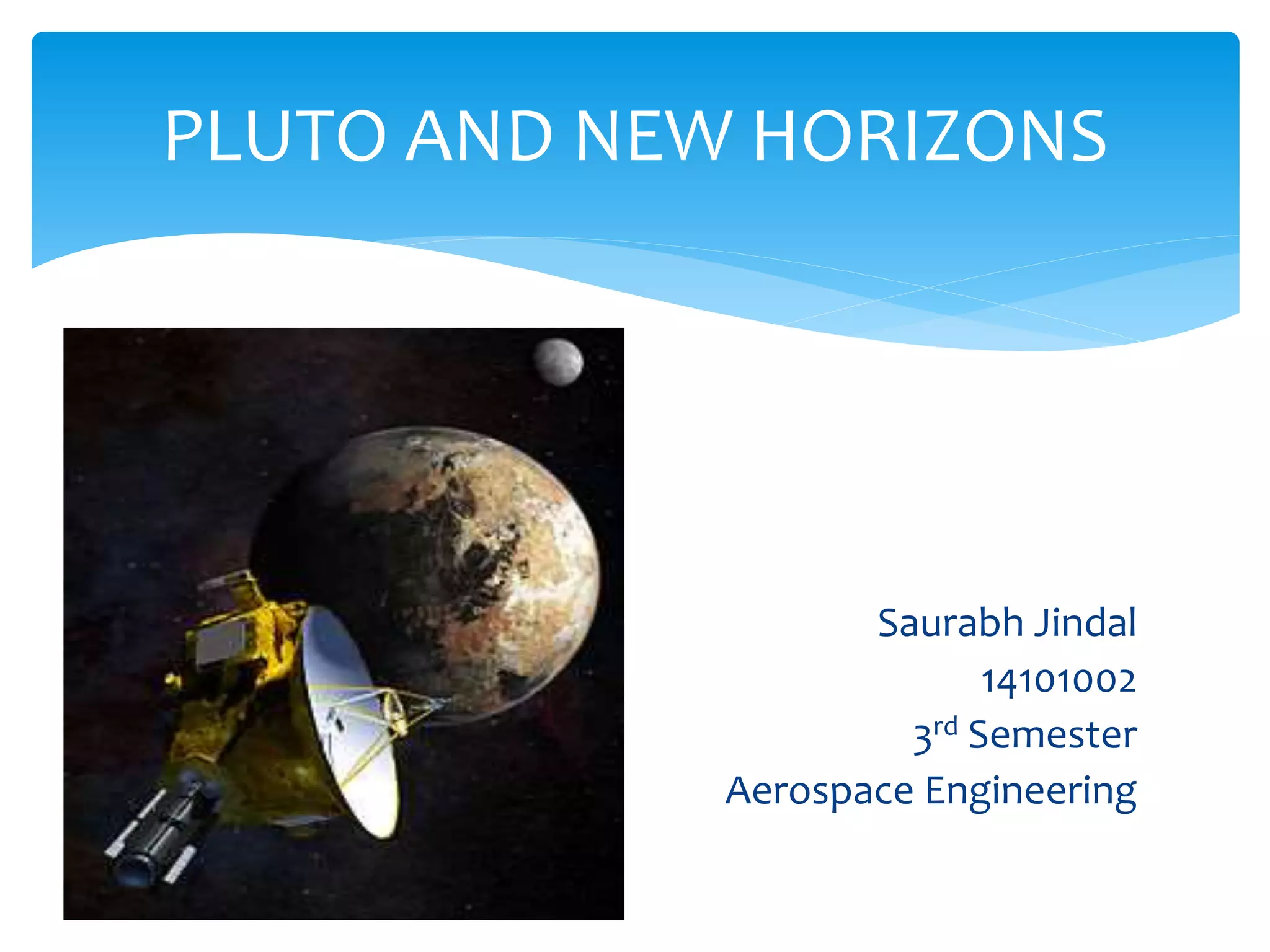
PLUTO AND NEW HORIZONS
NEW HORIZONS
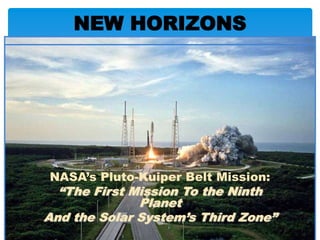
NASA’s Pluto-Kuiper Belt Mission:
“The First Mission To the Ninth
Planet
And the Solar System’s Third Zone”
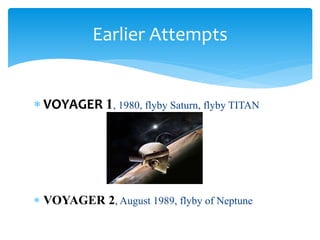
 VOYAGER 1, 1980, flyby Saturn, flyby TITAN
 VOYAGER 2, August 1989, flyby of Neptune
Earlier Attempts
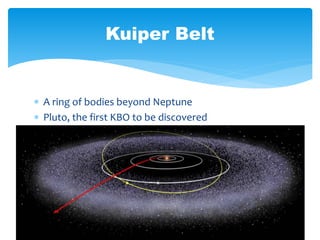
 A ring of bodies beyond Neptune
 Pluto, the first KBO to be discovered
Kuiper Belt
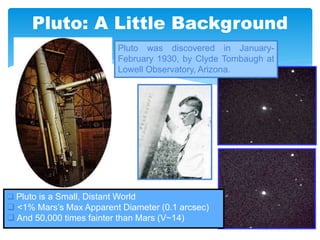
Pluto: A Little Background
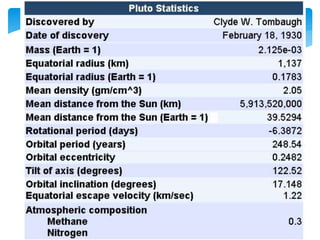
Pluto was discovered in January-
February 1930, by Clyde Tombaugh at
Lowell Observatory, Arizona.
 Pluto is a Small, Distant World
 <1% Mars’s Max Apparent Diameter (0.1 arcsec)
 And 50,000 times fainter than Mars (V~14)
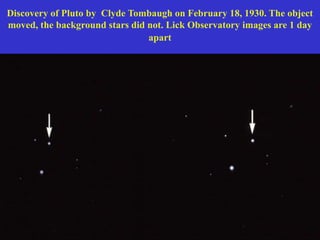
Discovery of Pluto by Clyde Tombaugh on February 18, 1930. The object
moved, the background stars did not. Lick Observatory images are 1 day
apart
 International Astronomical Union (IAU) is the
authority on such matters
 To be a planet, Pluto must:
 Orbit the Sun
 Be round
 Clear the neighborhood around its orbit
 Leaves us with 8 “planets”
 If only “round” and “orbit Sun”, 12 or more
What Is a Planet?
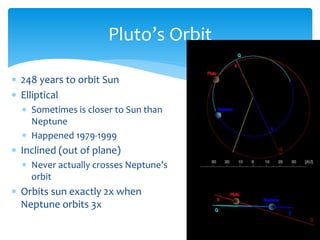
Pluto’s Orbit
 248 years to orbit Sun
 Elliptical
 Sometimes is closer to Sun than
Neptune
 Happened 1979-1999
 Inclined (out of plane)
 Never actually crosses Neptune’s
orbit
 Orbits sun exactly 2x when
Neptune orbits 3x
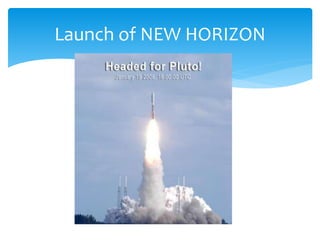
Launch of NEW HORIZON
Janvier 12 2006
Workshop 3e zone Slide 11
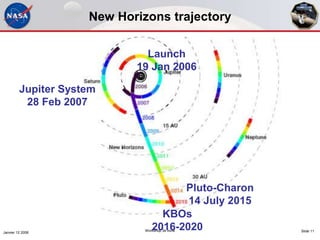
New Horizons trajectory
Pluto-Charon
14 July 2015
KBOs
2016-2020
Jupiter System
28 Feb 2007
Launch
19 Jan 2006
Janvier 12 2006Workshop 3e zone Slide 12
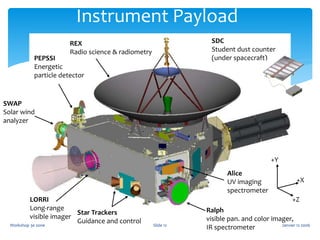
Instrument Payload
SWAP
Solar wind
analyzer
PEPSSI
Energetic
particle detector
LORRI
Long-range
visible imager
Ralph
visible pan. and color imager,
IR spectrometer
Alice
UV imaging
spectrometer
REX
Radio science & radiometry
Star Trackers
Guidance and control
+Y
+X
+Z
SDC
Student dust counter
(under spacecraft)
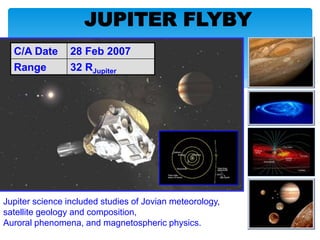
JUPITER FLYBY
Jupiter science included studies of Jovian meteorology,
satellite geology and composition,
Auroral phenomena, and magnetospheric physics.
C/A Date 28 Feb 2007
Range 32 RJupiter
Janvier 12 2006Workshop 3e zone Slide 14
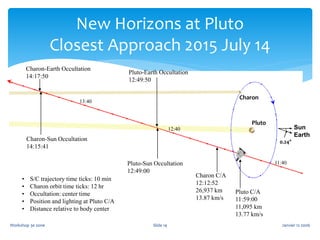
New Horizons at Pluto
Closest Approach 2015 July 14
• S/C trajectory time ticks: 10 min
• Charon orbit time ticks: 12 hr
• Occultation: center time
• Position and lighting at Pluto C/A
• Distance relative to body center
Pluto
Charon
0.24°
Sun
Earth
12:40
13:40
11:40
Pluto C/A
11:59:00
11,095 km
13.77 km/s
Charon C/A
12:12:52
26,937 km
13.87 km/s
Pluto-Sun Occultation
12:49:00
Pluto-Earth Occultation
12:49:50
Charon-Sun Occultation
14:15:41
Charon-Earth Occultation
14:17:50
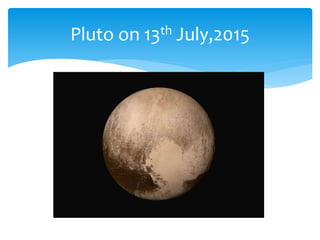
Pluto on 13th July,2015
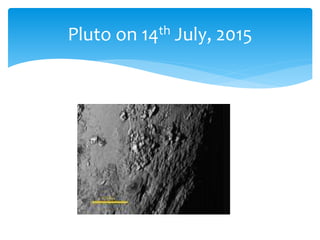
Pluto on 14th July, 2015
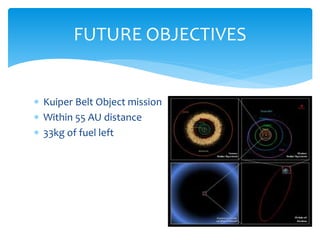
 Kuiper Belt Object mission
 Within 55 AU distance
 33kg of fuel left
FUTURE OBJECTIVES
THANK YOU
ANY QUESTIONS???

Pluto and new horizon

  • 1.
    Saurabh Jindal 14101002 3rd Semester AerospaceEngineering PLUTO AND NEW HORIZONS
  • 2.
    NEW HORIZONS NASA’s Pluto-KuiperBelt Mission: “The First Mission To the Ninth Planet And the Solar System’s Third Zone”
  • 3.
     VOYAGER 1,1980, flyby Saturn, flyby TITAN  VOYAGER 2, August 1989, flyby of Neptune Earlier Attempts
  • 4.
     A ringof bodies beyond Neptune  Pluto, the first KBO to be discovered Kuiper Belt
  • 5.
    Pluto: A LittleBackground Pluto was discovered in January- February 1930, by Clyde Tombaugh at Lowell Observatory, Arizona.  Pluto is a Small, Distant World  <1% Mars’s Max Apparent Diameter (0.1 arcsec)  And 50,000 times fainter than Mars (V~14)
  • 6.
    Discovery of Plutoby Clyde Tombaugh on February 18, 1930. The object moved, the background stars did not. Lick Observatory images are 1 day apart
  • 7.
     International AstronomicalUnion (IAU) is the authority on such matters  To be a planet, Pluto must:  Orbit the Sun  Be round  Clear the neighborhood around its orbit  Leaves us with 8 “planets”  If only “round” and “orbit Sun”, 12 or more What Is a Planet?
  • 8.
    Pluto’s Orbit  248years to orbit Sun  Elliptical  Sometimes is closer to Sun than Neptune  Happened 1979-1999  Inclined (out of plane)  Never actually crosses Neptune’s orbit  Orbits sun exactly 2x when Neptune orbits 3x
  • 10.
  • 11.
    Janvier 12 2006 Workshop3e zone Slide 11 New Horizons trajectory Pluto-Charon 14 July 2015 KBOs 2016-2020 Jupiter System 28 Feb 2007 Launch 19 Jan 2006
  • 12.
    Janvier 12 2006Workshop3e zone Slide 12 Instrument Payload SWAP Solar wind analyzer PEPSSI Energetic particle detector LORRI Long-range visible imager Ralph visible pan. and color imager, IR spectrometer Alice UV imaging spectrometer REX Radio science & radiometry Star Trackers Guidance and control +Y +X +Z SDC Student dust counter (under spacecraft)
  • 13.
    JUPITER FLYBY Jupiter scienceincluded studies of Jovian meteorology, satellite geology and composition, Auroral phenomena, and magnetospheric physics. C/A Date 28 Feb 2007 Range 32 RJupiter
  • 14.
    Janvier 12 2006Workshop3e zone Slide 14 New Horizons at Pluto Closest Approach 2015 July 14 • S/C trajectory time ticks: 10 min • Charon orbit time ticks: 12 hr • Occultation: center time • Position and lighting at Pluto C/A • Distance relative to body center Pluto Charon 0.24° Sun Earth 12:40 13:40 11:40 Pluto C/A 11:59:00 11,095 km 13.77 km/s Charon C/A 12:12:52 26,937 km 13.87 km/s Pluto-Sun Occultation 12:49:00 Pluto-Earth Occultation 12:49:50 Charon-Sun Occultation 14:15:41 Charon-Earth Occultation 14:17:50
  • 15.
    Pluto on 13thJuly,2015
  • 16.
    Pluto on 14thJuly, 2015
  • 17.
     Kuiper BeltObject mission  Within 55 AU distance  33kg of fuel left FUTURE OBJECTIVES
  • 18.