1
Subsurface Drainage System
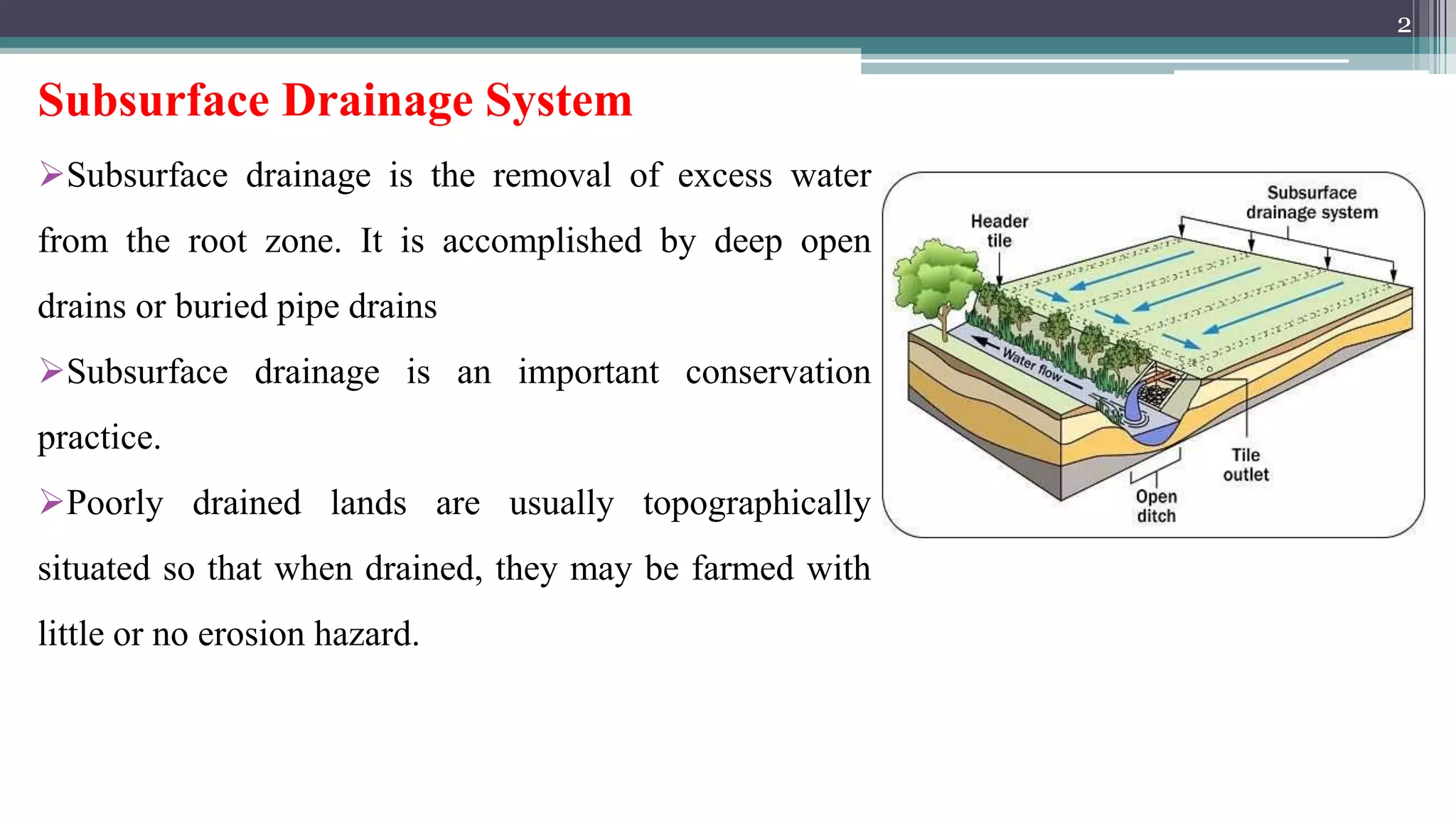
Subsurface drainage is the removal of excess water
from the root zone. It is accomplished by deep open
drains or buried pipe drains
Subsurface drainage is an important conservation
practice.
Poorly drained lands are usually topographically
situated so that when drained, they may be farmed with
little or no erosion hazard.
2
BENEFITS OF SUBSURFACE DRAINAGE
Provides aeration to root zone
Improves soil structure and maintains soil temperature
Avails land for early cultivation
 Facilitates easy movement of farm machines
 Removes undesirable salts from root zone
Decreases chances of flood hazards
Occupies no surface land
Small capacity drains are required
Less maintenance cost compared to surface drains.
3
Disadvantages of subsurface drains
Require high initial cost
Requires steeper gradient
Repair works are costly and inconvenient
Construction is difficult
4
Investigations for subsurface drainage
Topographic map of the area
Data of soil physiochemical properties
Position of ground water table and its fluctuation
Quality of groundwater
Logs of soil and subsurface material
Crops to be grown and their drainage requirements
Irrigation practices and their requirements.
5
 There are three main phases in implementation of pipe drainage system
 Design
 Installation
 Operation & maintenance
 Specific advantages
 Pipes are buried out of sight hence they do not interfere with farming operations
 There is no loss of farming land
 Don not harbour weeds
6
Open drains
• Dimensions ( cross-sections)
• Bed levels & slopes on longitudinal profiles
• Water levels at design discharge
Pipe drains
• Depth & spacing of field drains to be indicated in the map
• Diameters & slopes, elevation of outlet
Materials & Structures
• For pipe drains : Pipe, envelope materials, connection between field drains, collectors
& outlets
• For open drains: Bridge & culverts
7
• Materials
• The materials used in manufacture of drain pipe are
 Clay tiles
 Concrete pipes
 Plastic pipes
• The important criteria for pipe quality and for selection of the most suitable type of
pipe is
• Resistance to mechanical & chemical damage
• Longevity
• Cost ( include the cost of purchase, transport, handling & installation)
8
• What is draining Envelope
A drain envelop is a porous material placed around a perforated drain. The main need
for envelope is to keep the drain pipe sediment free. It performs one or more of the
following functions
o Filter function
• To prevent or restrict soil particles from entering the pipe where they may settle and
eventually clog the pipe
o Hydraulic function
• To constitute a medium of good permeability around the pipe and thus reduce the
entrance resistance
o Bedding function
• To provide all-round support to the pipe in order to prevent damage due to soil load
• Please note that the large diameter plastic pipe is embedded in gravel especially for
this purpose
9
• The first two functions provide a safeguard against the two main hazards of
poor drain line performance 1) siltation & 2) high flow resistance in the
vicinity of the drain
10
CASE STUDY
11
Title Effect of Subsurface Drainage System on Maize
Growth,Yield and Soil Quality
Authors Arumugam Balusamy¹´²*, Chinniah Udayasoorian¹ and
Rajamani Jayabalakrishnan³.
Journal & Year International Journal of Current Microbiology and
Applied Sciences
ISSN: 2319-7706 Volume 8 Number 02 (2019)
Location Pandipalayam Village, Karur District of Tamil Nadu,
India
12
Materials and Methods
• The subsurface drainage system installed in an area of 1.20 ha with different
lateral spacing.
• The perforated corrugated flexible PVC pipes with a diameter of 80 mm
used as a lateral and placed at a depth of 1.1 to 0.9 m from the surface.
• Before installation of it, the lateral covered with coconut fiber to allow the
passage of water through the perforation and avoid clogging of the pores.
• The blind PVC pipe with a diameter of 110 mm has used in the main
drainage,
13
Field preparation and sowing of maize
• The individual plots of 15, 20 and 25 m lateral spacing ploughed ridges and
furrows formed by adopting a spacing of 60 cm between the two ridges.
• Maize seeds (var. M 900 Gold) sown in the side of the ridges by adopting 25 cm
spacing.
• The cultural practices and plant protection measures carried out for the entire crop
growth period as recommended by TNAU, Coimbatore.
14
Details of standardization experiment with maize crop (Non-replicated
trail)
o T1 : 15 m lateral spacing
o T2 : 20 m lateral spacing
o T3 : 25 m lateral spacing
o T4 : Control (undrained field)
15
• The representative soil samples were collected at different crop growth stages
Viz., vegetative (30 DAS), heading (60 DAS) and at harvest stage at 0-15 cm
depth.
• The collected samples were analyzed for soil pH by potentiometer soil water
suspension of 1:2.5 ratio (Jackson, 1973).
• Electrical conductivity by conductimetry soil water suspension of 1:2.5.
• Exchangeable calcium and magnesium by versanate titration method.
• The exchangeable sodium percentage worked out by using the formula given by
Saxena et al., (1978).
16
Results and Discussion
• The different drain spacing of 15, 20 and 25 m influenced the soil reaction (pH),
electrical conductivity, exchangeable cations viz., Ca, Mg, Na, K, and ESP of soil.
• Overall the drainage system influenced the soil physicochemical properties
positively, thereby yield and growth of maize under different lateral spacing.
17
Soil reaction (pH)
• The soil pH plays an important role in the availability of plant nutrients in saline-alkali
soils.
• The presence of common acid forming cations ions viz., H+, Fe2+or Fe3+ and Al3+ and
base forming cations like Ca2+, Mg2+, Na+ and K+ are influencing the soil pH.
• In the present study, the soil pH decreased towards crop advancement.
• Due to the removal of some of the base forming cations from the soil by drainage effluent
and addition of H+ in the form of HCO3 (Fig.1)
• Similarly, Bharambe et al., (2001), Rakesh et al., (2005) and Pradeep et al., (2005) also
reported, That the reduction in soil pH due to the removal of sodium and bicarbonate ions
along with leachate water.
18
• The lowest soil pH of 8.88 was observed in the drained field with 15 m lateral spacing
possibly.
• Result of the removal of much ions through drainage effluent compared to other drain
spacing and undrained field.
Fig.1 Effect of lateral spacing on soil pH in the subsurface drainage system
19
Soil Electrical conductivity (EC)
• Soil EC is a measure of the amount of salts in the soil solution,
• Which affects crop yield, plant nutrient availability and activity of soil
microorganisms.
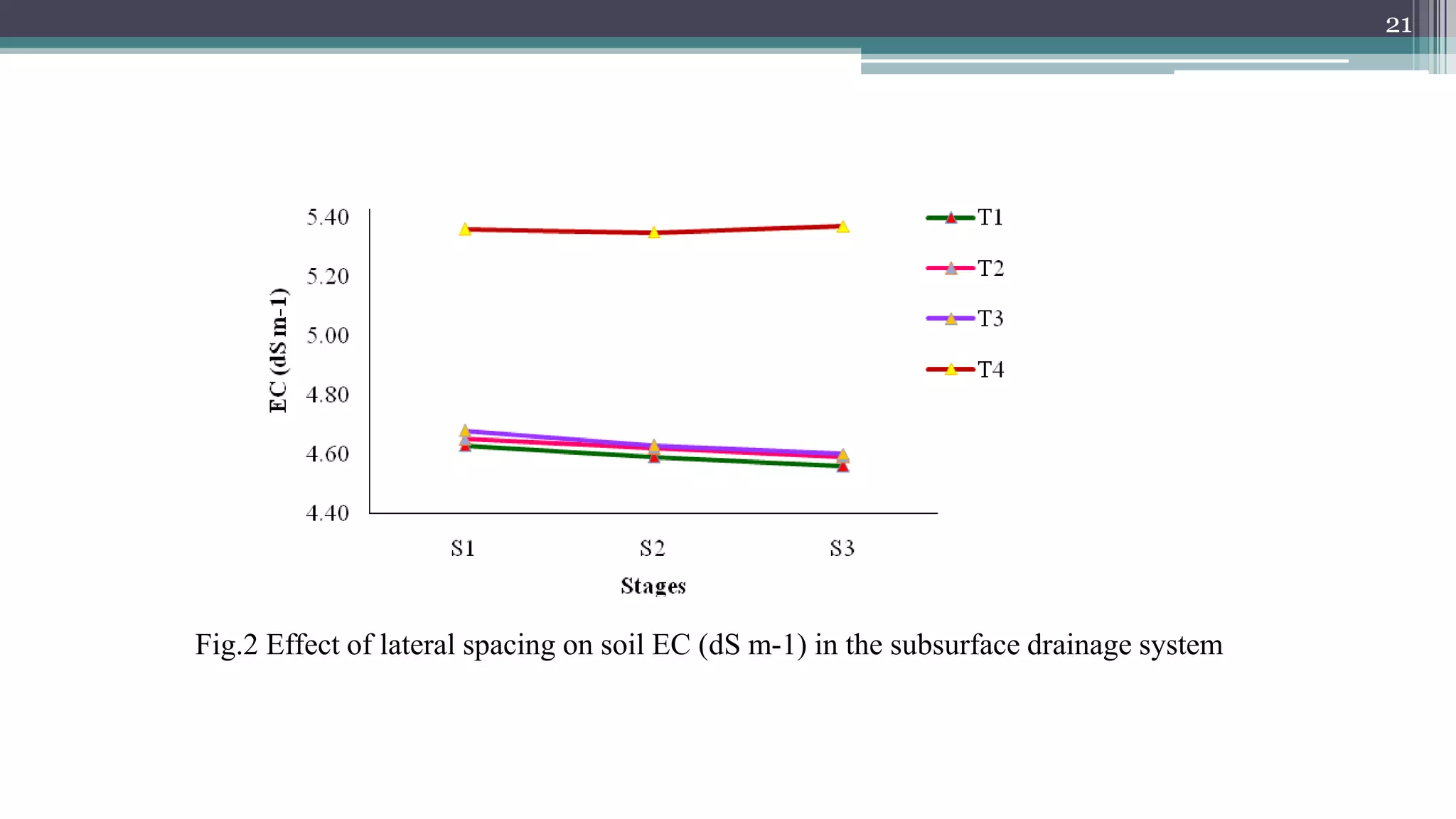
• In the present study, the soil EC showed a decreasing towards crop advancement
(Fig. 2) and
• In undrained field it showed an increasing trend.
• The decrease in soil EC noticed in the drained field due to the removal of soluble
salts through drainage water at different lateral spacing.
20
Fig.2 Effect of lateral spacing on soil EC (dS m-1) in the subsurface drainage system
21
• Soil exchangeable cations
• Exchangeable cations are those, which exchanged by a cation of an added
solution.
• The soil exchangeable cations Ca2+, Mg2+, K+ and Na+ often called the
exchangeable bases.
• In the present investigation, before the start of the experiment it was in the
order of Ca2+> Na+> Mg2+> K+.
• In drained field, the exchangeable sodium showed a decreasing trend and
other cations like Ca, Mg and K observed an increasing trend (Fig.3a to 3d)
22
Fig.3a Exchangeable Na (cmol (p+)kg-1)
Fig.3b Exchangeable Ca (cmol (p+)kg-1)
23
Fig.3c Exchangeable Mg (cmol (p+)kg-1)
Fig.3d Exchangeable K (cmol (p+)kg-1)
24
Exchangeable sodium percentage (ESP)
• The subsurface drainage system decreased the soil exchangeable sodium
percentage at the different lateral spacing in the drained field.
• ESP increased in undrained filed (Fig. 4).
• The highest decrease in ESP at 15 m lateral spacing was recorded as a result of
higher leaching of soluble salts especially Na through drainage water.
25
Fig.4 Effect of lateral spacing on soil exchangeable sodium percentage in the subsurface drainage system
26
• Effect of lateral spacing on maize growth and yield
• The provision of subsurface drainage system in waterlogged saline-alkali soil
increased the germination percentage, plant height, leaf length, leaf width and leaf
area index of maize crop,
• Due to removal of a large amount of soluble salts, water logging free condition and
increased nutrient availability in drained field, favored the plant growth and
development (Kolekar et al., 2011; Balusamy and Udayasoorian, 2017b).
• The highest cob length, maximum test weight, cob yield and grain yield was
recorded in the drained field with 15 m lateral spacing followed by 20 and 25 m
lateral spacing (Fig. 5).
27
• The increase was due to improvement in soil physical properties viz., infiltration
rate, porosity and chemical properties (low pH, EC, ESP) and improved nutrient
availability in the drained field
Fig.5 Effect of lateral spacing on maize yield (kg ha-1)
28
Conclusion
• The subsurface drainage system is a highly promising technology to overcome the
adverse effect of water logging and saline-alkali soil problem in the industrial effluent
and canal water irrigated areas.
• The provision of the subsurface drainage system, readily leach the soluble salts from the
soil layer through drainage water, which is a limiting factor for proper growth and
development of plants in salt-affected soil.
• The overall improvement in the soil physicochemical condition, increase in germination
percentage, plant height, leaf length, leaf width and leaf area index of maize crop was
observed, due to removal of a large amount of soluble salts, water logging free condition
and increased nutrient availability in drained field, which favored the plant growth and
development
29
THANK YOU
30

Subsurface drainage

  • 1.
  • 2.
    Subsurface Drainage System Subsurfacedrainage is the removal of excess water from the root zone. It is accomplished by deep open drains or buried pipe drains Subsurface drainage is an important conservation practice. Poorly drained lands are usually topographically situated so that when drained, they may be farmed with little or no erosion hazard. 2
  • 3.
    BENEFITS OF SUBSURFACEDRAINAGE Provides aeration to root zone Improves soil structure and maintains soil temperature Avails land for early cultivation  Facilitates easy movement of farm machines  Removes undesirable salts from root zone Decreases chances of flood hazards Occupies no surface land Small capacity drains are required Less maintenance cost compared to surface drains. 3
  • 4.
    Disadvantages of subsurfacedrains Require high initial cost Requires steeper gradient Repair works are costly and inconvenient Construction is difficult 4
  • 5.
    Investigations for subsurfacedrainage Topographic map of the area Data of soil physiochemical properties Position of ground water table and its fluctuation Quality of groundwater Logs of soil and subsurface material Crops to be grown and their drainage requirements Irrigation practices and their requirements. 5
  • 6.
     There arethree main phases in implementation of pipe drainage system  Design  Installation  Operation & maintenance  Specific advantages  Pipes are buried out of sight hence they do not interfere with farming operations  There is no loss of farming land  Don not harbour weeds 6
  • 7.
    Open drains • Dimensions( cross-sections) • Bed levels & slopes on longitudinal profiles • Water levels at design discharge Pipe drains • Depth & spacing of field drains to be indicated in the map • Diameters & slopes, elevation of outlet Materials & Structures • For pipe drains : Pipe, envelope materials, connection between field drains, collectors & outlets • For open drains: Bridge & culverts 7
  • 8.
    • Materials • Thematerials used in manufacture of drain pipe are  Clay tiles  Concrete pipes  Plastic pipes • The important criteria for pipe quality and for selection of the most suitable type of pipe is • Resistance to mechanical & chemical damage • Longevity • Cost ( include the cost of purchase, transport, handling & installation) 8
  • 9.
    • What isdraining Envelope A drain envelop is a porous material placed around a perforated drain. The main need for envelope is to keep the drain pipe sediment free. It performs one or more of the following functions o Filter function • To prevent or restrict soil particles from entering the pipe where they may settle and eventually clog the pipe o Hydraulic function • To constitute a medium of good permeability around the pipe and thus reduce the entrance resistance o Bedding function • To provide all-round support to the pipe in order to prevent damage due to soil load • Please note that the large diameter plastic pipe is embedded in gravel especially for this purpose 9
  • 10.
    • The firsttwo functions provide a safeguard against the two main hazards of poor drain line performance 1) siltation & 2) high flow resistance in the vicinity of the drain 10
  • 11.
  • 12.
    Title Effect ofSubsurface Drainage System on Maize Growth,Yield and Soil Quality Authors Arumugam Balusamy¹´²*, Chinniah Udayasoorian¹ and Rajamani Jayabalakrishnan³. Journal & Year International Journal of Current Microbiology and Applied Sciences ISSN: 2319-7706 Volume 8 Number 02 (2019) Location Pandipalayam Village, Karur District of Tamil Nadu, India 12
  • 13.
    Materials and Methods •The subsurface drainage system installed in an area of 1.20 ha with different lateral spacing. • The perforated corrugated flexible PVC pipes with a diameter of 80 mm used as a lateral and placed at a depth of 1.1 to 0.9 m from the surface. • Before installation of it, the lateral covered with coconut fiber to allow the passage of water through the perforation and avoid clogging of the pores. • The blind PVC pipe with a diameter of 110 mm has used in the main drainage, 13
  • 14.
    Field preparation andsowing of maize • The individual plots of 15, 20 and 25 m lateral spacing ploughed ridges and furrows formed by adopting a spacing of 60 cm between the two ridges. • Maize seeds (var. M 900 Gold) sown in the side of the ridges by adopting 25 cm spacing. • The cultural practices and plant protection measures carried out for the entire crop growth period as recommended by TNAU, Coimbatore. 14
  • 15.
    Details of standardizationexperiment with maize crop (Non-replicated trail) o T1 : 15 m lateral spacing o T2 : 20 m lateral spacing o T3 : 25 m lateral spacing o T4 : Control (undrained field) 15
  • 16.
    • The representativesoil samples were collected at different crop growth stages Viz., vegetative (30 DAS), heading (60 DAS) and at harvest stage at 0-15 cm depth. • The collected samples were analyzed for soil pH by potentiometer soil water suspension of 1:2.5 ratio (Jackson, 1973). • Electrical conductivity by conductimetry soil water suspension of 1:2.5. • Exchangeable calcium and magnesium by versanate titration method. • The exchangeable sodium percentage worked out by using the formula given by Saxena et al., (1978). 16
  • 17.
    Results and Discussion •The different drain spacing of 15, 20 and 25 m influenced the soil reaction (pH), electrical conductivity, exchangeable cations viz., Ca, Mg, Na, K, and ESP of soil. • Overall the drainage system influenced the soil physicochemical properties positively, thereby yield and growth of maize under different lateral spacing. 17
  • 18.
    Soil reaction (pH) •The soil pH plays an important role in the availability of plant nutrients in saline-alkali soils. • The presence of common acid forming cations ions viz., H+, Fe2+or Fe3+ and Al3+ and base forming cations like Ca2+, Mg2+, Na+ and K+ are influencing the soil pH. • In the present study, the soil pH decreased towards crop advancement. • Due to the removal of some of the base forming cations from the soil by drainage effluent and addition of H+ in the form of HCO3 (Fig.1) • Similarly, Bharambe et al., (2001), Rakesh et al., (2005) and Pradeep et al., (2005) also reported, That the reduction in soil pH due to the removal of sodium and bicarbonate ions along with leachate water. 18
  • 19.
    • The lowestsoil pH of 8.88 was observed in the drained field with 15 m lateral spacing possibly. • Result of the removal of much ions through drainage effluent compared to other drain spacing and undrained field. Fig.1 Effect of lateral spacing on soil pH in the subsurface drainage system 19
  • 20.
    Soil Electrical conductivity(EC) • Soil EC is a measure of the amount of salts in the soil solution, • Which affects crop yield, plant nutrient availability and activity of soil microorganisms. • In the present study, the soil EC showed a decreasing towards crop advancement (Fig. 2) and • In undrained field it showed an increasing trend. • The decrease in soil EC noticed in the drained field due to the removal of soluble salts through drainage water at different lateral spacing. 20
  • 21.
    Fig.2 Effect oflateral spacing on soil EC (dS m-1) in the subsurface drainage system 21
  • 22.
    • Soil exchangeablecations • Exchangeable cations are those, which exchanged by a cation of an added solution. • The soil exchangeable cations Ca2+, Mg2+, K+ and Na+ often called the exchangeable bases. • In the present investigation, before the start of the experiment it was in the order of Ca2+> Na+> Mg2+> K+. • In drained field, the exchangeable sodium showed a decreasing trend and other cations like Ca, Mg and K observed an increasing trend (Fig.3a to 3d) 22
  • 23.
    Fig.3a Exchangeable Na(cmol (p+)kg-1) Fig.3b Exchangeable Ca (cmol (p+)kg-1) 23
  • 24.
    Fig.3c Exchangeable Mg(cmol (p+)kg-1) Fig.3d Exchangeable K (cmol (p+)kg-1) 24
  • 25.
    Exchangeable sodium percentage(ESP) • The subsurface drainage system decreased the soil exchangeable sodium percentage at the different lateral spacing in the drained field. • ESP increased in undrained filed (Fig. 4). • The highest decrease in ESP at 15 m lateral spacing was recorded as a result of higher leaching of soluble salts especially Na through drainage water. 25
  • 26.
    Fig.4 Effect oflateral spacing on soil exchangeable sodium percentage in the subsurface drainage system 26
  • 27.
    • Effect oflateral spacing on maize growth and yield • The provision of subsurface drainage system in waterlogged saline-alkali soil increased the germination percentage, plant height, leaf length, leaf width and leaf area index of maize crop, • Due to removal of a large amount of soluble salts, water logging free condition and increased nutrient availability in drained field, favored the plant growth and development (Kolekar et al., 2011; Balusamy and Udayasoorian, 2017b). • The highest cob length, maximum test weight, cob yield and grain yield was recorded in the drained field with 15 m lateral spacing followed by 20 and 25 m lateral spacing (Fig. 5). 27
  • 28.
    • The increasewas due to improvement in soil physical properties viz., infiltration rate, porosity and chemical properties (low pH, EC, ESP) and improved nutrient availability in the drained field Fig.5 Effect of lateral spacing on maize yield (kg ha-1) 28
  • 29.
    Conclusion • The subsurfacedrainage system is a highly promising technology to overcome the adverse effect of water logging and saline-alkali soil problem in the industrial effluent and canal water irrigated areas. • The provision of the subsurface drainage system, readily leach the soluble salts from the soil layer through drainage water, which is a limiting factor for proper growth and development of plants in salt-affected soil. • The overall improvement in the soil physicochemical condition, increase in germination percentage, plant height, leaf length, leaf width and leaf area index of maize crop was observed, due to removal of a large amount of soluble salts, water logging free condition and increased nutrient availability in drained field, which favored the plant growth and development 29
  • 30.