RESERVOIR COMMAND AREARESERVOIR COMMAND AREA
MANAGEMENT
­ SK SHUKLA
Introduction
WATER – NECESSITY FOR LIFE
 Nature’s most important gift to living beings identified in the universe as water cycle, 
serving most basic human need and a valuable national asset. 
 Since the beginning of human race mankind found it easy to dwell along rivers water Since the beginning of human race, mankind found it easy to dwell along rivers, water 
bodies and engineered dams with reach from catchment area to serving point at 
command area for water storage and supplies
 India has traditional age old ponds to thousands of large dams with height of at least India has traditional age old ponds to thousands of large dams with height of at least 
15m and there are scores of small dams and barrages.
WATER SHORTAGE– A MAJOR CHALLENGES AHEAD
 Our planet has started facing a water crisis like in public health where more than a 
billion people in developing nations lack access to safe drinking water, and more than 
2 billion lack proper sanitation due to inadequate supplies. 
 Water shortages likely to spread more severely into key sectors‐notably agriculture 
and energy.
 Global energy demand is projected to increase 57% by 2030 and water demand for
Reservoir Command Area Management SK Shukla 2
Global energy demand is projected to increase 57% by 2030, and water demand for 
food production might easily double
Water Resource Development: Storage & Irrigation
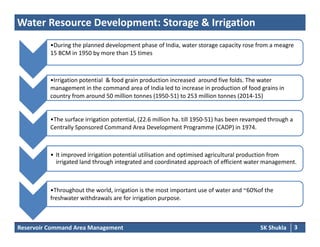
•During the planned development phase of India water storage capacity rose from a meagre•During the planned development phase of India, water storage capacity rose from a meagre 
15 BCM in 1950 by more than 15 times
•Irrigation potential  & food grain production increased  around five folds. The water 
management in the command area of India led to increase in production of food grains in 
country from around 50 million tonnes (1950‐51) to 253 million tonnes (2014‐15)
•The surface irrigation potential, (22.6 million ha. till 1950‐51) has been revamped through a 
Centrally Sponsored Command Area Development Programme (CADP) in 1974. 
• It improved irrigation potential utilisation and optimised agricultural production from 
irrigated land through integrated and coordinated approach of efficient water management.
•Throughout the world, irrigation is the most important use of water and ~60%of the 
freshwater withdrawals are for irrigation purpose. 
Reservoir Command Area Management SK Shukla 3
Water Management And Statutory Steps taken
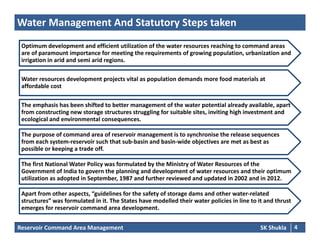
Optimum development and efficient utilization of the water resources reaching to command areasOptimum development and efficient utilization of the water resources reaching to command areas 
are of paramount importance for meeting the requirements of growing population, urbanization and 
irrigation in arid and semi arid regions. 
d l j i l l i d d f d i lWater resources development projects vital as population demands more food materials at 
affordable cost
The emphasis has been shifted to better management of the water potential already available, apart The emphasis has been shifted to better management of the water potential already available, apart p g p y , p
from constructing new storage structures struggling for suitable sites, inviting high investment and 
ecological and environmental consequences. 
The purpose of command area of reservoir management is to synchronise the release sequences 
from each system‐reservoir such that sub‐basin and basin‐wide objectives are met as best as 
possible or keeping a trade off.
The first National Water Policy was formulated by the Ministry of Water Resources of the 
Government of India to govern the planning and development of water resources and their optimumGovernment of India to govern the planning and development of water resources and their optimum 
utilization as adopted in September, 1987 and further reviewed and updated in 2002 and in 2012. 
Apart from other aspects, “guidelines for the safety of storage dams and other water‐related 
structures” was formulated in it The States have modelled their water policies in line to it and thrust
Reservoir Command Area Management SK Shukla 4
structures  was formulated in it. The States have modelled their water policies in line to it and thrust 
emerges for reservoir command area development.
Managing Command Area
An efficient development and better use of water resources, therefore, would be of great 
importance for their survival. 
All such water bodies have command area which need to be economically irrigated for 
cultivation, supplied water for multi purposes including drinking, individuals livelihood, 
socio cultural needs, industrial uses, transport, forestry, aquatic lives, flora fauna and othersocio cultural needs, industrial uses, transport, forestry, aquatic lives, flora fauna and other 
environmental services etc .
When we talk about  Command Area Development, its aim is for all round development p , p
and in the process for a better Water Management including to make efficient irrigation, 
optimizing the agricultural production and productivity. 
Ministry of Water Resources in coordination with the States level agencies carry out this 
task on planned basis.
Reservoir Command Area Management SK Shukla 5
Managing Command Area
A Command Area Development Authority is established to manage better, the 
irrigation command areas through an integrated approach with the :
i) Construction of field channels and field drains 
ii) Land shaping wherever necessary 
iii)Introduction of rotational supply of water to ensure equitable and assured 
distribution to individual farm holdings.
 To achieve these aspects, the water supply at the receiving end has to be 
reliable, adequate, predictable and technologically serviceable. 
 It needs farmers education and participation planning and commitment It needs farmers education and participation, planning and commitment
This programme was reworked as Command Area Development and WaterThis programme was reworked as Command Area Development and Water 
Management Programme (2004‐07) further restructuring to Accelerated 
Irrigation Benefits Programme (AIBP) launched during 1996‐97 as financial 
assistance to States by Centre to enhance the irrigation potential and uses.
Reservoir Command Area Management SK Shukla 6
y g p
Command Area Scoping
 The Command Development Authorities are instituted as overall charge of The Command Development Authorities are instituted as overall charge of
the comprehensive development of the Command Area, viz., conservation
of land and water, construction of field channels, construction of field
drains, land reclamation, formation of Local Roads, implementation ofdrains, land reclamation, formation of Local Roads, implementation of
various programs including pisciculture, floriculture, aquafarming,
Vermiculture (‐Agriculture of Earth worm), Tissue culture (‐Production of
a new plant from plant cells), Apiculture(‐Study of honey bee),p f p ) p ( y f y )
Horticulture (‐Study of fruits and vegetables), Pomology( ‐Study of fruits),
Sericulture (‐Rearing of silk worm), Moriculture (‐Production of mulberry),
Viticulture(‐Production of grapes), and many such programme, etc.
 It coordinates with the concerned departments to protect the fertility of
soil, availability of good seeds, fertilizers, pesticides, etc. on time and in
ffi i t tit ll i ti t h l th i i lt l dsufficient quantity well in time to help their agricultural programmes and
production in sync with departments of Water Resources, Irrigation,
Agriculture, Cooperation, Horticulture etc.
Reservoir Command Area Management SK Shukla 7
Significance of Command Area Management
 We are still groping with the excess water discharge and flooding frequently We are still groping with the excess water discharge and flooding frequently 
on natural imbalances of water cycle, floods reaching to streams command 
area, calling for management after moderation through reservoirs.
 The crises of floods and draughts in different parts threaten the issue of food 
security, create more serious issues of water logging, deterioration of quality 
of soil, interstate disputes for water checks and controls, etc. apart from loss , p , p
to life and property.
 Therefore, constructing large / medium or small dams on rivers is worth 
continuing as a solution to it with a paradigm shift with a rational evaluation 
of pros and cons of the strategies strategic change against ‐ usurp, amass and 
distribute.
 Based on data analysis of Remote Sensing, spatial data and Flood Control Cell 
Data analyses, suitable sites for canal are identified where excess water can 
b di t d th h N t l D i d C l
Reservoir Command Area Management SK Shukla 8
be diverted through Natural Drainage and Canal.
Significance of Command Area Management
 The massive task of interlinking rivers in the country, networking through 
canals and drainage system requires multidisciplinary understanding, 
investigation on hydrological, agricultural, social and economic factors and 
new vistas of  command area management necessitating major works to 
be studied using GIS and remote sensing. g g
 The digital information on topography, contours, soils type, drainage 
pattern, Satellite Image Processing details, Digitization on satellite images 
like (canal, river & lake) and Spatial Analyzes etc. to be worked out from 
toposheet and the landuse pattern of the command area.
Reservoir Command Area Management SK Shukla 9
Command Area Management
 Reservoir Command Area Management carries greater significance Reservoir Command Area Management carries greater significance. 
 Planning for water resources development in the form of Hydro Power Project 
Development by building up reservoir in a basin, requires scientific assessment p y g p , q
of the available water resources and reasonable needs of the basin in 
foreseeable future for various purposes such as drinking, irrigation, hydro‐
power industries navigation etcpower, industries, navigation, etc. 
 Hydrological studies carried out to estimate the available quantity of water in a 
given basin and hydrological analysis done for arriving at the water balance
 Surface water flow availability done using the best‐fit equation and the 
weighted rainfall for the entire sub‐basin, generating long term yield series from 
hi h th 75% d 50% d d bl i ld f th b b i t d hi hwhich the 75% and 50% dependable yields of the sub‐basin are computed which 
is to feed the ultimate stage of various uses viz., irrigation, drinking, industry 
and hydropower etc.
Reservoir Command Area Management SK Shukla 10
Command Area Management
 Whil th d i d l tili ti th d t il d j t t i While the designed annual utilisation as per the detailed project reports is 
considered for the existing and ongoing irrigation projects, the requirements 
for future projects are determined by adopting intensities of irrigation as 
150%, 125% and 100% for major, medium and minor projects respectively, 
taking the irrigation efficiency as 55% for major/medium projects and as 70% 
for minor projects.
 While dealing with the subject, country’s vulnerability to perennial flood 
zones in various parts of it is well known which is manageable technically. 
Th ff t h till i iThe efforts, however, are still compromising.
Reservoir Command Area Management SK Shukla 11
Command Area Management: An Example
 The Mahanadi basin as a flood zone was infamous inundating large tract 
annually. During 1937  Sri. M Vishwesharya had advised preparation of 
d f fl d l i M h di b i d d i fstorage dam for flood control in Mahanadi basin and recommendations of 
Flood Advisory Committee (1938‐42) were accepted 
 It was mooted to construct three major dams at Hirakud, Tikarpur and Naraj. It was mooted to construct three major dams at Hirakud, Tikarpur and Naraj. 
We could have only Hirakud dam , across Mahanadi River, developed in 1957. 
 The filling of dam started in 1956. 
 Irrigation, power generation, and flood control started from 1957. The 
irrigation achieved its full potential in 1966.
Reservoir Command Area Management SK Shukla 12
Issues faced
 Since 1974 when the command area development programs were speedily
rolled out, numerous constraints were identified including:
 Manual inaccurate land records, farmers plights in land consolidation,
lack of funding and non participatory approaches of governing agencies
 With the digitisation of land records, more planned development of
infrastructure for canals from barrages to fields reaches and involvement of
farmers in localised groups, a much better position of management hasg p , p g
institutionalised today
 However much needs to be done and certain historical adversities need
correction for a rapid out turn in the benefits of command area management
Reservoir Command Area Management SK Shukla 13
Issues faced
RIGHTS TO RESPONSIBILITY
 UN Human Rights advocacy is there for individuals ‘right to water’ but this 
right gets superseded on ‘right to religious freedom’ fulfilling socio religious 
obligations
RIGHTS TO RESPONSIBILITY
obligations
 Conflict crops up on religious performances along rivers like Ganges in the 
form of worships, pilgrimages, religious congregation on confluences holding 
large devotees, disbursal of offerings, immersion of idols, last rites 
performances and dispersion of ashes, bodies etc. 
 These are matters of  grave concern to the purity of water and its hygienic g p y f yg
preservation
 Command area management has to struggle with the mindset of the masses 
to bring out more educated solution where religion is to be used as anto bring out more educated solution where religion is to be used as an 
educated platform to save the rivers
Reservoir Command Area Management SK Shukla 14
LOW EFFICIENCY
Issues faced
 Irrigation projects in the command area function on a low efficiency, in most 
cases approximately 30 % due to evaporation losses, seepage losses, water 
pilferages, silting in reservoir and abnormal flushing, poor conditions of canals, p fe ages, s g ese o a d ab o a f us g, poo co d o s of ca a s,
non optimised reservoir operation etc.
 Therefore enough scope exists for better management and application
 In command areas , water logging has been occuring, widely necessitating to
WATER LOGGING
drain the subsurface water for reclamation of soil and better conceptual
process for supplies
UNCONTROLLED IRRIGATION REDUCED COMMAND AREA
 Some farmers take undue advantage of their closer access to water and over‐
irrigate their farms by depriving the tail‐enders 
UNCONTROLLED IRRIGATION ‐ REDUCED COMMAND AREA
Reservoir Command Area Management SK Shukla 15
 Hence, the full command area of the irrigation project needs to be served
MISPLACED UNDERSTANDING
Issues faced
 Demand and supply of available surface water not the only consideration
 The groundwater recharge, effect of changes in cropping pattern after
availability of water, aquaculture, riparian rights, environmental flow, etc. are
equally important
 Stopping of flowing water and diverting the same transversely to field is old 
OLD METHODOLOGY OF CAD
age practice, but is irrelevant today
 Natural beneficiaries of the water i.e. the people in the downstream of the 
dam are deprived of their riparian rights in this process and due to excess 
water spread,  the people in the vicinity of the dam are required to be 
displaced
Reservoir Command Area Management SK Shukla 16
THANK YOU

26 nov16 reservoir_command_area_management

  • 1.
    RESERVOIR COMMAND AREARESERVOIRCOMMAND AREA MANAGEMENT ­ SK SHUKLA
  • 2.
    Introduction WATER – NECESSITYFOR LIFE  Nature’s most important gift to living beings identified in the universe as water cycle,  serving most basic human need and a valuable national asset.   Since the beginning of human race mankind found it easy to dwell along rivers water Since the beginning of human race, mankind found it easy to dwell along rivers, water  bodies and engineered dams with reach from catchment area to serving point at  command area for water storage and supplies  India has traditional age old ponds to thousands of large dams with height of at least India has traditional age old ponds to thousands of large dams with height of at least  15m and there are scores of small dams and barrages. WATER SHORTAGE– A MAJOR CHALLENGES AHEAD  Our planet has started facing a water crisis like in public health where more than a  billion people in developing nations lack access to safe drinking water, and more than  2 billion lack proper sanitation due to inadequate supplies.   Water shortages likely to spread more severely into key sectors‐notably agriculture  and energy.  Global energy demand is projected to increase 57% by 2030 and water demand for Reservoir Command Area Management SK Shukla 2 Global energy demand is projected to increase 57% by 2030, and water demand for  food production might easily double
  • 3.
    Water Resource Development: Storage & Irrigation •During the planneddevelopment phase of India water storage capacity rose from a meagre•During the planned development phase of India, water storage capacity rose from a meagre  15 BCM in 1950 by more than 15 times •Irrigation potential  & food grain production increased  around five folds. The water  management in the command area of India led to increase in production of food grains in  country from around 50 million tonnes (1950‐51) to 253 million tonnes (2014‐15) •The surface irrigation potential, (22.6 million ha. till 1950‐51) has been revamped through a  Centrally Sponsored Command Area Development Programme (CADP) in 1974.  • It improved irrigation potential utilisation and optimised agricultural production from  irrigated land through integrated and coordinated approach of efficient water management. •Throughout the world, irrigation is the most important use of water and ~60%of the  freshwater withdrawals are for irrigation purpose.  Reservoir Command Area Management SK Shukla 3
  • 4.
    Water Management And Statutory Steps taken Optimum development andefficient utilization of the water resources reaching to command areasOptimum development and efficient utilization of the water resources reaching to command areas  are of paramount importance for meeting the requirements of growing population, urbanization and  irrigation in arid and semi arid regions.  d l j i l l i d d f d i lWater resources development projects vital as population demands more food materials at  affordable cost The emphasis has been shifted to better management of the water potential already available, apart The emphasis has been shifted to better management of the water potential already available, apart p g p y , p from constructing new storage structures struggling for suitable sites, inviting high investment and  ecological and environmental consequences.  The purpose of command area of reservoir management is to synchronise the release sequences  from each system‐reservoir such that sub‐basin and basin‐wide objectives are met as best as  possible or keeping a trade off. The first National Water Policy was formulated by the Ministry of Water Resources of the  Government of India to govern the planning and development of water resources and their optimumGovernment of India to govern the planning and development of water resources and their optimum  utilization as adopted in September, 1987 and further reviewed and updated in 2002 and in 2012.  Apart from other aspects, “guidelines for the safety of storage dams and other water‐related  structures” was formulated in it The States have modelled their water policies in line to it and thrust Reservoir Command Area Management SK Shukla 4 structures  was formulated in it. The States have modelled their water policies in line to it and thrust  emerges for reservoir command area development.
  • 5.
    Managing Command Area An efficient development and better use of water resources, therefore, would be of great  importance for their survival.  All such water bodies have command area which need to be economically irrigated for  cultivation, supplied water for multi purposes including drinking, individuals livelihood,  sociocultural needs, industrial uses, transport, forestry, aquatic lives, flora fauna and othersocio cultural needs, industrial uses, transport, forestry, aquatic lives, flora fauna and other  environmental services etc . When we talk about  Command Area Development, its aim is for all round development p , p and in the process for a better Water Management including to make efficient irrigation,  optimizing the agricultural production and productivity.  Ministry of Water Resources in coordination with the States level agencies carry out this  task on planned basis. Reservoir Command Area Management SK Shukla 5
  • 6.
    Managing Command Area A Command Area Development Authority is established to manage better, the  irrigation command areas through an integrated approach with the : i) Construction of field channels and field drains  ii) Land shaping wherever necessary  iii)Introduction of rotational supply of water to ensure equitable and assured  distribution to individual farm holdings. To achieve these aspects, the water supply at the receiving end has to be  reliable, adequate, predictable and technologically serviceable.   It needs farmers education and participation planning and commitment It needs farmers education and participation, planning and commitment This programme was reworked as Command Area Development and WaterThis programme was reworked as Command Area Development and Water  Management Programme (2004‐07) further restructuring to Accelerated  Irrigation Benefits Programme (AIBP) launched during 1996‐97 as financial  assistance to States by Centre to enhance the irrigation potential and uses. Reservoir Command Area Management SK Shukla 6 y g p
  • 7.
    Command Area Scoping  The CommandDevelopment Authorities are instituted as overall charge of The Command Development Authorities are instituted as overall charge of the comprehensive development of the Command Area, viz., conservation of land and water, construction of field channels, construction of field drains, land reclamation, formation of Local Roads, implementation ofdrains, land reclamation, formation of Local Roads, implementation of various programs including pisciculture, floriculture, aquafarming, Vermiculture (‐Agriculture of Earth worm), Tissue culture (‐Production of a new plant from plant cells), Apiculture(‐Study of honey bee),p f p ) p ( y f y ) Horticulture (‐Study of fruits and vegetables), Pomology( ‐Study of fruits), Sericulture (‐Rearing of silk worm), Moriculture (‐Production of mulberry), Viticulture(‐Production of grapes), and many such programme, etc.  It coordinates with the concerned departments to protect the fertility of soil, availability of good seeds, fertilizers, pesticides, etc. on time and in ffi i t tit ll i ti t h l th i i lt l dsufficient quantity well in time to help their agricultural programmes and production in sync with departments of Water Resources, Irrigation, Agriculture, Cooperation, Horticulture etc. Reservoir Command Area Management SK Shukla 7
  • 8.
    Significance of Command Area Management  We arestill groping with the excess water discharge and flooding frequently We are still groping with the excess water discharge and flooding frequently  on natural imbalances of water cycle, floods reaching to streams command  area, calling for management after moderation through reservoirs.  The crises of floods and draughts in different parts threaten the issue of food  security, create more serious issues of water logging, deterioration of quality  of soil, interstate disputes for water checks and controls, etc. apart from loss , p , p to life and property.  Therefore, constructing large / medium or small dams on rivers is worth  continuing as a solution to it with a paradigm shift with a rational evaluation  of pros and cons of the strategies strategic change against ‐ usurp, amass and  distribute.  Based on data analysis of Remote Sensing, spatial data and Flood Control Cell  Data analyses, suitable sites for canal are identified where excess water can  b di t d th h N t l D i d C l Reservoir Command Area Management SK Shukla 8 be diverted through Natural Drainage and Canal.
  • 9.
    Significance of Command Area Management  The massive task of interlinking rivers in the country, networking through  canals and drainage system requires multidisciplinary understanding,  investigation on hydrological, agricultural, social and economic factors and  new vistas of  command area management necessitating major works to  be studied using GIS and remote sensing. gg  The digital information on topography, contours, soils type, drainage  pattern, Satellite Image Processing details, Digitization on satellite images  like (canal, river & lake) and Spatial Analyzes etc. to be worked out from  toposheet and the landuse pattern of the command area. Reservoir Command Area Management SK Shukla 9
  • 10.
    Command Area Management  Reservoir CommandArea Management carries greater significance Reservoir Command Area Management carries greater significance.   Planning for water resources development in the form of Hydro Power Project  Development by building up reservoir in a basin, requires scientific assessment p y g p , q of the available water resources and reasonable needs of the basin in  foreseeable future for various purposes such as drinking, irrigation, hydro‐ power industries navigation etcpower, industries, navigation, etc.   Hydrological studies carried out to estimate the available quantity of water in a  given basin and hydrological analysis done for arriving at the water balance  Surface water flow availability done using the best‐fit equation and the  weighted rainfall for the entire sub‐basin, generating long term yield series from  hi h th 75% d 50% d d bl i ld f th b b i t d hi hwhich the 75% and 50% dependable yields of the sub‐basin are computed which  is to feed the ultimate stage of various uses viz., irrigation, drinking, industry  and hydropower etc. Reservoir Command Area Management SK Shukla 10
  • 11.
    Command Area Management  Whil thd i d l tili ti th d t il d j t t i While the designed annual utilisation as per the detailed project reports is  considered for the existing and ongoing irrigation projects, the requirements  for future projects are determined by adopting intensities of irrigation as  150%, 125% and 100% for major, medium and minor projects respectively,  taking the irrigation efficiency as 55% for major/medium projects and as 70%  for minor projects.  While dealing with the subject, country’s vulnerability to perennial flood  zones in various parts of it is well known which is manageable technically.  Th ff t h till i iThe efforts, however, are still compromising. Reservoir Command Area Management SK Shukla 11
  • 12.
    Command Area Management: An Example  The Mahanadi basin as a flood zone was infamous inundating large tract  annually. During 1937  Sri. M Vishwesharyahad advised preparation of  d f fl d l i M h di b i d d i fstorage dam for flood control in Mahanadi basin and recommendations of  Flood Advisory Committee (1938‐42) were accepted   It was mooted to construct three major dams at Hirakud, Tikarpur and Naraj. It was mooted to construct three major dams at Hirakud, Tikarpur and Naraj.  We could have only Hirakud dam , across Mahanadi River, developed in 1957.   The filling of dam started in 1956.   Irrigation, power generation, and flood control started from 1957. The  irrigation achieved its full potential in 1966. Reservoir Command Area Management SK Shukla 12
  • 13.
    Issues faced  Since 1974when the command area development programs were speedily rolled out, numerous constraints were identified including:  Manual inaccurate land records, farmers plights in land consolidation, lack of funding and non participatory approaches of governing agencies  With the digitisation of land records, more planned development of infrastructure for canals from barrages to fields reaches and involvement of farmers in localised groups, a much better position of management hasg p , p g institutionalised today  However much needs to be done and certain historical adversities need correction for a rapid out turn in the benefits of command area management Reservoir Command Area Management SK Shukla 13
  • 14.
    Issues faced RIGHTS TO RESPONSIBILITY UN Human Rights advocacy is there for individuals ‘right to water’ but this  right gets superseded on ‘right to religious freedom’ fulfilling socio religious  obligations RIGHTS TO RESPONSIBILITY obligations  Conflict crops up on religious performances along rivers like Ganges in the  form of worships, pilgrimages, religious congregation on confluences holding  large devotees, disbursal of offerings, immersion of idols, last rites  performances and dispersion of ashes, bodies etc.   These are matters of  grave concern to the purity of water and its hygienic g p y f yg preservation  Command area management has to struggle with the mindset of the masses  to bring out more educated solution where religion is to be used as anto bring out more educated solution where religion is to be used as an  educated platform to save the rivers Reservoir Command Area Management SK Shukla 14
  • 15.
    LOW EFFICIENCY Issues faced  Irrigation projects in the command area function on a low efficiency, in most  cases approximately 30 % due to evaporation losses, seepage losses, water  pilferages, silting in reservoir and abnormal flushing, poor conditions of canals, p feages, s g ese o a d ab o a f us g, poo co d o s of ca a s, non optimised reservoir operation etc.  Therefore enough scope exists for better management and application  In command areas , water logging has been occuring, widely necessitating to WATER LOGGING drain the subsurface water for reclamation of soil and better conceptual process for supplies UNCONTROLLED IRRIGATION REDUCED COMMAND AREA  Some farmers take undue advantage of their closer access to water and over‐ irrigate their farms by depriving the tail‐enders  UNCONTROLLED IRRIGATION ‐ REDUCED COMMAND AREA Reservoir Command Area Management SK Shukla 15  Hence, the full command area of the irrigation project needs to be served
  • 16.
    MISPLACED UNDERSTANDING Issues faced  Demand andsupply of available surface water not the only consideration  The groundwater recharge, effect of changes in cropping pattern after availability of water, aquaculture, riparian rights, environmental flow, etc. are equally important  Stopping of flowing water and diverting the same transversely to field is old  OLD METHODOLOGY OF CAD age practice, but is irrelevant today  Natural beneficiaries of the water i.e. the people in the downstream of the  dam are deprived of their riparian rights in this process and due to excess  water spread,  the people in the vicinity of the dam are required to be  displaced Reservoir Command Area Management SK Shukla 16
  • 17.