2.5 analysing electrical energy
and power
Learning objective
• Analysing electrical energy and
power
Learning outcomes
• Difine electrical energy
• Define electric power
• Solve problems involving electrical energy and
power
• Compare power rating and energy consumption
of various electrical appliances
• Compare various electrical appliances in terms of
efficient use of energy
• Describe ways of increasing energy efficiency.
Electrical
energy
The energy released when electric charges flow
through any two point in an electric circuit
UNIT :
Joule (J)
E = VQ
E = VIT E = I²Rt
E = V²t
R
ELECTRIC
POWER
Defination: the rate at which
electrical energy is released
P = E
t
P = V I P = I ² R
P = V ²
R
Question 1
An electric kettle is connected across a 240
V power supply. If the resistance is 40Ω,
calculate
a. The current flowing through the
element.
b. The quantity of heat produced in 10
minutes.
[ans : a. 6A, b. E = 864 kJ]
Question 2
A filament lamp is labelled “12V, 36W”. If
the lamp is connected to a 12V power
supply, calculate
a. The current that flows through the
lamp,
b. The amount of electrical energy used by
the lamp in 30 minutes.
[ ans : a. 3A, b. 64.8 kJ]
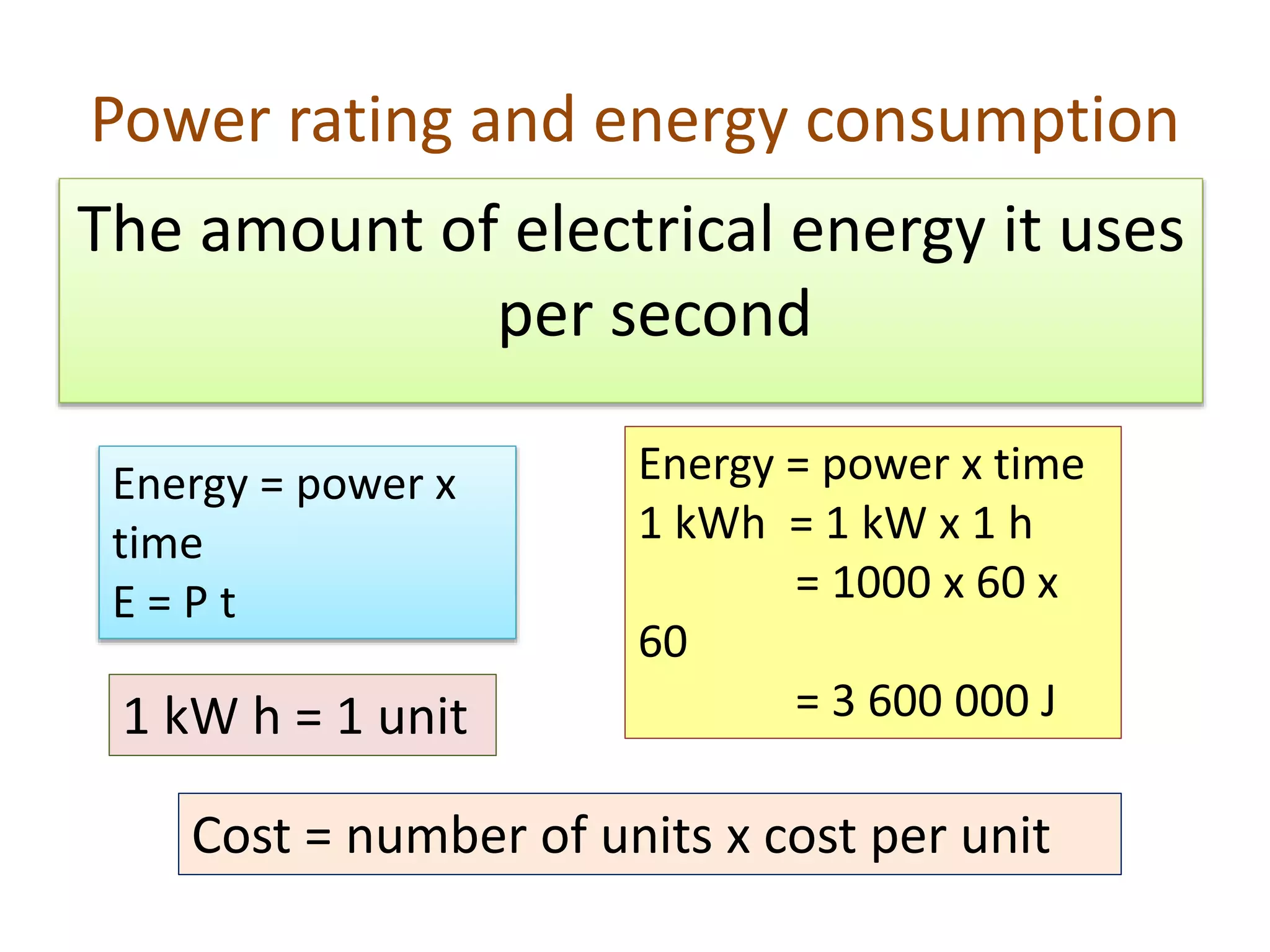
Power rating and energy consumption
The amount of electrical energy it uses
per second
Energy = power x
time
E = P t
Energy = power x time
1 kWh = 1 kW x 1 h
= 1000 x 60 x
60
= 3 600 000 J1 kW h = 1 unit
Cost = number of units x cost per unit
TNB electricity meter
Tariff rate
The cost for one unit of electricity
Question 1
If one unit of electricity costs 21.8 cents,
calculate the cost of using five 36 W
fluorescent lamps and a 120W television if
they are switch on five hours a day for the
month of January.
[ ans : RM10.14]
Question 2
• A room air conditioner rated at 1 500 W is
turned on eight hours a day. How much would
you have to pay at the end of 31 days if the
tariff rates are as shown in table below.
• [ans : RM 93.31]
Energy efficiency
Efficiency = output power X 100%
Input power
Question 1
A lamp is marked “ 240 V , 100W” .
What is the efficiency of the lamp if
it produces a light output of 12 W?
[ans : 12 %]
Increasing Energy Efficiency
• Use more energy efficient lighting
Incandescent bulb Compact fluorescent bulb
Replace or clean air conditioner filters
Use electrical appliances wisely
Iron clothes Wash clothes
Eliminate wasted energy
Choose energy efficient appliances
Boost energy efficiency
Question
Table shows the characteristics of materials that can be
used for making a heating element.
Explain the suitability of each characteristic in Table.
Determine the most suitable material to be used for
making the heating element for an electric kettle
material characteri
stic
Melting
point/ ºC
resistance Oxidation
level
Density/k
gms¯¹
S 650 6.0 High 2900
T 550 5.5 Low 3150
U 50 10.0 Moderate 18 500
V 350 15.0 High 7400
W 200 7.0 Low 8000
Characteristic Explanation
High melting point So that the element does not
melt easily during the heating
process
Low resistance Allows for a larger current to
flow through it and produce a
considerable amount of heat
Low oxidation To prevent oxidation
Low density To make the kettle portable
Material T is selected.
It has a high melting point, low resistance, low
oxidation level and low density
Question 2
Diagram shows an electric kettle
which is labeled “240V, 1000W”
a. What is meant by
i. 1000 W
ii. The power rating of “240 V ,
1000W”
b. State one suitable material that can
be used as the heating element of
the kettle.
Answer
(a)(i) 1000 W is the electrical power of
the kettle which consumes 1000 Joules
of energy per second.
(II) the power rating indicates that
the kettle releases 1000 J of energy per
second when 240 V is supplied to it.
(b) Tungsten / Nichrome

2.5 analysing electrical energy and power

  • 1.
    2.5 analysing electricalenergy and power
  • 2.
    Learning objective • Analysingelectrical energy and power
  • 3.
    Learning outcomes • Difineelectrical energy • Define electric power • Solve problems involving electrical energy and power • Compare power rating and energy consumption of various electrical appliances • Compare various electrical appliances in terms of efficient use of energy • Describe ways of increasing energy efficiency.
  • 4.
    Electrical energy The energy releasedwhen electric charges flow through any two point in an electric circuit UNIT : Joule (J) E = VQ E = VIT E = I²Rt E = V²t R
  • 5.
    ELECTRIC POWER Defination: the rateat which electrical energy is released P = E t P = V I P = I ² R P = V ² R
  • 6.
    Question 1 An electrickettle is connected across a 240 V power supply. If the resistance is 40Ω, calculate a. The current flowing through the element. b. The quantity of heat produced in 10 minutes. [ans : a. 6A, b. E = 864 kJ]
  • 7.
    Question 2 A filamentlamp is labelled “12V, 36W”. If the lamp is connected to a 12V power supply, calculate a. The current that flows through the lamp, b. The amount of electrical energy used by the lamp in 30 minutes. [ ans : a. 3A, b. 64.8 kJ]
  • 8.
    Power rating andenergy consumption The amount of electrical energy it uses per second Energy = power x time E = P t Energy = power x time 1 kWh = 1 kW x 1 h = 1000 x 60 x 60 = 3 600 000 J1 kW h = 1 unit Cost = number of units x cost per unit
  • 9.
  • 10.
    Tariff rate The costfor one unit of electricity
  • 12.
    Question 1 If oneunit of electricity costs 21.8 cents, calculate the cost of using five 36 W fluorescent lamps and a 120W television if they are switch on five hours a day for the month of January. [ ans : RM10.14]
  • 13.
    Question 2 • Aroom air conditioner rated at 1 500 W is turned on eight hours a day. How much would you have to pay at the end of 31 days if the tariff rates are as shown in table below. • [ans : RM 93.31]
  • 14.
    Energy efficiency Efficiency =output power X 100% Input power
  • 15.
    Question 1 A lampis marked “ 240 V , 100W” . What is the efficiency of the lamp if it produces a light output of 12 W? [ans : 12 %]
  • 16.
    Increasing Energy Efficiency •Use more energy efficient lighting Incandescent bulb Compact fluorescent bulb
  • 17.
    Replace or cleanair conditioner filters
  • 18.
    Use electrical applianceswisely Iron clothes Wash clothes
  • 19.
  • 20.
  • 21.
  • 23.
    Question Table shows thecharacteristics of materials that can be used for making a heating element. Explain the suitability of each characteristic in Table. Determine the most suitable material to be used for making the heating element for an electric kettle material characteri stic Melting point/ ºC resistance Oxidation level Density/k gms¯¹ S 650 6.0 High 2900 T 550 5.5 Low 3150 U 50 10.0 Moderate 18 500 V 350 15.0 High 7400 W 200 7.0 Low 8000
  • 24.
    Characteristic Explanation High meltingpoint So that the element does not melt easily during the heating process Low resistance Allows for a larger current to flow through it and produce a considerable amount of heat Low oxidation To prevent oxidation Low density To make the kettle portable Material T is selected. It has a high melting point, low resistance, low oxidation level and low density
  • 25.
    Question 2 Diagram showsan electric kettle which is labeled “240V, 1000W” a. What is meant by i. 1000 W ii. The power rating of “240 V , 1000W” b. State one suitable material that can be used as the heating element of the kettle.
  • 26.
    Answer (a)(i) 1000 Wis the electrical power of the kettle which consumes 1000 Joules of energy per second. (II) the power rating indicates that the kettle releases 1000 J of energy per second when 240 V is supplied to it. (b) Tungsten / Nichrome